Ancillary Justice
This is my second time around in reading this book. I knew I needed to reread it before reading Ancillary Sword. You can read my original review over here.
 Multiple spoilers ahead!
I still found the almost exclusive use of ‘she’ to be quite disconcerting, and I feel like I noticed those few times that someone is ‘properly’ gendered more than I did the first time I read it. I still found myself trying to pick gender clues from behaviour and descriptions, which of course says something about me… and also quite a lot about Leckie, since I really don’t think she enables such a reading of anyone. I have absolutely no clue what sort of genitalia Lieutenant Awn had.
Because I wasn’t so staggered by the gender issue this time I believe I felt the imperialism/colonialism aspect more. The Radch is a monumentally arrogant civilisation – and I felt very keenly those discussions about how such a sentence would be constructed in their language, since the word for ‘civilised’ IS the word FOR their civilisation, and for themselves: Radch. So this arrogance, this narrow vision, is constructed into their language – while I’m not a complete subscriber to the notion that language creates reality, it certainly has an impact on our perception of such. Leckie herself notes the similarities between the Radch and the Roman Empire, which is useful both for the yes and the no. Make new peoples citizens, subsume/ align their gods with your, but use ‘corpse soldiers’ to help make it work and have a bunch of apparently random cultural hang-ups.
I loved the gloves thing this time. I could drive myself mad trying to figure out how a culture develops a horror of bare hands except in the most intimate of circumstances.
I’m not sure I noticed the descriptions of skin colour last time (oh the advantages of being white). Much like the people of Earthsea, the Radch are dark-skinned… which is neither here nor there in the book’s greater scheme of plot and character and theme, but is nonetheless important in the greater scheme of, you know, the world.
Another aspect I feel I appreciate more deeply this time around is the religion. Everyone, basically, is religious. All of the ships are named after religious figures; all of the decades of soldiers likewise. There is an expectation that senior soldiers will pray and cast the omens each morning. Each new planet has their own religion whose parallels with the Radch’s own must be found – and there’s even discussion of a problematic, exclusively-monotheistic bunch who have caused issues in the past, who basically appear atheist to the Radch: either horrifying or bemusing, depending on your attitude. Not everyone is especially devout, but there is no doubt in anyone’s mind that religion belongs in humanity and in space and everywhere there are humans. This is refreshing.
Finally, the plot. Even though I did have some memory of how everything was going to play out (that notorious memory of mine), I still found it gripping. The massacre of civilians to the death of Awn, the gradual change in Seivarden, the drama at Omaugh: it’s not the most fast-paced space opera I’ve ever read, but it is definitely compelling and in no way just a vehicle for discussing Important Issues.
Galactic Suburbia 118
In which we take on the Hugosplosion, update you on Aussie awards, defy Doomsday, and address the possible misappropriation of the term glittery hoo-ha. It’s just been that sort of fortnight. … without me! It’s an epic one! You can get them from iTunes, or at Galactic Suburbia.
Defying Doomsday crowdfunding campaign.
Tiptree Award (more on this next time when Alex is with us)
HUGOSPLOSION – take a deep breath, we’re going in.
Updated Hugo ballot as of Sat 19 April
io9 – the withdrawal of two authors from the ballot.
Stats on the Hugos: Whose Rocket by Aidan Walsh
David Gerrold, this year’s GOH on the history of the Worldcon
#NewHugoCategories Hashtag on Twitter
Connie willis on Why I won’t be a presenter at this year’s awards
George RR Martin being outspoken on LJ about who is responsible for Sad & Rabid Puppies.
Kari Sperring on ego and the expectation of awards
N K Jemisin – Not the affirmative action you meant, not the history you’re making
Alisa’s proposal for her Hugo reading.
What Culture Have we Consumed?
Alisa: Lost, Sex Criminals, Daredevil Ep 1, Etiquette and Espionage by Gail Carriger (she’s an archaeologist? Oh man!)
Tansy: Rat Queens; Interstellar; Faerie Tale Theatre, Daredevil, The Blacklist; Eleanor Arnason – Me & Science Fiction, what are we, chopped liver?
Please send feedback to us at galacticsuburbia@gmail.com, follow us on Twitter at @galacticsuburbs, check out Galactic Suburbia Podcast on Facebook, support us at Patreon and don’t forget to leave a review on iTunes if you love us!
Guns of the Dawn
This book was provided to my by the author at no cost.
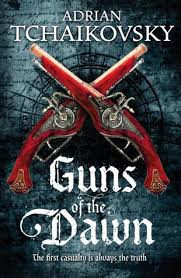 The main problem, for me, with Guns of the Dawn is that I thought I was getting a book based on the French Revolution, with a bit of magic. So I was expecting it to actually be about the French side, and I was excited to try and find familiar faces or at least familiar issues. However, that is not what I got. The extent to which this is based on the French Revolution is that Denland has had a revolution, and now has no king, and is at war with one of its neighbours. The Goodreads outline tells me that it’s pseudo-Napoleonic, and the era feels about right for that, but still there’s nothing obvious to connect them except the regicide bit and the war-with-neighbours bit (I’m not a Napoleonic Wars expert, so I’d be interested to hear from others who see closer resemblances). I freely admit this is a problem with my expectations and not a problem with the book, but it did colour my reading of it a lot and – well, that’s just the reality.
In attitude, this novel feels far more closely aligned with World War 1, reflecting its having been written (I presume) and published around the centenary anniversary. There’s a lot about the futility of war, and the horrendous conditions where most of the action takes place has thunderous echoes of trench warfare (and of jungle warfare too, from later wars). There’s also issues of new technology, mimicking some of the developments of WW1 (and the recount of a cavalry charge being mown down by artillery parallels the story often told about Poland and the Germans in WW2).
The book opens with the protagonist, Emily, in her first battle in an area known as the Levant. After that, the first third is mostly about Emily’s life before being called up as a soldier, and I guess it’s a story of manners: the family are gentry but poor, there’s three sisters and only one married and no parents; there’s a jumped-up, venal bureaucrat and problems with how to keep the estate going while the men are gradually drained off to go fight Denland. This section felt too long by about half. I understand that Tchaikovsky is trying to show how genteel and simultaneously how resourceful Emily is, but it really just dragged on and without the knowledge that she was soon going to be fighting, and that then something different would happen, I may have stopped. Don’t get me wrong, I have no problem with that sort of book when I know what I’m in for. But the title doesn’t give any clue that one third of the book will be Austen-esque, and neither does the blurb. And even if I did anticipate it – Too. Long.
Most of the rest of the story is a fairly relentless meditation on the unpleasantness of war. Lots of people die. There are terrifying battles where finding the enemy and negotiating the ever-shifting swamp are equally difficult. There’s some of the difficulties you’d expect from having women in a man’s army. Tchaikovsky also includes those moments of camaraderie that every war-story needs, both for verisimilitude and to break up the unrelenting horror. Again, I found this part of the story too long. There was too much floundering in the swamp, too much focus on problems in the camp. It ended up losing some of its impact because I got impatient.
Is the book well written? Yes, the prose is entirely readable – after all, I read something like 650 pages (ebook) even though I wasn’t entirely convinced by the whole set up. Are some of my issues with the book entirely my own and not the book’s? Indubitably. But I still think it would have been better if it had been cut by a third.
Galactic Suburbia 117: Ursula le Guin essays
In which we take apart “The Space Crone” and “Is Gender Necessary (Redux)” from Dancing at the Edge of the World: Thoughts on Words, Women, and Places by Ursula Le Guin. Get us at iTunes or from Galactic Suburbia.
Defying Doomsday
Night Terrace
Please send feedback to us at galacticsuburbia@gmail.com, follow us on Twitter at @galacticsuburbs, check out Galactic Suburbia Podcast on Facebook, support us at Patreon and don’t forget to leave a review on iTunes if you love us!

The Other Wind
And then I finished the Earthsea series and I was simultaneously overjoyed and despondent.
Spoilers for the entire series.
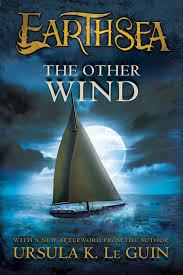 This is a great and wonderful novel, full of death and life and love and loss and powerful changes and the steadiness of hope. It’s a spectacular way of bringing all the threads of the past five books of Earthsea together, and addressing most (perhaps all) of the issues raised in them: men’s and women’s magics, dragons and humanity, the necessity and fearfulness of change.
The plot: a witch’s son has been having dreams about the place of death. The dead are able to call him and even touch him across the wall that separates that place from the living, and this is a fearful thing indeed. He goes to Roke for advice, from there is sent to Sparrowhawk as a man who has crossed the dead lands, and from there is sent on again to the new king, Lebannen, since that’s where Tehanu and Tenar are. Coming to Havnor, Alder finds himself in the most court intrigue Le Guin has ever shown: a princess has been sent from the Kargad Lands with the clear intention that she should wed Lebannen; Lebannen is all petulant about being forced into something, plus he finds it hard to accept her cultural differences. Then there’s the dragons who have come to ravage the inner lands of Earthsea – although not killing humans… and then they all – bar Sparrowhawk – end up on Roke, where the changes that were suggested in the world back in The Farthest Shore, and the ideas of death and shadows and Old Powers from the earliest books, all come together in a mighty crescendo.
It’s a captivating plot, and it’s one of the most plot-driven of the Earthsea stories, but the characters are absolutely still the essence of the book. I love that Sparrowhawk is an old man in this book. He has been in previous stories too, but I love how generally comfortable he is with his new station. He still mourns for wizardry but it’s an accustomed thing rather than a gaping wound. His happiness with Tenar is comfortable and comforting. Their adoption of Tehanu and their respect for her oddness is a lovely example of Family. Doing the hard things, and ensuring that your family does the hard but necessary things and supporting them in it… it’s strong and honest and inspiring. There may have been a tear at the very end, for Tehanu. And I love Tenar; she is an awesome example of old women doing what old women can do: say the truth, get things done, not care about perceptions – she’s the fictional example of Le Guin’s essay “The Space Crone.”
I was so excited to have Irian/Dragonfly back! To know that she has found her place in the world with the dragons is very satisfying. She’s another character who agrees to do the hard thing – come back and deal with the humans for a short time – even though she doesn’t especially want to. I like that aspect of her character. And her passion.
Seserakh, the Kargish princess, is the most intriguing of the new characters (Alder is vital for the plot, but he’s still just a man with an unfortunate manner of dreaming). I’m a little uncomfortable about the fact that she wears a red veil, and that going bare-faced is a really big deal – the women who made fun of her at home were “bare-faced whores” – because I can’t figure out whether this is a dig at Islam or not. Seserakh herself is a strong, vulnerable, determined and passionate character… but she does end up removing the veil to be accepted. So I don’t know whether to be disappointed by this aspect or not.
Basically everything about this novel (with exception above) is wonderful and I’m so sad that it’s the end of Earthsea.
Galactic Suburbia 116
Our special 2014 Galactic Suburbia Award episode! Listen to find out our winner and shortlist for our award to honour activism and/or communication that advances the feminist conversation in the field of speculative fiction. You can get us from iTunes or at Galactic Suburbia.
CULTURE CONSUMED:
Alisa: Haven S5, Tempest’s Reading Challenge
Alex: Tehanu, Tales of Earthsea, and The Other Wind, Ursula le Guin; Jupiter Ascending; Waistcoats and Weaponry, Gail Carriger.
Tansy: D’Artanyan i tri Mushketyora (1979); New Avengers: Breakout prose novel by Alisa Kwitney; New Avengers: Breakout, by Brian Michael Bendis; Curb Stomp #1 – Ryan Ferrier (writer), Devaki Neogi (artist); Princess Leia #1 – Mark Waid (writer) Terry & Rachel Dodson (artists).
NEXT TIME: tune in for our Ursula Le Guin essay spoilerific. We will be covering: “The Space Crone” & “Is Gender Necessary? (Redux)” (both in Dancing at the Edge of the World: Thoughts on Words, Women, and Places) and “Science Fiction and Mrs Brown”(in The Language of the Night: Essays on Fantasy and Science Fiction).
Please send feedback to us at galacticsuburbia@gmail.com, follow us on Twitter at @galacticsuburbs, check out Galactic Suburbia Podcast on Facebook, support us at Patreon and don’t forget to leave a review on iTunes if you love us!
Tehanu
It’s official. I like the Tenar-focussed books more than the Sparrowhawk-focussed ones. Don’t get me wrong – I adore Ged, and I love the quests and the excitement of A Wizard and The Farthest Shore. But there’s something wonderful about Tenar as a character, and there’s something wonderful about the more inwardly-focussed and (is this silly?) more relatable stories of Tenar’s life, that makes my heart ache with joy.
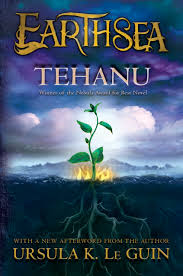 I can only imagine the wild joy that Tehanu must have been greeted with when it was released in 1990, 17 years after The Farthest Shore. Intriguingly, it begins before that story has finished – there is a problem with magic, and eventually Ged is delivered to Gont by the dragon Kalessin, but that’s not even the start of the story.
The story really begins with The Tombs of Atuan, and more even than The Farthest Shore continues A Wizard this is basically the second half of Tenar’s story. We skip the bits about being a wife and a mother… I don’t believe that’s because Le Guin sees those bits as unimportant, but perhaps because this bit – the being a widow stage – allows for more freedom of story, and even perhaps because this bit is told less often. There’s an ironic comment at some point about how once she got old, Tenar disappeared to men’s eyes. I adore how much this story is about being old, and getting on with life, and old =/ dead.
So Tenar is a widow, and she’s in charge of her dead husband’s farm because her son is off being a sailor, and she takes in a young girl who has been left for dead after being severely burnt. There’s a lot in the story about perceptions of physical appearance – whether through age or this sort of physical impairment. There’s also a lot about why men (humanity in general I suppose, but the major focus is on men) do what they do, and the child’s situation is emblematic of all of this. As is Tenar’s steadfast, generous, stubborn heart in caring for Therru as her own. Ged does turn up, eventually, but he doesn’t take Tenar on adventures. This time, he is drawn into her world, in an inversion of their first encounter. This time, it’s he that’s struggling with his identity and his purpose in life, and Tenar who takes him in hand.
There is adventure, of a sort – nasty men and even an encounter with the king – but they’re blips in an ordinary life, a brush with celebrity. The very end of the story is a different matter (which: !!!), but still the resolution is in keeping with Tenar’s desire for an ordinary life. There’s more interest in goats, and spinning; in peach trees; in small-town relationships – especially between women – and understanding changed-but-the-same friends. I have to say that in writing in this I experienced a twinge of concern, that perhaps I’m not selling this to – yes, you guessed it – male readers. And then I realised how I was feeling and nearly despaired. Of course I think men should read this, in the sense that I think everyone should because it’s saying such deep things about life and because it’s written so gorgeously. If men – and indeed women – choose not to read this because they think they only enjoy adventures, well, their loss.
Because Le Guin is saying a great deal about ‘real life’ in this book. In her discussion about where power lies, and what power is; about the relationship between men and women in terms of power and trust; about motherhood and what it means; about the nature of knowledge; and perhaps even a suggestion of how to live ‘the good life’.These themes are another way in which the continuity between this and The Tombs is evident. I don’t particularly like some of what she has to say about men’s and women’s power, and I’m not sure that I’m even meant to agree with or like it, but it’s still intriguing.
I adore this book.
Comment on revelation about Ged: SPOILER!!
I am deeply fascinated and intrigued by Le Guin’s revelation that wizards are essentially sexless – neutered in some way by magic. Hmmm, the terminology here may get me in trouble. At any rate, he’s basically not experienced adolescence. I can only imagine that she was asked whether Tenar and Ged had had sex in the boat en route to Havnor, and this is her explanation of why not! It’s a very cunning way of helping to partly explain the lack of women on Roke – that is, no wives or girlfriends – as well as reassuring the readers about wizards not using their powers for manipulation.
Galactic Suburbia 115: in which we are five!
It’s our birthday! (We’re on iTunes or at Galactic Suburbia.)
CAAAAKE
Aurealis Awards! (Alisa moonlighting at Coode St)
What Culture Have we Consumed?
Alisa: Cherry Crow Children by Deborah Kalin, Perth Writers Festival – Elizabeth Gilbert
Alex: up to date with Saga (in trade); The Chimes, Anna Smaill; A Wizard of Earthsea, The Tombs of Atuan, The Farthest Shore, Ursula le Guin; Etiquette and Espionage, and Curtsies and Conspiracies, Gail Carriger.
Tansy: Spider-Gwen #1, Companion Piece, Fangirl Happy Hour #4 (Renay’s rant on female characters & agency)
Please send feedback to us at galacticsuburbia@gmail.com, follow us on Twitter at @galacticsuburbs, check out Galactic Suburbia Podcast on Facebook, support us at Patreon (http://www.patreon.com/galacticsuburbia) and don’t forget to leave a review on iTunes if you love us!
Waistcoats and Weaponry
I received this book from the publisher.
There are spoilers ahead for the first two books of this series, Etiquette and Espionage and Curtsies and Conspiracies. I’m also going to talk about the very end of this book, but I’ll let you know when that’s about to happen.
 I continue to be impressed by the fact that the problem set up in the first book, about the mysterious crystalline valve, has continued to be a significant plot point across the three books of the series so far. Aside from a simple continuity of characters, this makes the series feel more cohesive than it otherwise might and it’s something I especially did not expect from an adventures-at-school book. Sorry for doubting you, Carriger. It does of course continue to develop, until here we start to see how the valve might actually be used nefariously. The other intriguing, if fleeting, piece of continuity is Professor Braithwope’s mental instability, caused either by the snapping of his vampiric tether or his experience in the aether. It would have been nice to see a bit more resolution of this, but I’m glad he hasn’t simply been abandoned.
The focus of the series, of course, is the growing friendship of the girls – Sophronia and Dimity especially, but Agatha and Sidheag as well. (Sophronia is the central protagonist throughout; Dimity got a starring role in C&C; Sidheag has her turn in this book… which surely means that the fourth book will finally give us some Agatha love? She’s absolutely the most mysterious at this point – apparently from great wealth, there’s no hint about why she’s at Miss Geraldine’s, and given her apparently mouse-like character how could she ever survive as an intelligencer? So that’s something to hope for.) Sophronia and Dimity continue to be inseparable; I was concerned that Dimity was just going to be the slightly dopey sidekick, but again I should have trusted Carriger; she’s definitely got a mind of her own, and although she doesn’t try that hard to stop Sophronia being mad, she doesn’t just go along blindly. I was glad to see more of Sidheag, while feeling sorry for the reason behind it. Solid female friendships are a lovely lovely thing.
One of my disappointments with this book is the same as in Curtsies and Conspiracies: the boys. There’s a lot of anguishing over Lord Mersey and Soap. Felix is a useful person to know but he’s a right pain in the butt and I got pretty sick of him, it must be said; his overly familiar and pushy attitude towards Sophronia was irritating and bordering on offensive. I like Soap. I can appreciate the we’re-just-friends narrative, as well as everyone rolling their eyes at the idea that Sophronia is so naive. I really appreciate that this is a cross-race and – perhaps even more pertinently – cross-class friendship/might-be romance. Felix vs Soap isn’t much fun, though, bordering on possessiveness sometimes. Sophronia doesn’t really put up with it, which is good, but it still bugged me.
But not as much as the ending… thus SPOILERS NOW. (So skip the next paragraph or just know that I did enjoy it and still look forward to the fourth book later this year.)
I knew that there was going to be some drama involving werewolves and Soap wanting to change from about the middle of the book. As soon as there were guns pulled at the end I got that sinking feeling and yup, then Soap got shot right while Lord Slaughter happened to be standing there. Oh what a surprise. At least it wasn’t in protecting Sophronia directly. I did like that Sophronia saved her friend, and was wonderfully gallant in standing up to Slaughter and demanding he try – and that she stood by her promise to be indentured to him (HOO BOY). But… there’s still something about this turn of events that makes me uncomfortable. I’m glad Soap was saved, and yes he wanted to be a werewolf, but this is not on his terms. I can’t express it much better than this: it just wasn’t quite right.
I did like it, I really want to find out where Sophronia goes now, and I REALLY want a book featuring Agatha. You can get this one from Fishpond.
Curtsies and Conspiracies
 This is another hugely enjoyable book from Carriger. Once again our girl Sophronia is thrown into difficulties at her alleged finishing school. This time she has a lot more to do with the supernatural element of her world, especially the vampires. Of course there’s a lot of discussion of dresses and fashion and hats and reticules; she must figure out how to carry a knife without it being obvious, she must learn to bat her eyelids effectively, and how best to carry the implements required of a young lady in her position. I’m still surprised by how enjoyable I find yet another school focused book.
Most of this book is spent on the dirigible of Miss Geraldine’s finishing school. Some time is spent in classes, learning about domestic economy, poisoning, fainting and how to properly address vampires. But for Sophronia, much of her time is spent on the outside of the dirigible – climbing – as well as with the sooties down below and the dressing-as-a-boy Vieve. Interestingly the plot follows on from Etiquette and Espionage, in that the MacGuffin here is the same. Of course this time it’s not so much about finding the prototype as it is about figuring out what it can do, how it will do it, and who will control it. There’s a surprising amount of politics for a book that seems at least on the outside as being solely can send with fashion. I guess that’s kind of the point; that the two don’t have to be mutually exclusive and anyone who is thinks they are is likely to underestimates graduates of Miss Geraldine’s finishing school.
One of the big differences in this book compared to the original is that there’s a lot more boys. I’m not really sure what I think about this; on the one hand it’s obviously an important skill for girls like Sophronia and Dimity to learn – that is, how to deal with difficult yet handsome young man. And of course reappearing in this book is Soap, certainly one of my favorite characters although somewhat problematic given that he’s black and his nickname is Soap. On the other hand I really enjoyed the almost exclusively female cast of the first book; the fact that boys were not necessary for the book to proceed, the fact that the girls were perfectly capable of getting themselves into and out of scrapes generally without any male assistance (or hindrance) at all. While some of the ways that Sophronia dealt with her would-be suitors was entertaining, I did find myself enjoying the sections of the plot that solely involves the girls generally more enjoyable.
I continue to be fascinated by the development of this world that Carriger initially developed for the Alexia books. And of course I remain desperately keen to find out how this series will intersect with the earlier one. One of those intersections is quite obvious but I have no doubts that Carriger will provide some further surprises in the rest of the series.


