Without a Summer: the third Glamourist History
The following has spoilers for Shades of Milk and Honey and Glamour in Glass, I guess. Seriously, why haven’t you read them yet?

I read this quite a long time ago, and I have no real excuse for not having reviewed it earlier; it’s certainly no reflection on the story. Is it a good story? Yes. Does it fit in well with the other two Glamour novels? Yes. I think that this is the sort of book you don’t need to read the review of, if you’ve already read the others or like the idea of Jane Austen with magic (basically). Actually that’s not quite right… this one, in particular, is more like Elizabeth Gaskell with magic – and I say that having only watched film/TV versions of Gaskell, but given she’s described as Austen with ethics (that is, a more explicit examination of society and ethics than Austen), I feel I can make that claim. Because here Kowal does get into some discussion of class, in particular, and race as well.
The idea of a year ‘without a summer’ is actually based on fact; 1816 was a year that felt summer-less, because of the effects of volcanic ash from an eruption in the ‘East Indies’ as Kowal describes it. For the sake of the novel, Kowal introduces the idea of blaming this on coldmongers – people whose glamour is particularly attuned to making cold, so they get jobs doing things like keeping food or rooms cool. The story has both political aspects – which revolves especially around class – and personal aspects, which also revolves around class and race but also around family relationships.
The political: this is a time of Luddites, and issues of unemployment; tie in the cold, and fear of glamourists, and there’s a very dangerous situation brewing. It would be hard to talk about that without giving away some of the details whose revelation is part of the delight of the story, so I won’t. Suffice to say that the concerns Kowal raises fit perfectly into the period, and complement the personal issues going on for Jane and Vincent perfectly.
The personal: Jane and Vincent are faced with a number of issues to deal with, and to my delight not all of them are dealt with easily. The one that most struck me, by the end, was Jane’s relationship with her sister Melody. Pride and Prejudice hints at the difficulty of older and younger sisters relating, as does Sense and Sensibility – but these tend to show the older as being in the right, and the younger as needing to be tamed in some way. Kowal does very clever things here with that trope; Jane and Melody’s relationship is more realistic, and more painful, than in the Austens – and this makes the story the more uncomfortable and real as a result. Secondly, there’s the introduction of Vincent’s family. They’ve been less than shadows to this point; all that we’ve known is that Vincent has cut himself off in order to be a glamourist, and his family don’t approve – and that they’re from High Standing. They arrive with a vengeance here, and Kowal spares no mercy. Vincent definitely comes out of the whole thing as a more impressive man for overcoming the family issues that he was dealt.
Some of the other issues facing the pair mingle with the political. In particular, they are confronted by race issues, both because many of the coldmongers – whose problems they can hardly help themselves from being involved with, touching as it does on glamour more generally – are black, and because one of the families they end up heavily involved with are Irish. This may seem strange to those without knowledge of how the United Kingdom worked in the nineteenth century; but as Kowal points out in her afterword, at this time “the notion of ‘white’ excluded not only people of Anglo-African or Anglo-Indian descent but also Irish” (356). Some of Jane’s own prejudices are confronted, along with those of London at large – not comfortably, but I think, for the reader anyway (at least, this white reader; I won’t try to imagine how to read it as someone confronted with racism on a regular basis) in a sympathetic manner. That is, not that the racism is easy to read, but the confronting of it is more like what 21st century tolerant sensibilities would prefer.
I’m sure I had more to say when I originally read this, but – the characters remain engaging and delightful, Kowal continues to find genuine circumstances for them to interact with, and her style remains a delight to read. I’m not sure if I want more stories here; there would surely be a danger of Jane and Vincent turning into the unexpected epicentre of everything interesting in 19th-century England, which would end up being silly. And would insist on bringing up the issue of pregnancy and children… which might not be a bad thing, I just can’t think how it would be done. But then, I’m not an author. Maybe I should just Kowal to know what is best for her characters…
You can get Without a Summer from Fishpond.
Galactic Suburbia 83
 In which we tamper with our format to discuss reconciliation in SF, and the disappearance of women in modern movies.
Discussion
NK Jemisin’s GoH speech about reconciliation in SF
The Chief of Army, Lieutenant General David Morrison on not turning a blind eye.
At the movies, all the women are gone.
Culture Consumed
ALEX: The White Queen, Gwyneth Jones – abandoned; Mono no Aware, Ken Liu; After the Fall, Before the Fall, During the Fall, Nancy Kress; Throne of the Crescent Moon, Saladin Ahmed. (Also S2 of Game of Thrones.)
ALISA: PhD paper – Female bestsellers: A cross-national study of gender inequality and the popular–highbrow culture divide in fiction book production, 1960–2009 by Marc Verboord
TANSY: Original Sin, by Andy Lane; The Mists of Avalon by Marion Zimmer Bradley
Please send feedback to us at galacticsuburbia@gmail.com, follow us on Twitter at @galacticsuburbs, check out Galactic Suburbia Podcast on Facebook and don’t forget to leave a review on iTunes if you love us!
Galactic Suburbia is 82
 In which we talk sexism in the industry, feminist space opera, childbirth and babies in comics, space cowboys, and the hidden value of translators. Also, Watson is a girl now!
News and Links
The SFWA Bulletin Discussion:
Foz Meadows dissects the Malzberg/Resnick article causing most of the controversy and protest.
Jim Hines curates a massive list of protest blogs/tweets on the issue (though as he himself makes clear this is not a comprehensive collection of links to the entire debate, or every post on it – just the ones protesting the sexist attitudes published in the Bulletin, as proof they were not anonymous).
Ann Aguirre on her experiences of sexism in the SF industry.
Alisa’s Observations Part I & Part II
Tansy on Why It’s Important (And Why We’re Still Talking About the SFWA Bulletin)
New Women vs Tropes in Video Games: Damsels In Distress, the trope so widespread that this is Part 2 of a 3 part series.
Lambdas: the LBGTQ Literary Awards! Some speculative fiction representation there…
Culture Consumed
ALEX: Space Cowboys; Chase the Morning, Gates of Noon, and Cloud Castles – Michael Scott Rohan; Hawk and Dove, Karl Kesel and Barbara Kesel (5 issues, 1986); X-Men #1
ALISA: The Rook, Daniel O’Malley; Saga; Small Blue Planet Ep 4: Israel; Quick PhD update
TANSY: The Other Half of the Sky, edited by Athena Andreadis & Kay Holt; Elementary
Please send feedback to us at galacticsuburbia@gmail.com, follow us on Twitter at @galacticsuburbs, check out Galactic Suburbia Podcast on Facebook and don’t forget to leave a review on iTunes if you love us!
Cloud Castles: the re-read
Spoilers for the first two books, Chase the Morning and Gates of Noon – although really, there’s three books, surely it’s no spoiler to say that Stephen survives and has further adventures?
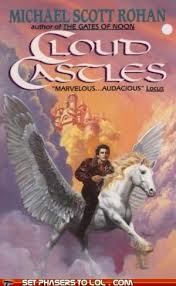 Stephen Fisher, no longer quite such the hollow man as previously; oh look, the brief love and forgiveness of his ex-girlfriend has worked not quite a miracle, but certainly wrought some change. Whodathunkit. When this novel opens, Stephen is in an intriguing position: he remembers the Spiral all the time when he’s in the Core, he’s deliberately had many adventures there – but his life in the Core isn’t harsh or empty enough to give it up. In fact, he’s now the head of his company and he’s got a brand new, very interesting project on the go. No on-going relationship, but still – he’s not the hollow, use-and-leave type that once was. Which is good, right?
The ultimate reveal is brilliantly constructed. Up to that point… well, the story threatens to feel a bit samey. In fact, it is: there’s challenge from the Spiral affecting Stephen’s life in the Core, and he goes out and faces it and there are ups and downs, and something Big from out near the Rim challenges Life As We Know It. All of these things happened in the previous novels, and they happen here too. But the great thing about Rohan’s writing is that it still manages to be interesting and thoroughly enjoyable. For instance, in the mythos he’s mined: there’s been voodoo; and Asian myth from Buddhism to Hindu to animism; and here, Rohan brings it back to Europe. In terms of action, the first two books were similar in involving ships; here, the focus shifts to the possibilities of air travel (AIRSHIPS!). And I swear Rohan must himself have taken up fencing between Gates of Noon and this book, because the fights seemed to get a whole lot more technical… which I kinda skimmed occasionally. And while some of the side characters are the same – really, who could ever get sick of Mall? Really? And there are new characters too: happily, to my mind, especially another woman, who gets a bit more fleshed out than Claire or Jacquie ever managed to be in the previous books.
Yes, there’s some annoying repetition with Stephen bemoaning his life – but Gates of Noon was definitely the worst for that, and his growing/filling up has largely curbed that. And yes, the portrayal of women is not always great – Stephen occasionally has a ‘private’ leer which the reader is privy to – but Mall gets to be Amazing. This could be problematic, because clearly it’s not realistic and it’s annoying if the only woman has to be so much better than any of the men to warrant any air time: but it does entirely fit the idea of Mall being over 400 years old, and moving outwards on the Spiral, and therefore – like Jyp is, to a lesser extent – becoming… clarified. And she’s not the only woman, which helps.
So I firmly believe these books deserve their space on my shelf.
Galactic Suburbia 81
 In which we chew over shortlists, awards winners, book covers and gender issues, all of which pales in comparison to the FIRST QUILT IN SPACE. You can get us from iTunes or Galactic Suburbia.
Hugo Packet! What are YOU going to read? Would password protected freebie novels put you off reading them?
Campbell Memorial Award finalists
Comments: Tansy on “winning too many awards” & Keith Stevenson on why the awards are just fine and don’t need to be ‘sorted out’. To add some positivity (which more accurately reflects most people’s experience of this awards night!) check out Sean’s Storify of the AA’s night and Tehani’s post on attending at the last minute with lovely frockage pics. For even more gorgeous pictures, Cat Sparks’ Flickr feed is the way to go!
The coverflip experiment, started by Maureen Johnson’s piece on Huffington Post.
The artist behind the Georgette RR Martin cover discusses her imaginary brief.
Hawkeye Initiative Coda – using humour & art to get the gender point across in the workplace.
THE FIRST QUILT IN SPACE! Frontier craft for the final frontier.
Also, bye bye Commander Hadfield – thanks for bringing back the sense of wonder
The most significant futurists of the past 50 years
Tansy’s Melbourne public appearances:
Sisters in Crime 14 June http://www.liviaday.com/wordpress/2013/05/20/something-rotten-in-the-apple-isle-sisters-in-crime/
Splendid Chaps 15 June – details tba, keep an eye on the Splendid Chaps website for booking details after the 23rd May.
Culture Consumed
ALISA: Star Trek Into Darkness
TANSY: Iron Man 3 FINISHED GAME OF THRONES BOOKS; Queers Dig Time Lords, 2 Minute Time Lord discussion with editors/contributors of QDTL
ALEX: Alanna, Tamora Pierce; The Thief, Megan Whalen Turner
Please send feedback to us at galacticsuburbia@gmail.com, follow us on Twitter at @galacticsuburbs, check out Galactic Suburbia Podcast on Facebook and don’t forget to leave a review on iTunes if you love us!
The Gates of Noon
Probably spoilers for Chase the Morning.
Ah Stephen. Forgotten the Spiral, really? At least it didn’t happen immediately… still, it shouldn’t be a surprise that your brain couldn’t cope with the weirdness for very long. Too much career, too many one-night stands, to enjoy.
Until it reaches in to grab you again.
 In Chase, a lot of Stephen’s hollowness seems to stem from his long-ago break-up with the lovely Jacquie. Here, Stephen has got himself – and his company – involved in a project to ship the cargo of a charity irrigation system to Bali precisely because of her name. But the project is dogged by malign forces, it seems, such that they cannot organise to move it any closer to Bali than Bangkok. And with a little bit of pushing from external forces, Stephen Fisher – the Hollow Man, defeater of nasty forces last time he ventured into the Spiral – manages to find his way out of the Core again, and sets up a rather unusual method by which to deliver his cargo. It involves an ancient steamer, a seven-foot tattooed Maori, and an outlandishly mixed crew. Also another magician-type, although Ape is nothing like Le Stryge, which is about the best that Stephen can hope for. Cue adventures.
As with Chase, many of the awesome things I remembered are indeed still present. I love Rohan’s descriptions of battles, and also his evocation of sailing – be it on seas or stranger tides. The very idea is still utterly captivating – sailing into the dawn or dusk, into the clouds! – as is the idea that places have shadows. Actually, perhaps they’re closer to Platonic ideals, since they capture what is and was and will be; the essential nature of a place, even if never actually existed anywhere but in the imagination of very many people. And the idea of moving out into the Spiral as somehow refining people, as well as places, is also a wonderful one for story.
Also as with Chase, there are a couple of things that bugged me, and the main one was Stephen and his hang-ups. While the first book was mostly all “woe, I am a hollow man!”, this book is replete with “woe, I done wrong by Jacquie!” – which he did, right enough, but I could have done with a little bit less breast-beating. He does, true enough, make some attempts at restitution – and he was pretty nasty, so maybe I should cut him some slack as his conscience actually teaches him a lesson. But I didn’t have to be subjected to everything going through his head every time; it could have been indicated with a sentence or two, easily enough, especially the fourth or fifth or tenth time.
Also, bit of eye-rolling casual sexism. Irked me. It mostly does all right on the not-racist front – which, given it’s set largely in South-East Asia, is a relief. There are some bits where people’s mannerisms or characteristics are referred to as ‘oriental,’ at which I cringed a little, but on reflection those things are not usually coded negatively so… yeh, not sure what I think about that. But the inherent desire of the book is to balance tradition and ‘progress’, and I cannot fault that.
The other thing I cannot fault, and found also in Chase, is the very suggestion that there must be something MORE. More than career, more than sex-as-an-end, more than selfishness. Stephen finds that in action, but also in helping others; Mall and Jyp and others find it in becoming, and doing, what they are meant to be. It’s a worthy aspiration.
Is it very different from Chase? Well, the intention of the adventure is different, and Stephen doesn’t have to go through all the rooky, learning-to-be-on-the-Spiral stuff, so things happen a bit more immediately. There’s more sexual tension; there’s also more at stake, which I think made it work as a sequel. If it had been yet another “save that girl!!”, I am unlikely to have bothered. Plus, quite different places and different villains, which is great.
The Suck Fairy has been kind.
Galactic Suburbia is 80!
 In which there is gallivanting, schlepping, recycling and rejoicing – cos a Galactic Suburbia baby is on the way!
News
Conflux Update: Alex’s Report, Alisa’s Report, Everyone Else’s Wrap Ups
Ditmar winners (and associated awards) announced.
Through Splintered Walls Art Exhibition
Aurora Award ballot – Canada’s Ditmars?
Shirley Jackson Award shortlist
Culture Consumed
ALEX: Iron Man 3; Oblivion; Cloud Atlas
ALISA: The Adventures of Alyx, Joanna Russ
TANSY: A Song of Ice & Fire update, Flower and Weed by Margo Lanagan
Please send feedback to us at galacticsuburbia@gmail.com, follow us on Twitter at @galacticsuburbs, check out Galactic Suburbia Podcast on Facebook and don’t forget to leave a review on iTunes if you love us!
NatCon/Conflux 9
 This photo pretty much sums up my Nat Con experience: blowing bubbles, with a friend, at the Ditmars ceremony, onto another friend’s head… and his rather nice shiny suit…
I also attended Sean Williams’ presentation on his PhD work – about MT/demat/”beam me up Scotty” technology and how it’s been presented in SF literature for the last 140 or so years, and that was awesome, even though it meant sitting on the floor behind Sean because the room was so full (and getting a hand up from Scott Westerfeld, and I didn’t know it was him because he wasn’t wearing a name badge NO FAIR). And I went to the Ditmars ceremony which was awesome because Deb Biancotti ran it like a drill sergeant, and because I got to applaud a lot of friends getting very nice shiny awards.
And there was also a rather large amount of talking.
Galactic Suburbia 79
Alex & Tansy discuss the Stella, the Shadows, behaving badly on the internet, criticising criticism of the Hugo criticism, and whether the suck fairy has visited Farscape, the Star Wars Thrawn trilogy, or The Mists of Avalon. You can get us from iTunes or at Galactic Suburbia.
News
The Stella Prize announced its winner last night at a glittery ceremony. Carrie Tiffany won the $50,000 prize for her second novel Mateship with Birds and promptly gave back $10,000 to be awarded to her fellow shortlistees. Classy!
Australian Shadows Award – and the skulls go to…
Seanan McGuire talks about perceptions about self-promotion and the Hugos
We also wanted to draw attention to the post Seanan linked to, “Language Myth #6 – Women Talk Too Much.” Particularly this quote by Dale Spender:
“The talkativeness of women has been gauged in comparison not with men but with silence. Women have not been judged on the grounds of whether they talk more than men, but of whether they talk more than silent women.”
Hugh Howey – The Bitch from Worldcon post
In response: Tobias Buckell – Don’t Punch Down
Chronos Awards – for SF & Fantasy professional & fan works coming out of the state of Victoria.
Eisner Award shortlists – nice to see Saga & Hawkeye nominated, but Tansy particularly wants to draw people’s attention to the categories for comics & graphic novels aimed at children.
Mind Meld – favourite women writers in genre
(Also – books you savour vs books you devour)
Culture Consumed
ALEX: Farscape season 1; Dark Force Rising, and The Last Command, Timothy Zahn; Rapture, by Kameron Hurley; Sky is Calling, The Impossible Girl (Kickstarted album)
TANSY: Game of Thrones Season 2; Swordspoint the audiobook, The Mists of Avalon, Coode Street Podcast episode 140 featuring Nalo Hopkinson.
Please send feedback to us at galacticsuburbia@gmail.com, follow us on Twitter at @galacticsuburbs, check out Galactic Suburbia Podcast on Facebook and don’t forget to leave a review on iTunes if you love us!
Megan Whalen Turner’s The Thief
I picked this up because someone – maybe Tansy? – was appalled that I’d never read any Megan Whalen Turner. So here we go. (Slightly spoiler-y but not very.)
This is definitely aimed at a YA audience (ish), and I think I would have adored it if I’ve read it a little younger. That said, I enjoyed it more than the first couple of pages suggested I might.
 The book opens with a thief, Gen, in prison. He’s pulled out of his cell and taken for an interview with the king’s magus – head scholar, not magician, so an interesting choice of words there – because the magus wants to use his particular talents for a very specific mission. It’s a rahter intriguing beginning because it’s unclear how the reader should feel about Gen: clearly he’s a thief, so that’s bad; but he’s an engaging narrator, which is ambivalence-making; the magus isn’t that nice and the king is a bully, so that makes Gen look good. There’s also a question over Gen’s abilities, since lots of people are taunting him for the boasts he made before his capture, and clearly he’s been in jail for ages, so does that make him a bad thief? On the other hand, the fact that he’s going to be used by the magus is an indication of his skill, so… yeh, lots of ambivalence here. I like well-constructed ambivalence.
Turner keeps Gen an engaging character for the length of the novel. Various bits and pieces come out about his past, and his sense of self, and all of these go to construct an intriguing and likeable man. I had to stop after the first chapter or two and re-read some sections because I half-wondered whether Gen was going to turn out to be female… that would have been really awesome, but alas no. (There’s only two female characters, I think, who get any real airtime, and that not much.) I was really, really impressed with the twist at the end… I had been fully expecting a fairly straightforward ending, and would have been fine with that – although quite what could have been done with Gen when they got back I don’t know, maybe just allowed to slip away? Anyway, the way such a major revelation actually worked in perfectly with what had gone before? Genius. The magus is a bit fickle, especially in his attitude towards Gen but also towards his two students, and I could never quite figure out whether he was meant to be thawing out over the course of the journey or if he was indeed this mercurial, sometimes-ill-sometimes-even tempered teacher that everyone had to be careful of. Overall not entirely convinced. Of the others on the journey – I don’t feel that they were quite rounded out enough for me to care that much. Interestingly, Gen is big enough to basically plug that lack. There are other characters here and there but none that are memorable.
The plot, obviously, is that of a quest – go find this ancient artefact which could have ramifications on… stuff. Along the way there’s politics and mythology and personality clashes, and a lot of walking and some adventures. It’s fun and well-paced – the walking doesn’t drag (heh), the discussions the characters have enliven things nicely, and the conclusion packs a really brilliant punch. I ploughed through this very easily and with great enthusiasm.
So I liked the characters, and the plot was fun. The world is another aspect that made me ambivalent. The author’s note vindicated my feeling from the opening chapters that this was definitely heavily influenced by Greece, and its ancient (and semi-mythologised) past. However I was weirded out by scrolls and books in the same library – which I know must have happened, but it’s still weird – and Turner only notes that Gutenberg did movable type in 1445 in the author’s note, just to give context I guess. So it’s kinda real-world ancient, kinda medieval, kinda… not. That aspect bugged me a little but when they got into the countryside it wasn’t such a problem. For the world itself – I was impressed to see the levels of the politics discussed, which makes me wonder actually at my tagging it YA although it did get to be a Newbery Honor Book. I liked the Canterbury Tales-esque aspect of telling stories to each other, although these were of mythology not everyday life, and that these myths were clearly inspired by Greek tales but made wholly Turner’s own by twists and details; there was some discussion about how much the gods affect everyday life, although not much. In all it was quite a comfortable world, I guess.
This is the beginning of a series; I will definitely be looking out for the rest of them. You can buy a shiny new copy over at Fishpond.

 Randomly Yours, Alex