Persians: the Age of the Great Kings

I read this courtesy of NetGalley. It’s out in April 2022.
I really, really wanted to love this book.
(That, children, is called ‘foreshadowing’. You can almost see the BUT looming behind those words.)
A book that’s basically the postcolonialist version of Persian history we’ve all been waiting for! A view on Persian history that’s not just repeating the Greek and Roman commentaries that were absolutely written with a very particular perspective! YES PLEASE. And even more when Llewellyn-Jones makes the acerbic comment in the introduction about how the concept of European superiority can be dated back to Herodotus etc and the way they presented the terrifying East. So yes, let’s have a version of Persian history that is largely based on Persian sources, or uses the Greek sources very carefully – to find the Persian reality behind the Greek propaganda.
And it starts so well. There’s a discussion about Persia vs Iran as a name – and I’m not sure whether his explanation of the political nuances there are accurate, so I defer to others on that, but it seemed to make sense within what I do know. There’s a discussion about the archaeological activities that give historians what they know from Persepolis etc, and a candid admission about the lack of sources. The Persian history proper starts with a discussion of the movement of different peoples into the area we know today as Iran, and some speculation about how they interacted etc. Then it moves into discussing the development of the Persian empire as empire, and interaction with the Medes. All of this section was intriguing and the use of inscriptions was well done. I did start to get a bit uncomfortable about the lack of reference to other sources – like other historians; I understand that getting the balance of what can seem to be most approachable, and what can seem too scholarly, may revolve around footnotes etc but… there’s just no way the author didn’t use other references.
I also started to get a bit uncomfortable when the author claimed that Cyrus’ mother “delighted in singing Median nursery rhymes to him” (p60 of the e-version), because that seems… weirdly specific? And then I got to the description of him as “lean and good-looking in that way that Persian men are uniquely handsome” (p63 of the e-version) and I had to stop and blink and decide whether to laugh or cry. What happened to treating the Persians as real people and not exoticising them, which I thought was part of the postcolonial agenda? I also have a problem with the statement that “A society that requires such codes of respectful behaviour” (obeisance before the monarch, etc) “is very likely to have autocratic political organisation, characterised by the coercive power of a king” (pp194-5). It just seems too blanket a statement.
And then! We have Darius’ half-sister and wife described as “a Lady Macbeth-like villainess, hellbent on power and ruthless in her bloody ambition” (p288) and I really started to wonder whether it was now a different author, or if he had been to sexy the book up. Next we have “years of adoration and unnaturally demonstrative mother love meant that [Darius] was self-centred, cruel, vindictive, and brutal” (p292); and that mothers experience “that particular twang of jealousy… when their sons give their hearts to other women” (p294). In case we worried that it was about misogyny, we then have a eunuch described as “a veritable creature of the court” (uh, eunuchs who are made eunuchs to BE at court are literally that??) who was “born to corruption, whose ambitions were for the very highest office of state” (p333) and I just can’t even. The author then has the temerity to accuse the Greeks of employing the “topos of the wicked eunuch” and I need to ask some questions about self-awareness.
So. I am ambivalent about this book. It’s a super necessary idea, and the use of Persian inscriptions and the way some of the Greek sources are handled is a really good example of how to read through sources to get more than they think they’re saying. On the other hand, some of the descriptions are clearly ridiculous (robes of “chiffon-like linen, gauzy cotton, and shimmering silk” (p293) – not to mention that nursery rhyme – really need some evidence!). And the bits quoted above are enough to make me despair. Did I learn something about the Persian empire and the kings who ruled, and the way it all worked? Absolutely. Is this the last word in Persian imperial history? I sure hope not.
Would not recommend to someone who is completely new to the history of this area and time, or to someone who is naive in reading historical books. For those looking to deepen their knowledge, it’s useful – with the caveats above.
Atlas of Forgotten Places
I read this courtesy of NetGalley. It’s out now.
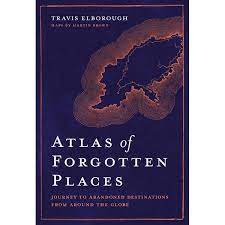
These are beautiful books, even in electronic copy – this Atlas of Forgotten Places, and the Atlas of Improbable Places; I’m sure they’re even more lovely in paper. That’s definitely a key thing to note. The photography of each place is generally very good, and evocative of whatever idea is being presented; and the maps are also intriguing. They show where the place is in context – near other towns or within a country or whatever is relevant – and also shows the layout of the particular area. Because with this Atlas in particular, I think, many of the places featured aren’t just individual buildings (although there are plenty of those); they’re also entire towns, or bits of towns. And the maps show what still exists, what’s crumbling, what’s changed over time. They’re really well produced.
Chapters includes Vacant Properties, Unsettled Situations (abandoned towns, largely), Dilapidated Destinations (tourist spots and hotels), Journeys Ended (airports etc), and Obsolete Institutions. Sometimes the categorising is a bit of a stretch, but I’m happy enough to go along with it. It closes with Alcatraz, which I thought both amusing and fitting; there’s a town called Santa Claus, a lighthouse, several hotels, and a Bangkok mall, as well.
I have two quibbles. One is an admittedly minor irritant: the book needed slightly better editing (ashes are interred, not interned, surely). The other is that sometimes most of the entry for a location is a digression – about Napoleon, when the entry is about something on Corsica, or about why an indigenous group where bowler hats when it’s about a railway in Bolivia, or how both cardigans and balaclavas were named for military things (a man and a place) associated with the Crimean War, when it’s a submarine base in Balaklava. If you’re going to feature a place, surely you should spend your two-ish pages talking just about that place? Expanding more on what it was like and what led to its being forgotten? It made me wonder whether Elborough was padding for the sake of making each entry about equal, and pointless words really, really annoy me.
I should also note that the list of places mentioned in the blurb on Goodreads is wrong – three of the places mentioned there do not actually feature in the book that I read (I doublechecked the index and everything). So if you want to read about the abandoned Peter’s Ice Cream Factory, it’s not in this book.
Those quibbles aside, though, I have no trouble recommending this for the armchair traveller, or the lover of quirky facts.
Public Faces, Secret Lives
I read this courtesy of NetGalley. It comes out in May 2022.
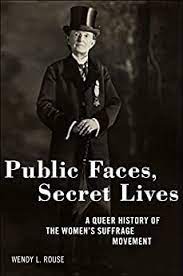
I have been known to joke that historical women were invented in the 1960s – before that, only Cleopatra, the Virgin Mary, Joan of Arc and Elizabeth I existed (obviously none outside of the European context). More recently I have added that queer people were invented in the 21st century.
I was joking, but … only because there’s an element of truth. Straight white men rule history, amiright?
This book, then, is a massively important addition to the history of the fight for suffrage.
I should point out that although I have a fairly substantial library of suffrage books, they are all either Australian or British. My knowledge of the American experience is limited to the film Iron Angels, and the magnificent “Bad Romance” spoof video clip. I do not, therefore, know a lot about the private lives of the main characters like Susan B. Anthony, who aren’t covered here in any detail because it’s been done elsewhere. It’s interesting therefore to get the focus on women who were, apparently, lesser lights – or who have become such as the history of the period has been presented.
I’m also not an expert on queer history, so I don’t know whether Rouse’s particular definition is standard or expansive. Here, queer is outlined as “individuals who transgressed normative notions of gender and sexuality… suffragists who were not strictly heterosexual or cisgender” (p2). There’s a nice point about how language changes and that words we might use to describe relationships today, for instance, may not have been available to or appropriate for people in the past.
The chapters follow general themes, or categories, allowing Rouse to explore different ways in which queerness was expressed – and fought against, in some instances. For example, in the chapter “Mannish Women and Feminine Men”, she examines how some suffragists fought against the derisive stereotype of ‘mannish women’ by insisting that suffragists perform femininity to a signifiant degree – to the detriment of gender non-conforming individuals and those women who advocated less restrictive dress. Other chapters include “Queering Domesticity” and “Queering Family” – so many of these women ended up setting up house together, and whether they were in physically romantic relationships can often not be conclusively determined, but they still spent their lives together! There’s also “Queering Transatlantic Alliances”, “Queering Space” and “Queering Death”, so it covers the entire gamut of suffragist lives.
There’s a really nice intersectionalism at work here, too, with commentary on how “queer white suffragists… helped maintain a system of white supremacy by policing access to the vote” (p63), for example. There are definitely black and First Nations people mentioned in the book, but I suspect one problem of not being familiar with the American history here is that I didn’t automatically recognise the name of any of the suffragists – let alone recognise whether they were white or not. Still, Rouse did point it out, and made note of the times when white suffragists, for instance, either tried to block black women from marching in demonstrations or told them to go to the back of the line. There’s mention, too, of class – something that’s often lacking in standard stories of the British fight for suffrage, if it focuses on Emmeline and Charitable Pankhurst and forgets Sylvia.
I’m really glad this book exists. It’s a really great look at the American fight for women’s suffrage in general (as far as I can tell), as well as presenting a dimension that is much-needed across all history.
Green with Milk and Sugar

I read this courtesy of NetGalley.
This is one of my favourite types of history books.
1. It’s about a fairly niche topic – the drinking of Japanese tea in America – which is shown to have connections with all sorts of issues and events across many decades. Trade connections! Racism and how attitudes towards different ethnicities develop and are deliberately cultivated! What happens to the samurai class when they’re moved out of Japanese society! Civil war and foreign war! Marketing and world expos and food regulation. It’s all here, and it’s woven in and through the overall topic beautifully.
2. There’s intriguing and what seem like weird facts. Like the idea of a punch made from ‘very strong tea’, plus a 1.25 pounds of sugar, a pint of cream AND THEN a bottle of either claret or champagne. I feel ill even thinking about it. Also, the idea that apparently people used to add Prussian blue to green tea, to give it a stronger colour??
3. There’s a personal connection to the author, and it’s neither gratuitous (I really like tea!) nor tenuous (my next door neighbour’s grandfather lived in Taiwan!) nor overly emphasised. Instead, the Hellyer family had been involved in importing “Japan tea” to America for many years, back when that was what it was called and when – as the subtitle suggests – “Japan filled America’s tea cups”. When appropriate, the Hellyer family experience is used to illuminate particular aspects of the story – Europeans as merchants in Japan, the shipping to America, and so on.
4. It’s just really nicely written. Hellyer has clearly done a lot of research, and has been very thoughtful in the way he’s put together the material. The overall story is easy to follow – but there’s no sense of a steady march towards a definite end. I mean, in one sense there is, because the reality is that American tastes in tea did change (not least away from tea). But it’s not all ‘oh woe everything was always leading to downfall’ – instead, it follows the changes in fashion and expectations and international relations and shows how those things interrelate with the drinking of, and importing/exporting of, tea.
I love history books about food that illuminate a seemingly mundane part of ordinary life and show just how complicated such things really are.
The Library: A Fragile History
Update: and THEN Allen&Unwin sent me a hard copy!! I’m so excited to have a physical copy of this amazing book!! And it is GORGEOUS – swirly oil-colour end papers, and A RIBBON. PEOPLE, a RIBBON. It’s just swoon-worthy.
The hard cover is RRP $49.99 and is out as of 30 Nov. I’m sure there will be a paperback copy at some point. Definitely the book for the bibliophile in your life.
I initially read this book courtesy of NetGalley.
Oh. My.

What an astonishing book.
Honestly I’ve had such a good year for book-related histories: The Gilded Page (Mary Wellesley), and The Bookseller of Florence (Ross King), and now this. Interestingly, this book contains parts of those two, because understanding how libraries function requires some knowledge of books themselves function, and how the book trade functions. It’s been like a mini-course in the whole book production history of Europe.
The authors begin with a discussion of the fabled Library of Alexandria, which is appropriate given its mythical place in the history of libraries… and ALSO that there’s some attempt to do something similar in the Alexandria of today, which is, let’s say, not the Alexandria of yesteryear.
What utterly intrigued me was the way that exactly what a library is FOR has changed over the centuries. I am a huge fan of the public library, and absolutely uphold its place as a community resource. I do know that in medieval Europe, libraries were the province of monasteries and nobles – not least because that reflects the literacy of the age, and also the aspirations of such people.
It was the use of libraries as exhibitions of wealth that was one aspect explored beautifully here – collecting the ‘right’ books, and beautiful versions. And then how do you have architecture that reflects that? If you’re worried about scholars nicking off with your precious tomes, and you only have a few books, then you chain the books up (literally) and your building reflects that. But when books starting getting more accessible and you are HAPPY for them to be accessed (unlike Oxford libraries not allowing students in and having opening hours for about three hours a week), then what the rooms look like needs to change.
I deeply appreciated the exploration of libraries as both weapons within colonialism and imperialism, and victims of it too. Colonial outposts in NZ and India being sent books; translations into the languages of the colonised; and libraries being looted, or outright destroyed, across the globe – these are things that need to be remembered and dealt with as people keep thinking about the use and abuse of knowledge as power. It would have been so easy to not include those things, and to stick with somehow seeing libraries as just repositories of books – ignoring books as power – but I’m so glad the authors wanted to give a rich and full exploration of libraries as institutions.
Look, I just loved this book. It’s beautifully written and has lovely images. It covers predominantly European examples of libraries. It does so across just over two millennia, from monastery to castle to private home to public institution. And the modern arguments about what a library is for! Clearly these authors are defenders of the existence of libraries, but they’re not just stuck in mid-20th century versions. They are, if anything, ambitious for what place libraries can and should have in communities.
I love books and I love libraries and this was a wonderful history of them both.
Until Proven Safe: the History and Future of Quarantine
I like to imagine Nicola Twilley and Geoff Manaugh saying “No one would have believed…” like Richard Burton at the start of Jeff Wayne’s War of the Worlds, when asked how they feel in 2021 about this book. They started it, as far as I can tell, many years before 2020… and then finished it while large portions of the world were getting the ideas of ‘quarantine’ and ‘isolation’ mixed up. (As the pair make clear, quarantine is when there is doubt about the infection status of a person or object.)

I came across this book because I am a massive fan of Gastropod, “food through the lens of science and history”, co-hosted by Twilley. And as a fan of wide-ranging history in general, it seemed like a good bet that it would be right up my alley. The podcast did one episode using some of the ideas from the book – talking about the quarantining of cocoa plants, mostly, so as to prevent the spread of chocolate-destroying pests, which I am heartily in favour of.
As the name suggests, the book covers both the history and the future of quarantine – and, of course, the present. Many more people know, in 2021, the origins of the word – the 40 days people and cargo on ships were kept out of places like Venice, for fear of sickness. Manaugh and Twilley visit Venice and Dubrovnik and Malta, places where quarantining had a long history in architecture and laws, and occasionally in famous people getting grumpy about being stuck.
The middle section is about quarantine today. As an Australian this is a particularly real issue; we really don’t want to bring yet more pests and diseases in if we can avoid it. There’s a reason dogs don’t get to be smuggled in, JOHNNY DEPP. It was fascinating to read about measures that are used around the world to try and stop invasive stuff – and how often, this is a stop-gap measure, because with ever-increasing world trade it’s just so easy for teeny critters and seeds to travel. This section also looks at ‘quarantining’ radioactive waste – which is a bit of a stretch, since there’s no real question about the stuff being dangerous; and the authors acknowledge that it is, indeed, about isolation, rather than quarantine; but their argument is that places doing this stuff are fascinating for ‘quarantine tourists’ because they showcase ‘extreme engineering controls’. And this section also looks at the measures used around space travel: like I didn’t know the first couple of sets of Apollo astronauts were required to quarantine for fear of moon diseases.
My one grumble about the book is a minor Australian one. In discussing Australian legislation from 1884, they call Australia “the newly unified continent” (p125). Australia didn’t federate until 1901. My quick google suggests that there were, indeed, “Sanitary Conferences” at this time aiming to have a united policy across the colonies, so I guess in that sense the continent was unified?
In the section about the future, Twilley and Manaugh do look at COVID responses, comparing them to medieval responses in terms of government use of power, and even deploy Foucault as a way of examining government (over)reach. We’re discussing these questions a lot at the moment, of course, and it was interesting to see it all in this context. And what was completely terrifying was to discover that there’s a “data-aggregation and modelling firm with close ties to the US defense industry” (p328) called Palantir. Palantir. The seeing-stones of Tolkien’s Middle Earth. Wikipedia notes that “beings of great power could manipulate the stones to see virtually any part of the world”. And someone at this company thought this was a good name for this company.
I think, given our situation at the moment, one of the last points made in the book is particularly pertinent: “Ironically, if quarantine does work… it will almost always be perceived as an overreaction” (p349).
Well written, well researched, broad ranging and examining difficult issues with compassion and clarity. This is a great history of quarantine and I thoroughly recommend it. Exactly WHEN you want to read it will depend on your experience of 2020 and 2021, I suspect.
Green Chili and Other Impostors
I read this courtesy of NetGalley.
Part travel memoir, part personal memoir, and part food history; it’s an intriguing combination. Furstenau discusses her own history – born of Bengali parents, in Thailand, and then growing up in the US. Throughout the book are comments about how hard it was to demonstrate that her visa to India ought to reflect that heritage, but given a lack of paperwork for her parents, it wasn’t to be. This sense of questioning where she belongs is woven through her discussion of “Indian” food, as she looks into the histories of both ingredients and dishes. “Indian” because some of what is discussed is about how now-common ingredients in Indian food actually came to India (green peas, chillis, potato… cheese…); and also some things you might think of as Indian are not, and some things appropriated by others are, of course, from India.
The author travels around India, sometimes visiting relatives and sometimes finding food-connected people, who talk about history and share recipes and teach her to cook some of the dishes. And these recipes are included, of course – Sandesh and Nolen Gur Cheesecake; Kedgeree (which is Indian, not Scottish, and the story of it becoming a breakfast staple is fascinating and I have never eaten it!); Koraishutir Kochuri (puffed bread with green pea filling, and goodness I really want to make this)… and so many others.
This book is very readable; it’s enjoyable to journey around India, it’s varied in what ingredients and ideas it discusses, and the recipes seem easy to follow.
Of Fear and Strangers
I received this via NetGalley.

What an absolutely remarkable book. It’s not quite what I was expecting – which was a history of, I guess, where xenophobia has occurred, and maybe it consequences. But more interestingly that that, this is a history of the very concept of xenophobia. It does use examples of historical xenophobia – of course it does; you can’t discuss what the word means without showing what it has looked like. But it’s more psychological and philosophical than I was expecting, as a way of getting to the guts of why humans can react so poorly towards strangers, and how we have tried to explain that to ourselves.
And the first thing I learned is that ‘xenophobia’ as a word is brand new. Like, end of the 19th century new. Makari goes through his whole journey of discovery about this – detailing what he read and what explanations he chased down – in what almost amounts to a thriller in terms of sudden clues popping up. This was the first hint that not only was this going to be fascinating information, but also that the style was going to keep me engaged and keep me ploughing through what otherwise might have been overwhelming, both intellectually and emotionally. This was also building on a very personal opening to the book: Makari outlines his own family’s experience of being “xenos” – strangers – descended from Lebanese ancestors, living in America, experiencing the dismissal of “Arabs” and wondering about his family’s place in the world. Being published in 2021, as well, and of course, the question of xenophobia and how “we” react to the “stranger” remains as tragically relevant today as it has been at any time in the past.
Part 1 explores “The Origins of Xenophobia” – where the word originates, how it was used to describe the so-called Boxer Rebellion in China – and therefore the ‘mad’ reaction of Chinese people to Westerners and all the ‘enlightenment’ they could bring. And then how the word was used in colonial contexts – xenophobia is a product of the inferior mind, because ‘they’ don’t understand what ‘we’ (colonisers) are bringing, and they don’t know any better than to be hostile! And then on through Conrad’s Heart of Darkness, flipping that idea of xenophobia around and showing how colonisers might be the scared ones… and then on into discussion of immigration. Sadly, that connects really early on with Jewish migration, and then of course the book leads into the Holocaust.
Part 2, then, explores “Inside the Xenophobic Mind.” I have neither philosophical nor psychological training, so this part both taught me many new things, and was also surprisingly approachable. Well, approachable in terms of understanding in general, although again confronting in some parts – like the experiments to train kids into having phobias to try and understand how such fears can develop… and also because some of the philosophical aspects definitely went over my head. So this section, too, made me think much more both about xenophobia as a concept but also about how different groups have approached the desire to understand it – external or internal reasons, love and projection and can we ever truly know someone else… and so on.
I would heartily recommend this to people who are interested in why humans act the way they do, for people seeking an understanding of the way the world is and has been; whether you’re an historian or not, whether you’ve knowledge of psychology or not, Makari makes difficult concepts relatively straightforward to grasp. And he doesn’t claim to be able to explain all of humanity, but the book does suggest a range of ways that we might try to think about ourselves, and our neighbours, and our leaders… and think about why we react the way we do. And that can only be a good thing, right? In fact, I think that as many people as possible should read this book, so that we can be much better at talking about these things and be a little less defensive.
The Hood, by Lavie Tidhar
I received this book courtesy of NetGalley.
This was… completely bonkers.
Some context: I studied medieval history at bit at uni, and I also did a subject about medievalism in modern society; I did an essay on Robin Hood. I am by no means an expert, of course, but I have some awareness of the whole mythology. Which is why I was so excited to read this. I had loved what Tidhar did with the Arthurian stuff in By Force Alone, and I was wide-eyed at what he would do here. The Robin Hood stuff is so wide-ranging – in history and in modern incarnation (Disney’s version is still the best) – that there’s just so much to play with.
Fascinatingly, Tidhar begins with Maid Marian, and goes somewhere I didn’t expect at all. And then goes to Will Scarlett, and likewise. And then to Rebecca – riffing off Ivanhoe – and… well, there’s a very long section of the story that’s exploring things other than a man with a bow and arrow and Lincoln green. In fact, I would argue that “Robin Hood” is probably the least important main character in the entire narrative. Which is a very interesting choice and one I’m still chewing over. Many of the characters recognisable from old and new stories make an appearance – Guy of Gisborne, the sheriff of Nottingham, Sherwood Forest, Little John and Tuck and Much the miller’s son – although perhaps not as you would expect them (that aspect I’m completely happy with).
The different sections, especially in perhaps the first third, are almost like stand-alone ballads; and maybe that’s intentional, reflecting the structure of those early, medieval ‘Gestes’. But it is somewhat disconcerting if you come to this expecting a straightforward “Robin Hood story” – because it definitely isn’t. I have no problem with this idea; disjointed narratives can be brilliant. Many of the early ideas do eventually have their pay-off later in the narrative, and often in quite clever ways; but it often didn’t feel like enough of a pay-off given the set up. I think perhaps there’s not enough of a crescendo – I finished the book feeling a little flat, a little lost – surprised: “is that it?”
(For those having read By Force Alone: that too was somewhat chaotic, but to me it always seemed like a coherent chaos. In contrast, I think The Hood doesn’t always succeed in coherence, narrative or character wise.)
Don’t get me wrong, I did enjoy the book. It’s a rollicking ride from the Anarchy of Stephen and Matilda’s civil war of the 1140s through to the 2nd, 3rd, 4th Crusades; Tidhar incorporates a surprising and unexpected amount of English history that’s usually not connected to the Robin Hood stories at all, commenting along the way. There’s an excellent range of characters, all stubbornly themselves and threatening to break away and live their own damned lives, thanks all the same. It’s not always easy to read – Tidhar clearly has a love of language and he likes playing with repetition and surprising slang – but it’s also not a slog.
I have no regrets about having read The Hood, and I will read whatever books Tidhar puts out in the Matter of Britain series (I think I heard it described as a quadrology, but I can’t for the life of me figure out what else will be included).
The Gilded Page
I read this book courtesy of NetGalley.
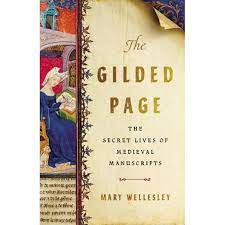
I loved this book.
I already love medieval manuscripts and the stories that go along with them – about marginalia and the sheer effort that goes in to making one. What Wellesley has done here is look at manuscripts to understand the people who made them, used them, saved them, and occasionally caused their destruction. I read this in uncorrected proof, as an ebook (and there’s some twisty lineage there from hand-written sheepskin to pixels), so I’m not sure whether the published version will have images, but that’s about the only thing that would make this even more of a joy to read.
An overview of the chapters will show just why this is such a fabulous book.
Chapter 1: Discoveries. aka “near heart-attack-land at the idea that the Book of Margery Kempe was nearly not found.” She uses just a couple of manuscript discoveries to show just how contingent our 21st century knowledge of, awareness of, and possession of such manuscripts is.
Chapter 2: Near Disasters. Imagine me having heart palpitations at the fire in Ashburnham House, home of the Cotton collection and various other rather important bits of parchment. As above with the contingency, with added flames.
Chapter 3: Patrons. Who wanted stories written about themselves, and who wanted their own copies of particular books (Henry VIII annotated his Book of Psalms. I have no problem with this, other than it reveals his colossal ego, equating himself with David.)
Chapter 4: Artists. The images added to some manuscripts make them incredible works of art. Wellesley examines what is known about some of the people who did this work, their inspiration and their methods.
Chapter 5: Scribes. Who did the physical act of writing… and that some of them were women.
Chapter 6: Authors and scribes. Probably one of the hardest things for moderns to grasp is the lack of the concept of ‘author’ in the medieval period. If a student copies a quote without a reference, they’re in trouble; 700 years ago, someone could copy out a story from Chaucer’s Canterbury Tales and stick it in their own collection of stuff with nary an acknowledgement (yes I am aware this happens today; it was less of a cause for hue and cry back in the day, for various reasons). Figuring out exactly who was the author of various things is the work of a lifetime for some historians.
Chapter 7: Hidden Authors… basically carries on a similar idea from Chapter 6, but in particular looks at works written for (and by?) anchorites – people who had decided to get themselves walled away, to devote themselves more fully to Christ.
The book’s intrigue – who wrote it? who sold it? why do we only have one copy? It’s got feminism – women wrote and read and commissioned and created. It’s suffused with a love of books and reading, it’s a celebration of books as objects, and it ends with Gutenberg and that weird interstitial period where some manuscripts were created by copying out the text from a printed book. And the author’s voice is present throughout, which I found a lovely touch: what it was like to view a manuscript at the British Library, or a discovery as an undergrad, or an experience learning about the making of parchment.
This is a wonderful book about books. Entirely accessible to the non-medievalist, in fact a great entry for those with no real conception of the medieval manuscript.

 Randomly Yours, Alex