The Tigris Expedition, Thor Heyerdahl

All of the things I said about The Ra Expeditions also apply here. Although this is happening in the late 1970s, so the racism is both a bit less, but also even less comfortable, if that’s possible.
Interestingly, I didn’t find this as historically problematic as Kon-Tiki or Ra. I think that’s mostly because he’s only sailing around places where there is actual archaeological evidence for contact – Mesopotamian stuff found in the Indus Valley, and vice versa – so there clearly was contact, although at how many degrees of separation is unclear from just those remnants. Although I did have to stop and laugh when Heyerdahl earnestly suggests that just because there’s a similarity between how a place name is said today, and how we think a word was said in a language nobody now speaks – well, that’s evidence that they might be the same place!
For real.
ANYWAY. I don’t need quite such an expurgated version of this book as with the other two, because the ideas and the language aren’t quite as offensive. And as with the other two, this is genuinely a fascinating adventure story. Getting the built made – of reeds, in Iraq – is another amazing story of ingenuity and the problems of materials etc in an area that really didn’t have ‘modern’ resources at the time. Was importing South American boatbuilders the most authentic way of doing it? Probably not. Anyway, then you’ve got eleven men on this little boat navigating the Arabian Gulf Persian Gulf Sumerian Gulf (there’s a whole thing about which name is appropriate), which is filled with enormous boats and isn’t all that easily navigable… and they go to Oman, and Bahrain, and Pakistan, and then back west – honestly it’s an amazing journey, with a lot of quite serious problems that they do manage to overcome. Heyerdahl is open about some of the friction experienced between the men – he has to be, given there’s someone with a camera filming them for much of the voyage – as well as their frustrations about what’s going on on land.
Would I recommend this wholeheartedly? No. Would I recommend it with reservations? Sure. Only to an historically literate reader, who’s in a place to deal with fairly stereotypical 1970s attitudes. It’s probably the best of the three in terms of not being problematic.
Left-handed and Sinister Booksellers, Garth Nix
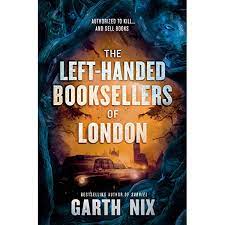
Apparently I didn’t review The Left-handed Booksellers of London when I read it, which leaves me with questions… mostly “why??” and “what was I thinking??”
I have loved pretty much everything of Nix’s that I’ve read, and this was no exception. Set in a 1983 with a history that’s slightly tangential to our own world (Clementine Attlee had me HOWLING with laughter), it’s about a girl, Susan, who has a terrible experience with something otherworldly and gets rescued by a bookseller… but not as you know them. Merlin is a left-handed bookseller, meaning he gets directly involved in dealing with incursions of Old World powers and idiot mortals who decide to meddle in things they ought not to. Adventures and revelations and betrayals ensue. Susan isn’t who she thinks she is, the world isn’t as she thinks it is, etc. I love Susan, I love Merlin, everyone should read this.
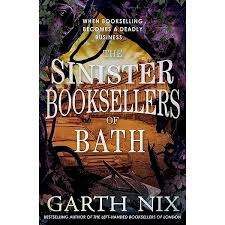
…ALL of which is why I have been looking forward to getting my hands on the sequel! It’s very much a sequel, don’t read this without the first (and why would you??). Susan continues trying to navigate in this newly expanded world she finds herself in; Merlin gets himself into some trouble early on and then they all spend the rest of the book investigating the consequences. Vivien, Merlin’s sister, is back, as are some of the assorted bookseller family members. There’s a mystery, there’s some mayhem, personal crises to be dealt with… and it’s all written as beautifully as Nix ever does. I loved it. A lot. I anticipate re-reading this, and trying to get it into other people’s hands if they’ve somehow slept through it.
Below the Edge of Darkness, Edith Widder
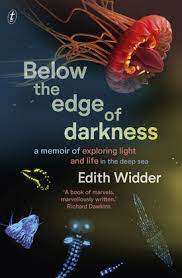
I heard Edith Widder on Unexplainable – one of my very favourite podcasts, such that I went back and listened to the year’s worth of episodes that happened before I found them (c/ Gastropod, another of my very favourite podcasts). She talked about deciding to use red light rather than white light when exploring the mid ocean and how that was a new thing, when she suggested it, and I was both boggled and entranced. I love me a good deep-sea exploration story, so when I discovered that the library had her book, I grabbed it.
I realise that the subtitle is “a memoir of…” but I didn’t realise that this was actually a memoir – that is, there’s more about her personal life than I had expected. Which isn’t a problem, it simply surprised me. Pretty much everything she talks about from her personal life is tied to her professional life, so in that sense it is very much a memoir rather than an autobiography: we don’t learn everything about her childhood, just about the very dramatic events that led her to eventually study bioluminescence and marine biology.
(Yes, I was one of those children who thought being a marine biologist would be cool. Yes, I thought it would involve whales and dolphins rather than plankton. No, I don’t love boats that much.)
Widder has been a leading light (heh, heh) for many decades in studying bioluminescence, and in figuring out how to video critters in the mid ocean – the largest living space on the planet – without actually interfering with their natural behaviour. If you’re interested in giant squid, you may actually already know of her: she’s responsible for the first footage of one underwater. She discusses a lot more than that, of course – ups and downs in research, things not going as planned, and generally learning really cool stuff about the place we know the least about on our planet. It’s nearly a cliche that we have better maps of the back side of the moon than of the depths of the ocean… but it’s true.
This book is awesome. The one thing I will say is that she does occasionally go on environmental tangents that feel disconnected from the rest of the chapter. Don’t get me wrong, she’s absolutely right and the book is absolutely the right place to be making the points (because I know she says it elsewhere as well). It just didn’t flow as seamlessly as it might have, which was a bit jarring overall. Nonetheless, it is generally really well written, and Widder has a brilliant sense of humour which often comes out in her footnotes. My very favourite is in discussion of the comparison of eye size, when she gives metric measurements for a giant squid’s eyes (30cm), and then says that in “American units” that’s 1/5 Danny DeVito’s height.
Highly recommended for my fellow science nerds, and fans of ocean science in particular.
Tusks of Extinction, Ray Nayler
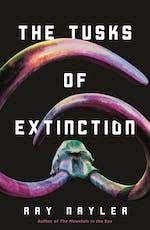
Read courtesy of NetGalley and the publisher, Tordotcom. It’s out in January 2024.
I had read and loved Nayler’s The Mountain in the Sea, so it was a no-brainer that I should want to read this novella. There are some similarities between the two, and a whole lot of differences.
Most importantly, it’s fantastic.
I hadn’t read the blurb before diving in – why would I, when I had high expectations? I assumed it was going to be about elephants, or maybe mammoths, and honestly that was enough. So yes, it’s about mammoths – although not quite as I expected. Nayler dives into the thorny questions around what it might mean, and require to bring mammoths back from extinction: in terms of science (although it’s not overly science-heavy; it’s only novella-length, after all), in terms of mammoths learning how to BE mammoths, and in terms of the human reaction as well. In particular, the focus is on poachers, beginning with elephant poachers and the people attempting to thwart them in various parts of Africa.
There’s a lot of humanity, there’s a lot of animal conservation, there’s a lot of scientific consideration. It’s provocative in the best way – no devil’s advocate crap, but raising important issues that don’t have simple answers. Well-written and engaging, this is a further evidence that Nayler is someone to keep watching out for.
Ares Express, by Ian McDonald

When I read Desolation Road I had no idea that I was reading a companion novel to Ares Express. Happily, it doesn’t matter what order you read them in – there’s no spoilers, and only one character in common… who is fairly central to the plot of both, but in ways that work separately for each novel.
Every time I read a new McDonald novel I’m reminded of just how awesome a creator he is. Here, the focus is a young woman born to a train family – they drive trains around Mars, and everything about the family is focused on the train. It’s a weird mix of a society, because it’s clearly technologically advanced – or at least, there are aspects of that, since they’re living on a terraformed planet and they have various tech things that don’t exist for us. At the same time, though, there are archaic aspects to the human side, including, sometimes, arranged marriage. Such is the future looming for Sweetness Octave Glorious-Honeybun Asiim 12th, and she is not having it. And so begins an adventure across Mars that will eventually have enormous repercussions.
The way McDonald gradually reveals his vision of this future world is masterful. There’s enough, early on, to understand the basics of society… and then slowly, slowly, enough of the history of the place is revealed that the reader’s vision is broadened. It’s looking through a keyhole vs eventually looking through a door. But not stepping through that door – there are still lots of tantalising bits that aren’t fully explained, which just makes it all the richer.
Sweetness is a great focal character: young, impetuous, smart, unafraid of challenges and usually willing to admit when she needs help. I would have been happy with an entire novel focused on her. But McDonald adds Grandmother Taal, and I love her to bits. Old ladies being feisty, taking up the slack when the younger generation is being a bit useless, fearless and clever and willing to meddle: she’s everything I love.
One of the great things about writing a middle-future novel where there’s been some loss of tech for whatever reason is that, despite being over 20 years old now, it still gets to feel vital and believable and not at all outdated. Ares Express is magnificent.
Tomorrow’s Parties (anthology)
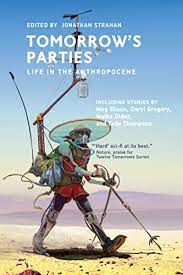
I really have to be in a particular frame of mind to read anthologies, which is why I read several in a row recently – including this one. It’s not that I thought I wouldn’t enjoy them – they’re Strahan anthologies, I’ve never not enjoyed one. It’s just a particular reading experience.
Anyway! Now I have read this awesome anthology and it was as stunning as I expected. As the subtitle suggests, the loose theme is “life in the Anthropocene”, and the authors largely took a similar-ish attitude towards what that means; there’s a lot of climate change-related stories, as is appropriate, and / but all of the authors took quite different approaches to what that might mean.
Every single one of these stories is amazing. I’m intrigued that Strahan chose to open the anthology with a conversation between James Bradley and Kim Stanley Robinson – it’s the sort of thing that I tend to expect at the end of the anthology – and maybe that’s part of the reason for it to be up front: to encourage readers to actually read it. It also sets up the climate change issues that are so front and centre through the rest of the book; the title is “It’s Science over Capitalism: Kim Stanley Robinson and the Imperative of Hope,” which itself speaks volumes.
The ten stories in this anthology are all exceptional.
Meg Elison, “Drone Pirates of Silicon Valley”: the future of online shopping and delivery, yes, but also rich vs poor, and the future of capitalism.
Tade Thompson, “Down and Out in Exile Park”: how communities might live differently, and how that challenges the status quo.
Daryl Gregory, “Once Upon a Future in the West”: multiple perspectives, and quite creepy at times. So many issues – the (negative) future of telehealth appointments, autonomous vehicles, bushfires…
Greg Egan, “Crisis Actors”: a very disturbing story that explores some of the consequences of living in a “post-truth society”. I always adore Egan’s short work.
Sarah Gailey, “When the Tide Rises”: another story that confronts capitalism head-on, bringing back the idea of the ‘company town’ as well as poking at the idea of companies making money from finally doing good for the planet. Brilliant.
Justina Robson, “I give you the moon”: one of my favourites, and not just because it’s one of the most hopeful of the stories. This is post-climate crisis, when humans have figured out how to live in more balance with the rest of the world (her vision is marvellous). Rather than focusing on how we get there, this story is about family dynamics, and ambition. It’s gentle and wonderful.
Chen Qiufan (trans. Emily Jin), “Do you have the Fungi sing?”: the consequences of a hyper-connected world, what happens if an area doesn’t want to participate – and possible alternatives.
Malka Older, “Legion”: completely and utterly different from all of the others, this is the story that’s going to stay with me the longest. Chilling, confronting, challenging… I had to stop reading when I finished this story and take a breath. It takes place over a short period of time – maybe an hour? – in the prep for, and during, an interview on a talk show. The host, Brayse, is interviewing a woman representing Legion, a group who have just won a Nobel Peace Prize. The reader is in Brayse’s head, which starts off as a reasonable experience and then gets… less so. Legion, as the name suggests, are not just one or a small group; they are everywhere, always watching through wearable cameras, and able to call out – or respond to – what they see: micro- and macro-aggressions, and all the ways in which some people are made to feel less comfortable right up to actual harm. Older nails the unfolding of this story perfectly.
Saad Z. Hossain, “The Ferryman”: another incisive take on the consequences of late-stage capitalism, this time how people will respond to death when, for the ‘haves’, death doesn’t need to exist.
James Bradley, “After the Storm”: being a child growing up in the ravages of climate change is likely to suck; at the same time, children do tend to be resilient and make their way within the world that they know. Bradley focuses on teenagers and their experiences – rather than the adults who know how things have changed – and captures the cruelty as well as the love of adolescents beautifully.
All in all, an excellent addition to the literature around ‘what next’.
Someone in Time (anthology)
I am late to the party… however, not SO late, because this just won the British Fantasy Award! Which it absolutely deserves.
I’m sure there are some readers who would avoid this because “they don’t read romance” (hi, I used to be one of those). The reality though is that you do; there’s almost no story – written or visual – that doesn’t include romance somewhere in its plot. What I have learned about myself is that I rarely enjoy what I think of as “straight romance” – that is, stories where the romance is the be-all of the plot; they just don’t work for me, as a rule. What I love, though, is when the romance is absolutely integral to the story and there’s a really fascinating plot around it. Every single one of these stories does that.
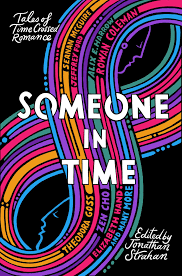
As the name suggests, this is set of stories involving romance and some sort of time travel. It’s a rich vein to mine, and every single one of these stories is completely different. Sometimes the time travelling is deliberate, sometimes not; sometimes the ending is happy, other times not; some are straight, some are queer; some pay little real heed to potentially disrupting the historical status quo; some have easy time travel while others do so accidentally; sometimes the time travel happens to save the world, and sometimes it’s about saving a single person. Sarah Gailey, Rowan Coleman, Margo Lanagan, Carrie Vaughn and Ellen Klages (a reprint) wrote my favourite stories.
And then there’s Catherynne M Valente’s piece. I did love every single story in this anthology; Valente’s story is breathtakingly different in its approach to both structure – eschewing linearity – and theme: the romance is between a human woman and the embodied space/time continuum. Hence the lack of linearity. It’s a poignant romance and sometimes painful romance; it also confronts the bitterness of dreams lost, the confusion of family relationships, the beauty of everyday life, and the ways in which even ordinary people don’t really live life in a straight line, given the ways our memories work (Proust, madeleines, etc). This is a story that will stay with me for a long, long time.
Herc – a novel
Read courtesy of NetGalley. It’s out at the end of August.

I am bored by Hercules as a hero. But as a character in other people’s lives – as a messy, complicated, often unheroic, flawed, and realistic person – I am THERE.
The man named Heracles by his parents (who then changes his name to Hercules (which is a cute way of getting around the Greek/Roman thing) because reasons) never speaks to the reader in Herc. Instead, it’s all the people around him who tell his – and their own – story, from birth to death: father, brother, sister, nephew, cousins; wives; lovers (male and female); cousins; others met along the way. This variety showcases the different ways that people interact with the man. Some love him, while others hate him. Some continually forgive his flaws, while others are unable to.
Hercules rarely comes across well. He is strong – but he has little idea how to mitigate that strength around ordinary people, and even seems unaware of what he’s capable of. He is aware of the terrible crimes he has committed – killing his music teacher as a child, murdering his first wife, Megara, and all their children, amongst other things – and accepts that there needs to be consequences… and yet. And yet he is still seen as a hero, by those outside of his immediate circle, and indeed often by himself. And yet he seems to largely get away with being terrible. And the book does not forgive him for that.
This story dives deep into the consequences of Hercules’ actions for those around him and it is pointed, it is complex, and it is deeply thoughtful. I would read more in this style any day of the week.
This All Come Back Now – anthology
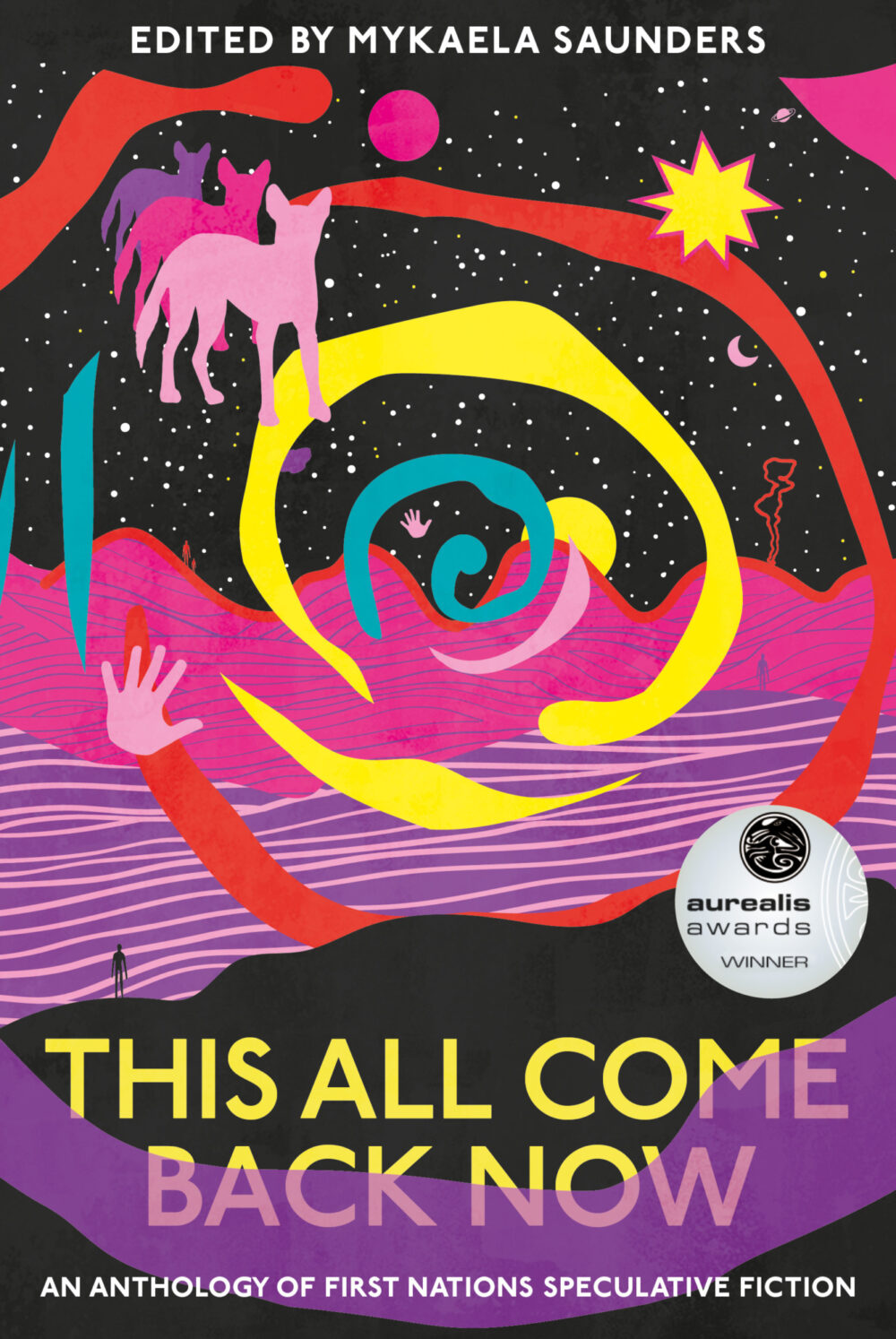
This came out last year, and I only found out about it this year… oops; not sure how I missed it (especially given its Aurealis Award!). Available from UQP.
The first all-Indigenous Australian speculative fiction anthology! Exciting that it exists; disappointing that it took until 2022 for it to exist. Oh, Australia.
First, how glorious is that cover? It’s so vibrant and exciting.
The editor, Saunders, gives a really interesting intro to the anthology. I go back and forth on whether I read intros to anthologies; sometimes they seem like placeholders, and sometimes they give a wonderful insight into the process. This is the latter (although I did skip the last few pages, where Saunders discussed the stories themselves; I don’t like reading that until after I’ve read the stories myself. YMMV). The comparison of an anthology with a mixtape has given me all sorts of things to think about. There’s also a brief discussion of First Nations’ speculative fiction – that it exists despite what a cursory overview of the Australian scene might tell you – as well as that insight into the creative process. This is one introduction that was definitely worth reading.
The stories themselves are hugely varied; this is not a themed anthology, like Space Raccoons, but instead is tied together by the identity of the authors. That means there’s experimental narratives and straightforward linear ones; recognisably gothic, science fiction, and fantasy stories; and other stories that refuse to fit neatly into categories. As with all such anthologies, I didn’t love every story; I have limited tolerance for surrealism, as a rule – it just doesn’t work for me, but I know it does for others. Some of these stories, though, will sit with me for a long time. Karen Wyld’s “Clatter Tongue,” John Morrissey’s “Five Minutes,” Ellen van Neerven’s “Water,” just as examples – they’re profound and glorious.
I love that this anthology exists. I’m torn between hoping there can be more books like this – because featuring Indigenous perspectives and writing in a concentrated way is awesome, showcasing the variety of stories and voices – and hoping that the authors featured here will also be published in other anthologies, and magazines, and have their novels published, as well. Maybe that’s not a binary. Maybe we can have both. That would be nice.
Divinity 36, Gail Carriger
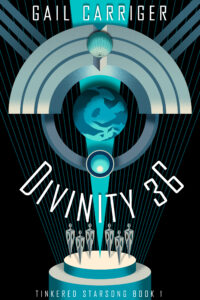
Sooo I missed this when it first came out – but it turns out I’m not too far behind the times as I read this first one (in a day…), went to look for the second one, and turns out it came out the next day (which is today, as I write). And the third comes out in October, so actually I’m doing just fine.
If you just want to buy it, or read what Carriger has to say: https://gailcarriger.com/books/d36/
So there’s many different aliens, pretty much all interacting companionably. One particular species, the Dyesi, search the galaxy for sentients who can sing or dance and then put them through rigourous training and bring them together as pantheons, because at that point those artists are gods. Yes, it’s a bit “The Voice” – or, more accurately, “Idol” where the prize is to ACTUALLY be an idol. And their performances get broadcast across the galaxy, and people literally identify as worshippers and send in votives and so on.
The focus of this series is a refugee who has a lot of trouble with ordinary emotional interactions thanks to childhood trauma. Brought together with new people and compelled to live and work with them, this is inherently a story about found family and in that it is simply lovely. There’s also, of course, music and art, and – amusingly – food and cooking.
This is a very cosy story, as should be no surprise to readers of Carriger’s work: that is, there is real and important trauma in various backgrounds but (so far) little immediate or overwhelming danger to our heroes; there’s a lot of focus on friendship and figuring out how all of that works, with a sense that obstacles can and will be overcome (not in a cheesy way). It’s a generally upbeat, inclusive, humorous, joyful story – and honestly who doesn’t need that in their lives sometimes? If you haven’t read any Carriger but you loved Legends and Lattes, I suspect this will work for you.

 Randomly Yours, Alex