Let’s go toaster shopping
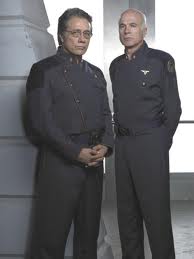 The start of season 2! Oh the excitement, the dread! Will Adama survive? What will happen on Caprica?
2.1 Scattered
The episode starts with a flashback to Adama and Tigh as rough young things, when they first join the Fleet. It then cuts very quickly to the present Fleet jumping away from the Cylon attack… but Galactica finds herself all alone. The Fleet is missing. Oh no!
Cut then to the downed Raptor on Kobol; the survivors are seriously not coping. The Lt is charge is totally out of his depth, and the Chief is too much a military man to try and go against a superior, although he does give advice when and how he can.
Yet another cut, and it’s Caprica: Starbuck and Sharon are at odds, and Helo is a bit helpless in figuring out what to do.
Back to Galactica, and Tigh is hitting the bottle hard. He beats up Boomer, at least partly to soothe his own feelings of helplessness at not being able to help Adama. Meanwhile, Gaeta comes up with the idea to network the Galactica’s computers so they can try and find the Fleet faster than otherwise possible, and Apollo is allowed out of the brig on parole, at least until the Fleet is back together again. The end is cliffhanger-y: trying to find the Fleet, Galactica gets attacked by Cylons and although they fight them off, a Cylon ship manages to crash into Galactica; we still have people on Kobol; and we still have people on Caprica. This is a Not Good Situation.
The most interesting part about this whole episode – aside from seriously earning the name ‘Scattered’, as we jump from one set of beloved characters to another – is the insight into Tigh’s soul, and his friendship with Adama. It’s not made entirely clear, but I think the suggestion is that both of them got out, or washed out, of the Fleet as young men; Tigh got bitter, but Adama refused to give up. He eventually got back in, and he then kept his promise to Tigh by bringing him back, too. So really, Tigh owes his entire career – and, probably, his life, since he seemed already about to drink himself to death – solely to Adama. This goes a long way towards explaining his ferocious loyalty and protection of the man. It’s dogged, it’s bloody annoying, but it’s also admirable.
2.2 Valley of Darkness
Having problems with your electricity? If you’re on board Galactica, that doesn’t mean Gremlins; it means enormous metal men with really scary guns. Yes, who would have guessed? The downed ship offloaded Cylons onto Galactica. Also, there’s a virus in the system, left by the nasty Cylons after they tried to penetrate all of Gaeta’s clever firewalls. The Cylons spend this episode attempting to take over the ship, or at least disable the important bits. Like life support. Roslin is freed by Apollo because the brig is in the way of the Cylons; he and various others attempt to hold off the Cylons. Which they do, although there are some casualties. Roslin ends up back in the brig at the end, though; Tigh is a hard, hard man. I love Roslin’s grace in this episode; she is a very proud woman and refuses to break under pressure.
Flick to Caprica: Helo and Starbuck are together, Sharon having nicked off somewhere. They find Starbuck’s old place: it’s filled with random art, piles of unpaid bills, and a very unsavoury frig. They listen to some music and then head out together in Starbuck’s army-surplus Hummer. I love this insight into Starbuck; we so rarely get a look back at what our people were like before the attack. She’s so quirky – the flat is nothing like I would have expected. Especially the art, which was done by her.
Meanwhile, down on Kobol, things are going very badly. They forgot some of their medication; the Chief takes a couple of people to retrieve it but they get ambushed, and one of them dies; and when they get back to the team, it’s too late to save the injured man. And they euthanase him. This vignette of the remaining humans is a stark depiction of attitudes and reactions while under pressure. The officer doesn’t cope; Baltar is next to useless, distracted by Six, and the vision he has of a baby – his baby, apparently; and the grunts are totally bewildered, which is understandable.
It’s a chaotic episode, but a good one.
2.3 Fragged
Much of this episode focusses on Kobol. The survivors discover that the Cylons are building an anti-aircraft battery, clearly to take down the expected search and rescue mission from Galactica. The Lt decides they need to attack it – which kinda makes sense, but yo, consider your people! A civvie, two grunt deckhands, and the Chief… not exactly brilliant military material. He really, really falters under pressure. What’s fascinating is that he’s shown going, step by step, through the things he’s been taught to do as an officer. But he doesn’t adapt them to the situation; he’s incapable of being innovative and flexible. When Cally balks, he pulls his gun on her… and Baltar shoots him. It’s a fascinating moment: has Baltar done it to save Cally? If so, why? Was it almost accidental, out of fright? I think it’s impossible to get a read on Baltar at this moment. It just further complex-ifies him. And as a result of the shooting, Six says she is proud of him, because killing makes you human. That’s one helluva bleak view on humanity. Then they get rescued, and everyone lies about the Lt’s death….
Meanwhile, Tigh is making more and more of a hash of things. I think he realises that things are going badly, but he just keeps on digging that hole. He declares martial law, insults the Quorum of Twelve, and is generally realising just how hard command is. Of course, he never wanted to be in command… not that Ellen wants to hear that. Dear Ellen goes to visit Roslin in the brig, where the President is having serious withdrawal issues – she hasn’t had her medication in a while. As a result, Ellen convinces Tigh to let the Quorum see the President, to get them off his back. Of course, because Billy is a resourceful young fellow, he gets her the drugs just in time so that Roslin is perfectly coherent when the politicians visit. Coherent enough, in fact, that she tells them about her visions. And that she is dying. This causes quite a stir – and most of the Quorum believe her. Tigh is left looking like an idiot.
This is one action-packed episode. Even the seemingly-quieter moments, with discussions of faith and politics, are incredibly tense.
BSG stats:
- Starbuck in the brig: 1
- Baltar in the brig: 1
- Women Baltar shows interest in (not including Six): 4
- Women Baltar actually gets to sleep with: 2
- Baltar religious conversions: 2
- Different sexy dresses worn by Caprica-Six: 11
- Apollo sides with President against Dad: 3
- Number of Cylons viewers know about: 4
- Number of Cylons humans know about: 2
- Roslin has a vision: 3
- People deliberately thrown out the airlock: 1 (+1 threat)
- Ships lost: 1
- Ellen gets suggestive: 3
- Starbuck and Apollo do fisticuffs: 1
BSG: not an update
I’m waaay behind in recapping BSG – which we have been watching, and I’ve even been taking notes, but the actually writing bit isn’t happening. In lieu of that, until I get my head together, I present BSG-as-romance: shipping Starbuck and Apollo.
It’s not really much of a secret any more that I am secretly a total sap at heart, is it?
Sanctuary: we give up
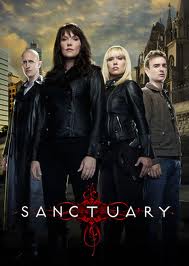 We’ve given Sanctuary the pilot and the first ep aaand… I think we give up.
I liked Amanda Tapping as Sam Carter in SG-1, so I didn’t think it unreasonable to chase up her next project (well, after Atlantis). But… this is not Stargate. For a start, Tapping has a ridiculous English accent which I just can’t take seriously. For seconds, even if the action in Stargate was sometimes a bit tacky – and I love it but I’ll grant that – at least they mostly built the sets. Here? It looks like every second shot is done against a blue screen and then the set added in later, because the production company was too cheap to figure out how to do a big-ass gothic pile other than via computer.
I didn’t mind the first episode; the getting-the-team-together thing is often quite interesting too me, and Tapping’s mysterious Dr Magnus clearly had A Past. The slightly-haunted-but-mostly-down-to-earth forensic pysch she recruits had some potential as the audience’s Everyman; I didn’t mind him. And Magnus’ daughter Ashley – Buffy crossed with Whistler from Blade 3, the one played by the Jessica – was humorous in a ham-kinda way. In fact, the best bit of the whole show has been the silly repartee between mother and daughter, where mother worries but only because she’s the one asking daughter to deliberately put herself in harm’s way. So I was willing to watch a few more… but then we watched the first proper ep. And it got my goat. Badly.
How badly? Well, apparently the last recorded mention of bubonic plague was in Scotland in the 800s (wah?). And the Morrigan are an ‘ancient’ myth first recorded in ‘medieval times’ – specifically in Arthur’s day. Yeh. From that point on I was just cranky and unwilling to give it any slack.
If you can tell me that halfway through the season it got better I will reconsider, but at the moment I am considering me and Sanctuary as officially Not Going To Happen.
Genesis, by Bernard Beckett
 Oh. My.
A librarian friend shoved this into my hands when I mention enjoying science fiction, and to be honest I was a bit dubious – I’d never heard of Beckett, for a start. Anyway, I started reading it last night and… I couldn’t put it down. Quite seriously. I read it in one hit. Now, it’s YA, and it’s only 145 pages, but still – I considered going to sleep at one point, but I picked it right back up again and kept on reading. Totally addictive.
This review has some spoilers
In one sense, the book’s story happens over only five hours: the five hours of Anaximander’s examination to try and get into The Academy. Her special topic is the life of Adam Forde, on which she expects to get grilled by the three Examiners for the whole time. Her first surprise comes when they ask her about the early years of The Republic, and she has to scrabble for her memory of history. Then they finally come to Adam, and the formative moments of his life, and she is comfortable in what she knows – although she also knows that some of her theories are controversial. Things do not, of course, proceed exactly as she had anticipated…
On another level, the examination is a clever way of recounting a fairly large whack of the book’s immediate history, without it feeling overwhelmingly like an info-dump, and weaving a story through those events. Anax and her Examiners, it is revealed, live in almost a post-apocalyptic world. The setting, New Zealand, is apparently the only place to have survived a dreadful war and subsequent plagues, all thanks to a far-seeing and eventually quite ruthless business man, Plato. He insisted on NZ’s quarantine, enforced by a great sea fence. The society which eventually developed – or was designed – centres on people’s usefulness to society, and their talents as determined by genetic testing. Adam Forde had been tested as being a Philosopher – the highest grade possible. But when he acts against his training – allowing a refugee girl past the sea fence – things start to get out of control. And then he is asked to interact with an Artificial Intelligence, to help it learn.
On yet another level, of course, the book is a searching and illuminating examination of what it means to be human, what it means to construct a society and what things we are willing to give up to have a safe society, how important safety and comfort are and at what price they should be bought… you know, all the easy topics. It’s not done cavalierly; I am staggered by how much depth Beckett managed to cram into this little book.
Perhaps the most clever aspect of the book is that you could simply read the story, and it’s quite engaging. You could read it and understand some of what Beckett is discussing about society, and it’s riveting. And then, when you start understanding the classical allusions, things get really interesting: Anaximander was one of the earliest Greek philosophers, apparently teaching Pythagoras and getting all into the scientific mode of thought. Her teacher in the book is Pericles – he who led Athens during part of her Golden Age, fostering democracy, beginning the Parthenon, and involved with the war on Sparta. The society of The Republic (set up by Plato? this is one of the more blatant references, and perhaps it was done deliberately to trigger the classical connections) is a lot like Sparta, and like what the original Plato suggested too. This is a very, very clever set up – but not so clever as to be overwhelmed by smugness.
The conclusion is… well, I am still thinking about it. This is where it gets REALLY spoilery!
I began to guess at the twist when the Examiners were pushing Anax about the Final Dilemma, and the discussions between Art (the AI) and Adam. I realised there just had to be some great reveal coming up, and that Anax and the Examiners were actually descendants of Art simply made sense. It didn’t lessen the tension, though – and it in no way prepared me for Pericles’ actions in the very last paragraph. I can’t believe I managed to sleep after that; it was, truly, gut-wrenching. Also, having finally looked carefully at the front cover (above), I am saddened: there wouldn’t be nearly as much of a surprise if you noticed before reading that those are orang utan hands.
This is a magnificent book, and I can’t believe I had never heard about it. I think I may have to try and buy it so I can shove it into other, unsuspecting hands.
Galactic Suburbia 26!
In which Tansy and Alex soldier on womanfully without their lost comrade, to catch up on three weeks of publishing news, the Nebulas, books, books, and more books, and tackle the crunchy pet subject of Australian SFF Publishing in its entirety: how do Australian specfic readers get their books? Who publishes them and how do we buy them? (Realised too late this is a pretty massive topic – please email us to tell us what we got wrong and what we left out!) We can be downloaded or streamed from Galactic Suburbia, or through iTunes.
News
Bitchgate round up; also a Scott Westerfeld interview on the topic.
LJ Smith, author of bestselling 20 year book series The Vampire Diaries fired by her publisher, who will hire a new writer to continue the books.
Interesting post by Tobias Buckell on ebooks (love the bit where he zooms out on the graph).
Borders and Angus and Robertson go into receivership.
RIP Nicholas Courtney!
What Culture Have we Consumed?
Alex: Life, Gwyneth Jones; The Dispossessed, Ursula K. Le Guin; Revelation Space, and Chasm City, Alastair Reynolds
Tansy: Debris (due Autumn (?) 2011) by Jo Anderton;
The Secret Files of the Diogenes Club, Kim Newman; Across the Universe, by Beth Revis.
Pet Subject: How do Australians Buy SpecFic Books?
This comes from a request by Niall Harrison to learn about the other side of Aussie specfic – the mainstream/Big Name Publishers, how Australians buy books, etc.
Big Name Australian Publishers (who handle SFF)
HarperCollins Voyager
Hachette Livre/Orbit (incl Gollancz, Picador, Little Brown etc)
Allen & Unwin
Random House
Pan Macmillan
The Cost of Australian Books/Australian editions – GST, the fight against parallel importation.
Chain Stores – Borders, Big W, Collins, ABC, Dymocks, Angus & Robertson (Borders & A&R now in receivership but not all shops company owned – many will close)
Online Shopping – local and overseas (Amazon, Book Depository, Fishpond, BetterWorldBooks)
Indie/SFF Specialist Bookshops
Hobart: Ellison Hawker
Melbourne: Minotaur and Swords and Sorcery (Reader’s Feast also has a well-picked if smallish selection).
Perth: Planet and Fantastic Planet, White Dwarf and a few more new and not so new
Sydney: Galaxy, Infinitas
Brisbane: Pulp Fiction Books
(who did we forget? Tell us!)
Feedback: Tehani from Perth, Cat from Wollongong & Shane from Redfern.
Please send feedback to us at galacticsuburbia@gmail.com, follow us on Twitter at @galacticsuburbs, check out Galactic Suburbia Podcast on Facebook and don’t forget to leave a review on iTunes if you love us!
Chasm City
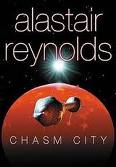 As with Revelation Space, this is the second time I’ve read Chasm City – and the first time was some years ago. Consequently, while there were a few things I remembered quite well, I still managed to be surprised by some of the twists and turns of the plot. This time, there were more occasions on which I picked up hints and allusions; I was quite proud of guessing what might be going on until I remembered that I’d already the thing…
Some spoilers follow
It’s another awesome space opera from Reynolds. One of the things which I had misremembered – and perhaps it applies more to one or both of the other Revelation Space books I’ve not reread yet – is the amount of cross-over between the stories. There are some allusions to ideas and people from Revelation Space here, but they are both very definitely stand-alone novels. And I like that; it’s a universe, rather than a series. I really liked that it ended with Tanner clearly talking to Khouri, which is one of the opening scenes from Revelation; it felt quite neat for readers of both books.
This book has quite a different feel from Revelation, which is interesting to see – to change from just your first to your second, particularly within the same universe, seems… game? Anyway, it is largely told with a first-person narrator – with occasional flashbacks to an historical character – and consequently the story is mostly linear (with the exception of those flashbacks, and the narrator’s own thinking about his past). I enjoy a narrator – particularly one, as in this instance, who is a bit unreliable. In fact I enjoyed most of the characters in this novel; there aren’t many, with the exception of the narrator (Tanner) who are particularly deeply developed, but they are certainly all individuated without becoming cliches. There’s a nice range of female and male characters, doing a range of different activities and with a range of different motivations – I think I said a similar thing about <i>Revelation</i>, but it’s true and it’s one of the appealing things about Reynolds.
The settings for Chasm are great. We’re in about the same time period as in Revelation, so chunks of the galaxy have been colonised, but there’s no FTL so getting places is still damn hard work. There are two prime locales: Chasm City itself, of course, on the planet Yellowstone, and the planet of Sky’s Edge. These are two radically different places, so Reynolds gets to indulge in two quite different visions of what interplanetary colonisation might look like. In thinking about that issue, I utterly adored the slow revelation about how the colonisation of Sky’s Edge came about; the slow generation-ships thing is enthralling, for me, and thinking about the lengths people might go to to get an edge is intriguing. I particularly enjoyed the slow but steady revelation and discussion of Sky Haussman’s character; that you start the novel knowing he was characterised as both a hero and a villain, and slowly that image is problematised… yeh, it really works for me. And Sky’s actions of course present an immense ethical quandary – which the reader can’t help but approach with the knowledge that it caused a centuries-long war on the planet itself. Chasm City, of course, is a wonderfully outrageous city, and I loved that Reynolds opened with an excerpt from a document explaining how the city has been affected by a plague – so the reader has that extra bit of information, and thus an advantage over Tanner. For me, it heightened the sympathy the reader could feel for him. And the plague itself iconic: something that affected the machinery of the place doesn’t seem disastrous, until you remember that this is a society using nano, with therefore machinery in everything – and everyone…. There are so many possibilities inherent in that idea.
The plot itself has a kinda revenge tragedy thing going on, which can be a bit tedious but in this instance is skilfully drawn out and well played, too. In fact there are numerous side-plots that at times could threaten to overwhelm the central point – the revenge – but ultimately Reynolds draws them all together and reveals that actually, he knew what he was doing all the time (of course).
It’s another of my favourites. Not quite as comforting as Revelation, in that the stuff about Gideon is rather off-putting, but familiar and relaxing nonetheless. And a damn good story.
The Last Gleaming of Kobol
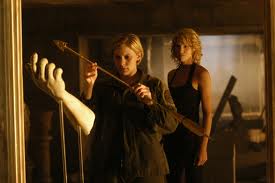 BSG rewatch: 1.12 and 1.13 (Parts 1 and 2)
Part 1
This episode opens with a marvellous montage: Boomer contemplating suicide, Helo facing off with Caprica-Sharon knowing she is a Cylon, Starbuck and Baltar in bed together but she calls for Lee…. All very unpleasant things to confront our (anti-)heroes. Baltar kinda-sorta convinces Boomer to kill herself, but it doesn’t work, which is unpleasant. There’s a wonderful scene, too, where Baltar has an argument with both the President and Six, simultaneously. Very clever, and very funny too – telling the President not to think of him as a play-thing??
Then, of course, things get really serious when the President has another vision, and the planet that has recently been discovered is revealed as Kobol: the Garden of Eden-equivalent, where the Scriptures report that the gods and men lived together in harmony. Because of that, the President is adamant that Starbuck should jump back to Caprica and retrieve the Arrow of Apollo so they can find their way to Earth. Adama, nor unsurprisingly and not illegitimately, finds this an immensely hard sell. The President goes behind his back, requesting Starbuck do it without orders… which she does. This is more than just Starbuck being capricious and anti-authoritarian; our girl is deeply religious, in her own way, and the betrayal she feels when she discovers Adama doesn’t actually know where Earth is hits her hard. This has all sort of ramifications for the fleet, of course, as well as for the individuals as people and political agents. Which is why it’s a two-parter, I guess…
Part 2
Because Adama perceives the President as having interfered in military matters, he demands her resignation and when she refuses, he orders a boarding party onto Colonial One to take her into custody. This, of course, is a totally shocking move, given that he had initially said he had no interest in a military dictatorship; we like and admire Adama; and, as viewers, we are predisposed to assume that the President is right. And when the boarding party get to the President, and Apollo changes his mind and pulls his gun on Tigh? Outrageous. Putting the President in jail is almost an anticlimax after what was effectively a mutiny from the all-round good-military-guy Apollo. But that is of course where she ends up… and Apollo too.
At the same time as this drama is unfolding, there are four other narratives going on. One is that Caprica-Sharon, who is still with Helo although kinda his prisoner, reveals that she is pregnant. WHO WOULD HAVE GUESSED. They end up meeting up with Starbuck, who has made it to Caprica, found the Arrow of Apollo, gets her ass seriously handed to her by a Six… and only isn’t killed because they fall off a ledge, and Six dies instead. So that’s all very exciting; it’s touching to see Helo and Starbuck reunited, as they’re clearly very good friends, but Starbuck’s reaction to Sharon is a bit overwrought.
Third, Boomer is well enough to undertake a very dangerous mission: blow up the baseship orbiting Kobol. She does so, but in the process ends up seeing her sisters and realises that she really is a Cylon. She has a great deal of difficulty with this discovery, of course, and is even more distraught when she gets back to Galactica aaaaand then she shoots the Commander. OOPS. Programming took over.
Lastly, we have the team that crashlanded on Kobol. This is all very stressful of course but the weirdest and most intriguing aspect is Baltar hallucinating the Forum as a complete building, and Six informing him that he will soon be looking after a baby. Baltar as a father?! Lords of Kobol, save us from our fate.
Thus ends season 1. I’m fairly sure that we didn’t have any time delay before getting to season 2 the first time around, and I’m awfully glad of that because this is SERIOUSLY a cliffhanger. Will Helo hate Caprica-Sharon forever? Can she actually have a baby? Is the Commander going to die of his wounds? How long will the President be in the brig? Will Starbuck get the Arrow back to Kobol? And will Starbuck and Apollo ever manage to get it on?!
BSG stats:
- Starbuck in the brig: 1
- Baltar in the brig: 1
- Women Baltar shows interest in (not including Six): 4
- Women Baltar actually gets to sleep with: 2
- Baltar religious conversions: 2
- Different sexy dresses worn by Caprica-Six: 9
- Apollo sides with President against Dad: 3
- Number of Cylons viewers know about: 4
- Number of Cylons humans know about: 2
- Roslin has a vision: 3
- People deliberately thrown out the airlock: 1 (+1 threat)
- Ships lost: 1
- Ellen gets suggestive: 3
- Starbuck and Apollo do fisticuffs: 1
Out of the box is where I live
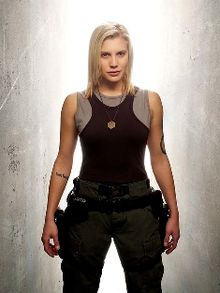
BSG rewatch, 1.09 -1.11
Tigh Me Up, Tigh Me Down
Oh Ellen. Ellen Ellen Ellen… your return to Tigh’s life just makes things so much more complicated. And you are such a complicated character yourself. Of course, you don’t seem complicated at the start; you seem like a lush, and a bit of a nymphomaniac frankly. There is probably no other character in the entire show who makes me as uncomfortable as you, every single time I see you. It’s all very well and good for Saul to be overjoyed at your return… but to immediately start sowing dissent between him and Adama? Trying to crack on to Lee? Ew.
We also get the first real signs of the distrust sown by Leoben coming to fruition, in the suspicion between the President and the Commander. With the Cylon-detector finally on line, apparently, Baltar is made to go back and forth between determining whether Ellen or Adama is a Cylon. And he declares neither of them is, but whether that’s the truth is of course completely unknown. We certainly know Baltar is untrustworthy….
This is also the episode where Starbuck stumbles upon Baltar and Six having sex… although of course Six isn’t actually there… oops. Also, EW.
The Hand of God
This is the ‘searching for tylium’ episode. The fleet is desperately short of fuel, so – as with the search for water – we have raptors out looking for asteroids that are tylium-rich. They find one… and it’s crawling with Cylons. Of course. Starbuck (whose quote is the title of this post) is still recovering from her broken leg, so rather than leading the crazy-ass mission she gets to experience the joys of command; she does so because her crazy-ass thinking is exactly what’s required for this attack to succeed. They use ships as a decoy, and things look to be going badly… and then Starbuck and Adama pull out their Sekrit Plan, and hurrah! everything goes well. Apollo gets to act the outrageous one for a change, proving himself to himself and his father. And there’s a lovely Star Wars-esque moment with Apollo flying up a fairly narrow tunnel.
Oh, and back on Caprica, Sharon spews….
It’s a run of the mill episode, really, where “run of the mill” involves an exciting and tension-filled action sequence, some frisson between the President and the Commander, and a few flashes to poor old Helo and Caprica-Sharon hiding out from the big bad Cylons.
Colonial Day
Oooh, a political episode! The quorum of 12 get together, and Tom Zarek gazumps the Pres by demanding that there be an election for VP. Which makes sense, and of course it looks like Zarek will be the man… until the Pres does the dirty on her original candidate, and replaces him with Baltar, who ends up winning. URGH. I really like Zarek in this episode; I love that the writers gave him really attractive politics – well, to me anyway; basically he comes across as a socialist. It’s all about the good of the community, and that’s fun. It certainly complicates his relationship with the President no end, because you can’t really argue against those things; you have to argue against the man himself, and that just gets a bit messy and uncomfortable after a while. Meanwhile, Baltar actually gets a real-world outlet for his overdeveloped libido, and Ellen just keeps on being lewd.
Also meanwhile, back on Caprica… Cylon-Sharon is no longer spewing but starving – GOSH I wonder what THAT could mean – and then Helo discovers that she’s actually a Cylon. OH NOES! Whatever shall we do!
There’s also an assassination attempt, proving that even with fewer than 50,000 people in the population there are still utter nutters out there who are willing to murder for their beliefs… or money…
BSG stats:
- Starbuck in the brig: 1
- Baltar in the brig: 1
- Women Baltar shows interest in (not including Six): 3
- Women Baltar actually gets to sleep with: 1
- Baltar religious conversions: 2
- Different sexy dresses worn by Caprica-Six: 6
- Apollo sides with President against Dad: 2
- Number of Cylons viewers know about: 4
- Number of Cylons humans know about: 2
- Roslin has a vision: 2
- People deliberately thrown out the airlock: 1 (+1 threat)
- Ships lost: 1
- Ellen gets suggestive: 3
Revelation Space
 I just love this book. I really really do.
I seem to remember that when I first read it, I found it a bit confusing – albeit in a good way – because there were lots of POV changes. I wonder now whether that’s one of the other books, because while there are flicks between POVs they converged more rapidly than I had expected and the connections seemed more obvious… but perhaps that is actually a function of me remembering, if barely, where at least some of the connections lay. One of the great things about having a relatively poor memory is that having read this some 5 or 6 years ago, there were stacks of things that there were once again a total surprise for me.
There’s a nice variety of characters here. Male and female, baseline-human and definitely not, and a mix of motives and attitudes. I have two favourites, and they’re the two most obvious: Sylveste and Volyova. Sylveste because he’s just a bit like Indiana Jones; he is, after all, inherently an archaeologist, who gets caught up in adventures. He’s also one of the most sublimely arrogant characters out there, in that fascinatingly entertaining way that only someone who is right so often that the arrogance seems appropriate can get away with. Like House or Holmes, I guess. Not quite diametrically opposed, but still radically different, is Volyova. She’s not quite a sociopath but she’s way more at home with weapons than other people. She gets some wonderful lines in the book, and I always enjoyed the sections told from her perspective; Reynolds gave her a marvellously dry wit and a drive for achievement as strong as Sylveste’s, with marginally less arrogance. I quite liked the POV switches, actually, even – perhaps, bizarrely, especially when – they were done seemingly mid-action sequence. The switch always added something to the scene, an understanding or a perception that could not have come from the initial character. I also liked that there wasn’t an omniscient narrator; it meant that events and revelations came slowly, ambiguously, enthrallingly.
The plot? Oh, the usual; humanity spread across the galaxy, encountering alien artefacts but where is everybody else, along with tantalising hints at what has happened to humanity as they spread – the alterations to baseline humanity are some of the intriguing of those; I love the Ultras and their chimeric alterations, heading towards being truly cybernetic beings. There are small-scale dramas and intrigues – love, abandonment, family drama – mixed in with the galaxy-impacting revelations, making this a seriously awesome representative of space opera. In fact it might have been the first book I ever read that made me genuinely consider space opera a sub-genre, and realise that I totally adore it. It might not be the absolutely most original plot in the world, but the revelations at the end were certainly new ideas for me, and the writing itself is so complex-but-clear that it doesn’t matter that it’s a play on the Fermi paradox; as an SF idea I think it has plenty of scope left anyway.
There are some slightly clunky bits in the narrative and the flow of the writing – a few bits where there is a bit too much info-dump via dialogue for example – but for a first novel, it’s a seriously awesome one. I am just itching to go read the rest of the Revelation Space books… they’re sitting there waiting for me…
A quarter-century of Galactic Suburbia
In which we hit and run the Locus Recommended Reading List, tackle e-books and piracy, and delve into the knotty issue of religion in science fiction. You can download or stream us at Galactic Suburbia, or subscribe to us on iTunes.
News
Locus Recommended Reading List – hot off the press!
Philip K Dick shortlist.
First annual Geek Girl Con in Seattle.
Cloud-delivered ebooks from Readings/SPUNC; comments from Benjamin Solah; and a response to comments on the internet about the cloud publishing.
Discussion of ebook piracy: Jim Hines found out the world is not the USA and the rest of the world does not experience publishing nor this ebook revolution apace with the USA. (Hines’ original post here). Charles Tan responds; Karen Healey says I was wrong and I’m sorry.
Weird Tales revamp (new website; pay rate to 5 cents per word; and implemented a new submissions portal for potential contributors).
Feedback (we love feedback)
Sean, Thoraiya, Niall
Pet Subject
The place of religion in science fiction. A Jew, a Christian, and a lapsed pagan discuss.
Modern religions, made up religions, machine religions… or no religions? What place can/does/should religion play in sf?
Jo Walton on religion in SF!
“There’s the kind of SF where the writer is themselves a member of some religion and this imbues their writing… .
Secondly, there’s theological SF… where the writer rigorously extrapolates science fictionally the consequences of some religious dogma being true. …
Thirdly, there’s the story as analogy thing… .
Fourthly, there’s using the way religions have worked in history and extrapolating that into the future.”
Please send feedback to us at galacticsuburbia@gmail.com, follow us on Twitter at @galacticsuburbs, check out Galactic Suburbia Podcast on Facebook and don’t forget to leave a review on iTunes if you love us!

 Randomly Yours, Alex