All of this has happened before
Spoilers
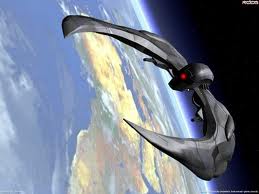 J has been at me for a good 18 months to do a Battlestar Galactica rewatch. I’ve been putting it off because… well… it just HURT the first time around. A lot. But he has proposed that we watch the entire thing over the whole year – so rather than watching a disk a night, which we may have been known to do (erm… a lot…), we’re going to treat it more like actual TV. Spread the load around. Rip the bandaid off slowly, you might say.
Anyway, we started by watching half of the mini series tonight, and the first thing that struck me was how young they all looked. The Chief was positively sveldt! Starbuck was mischievous and young! Above all, Adama and Roslin without four years of command? Not children by any means, but not haggard either.
The second thing that struck me was the familiarity of all those faces. Gaita! Tigh! Helo! Dee! Billy (whom I’d totally forgotten)!… and Baltar, Boomer, Apollo, Six, and *sigh* Starbuck. It felt just a little bit like a reunion. So silly, but true.
I’d forgotten a fair bit of the detail of what happens in the mini series. The actual start, with Six sauntering in and distracting the Colonial officer while he’s being blown up; Roslin being told about her cancer; the tension between Commander and Captain Adama. I had forgotten that ‘Head Six’ appears to Baltar almost immediately (in that dress), and the tension between civil and military rule already appearing – and Apollo siding with Roslin. I’m not sure I ever noticed before that spooling up the FTL was a dangerous move, and that Chief nearly KOs the XO because of the people who die in the decompression.
There is so much going on. So much that we decided to break the mini series when the Galactic arrives at Ragnok because we needed the breathing space. But, for all that I had visions of the deaths of most of these characters from later in the series, I’m glad we’re watching it again. I look forward to catching the hints I missed the first time, and focussing on detail because I won’t have to focus quite so much on plot.
I also enjoyed yelping “CYLON!” when I saw that nasty little PR type. Boo hiss.
Starting the Book Club: Tiptree
Over at Dreams and Speculations, the first of the year’s book club discussions is up and running. TJ has done a very clever thing by having not only one novel a month, but introducing a mid-month discussion on a couple of James Tiptree’s short stories from Her Smoke Rose Up Forever. This month, it’s “The Last Flight of Dr Ain” and “The Screwfly Solution.” I managed to be the second commenter, hurrah! … because she’s in America and has, I presume, automated the initial post to go up at midnight. Which means I’ll be waaaay behind on the conversation, but at least I got to say something early on 😀 . Essentially, while I liked “Ain” and it was certainly an interesting story for 1969, “Screwfly” was brilliant with all sorts of crunchy things to say about gender relations and sexuality and religious fanaticism.
The post is chock-full of spoilers, of course, but if you’ve read them or are interested in Tiptree’s work, it would be worth reading it and the comments.
Smellink verra nize indeed
 Hoo boy. I have been looking forward to this ever since I got to interview the Foglios for Galactic Suburbia way back at Aussiecon4, when they announced they’d been given a deal with Night Shade Books for the novels.
Actually, in some ways I have been looking forward to this for even longer: I first read about Agatha Clay in Girl Genius vol 9, the Hugo-nominated (and winning!) graphic novel. I had never heard of it before I got it in the Hugo packet, and… well… it was love. Pure, sweet, love. I read the entirety of vol 9; bought the ebook of vol 1; then discovered that you could just read the whole lot online, one page at a time. So I did that. One volume is one year’s worth of comics, and pages come out regular as clockwork every Monday, Wednesday, and Friday, so… yeh. You figure out how much reading that was.
Yes, I know. I lot. But I love it. It’s got Romance! Adventure! Mad Science!! And this is the sans-illustration novelisation of, I think, the first three volumes of the graphic version. So yes yes, I’ve read the story before. But this is a different version. It’s like… the novelisation of a movie. Only better.
Officially, the Foglios – wife&husband team Kaja and Phil – call this ‘Gaslamp Fantasy’. Which is different from steampunk, and I can sort of see how but I can’t always explain. I think, basically, that with steampunk things are meant to make sense, in the same way that good SF makes sense in a scientific way (sorta). Fantasy, though – fantasy gets to cheat outrageously, when it wants to, by wiggling its fingers and saying ta-DA! And as long as it does it in an entertaining enough way, it’s fine. I know, I know – I’m exaggerating ridiculously here, and the genre purists will pull me up for it. Whatever. This is gaslamp fantasy because it’s kinda the European nineteenth century, but at the same time it’s really not, and there are serious mad scientists running around, mostly with The Spark. A Spark is like someone with The Knack: whatever they want to make, whatever they fix, it Just. Works. Although most Sparks end up going nuts or being crushed by their creations.
There are numerous things I love about this series. Firstly, the characters. The main character is Agatha: a sometimes-bumbling, sometimes-competent wannabe mechanic. In the graphic novel, especially, she’s wonderful because she’s this voluptuous woman unaware of her own looks and perfectly capable of looking after herself, thanks very much. The rest of the cast, as appearing in the novel, are also great: both men and women, good and bad and somewhere in between, and – something that only occurred to me in reading it rather than looking at the pictures, which is a bit crazy – a wide ethnic mix, too. Black people, Jewish people, white people, Chinese people, the marvellous Bangladesh DuPree… not to mention all the slightly non-human types, too. And a talking cat. We love talking cats. Most of all, we love the Jagerkin. The Jagerkin inspired my title, because that’s how they talk: with the most outrageous faux-German accents you could possibly imagine (having heard Phil do his impersonation, I understand the inspiration now). They are crazy, they are mischievous, they love their hats, and they sometimes look like this:

They also have a propensity for lusting after entirely inappropriate women.
I love the plot, too. Sure you could roll your eyes at yet another story about a poor orphan girl who discovers something amazing about herself, but you know what? Who cares! It’s fun! Agatha makes it worthwhile! There’s a reason those stories get written so often. And here, along with the self-discovery stuff, there’s some serious mad science, a one-km-long dirigible, lots of explosions, and a touch of romance.
I bought the hardcover version, because the trade paperback isn’t out until August and that’s waaaay too long to wait (and it’s not very expensive anyway). It’s a lovely little production, with nice paper and cool cover art. My one gripe, and I’m a bit sad about it, is that there are some editing issues. There are a few spelling mistakes (‘access’ for ‘assess’), and someone really doesn’t like semi-colons – which would be fine if they used periods in their place, but mostly they used commas, and that just really, really, grated.
Is it original? Not if you’ve read the comic, no. I have no idea what it would be like to read this cold; I imagine there are some bits that might be a little confusing, but I can’t be sure. But did I enjoy it? Hell yes. And I will certainly be buying the second one (Agatha H and the Clockwork Princess) and third (title still TBA), because I am that much of a fangirl. Wheee!
The Outsiders
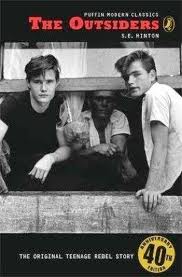 I’ve heard about this book for half my life, I guess, but I never got around to reading it because it just didn’t sound like my sort of book. Actually, I think for most of that time I was confusing it with another – possibly also by Hinton? – because I thought it was about cowboys….
Anyway, I finally read it. In an afternoon. The impetus is that I have to teach it this year and I’m glad that I read it well ahead of time, because I’m not ashamed to say that there were tears when I got to the end. Tears of sadness and tears of appreciation at the beauty of the story.
What can I say about it? I love Ponyboy, I think he’s awesome and I’ve probably taught kids like him; tough background but doing his best. I know I went to school with kids like him… and a lot of them didn’t get themselves out of the hole, sadly. His relationship with his brothers is fascinating – I read a review somewhere that was highly critical of some of the language used, questioning whether a 20-something boy would call his kid brother ‘honey’, but I’m not going to assume that I know how slang worked 40 years ago so I’m going to let that slide. I think what I appreciated most was Pony’s growing awareness of what his brothers were like as people, and how that affects their relationships; I presume that’s one of the things the curriculum wants students to consider for themselves and their own families. And the fact that there is a range of families portrayed, and that the group of boys effectively act as a family for one another, is intriguing and should also get students thinking, I guess.
Clearly one of the big messages the school will want students to consider is risk-taking behaviour and its consequences. And that’s fair enough, and I have no doubt that we will have discussions about whether Pony ought to have turned up for the big rumble, whether that was peer pressure, etc. But I hope we also have discussions about the class structure of Socs vs Greasers and how that might be reflected in our school, or not, and whether Socs really did have a tough life as well. Because those are some awfully important things to consider.
I was stunned when I realised that this was written by a seventeen-year-old. For me, it doesn’t have the feel of a debut novel, and it really doesn’t have the feel of teenage writing. Quite astonishing.
My sister describes the film as “a whole bag of sexy,” and looking at the cast I can see why: Estevez, Cruise, Swaze, Macchio, Lowe… but I still don’t think I’ll watch it. I don’t think I could stand it.
Surface Detail
 I got Surface Detail from my brother for Christmas; that is, I bought it, and he gets less $$ than he was going to for his Christmas/birthday present (it’s a long story). I wrapped it up and wrote the nicest note from him to me and everything, which apparently was a bit weird, according to the rest of the family (he wasn’t there)….
Anyway, I was very excited to finally have it in my hands. A new Culture novel! The world should rejoice! And this is one of the biggest ones yet, I think, at 627 pages. I’m way too much of a fangirl to give this a particularly critical review, but…
I have a really bad memory but I think this is one of the bigger casts that Banks has followed in detail, which contributes to its size. There are certainly some privileged characters, but most of those introduced do get some detail and resolution. They’re a good mix, too; mostly pan-human, but a few not, and to my utter delight a seriously warped AI whose avatar goes by name of Demeisen and whose attitude towards war, while reprehensible, was one of such unfeigned delight that I couldn’t help but adore him. In a reproving manner of course. I think the AIs, and the ships they’re encased in, are by and large my favourite part of any Culture novel. Not that Banks appears to feel any restrictions with his human characters, but with the AIs there are really no limits to the craziness he can put out there, and does. I think my other favourite character is the one who, if any deserve the name, is the main protagonist: Lededje Y’breq. She dies in the first chapter. Then, of course, she comes back.
Dying is, in fact, the focus of this entire book. I think someone who later becomes a main character is dead or dying in each of the first four chapters, and it kinda keeps happening. That’s because Banks decided to address one of the oldest issues in this book: whether there is a heaven or a hell. And the answer is, definitively, Yes There Is: because we made them. As virtual environments. Now the question becomes, should there be hells (heavens seem to be fine)? When it’s people just like us making them and deciding you go there? … which, in a place like the galaxy Banks gives us, naturally leads to war. That’s right people, war is hell and hell means war. Or something.
It is, of course, an awesome book. The scale is enormous; there have been a few Culture novels mostly restricted to one planet, but this is not one of them – it zooms all over the galaxy, faster than the speed of light. The plot, as mentioned, follows several different people or groups, some of whom end up tangling together and some of whom stay separate; the plot has an appropriate number of twists and surprises that I really didn’t see coming, such that I stayed utterly glued to the page the whole way through. And the language – well, it’s just swoon-worthy in parts. The speech from that dreadful avatar about why it likes war? Majestic. The descriptions of places? Concise yet evocative; I almost couldn’t read the descriptions of Hell.
Read it! You know you want to!
Fireship/Mother and Child
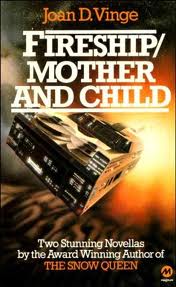 I love the idea of the novella double. Twelfth Planet Press is doing ones in the style of the old Ace doubles – different authors, back to back and upside down – and I really enjoyed the Tiptree/Russ double I read a few months ago. This one is different because it has two novellas by the same author, both of which had previously appeared in different venues. And the two stories are really quite different.
“Fireship” has the feel of a proto-cyberpunk story, to me, in that its emphasis is on a man/machine meld, and the action revolves around hacking a computer. The secondary characters are, sadly, largely two-dimensional and boring; they are there for plot resolution and really that’s it. The main character though… he is fascinating. MILD SPOILER! Ethan Ring is a gestalt: his personality is only created when a very ordinary man jacks into a superlogical supercomputer. Vinge posits the result as being entirely human in reactions and emotions, but lifted up by the computer’s abilities. Perhaps the most interesting dialogue is the internal, when human/machine/gestalt very occasionally interact. This is a really interesting take on the cyborg, and one that I’m not sure has been explored as much as it could be (if I’m wrong, tell me in the comments!). The other wonderful aspect of the story is the setting, Mars. We get intriguing glimpses of what it’s like to be on the colonised world – and it’s definitely got the feel of a colony – and some touching moments, like when the rains come and people rejoice. Additionally, there are some hints of some really interesting politics. Written in the late 1970s, it imagines politics basically being split between the US and “the Arabic states,” with Russia and China largely out of the picture.
Overall, “Fireship” is a quick read, with a fairly basic plot and ordinary characters. It’s worth reading to think about Ethan and what Vinge is saying about cyborg possibilities.
“Mother and Child” is an entirely different proposition. In three stages, the story is gradually told of a world struck by a terrible plague and suffering the consequences. The point of view gradually gets broader: at first, we see from a village smith’s perspective; then from a king’s; then, eventually – SPOILER! – from the point of view of an alien, tasked with dealing with the world and its inhabitants (reminiscent of le Guin’s Hainish cycle and Iain M Banks’ Culture, to an extent).
I’m somewhat conflicted about how it represents the main female character. On the one hand, the narrative is never from her point of view: it’s from that of her husband and then two abductors. On the other hand, she is entirely central – as the title points out – and is certainly shown as having agency: she picks her husband, and she actively decides on the fate of her child, and ultimately the fate of her world.
One of the most fascinating things about the story is its emphasis on the body. The plague has changed people, and it took me a while to realise just how much; revealing it would be too much of a spoiler, so I’ll just say that when they talk about having second sight, it’s not what you immediately think – and probably not what you thought just then, either.
I think “Mother and Child” is better written than “Fireship” and stays interesting more consistently. It certainly has better pace, perhaps because the three sections were really quite different from one another. I think I will read more Vinge, although I don’t think I will be racing out to get my hands on all her stuff.
The Killing Thing
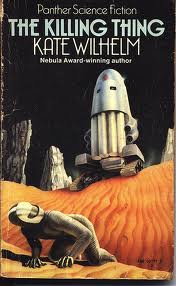 I went looking for The Clewiston Test at my local secondhand shop, but the only Kate Wilhelm I found was this one. It was short, and inexpensive, so I decided to give it a go.
On the face of it, this is a story about a man and a robot, the latter trying to kill the former, on a desert planet. At the start I thought it was going to be one of those novels that would have worked better as a short story – even at only 142 pages, I wasn’t sure the whole being-chased thing was going to have legs (ha, ha). That was before the man, Trace, started having flashbacks… and everything changed. The flashbacks filled in his own back story and that of the robot, giving a much larger context than I had anticipated. Interestingly, Wilhelm also gives the robot its own flashbacks, which disrupts the readers’ instinct to identify solely with the human protagonist. This is a brilliantly written piece : sparse details, appropriate to the subject matter, with Wilhelm deftly conveying the increasingly feverish experiences of Trace frighteningly well. She also does a fascinating thing in creating layers throughout the book: Trace revisits several key moments several times, and each time some new nuance is revealed to the reader, eventually building up to a full understanding of just what is going on.
The emphasis throughout the book is on the robot as a ‘logic box’ – its portrayal throughout is quite a different one from those found more recently, I think. The narrative only skirts around the issue of whether the robot is sentient, and what might be done if it is. Rather than dealing with this — and this is a slight SPOILER — Wilhelm is more interested in slowly, subtly, and cunningly making the reader aware of the fact that, being the well-trained soldier that he is, Trace himself can more than adequately be described as nothing more than a logic box. When I finally realised what Wilhelm was doing there, I both couldn’t believe I hadn’t picked up on it sooner and was terribly impressed with how skilfully she’d pulled it together.
The other really fascinating thing going on in this novel is its discussion of colonisation and the attitudes that colonisers bring to new places. In this case, it’s on a galactic scale, but the attitudes and issues and words and problems are all completely identifiable from the last century or two right here – and I do mean here, in Australia, as well as in the wider world. Some of the words she puts into the colonised’s mouths are uncomfortably familiar, which I’m sure is the point, and impressed me given the time at which it was written; I hadn’t thought those sorts of things were being articulated in the 1960s.
I had initially worried that the book would glorify war and the military, and it seems to indicate such a stance in the first few pages. However, by the end the book it’s clear that Wilhelm is indicting both war and the apparatus that supports militaristic attitudes, and when I realised that it was written in 1967 – well, it seems clear to me that this is an anti-war, anti-Vietnam piece. Perhaps that accounts for its lack of awards; I find it hard to believe it didn’t get any. This is a really, really, really good book.
Galactic Suburbia 23!
This is my 1000th post! And it’s a Galactic Suburbia one!
In which we greet a brand new year with discussion about digital media, awards, books, feminism, feedback, more books, anti-heroes, gender roles and take a look at what to look forward to in 2011. We can be downloaded or streamed from Galactic Suburbia, or from iTunes.
News
Follow up on the Jewish fantasy discussion by Rachel Swirsky.
Locus to go digital with issue #600.
Launch of the Cascadia Subduction Zone, new critical zine with focus on women’s work.
The i09 Power List: 20 people who rocked SF & Fantasy in 2010.
Carl Brandon Awards: Hiromi Goto and Justine Larbalestier.
Hugo nominations open – last year’s members of Aussiecon 4, don’t forget you’re eligible to nominate!
Feedback: Kaia, Kathryn & Thoraiya
What Culture Have we Consumed? [AND what culture are you most looking forward to consuming in 2011?]
Alisa: Fringe Season 3, Dexter Season 4, Being Erica (ep 1), Nurse Jackie, How I Met Your Mother, reading Managing Death (Trent Jamieson)
Looking forward to: LSS 2011
Alex: Zombies vs Unicorns, ed. Larbalestier and Black; Factotum, book 3 of Monster Blood Tattoo, by DM Cornish; Dervish House, by Ian McDonald; The Killing Thing, by Kate Wilhelm; Surface Detail, by Iain M Banks.
Looking forward to: Blue Remembered Earth (probably), by Alastair Reynolds; books 2&3 of The Creature Court, Tansy Rayner Roberts; the 2011 Women in SF Book Club; Bold as Love sequence (Gwyneth Jones); Twelve Planets (from Twelfth Planet Press).
Tansy: Wiped, Richard Molesworth; The Doctor Who Christmas Special! The Gene Thieves & the Norma; Ascendant, Diana Peterfreund; Big Finish Podcast
Looking forward to: Doctor Who and Fringe (SHOCK, I know), Sherlock, Torchwood, The Demon’s Surrender by Sarah Rees Brennan, Burn Bright by M. de Pierres.
Please send feedback to us at galacticsuburbia@gmail.com, follow us on Twitter at @galacticsuburbs, check out Galactic Suburbia Podcast on Facebook and don’t forget to leave a review on iTunes if you love us!
Belated: Boxing Day Mega Podcast
So I’m a bit behind the times, but I thought it worth mentioning that on Boxing Day, a bunch of Aussie sf podcasters (and one from Chicago) connected via Skype to record a mega podcast! Tansy and Alisa, my fellow Galactic Suburbanites, phoned in; there was Jonathan and Gary (for whom it was still Christmas!) from Coode St, Grant from Bad Film Diaries, and Ian from The Writer and the Critic. We talked about what we’d enjoyed about 2010 and what we’re looking forward to in 2011, and – amazingly – with seven people, we managed to record the shorted podcast any of the seven of us had ever been involved in! (As far as I could tell. I may be wrong.)
Jonathan Strahan, eminent editor and podcaster, was our recorder and producer, so you can get it from his website or download it via his podcast (The Coode St Podcast) on iTunes.
Death Most Definite
 (By Trent Jamieson)
Anthropomorphising death is not a new idea; humans have been doing it for thousands of years. Perhaps my favourite, and one of the more famous modern examples, is Terry Pratchett’s Death, astride his white horse Binky. ‘Death’ has often been characterised as a single individual, either solely responsible for the actual death of every person (much like Santa visiting every kid), or as some sort of observer, making sure your death goes according to plan. Trent Jamieson takes a different approach, by taking and developing the idea of the psychopomp.
Psychopomps act somewhat like the ferryman Charon: not responsible for death itself, they are rather charged with ensuring the soul makes it to the afterlife. This role has often been seen as a supernatural one, with the psychopomps themselves feared as bringers of death. Jamieson’s trick, and one that works very nicely, is to make psychopomps basically ordinary humans, who happen to have a somewhat unusual job. And this is one aspect that makes Death Most Definite an amusing novel to read: being a psychopomp is just that. A job. Complete with bureaucracy, office politics, bad Christmas parties, and the potential for aggressive takeovers.
Our narrator is Steve, a Pomp who joined the business because it’s what people in his family do (with the exception of the Black Sheep, that is. I love the idea of the black sheep being the ones who want ordinary lives). He’s not bad at his job, which essentially consists of being a conduit for souls to reach the afterlife (they actually go through his body, in some sense), and keeping an eye out for Stirrers – nasty critters from the Other Side, who are capable of inhabiting a dead body and must be sent back, lest they start to take over the world. But he doesn’t love it, and he doesn’t really have the social nous to deal effectively with office politics. Things start to go badly for him when he sees a dead girl in a food court who doesn’t appear to want pomping – and who then tells him to start running. Right before someone starts shooting at him. These things should not happen; and he should most definitely not be checking out the dead girl, and finding that she is decidedly hot.
The plot follows Steve discovering that all is not well at Mortmax (which is a great name), the company that employs the Pomps. In fact, things go very bad, with all sorts of unscheduled deaths taking place and office politics getting decidedly unpleasant. Steve must figure out what is going on, not get killed himself, cope with being one of the few Pomps left to do their work… and eventually take a stand to save the world (his bit of it, anyway).
Steve is an engaging and amusing narrator. He’s self-deprecating, which adds a nice light wit to the tone of the novel without turning into an attempt at a seriously comedic book – attempts that too often fall flat. He’s agreeably individual – tall, gangly, moping for an old girlfriend, and into scrapbooking – without coming across as The Only One With A Destiny. He’s ordinary, and so are his workmates, which helps make the business of being a pomp also seem quite ordinary.
The other main character is Lissa, fellow Pomp and recently dead. She’s feisty and determined, not prone to damsel-in-distress mode. She and Steve share some marvellous banter – it felt quite realistic. Because the novel is from Steve’s point of view, however, we don’t learn nearly as much about Lissa as we do about Steve, which was a little disappointing. As a result, she’s less well-developed and complex than him. This is not to say she’s stereotyped, though – she’s not, and there are hints at depth which will hopefully be more fully explored in the next two novels (Managing Death and The Business of Death).
One of the more unexpected aspects of the novel is the fact that it is largely set in Brisbane. Brisbane is not exactly renowned as a place to set urban fantasy (which I think this is, although I’m not a great categoriser). I don’t know the city at all, but from the descriptions of the streets, the shops, and the general layout I get the feeling that the book stays quite true to it. Such a setting – and the occasional foray into the Queensland hinterland – adds to the sense of ordinariness that permeates the book. I mean that in a good way, of course. Clearly the work of a psychopomp is not ordinary, and the nastiness that ensues throughout isn’t either – thankfully. But unlike some urban fantasy that makes the characters and places seem exotic and mysterious (which can be entertaining to read), I can well imagine meeting these people and walking these streets. It brings a sense of… proximity, I guess, that made me at least care all the more about what happened to Steve in particular.
This is Jamieson’s debut novel, which actually surprised me a bit; it doesn’t have that feel. It’s a fast-paced, engaging, and overall entertaining book. Although it’s the start of a trilogy, it is self-contained, for which HALLELUJAH. Of course it’s nice to know that there is more to find out, but it is also very nice to not be left in suspense at the end of a book when you don’t have the sequel sitting right next to you. Hopefully, Death Most Definite and its sequels do well, and there will be more Jamieson novels in the future. I read it in one sitting (well, with a break for dinner, but that hardly counts).


