Hard Reboot

I received this as a review copy courtesy of NetGalley.
It’s a far future universe where humans have spread to other planets and the Earth is basically a dump. It’s still worth visiting if you’re a historian or archaeologist, but you have to take drastic measures, like disabling your ability to access the network, and even physically covering up the jacks in your head, because otherwise they’re likely to be targets for malware.
Kas, a scholar whose background may get in the way of her achieving her goals, gets the chance to go to Earth and watch mech battles in the Drome (and it took me an embarrassing number of pages before I fully clicked that this was short for hippodrome or similar). From there, things go exceedingly not well, from accidentally laying a bet to being chased to meeting people she’s not meant to and getting on the wrong side of her boss.
Hard Reboot is fast-paced and exciting and a lot of fun to read. It flits between Kas’ perspective and that of Zhi, a mech pilot struggling to make her way as an individual in a society dominated by a corporate-or-is-it-a-gang. The narrative reveals teasing bits of what has made human society the way it is, but there’s still enough that’s not explained that it remains a bit opaque, a bit mysterious. Kas and Zhi’s interactions include an amusing level of banter, and the descriptions of the mech battles balance being precise in the mechanics with not going into the sort of boring detail that irritates me in some fight descriptions (my spatial awareness doesn’t really let imagine what you’re describing and also I don’t really care).
Definitely another good novella in a string of such from Tor.com.
Plantagenet Princes
I received this book to review via NetGalley.
The good things:
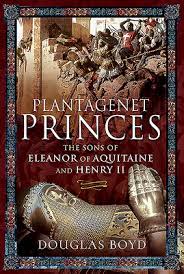
- The very concept. I love the idea of a book that covers all the Plantagenet fellas from Henry II to Richard III. Seeing their wildly varying careers one after the other points up just how outrageous and sometimes amazing and sometimes dreadful this lot could be. So great.
- Some of the context given. I appreciated the broader comments about the Crusades, for instance – and this lot were involved right up to Crusade #8, which I didn’t know before this. The book starts with a very general intro to the concept of being a knight, and then gives an overview of the first couple generations after the Conqueror. I didn’t need these, but for a reader less familiar with the era I’m sure it would be very welcome.
- Eleanor of Aquitaine. Any time I get to read about her, it’s a good day.
- It’s pretty straightforward to read.
The less good things:
(sigh)
- The author mentions an historian who claims the Bayeux Tapestry must have been designed by a man because there are penises embroidered on it. And just… leaves that comment sitting there.
- The author repeats that old saw about spices being used to cover the taste of rotting meat. Pretty sure that’s been debunked.
- The editing. Most significantly, the editing. First, there’s some odd things going on here with the structure. Clearly I read a review copy so I don’t know whether it’s still got some editing to go. But there were bits where I wasn’t sure if it was a typo or deliberately presenting variant spellings (Saladdin, and then Saladin); and there were several occasions where it felt like sentences were in completely the wrong place. Like, he would have a paragraph about an event; then the next event in the next paragraph, but suddenly the first event is mentioned completely out of context. And this got more frequent as the book progressed. Really quite confusing. And then additionally, several times there would be two men mentioned as being involved in something, and then “he” made some final gesture… and it was often unclear which “he” was being referenced.
Overall, I did enjoy this as a history of the family. It presents the princes in their context, shows how they’re connected and how they variously win and lose bits of their empire-not-an-empire. I suspect it would be a bit hard for someone with absolutely zero knowledge of the early Middle Ages, but then again if you’re picking this up you must have at least an ember of a passion for that time. The editing problems came close to killing the enjoyment a couple times, but I was able to bull past it.
We Are Satellites
I received a review copy of this novel from NetGalley.
I love Sarah Pinsker’s work and this is no exception.

We have always lived in a world where access to technology can determine what an individual is able to do. We’ve also been making body mods, as a species, for an awfully long time. And SF writers have been wondering about wearable tech, and body mod tech, and brain alteration, for a fair while. We Are Satellites fits right on in to that area of exploration.
The book opens with a new device, a Pilot, becoming available. The exact science is never explored but it’s designed to help with focus and somehow enable users to have ‘functional multitasking’. And to show that you’ve got one you have a small blue LED on the side of your head… yes, it took me an embarrassingly long time to realise this was a Pilot light. A Pilot is connected directly into your brain and this very idea is absolutely terrifying to me.
Pinsker chooses to tell the story through one family: Val, Julia, David, and Sophie. Val is a teacher; she’s anti-Pilot (and look, all her reasons are so completely mine that I can’t help but make her my favourite). Her wife Julia works for a politician and ends up getting a Pilot (and her reasons absolutely make sense, don’t get me wrong, it just makes me a) squeamish and b) cranky at the idea of feeling compelled to get something in order to keep up). Their son David also gets a Pilot, while daughter Sophie can’t because of her epilepsy. Pinsker uses chapters from the perspectives of the different characters to both explore the various issues and move the narrative along; one thing I loved is that it wasn’t a steady cycling through each character, but there were times when you got three Val chapters and then moved to one of the others. This meant the narrative felt less jumpy than might otherwise occur, and you can get to know one character that bit more. Using the multiple perspectives, though, also means the chance to get a more authentic exploration of having/not having a Pilot, and exactly what’s going on within the family.
The story arcs over several years, which means that Pilots have a chance to become more embedded in society, and for expectations within society to change, and for organised protest to develop too. It also means Sophie and David grow up and the family dynamics change. All of this makes for a narrative that moves along at a nice pace – striking the balance between interrogating issues thoughtfully, and experiences that compel reaction.
This is a hugely enjoyable novel and I wouldn’t be surprised to see it on awards lists next year.
Revelations: a novel about Margery Kempe and Julian of Norwich
I received this as a review copy from NetGalley.

A fictionalised account of the life of Margery of Kempe, generally regarded as being the author of the first autobiography in English. Mystic, wife, mother, pilgrim, accused heretic, all-round confounder of stereotypes and expectations. Margery always comes across as something quite extraordinary, beginning with the fact that we know anything about her at all – so few medieval women are known to the historical record, let alone in her own words. (Well, probably; she’s recorded as having dictated her account to a scribe. But I don’t think anyone seriously doubts that her words are her own.)
What Sharratt chooses to do in order to really bring Christianity and mysticism to the forefront is highlight Margery’s friendship with Julian of Norwich. They definitely did know each other, so that bit isn’t a problem. Julian was an anchorite – she took vows and was sealed up in a room that she never left, the better to contemplate God. She was also an author – the first named English female author, in fact. Her book was about revelations from God, concerning grace and love and the overwhelming affection that God has for creation; and she goes so far as to refer to ‘Mother God’, and call God’s love maternal. Sharratt makes her quite accessible, here, and the fate of her book is a significant part of the story – written as it was when England was terrified (and intrigued) by “Lollardy” – the idea of having the Bible in English and challenging the supremacy of priests as interpreters of God’s word, and various other things imputed to them.
Julian and Margery together certainly challenge the structure of the medieval Catholic Church. Margery, too, claimed to have visions, and Sharratt includes them as genuine and deeply affective experiences. Through Julian and Margery, Sharratt touches on some of the issues facing the Catholic Church throughout the Middles Ages – the role of priests and of communion and the accessibility of God to laypeople. The book doesn’t get especially deep into these issues, though. There are some truly despicable friars and priests, but also some genuinely loving and holy ones. Margery and Julian are certainly shown to be faithful daughters of God.
The one thing that troubled me here was some of the historical licence taken. Various true events have been included out of time for emotional impact: Margery witnessing the burning of Jan Hus, for instance. I don’t really see that this was necessary to heighten the tension, and I don’t think Margery needed to see someone being executed in order to have the reality of the dangers she faced brought home.
Overall, I enjoyed this book. It’s well written and a fast read (I read it in a single, admittedly uninterrupted, day). It’s useful for emphasising both the similarities of the Middle Ages to our own time, as well as the vast differences. I already knew a little about both Julian and Margery, so I don’t know what this would be like with no prior knowledge; I suspect it would be fine.
The Hunt for Mt Everest
I received this courtesy of NetGalley.
I am not a mountaineering or climbing person. I am, though, fascinated by tales of ‘discovery’ and history in general and finding out about bits I know nothing of.

‘Discovery’ in quotes because, of course, while this story is about the hunt for “Mt Everest”, it’s not like the mountain was unknown to the people of Tibet or Nepal or, I imagine, people in China or (what is now) India. And thankfully Storti makes this clear fairly often – that this is discovery only for westerners and, in particular, the British. Storti is under no illusions that some of the things done by the British in both India and Tibet were despicable, and I think he keeps an even hand in explaining the contemporary reasoning (I learned more about “the Great Game” of Britain v Russia in this one book than ever before; the 19th century is so not my period), while simultaneously not excusing or approving of, for instance, sending spies into Tibet when it was explicitly closed to foreigners.
So: the book! The overall point is the discovery that what the British decided to call Mt Everest turns out to be the highest peak in the world. (Yes, there’s a section on why it’s called Mt Everest, and the fact that didn’t even match contemporary expectations of using local names.) There’s a digression into the ‘discovery’ of mountains as beautiful – until the early 19th century they were generally dismissed as being a waste of space and just getting in the way; and also about the development of mountaineering as a hobby, and people climbing in the Alps. Also a whole bit about the great trigonometric survey of India, which was fascinating and absolutely relevant and also bonkers as an undertaking. Within all of that is the colonial attitude towards India, and towards Tibet in particular – the fact that Tibetans didn’t want the British within their borders and what some men did in contravention of that (Mr Younghouse, I’m looking at you, arrogant bastard). And eventually, there’s the expedition in 1921 that finally means westerners got a look at Mt Everest from close up.
Storti writes a really engaging narrative, explains issues clearly, and balances storytelling with historicity. As someone on the outside of mountaineering I’m unconvinced that George Mallory is more important than Edmund Hillary in the whole Everest saga, but I’ll allow him to champion the man now I know a bit more about him (interesting to read about, probably a right pain in the bum to actually spend time with).
This was a really fun book to read (well, fun and sometimes tragic, as is always the case with both mountaineering history and colonial history).
Forces of Nature
I received this book via NetGalley.
I’m a bit conflicted by this book.

On the one hand, it’s a pretty great introduction to women in science – and the fact that women have ALWAYS been “in science”, they’ve just been obscured (deliberately or not) on a personal level or an institutional one; by which I mean, “science” has been constructed as a discipline in order to leave the ladies out (eg midwifery isn’t really medicine). Recovering the presence of women is always good.
I LOVE that Marie Curie isn’t mentioned until the last chapter. Seriously: the authors make this choice an explicit one, explaining that she gets used as the exemplar and that’s not useful (and also people ignore a whole bunch of facts about her, too).
I liked that the authors aimed to go back to ancient women, despite the overwhelming lack of evidence (because patriarchy AND because time); they make a good case for ways in which ancient women would have been involved in scientific endeavour.
On the other hand…
I wasn’t always sure whether the authors were picking women as examples, or if they thought they were being exhaustive. If the latter, then they didn’t succeed – and surely they weren’t trying for that in a book intended for the general reading public – but I would have felt more comfortable if they had been clearer about their decision-making paradigms.
There were some sweeping statements about “women” and their access to education/lack thereof. Very occasionally there were comments about how class also interacted with gender – but I felt there was a serious lack of this latter point. Class had a HUGE impact on access to time, let alone equipment; this intersection should have been made much more obvious. As well, other discussions about women’s involvement in science has pointed out that gentlemen-scientists, for instance, often had female servants assisting; that’s not discussed here.
Occasionally, the authors do not walk the line I think they intend to. For instance, when Western Europe experiences a craze for natural history and botany, the latter in particular is seen as appropriate for women to be involved in, for various reasons. The authors point out that it was thought women were closer to nature, and therefore had an affinity for botany… and then seem to suggest that women really were better at botany? I was a bit confused about what the authors thought they were doing here.
This is, too, an overwhelmingly European (and eventually American, largely still of European descent) book. Not exclusively – there is mention of women in ancient Egypt (of course; that’s basically European in the way it’s often discussed!), and women medical practitioners in ancient China. There’s a Japanese scientist in the 20th century who did awesome things regarding ocean currents and nuclear fallout, a woman of mixed Irish/Mexican ancestry who was an archaeologist, and a few others. I would have liked to see an acknowledgement that evidence is overwhelming white, because colonialism (in Europe and America) and because… lack of access, or something? for Asia. Africa, South America, Australia…
I got whiplash when the discussion leapt from Algoanice, living in probably the first century BCE, to Hildegard, who was born in 1098 CE.
As a way of enlarging your understanding of women’s place in science over time, this is a fine place to start, as long as you remember the caveats about class and race.
The Bookseller of Florence
This is one of the best history books I’ve read in years.

It’s written superbly. The language is a delight – but not so clever or lyrical that it gets hard to read. The pace is just right, and the level of detail is an absolute delight: the right balance of fascinating without getting into ridiculous minutiae.
It’s wonderfully historical: it uses primary sources and historians to make arguments and illustrate points, and they’re all woven within the story seamlessly. It uses endnotes, so you don’t have footnotes cluttering the page but you still have the reassurance that the author has done the research!
It illuminates (heh) the context magnificently. The Renaissance, Italy, and Florence are really not my scene, beyond knowing a few names (Medici, Borgia. – and Sforza for some reason?). The author sets the general scene for all three so that I felt completely comfortable going in. The book is ostensibly about Vespasiona, the “king of booksellers”, who started as a fairly uneducated boy working in a book binder’s in Florence and became the man who could either track down a manuscript or have a beautiful new one made for you – where “you” could be a wealthy-enough person in Florence or, like, the Pope (a few of whom he knew by name, hello). Beyond being a biography, though (which would have been fascinating but not that long because info about his early life is lacking) this is almost a biography of TEXTS, as objects and sources of knowledge, in this crucial moment – the 15th century. Why was it crucial? Well, a bunch of ancient Greek texts were being rediscovered and translated – especially Plato, who was being brought into the Christian fold as Aristotle was two centuries before. There were changes in the way knowledge itself was perceived, and an increase in the number of people (let’s be honest, basically men, but still) who were chatting/arguing/ getting fiery about various bits of knowledge. OH, and THEN, Gutenberg and his crazy weird moveable type (NOT first invented by him, of course, that was happening over in Asia already, and the author acknowledges that) comes along. The way the author contextualises that, and discusses the stats about book publication (mss numbers rose when print came along – probably because of increasing literacy) – it’s all just an absolute delight.
The book balances political history, social history, and a bit of economic history to make a thoroughly well-rounded examination of the period. And it still manages to revolve around this one man, Vespasiano, who coordinated the production of beautiful books and magnificent libraries, who became an author himself in old age, and was probably a bit of a cranky old man about those new-fangled print books.
Gosh I loved this book.
Beginning French…

No, I am not learning French. I read this courtesy of NetGalley.
One of the reviews at the start of this book said “Move over, Peter Mayle” – as in the author of A Year in Provence.
To which I can only say: uh, no.
Look, this is an enjoyable enough story. I’ve just watched several episodes of a show where people buy a French chateau and renovate it, so clearly I like the genre of doing things like that. But the thing that Mayle did was very clearly situate himself within his village: while he takes part in many of the amusing adventures he recounts, he’s not necessarily the focus. Mayle makes it clear how much he loves the place and the people.
Now, Les Americains are admittedly different because they don’t live in their house; they come for maybe a couple of months a year. But the people they mostly interact with are other foreigners (a lack of French is a problem here, too), and the focus of the book is the relationship of the couple, and their own personal experience. It’s just not the same as trying to explain or explore a village to a readership who will never get to live there.
There’s also a “Lunch in Paris” vibe where the couple’s daughter, a chef, provides recipes for some of the food they eat. This is a nice aspect but the food never felt quite central enough to the story to make this feel like a compelling addition.
Did I finish the book? yes. Am I dying for more information about how this couple spends their holidays? No. And it might just be me but I find it hard to take seriously anyone who takes their pet overseas, and then acts like the pet is a human.
The Album of Dr Moreau
I received this as an ARC courtesy of NetGalley.

This novella has gone straight to my “Possible 2022 Hugo Awards nominees” list.
Actually the first thing I should admit is that I don’t think I’ve ever read The Island of Dr Moreau, so if Gregory is doing anything more clever than the sorts of things you can pick up with a general understanding of the story (and he probably is), then I missed it and I’m sorry about that. HOWEVER, this does mean that you don’t have to know what the author is riffing off in order to appreciate this as a deeply funny, deeply interesting, and generally wacky story.
There’s a lot going on in not many pages.
It’s a detective story: there’s been a murder, and it needs to be investigated, and it is. Despite TS Eliot’s rules of detective stories.
It’s framed as a story being told to someone who knows bits but not all of a story. The narrator occasionally intervenes.
It’s definitely science fiction: after all, the members of the band that it revolves around are human-animal hybrids. And what a band they are.
It’s about music, and I’ve had Backstreet Boys stuck in my head half the day, THANKS FOR NOTHING GREGORY.
It’s about family and love and loss and identity and humanity. Stereotypes and terrible puns and growing beyond your childhood. Also, Las Vegas and fandom.
This story is one hell of a ride. I loved every minute of it, even when it made me feel a bit confused (that got cured), or sad (that didn’t). You should definitely read it.
Star Trek Picard
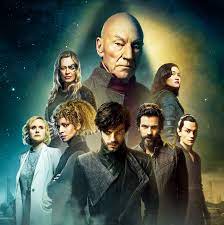
What, did you think I was kidding about leaping into Picard?
So… this was awfully lumpy.
(Spoilers ahead.)
Things I loved:
I love Raffi. I love that Picard’s arrogance is shown to have terrible consequences for those around him, I love that she is broken and that she is consciously trying to put herself back together again, I love that she has enormous emotional reserves for those around her and that she’s also very angry about everything that’s happened. I love how complex she is. I love that she is so badass.
I love Elnor. An Australian accent in space!?!?!?! I love that he gets to just… say whatever is in his mind, I love his mad skillz, I love the way he makes decisions. He’s just generally awesome.
I love Rios. I love his ridiculous 5-part holograms with their ludicrous accents. I love his skills, his development from wannabe mercenary to something else, I love his general attitude and his relationship with Raffi.
I love Seven. That she is not in a catsuit and that she continues to just generally be awesome. I love that she is shown to be complex, to have had a complex life since getting back to the Alpha Quadrant, and has learned some serious skills in snark.
I love old Riker and Troi. So cute. Less convinced by the kid, but whatever. I guess including them is basically just fanservice, but even I – as a not-massive TNG fan – enjoyed seeing them.
I really liked that it was actually Hugh, as the Director! Definitely fanservice there but it made even me happy. It’s a neat call-back and despite his fate, I’m glad we saw him.
I kinda liked Narek. I know, I KNOW, this shows terrible taste on my part. But… he’s an intriguing character! Mostly! Competing principles are compelling! Not that he deserves to be in the front of the image I’ve chosen, though: that really should be Soji.
I don’t mind Picard as a character. Look, I’ve seen a fair range of TNG; I don’t know all his complexities but I know enough. I think this does a good enough job of capturing the man – although I’m sure there are some people who are pissed that he’s shown to have epic levels of arrogance and selfishness (… I think they were obvious in the original show, personally). I quite liked that they showed him in his less than perfect humanity (ahahaha; little in-joke there). Having to deal with not everyone jumping at your beck and call – well, not immediately – made this just that bit different.
So there were good bits. I liked the idea of a captured Borg cube, I was intrigued by the idea of synthetics being banned, and there were some really great cinematic bits. But goodness the plot was just… lumpy. Also, the sound mixing was dreadful; there were lots of bits where I found the dialogue really hard to hear, and then explosions were LOUD.
Part of the problem is just how much is going on in the plot. Romulans and synthetics and Borg and secret police and people harvesting Borg and Picard having brain problems and… etc. I like a complex story, I really do, but this felt like a bunch of different plot lines that didn’t get properly woven together – like someone had LOTS OF IDEAS and they REALLY WANTED all of them to be in the show JUST IN CASE it didn’t get renewed. And yes it felt like it was happening in all-caps.
I didn’t mention Soji above. I liked her well enough? But she wasn’t my favourite character. And this made me sad. It should have been a show that was overwhelmingly, for the second half anyway, about her developing as a person when she discovers her life is a cover-up. But I don’t think she gets much character development, overall. I don’t know what could have been changed; I do know that I was left feeling like she wasn’t hugely different from when we first meet her, and that doesn’t make much sense.
When I first watched the credits, I thought it looked like Picard was being put together. And then there’s the stuff with Data, and then the vague intimation of a brain abnormality, and I had a wild assumption that Picard was himself going to turn out to be a synthetic – or had been replaced by one at some point. And then I shook my head and told myself not to be daft. And then the last ten minutes happened. Whoa.
Will I watch the next season? Of course; eventually. I don’t think I’ll be keeping Prime in anticipation, or getting it as soon as the first episode airs. But I am cautiously intrigued to see where it goes next, especially if Rios and Raffi stay on board (and what was that cutesy little hand-holding between Seven and Raffi?!).

 Randomly Yours, Alex