By Force Alone
I have a long and increasingly cynical relationship with King Arthur, and all the stories around him. I read a fair bit of it as an adolescent – I even did subjects at uni about the mythology and so on. But as sometimes happens, I got cynical and impatient as I got old, and I haven’t read much new Arthur stuff in a long time.
I did re-read Susan Cooper recently, which was an excellent choice and is a bit more left-field than other Arthuriana so doesn’t really count. (Also, not new to me.)
 And then a friend started raving about this book and while he’s not prone to hyperbole I was a bit like… really? That good? But I was intrigued and so I bought it and…
By golly.
I’m not sure I can read another Arthur book ever.
This is it. This is everything.
Tidhar knows Arthuriana intimately. He’s referencing medieval romances. I’m pretty sure there are Mists of Avalon references, and Sword in the Stone. There’s the grail, sure, and the Green Knight, which is obscure but not that obscure… but there’s also the Questing Beast, and… and… yeh. So this is in no way someone coming in and thinking they’re reinventing Arthur (which has been done, and oh so badly). This is someone who knows Arthuriana deeply.
The thing I kept thinking of when reading this was A Knight’s Tale, that Heath Ledger break-out film. It used modern(ish) rock music in order to make the point about how people in the 14th century (the time of Chaucer) would have perceived music that 20th century ears hear as weird and ‘old’, and it used utterly modern language. By Force Alone is simultaneously utterly set in the 5th or 6th century – the Romans are gone, Britain is a by-water and non-existent in political terms, the Anglo-Saxons are coming (ignore the historical reality here) – but feels in some ways very 21st century: Arthur screaming ‘Come at me if you’re hard enough!’ Bully boys in London who want to be knighted, talking about being ‘made men’. Picts on the northern border being vicious.
Everyone, actually, being vicious.
This is a vicious book. There is no gallantry. There is no courtly love – which is right because the notion wasn’t really a thing until at least the 12th century and then honestly becomes part of nostalgia basically the next day. There is no honour except for what you can get; kings hold power by force alone; Galahad gets him nickname for quite, um, different reasons from how it’s usually told.
This book left me dazed. It starts with Vortigern and ends where every Arthur story ends. It covers so much at a break-neck speed that honestly it’s all you can do to hold on and see where this beast is going to end up. But it’s all completely controlled and Tidhar knows exactly what he’s doing. And what he’s doing is amazing. He’s setting a monumental myth in context, and exposing some of the nasty underbelly of nationalism and the Matter of Britain, as well as writing intriguing characters out of characters who are just so well known (what he did with Lancelot was… unexpected, and I’m curious to chase up whether it was based on stories I don’t remember or know; the Green Knight was the most amusingly outrageous). And he keeps the fantastical nature of Merlin and Morgan and makes that part of Britain itself… but in such a way it almost feels realistic. Almost.
This book is incredible.
Good Morning, Midnight
 The most enduring result of my first-semester first-year English course, aside from a healthy disdain for both DH Lawrence and James Joyce, was a love of Jean Rhys. I haven’t read Good Morning, Midnight since I was 17… and a lot more callow than I realised at the time.
Reading at this at 40 was, unsurprisingly, a whole other thing.
The first thing that I have to say is that whoever wrote the blurb for the Penguin edition really didn’t understand it. In the first sentence they very bluntly set out two things that are serious revelations in the book; and then the last sentence of the summary is just wrong. I don’t know whether they read the book and didn’t get it, or whether the summary was written from third-hand information, or what. But what I can say is: don’t read this blurb. It’s also deeply unsympathetic, which made me cranky.
Sasha is in Paris. It’s the late 1930s, and she’s been in a bad way, but she’s better now. Honest. As she walks around Paris, much of the novel is taken up with reminiscing – about being in Paris in the heady post-war days when she was a Bright Young Thing, or living like it anyway. The Sasha doing the remembering is a bit older than I am now. She has lived a lot, experienced joy and tragedy, struggled with identity – all the things you would expect for someone in her late 40s.
There’s little action in this novel – and let’s be honest, that makes it a bit unusual for me. It’s a deeply internal novel, although it never gets to self-indulgent navel-gazing. It’s an emotional novel, although it never tried to make the reader experience wild and tumultuous feelings: it balances the line between clinical – here’s what happened – and drawing the portrait of Sasha’s experiences so finely that honestly, at the end, I felt a bit exhausted. It’s short; I read it in a day. And when I finished I had to go dig out the bottle of Pernod from the back of the cupboard and sit and have a quiet drink. (Sasha drinks a lot of Pernod in her time in Paris.) Rhys writes so… matter-of-factly about life, and the difficulties of life. Her genius is in not making it melodramatic and also not detached.
In an odd way I see a connection between this and The City We Became; Paris is an integral part of the novel. The places Sasha goes, and the influence cafes and faubourgs and parks have on her mood – it reminds us that a place isn’t always only, or just, a place; it’s a trigger for emotions and memory, sometimes even a repository of them. As with The City, I don’t know Paris – I’ve visited once but didn’t invest in the place that deeply. I can only imagine what it would be like reading this as someone who knows the area.
I love this book. It’s not likely to be one I re-read every year; I’m not sure I have the emotional resilience for that. But every few years, now that I’m reminded of it? Absolutely.
The City We Became
 I loved the short story that turned into the prologue of this book. And I love this book.
It should be noted that I do not know New York. At all. I understand people who love NYC have a very particular reaction to this book, but that’s not me. You tell me it has five boroughs? OK. You tell me Staten Island doesn’t like being one of those boroughs? Happy to believe you. You could tell me that New York streets are all slightly curved either north or west and I would have to actually do research to see if you were right.
So anything I say about this book in relation to New York City should keep that in mind. My love for this book does not stem from my love for the city that is, in more visceral ways than is usually meant by this phrase, truly a character within the book.
Six characters, in fact…
Look, to some extent my reviewing this book is a bit redundant. There have been lots of other reviews by people who are far more eloquent than me; who know New York better than me, who can speak to the WHAT THE HECK WAS THAT twist that I seriously didn’t see coming (possibly because I don’t have a certain background, which I am completely fine with), who can speak to the way this book reflects Americana with much more knowledge than me. So what do I have to add?
I can say that even as someone who doesn’t know the USA or NYC, this book is visceral and captures a city brilliantly. And USES a city and the way people think about it to magnificent effect
I can say that it’s fantastically paced – meeting new characters and ‘getting the band together’ can sometimes be tiresome, but not here. Here, it’s all so intricately part of the evolving plot and understanding what the heck is happening that I barely noticed half the characters hadn’t met each other for a substantial part of the novel.
I assume that those who know NYC will agree with the choices made for who represents each borough, or at least see where Jemisin in coming from; the explanation for why you get a particular person in a particular area made sense to me in a fictional way, at least. So I can say I loved the variety of characters and the amount of backstory that is woven expertly into the current story and why those things are necessary and how each character could really just have a mundane story written about them and it would still be fascinating.
I can say that I have precisely zero regrets about pre-ordering this six months ago and have every intention of doing the same as soon as the sequel is announced.
And… SPOILERS BELOW:
Slow River
 I don’t often go to the library, privileged as I am to be able to afford books, as a rule – and I like owning books. But sometimes I think I might like to read a book and probably not own it.
This book is one that I picked up at the library because I was there getting something else; the yellow of the SF Masterworks stood out to me, along with Griffith’s name – I didn’t know she had a piece in that set. So, serendipity at play.
This is a fascinating novel and one that I can’t really do justice to in a review – I’d give too much away and I hate doing that.
At the centre is Lore, who either doesn’t know much about herself or doesn’t want to know much about herself when she wakes up naked on the street. She’s taken in by Spanner, who might have acted like a saviour but really isn’t one, not in how she acts and not in how she thinks, and she doesn’t want to be one either. The relationship between Spanner and Lore is… difficult, and sometimes unpleasant; necessary, too, at least for a while. Griffith does a good job at revealing details quietly, and slowly, and almost without you noticing, so that a complex picture gradually comes to light.
This is also the case with Lore’s own family and personal history. A glimpse here and an idea there, gradual filling in of gaps, and suddenly things make so much more sense.
The world Griffith created as futuristic in 1995 is really quite recognisable today. There are some things that are still futuristic – the bioremediation of waterways is probably still a long way off – but her descriptions of the city and the way things work is full of familiar detail. And that’s where Griffith’s genius is, I think; it’s in the detail. This isn’t a Neuromancer adventure; it’s not a Mellissa Scott adventure. This is a story about life and the difficulties – and joys – of relationships, set in a web of competing economics and politics. Above all it’s about identity, and whether identity is mutable or not; whether revelations can change who we are, and whether we want them to; whether other people can change who we are, and whether we want them to.
Just great.
Made to Order
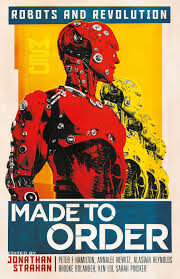 For the centenary of the coining of the word ‘robot’, Jonathan Strahan has compiled an anthology of new work about those… beings? objects? creations? The word ‘robot’ is derived from the Czech word for slave, so perhaps it’s appropriate that a description of what they are is hard to come by. Strahan begins by putting robots into an even greater lineage and ancestry than a hundred years, though, pointing out that the Greek god Hephaestus has golden assistants, and the many stories of golems, and coming up to Frankenstein’s creation too. He goes on to touch lightly on the myriad ways robot-like beings have influenced fiction more recently (tripods to chat bots). I don’t always read introductions (sorry J), but this one is well worth the time and really sets the scene for the entire anthology.
I won’t go over every story, because that would be a bit tedious. Basically every story was great, which pleased me immensely!
Vina Jie-Min Prasad starts off the anthology with “A Guide for Working Breeds,” written as a series of chats between two bots. One is required to be the mentor for the other, who is pretty new to the whole work-scene; the slight boredom and irritation of the first is set off against the enthusiasm of the newb and feels all too real. The entire narrative is in chat; Prasad works in enough detail that by the end of it I felt like I had read far more narrative than was actually on the page. Very nice.
On the other hand, Peter Watts’ “Test 4 Echo” is not nice. It’s a great story, but it’s not nice. It’s got solar exploration and an intriguing design for a robot on Enceladus, but the way that the robot is treated is not nice. It’s got discussion of developing robot sentience, but the way it works out is not nice. I really enjoyed it… but it’s not nice.
“The Hurt Pattern,” from Tochi Onyebuchi, is a terrifying look at a very near, very plausible future that is more about the humans than the robots, because it’s about how humans teach robots and what we can unconsciously impart, and how that can be manipulated and used for profit, or nefarious purpose. I found this story distressing, actually, because it’s so very believable: how algorithms can be used to affect society. Including law enforcement.
In-built obsolesce crops up a few times, and perhaps nowhere as poignantly as in John Chu’s “Dancing with Death” which features a robot that should be on its way out and a mechanic who is more than he seems and also a really, really good mechanic. This one really is beautiful.
Sofia Samatar contributes probably my favourite story, in “Fairy Tales for Robots.” Onyebuchi presented a nightmare scenario for what might happen with the way humans teach algorithms; Samatar presents someone trying to teach a ‘robot'(ish) to think for itself, to consider how stories might guide decisions and attitudes. The way Samatar takes fairytales and myths – some familiar to my Anglo-Australian upbringing, others not so – and demonstrates how they can be seen as relevant to an artificial life is just breathtaking, it’s so imaginative. I really, really loved this piece.
Twilight
I recently did a thing. Perhaps a silly thing, perhaps a pointless thing. I fell off – or, perhaps, swan-dived – off the cliff. I finally watched Twilight.
It was a Sunday night. I was in need of something that didn’t require much attention, as I wanted to knit.
Notice how I need to justify myself? Oh Twilight, the amount and type of emotion you stir simply by being named.
Even had I been 15 when Twilight came out, it would not have been quite my thing. I’ve never been much of a one for romance movies – at least not at the cinema – and I never went in for paranormal romance much, certainly not as a kid (with just a few noticeable exceptions; ahem, The Changeover, Margaret Mahy).
As a movie, I was not very impressed. I thought the effects were pretty lame – not sure if that’s a time factor or not; I thought the tinkly music accompanying the sparkly vampire reveal was overdone; I didn’t think much of Pattinson’s performance. There are definitely bits of the narrative that I thought were pretty poor and being watched while you sleep by someone who doesn’t have permission to do so is utterly, utterly creepy.
However. My goodness I can understand why this was so popular. What an absolute slightly-awkward-teen-girl fantasy! Your parents are fine but a bit distant (so relatable); you’re new but everyone wants to meet you; new to school but instantly get friends; all the guys want to date you but you know how to redirect them so everyone ends up happy. You’re awkward in sport but it doesn’t matter. And then you fall in love with the hot guy no one understands who warns you he’s the villain but you know he Has a Heart of Gold and you can Really Reach Him.
This story is a story a million nervous, worried, awkward, frustrated, dreamy, anxious, and lonely girls dream of living. It’s catnip. It’s not necessarily good for them, but it fills a need/ meets a hunger/ suggests a pathway in a glorious, sparkly, slightly creepy, romantic way and I kinda don’t blame them for eating it up with a spoon.
I have no intentions of watching the rest (… until I really need another no-pressure movie, possibly…) but I don’t blame anyone who loved it.
It Might Get Loud
I’m assured it’s not too weird to have a favourite documentary, but it does still feel a bit strange to admit that I have one – and that I’ve watched it more times than I can count. I’m not sure why that seems weird; I guess I don’t know that many people who count non-fiction things as ‘favourite’.
 I love music history and I love music documentaries. Led Zepellin are my favourite band. I’m a fan of (early-mid) U2, and I quite like The White Stripes. And I love rock music. So Jimmy Page, The Edge, and Jack White in one place talking about the electric guitar, occasionally teaching each other their songs, and each going on a journey with the documentary maker about their journey to being guitar players… I mean, I was always going to love this documentary.
The moment when Jimmy Page starts playing Whole Lotta Love and Edge and White just stare at him in raptures is everything.
They play Seven Nation Army together. And In My Time of Dying. And, although it’s a deleted scene (WHY), Kashmir.
I really enjoy the background pieces for all three, although I believe very little of what Jack White says (it’s fun to watch but I take it all with a liberal fist of salt). The idea of Page playing muzak and simply revolting from sessional music, and Edge’s horror of the Irish troubles leading to Sunday Bloody Sunday; their sheer delight in music and each other and their drive to keep playing and discovering; it’s all magnificent. I could have had a bit more of them together comparing notes, but I guess I can’t have everything.
Sleep it off Lady
Once upon a time I was an undergrad Arts student. I was going to study English and History. One of my first semester English classes was Modern Literature. I had no idea ‘modern’ was a critical term rather than just a temporal one; I had never done any literary theory or real critique. I discovered that I loved Orlando (Virginia Woolf) and could barely keep my eyes open for Dubliners (James Joyce); I was captivated by Heart of Darkness (Joseph Conrad) and finally watched Apocalypse Now as a result. And I read Good Morning, Midnight and I don’t even really remember the story but I remember being absolutely bowled over by Jean Rhys. I later read Wide Sargasso Sea (because I kinda do love Jane Eyre) and was astonished all over again.
 Some years later I supported The Second Shelf in their Kickstarter, and as part of my reward I got a first edition of Sleep it Off Lady, a collection of Rhys’ short stories. This was a pretty great result for me, since I had let her fall off my radar, and now I could re-discover this writer that A. Alvarez in 1974 called “quite simply the best living English novelist”.
In some ways I don’t really know how to talk about this collection. They are, by and large, realist fiction – and most are more along the vignette line, rather than having fully developed narratives. But all of them comment on some aspect of life, or relationships, or social interactions. And none of them have superfluous words and none of them are sentimental and all of them left me thinking about what life is like.
“Pioneers, Oh, Pioneers” is set on a Caribbean island, where Rhys grew up; from the perspective of a young girl we get a view on how the Europeans might view another European who doesn’t really match their idea of how a European man should act.
“Goodby Marcus, Goodbye Rose” is also set on a Caribbean island, again told from the perspective of a young girl… whose innocence and expectations of an ordinary life are basically removed when an old man grabs her breast.
Some of the vignettes are reflections on being a young woman in the pre- and inter-war years in Britain, or Paris. And several are haunting reflections on getting old, as a woman, and how people might view you, and how you might view yourself.
This is a really short collection and all of the stories are short, too. They pack an immense punch and they will definitely be re-read.
The Forgotten Rebels of Eureka
 Well I’m only about six years behind on this.
It’s a truth universally acknowledged that I don’t much care for Australian history. Except for the women’s suffrage bit. There are lots of reasons for this and some of them are the same ones everyone else trots out and some of them are idiosyncratic (I really like my history to be properly old, and I like the textual/ architectural etc remains, which is problematic for Indigenous history).
Anyway. I loved You Daughters of Freedom and back when we were still able to congregate with others (ah, the good old days), I went to hear Clare Wright speak about it. I took my copy of Daughters to get signed… and then while I was there I thought I should get this, and also get it signed (which meant lining up a second time which she thought was very funny). This is partly because I was feeling a bit giddy-fan-girl, and partly because she described it as her ‘democracy trilogy’ – the third to be about the Yirrkala bark petitions, I believe, which I will absolutely be buying and reading. I also figured that while I’m fairly indifferent towards the whole Eureka myth and the way it figures in Australian history, I could trust that Wright wouldn’t give me a rah-rah-tattoo-the-Southern-Cross-on-your-chest story.
Wright does a marvellous job of peopling the gold rush fields of Ballarat with real people – men and women and children, from many different places around the world. This is the real key to her work. She points out just how masculine the story has been, and the take-away myths that have grown up around it; and then she debunks those myths by not only pointing out that women were there, but by pointing up how significant the contribution of women was.
Women as publicans. Women holding gold licences. Women running shops. Women running the newspaper, and writing copy for it. Women running a theatre. Women holding together their families. Women being expected by the government to make the place more civilised. The lack of Chinese women being used as an excuse to be racist shits. Women giving birth (including in the middle of the storming of the Stockade!) and women dying. Women as reasons for men to try and make more money, to look after the families – and to stop the woman from being the one supporting the family. Lady Hotham being appealed to, to intervene with her husband, the ruler of the colony. They were there. And important. And ultimately shoved back into old gender roles, for the most part, when the gold fields got more mechanised and Ballarat organised itself as more of a regular town and when the franchise got extended to more men, but no women.
One of the things I liked about Daughters is that it recognised that Indigenous women were excluded from the achievements of 1902 (although Ruby Hamad has words to say about how this is discussed and to what extent, in White Tears Brown Scars). The Wathaurung people appear occasionally in this story: reminders that they had been finding gold in the area for centuries, and that some of them engaged in commerce and relationships with Europeans, and so on; but overall not that much. It seems that Wright had to do immense digging (heh) in the archives to find the information about the white women that she uses in the book; that there would be far less archival information about Indigenous people and their interactions with each other or Europeans doesn’t surprise me at all. Sadly. Could Wright have done better? Maybe. Would it have made the project even bigger? Absolutely. Was it the point of the book? No. If someone hasn’t tried to do a really in-depth look at the Indigenous experience of the Victorian goldfields, that should absolutely happen.
I have a much greater appreciation for what life was like on the goldfields (pretty shit), the political situation with both Hotham back in Melbourne and the local authorities (also pretty shit, for a variety of reasons), and some of what led the miners to actually create what we know as “the Eureka Stockade” (pretty haphazard, not really intended to be a Great Last Stand Bastion), and of course the place of women in all of this. The entire situation really does deserve a place in discussions about the development of Australia as a democracy, as a social liberal experiment, and in how Australia developed its identity (exclusion of the Chinese, other variations on racism, how people spoke of themselves in relation to Britain, etc etc). Which is something I never thought I would say.
(My enthusiasm has one caveat. There’s this weird bit where she talks about women’s menstrual cycles synchronising, and something something hormones affecting a situation, and… it’s just odd. It doesn’t fit with the rest of her style, and the synchronising almost certainly isn’t true, and… yeh. I was a bit thrown.)
Even if you think you don’t like Australian history – if you like history, and the reclaiming of forgotten groups, this is definitely one to read.
Rosewater
 I am … honestly not sure what the point of this novel was.
Overall I liked it. Mostly. I thought it was an interesting way of thinking about reactions of first (or is it?) contact with aliens and the repercussions of that. But once I got to the end, I realised that it felt a bit more like a prologue to a novel, because narrative-wise really very little actually happened, except in the past, as told through flashbacks. And it didn’t feel like that – the past – was the point, which means… I’m not entirely sure what the point was.
Rosewater is in the name of a township that has grown up around an alien dome that plonked itself down in Nigeria in the mid-21st century. Kaaro lives there and works using his psychic skills to stop other psychics from pilfering knowledge from other people (I think?). The flashbacks are mostly about Kaaro’s life, weaving around his experiences and how his life has intersected with the coming of the alien dome. He’s not always been an upstanding member of the community, to put it mildly, but / and he’s also worked for a shady part of the government, using his ‘sensitivity’ in interrogations and the like. Kaaro is not a particularly nice person; in fact, especially early on he is actively unpleasant. And while he does grow up a bit, he never gets to be the sort of person I’d like to spend time with – and even his unpleasantness isn’t particularly interesting. In fact I didn’t really care for or about him at all.
The other characters around Kaaro are minimally developed. His boss from the government is pretty 2D – hard-nosed, no humour, doesn’t respond to his suggestive comments; the love interest is at least a bit mysterious and has some active agency of her own; most of the others are flash-in-the-pan, barely fleshed out ciphers. Even the renegade that pops in and out of Kaaro’s past (almost literally) has basically no back-story.
I got to the end of the book a bit confused that this could be the start of a series (a trilogy, I believe). On the one hand, as I said this all feels like it should be the build-up for something epic. On the other hand, the conclusion left me feeling like there was no epic to come. Clearly in an alien contact story there’s always something that can happen, good or bad, but I wasn’t left grasping for the rest of the story.
Maybe it was just me, and this book just wasn’t for me. I can cope with that.

 Randomly Yours, Alex