Around the Table: 52 Essays on Food and Life
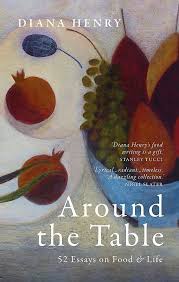
I adore well-written food essays, and Diana Henry definitely knows how to write them.
These are not new essays: they are collected from the many books that Henry has written over the lat few decades. As she acknowledges in the Introduction, this means that the essays follow changes in her own life – both children now adults – as well as changes in the British food scene, which is the audience she primarily writes for. Much easier now to find preserved lemons and sumac and other such ingredients that were ‘exotic’ some years ago. So it’s an interesting time capsule in that way.
Are there elements of this reflecting a deeply privileged life? Of course. Henry has travelled a lot, and she has visited some amazing restaurants – although she is at pains to point out that most of the places she visits are not the very high-end places, and that when she does get to those, it’s a determined effort. That said, she does still manage to buy a truffle every couple of years; and travel appears to have been straightforward for her over her whole life. Having said all of that, a book like this is aspirational – and it’s also armchair travelling. It fills those niches neatly; I will never get to have the experiences that she did, but I can enjoy hers vicariously.
I have several recipes online that I want to try already – socca, in particular – and I was reminded that you can make vin d’orange and that one might make that with mandarins instead. And if I were reading this in paper, I would have dog-eared pages or dug out the sticky notes to keep track of all of the ideas they inspired (apricot and lavender jam). As it is, I do believe I might need to buy this in paper. That’s a mark of a good book.
Once There were Wolves

This is not the sort of book I would tend to read, but it was our book club pick so I went ahead. And let me tell you, there was a degree of whiplash because I had just finished EJ Swift’s When There are Wolves Again, which has some similar ideas – rewilding, wolves should be back in Britain – but is also completely different.
Content warning: animal deaths, and violence towards women.
Once isn’t linear; we get a lot of flashbacks to points in Inti’s life, explaining how she and her twin have ended up in the Cairngorms. It’s clear that there’s been a significant trauma for the sister, Aggie, but it’s unclear just how far in the past that is – until it’s not, and then it’s sadly predictable.
So there’s the unravelling of what happened to Aggie, and there’s the reintroduction of wolves to Scotland and in particular around a farming community that is deeply divided as to whether the wolves are a good idea. And then there’s the death of a man who has clearly been violent towards his wife, and with whom Inti has been clashing. Figuring out who or what killed him runs parallel with Aggie and Inti’s story.
The book is well enough written; I skimmed a few sections, I admit, because I got a bit impatient with some of the angsting. I didn’t exercise myself to try and figure out what was going on, but let myself be carried along by the narrative, partly because I was feeling lazy and partly because the story didn’t really incite much enthusiasm for doing so – I knew it would all be tied up neatly.
It’s fine. If you’re up for a standalone mystery set in Scotland with a few different threads, this may well be for you.
When There are Wolves Again, EJ Swift
I read this courtesy of Netgalley and the publisher. It’s out in October.

I have never read a book quite like this.
It is one of my favourite books of the year.
Partly it’s the structure. We open with Lucy and Hester talking in 2070, and then swiftly move to Lucy recounting her life, starting as a child going to stay with her grandparents during 2020 (yes, the real 2020). Chapters alternate between Hester – documentary film maker, estranged from her family, a lineage of dogs her constant companions – and Lucy, growing up in a Britain rapidly coming apart thanks to climate change, also largely estranged from her parents. Both women provide a lens through which to understand the ecological changes being wrought – the heat, the floods, the fires – as well as the attempts at mitigation, particularly through rewilding efforts. These two interwoven narratives – lives that have brushed against one another over decades, then finally cross in 2070 – are a beautiful way of exploring different reactions to events, giving two generational perspectives on those events, and laying out the similarities and differences between the two women.
Partly it’s the climate change. I have read a few books focused on its near-future impacts, but it’s not something I have sought out; I generally find such speculation too depressing to want to immerse myself in. And Swift’s vision definitely has its grim aspects. As well, my exposure has tended to focus on America (because cultural imperialism) or Australia (because home). To read about what might happen in Britain – the fires, the impact of 40+ degree heat in a place where homes REALLY aren’t designed for it, let alone the impact on wildlife and particularly birds – was shocking all over again. Perhaps, even probably, this sort of thing has been written before. But I haven’t read it, and I’m going to go out on a limb and say very little will have been written with the lyricism and intensity that Swift brings.
And partly it’s the ultimate hope that Swift holds out. Between 2020 and 2070, truly devastating things happen, death and destruction and political evil (I haven’t even mentioned Albion First yet). And yet. And yet, there are people actively trying to mitigate the worst effects, who struggle on in the face of immense pressure. Greta Thunberg is name-checked. People push on despite obstacles, mostly as a group, and this offers hope.
I loved it.
The Far Edges of the Known World
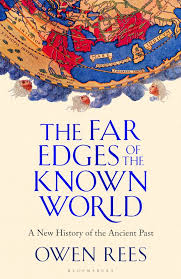
This book is right up my alley. Really old stuff, questioning received wisdom, drawing together both evidence that has been known for ages and new discoveries via archaeology… and engagingly written as well. I enjoyed it immensely.
Rees starts with the poet Ovid, who for some unknown reason got exiled by that Great Bastion of Reason, Octavian Who Got Himself Called Augustus (“Illustrious One”). Basically for the rest of his life – as far as we can tell – Ovid spent his time complaining and petitioning to be allowed back to the Centre Of Life and Light, Rome. Now, firstly this does give us David Malouf’s quite fabulous An Imaginary Life, so that’s a good thing. But it also deeply colours how subsequent historians have thought about “the edges” – those bits where if there’s a bright centre to the universe, you’re in the town that it’s farthest from. And as Owen Rees shows, this is just not a fair way of characterising “the edges” at all. Not least because “edges” implies a centre, and (the centre of a galaxy being a real thing notwithstanding), the idea that there is a “centre” to “civilisation” brings up SO MANY QUESTIONS.
The first section is about pre-history – which is a concept that Rees takes pains to explore as a concept – and it looks at Lake Turkana in Kenya (some of the earliest human occupation), the Great Cataract in Sudan, and Megiddo in Israel. This section was absolutely enchanting and sets up a lot of the ideas followed in the rest of the book: contact between different areas, the sorts of evidence we can use, and so on.
Section 2 looks at the Greek world, and Section 3 looks at the Roman. So we get the expected ‘edges’: ancient towns in (what is now) Ukraine, Egypt, France, and England, Morocco, and Egypt. This was the bit that was most familiar to me – because I know about these empires – and which was therefore the most fascinating, because it complicated all of that so fantastically. The cross-fertilisation between the hegemonic empire and the ‘barbarians’ on the border, what we can figure out of how people interacted: I LOVE IT.
Finally, the last section is ‘Beyond the Classical World’ – the book is really aiming at a specifically English, maybe American, audience, those people who are very firmly in the “Greece and Rome are THE ancient areas and everywhere else is weird.” I suspect folks who come from a perspective that says India and China were really important – let alone other civilisations – will find some of the sentences a bit surprising, maybe borderline patronising, because there’s a little bit of “these other civilisations also existed!” I suspect this does not actually reflect Rees’ own perspective, but the expected audience. ANYWAY, this section looks at ancient towns in Ukraine, Pakistan, Vietnam, and Ethiopia and Eritrea. This section was really cool and MUCH more unknown for me.
I guess the short version is “I learned a lot and enjoyed doing it.”
All That We See or Seem, Ken Liu

I read this courtesy of NetGalley and the publisher. It’s out in October.
Julia had a difficult childhood, which included living on the streets and learning to be a hacker. Now, she’s making ends meet by doing pretty basic work; it’s not fulfilling but it brings in some money. Her life is thrown into turmoil when Piers turns up: he’s a stranger, looking for someone who can help him find his wife Elli. She’s a oneirofex – someone who leads others in vivid dreams – and she’s gone missing. It’s a case of pulling on a thread and the entire garment unravelling, as Piers and Julia discover unexpected things in Elli’s past that have very real consequences right now.
And then the story goes in a direction I really didn’t expect. The swerve made me quite disoriented, but eventually I could see what Liu was doing, and overall I think it works.
This is a near-future novel, and the key aspect is that it’s very clear Ken Liu has given enormous thought to the question of “AI”: what “artificial intelligence” actually means, how it might be used in future in large and and small ways, and particularly what the consequences might be. Liu is no “it’s all Skynet” doomsayer, but he’s also no “this is the answer to everything” evangelist. Julia, in particular, uses AIs in useful and creative ways. But at the same time, there is no doubt that the ubiquity of AI in this world has had some dreadful consequences: for artists, for privacy, for security, for what I would think of as ordinary life. This is a challenging novel in the best possible way: with an engaging narrative and characters that matter, Liu makes you think about things that are happening right now. It’s not didactic, but to me at least it’s pretty clear what Liu wants you to think at the end of the novel (but maybe I, as an anti-LLM person, am just reading in what I want to see).
Canterbury 2100
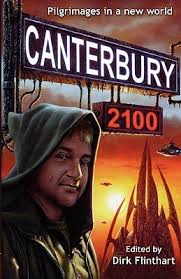
I really thought that I had reviewed this fifteen years ago when I first read it, but apparently not. How ridiculous! Anyway, I decided to reread it on a whim, and it’s still a delight.
It’s based on Chaucer’s Canterbury Tales, of course – pilgrims telling stories as they travel to Canterbury. Here, after a series of apocalyptic events only vaguely referred to, a bunch of people (mostly pilgrims) are travelling to Canterbury on a nuclear and steam-powered train. They’re delayed by rain (and worse), and start telling stories. The same sort of stories, at heart, as those told in Chaucer’s story: individuals and communities, loss and love and hope and tragedy, believable and not; all revealing tantalising glimpses about the people and their world.
There’s a great range of styles, as there should be in an anthology like this, and maybe sometimes the stories don’t seem like they’re quite coming from the same world. But honestly, would someone from Kununurra tell the same sort of story about Australia as someone from Canberra? And did you really think all of these people were telling the unvarnished truth? … all of which is to say, the collected stories feel real in a very human way.
Published in 2008, one of the fun bits is to look at the authors and see who I still know. Third up is Angela Slatter, who is still going from strength to strength; likewise Trent Jamieson, Lisa L Hannett, Kaaron Warren. There’s Martin Livings and Laura E Goodin and Grant Watson and Thoraiya Dyer… and of course it’s edited (and with connecting text) by Dirk Flinthart. Truly it’s a who’s who.
If you can still find it, this is such a fun anthology.
Damascus: Taste of a City
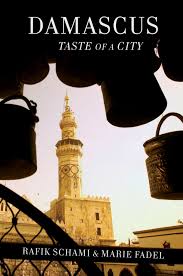
Some time ago I got a bit carried away: I discovered Haus Publishing and their astonishing range of “travel” books, and it’s fair to say I bought quite a few. This is one of them. I had never heard of Scami before, and I didn’t really know what this book was about, but I figured someone talking about Damascus was likely to be fascinating.
Schami is an author, and Syrian, and (at time of writing) had been living in exile in Germany for decades. This book is (he says) essentially transcriptions of phone conversations he had with his sister, Marie: she wondered around their part of Damascus – the Old City, the Christian Quarter – and described what she was seeing, hearing, smelling, remembering. Alongside that are the recipes. Apparently Damascenes are well known for their cooking. The book collects recipes from friends, relatives, and associates of Schama’s family, alongside incidental details about how it can be served, why this person makes the best one, and so on.
It’s very close to walking with a resident, which of course is the point. It’s also an insight into familial and friend relationships – people that I will never know, with complexities I can never understand and which can only be hinted at here, but which speak to a vibrant city that is one of the oldest continually inhabited cities on the planet. It’s almost but not quite voyeuristic – it’s gossipy, for sure, but for me it stops short of being intrusive, so I didn’t feel uncomfortable about knowing these details of people’s lives.
I can’t wait to go back through the book with sticky flags, figuring out what to cook from it.
A Letter to the Luminous Deep, by Sylvie Cathrall
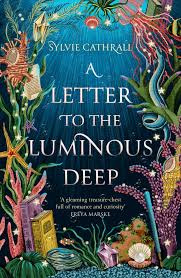
I picked this up because someone mentioned the sequel, and I thought it sounded amazing. And because it turns out I’m a bit of a sucker for the epistolary novel.
There’s a tangle of letters here. Henerey Clel and E. were writing to each other for some months… and then they disappeared, presumed drowned. Their correspondence is pieced together by Henerey’s brother and E.’s sister, some months later again, through their own correspondence. And notes from other people are also included, to flesh out various issues along the way.
Why are Henerey and E. presumed drowned? Because the world they live on has almost no land above the ocean; because E.’s house is literally underwater – and there was some sort of disaster while they were outside, near that house. The world itself is one of the most wonderful and intriguing parts about the novel; exactly how it works is gradually – very gradually – teased out over the course of the entire book, and piecing together its history is almost as much fun as learning about E. (reclusive, highly intelligent and curious, anxious, probably has OCD) and Henerey (scholar, slightly awkward, frustrated by academia, highly intelligent and curious), and of course about Sophy and Vyerin.
The language won’t work for everyone: it’s a bit on the highly-stylised end. “O dearest E.!” and so on. But for me, I felt it was done with such love – Cathrall isn’t making fun of the language, but writing it with immense enjoyment – that I was prepared to go along with it, and even enjoy it most of the time.
I must admit that I put a hold on the second book… and then let it lapse. I read the blurb, and I’m not really convinced that it sounds as compelling as the first book. At least, not enough to read it immediately. Does this first book need a sequel? I think it probably does, but also I’m willing to let the mystery just sit, at least for now.
Fulvia: The Woman who Broke all the Rules in Ancient Rome
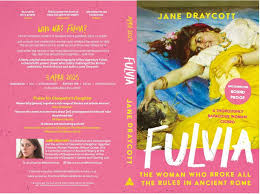
THIS BOOK.
Argh, this book. I have been waiting to get my hands on this book for… I dunno, a year or something? And now I have read it and it was wonderful.
I have enjoyed Jane Draycott’s work since reading Cleopatra’s Daughter: she has a wonderfully engaging style, she makes it clear when she’s making educated guesses but doesn’t shy away from them, and she’s determined to excavate interesting women out of either being completely ignored (Cleopatra Selene), or mostly ignored except when they’re excoriated (Fulvia).
Had I completely forgotten that Fulvia was married to Marc Antony? Uh, oops. I KNEW there was another reason that I was dead keen on learning more about her.
So little is known about Fulvia as a person that Draycott has to spend quite a lot of time going over what is known about OTHER Roman women in order to a) have a stab at discussing what most of Fulvia’s life was like, and b) putting her in context for both why some of the things she did were so unusual, and why some of the things she did were NOT unusual but still got maligned. While I already knew a lot of these things it was still great to see it all put together like this, and particularly in conversation with the life of one particular woman – for someone coming to the book with zero knowledge of Rome, I think it would be pretty accessible. The main thing that isn’t all that accessible, and which there is no getting away from, is the names. My goodness, Romans, could you not have had more imagination in your nomenclature? Gets me every single time.
Anyway. This book is a delight. It’s the best sort of revisionist history: not just accepting what ancient sources say, but examining their reasons for doing so; adding in the archeological evidence, as well as other source material; and bringing a trained feminist idea to persuasively make the case for how misogyny has worked over the centuries to write Fulvia’s story.
Look, it’s just really good. Highly recommended for anyone interested in late Republican Rome, and/or women’s history in general.
The Greatest Fight of Sunny Granada, and other stories

This is another of the book sent by a Filipino friend. You can buy it over here.
I’d not come across Kenneth Yu’s work before, but apparently this is his second collection of short stories. There’s a really interesting variety in the stories presented here.
The eponymous story is very clearly science fiction, and told non-linearly, about a man who starts off as a boxer/MMA etc on Earth and then leaves the planet to find more career options fighting aliens in the arena. Certainly on one level it’s about fighting as a sport and sport for money, but of course it’s also about family and inheritance and Place as home.
Then there’s “Spider Hunt,” which feels more like fantasy; “The Probe” is maybe SF, maybe fantasy, and works by muddying the lines. “Beats” is also genre-defying, intriguing and mysterious.
While I can see, and appreciate, what “Operation: Bleach” is doing, I’m as white as they come; I suspect it hits far harder for folks with browner skin than mine and who live in a society that upholds my sort of skin as somehow preferable. It’s another story told inventively – a series of newspaper articles and comments – and it’s probably my favourite story of the collection.
I found “Lost for Words” a bit confusing, to be honest – it’s very short, and I don’t think entirely works as a story. Then “All That We May See” tips into horror, “One Morning at the Bank” is a superhero story, and “Blending In” feels basically like realism.
And then “For Sale: Big Ass Sword” is told entirely as an ad on Talipapa, which I understand to be an online trading site for the Philippines; the story leans into folktales/fairy tales, and is a really solid conclusion.
It was never predictable what the next story would be like, and I really enjoyed that aspect, as well as the stories themselves.

 Randomly Yours, Alex