The Glass Universe
This review first appeared in Crux, the magazine of the Astronomical Society of Victoria.
 Amazing things happened at the Harvard Observatory around the turn of the twentieth century. Draper provided funding for photography of stellar spectra, while Bruce gave $50,000 towards a new 24-inch astrophotographic telescope. Pickering found the first spectroscopic binary, and Maury found the second; Fleming classified stellar spectra and discovered novae. Cannon worked on variable stars and explored the relationship between spectral type and magnitude; Leavitt also worked on variables and proposed the period-luminosity relation. Ames and Payne were Harvard’s first graduate students in astronomy.
Anna Draper, that is. Catherine Bruce. Edward Pickering and Antonia Maury. Williamina Fleming. Annie Cannon and Henrietta Leavitt. Adelaide Ames and Cecelia Payne. As Dava Sobel makes beautifully clear in The Glass Universe, women were fundamental to the astronomical work and discoveries at Harvard Observatory in its early years. This is a book in love with astronomy and its history that wants to ensure everyone who contributed—not just the now-big names like Hubble—is recognised.
Sobel points out three groups of women who contributed to astronomy. She opens her book by demonstrating how women contributed financially to astronomical work. Anna Draper provided money and telescopes so that stellar spectra could be investigated at Harvard, and endowed the Henry Draper Medal. This was done in honour of her late husband, but also reflected her own interests: she had observed with Henry, and helped with the photography; part of their honeymoon involved shopping for a glass disk for a 28-inch telescope, which the pair then ground and polished over years to transform into a mirror. At 73, Catherine Bruce’s vague interest in the stars was encouraged by Edward Pickering and by her death in 1900 her gifts totalled $175,000 (over $4 million today). Other women endowed telescopes, awards, and scholarships.
The second group, appropriately taking up most of the book, are the individual researchers at the Observatory. Most of them started as computers: examining glass plates, calculating visible magnitudes, cataloguing spectra. Some of the women worked on this for decades. Some undertook further work as their curiosity was sparked by the spectra they investigated, or the magnitudes they calculated, or they noticed interesting relationships between period and luminosity. These women published papers, and contributed to the papers of other astronomers, especially Pickering and Harlow; some of them were awarded annual medals, although not many; some were honorary membership to societies such as the Royal Astronomical Society, while Cannon was the treasurer of the American Astronomical Society. The work these women undertook was thanks in no small part to the unusual willingness of Edward Pickering and Harlow Shapley (yes, that Shapley), directors at the Harvard Observatory between 1877 and 1952 (Solon Bailey had two years as interim director), to not only work with women but encourage their independent work and acknowledge them in publication. Their work is therefore also acknowledged and discussed, since it would be impossible to separate it from that of the computers in particular.
The third group of women consists of the wives and other family members of acknowledged astronomers. Solon Bailey’s wife, Ruth, contributed to his observatons for the Harvard station in Peru, while Pickering’s and Shapley’s wives played crucial roles at the Observatory in making the whole place work. The third director’s daughter, Anna, became a computer. They are the least well served by the book; it is presumably difficult to uncover contributions if they weren’t acknowledged at the time.
Dava Sobel has not only written a compelling history of Harvard Observatory, and not only conducted a remarkable survey of the contribution of women to astronomy, but has also written an intensely readable book. There’s some wonderful scientific discussions included, about Cepheid variables and their importance to figuring out the size of the universe and the like—but these do not dominate. If you are looking for a book about the history of astrophysics, this is not it and does not want to be it. No understanding of astrophysics is required to read it. Rather, this is a history of the people involved; it has a little about their relationships with one another, but it’s mostly about the work; it sounds like most of them put their work first anyway, so that’s appropriate. It demonstrates just how much computing power was required a century ago to understand the heavens—when that computing power could be jokingly measured in “girl hours”, and sometimes “kilo-girl hours”. The women who worked at the Harvard Observatory were a crucial part of the astronomical community.
Girl Reporter
 I received a review copy of this because, well, I asked my good friend Tansy if I could read it early and she said yes… it’s coming from Book Smugglers in December and you can pre-order it right now.
I have described this as a distillation of Tansy, and I stand by that. If you listen to Galactic Suburbia, or probably Verity! as well, you’ll find as you read this book that you recognise a lot of things. Not the characters, as such, nor the plot beats, but the themes. It’s superheroes and feminism, yes, which Tansy is definitely obsessed with. But more than that, it’s got romance (she’s been reading a lot of them), motherhood (there’s been a few essays on the topic in the last few years), queer representation and ethnic diversity (she’s a champion for those things). It’s got people discussing ‘old’ media vs ‘new’ media, and speculation about new new media; millennials doing excellent things and not taking crap from their elders; and a whole bucketload of snark and banter. And given her obsession with Press Gang and Lynda Day, it was only a matter of time before that came out in her fiction. Also, it’s sooo Australian.
So yeh. This is a very Tansy book.
But wait! You don’t know who Tansy is? That’s ok! You’ll still enjoy this novella if you’re interested in superheroes, and especially if you’re interested in superheroes beyond them just punching villains and swooshing in capes. This is set in the universe of “Cookie Cutter Superhero” from Kaleidoscope and “Kid Dark Against the Machine” – and if you liked those, you’ll be super excited to know that some of the characters recur here (you can definitely enjoy this cold but it’s so worth reading those other two stories anyway). It’s a world where machines mysteriously appeared, many years ago all over the world, which turn ordinary people into superheroes with different powers (and outfits) – and return them to normal again too. The stories are set in Australia, and while the first two deal with superheroes themselves this one is specifically focussed on Friday Valentina, a vlogger with a famous mother and a variety of baggage. Her vlogging focus is superheroes and they do end up being very… involved… in the story.
It’s a hugely enjoyable story that also says some sharp things about a variety of relationships, and about Australian politics in passing too. I’m rather hoping there might be more stories in this world to come…
The Silver Well

If I tell you that reading this was like reading Angela Slatter, I think you’ll get a feel for the fact that I adored it, and for I the style of these stories.
Forsyth and Wilkins have written a set of stories that, until the last one wraps back to the first, go progressively further back in time – but always set in and around the same village in England, Cerne Abbas. In a way, it’s similar to those books of James A. Michener that I’ve read (Space, The Source) and Edward Rutherford (London, Sarum): they follow a place and a family. But these stories are generally on the more positive end, where those aren’t always; and they’re also tending towards the fantastical, which those men veer away from. Plus, neither of them ever had illustrations by Kathleen Jennings at the start of their chapters.
The book opens with Australian Rosie returning to the English childhood home of her grandparents after heartbreak, in 2017. The stories then progress back to World War 2, the 1850s, the time of the English Civil War, that of Henry VIII, the first millennial crisis of 999AD, and that of the Celts as the Romans arrive. In each case there’s some specific issue of the time that ties into the very personal experiences of the people living in Cerne Abbas, and the individual at the focus of the story. And they never stray very far from the village and its titular well.
These stories are a delight. They’re sympathetic without being cloying, sensible without being heartless; they are stories that know what it means to be human and that sometimes what’s required is hard advice, but sometimes it should be a shoulder to cry on. There’s love and loss, evil and saintly behaviour… it’s not clear exactly what each story will give you when you start reading, except that it will be sad ad mildly traumatic and possibly heart wrenching. Also, beautiful.
I really loved this collection.
Lotus Blue
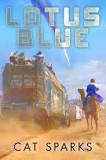 While this may not be a uniquely Australian perspective on the future – other places have deserts – there’s still definitely a strong Australian flavour running through this world. The Dead Red Heart, the dust and sand, the mad tankers (Sparks acknowledges a debt to Andrew Macrae’s Trucksong), the caravans, the grim survival in the face of crappy odds. Also the place names that occasionally gave me a giggle, to see them cropping up in this devastated future.
Cat Sparks is a friend… but she’d never expect anything but the truth from me, so don’t worry; this is definitely a fair review.
So it must be pointed out that you shouldn’t come to this book hoping for a happy post-apocalypse world, or a happy post-apocalyptic story. That is not how Sparks rolls. There is unpleasantness and violence and maiming and death and loss and lots and lots of hideous sand. This is a world where human survival relies on following rules that enable communities to survive even if you don’t understand them; where groups have to be wary of other groups because even though helping each other is a good idea, sometimes my group against yours might mean we survive at your cost. Did I mention the sand? There’s a lot of sand. Life is hard and for most people, requires hard work and sacrifice. Well, for most people… and that (naturally) is one of the tensions that Sparks works through here.
This is a world after global conflict, some indeterminate period in the world’s past, that involved soldiers created by humans – robots, cyborgs, and all manner of variations on the theme. Exactly what happened in the past is never spelled out; I got the feeling that a whole bunch of conflicts got conflated and thus, a thoroughly mangled world – which isn’t unimaginable. But the history itself doesn’t matter so much, except insofar as the remnants can be either helpful or harmful to the humans still making their way. Coming off Isobelle Carmody’s Obernewtyn series, this is refreshing, and I liked it: for most of the population survival is more important than history, and that makes sense.
The novel is made up of a large and varied cast, whose stories eventually intertwine. There’s an adolescent on a caravan in the desert fed up with her life; a supersoldier reawakened; an old, old woman eking out the end of her life; a grifter; and representatives of those doing better than everyone else, come to see what the rest of the world is like. It was good to read the variety of perspectives and remember that human survival will mean a diverse range of experiences.
The story at its most basic is a straightforward one. But the thing that really made this stand out was the world building. It helped that I happened to be reading this in a blast of hot days, but even if it had been the middle of winter I would have felt hot, felt parched, felt distressed by the unrelenting nature of the world – this is a world that really can’t support humans very well anymore. But humans are determined and bloody-minded, and that comes through too.
One thing that annoyed me was in the proofreading. There were a number of instances where commas were in weird places. And of course I can’t now find an example because I forgot to mark them, so it looks like I’m complaining out of turn. But they were definitely there: commas as though there were three adjectives but there was only two, for instance. Not a problem with the story, but something that threw me a few times.
Overall this is (I can’t believe) a great debut novel from Sparks. I hope she has more vices stories in her after she finishes her PhD…
on Joanna Russ
 I’ve had this book on my shelf to read for a good few years now. I didn’t read it at first because I hadn’t read enough Russ, and then I put it off because I thought the book itself was going to be scary. The other day I finally decided it was Time, and I’m so glad that I did. Because this book is fantastic.
It’s not a book to read if you are completely unfamiliar with Russ, in my opinion. There are a few of her works that I haven’t read and when they were discussed, I was definitely a bit less engaged and a bit left out of the conversation (my fault, not that of the writers). So you really want to have read “When it Changed” and The Female Man, and The Two Of Us and We Who are About To… before coming to this. That said, that’s not exactly a hardship. Well, The Female Man might be; it’s not linear, it’s very 70s-second-wave-feminism in its attitude towards trans women (ie not very positive), and it’s playing rough with a lot of literary conventions. BUT it’s still worth reading and then you can read THIS set of essays and that’s great!
The first five essays deal with Russ in her context, and I found this deeply amazing and exciting to read. Russ as reviewer, Russ in community, Russ being all edgy and spiky and much as I wish I could have met her I think she would have intimidated me! I also loved this section for helping me get deeper into an appreciation of what it was like to be a feminist and a female SF fan in the 60s and 70s. Things are still not always great today but things have, largely, improved – at least in my experience. These essays are all beautifully written, too, and use such a fabulous array of sources from the period that it makes me want to tell everyone to keep their ephemera! Store it safely! Print your emails!
The second, bulkier section includes essays on Russ’ fiction. Some of these go deeply into literary criticism territory – like Tess Williams using Mikhail Bakhtin’s carnival theory – and I haven’t read much lit crit in… quite a few years. So there were definitely a few bits where I did not get as much out of the essays as I might have when I was still studying and had practise. Nonetheless, the ideas that the essayists present are fascinating and intriguing and gave me new ways of thinking about the different stories. They also made me want to go and read Kittatinny, for instance, which I had thought I didn’t really need to. The essays use a range of devices and theory and ideas to get at the meat of Russ’ stories, to look at what they’re saying about society and gender and people and literature. It was actually really exciting to read.
The other thing this book gave me was a love of my feminist foremothers, Russ and the others that she was bouncing off/working with/ inspiring later. It made me really, really appreciative and fiercely grateful and amazed, too.
I’m so glad I got around to reading this book.
Galactic Suburbia 178
In which the trashfires are covered in rainbows this week. So many trashfires; so many rainbows. Huge congrats to all the QUILTBAG/LGBTQ Australians who got engaged since Wednesday 15th 2017, including friend of the podcast John Richards! You can get us at iTunes or at Galactic Suburbia.
WHAT DO WE CARE ABOUT THIS WEEK?
Australia voted Yes! And we really want Penny Wong to lead the country now please.
World Fantasy Awards: results out
China, the largest SETI telescope, and Cixin Liu
CULTURE CONSUMED:
Alisa: All the news. Literally all the news.
Alex: Lord of the Rings; Wynnona Earp season 1; Searching for Sugarman; The Red Queen, Isobelle Carmody
Tansy: Hamilton’s Battalion, Tremontaine Season 3,
Tansy’s new superhero novella Girl Reporter is available for pre-order now!! Check out her cover reveal on the Mary Sue.
Please send feedback to us at galacticsuburbia@gmail.com, follow us on Twitter at @galacticsuburbs, check out Galactic Suburbia Podcast on Facebook, support us at Patreon – which now includes access to the ever so exclusive GS Slack – and don’t forget to leave a review on iTunes if you love us!
Muriel Matters
 The short version is that Muriel Matters was an Australian actress and acclaimed elocutionist who went to Britain and ended up participating in the suffrage movement in the early 1900s, and went on to work with underprivileged children, among other things. She was also one of the first women in a flying machine, and was – as far as we can tell – the first person to engage in aerial leafletting: she tossed Votes for Women pamphlets over the side of the airship basket. She was amazing and this biography captures her wonderfully.
The longer version… is basically going on about some of the other, remarkable parts of Matters’ life. Like chaining herself to the Grille, part of the screen that stopped MPs from seeing the women who were in the tiny little room where they could watch parliament. Or the things that she endured while on her endless speaking tours, such as constant heckling and having eggs – and other things – thrown at her. The stays in prison. And her magnificent speeches about suffrage – which was not an end in itself, for Matters, but merely the beginning of women coming to full participation in social life and the fabulous consequences that would have for society. At the moment, it’s all too tragic to read some of Matters’ hopes and dreams for how women would be able to participate once they had the vote. Because yes, there were some positive changes made in SA, for example, once women were voting, around labour laws and the like. But we still see the ways in which women are hampered from full participation and the consequences of women’s voices not being taken seriously.
Wainwright, who also wrote Sheila, has done a remarkable amount of research here. Matters has never had a biography written before – and I’ve read quite a few books about English women’s fight for suffrage and she has never featured significantly in any of them. Matters died a widow, and with no children, and most of her family gone and overseas, so most of her own papers have been lost. So there’s a huge amount of reconstruction from newspapers, from early accounts of the suffrage movement, and other such sources to find out what can be found out. There are gaps, of course – in particular around Matters’ personal relationships – and Wainwright offers speculation but is clear that that’s what it is.
As to her politics and passions, those seem quite clear from her speeches and from where she devoted her energies. After becoming disillusioned with parts of the suffrage movement, Matters works with striking workers and then eventually becomes one of the first Montessori-trained teachers in Britain, working with children in slum areas. Knowledge of her later life is sketchy because she disappears from public view, which is such a shame because surely this woman didn’t sit at home fuming, after her actions earlier on? It makes me want to encourage everyone to print their emails and keep them in secure vaults so that historians can find them later.
This is an engaging, thoughtful, and generally lovely look at a fascinating and important woman who was part of a historical struggle that most people know far too little about.
Galactic Suburbia!
WHAT’S NEW ON THE INTERNET/WHAT DO WE CARE ABOUT THIS WEEK?
No more Writer and the Critic: announcement
Feminist Poltergeist podcast, from Ellenbutnotdegeneres:
Carmilla movie out
OUR DISCUSSION: Leisure, freelancing/part-time hours and guilt.
CULTURE CONSUMED:
Alisa: Otherlife; Stranger Things S2; The Trauma Cleaner, Sarah Krasnostein; Pop Culture Happy Hour; Friends Like These
Tansy: Podcasts: Uncanny 14b (To Budapest with Love by Theodora Goss & Some Cupids Kill with Arrows by Tansy; Kameron Hurley’s Get To Work Hurley #6 (how to write when overwhelmed by the world); Fangirl Happy Hour #100 (On Brand) & #101 (Howl’s Moving Castle); Thor Ragnarok – ABC Radio interview
Alex: Nexus, Scott Westerfeld, Margo Lanagan, Deborah Biancotti; Bold as Love sequence, Gwyneth Jones; Lord of the Rings; Glitch season 2
Please send feedback to us at galacticsuburbia@gmail.com, follow us on Twitter at @galacticsuburbs, check out Galactic Suburbia Podcast on Facebook, support us at Patreon – which now includes access to the ever so exclusive GS Slack – and don’t forget to leave a review on iTunes if you love us!
The Tallow-Wife
 I can always rely on Angela Slatter to shatter my heart.
This wee volume was put together by Fablecroft for Conflux, the Canberra SF convention, this year. It’s a teaser for Slatter’s next volume of stories set in the world of Sourdough and Bitterworld Bible, basically. The main feature is the title story, with a couple other short bits included, and – to make it extra special – illustrations from Kathleen Jennings.
“The Tallow-Wife” is exactly the sort of story I have come to expect from Slatter, especially when it’s a story from this world. It’s a family story, it’s a gentle story, it’s a nasty story as only family stories can be. There’s hints and suggestions of machinations that aren’t spelled out, there’s layers of heartbreak and confusion, and it’s all presented in beautiful prose that sometimes bewilders me: how can such lovely words be telling a story that tears me up? It took me a good couple of weeks to read this – I read it in two sittings but after I put it down the first time I was super reluctant to pick it back up because I knew it would just hurt. And it did, but it was worth it, and I loved it for all the pain.
It must be noted that this is a lovely <i>object</i>, too. Hard cover, Jennings pictures; it’s a delight.
Nexus
 This book was sent to me by the publisher, Allen&Unwin, at no cost. It’s out today; RRP $19.99.
I enjoyed but wasn’t blown away by Zeroes; I was immensely more impressed by Swarm. With a few niggles about the haste with which this third book ended, I am basically very satisfied with how the trilogy concluded. It levelled up nicely, ramped up the consequences and problems being faced, complex-ified the characters… and it’s a very fast-paced read. Hugely enjoyable.
The basic premise, in case you’ve missed it: six kids in a little town in America, all born in 2000, have powers, of a sort. They’re all different powers and take varying degrees of control. None of the kids is really all that happy to have their powers. They end up working together basically because of Nate, or Bellwether, whose power is a persuasive one. So if you’re into superpowers and their consequences for individuals and families and communities, this should definitely be on your radar. Continue reading →


