A Million Suns
I loved Across the Universe, the first of Beth Revis’ series about a generation ship. I was really excited about the sequel and bought it ages ago… and have only now read it, as part of my Read the Books I Own but Haven’t Read thing.
Sadly, I was disappointed.
 Spoilers for Across the Universe and A Million Suns.
The story picks up pretty much where the first one left off, again alternating between Amy – awakened before time on a generation ship that’s meant to be racing towards a new planet for colonisation – and Elder, now officially the one who’s in charge of the ship and the one who woke up Amy when he wasn’t meant to (which, the more I think about it, CREEPY. Which gets addressed briefly here but not enough). The book revolves around the issues confronting the population now that they’re off the drug that’s been in the water, keeping them all nicely docile, which also means that they can now realise that they’re being led by a sixteen year old boy (an issue which is only briefly addressed).
The good: I continue to like the exploration of generation ship issues. While I have some problems with how it’s done, it’s nonetheless good to see it done at all. If you’ve grown up in a tin can, it makes sense that at least some people are going to find the idea of not having walls utterly terrifying. It also makes sense that some people are going to resent begin, effectively, just a means to an end – why do stuff for people, and a destination, that you’ll never see? I was glad that Revis addressed some of the issues of resources and the problem of being a closed system, even if not in great detail.
I liked that people started thinking about political change. I can’t decide whether that happened too quickly or not, but it amused me greatly to see the French Revolution being referenced.
There are some pleasing aspects in Amy and Elder’s relationship. I really like the discussion of whether, if you only have one possible choice, falling in love with that person is real. There are too many examples of that just happening, as if OF COURSE I love you because you’re in front of me. Of course, this ignores the fact that people don’t necessarily fall in love with people of their own age – as demonstrated by Victria – which makes Amy’s flailing about do I/don’t I a bit precious. As mentioned above I really liked that Elder’s fascination with frozen Amy was revealed to Amy, even if it was only briefly an issue for her when I think it should have been more significant.
Overall, the writing is smooth; it’s not hard to read.
The bad: look, I don’t think I’ll read the third. That should tell you enough.
Amy and Elder both drove me nuts at different points. Amy whinges a lot, and Elder is alternately arrogant and fearful and it didn’t always make sense in context. Their relationship bugged me, especially towards the end – and I got annoyed because much of the story is about their relationship. When I realised that really, this is a love story that happens to be set in space, I got a bit less annoyed. Because that’s totally fine: it’s not what I was expecting or hoping for, but it’s a perfectly fine choice for Revis to make. Except that the story of their love just didn’t interest me that much – but that’s an issue of story telling rather than story choice.
To move on to the plot – Orion setting clues for Amy so that she finds out the truth about the ship was just ridiculous. It makes no sense for Orion to have done that, since I don’t think it’s suggested anywhere that he was sadistic. One clue, leading Amy to discover a video of Orion explaining the truth about the Godspeed, would have made sense. Or leading her to the space suits so that she could go out and see the truth for herself – that would have been fine too. But this convoluted trail that relied on Amy, a seventeen year old, having read certain stories and paying any attention to the shelving of books… seriously. No.
And the great reveal? I absolutely guessed that the ship was stationery, having already arrived. I think that the idea of people refusing to go down because of wild animals is weak, and the suggestion that people would not have earlier made exactly the decision that’s made at the end of the novel – of splitting the population – is ludicrous. The only thing that kept me reading this was to find out how the generation ship aspect was dealt with; I do not care enough to read about the population trying to make their way on the dirt.
Fringe: season 1
Tansy and Alisa have been raving about Fringe for I don’t know how long. I tried the first episode ages ago and wasn’t that grabbed by it, but listening to those two – and hearing them agree that it was great – piqued my interest. So I bought the boxed set.
This is not a review, just some rambling thoughts and questions about the series. It does contain spoilers. And if you comment with spoilers about the next four seasons, I will track you down and cry at you.
 Characters: eeeee I love Olivia. I remember I think Alisa saying that she’s the gun-drawing violent one in comparison to Peter’s more cautious character, and there really are some nice stereotyped gender-swapped moments. But Olivia overall is awesome. I love that they give her such a good relationship with her sister and niece without it compromising her job (even though it puts the niece in danger once, which was unpleasant). I do think she accepts the weird stuff a bit faster than I would have expected… but perhaps that can be explained by her both experiencing the weird stuff first hand, and her being driven enough to use any means necessary to catch the villains. And she sometimes ties back her hair before going off to chase villains!
I love Peter. I am not coming from a Dawson’s Creek background, so there is no residual Pacey affection clouding my thoughts. But Peter – he’s marvellously complicated. I love the exploration of his relationship with Walter, I love his shady past and the way he’s really quite open about it and uses it for good. It’s a bit problematic to see just how quickly he appears to have turned to the Bright Side, but I think that can be explained by the Bright Side finally giving him enough of a challenge that he doesn’t need to evil to be amused anymore. There’s clearly a lot more to be found out about Peter’s background – I don’t think they’ve adequately resolved the whole ‘people are after him’ thing, so I expect that to keep recurring, which is so fine.
Walter is… well. Brilliantly acted. John Noble portrays driven, and confused, and childlike, and distressed magnificently. Snapping between his different mental states is done to great effect, and I love that his attitude isn’t always in keeping with everyone else’s; he’s so clearly on a completely different plane from those around him. While Olivia and Peter are great, and drive the plot forward, I don’t think the show would work without Walter. And I don’t mean because he’s the brains and clearly partly (if not mostly) the reason for the weirdness going on – I mean because his offbeat character is what makes this more than just an X Files remake.
And then there’s my one frustration: Astrid. We know a little about even Broyles’ home life, by the end of the season, but Astrid? Nada. We know she’s got a linguistics and computer science background, but only because it was relevant to the plot at one stage. If I don’t get some more background on her in the next season, I am going to be very cranky indeed. My darling is convinced she’s going to end up being evil…
The plot: I like the alternate reality thing. I still don’t really see how or why the nasty events to this point contribute to anything to do with the alternate reality – because I assume that’s what will be revealed – but I’m willing to go along with it. There were a few episodes that threatened to slide into just-another-monster-of-the-week, but mostly the writers rescued them with some line about the Pattern, or more often linking it back yet again to Massive Dynamic. I adore the fact that Massive Dynamic is slip-sliding between Good and Bad, just like William Bell and Walter himself.
Yes, I had absolutely guessed the truth about Peter before that last reveal at the end of the last episode. Walter had been dropping some pretty major hints, after all.
Questions: when will Peter find out about the truth of where he’s from? Is Nena Sharpe evil? Is Astrid evil? Did Walter write the manifesto? How bad can things get from here? Will Olivia and Peter get together? How much more Leonard Nimoy can I have?
Yeh, totally hooked.
The Crooked Letter
I’ve read this as part of my great Read Everything I Own but Haven’t Read Yet pledge, which I’m hoping to make serious inroads into this year. We’ll see…
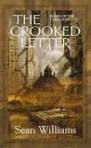 I got this a number of years ago as part of a show bag at a Swancon. I had read some Williams before, but not much. Since then I have read large chunks of his SF, but – until now – none of his fantasy except for the Troubletwisters books with Garth Nix. (It’s actually been a while since I read much fantasy at all, which is curious to realise.)
Slight spoilers!
Williams clearly has a thing for twins. In this, the twins are mirrors of one another, down to one of them having his heart on the righthand side of his chest. Their names are Seth and Hadrian – and I’ll admit to being a bit disappointed with the name choice, given that both lend themselves to some nice tricksy name-association, just not with each other. Moving on… Seth and Hadrian are on holidays in Europe. They end up travelling with a girl, Ellis, and then everything gets weird when one of them is stabbed. That’s not the weird part, though – the weird part is the non-stabbed one waking up and realising that the world is very, very different from when he last had his eyes open. And then things just get worse. For both of the twins.
There are some really nice elements to this story. Overall I thought the twins’ relationship was a well-developed one, nearly perfectly balanced between love and… not hatred, but perhaps despair at being tied to this same person in so many ways for so long. Occasionally I got a bit bored by the whinging, but perhaps that’s teenagers for you. The cherry-picking of mythology and characters from all over the world was a nice touch – it certainly avoided being eurocentric, which is always nice to see, and plays into a bit of a Jungian idea of the great subconscious with these commons themes that can (maybe) be seen. And I especially loved that Hadrian’s adventures mostly took place in a city – THE city, the great underlying city, what every city dreams of being. While I do love me some epic horse-riding and camping out, grand fantasy played out on city streets also has a lot of appeal.*
There are, though, some aspects that grated. Hadrian’s absolute insistence on finding Ellis – and that people are willing to help – strained credibility: HELLO, everyone ELSE appears to be dead, so how exactly are you planning on finding one probably-dead girl in the great uber-city? I was hoping right from the start that Ellis was going to turn out to be more than just a girl, and that all of the non-humans knew it, since that would excuse it to some extent. The first was correct but not the second, so my annoyance with that plot element still exists. Sometimes the mashing of multiple mythologies did not gel for me, and the explanation of the Three Realms really didn’t work for me. I can’t explain why; I don’t think it’s my faith getting in the way, since it rarely does with this sort of fantasy (that is, the sort that’s clearly playing with pagan ideas, rather than Crystal Dragon Jesus types).
I did finish it, which means I did enjoy it even if I didn’t adore it. I own the second Books of the Cataclysm, The Blood Debt. While it’s not next on my list, I will definitely be reading it at some point… and from there I’ll see whether I get around to the other trilogy that this is actually a prequel to, the Books of the Change.
You can get The Crooked Letter from Fishpond.
*Hmm. Do I need to read Lord of the Rings again sometime? I’m getting an itch…
Diamonds are Forever
This review is part of Project Bond, wherein over the course of 2014 we watch all of the James Bond movies in production order.
Summary: in which Bond is Connery again, Blofeld is the villain again, and the action takes place in a remarkably tacky Vegas that includes an elephant playing the slots (and winning). This is the first new Bond for Alex!
Alex: Yes friends, Connery came back for one more film after what was apparently a spectacular flop thanks to George Lasenby (unfair!). Mimicking the opening of that film, we hear Bond’s voice in the prologue long before we see his face, going for that tantalising thing of “is it? Is it??” which must have been completely offset by what was undoubtedly a massive advertising campaign.
If you haven’t seen the film, then my summary contains a massive spoiler, because Bond kills Blofeld in the prologue just before he undergoes some sort of plastic surgery. After all, the man has just shot his bride! … about which M is astonishingly insensitive, asking acerbically whether he can expect Bond to get back to his job now please? If he’s quite over being all emotional? Anyway, the grand denouement in the final act is that Blofeld is in fact not dead, but is manipulating a diamond-smuggling racket by impersonating a reclusive casino mogul. As one does when one has once again changed appearance, no longer being Telly Savalas but now Charles Gray.
The franchise can’t really decide whether it wants continuity or not: Bond kills Blofeld for revenge, but then ignores being a widower; Blofeld remarks that “science was never my strong suit” – except that of course it was, in the last film, since it was never suggested that he was simply the manager of the anti-allergy clinic. I imagine that this was a problem at least partly because that mysterious they never imagined the franchise would extend to six films; after all, who needs to think too hard about continuity for a run of maybe three films?
Before this reveal, it appears that the main villains are two utterly inscrutable men: Mr Wint and Mr Kidd, as they always call each other. Their motives for creating mayhem are never, as far as I can tell, fully revealed; they don’t even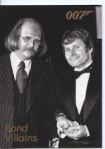 seem to be in it for the money. Maybe they just like killing and creating mayhem. They do have that feature common to most Bond villains: something that sets them apart from that manliest of men. Not a deformed hand or a scar… instead, they appear to be gay. Evidence? They are grown men who hold hands, and one comments that “Miss Case seems quite attractive – for a lady.” I’m intrigued that a film from the late 60s got away with having a homosexual couple. Villainous and hardly flaunting it, but still; my expectation of this era is that this was utterly verboten. Perhaps a franchise like this could get away with it? … but if that’s the case, then why don’t we see more gay characters in mainstream cinema in the 21st century? These are the questions that try, etc.
The plot revolves around diamond smuggling, which lends Moneypenny the opportunity to hint very broadly at Bond bringing her back a diamond ring – too soon! The real problem with the smuggling is that those diamonds are not, then, appearing on the market – they are presumably being stockpiled to then be dumped, or such a tactic threatened for blackmailing purposes. So once again Bond’s talents are being utilised for the benefit of the economy, not national security. To figure out what’s going on, Bond impersonates a diamond smuggler to hook up with Tiffany Case, to whom one of his first comments is “That’s a nice little nothing you’re almost wearing; I approve.” So what I think of as Roger Moore-era scripting, isn’t.
Which leads me sideways into a discussion, as always, of the women in the film. Case is initially a tough, business-oriented middleman for the smuggling operation. However, her character rapidly descends into can’t-do-anything-ness, which I found intensely irritating. Bond slaps her at one oint, to get information from her, and she barely reacts. My own reaction to this is complicated. I understand that in action films, there is violence. The fight scene between Pitt and Jolie in Mr and Mrs Smith? Brutal, and appropriate. The dance/fight between Starbuck and Apollo? Ditto. I don’t have a problem with men and women being violent in that context. Done in a manner that actually makes sense in the context, even demonstrations of the horror of domestic violence can make sense (this is an exception rather than a rule though). My problem with the violence shown in this – and other Bonds – is less that it’s a man hitting a woman, and much more that the woman rarely complains and it’s frequently immediately preceding or following sex. Yes, I know that the psychology around women in domestic violence situations is incredibly difficult: but this is Bond. It’s not aiming at verisimilitude, nor is it attempting to get across a deep message. Instead it’s suggesting that such violence is completely acceptable in someone like Bond – someone we admire. And I think that’s contemptibly lazy.
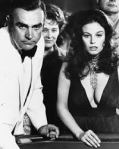 I should also mention the other three women in the film, but that won’t take much space. Bond meets Plenty O’Toole at the craps table; they go back to his place where a goon throws her over a balcony – fortunately for her, into a pool; she ends up drowned in a different
  pool later in the film. And then there’s Bambi (who’s white) and Thumper (who’s black): (body)guards of Willard Whyte, the man Blofeld is impersonating. They’re beautiful and athletic and tough, and of course Bond manages to take them both down.
Back to the plot, briefly: Unlike Goldfinger, whose goal really did revolve around the economy, Blofeld’s plans are grand and involve worldwide nuclear disarmament. For this reason he is working hand-in-glove with Professor Metz, a committed pacifist, who of course believes that Blofeld won’t actually take the final step of using the laser to harm anyone. Aw, so sad to see his disillusionment. Bond foils the plan to use the laser by switching cassettes (cassettes!) and stuffing the real one down Case’s bikini bottoms. Case then switches them back, thinking this is what Bond wants her to do and that she’s the one putting in a fake. Bond’s wrath at Case’s incompetence is spectacular… except of course it wasn’t incompetence, it was an entirely understandable and incredibly brave undertaking on her part – Bond just didn’t think she had the ability to do anything useful. It all comes good of course and Blofeld is really and truly killed, The End.
There is further evidence in this film of the franchise’s inherent SFnal nature. Tiffany Case has a most awesome machine that scans a photograph of Bond’s fingerprints and compares them with a set on file; Q has provided Bond with fake fingerprints for just such a contingency. There’s some discussion of radiation shields, a fake moon setting, and the whole point of the diamonds is actually to somehow allow the satellite to focus its laaaaaassseerrrrrrr better.
James: The most striking thing about this film is how different it feels to all the European based films which have come before. The American muscle cars, the desert and big sky country. Vegas is super cheesy and the car chases contrived. It would seem the world was still obsessed with space when this film was made with yet another villain using satellites to create a mayhem and destruction story line. One particular conjunction of all these themes was a chase involving a moon buggy, moto-trikes and cars across the desert – incomprehensibly the moon buggy with its top speed of about 7km per hour easily beats all comers. 1.5 Martinis.
Greg Egan: Quarantine
I think – in all my vast understanding of the world – that one of the things that really sets Greg Egan apart is his willingness to drive real physics to its ruthless end.
This is not to say anything against his plots or his characters. On the contrary, I think Egan does utterly absorbing plots and some remarkable characters. But so do other SF writers. There are few others, though, who combine this with a determination to take real-world physics and drive them a long, long way.
 Quarantine is a case in point. Take the idea that quantum mechanics suggests, that of collapsing probabilities as a wave function and the role of the observer in doing so. (Dear scientists, if I have just or am about to claim the equivalent of the Dark Ages being a real thing, please let me know and forgive me at the same time.) This leads to the many-worlds theory, whereby every action spawns alternate worlds where that action was done differently.
Now extrapolate to its ruthless conclusion.
Now add a detective thriller plot.
Now add a world in which there are no stars – they went out some decades ago.
Add the ability to mod your brain (turn off boredom, modulate emotions, change memories and attachments).
Add a world where Arnhem Land has become an autonomous nation and offered part of its land to become New Hong Kong.
… and you begin to get an idea of what Quarantine is like. Seriously, just a few of those things could make for a great novel. But they’re all there. Some are just part of the world-building, some are fundamental to the plot, all work cohesively together to produce a book that I read in a day (it’s only 250 pages, ok? And there are no formulae in this one, unlike the Orthogonal books).
I am never bored by Greg Egan, I am never impatient with Greg Egan, I am consistently surprised by Greg Egan. This is another good one.
You can get Quarantine from Fishpond.
Galactic Suburbia 96
In which we announce the 2013 Galactic Suburbia for activism and/or communication that advances the feminist conversation in the field of speculative fiction.
[If you want to listen unspoilt to the episode discussing shortlist and winners of the GS Award, listen over here right now without reading the rest of the show notes. Don’t even glance at them! Move along, nothing to see here]
Culture Consumed:
Alex: Shadow Unit! Haven ep 1!
Alisa: Fringe, Haven S1, Game of Thrones S1 and S2, Veronica Mars Movie
Tansy: The Lotus Palace by Jeannie Lin; Dark Eyes 2 (Big Finish); Veronica Mars Movie
Shout out for Night Terrace.
Cranky Ladies of History funded!
Galactic Suburbia Award!!
for activism and/or communication that advances the feminist conversation in the field of speculative fiction
Malinda Lo’s continuing statistics gathering on LGBT YA books
Foz Meadows for her blogging generally, but particularly “Old Men Yelling at Clouds.”
Anita Sarkeesian – Tropes vs Women in Video Games (Damsel in Distress 1 & 2, Ms Male Character)
Kameron Hurley, ‘We Have Always Fought’: Challenging the Women, Cattle and Slaves Narrative,” at A Dribble of Ink.
The Doubleclicks – Nothing to Prove music video
Cheryl Morgan – The Rise & Fall of Grimpink
Deb Stanish for her essay in Apex magazine: “Fangirl isn’t a Dirty Word.”
Honorary shortlistee (the Julia Gillard Award):
Wendy Davis for her amazing filibuster
Joint Winners this Year!!!
(drum roll please)
NK Jemisin for her GoH speech from Continuum (link)
Elise Matheson for her essay “How to Report Sexual Harassment at cons” (link)
Also discussed:
“Not Now, Not Ever” (Gillard Misogyny Speech) by Australian Voices
Please send feedback to us at galacticsuburbia@gmail.com, follow us on Twitter at @galacticsuburbs, check out Galactic Suburbia Podcast on Facebook and don’t forget to leave a review on iTunes if you love us!
Freedom and Necessity
So there’s this girl I’ve known for about half of my life. She’s been foisting books on me for most of that time. Sometimes that works out really well; she threw a comic fantasy at me by a new Tasmanian author once, someone called Tansy Rayner Roberts, and that’s turned out ok. At other times, I have been less… enthused. Because much of what she has directed me to has been romance.
(Long time readers of this book, cue the eye-rolling.)
Mea culpa: I have been a member of that set who poo-poohed romance as a genre. I have been dismissive of the covers and presumed they genuinely represented the contents; I have dismissed romance as not worth reading; I have dismissed the people who loved reading it. The fact that some of my friends enjoyed reading it confused me no end, because how could they be part of that group? I dismissed it as mere escapism… even as I bared my teeth at people who did the same to me over reading science fiction.
I am not proud. I am still getting over this attitude. And what both makes this attitude bizarre and helped me get over it was, at the time grumpily, actually reading most of the books I was directed to… and realising that they were well-written. Yes there’s crap romance; there’s really crap SF too. This should be no surprise. Also, I finally admitted that I quite like good romance aspects to my SF&F, and that that is okay. Part of my problem had been dealing with rather anti-girl and anti-feminine aspects of my own character (this is something that’s years in the discarding).
Anyway, she gave me Freedom and Necessity, and… the world changed.
The aforementioned friend recently sent me a copy of Freedom and Necessity which she rescued just for me, thinking I should read it again. Oh, how I love this book.
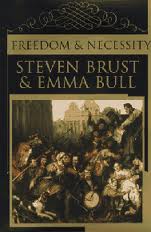 It’s 1849, and the convulsions that threw Europe into confusion in 1848 – attempted revolutions all over the place – have mostly simmered down. The Chartist movement in England (wanting outrageous things like manhood suffrage, paying politicians – so you don’t have to be rich to stand for election – and a secret ballot) has also mostly been contained. James Cobham wakes up at a rural pub with, he writes to his cousin, no memory of the last two months, during which time he has been presumed dead by drowning.
The entire novel is constructed via letters and a few diary entries. This does mean an occasionally improbable concession towards memories being excellent, but also raises the intriguing possibility of unreliable narrators all the way through. Also, the friend pointed out that reading it on the days the letters are written is both a fascinating and excruciating experience – the latter because the urge to keep reading is just. so. strong.
There are four main letter-writers. James; his cousin Richard; James’ step-sister and Richard’s paramour, Kitty; and Susan, also a cousin. The family is aristocratic in that way that doesn’t entirely make sense for a modern Australian – they’re not dukes, but they are wealthy and landed. James has been the family’s black sheep for a long time and clearly has a dubious past; Richard is something of a dilettante and scandalous for living with Kitty; Kitty seems flighty and wilful, at least at first; and Susan is sensible, determined, and intimidatingly modern.
Susan is my favourite. Susan is on visiting terms with Friedrich Engels.
The plot wheels between political machinations, dastardly plots of a political and a personal nature, family in-fighting, pseudo-druidical secret societies, fairly in-depth philosophical arguments, and falling in love. The fact that it is written as letters between different people means there are four distinct voices, with their own personal ambitions, hang-ups, and secrets; people don’t have all the same knowledge at the same time; and sometimes letters don’t get to their intended recipient at the hoped-for time, leading to… well. You can imagine.
I love the romance aspect; I love the historical aspect; I love the thriller aspect. There are serious arguments about Hegel that leave me bewildered. This book is delightfully well-rounded, and I am so very thankful to Kate for giving it to me so I can read it again and again, and loan it to Very Special People.
(Kate, by the way, is the creator of incredible jams and chutneys from local Tasmanian ingredients. If you’re keen on suchlike, search her out on Twitter – @justaddmoon – seriously awesome! /end plug)
You can get it”> from Fishpond!
On Her Majesty’s Secret Service
This review is part of Project Bond, wherein over the course of 2014 we watch all of the James Bond movies in production order.
Summary: In which Blofeld plans to hold the world to ransom with an infertility virus via pretty girls, while Bond proves he’s a Time Lord, breaks the fourth wall, pretends to be a gay genealogist, and gets married.
And widowed.
 Alex: Let me deal with each of the points above in order.
Once again we’re back to SPECTRE doing evil things, but this time Bond deals exclusively with Blofeld. In the course of trying to bring Blofeld down in the interests of “of course I would”, Bond discovers that Blofeld is running a not-for-profit centre dealing with severe allergies. Which sounds surprisingly philanthropic until it’s revealed (partly via a very acid-trip/hypnotism colour sequence) that the patients have all been tasked with spreading a nasty virus that will render anything it comes near – including humans – infertile somehow. Exactly how? No idea. But it will, honest! Unless the UN grants him… immunity!! (Wha-?)
All of the patients are very pretty young girls. This allows for some gratuitous shots of women in crazy/skimpy clothing, lounging around. It reminded me a lot of Castle Anthrax.
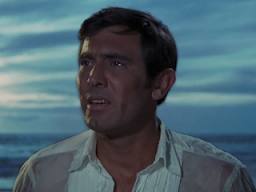
Bond, however, is not Bond. Or rather, he is Bond but his face has changed, not that anyone notices. Connery hung up the Walther PPK after five films and Broccoli et al went with George Lazenby instead: an Australian who, before this, had only ever done chocolate commercials. And the first sight I got of him this time, all I could think was: Look at that chin! You could hurt someone with that chin. The prologue introduces both main protagonists, as Bond gets into a high-speed car-flirtation with a woman who then tries to walk into the ocean. He rescues her, ends up getting decked by thugs, and then – after defeating them – she’s gone. At which point Bond picks up her shoes, comments “This never happened to the other fellow” and looks straight at the camera. I’m honestly not sure what I think of this level of meta in my Bond. It’s a bit weird, frankly, and is matched by the “all the girls I’ve loved before (and the villains who’ve failed to stop me)” montage in the credits immediately after – and the souvenirs, matched with appropriate musical stings, that Bond finds in his desk when he’s back in London. (Bond has a desk! Who knew?)
Lazenby often gets panned in the “who’s your favourite Bond” discussions and look, this is not the greatest Bond film. But I don’t think that’s entirely Lazenby’s fault. In fact, when Bond is facing off against Blofeld – now played  by Telly Savalas – I think Lazenby is excellent. Despite being in a kilt (another thing that never happened to the other fellow. Also, I don’t think Connery would have been shown flicking through a Playboy and nicking the centrefold). It’s not Lazenby’s fault that the script is a bit weak; the montage of riding horses through dappled light is utterly eye-rolling, despite the presence of Diana Rigg, and would not have been improved by Connery (or, dare I say, Daniel Craig). Plus, I’m not sure whether it’s because of Lazenby or changing expectations of film-making, but I think the fight scenes were slightly more realistic and definitely more aggressive than in most of the previous five films.
I’d like to point out right here that Bond and Blofeld met in the last film, so the idea that Bond could try to fool him by posing as someone else – even a gay genealogist with the College of Heraldry – is ludicrous, unless we accept that You Only Live Twice is retconned out of continuity?
Anyway, Blofeld wants his position as the real count de Bleuville accepted, which is how Bond gets into his clinic, by posing as the genealogist who will investigate his claim. (He has his own coat of arms investigated to brush up on heraldry. His family’s motto? “The world is not enough.”) This leads to ‘amusing’ scenes of boring pretty young ladies absolutely stupid with discussion of lions couchant and bezants. Did I mention that one of these young ladies is Joanna Lumley?

Speaking of ladies, so far I’ve only hinted at the primary Bond Girl in this film, and she’s the most famous of these first six: Diana Rigg. She also has a sensible name! – Tracy. And Tracy is a match for Bond – ruthless, somewhat careless about sex (by traditional standards – she sleeps with him partly because she thinks she ‘owes’ him after he stumps for her at the card table), stubborn and independent… well, that’s what she’d be like today. She doesn’t entirely get to be that here, not least because her father – second only to Blofeld in European crime but still very much a frustrated and concerned father – decides to bribe Bond to woo her, because “what she needs is a man to dominate her.” To his credit, Bond protests that what she actually needs is therapy… but in return for Blofeld’s location, he will indeed get more involved with her. Of course it all ends up gooey and sentimental and they fall in love, and they get married at the end of the movie. There are royalty present, apparently. Moneypenny cries.
And then, as they leave on honeymoon, Blofeld – who should be dead – drives past, and his 2IC shoots at the car, and Tracy dies. Tracy, the Bond girl least involved in Bond’s machinations to this point, is killed not in a fight or as a hostage or a statement of ruthlessness, but because the villain can’t aim properly. I hate this ending so much.
Racial issues: there’s only two non-white characters, by my reckoning; an Asian woman who only appears briefly, and a black man working for Tracy’s father, who fights well but only gets to grunt, never speak.
Louis’ version is lovely, but having only known Iggy from his Stooges days and then doing insurance ads… well, this is a revelation.

James: The credit girls have improbably pointy boobs in this film. The cast seem to be wearing too much foundation, but perhaps that’s just the high-res scans and retouching of the original films. I enjoyed the ski scenes and everyone loves a mountain top fortress. The plot and script is the weakest of all the film so far. Lazenby isn’t good, but I’m not sure he’s as bad as he gets portrayed either. Not a gadget to mention in this film. 2 Martinis.
Galactic Suburbia 95
In which the Hugo host debacle online conversation became a many-tentacled AI that wants to steal our souls, and ladies are cranky. Get us from iTunes or over here!
Speaking of Cranky Ladies – check out Tansy and Tehani’s crowdfunding campaign.
News In Depth: The Hugos v. Jonathan Ross, Safe Spaces & Online Discussions
Foz Meadows laying out the original drama in her usual inimitable style.
Cheryl on the arguments for & against Jonathan Ross as host as particularly on the importance of Intersectionality – how to be a good ally, and why you LISTEN to why people are upset, even if it’s inconvenient to you or your community.
The Chairs of LonCon apologise for the situation – weirdly, this graceful and thorough acknowledgement of their responsibility for how the chain of events went is often not being mentioned in coverage of the discussion.
UPDATE, PLEASE READ:
The downside of recording several days ahead of broadcast is that sometimes the conversation we are contributing to moves on without us – in particular with the “Hugos and Jonathan Ross” conversation we recorded on Wednesday night there has been some serious reframing of the narrative, some of it highly gendered.
We wanted to reference some of this further discussion rather than be seen to ignore such an important (and troubling) development.
Some important posts calling attention to the reframing of the narrative to trivialise the concerns of women (and to hide the fact that many prominent men shared and vocalised those concerns):
Kameron Hurley on Power, Responsibility, Empathy and Privilege
Kari Spelling on how the conversation has changed from being about the unsuitability of Ross as a Hugo host to being about how women were “mean” on Twitter – and how those women are continuing to be unfairly targeted.
Natalie Luhrs on “Reframing and Punching Down” – with particular reference to how those posts calling for people to be nicer to each other, or how fandom is too hysterical to deserve nice things, aren’t always as helpful as you think they are.
David Perry questions the mythical concept of Seanan Maguire’s Angry Mob, calling particular attention to how Seanan and her tweets are now being reframed as central to Jonathan Ross’s resignation, due to selective quoting, selective memories and gross misrepresentation of the actual timeline of events. This is important stuff, people. Our history just got rewritten while we were watching.
[note: we deliberately didn’t mention Seanan by name while discussing the issue in this episode of GS because we could see she was already being unduly blamed and centred in the discussion despite being only one participant – it’s the exchange between Seanan and Jane Goldman mentioned in the Perry article that Alisa also refers to as a conversation that ends in mutual apologies and is later misrepresented by others long after it’s concluded.]
Another important post by Kameron Hurley, Rage Doesn’t Exist in a Vacuum. On why internet rage happens, why someone else might be more upset than you are about a thing, and why it’s important to speak up about upsetting things even if it ruins someone else’s happy party fun times.
Culture Consumed:
Alisa: Game of Thrones S1, Fringe S3, Kaleidoscope ToC
Tansy: Ms Marvel #1 & She-Hulk #1 Fringe S3
Alex: Midnight and Moonshine, Lisa L Hannett and Angela Slatter; A Stranger in Olondria, Sofia Samatar
Pet subject: feedback
Galactic Suburbia Award!! (last call for suggestions)
for activism and/or communication that advances the feminist conversation in the field of speculative fiction
Please send feedback to us at galacticsuburbia@gmail.com, follow us on Twitter at @galacticsuburbs, check out Galactic Suburbia Podcast on Facebook and don’t forget to leave a review on iTunes if you love us!
The Pankhurst women
 This post is written as part of the Women’s History Month Cranky Ladies of History blog tour. If you would like to read more about cranky ladies from the past, you might like to support the FableCroft Publishing Pozible campaign, crowd-funding an anthology of short stories about Cranky Ladies of History from all over the world.
One cranky lady is awesome. Three in one family? That deserves a collective noun.
Let’s call them a Pankhurst.
These were women who went to prison, and on hunger strike, for their beliefs. Who held controversial views and insisted on their right, as humans, to make their views heard. Emmeline and her daughters Christabel and Sylvia Panhurst were very definitely Cranky Ladies. (Emmeline also had another daughter, Adela, who was probably equally cranky and was certainly involved in politics and the suffrage movement; less seems to be known about her activities than those of the other women in the family, though.) Their primary focus for much of their politicking careers was gaining suffrage for women in Britain (Sylvia went on to do other, also radical, things.)
Emmeline came from a family that had long supported equal suffrage for men and women, and married a radical lawyer named Richard who was a pacifist, republican, anti-imperialist and also a supporter of women’s suffrage. Gloriously, he seems to have genuinely walked the talk, and encouraged his wife to be involved in committees supporting women’s suffrage – even when they had children, which is also remarkable. She did many serious things as a young wife and mother, including hosting political parties for her husband – let’s not forget how important a space this could be for women; salons were not just about cucumber sandwiches and gossip, but often a place where women could genuinely get their views heard, in a society that prevented women from voting at a national level. She also worked as a Poor Law Guardian, including taking issues such as poor diet, clothing and conditions straight to the authorities and arguing for change – some of which was made. And she was in at the outset of the Independent Labour Party in the 1890s, forming a close working relationship with Keir Hardie.
All of these things would be enough to make Emmeline an admirable woman, if not one that stood out: there were, after all, many other women doing similar things at the time – you don’t get to have a Manchester National Society for Women’s Society with just one woman involved, and of course there were other societies doing similar things around the entire country. But Emmeline is most well known for the organisation she founded, with her daughters, after her husband’s death: the Women’s Social and Political Union, or WSPU.
You might have heard of them. They’re the ones who were originally called suffragettes by the Daily Mail, in an effort to be disparaging. How’d that work out again?
Emmeline and Christabel, in particular, decided that the so-called ‘constitutional’ methods used so far, especially by groups like the NUWSS (National Union of Women’s Suffrage Societies, headed by the awesome Millicent Fawcett), were just taking too long. Petitions, rallies, and refusal to pay taxes was all well and good, but maybe what was needed was something a bit more… confronting. Christabel later said that the first militant action she ever undertook was simply (‘simply’!) speaking in a political meeting; Emmeline identified the first militant act of the WSPU as when a group of women stood on the steps of the House of Commons to protest against the Women’s Enfranchisement Bill having been deliberately talked out, so that no vote on it could be taken. Things escalated from here, with all three Pankhurst women being arrested at various points for various actions, including deliberately spitting at a policeman in order to get arrested; ‘incitement’, in Emmeline’s case; and sometimes for speaking in public. Members of the WSPU did more and more radical things, up to and including arson and destruction of public property; Emily Davison, she who died after being knocked over by a horse at Epsom Derby, was a member.
When they were put in prison, most of the WSPU were put into the Second Division – where ordinary criminals went – rather than the First Division, for political prisoners. Partly to protest this indignity, many of them – including all three Pankhursts – went on hunger strikes. The authorities responded by force feeding them, which caused outrage, and was later stopped when the government – a Liberal government! – introduced what became known as the Cat and Mouse Act: when a woman got sick from a hunger strike, she was released to recuperate… and then got rearrested. Rinse, repeat. Emmeline, Christabel, and Sylvia all went on numerous hunger strikes, and Emmeline’s health especially was seriously compromised.
I should note at this point that I do sometimes fall into the trap of talking up the Pankhursts and their militancy and ignoring the long, hard work that women like Fawcett put in for many decades on the suffrage issue, which also contributed enormously to the profile of the women’s suffrage movement, and helped to demonstrate that the vote was not simply desired by a small bunch of waspish spinsters trying to get back at men. I firmly believe that suffragists (as the constitutionals are often remembered) and suffragettes both contributed to the eventual success of the movement.
Throughout its existence, Emmeline and Christabel ran the WSPU fairly undemocratically. Which sounds like an odd temporisation, but the reality – which seems actually quite hard to come at – is that while they ran the WSPU along authoritarian lines (there were no elections; the Pankhurst word was it), members could and did often run their own thing when it came to protesting. All the evidence suggests that they had no idea of what Davison was going to do at Epsom, for instance. And they lost the support of Sylvia, mostly because their politics diverged: Sylvia kept going left (she ended up being involved in the founding of the British Communist Party), while Emmeline and Christabel were starting to tend right. They never reconciled.
Women got the right to vote in Britain in 1917, if they were over 30 and either householders or married to a householder; in the same bill, all men over 21 got the right to vote. Women got the franchise on the same basis as men in 1928. Emmeline and Christabel had not actually been involved much in the struggle since 1914, having chosen to devote their efforts to WW1; Sylvia continued to protest, with her East London Federation of Suffragettes, because she was also protesting against the war itself. Emmeline even went to Russia and got to meet Kerensky, between the February and October Revolutions, although neither was very impressed with the other. After the vote was achieved, if on compromised grounds, Emmeline did not retire to a life of carpet bowls and singalongs: she went on lecturing tours of America and elsewhere, and even stood as a parliamentary candidate for the Conservative Party. Christabel also went on speaking tours; she was most focussed on the problems of venereal disease, and how to stop this ‘great scourge’. Sylvia went on to have a long and radical life: she was involved in socialist politics, she ran a newspaper that was probably the first British publication to run a black journalist’s article, and she was intensely motivated by anti-racist, anti-fascist, and anti-imperialist ideas. Also, she had a baby without being married, and she wasn’t ashamed of it. In the 1920s.
Emmeline Pankhurst. Christabel Pankhurst. Sylvia Pankhurst. Three very cranky ladies who have had a huge impact on history: the first two mostly in Britain, the last in Britain but also in Ethiopia, where there’s a street named after her in Addis Ababa for the work she did on their behalf. Every time I think that voting is a waste of time because one person can’t change things, I think of their sacrifices – even though in a different country – and I realise just how amazing an opportunity it is.
(I’ve reviewed biographies of Emmeline and Sylvia, as well as other books about suffrage history.)


