The Man with the Golden Gun
This review is part of Project Bond, wherein over the course of 2014 we watch all of the James Bond movies in production order.
 Summary: in which Bond meets his assassin-y match and there’s something about solar power? Also, Bond seems surprisingly disinterested in teh ladeez. With bonus Christopher Lee!
Alex: another Bond that I’d never seen before! So that was exciting! … which was something, at least, since this is another film that took us two sittings. Partly that was tiredness on our part, but partly that was because this film so soooo slooooow. Better than Live and Let Die, but slow nonetheless. Probably the most exciting part of the entire film was thinking, “hey, Scaramanga looks familiar. He actually looks a bit like Christopher Lee!” And then realising omg it IS Christopher Lee!!
I’m being slightly unfair, I guess. Let me start then with ways in which this film shows its cleverness. I had always thought that the theme song for this, sung by Lulu (does that make it the most pop song of the lot? does she beat Madonna and A-ha?), was an amusing conflation of the villain with Bond. Turns out that all of the lines are actually applicable to Scaramanga, right down to the “Love is required/ Whenever he’s hired / It comes just before the ki-ill.” But the entire film is actually intent on making the similarities between Scaramanga and Bond quite clear. Scaramanga himself draws the parallel – “Ours is the loneliest profession” – noting somewhat tartly that the main difference is that he makes good money from it, as opposed to Bond. Bond of course defends himself by saying he only kills on HM’s government’s orders, but that’s after quite a strong assertion of kinship from Scaramanga, and I must say Bond comes off as less than convincing. So I do really like that the film is problematising Bond’s position as ‘licensed to kill’.
 Let’s talk about Scaramanga, since we already are. He’s shown in the prologue and immediately established as evil, because he’s physically different from the norm: he has “a superfluous papilla or mammary gland,” as Bond – that supercilious snob – so pretentiously puts it (he means a third nipple). He also has a servant named Nick Nack, a cordon bleu-trained chef who happens to be a dwarf. Again, this clearly places Scaramanga in the villain category for the Bond universe, because who else would tolerate a ‘freak’? This sort of ableism and Othering is really, really wearing. Anyway, from a narrative perspective Scaramanga and his servant are intriguing. Nick Nack allows an assassin – whom he’s paid – into Scaramanga’s inner sanctum. The assassin and Scaramanga proceed to play hide and seek, with Nick Nack sadistically commenting from behind the scenes. Turns out, this is a game they play – Nick Nack will inherit everything if Scaramanga is killed. So Scaramanga is fearless and rates his own abilities, but is also very keen to keep honing his skills. And he’s obsessed with his beautiful hand-crafted golden gun.
Backtrack: to plot. Bond takes on the task of chasing Scaramanga down when a golden bullet with ‘007’ inscribed on it arrives at HQ. Scaramanga turns out to be connected in some way to Bond’s earlier assignment, tracking down a solar energy scientist, who appears to have gone rogue and maybe defected to the Chinese? This was unclear to me. There’s also a Thai businessman, Hai Fat, somehow connected to everything; his appearance really confused me because I thought Bond went from Macau to mainland China, but it turned out that he went to Thailand. Hai Fat ends up dead, Bond and Scaramanga fight – partly over who’s a better assassin, partly over who is better – the one who makes money or the one with ‘morals’ – and partly over Scaramanga having access to solar power that will not only power lots of batteries but can also (natch) be turned into a laaaaaserrrr. Um, the end. Oh, except for Bond zipping Nick Nack into a suitcase, because that’s always hilarious.
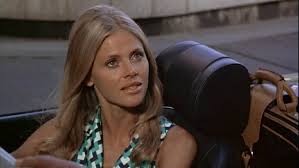 There are three women in this film, and they have far less significant roles than in the last couple of films. They’re even more boring than Solitaire, who at least got reasonable airtime. There’s Goodnight (yes, seriously), an MI6 agent that Bond’s slept with previously. At one point she gets feisty, declaring “Killing a few hours as one of your passing fancies isn’t quite my scene” – but it’s ruined by the incredibly thick layer of Vaseline on the lens, and that she ends up in his bed very soon thereafter (“My hard-to-get act didn’t last very long” – I kid you not, that’s what she says). This in turn is ruined when Ms Anders walks in. She’s Scaramanga’s latest lover, who is actually responsible for the 007 bullet. She initially seems to be awesome – Bond surprises her in the shower, but she gets out all cool and calm with a gun in hand, demanding her robe – but goes all to pieces quickly. Mind you, this is after Bond has been very rough with her, so maybe I’m being too harsh. When Anders walks in, Bond puts Goodnight in the cupboard… then when Anders leaves, Bond apologises with “next time.” Goodnight is further shown to be incompetent when she leans on a master override switch that will destroy Scaramanga’s base, with her and Bond still left inside – Bond gets very cranky, as if she did it deliberately. The other woman in the film? A bellydancer, from whom Bond plucks a bellybutton charm with his mouth. Yes, really.
Racially… well, again we at least have non-Anglos being played by non-Anglos. I really enjoyed Soon-Tek Oh, playing a Chinese agent in Macau and Thailand (even if Oh is Korean…) – he was great, even if they did give him some cringe-worthy stereotyped moments like he and his nieces being ace karate experts. He’s a good sidekick and hurrah! doesn’t die. Richard Loo, playing Hai Fat, does die but he’s a villain and is done in by his ally, and what do you expect anyway? I don’t think there’s anything mean said about him for not being white, which is at least a bare minimum. Oh, and as befits Bond the Great White Messiah, he’s quite good at fighting karate experts – he ignores the expectations of respect, and kicks his opponent while he’s bowing. 
The very weirdest thing about this entire movie is the inclusion of JW, the absolutely appalling, tobacco-chewing/spitting, nigh-unintelligible good ol’ southern boy sheriff from Live and Let Die. How is it even possible that he was popular enough as a character to be worth imagining as someone who would take a trip to Thailand? So that he could see Bond and end up ‘helping’ him? Every scene he was in made me want to throw something at the screen.
Graceling
Reading this was like eating M&Ms. Stopping was very hard. I began it one evening at 8pm. I finally forced myself to go to bed at 10pm. I had read about 200 pages. The prose is just that easy to read.
 This secondary world of Cashore’s isn’t a place where magic happens. It is, though, a place where some people are born Graced: they have a skill, or a thing, that they are superbly, unbeatably, good at. You might be a Graced chef, or a Graced archer; be Graced with mind-reading, some sort of prescience, or being able to eat rocks. I was about to write that I would like to be Graced with memory, but then I remembered the books I’ve read where characters never forget anything and I realise that would be appalling. Perhaps I would like to be Graced with pastry-making. Or with patience. Perhaps pattern recognition.
Anyway, you can tell someone is Graced before they act because they have eyes of different colours. Sometimes this happens as soon as the baby is born; sometimes it takes months, even years, for the eye-colour to settle in. In most parts of the Seven Kingdoms, those who are Graced are automatically feared, and become the property of the King. When you are already the king’s niece and your Grace is fighting… well, Katsa was screwed from the moment she threw her first punch as an under-ten. She’s been fighting for, and being a one-person bully gang in aid of, her uncle for a long time now. But she’s starting to try working around and under the king – helping out people where she can – and this has to come to a head at some point.
The story is a quest for knowledge and for self-identity. Katsa’s age is unclear – she’s certainly late teens if not 20s – and it’s not quite a coming-of-age; she’s cynical and knows about the world already. But while embarking on a quest to help a friend discover the truth about a family member, she definitely learns more about herself and how to be in the world. This search for identity is a current through the whole story, but it’s not overwhelmingly dominant; there are some reflective moments, but there are a lot of moments of action too, for readers like me who usually prefer that sort of story. And the actual quest means that Cashore gets to introduce us to bits of the Seven Kingdoms, which is always fun. I enjoyed the developing friendship between Katsa and Po, I liked the secondary characters, I liked that there were a few plot twists and that while it’s not a light and breezy story, it’s also not grim and gloomy (I have no problem with either, I just like that this one was at the lighter end).
There are a few failings. The ten-year-old is unbelievable enough that I thought she was going to end up being Graced with something that made her wiser than her years. Some of the secondary characters, especially Katsa’s cousin, could have withstood a bit more character development. Over on Goodreads I briefly saw two complaints. One is that it’s an enjoyable book except for the “raging feminist agenda.” I am bewildered by this. Is it a raging feminist agenda to have a supremely competent female lead, to suggest a woman can be a monarch, to not have a female character desperate to get married, to allow characters sex before marriage, to have female characters who don’t care that much about clothes? If so, AWESOME I WANT MORE. Me, I just see that as, y’know, reflecting the real world. The other complaint is about the romance – spoiler! There is one! (If you didn’t know that, you could read the cover quote which claims it has “a knee-weakening romance that easily rivals that of Twilight” … Thanks, LA Times. I have nothing to say.) That reviewer, I think, has an interesting point to make which is that (SLIGHT SPOILER HERE) Katsa’s refusal to consider marrying Po means that what they have isn’t really love, because love is meant to be sacrificial. She is NOT saying they ought to just get married – at least as far as I understand it (here, read it yourself – it’s the one written by Miss Clark). However, while I see her point, I think I disagree. I think Katsa is willing to be with Po forever, and that especially at this point it’s not not-love for her to be keeping her options open, and being wary. Or maybe I’m just too dewy-eyed.
There are two other books in the not-quite-series, but I don’t think I will hurry to get either. While I loved this book, it’s the writing and the characters that I adored. I’m not so fussed about other people in the world and their carryings-on.
(Another books from the stash of unread books, busted!)
You can get Graceling from Fishpond.
Hav
 I have never, in my life, read a book two times in a row. Until I read Hav. This was possible because Hav is not a novel in the ordinary sense. It’s a travel memoir to a fictional place that could easily exist; it’s a meditation on East meeting West, on history and culture and modernity; it’s about being a stranger in somewhere simultaneously familiar and alien. And it has some of the most wonderful prose I’ve come across.
This section from Hav illuminates many of the aspects that make the book so wonderful.
[The boats] often use their sails, and when one comes into the harbour on a southern wind, canvas bulging, flag streaming, keeling gloriously with a slap-slap of waves on its prow and its bare brown-torsoed Greeks exuberantly laughing and shouting to each other, it is as though young navigators have found their way to Hav out of the bright heroic past. (p66)
This. It’s beautiful, for a start. It suggests that conjunction of somewhere existing both in the present and, somehow, in the past that makes Hav so intriguing. And it’s quoted back at its author in the second part of the book, as an indication of her own understanding of Hav.
(We’re all about the meta.)
Two thirds of the book was written and published in the 1980s. According to Ursula le Guin, who wrote the introduction, it led to people going to their travel agents looking to book a ticket to Hav because it was so convincing. Now, it really is convincing, but at the same time there are aspects that make it quite clear that Hav is a fiction. Like the fact that you’ve never seen it on a map, maybe? I was confused by that until I look Jan Morris up, and discovered that she has written many actual travel books (under that name and as James Morris). So I concede that perhaps if you knew her earlier work, you could be forgiven for some confusion if not quite that much. Anyway, the last third was written in the early 21st century, and sees Morris going back to Hav after the Intervention – which was just starting as she left last time. And this allows Morris to explore a whole other aspect of culture and development.
“Last Letters from Hav” are entries written between March and August, with Morris arriving in Hav at the start and being bustled out as trouble brews at the end. In between, she does what any travel writer does: she stays in interesting places, she visits the important and not-so-important places in the city, she talks to people, she reminisces about what other people have said about the place. I’ve been having a great deal of difficulty writing this review because the books is absolutely busting at the scenes with themes, with commentary, with historical (a)musings. There’s multiculturalism and colonialism and identity – the losing and finding and historical nature of and doubt around. There’s appropriation on a massive scale – see previous note – and getting on with the business of life. There’s ordinary mystery and profound mystery, religion and politics and architecture and this book had me in RAPTURES. Can you tell?
Hav is a city-state in a world that really doesn’t have them any more. It’s got an uneasy relationship with Turkey, its only (?) land neighbour, but a seemingly thriving one with certain Arab nations and perhaps the Chinese. It’s basically meant to be somewhere like the Dardanelles – although the geography isn’t quite right – because it’s a big deal that this was where Achilles and his Myrmidons came ashore. And the Spartans too, apparently. And, later, Arab merchants, and Venetian merchants, and it’s one of very few venerable Chinese merchant settlements outside of Asia. See how Morris twists history and makes it just believable? There really were moments where I could believe this was real. Because her discussion of history is modern, too: the Brits wanted to colonise it; Hav was shared by France, Italy and Germany under a League of Nations mandate; Hitler might have visited, and Hemingway did. Morris talks to people who are flotsam from this era; and also to a man claiming to be the 125th Caliph. Also a casino manager, members of the ‘troglodyte’ race who live in the nearby mountains, the local philosophers, and some bureaucrats. She visits odd monuments, the Conveyor Bridge (I admit I had to ask someone whether that was actually possible, because I was teetering on the edge of What Do I Believe?), and the Electric Ferry. I don’t believe that this book could have been written by anyone other than an established travel writer, because her eye and ear for (even imaginary) detail is breathtaking.
The second section is much shorter and deals with only a week or so, some two decades later when Morris is invited back to Hav after the Intervention. “Hav of the Myrmidons” does all of the same things as “Last Letters,” with additional meditation on the nature of change and tourism and the impossibility of an outsider ever really understanding the internal workings of a foreign city. There’s also the inevitable nature of change, and the sinister side of globalisation with imported labour and native populations made to relocate – which, intriguingly, is given a possibly positive spin. Morris’ books is either revered or believed to be banned in Hav, depending on who she speaks to (it’s one of the bureaucrats who reveres it that quotes the passage above at her, as part of the reason for why she was asked back). But things have changed. Most of the glorious many-centuries-in-one-place nature of former Hav is gone, replaced with new and forbidding and disorienting architecture. Like the massive Myrmidon tower, surmounted by an M – but no one really knows who or what the Myrmidons are, or meant to be, in this context. Some things of old Hav have been retained, but sanitised, bent to a new understanding of the world. Tourists are allowed, but only in a defined space – which leads to another bit I wanted to quote, because I think it’s an indication of a travel writer’s despair:
“The thing is… one feels so safe here. The security’s really marvellous, it’s all so clean and friendly, and, well, everything we’re used to really. We’ve met several old friends here, and just feel comfortable in this environment. We shall certainly be coming again, won’t we darling?” “Oh, a hundred percent. I think it’s bloody marvellous what they’ve achieved, when you remember what happened here.” (p196)
Thus spake an older English couple with no intention of leaving the resort.
Hav puts me in mind of China Mieville’s The City and the City, and Christopher Priest’s The Islanders, both of which do a similar thing with inventing places that ring so amazingly true. The Priest is clearly fictional but written as a travel book; the Mieville is a fiction but set in a city that purports to be real. I guess Hav conflates the two.
This review gets nowhere near what I really want to say about Hav. I am so glad that it exists, and that I have read it. And now I will force it into the hands of anybody I possibly can… although I admit to some trepidation that maybe other people won’t like it as much as I do. (I haven’t been able to look at any Goodreads reviews for that reason.) I may have used the word intriguing too many times, and I may have given in to hyperbole, but I don’t care. I love this book and want to hold it to my heart FOREVER.
(Another of the books that has been languishing on my shelves for far too long, unread. WHAT OTHER GEMS ARE WAITING FOR ME??)
You can get Hav from Fishpond.
Black Ice
It’s the exacting details in this book that means it has dated so dreadfully that for all it’s an interesting enough story, I just can’t imagine anyone born after about 1980 enjoying it. Except possibly for its historical value.
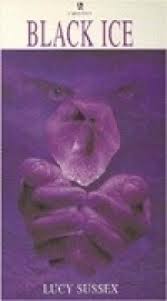 There are two plots entwined here: a ghost story, and a technology story. And they’re packaged with a family drama, just to give the main character another headache.
The ghost story aspect holds up, as one would expect, in that it’s not context-reliant; you could have the same story set in 1850 or 2050. Syb’s new house is always cold, and the new housekeeper Hille starts talking spooky things as soon as she moves in. Hille wears an amethyst and claims to see ghosts, or spirits, all over the place. Syb is dubious, but….
The technology aspect, though – oh, I giggled. This was published in 1997. Syb is really lucky because she has an email address and can dial up the internet with her modem any time she likes. She wins a competition and gets an internet camera. People are able to get hold of each other’s email addresses quite easily, there’s only a few websites to search for on any one topic, and hacking is a breeze. I have no doubt that Sussex was going for close-to-bleeding-edge experience with this story, and going for serious verisimilitude with the intricate details. But all of that means that it really hasn’t travelled well. Which is a shame, because Sussex does write well and engagingly.
The inside cover calls it a Children’s Book; it’s what I would consider the younger end of YA. Syb’s parents are going through a rough patch, and this is dealt with brusquely but (and?) sensibly. It’s a “this is not the end of the world” attitude, but not “this doesn’t matter.” Intriguingly given how many such novels get rid of the parents completely, Sussex does it a bit differently: the mum goes away but stays in contact via email; the dad is always a bit absent in his attitude but is always present and still relevant. Also, the romance interests are just barely present but more usually as an irritant than anything else.
This book was read as part of my read-all-the-books-I-own-but-haven’t-read effort, and conveniently also contributes to the Australian Women Writers challenge for 2014.
Indy vs Henry
 I love Indiana Jones, but there’s a lot to dislike in Dr Henry Jones Jr. And that’s without considering the gender and race aspects of his stories.
Indiana Jones, as an adventurer, is pretty much awesome. The whip, the hat, the jacket. Rescuing people, finding artifacts, rescuing his dad – all of these things make great movies and a man who is often admirable. (Like I said, this is ignoring the problematic stereotypes, which are not my focus here.) 
Dr Henry Jones, though, is meant to be an archaeologist. A reputable one. An academic at a prestigious university. And this is where, on recently watching The Last Crusade, I got a bit sad and discovered some Suck Fairy dust. Because basically, Jones is Schliemann. He’s an adventurer, he’s single minded, and he’s destructive. To get to a tomb that might exist in catacombs that might be under a converted church, he destroys a library’s floor – presumably a floor that dates to the Middle Ages, if we’re expected to believe the trail of clues. And when he’s in danger for his life, he destroys a thousand-year old tomb (ok maybe that one is almost acceptable). So like Schliemann, Jones is only interested in preserving the bit of old stuff that he cares about. Never is there concern for the provenance of artifacts, of preserving the context in which items exist. And those items do end up in museums, which is good – but they’re not museums in the countries where the items were discovered, or even vaguely associated.
And although it’s only shown briefly, there’s also Jones’ position as a lecturer. I’m sure he’s a great lecturer, and he’s clearly very knowledgeable. But does he care about teaching? Or even research? Doesn’t seem that way. There’s dozens of students waiting to speak to him after class, and a huge stack of papers that haven’t been graded yet, and what does Jones do? Legs it out the window. Oh, so responsible.
Lara Croft behaving like Indiana bugs me far less. She never pretends to be anything other than an adventurer and opportunist (in the best possible way). You can’t expect her to be concerned about provenance; it doesn’t matter, in her context. But Jones should know better. Especially given how often he is shown to be morally outraged by the careless abandon with which the villains treat the objects that they’re both after – right from when as a young River Phoenix he’s indignant at the removal of an object that “belongs in a museum.”
Does this stop me from loving the Indiana Jones movies? No. It’s a sign of love that I can critique something while watching it for the umpteenth time (as I am doing right now, sitting in a guest house while my darling is off on a mountain bike somewhere. And I’ve sadly run out of wool in the middle of two different projects). And this issues deserves critique.
Galactic Suburbia 99: Orphan Black
Episode 99: Spoilerific Special – Orphan Black
Alisa and Alex welcome you to Clone Club! That is, an incredibly spoilerific discussion of the first season of Orphan Black. If you haven’t watched it yet (it’s only 10 episodes), we’ll be right here when you’re through. You can listen to it thanks to iTunes, or at Galactic Suburbia.
Things we discuss: the clones themselves (and we do use the c-word); representations of motherhood; whether and how the show is SF; the various characters – and their diversity – as well as a rather large amount of gushing love for the show overall.
We really mean it about the spoilers.
Things we got wrong: Sarah’s boyfriend is Vic, not Vin (oops). And Alison’s nemesis is Ainsley, of course!
ETA: and it’s not meant to be set in New York, as we mistakenly suggest! Oops, again.
Please send feedback to us at galacticsuburbia@gmail.com, follow us on Twitter at @galacticsuburbs, check out Galactic Suburbia Podcast on Facebook and don’t forget to leave a review on iTunes if you love us!
Live and Let Die
This review is part of Project Bond, wherein over the course of 2014 we watch all of the James Bond movies in production order.
Project Bond has been a bit out of whack over the last month, initially due to holidays and then latterly thanks to tragic DVD player heartache. But now we are BACK and on schedule with the first of the Roger Moores!
 Summary: in which James Bond takes an excruciatingly long time to deal with a voodoo-manipulating, heroin-dealing president of a fictional Caribbean island. There are not enough alligators, chases, or explosions.
Alex: it took us two nights to watch this film. After 80 minutes, with another 40 still to go, we cracked it: it was so boring. How does a film with probably the greatest theme song of the oeuvre, and Roger Moore’s introduction, get to be so dull?
You want to know the plot? OK. Three British agents have been killed and their deaths have all been connected to the island nation of San Monique. Bond is sent in to find out what’s going on. There’s clearly something weird going on with Kananga, the president, and it turns out that he is growing opium poppies… and somehow finding time to also be Mr Big, a drug boss in New Orleans. Bond steals Kananga’s Tarot-reading fortune-teller, Solitaire; foils all of his plans; and lives happily ever after the end.
It should not have been so boring. Why was it boring? Because the chase sequences – and there are some really awesome ones – like the boats! brilliant! – Just. Go. On. And on. The cinematography doesn’t help: the angles are weird and don’t create any tension whatsoever. It’s a quintessential villains-revealing-all-their-plans story, which is also boring. There is so much that could have been done with a discussion of politics – why would a foreign president want to flood the American market with free heroin, and then sell it when there are many more users? I can imagine this working in the 21st century: what a way to kickstart your economy after the GFC. But motivation never gets discussed; instead the villains are just… villains. And the dialogue is utterly lacking in zing. And and there’s a lot of dead air with girls.
Perhaps the most interesting moment from a Bond perspective is the opening: Bond is in bed with an Italian spy, then M arrives… because Bond is at home. At home. Bond has a home! This is the first time in any Bond movie that Bond is even vaguely domestic, which is rather exciting. In order to distract M from the woman, Bond makes M coffee. In his kitchen. With a really remarkable coffee machine – which makes M ask “is that all it does?” But the point is, Bond has a house and occasionally uses it. That’s cool.
Anyway. This movie is boring but it has a lot for discussing about gender, and about race. This starts with the credits, where there are remarkably nude black women doing some dance-y, vaguely white-version-of-voodoo, moves.
Let’s start with race. It must be said that I am white, so of course that makes my perception. Other readings are absolutely welcomed… because I think that Bond as a character is remarkably unracist. He’s a  condescending son of a gun, but he’s that way with (white) Leiter as well as, in this film, as well as the black CIA man and the black henchmen. And he has no problem with sleeping with non-white women, as has been demonstrated here and in previous movies. This is not to say that the film is not racist; it would have been hard pressed not to verge on racism: all of the villains are black, and it uses (a 1970s white version of) voodoo as a plot device. In some ways the black villains are actually egalitarian: Bond treats them in exactly the same way as he treats white villains (with contempt). And Kananga is certainly shown to be intelligent: he outwits the CIA eavesdropping with ease. There’s an interesting moment of the film being self-aware of what it’s doing: white tourists are shown watching a ‘voodoo’ show that’s being performed specifically for tourists. In much the same way that voodoo is being used by the film, for voyeuristic purposes, epitomising the fetishising of the Other. Also, just for a wee nod to continuity, Bond goes out on a fishing charter… with Quarrel Jr. There is no way this can actually be Quarrel-from-Dr No‘s son, but it’s a humorous Easter egg anyway. (Others are avoided; Bond order a bourbon, no ice, instead of a martini.)
On the topic of racism, the most revolting character in the film is white. A ludicrous, stereotyped, good ol’ southern boy sheriff, complete with chewin’ ‘baccy. He’s so awful it’s not even funny.
 And then there’s the gender stuff. Bond sleeps with three women. The first is an Italian spy; I’m not even sure she’s named, and she barely speaks. Then
there’s the black, female CIA operative who turns out to be The Bad One (I feel I should be keeping score). It looks like she will hold out for at least 5 minutes – saying “Felix warned me there would be moments like these.” Bond replies: “What did good old Felix suggest?” “If all else fails, cyanide pills. I settled for two rooms” – which is GOLD. And is completely spoiled by freaking out about a (presumably) voodoo curse, and insisting “please don’t leave me alone tonight” (Bond replies “All right dear, if you insist.” There’s also a moment later where she tries to convince him not to kill her, because they’ve just had sex – “you wouldn’t, not after what we’ve just done” – to which Bond replies “well I certainly wouldn’t have done it before.” URGH.) However, this pales in comparison to the role of Solitaire. Solitaire is played by Jane Seymour, in her first big role, and I simply cannot see her as anything other than Dr Quinn, Medicine Woman (which means Roger Moore ought to have waaay more hair, and be wearing leather… I was SUCH a sucker for that show). Solitaire is a pawn, more than any other Bond girl to this point. Other women may have been passing fancies for  Bond; other women might have moved between the villain and Bond; but Solitaire is nothing but an object to both. Kananga is outraged that Solitaire sleeps with Bond partly because it means her Tarot ability is gone, but largely because, he says: “when the proper time came, I would have given you love – you knew that!” So not only did you remove your gift from my keeping, you also had sex with a man other than me. Bond is no better; he wants her simply for what she represents: a means of screwing with Kananga. He seduces her in the most disgusting, despicable manner: coldly manipulating her belief in the Tarot by making her pick the Lovers card… from a stack that was entirely Lovers cards. He thereby ruins her entire life, and makes her think that she had no choice because it’s what the cards willed – and they have never lied. I hated Bond in that moment, and it’s going to take me a while to get over it.
On an aesthetic level: I like Moore’s voice, but I Do Not Understand a cleft chin. And the lines are so so cheesy that I can’t ever take him seriously as either an action man or a romantic lead.
I wanted to embed this video, but it’s a bit dodgy so I’ll just give you a link. Yes, the Wings theme song is one of the best Bond songs ever; yes the Gunners cover is awesome. However, Chrissie Hynde (the  Pretenders) does THE best version, hands down. This is on the same compilation as the Iggy Pop covering “We have all the time in the world,” and if those two covers together don’t want you to go out and get Shaken and Stirred, you are not as big a fan of these songs as I am.
James: Awful.
0 Martinis. (Although you might need 4 or 5 to get through it.) You do get to see Bond run across some alligators like it’s a game of Frogger, though.
Galactic Suburbia
Galactic Suburbia the John Campbell Memorial not a Hugo Episode
In which we do discuss the Hugo shortlists both Retro and Current, but this is not an episode. Not at all. For… administrative reasons. We’re on iTunes or over at Galactic Suburbia.
Brandon Sanderson says interesting things about fandom groups, and the Wheel of Time nomination.
Some gender notes on the Hugo shortlist
Tansy’s Hugo links post
Tansy & John DeNardo of SF Signal discuss the shortlist on Coode Street Podcast
THANK YOU EVERYONE WHO NOMINATED GALACTIC SUBURBIA FOR BEST FANCAST, WE LOVE YOU TOO. WE LOVE YOU SO MUCH WE WOULD GIVE YOU FIVE STARS ON ITUNES.
Galactic Suburbia 98
In which we approach Fringe from multiple sides, rant about Game of Thrones, muse about cake lit and Alisa is a PhD student again! Bonus supplemental awards chat (but not in depth about the Hugos because we recorded before the shortlist went public) and an invitation to CAKE OUT for our 100th. See you there…
You can get us from iTunes or over at the Podbean site. I should warn you that I felt entirely off my game for this ep, but Tansy and Alisa keep the ball rolling very nicely.
Culture Consumed:
Alex: Fringe season 1; A Million Suns, Beth Revis; The Crooked Letter, Sean Williams;
Tansy: Game of Thrones rant, Jenny Colgan novels, Jago & Litefoot 7, Yonderland!
Alisa: Game of Thrones; Generation Cryo; The Cuckoo by Sean Williams, Clarkesworld Issue 91; the PhD Report
Aurealis Awards were awarded.
(sidetracked: Before the Internet from XKCD)
Hugo nomination (!! third time running!!)
CAKE COMPETITION! For our 100th episode, we would like to have a new logo. On a cake. Designed by you. Send a picture of your creation and you could win… something… and you can eat the cake, too. (This is episode 98, so you’ve got 4 or 5 weeks to plan your creation.)
Please send feedback to us at galacticsuburbia@gmail.com, follow us on Twitter at @galacticsuburbs, check out Galactic Suburbia Podcast on Facebook and don’t forget to leave a review on iTunes if you love us!
River of Gods
 One of the central yet peripheral things in many characters’ lives in this remarkable novel is the ‘soapi’ Town and Country. It’s the Indian version of Neighbours, or Eastenders. And in some senses this show – banal and humdrum, focussed on banal and humdrum activities, just like those shows that have enormous and devoted followings today – is emblematic of River of Gods itself. It is neither banal, nor humdrum; but much of it is concerned with surprisingly mundane and domestic issues, which become absorbing and riveting partly because of the skill of the author, partly because of the allure of the exotic: the exotic of the future, and the exotic of a country other than my own.
(Is it wrong to be enchanted by the exotic? And by exotic I simply mean other-than-my-familiar… which is, surely, an inherent part of the appeal of much fantasy and science fiction. Perhaps Other would be a less loaded term than exotic, at that. Hmm.)
River of Gods is set in 2047; the cover proclaims “Happy birthday, India.” Which becomes rather ironic, and somewhat sad, when it turns out that India as it exists in the early 21st century doesn’t exist in McDonald’s vision of its future: it has fractured into several, often rival, states. The political aspect is rarely front and centre in the novel; although it consumes at least one of the characters, McDonald focusses on his larger life, rather than simply making him a political animal.
See how I’m struggling to get on with this review? It’s hard to figure out where to start, what to say. Perhaps I should begin with “I adored this novel,” and attempt to explain why…
I adored this novel. You can stop reading now if you like.
Structure
The novel itself is split into five parts, each of them named for some aspect of Hindu mythology. It’s entirely possible that I have missed some deeper meaning here that relates to the novel’s structure, but I didn’t have much access to the internet while I was reading it so I wasn’t able to chase up meanings. The first part sets up the rest of the novel, introducing all but one of the main characters. Each of them gets their own chapter (in the third person), and the issues set up here continue across the novel with occasional intersections with other characters or their issues. Shiv is a crook, involved in various nefarious deals; Mr Nandha is a Krishna Cop, concerned with the regulation of aeais (AIs). Shaheen Badoor Khan is deep in the political regime of Bharat, Najia an ambitious journalist, and Lisa is a polymath scientist concerned with alternate versions of Earth’s development. Add to that a dropout scientist, a set designer for Town and Country, and a wannabe stand-up comic forced to go home to the family business. Parvati, married to Mr Nandha, is introduced later. Through their individual experiences, the novel tells the story of the world over a couple of weeks in 2047, with India as the focus.
Plot
Family trouble, political intrigue, criminals to chase, and AIs to try and understand. Also an alien artefact.
Each of the characters has a story. For some of them, the novel encompasses crisis and resolution. For others, we’re brought in halfway through, while for yet others we’re made to leave before the resolution. Some of these stories are exactly the sorts of domestic stories that are the fundamentals of soapies today: love and family and betrayal. (Please note I am in no way using ‘domestic’ in a derogatory sense here. Domestic stories are different from, for example, politically-focussed stories: Much Ado about Nothing is domestic, Macbeth – despite some domestic scenes – is not.) Other aspects are more detective story or political thriller. It does need a bit of adjustment to jump between them, but each chapter heading clearly tells you who the focus is, so it’s not that hard.
Language
McDonald uses Indian slang and terms throughout the novel. I didn’t realise until I was a third or so in that there’s a Glossary at the back (it is mentioned in the contents pages, but who reads the contents pages of a novel?), but even then not all of the words are explained. Most of the time the words – especially the slang – are understandable within context; I don’t need the exact translation to understand when someone is using profanity. Now, I have absolutely no idea whether McDonald is using the slang and other terms in appropriate ways. I’m willing to assume that he hasn’t made too many stupid and insensitive mistakes because he’s seemed to do well in the other, non-Western, novels of his that I’ve read – but if I’m completely wrong here I would like to know, so drop me a line if I need to be put right.
I loved the language. It was a little bit like reading a Greg Egan novel; if you’re put off by not being able to understand absolutely everything, this is not the novel for you (and I’m sad for you). And McDonald writes in an utterly captivating manner that meant putting this novel down was occasionally painful.
Characters As mentioned above, the novel focusses on a great range of people (and it passes the Bechdel test, if not spectacularly), which is a fine way to demonstrate the depth of the world-building. I’m not in love with how some of the female characters were portrayed (and some of the sex scenes seemed out of character with the rest of the novel), but other women were presented realistically. The men and women were just as likely to be competent or not, ruthless or not, etc. There’s only one main character who stays at home, with no job, and she’s female – but this makes sense in the context of 2047 India: there’s more men than women (one to five), so those women who want to work have trouble doing so because the men are favoured.
One of the most intriguing characters, both for who yt is and for yts storyline, is Tal. See that “yt”? Tal is a nute, surgically altered to have no genitals and psychologically/mentally altered to change the neurological aspects of yts previous gender. How Tal comes to physically be thus is briefly discussed, but why is not – so private a decision that the reader isn’t invited in. I have no idea how a reader who identifies non-cis would read Tal and those like yt. As an outsider looking in, I thought yt was treated like every other character and while yts nature was absolutely necessary for elements of the plot, it didn’t feel like a MacGuffin. While yt is treated as a freak by some, this is never (I think) portrayed as an acceptable attitude; and yt’s treated as an ordinary co-worker or neighbour by others. Yts other-ness isn’t treated as something added in just to add spice to the narrative, but as a genuine choice that ought to be available to people who so choose to change their own bodies. A minority, and one occasionally feared and derided, but legitimate.
Issues and themes
There are many. The place of women, as mentioned briefly above. The place of AIs – how do you legislate against them, how do you police that, and what are likely to be the ramifications? Climate change is a major factor, looming large in the background, because the monsoon hasn’t come to India in quite a while and this is, of course, disastrous. The development of new technology features. How to exist as a minority, and how to live as a fish out of water.
Overall, this is another great novel by Ian McDonald and I’m looking forward to reading Cyberabad, his set of short stories set in the same universe. You can buy it from Fishpond.


