Galactic Suburbia 102
 In which Alex and Tansy debrief Alisa on their ContinuumX hijinks, and a crowdfunding scheme unfolds… please admire our lovely new logo thanks to longtime listener Terri and her ninja cupcake skills! You can get us at iTunes or Galactic Suburbia.
News
Ditmars, Norma, etc etc. Con report! Book launches, panels…
Literary Guests of Honour: Ambelin Kwaymullina & Jim C Hines (speeches not available online yet, will link when we can)
Check out also the great Continuum X Twitter Storify
As mentioned by Ambelin in her GOH speech, the Australia Council guidelines on writing about Indigenous culture and people, which were formulated by Indigenous people.
What Culture Have we Consumed?
Alisa: The Gods of Wheat Street; Vaginal Fantasy (The Lions of Al-Rassan, Guy Gavriel Kay);
Alex: Kitty and Cadaver, Narrelle M Harris; Vanity and Valour, Mary Robinette Kowal; Vox Day and Ted Chiang; Edge of Tomorrow (and X Men: Days of Future Past)
Tansy: Lightspeed Magazine Women Destroy Science Fiction, Seanan Maguire “Each to Each.”
And our cake logo winners! It’s Terri! Because we never knew how much we needed to be a cupcake until we became one. We hope we were delicious.
New way to support Galactic Suburbia via our Patreon page – help us cover our running costs, & if we hit $50 per podcast we will commit to regular Spoilerific Club podcasts! plus other incentives, for you and for us.
You may also be interested in these other Patreon campaigns:
Tansy’s Musketeer Space project.
Terry Frost’s Paleo-Cinema Podcast page, also inspired by the crowdfunding panel at ContinuumX!
Please send feedback to us at galacticsuburbia@gmail.com, follow us on Twitter at @galacticsuburbs, check out Galactic Suburbia Podcast on Facebook and don’t forget to leave a review on iTunes if you love us!
Moonraker
This review is part of Project Bond, wherein over the course of 2014 we watch all of the James Bond movies in production order.
Summary: in which, space. And Jaws. But no sharks.
 Alex: still not a fan of Moore. However, there were some parts of this film that I actually liked. It’s definitely better paced than the earlier Moores, and who doesn’t love a good giggle over the hilarity of 1970s space stations? It does, however, feature my least favourite Bond theme. Sorry Shirley, it does nothing for me.
The prologue introduces us to the shuttle, Moonraker, as it gets hijacked. We also see Bond encounter Jaws again, henchmanning for some random villain, and then they both end up out of a plane sans parachute. This section had some truly awesome cinematography, and the feature on the DVD about how it was shot is definitely worth watching.
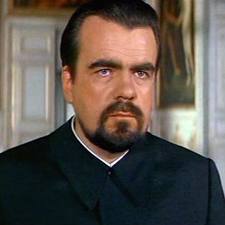 The shuttle was built by Drax Enterprises, and himself is pissed that the British lost his shuttle. So Bond is off to California to snoop around, see who might be responsible for it going missing. I WONDER WHO IT COULD BE? Oh wait, Drax is dressed almost entirely in black and speaks with a slight accent and in a monotone! Nothing suspicious here! No visible deformities, anyway, which is just about a first for this franchise. He does have two Lady Friends, one black and one white, who don’t speak; and two perfectly trained Dobermans; and a Generic Asian Servant. And yes, I really do think those three things can be listed as about equal, from the film’s perspective.
Drax graciously allows Bond to meet one of his chief scientists, Dr Goodhead. Who is, surprise! Female. Bond, condescending: “Are you training to be an astronaut?” Goodhead, I Am So Used To This Crap: “I’m fully trained, on loan from NASA.” What follows would be termed willy-waving if it were between two men, but because it’s between a man and a woman there’s the mandatory sexual frisson – from Bond anyway – as he tries to demonstrate to the woman WHO HAS AT LEAST ONE PHD that he knows as much as her. Because showing you’re smarter than her is a sure way into a woman’s pants. Or something. Still, hurrah for a competent female scientist! She may be my favourite woman from the Moore era yet, which still isn’t saying a whole lot because I didn’t love her. As an actress I found her boring and wooden; as a character she started off well but, as always, goes downhill after she (inevitably) succumbs to Bond’s irresistible charms. Not only does Bond have an ORGAN I CAN’T MENTION that turns women from evil to good, it also apparently saps the competency from them.
 Anyway. Bond chases Drax’s establishment to Venice – hello gondola chases – and has a tour through a glass museum, which as soon as it comes on screen you just KNOW is going to be the scene of a horridly destructive fight. And it was. Then Bond goes to Rio, as far as I can tell just so that he can sleep with the local MI5 contact and the film can showcase Carnevale. And then he and Goodhead, who have now teamed up because she’s actually CIA, are off down the Amazon and there find Castle Anthrax. Seriously. All the astronauts in training there are beautiful and lissom and – it turns out – paired to one another, because Drax’s goal is to sterilise the Earth and bring back his genetically perfect humans to Rule The World! They all end up in space, and eventually, after some pretty cool null-grav scenes, Bond escapes and destroys it.
Brief space rant now. It can’t be that far out in orbit because it doesn’t take that long to reach it in their shuttles. How did they avoid detection? Well, Drax has developed a cloaking device (basically) that prevents radar from detecting  them. Ta dah! … but wait – what about the astronomers?? This is pre- any space telescopes. It’s also a time when, I presume, the light pollution wasn’t nearly so bad as it is today. I can guarantee that amateur astronomers would have spotted it, let alone the pros. Heck, I’ve followed the ISS in a telescope by moving the scope manually, and you can see the shape quite easily. This space city is meant to be much bigger than the ISS.
/end rant
That issue aside, the end of the space city is actually the most terrifying part of the whole movie because US-trained space troops fly up to occupy it (once they know it’s there): they know how to fight in space, and they have laser guns. This is what the 1980s feared with discussion of the militarisation of space. And I can well understand the fear.
Weird moment: the code to get into a secret lab is the signature motif from Close Encounters of the Third Kind.
From a racial perspective: Generic Asian Servant gets to beat up Bond a bit, but of course can’t win. There are some non-white astronauts in Drax’s plan for perfecting humanity, so that’s awesome – but it is overwhelmingly white.
From a feminist perspective: Goodhead isn’t bad; she takes a while to succumb to Bond, and she is blunt about her lack of trust in him. She stays mostly competent when she’s allowed to demonstrate it. There are three other “Bond women.” He’s smooching one at the start, who then pulls a gun on him – hilarious, but she is then nowhere while the fight takes place, and given it’s on a plane that makes no sense. Then there’s Drax’s helicopter pilot. Bond kisses her, she responds with “You presume a great deal” – and then kisses him back. She dies. The Brazilian contact is attacked by Jaws in a clown outfit.
Jaws! How remiss of me not to mention: Jaws gets a girlfriend! Aww… they meet when he’s just finished destroying a cable car with Bond and Goodhead on board. They both end up on the space city, and Jaws actually helps Bond when he realises that neither he nor Braids meets Drax’s standards of human perfection. And he even gets to speak, which I’m sure meant that he had to take out the metal teeth.
 J
J ames: Classic movie poster – almost as awesome as the vintage Star Wars ones. It might be my favourite part though. The effects are improving as we move forwards in time too but like Alex I’m bored with Moore and ready to move on. More space, more lasers – I had never really noticed in the past how central space, orbital weapons and lasers are to Bond (and it’s not about to stop yet…). 2 Martinis.
North Wind
I did not manage to finish the book prior to this one, Gwyneth Jones’ White Queen. I am slightly surprised that I finished this one, in that light, but the structure of this novel is definitely easier to cope with, and I think the plot is slightly more straightforward too.
So in White Queen the aliens arrive and it turns out they’ve been living amongst for rather a long time. The world is a difficult place in which to live anyway – environmental stuff etc – and when the aliens finally decide to make contact there’s a conference on women happening … and for whatever reason, the aliens decide that that is the world government. Which means that all of a sudden (ok, I think it makes months or years) there is an actual real Sex War, at least partly because of the aliens. Stuff happens… etc.
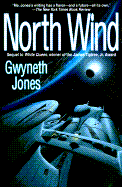 North Wind is told from two main viewpoints. Sid is a human liaison to the Aleutians – the aliens. Bella, also known as Goodlooking, or the librarian, is an invalid Aleutian. Their experiences of the world are very different: because of their expectations of gender, because of their expectations of humanity, because of their expectations of family and other social interactions. Their interactions with each other are immensely complicated for all of these same reasons, and because of the circumstances in which they find themselves.
This novel could have been relatively straightforward. It’s an attempt to figure out what is indeed a complex problem, but the actual events along the way are not that Byzantine.
Jones, however, was not interested in writing a relatively straightforward novel. And that’s perfectly fine; just don’t expect it to be one. Because Jones used this novel to explore concepts of gender, in particular, in detail and in complexity that you don’t often get in novel form. Not from widely popular novels that get nominated for the Clarke Award (in 1995) necessarily, anyway. The Aleutians have a very different concept of gender from most of humanity, and the intersection between the two species’ expectations and lived experiences highlight, in particular, humanity’s limitations.
I found this a difficult book to read partly because of the switching of pronouns, which takes some getting used to; partly because Jones uses narrative ellipses to imply things and sometimes I wasn’t fast enough on the uptake. Probably I missed some subtleties from not finishing White Queen (like the issue with Johnny, but that is eventually explained). It’s a clever book, and it’s an important book, and I want to say it’s an ambitious book but so often that phrase gets used in a condescending tone and I really don’t mean it like that. I really mean that Jones is doing ambitious and difficult and passionate things. But… I didn’t love it. I think it was too difficult for me. I won’t be rushing out for Phoenix Cafe, the third in the series. Which makes me a bit sad because I had intended to read all of Gwyneth Jones’ work, but I don’t have to like everything, I’ve decided.
Yet another book off the TBR shelf! Go me!
Hardwired
I don’t think I’ve read a Walter Jon Williams novel before. I’ve read some of his short stories, in anthologies, and generally loved them. Pretty sure I got this novel from Better World Books because it was in the bargain pile and I thought it would be an interesting enough place to start reading his work. Plus, I suspect I was in a cyberpunk zone.
ETA: No, I am stupid. Of course I have read other Williams books… This is Not a Game, AND Deep State, and The Fourth Wall. I can’t believe I forgot that.
It’s a good thing I have read other stuff by him in the past.
 It’s not a bad book. I did finish it. But it’s definitely not a great book, and I’ll be more circumspect in what I choose to read of his in future. Probably I will ask Jonathan for recommendations. A couple of reviewers over on Goodreads suggested that this was an example of style over substance, and that this was Williams trying to be William Gibson. The former I agreed with, by about halfway through; the second I disagree with, although I haven’t read Gibson’s complete cyberpunk oeuvre so perhaps I can’t entirely make that decision.
Style over substance: there are some lovely, almost lyrical passages in this novel. There are some amusing and clever descriptive passages. There are some that are just a bit silly, though, and seem like evidence either of Williams trying a bit too hard or the editor not trying hard enough.
William Gibson: keeping in mind it’s been a while since I read Neuromancer etc, I think there’s a different aesthetic at work here, and a different use for technology. Williams has tech for a purpose, and that’s why it exists. Even the character who loves the tech and most lives for it loves what it allows him to do, and feel – being a pilot. My memory of Gibson is that the technology is a bit more… pure is the wrong word, but perhaps abstract? Good for doing stuff, but that’s not it’s sole purpose. Those who are more familiar with Gibson, feel free to correct! (This reminds me that I really, really must read them again/finish the series (pl) that I have started…).
This is a world where orbital communities are doing nasty things to the dirt-siders, along the lines of controlling their economy and doling out important things like drugs (… the medicinal ones and the ‘medicinal’ ones). Well, I say ‘dirt-siders’; I really mean ‘people living in the former USA’, because as far as I can tell the rest of the world just doesn’t exist for this novel. Just a little thing those of us outside of the USA notice. Anyway, it’s the former USA because it’s all been divided up for various reasons that I’m sure have more resonance with people who have an actual grip on USAn geography and history (i.e. not me).
The novel is told from two perspectives: Cowboy is a pilot who lives to fly but has been grounded by the dangers of doing so – because he mostly flies on illicit ‘pony express’-type runs. Well, he’s been grounded, but he still gets to do his runs in a panzer. I was a bit dozy while reading the start because it took me ages to realise that meant he was crashing across continental US in a tank. The other perspective is provided by Sarah, whose childhood was seriously screwed up and who will do most anything to raise the serious money needed to get a better life, including radical body mods and very dangerous work. Cowboy and Sarah’s stories collide, mesh, separate and do reasonably interesting things. Intertwined throughout are advertisements for various companies – mostly for body mods or drugs – and the occasional news heading. I don’t think this is something invented by Williams, but when it’s done well (and I think it is here) I really like it as a style.
Cowboy and Sarah are both interesting enough, but I didn’t really engage with either of them. They were both too distant. Cowboy’s monomania about flying – even when it begins to get tempered by a developing conscience – prevented me from clicking with him. I thought he was pretty consistent, though, and could appreciate that. Sarah didn’t really work overall. Her concern for her brother, especially, felt out of place with the rest of her attitudes. I have no doubt it’s possible for a cynical, pessimistic person to care as deeply for a family member as Sarah is shown to – but I didn’t buy it here. Especially given what it ends up costing her.
The plot itself is fast-paced enough that I kept reading; there were some nice twists, although nothing completely unexpected. I don’t remember anything that made me want to throw the book away, so that’s faint praise but praise nonetheless. Not one I’m recommending to anyone but a hardcore Williams or cyberpunk fan.
Galactic Suburbia 101
 In which we emerge from our cake coma to discuss awards, speeches, hashtags and online activism. And, okay, more cake. You can get us from iTunes or at Galactic Suburbia.
News
Norman Hetherington’s birthday celebrated by Google: Australians love Mr Squiggle!
Nebula award winners announced.
N K Jemisin’s GoH speech and Hiromi Goto’s GoH speech at Wiscon
Alisa’s post: If You Aren’t Part of the Solution
Discussion of #yesallwomen and #notallmen
Charles Tan’s important essay on Bigotry, Cognotive Dissonance and Submission guidelines
What Culture Have we Consumed?
Alisa: Total Devotion Machine, Rosaleen Love; Perfections, Kirstyn McDermott; The Lady Astronaut from Mars, Mary Robinette Kowal
Alex: A Pursuit of Miracles, George Turner; Black Ice, Lucy Sussex; Jane Bites Back, Michael Thomas Ford. Project Bond.
Tansy: X-Men Days of Future Past, Sex Criminals by Matt Fraction, Robotech Rewatch
Galactic Suburbia Scrapbook – is still a preorder which means if you go ahead and preorder, we’ll send you a copy of the book when it drops, glitch with the Paypal means it charges you 1c on preorder but Alisa refunding those. And also, all sales for the Scrapbook will go towards running costs for GS.
PS we have a donation button on the Podbean site, which we thought we would mention because we got scolded by email… if you want to throw us a donation towards our hosting fees, we will be very grateful!
Check out our Pinterest board for the entries in our cake logo contest! We haven’t been able to choose, so we’re asking for feedback from our listeners. Vote for your favourite by emailing us – and remember it’s not about how much you like the look of the cake itself, but which picture you think makes the best logo to represent us for our next 100 episodes.
Please send feedback to us at galacticsuburbia@gmail.com, follow us on Twitter at @galacticsuburbs, check out Galactic Suburbia Podcast on Facebook and don’t forget to leave a review on iTunes if you love us!
The Spy Who Loved Me
This review is part of Project Bond, wherein over the course of 2014 we watch all of the James Bond movies in production order.
Summary: in which Russia’s best agent is a woman, someone is stealing submarines, cars turn into submarines and Bond visits Egypt. All to a very groovy 70s version of the Bond theme.
 Alex: well, it turns out that James was right. There are a lot of Bonds I haven’t seen! … most of the Moores, in fact. And you know what? I am not sad about that fact. Because if I had, indeed, seen these movies before, then I would now have sat through them at least twice each, and I’m just not going to live that long.
I’ve figured out how to make a decent Roger Moore Bond. Take this plot, make Christopher Lee play Stromberg, and Jane Seymour Triple X. Ta dah!
Back in From Russia with Love, we were introduced to the idea of a Russian agent being female. The prologue here opens with the Russians deciding to put their best agent onto the case of a submarine going missing – then cutting to a bedroom scene – and it turning out that Triple X is actually the woman. Surprise fake out! Amusingly, this is then replicated with the British doing the same thing and, of course, cutting to Bond also in bed. He then escapes from dastardly Russians via a parachute with a Union Jack on it…
The credits feature an astonishing number of nude women in silhouette. And Carly Simone, whose “Nobody does it better” has grown on me a lot since I’ve stopped automatically associating a real estate agent with it.
 We meet the man responsible for the disappearing subs very quickly, and the fact that he’s ruthless immediately: he kills his lover for apparently giving away secrets, and for I think the third time? is a villain with a penchant for sharks. He, too, continues the villain-as-deformed theme, although less obviously than some: his thumb and forefinger webbing is very pronounced. I guess this is meant to account for his love of the life aquatic? Or something anyway. Writing that I realise that other villains have a thing with water – Dr No, and the guy in Thunderball I think? Stromberg gets the coolest looking lair to this point, although it’s spoiled by the narcissism of calling it Atlantis. Stromberg’s villainy is further amplified by, of course, his henchmen. Let’s just glory in the fabulousness that is Jaws for a moment:
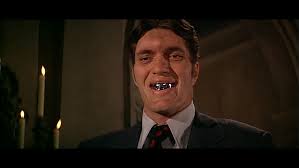
Yup, fine specimen of a henchman. To my everlasting joy, the film managed to combine both Stromberg’s love of sharks and Jaws’ ability and willingness to bite anything and everything by featuring a fight between a great white and the metal mouth himself. You know who wins already.
There is actually a plot here, and I think it’s a better one than the previous two – so surely that’s a good sign, right? The first was rock bottom, the second clawed its way out of despair, this one is almost conceivably bearable? Almost? Bond and Triple X (who is named at some point, I know, but I missed it and anyway the code name works) end up in Egypt chasing down the owner of a microfilm with details about the sub-thief. Bond turns out to rock pseudo-Tuareg gear and to speak Arabic, as well as having an old Cambridge chum who sets him up for the night in a totally Lawrence of Arabia tent and a member of his harem. Then, getting back to the point, Bond continues searching and manages to get a third woman killed by a bullet intended for him. There’s some killing, some arguing, and then Bond and Triple X find themselves having to work together when Jaws makes off with the microfilm.
To James’ eye-rolling, I must stop here a moment and squeal about how awesome it was to see Bond on location in Egypt, having been there myself. I’m astonished they let them film in Karnak, but I guess the 70s was a different time. The most hilarious bit, though, is when they’re at the Sound and Light show at Gaza… because the voice-over from 1977 is exactly the same one that I heard in 2013. Exactly.
Bond and Triple X fight Jaws at Karnak; there’s a hilarious moment where Triple X can’t get their escape van into gear, because everyone knows that women can’t drive, especially not manuals! Ha ha! And then neatly reverses into Jaws. Bond notes “You did save my life;” she tartly replies with “Everybody makes mistakes.” And then they walk in the desert, because the van breaks down, and they seriously, no jokes, do so to the strains of the Lawrence of Arabia theme. My eyes rolled so hard it hurt.
And then Triple X and Bond discover they have to work together. Gee, thank bosses. Off to Sardinia they go, via a train trip featuring Jaws in Triple X’s wardrobe (Bond electrocutes him, she falls into Bond’s arms afterwards) and the discovery that Stromberg is capturing nuclear missiles in order to blow up both the USSR and the USA so that he can start the world anew… apparently under water or something? Isn’t this all sounding very familiar, a la Blofeld? I guess there are only so many supervillain prime motivating factors to go around, and wealth is not Stromberg’s concern at this point. Anyway, Bond foils the plot, making the nukes blow up the subs instead… which still means that there were two nuclear explosions in the middle of two oceans, but apparently we don’t care about that. Triple X is taken by Stromberg back to Atlantis and forced to wear an outrageous dress; Bond rescues her and they get away in a bachelor pad escape pod, complete with Dom Perignon 52:
I really liked Triple X most of the time. She has a lovely line in snark, is well aware of what Bond is about, and is mostly allowed to be competent. Blowing sleeping powder in Bond’s face when he gets amorous? Priceless. Apparently getting over her dead lover very quickly is less so. Vowing to kill Bond after the mission, when she discovers he killed her lover, was awesome – I love her professionalism in agreeing to finish the mission before killing him. And she didn’t blow their cover as his ‘wife’ even when Bond tells her “don’t be a bother” when being shown around Atlantis. Reneging on that vow to kill him – without even trying! – was disappointing. I would have liked her to put up more of a fight.
Bond continues to be a snob and ludicrously knowledgable. He poses as a marine biologist, he knows Arabic, he gets a detonator out of a nuclear bomb, and he can reprogram computers.
James:
Underwater car … one of the coolest Bond cars yet? Another lukewarm film otherwise. The opening ski chase is classic bond and Triple X is a nice evolution for Bond as a franchise but there was still more cheese than a 1970s fondu set. Great music.
2 Martinis

Musketeers
I love The Three Musketeers in the same way I love Sherlock Holmes. Via their later interpretations.
I’ve read Dumas… a long time ago… probably when I was too young to really enjoy it. And after I’d seen the movie, and loved it.
 Hmm. Let’s be honest. After I watched Kiefer Sutherland and some others and loved Kiefer Sutherland. The others were ok too.
ANYway, I love the idea of the Musketeers, and I adore reinterpretations. Thus, readers: Musketeer Space! Tansy is doing a gender-swapped space opera version and I am very much looking forward to reading it. She’s also experimenting with Patreon to see whether people want to support her in the endeavour, and is offering all sorts of incentives. Like promising to review Musketeer-related stuff. The first such is a review of the 2011 Musketeer movie involving airships and other steampunkery, which I tragically never got around to watching. Until today.
 There are many, many amusing aspects to this movie.
Number 1: I’ve thought of Luke Evans as the new Orlando Bloom for a while now, so to see them in the same movie is hilarious.
 Number 2: as Tansy points out, Orlando Bloom is doing his best to channel 1970s Elvis hair.
Number 3: Mads Mikkelsen chewing the scenery.
Like the Sutherland version, D’Artagnan is the most wet and boring of all the characters. I just don’t get him, and I eye-roll so hard at the thought of Chris O’Donnell that don’t even get me started.
I mostly agree with Tansy’s review, especially the desire to see Milady and the lads conduct heist after heist after heist. I do disagree with her about the Cardinal – remembering that I am no connoisseur of the original, I don’t think he was dull; understated, perhaps, instead of underplayed. Tim Curry was an archetypal villain in the Sutherland version and I can’t help but feel that this one was doing his best to differentiate himself. I thought it worked ok. I also disagree with her assessment of Constance’s speech about a lady in waiting not being as important as a musketeer – my understanding of this section is that she was suggesting she was in less danger partly because she was a woman, but mostly because her position as a lady in waiting offered protection. It is possible I misheard some of this exchange because the knitting was distracting me….
I am most saddened that, after a delightfully swoony prologue read by Matthew MacFadyen, he really just phoned in this performance. Not a jot on Kiefer.
I do not think this has a lot of rewatchability, so I am amused and impressed that Tansy sat through it a second time. It was genuinely enjoyable, and there may have been shrieks of laughter especially over the airship’s steampunk machine guns, but it is not a cinematic masterpiece.
Also thanks to Tansy, I now have “All for Love” stuck in my head. And I’m starting to fear that the Suck Fairy may have visited my beloved 1993 (gasp! 1993?!?) version…
A Pursuit of Miracles
I’ve had this book sitting on my shelf I think since AussieCon 4, in 2010. Oops. And I don’t think I realised it was a set of short stories, otherwise I probably would have read it earlier. Yup. Oops. Still – another book off the TBR pile!
So. George Turner. I’ve never read anything by Turner before. I’ve heard his name a bit, from those who were active in Australian SF in the 1980s, but… that’s not me. So now I get to actually have an opinion! And that opinion is… he’s not bad. Not my new favourite author, and perhaps the shorts aren’t his best work – hopefully someone will tell me? – but these are solidly intriguing, sometimes deeply engrossing, stories. The introduction has it right, too: many of his protagonists are quite aggressive, which gives the entire collection a certain pugnacious feel.
“A Pursuit of Miracles” is ostensibly about the experimental pursuit of telepathy. However this is really just am excuse to meditate on what might happen in and with a society that believes itself to be living in the Age of Miracles – that this might give scientists leeway to do what they like, such as experimenting on humans and calling them not humans. The discussion about how dreadful telepathy or telempathy would be is indeed insightful.
“Not in front of the children” is hilarious as a rumination on generational divide. The question about whether people would actually want to associate with previous generations if they were all alive at the same time is, again, insightful, and Turner is really very funny in suggesting how the generations would distinguish themselves. I can’t help bit wonder if Turner had grandchildren when he wrote this.
“Feedback” is the story I am most indifferent towards. A discussion of solipsism is not my thing, and the use of the term “Abo woman” stung.
No wait, “Shut the door when you go out.” This one I really didn’t care for.
“On the Nursery Floor” is the most intriguing from the point of view of form – a series of interviews with occasional journalistic interventions. The idea is one of investigating the consequence of meddling with intelligence. This is a more severe version of Brian Caswell’s Cage of Butterflies, and very clever.
“In a Petrie Dish Upstairs” is, of the stories that seem at least vaguely plausible (I exclude “Feedback” and “Shut the door”), the least sensible. The idea that three generations – fewer, in fact – would be enough to change a society separated by distance if not entirely psychologically is unlikely. Obviously it’s a thought experiment to some degree, but that timing aspect got to me. The other bits, though – how women might be considered, the politics, the concept of Ethics, the change in language – were clever enough to make it worth reading.
“Generation Gap” is silly.
The final story uses a few different narrators – including an astonishing but, on reflection, entirely believable reversal – to tell a story that, in close up, is about the destruction of a family and one boy’s bid not to slide into ignominy. On a larger scale, this is a terrifying view of the implications of climate change on society, and it’s very, very ugly. A fine conclusion to the collection.
Dinosaur
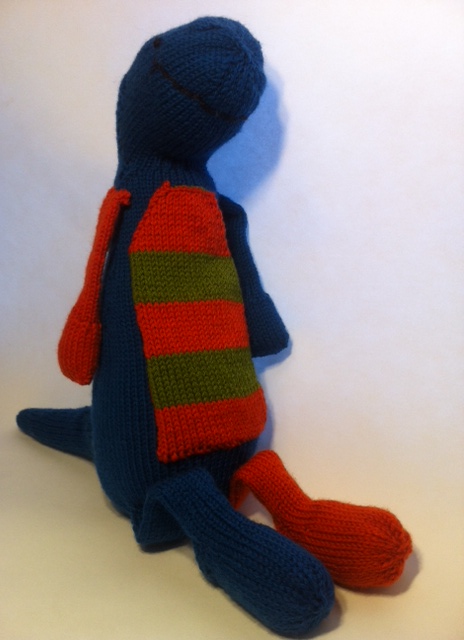
So there’s this. I started knitting it months ago… ran out of the blue, but I always planned on giving it particoloured limbs anyway… but I stopped, and lost momentum. Knitted some other things. Finally, I realised the birthday is fast approaching that this is intended for, so that spurred me on. Didn’t take long to finish it off. 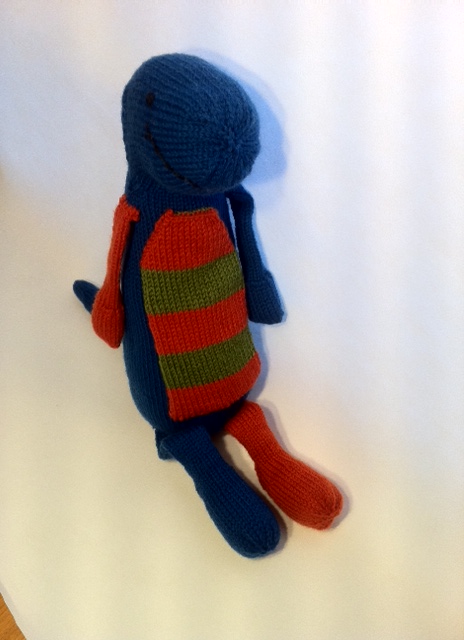
Galactic Suburbia is 100!
Alisa, Alex and Tansy invite all our listeners to join us as we celebrate our 100th episode of Galactic Suburbia in time-honoured tradition, with cake! We can be found over at iTunes or at Galactic Suburbia.
Alisa is eating Golden Gaytime cheesecake. Tansy is eating orange sour cream cake. Alex combined them both to create chocolate orange cheesecake! Let us know what kind of cake you ate while listening to the podcast! If you’d like to enter our cake logo contest, please send a picture of your Galactic Suburbia themed cake to us by email or Twitter by the 27th May!
NEWS
The Norma Shortlist includes some Twelfth Planet Press books!
Alisa recently announced the Kaleidoscope TOC, and may be launching Rosaleen Love’s book Secret Lives of Books at Continuum.
Hugo Packet – Orbit UK not including the novels.
Tansy news: upcoming Tor.com reread column & web serial
The Galactic Suburbia scrapbook available soon for download.
Listen to the episode for giveaway codes. Free books!
Limited editions second print run for Love & Romanpunk by Tansy Rayner Roberts. Let Alisa know now if you want one of these – she’s printing them for London.
What Culture Have we Consumed?
Alex: Hav, Jan Morris; Graceling, Kristin Cashore; so much Fringe. And Orphan Black. No more Comixology for me.
Tansy: Captain America: Winter Soldier; Gravity; Fangirl by Rainbow Rowell, Saga 3
Alisa: OMG I AM IN EDITING/PROOFING ARMAGEDDON – Kaleidoscope almost ready to drop and Secret Lives of Books! And …. Tea and Jeopardy
Galactic Suburbia highlights.
We love you all, thanks for listening to us!
Please send feedback to us at galacticsuburbia@gmail.com, follow us on Twitter at @galacticsuburbs, check out Galactic Suburbia Podcast on Facebook and don’t forget to leave a review on iTunes if you love us!


