Enclave, by Claire G Coleman
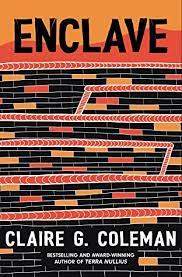
I received this from the publisher, Hachette, at no cost.
If you’ve read Terra Nullius or The Old Lie, by Coleman, then I heartily recommend the same strategy as I used: just read the book. Don’t read this review, don’t read the blurb. You already have a sense of how Coleman writes, and what Coleman writes. The first two were very different, but you know how they’re similar; this is also very different, but it’s clearly a Coleman novel. If you were staggered by those first novels, then you really don’t need to anything else other than: it’s a new Coleman novel.
Still with me? Haven’t read either of the first two (but now you know you should because they’re amazing), or somehow not sure about this one? Christine lives in a walled city with no contact with the outside world. Everyone knows that the outside world is terrifying, full of violence and bad things; unlike their city, which is calm and peaceful and carefully surveilled for any trouble. Everyone who lives inside this city is white; the bussed-in servants are brown, but they’re nameless and just go about making houses liveable. Christine isn’t entirely happy – her best friend is missing and she doesn’t know what to do – and then does something unforgivable, and then everything changes.
It’s fantastic.
Bootstrap, by Georgina Young

Received from the publisher, Text, at no cost. It’s out on 19 July 2022, $32.99.
As a time travel/ romance set in Australia, this book is fine. A pretty slow start – there’s a lot of setting up of the small town and the two main characters – but the second 2/3 is pretty well paced. There are some quirky ideas, the characters are believable (and recognisable, for Australians at least), and it’s… fine.
Yes, I know that sounds like damning with faint praise. And it is fine! Truly! I didn’t mind reading it! But… it’s not outstanding. Sadly. For a YA audience that’s not read many time travel stories; or for Australians who have never seen themselves on the page before, maybe it would be different? I don’t know.
I have a couple of issues with the book. The first is with the blurb writer – note, please, NOT with the author. The book itself literally references The Time Traveller’s Wife. So when the blurb calls this a “genre-bending” novel? No, it’s not. Jonathan Strahan’s new anthology is literally Someone In Time: Tales of Time-Crossed Romance. So time-travel and romance isn’t new. Even making it queer doesn’t make it new.
The second issue is the language. It’s very Australian. In fact, I would go so far as to call this excruciatingly Australian. I am a big fan of stories being told in the vernacular, but this felt like the author had first written the story in more generic English and then went back and switched everything to the most ocker she possibly could. For instance: “I get a schnozz full of water” (138), “I wanna touch him” (140), “And it’s like finally, ya nong” (144) and so on. Piles of Aussie slang (logs in the toilet) and references to Australian brands (Lemon Fresh, a man eating a Barney Banana ice cream “shoulda gone a chocolate Paddle Pop, idiot” (58). It just ends up feeling like the author is trying too hard. But maybe I’ve become an elitist and I don’t appreciate what kids in small towns really want to read. So if this works for those kids, awesome! It just means I’m not the right audience, and I’m fine with that.
The Mongol Storm: Making and Breaking Empires in the Medieval Near East

I read this courtesy of NetGalley. It’s out in November, 2022.
As a Jill-of-all-trades when it comes to history, I feel like “the Mongols” is one of those topics that a lot of people have vague ideas about but don’t really know what they’re talking about, or any details at all. Genghis Khan, Kublai Khan, greatest land empire of all time… done.
Yeah. This book has made an enormous difference to the way I see the Mongols as a group, as an empire, as an historical force.
In his Introduction, Morton promises “a multi-perspective history of the Mongol invasions constructed from many different viewpoints”. And that’s definitely what the book delivers, as the way that the movement of Mongol troops – in and out of territory, sometimes staying, sometimes just installing new leadership after dismantling entire areas – impacts on a variety of pre-existing governments. The thing that surprised me is just WHERE that is happening… because it’s the “Near/Middle East” (which is a stupid term for an Australian to use, but there we go). The book is focussed on how the Mongols impact on everything from Egypt, through the Frankish kingdom of Jerusalem, to Byzantium, and to Syria and Georgia and Armenia. I don’t quite know where I thought the focus would be – I knew the Mongols had briefly penetrated Europe and made everyone crap their pants – but this was not it. And the thing is, the Mongols are a significant force for DECADES. There are events in this history – across the 13th and into the 14th centuries – that I already knew but that I had NO IDEA were at least partly as a result of the pressure coming from the east, via the Mongols: either directly because of the Mongols’ actions, or because of the movement of people driven out by the Mongols (directly or through fear). How is it I had no idea of this?? I’m going to say it’s at least partly racism, and also partly the occasionally narrow focus of some histories – in trying to narrow down the historical story, some things get chopped. (Rant could be inserted here about how choices are made, etc… but I’ll spare my reader.)
One of the slightly odd parts of this book is that it is NOT as focussed as I had expected. There’s entire sections about the politics of the Franks in Jerusalem and the Crusader States… with no apparently connection to the Mongols. Morton gets there eventually, but it does sometimes feel like there’s a lot of extraneous detail that wasn’t required to actually understand the point of the book – the Mongols. Not that I didn’t enjoy the detail! It just wasn’t necessary.
Obviously, I learned an enormous amount from this book. About the Mongols themselves – how they were organised, how they viewed themselves (as having a mandate from heaven to rule, and that all religions were fine because they were all subsumed within their own), and how they dealt with subject people. I also learned a huge amount about what was going on in Egypt around the period of the Mamluks coming to power, and to the east I finally learned something about Georgia and Armenia, which hadn’t previously come across my radar in this period. Also more about the Crusader States, and generally how all of these states interacted with each other. Which is also something that I feel like has been missing from my knowledge here. Of course rulers were in contact, of course they were making deals and alliances, including across religious and ethnic lines… but I don’t really kn0w about them.
The book itself is well-written. I found it engaging – perhaps because I was already invested in the general period and area. As with all such books, I did sometimes find the names hard to follow… if only everyone in the past had differentiated their names more (did there need to be more than one Bohemond?). Morton has structured the book well, largely chronologically and within that, geographically. There are also some useful maps that make locating the changing circumstances of the various polities easier. Overall, definitely a good addition to my understanding of the world.
The Genesis of Misery, Neon Yang

I read this courtesy of NetGalley. It’s out at the end of September, 2022 (sorry; I promise it’s worth waiting for).
WHAT DID I JUST READ AND WHERE CAN I GET MORE OF IT?
… actually, I’m pretty sure there’s nothing else quite like this. (Dare I hope to add ‘yet’?)
This was just… so much. So great and so complex and so enthralling. So fast-paced and so intricate. So many genders and so many alliances and betrayals and things-aren’t-as-they-seem; so many space battles. Also angels and messiahs and heretics and possibly divine intervention. Also an irritable and foul-mouthed protagonist who is out for the main chance and whom some people think might just be the path to salvation. Of some sort.
Where do I even begin? The story starts with one person (probably human) asking another (not human, taking many different shapes throughout the conversation) for ‘the story of Misery Nomaki’ – and what follows is that story, with all the narrator’s caveats about truth and consequence and revelation all being problematic. At the start of that story, Misery (she/they) is having a bad time, trying to make her way through a very large space station; she’s able to manipulate any holystone she comes across, which is useful, but that doesn’t necessarily help when you’re stuck in a warren of tunnels and don’t know where you’re going. Her delusion, Ruin, isn’t being of any help, and there are weird all-white, maybe-cloned saints that are freaking her out.
… and it just gets more quirky, and more clever, and more intricate, from there. Fighting princesses, treachery, giant battle mechs. Zero clear explanation of ‘holystone’ – holy obsidian, holy jasper, and so on – but some very tantalising hints; no real explanation of how saints actually happen, except that somehow they can live on starlight alone? Sometimes an author’s expectation that you’ll just go along with whatever whacky things they’ve created for their new world is overwhelming or irritating or enough to make a book Too Much Work. Not so here: there’s just enough explanation to make everything hang together – surely you don’t need saints explained, this is what they’re doing! – and the writing is so gripping, and Misery so enticing, that explanations can wait; I need to know what’s happening next RIGHT NOW.
Everything about this book worked for me.
Finally, something I’ve seen a couple of people mention that to me, at least, is a bit of a spoiler (in an odd way), but may be just what someone else needs in order to read this… it’s an historical thing that the story seems to be inspired by (I haven’t read confirmation of that, but it does make sense)… only read on if you’re now intrigued!
…
Continue reading →Budapest: Between East and West
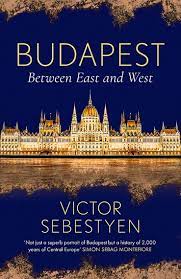
I received a copy of this book from the publisher, Hachette Australia, at no cost. It’s out now; $32.99.
Things I knew about Budapest before reading this: it used to be two towns, and pictures of Soviet tanks in the streets in 1956. I think that’s about it, really.
An intriguing aspect of this book is that it’s written by a man born in Budapest, whose family fled Hungary when he was a child. Sebestyen makes no secret of this, and of his connection to the country and the city. So there’s a mix of ‘objective’ history, and also the occasional mention of how things relate to him personally. I like this kind of honesty a lot.
One annoying aspect – and this might just be a personal gripe – isn’t peculiar to Sebestyen, and is at least partly a reflection of the historical record (and my personal preferences). The book begins with a very brief look at what is known of the area around Budapest from pre-history, and then moves to what the Romans did. There’s barely a discussion of Attila and the Huns. By p30 we’re up to the year 1000. p109 and we’re already at 1800 and at p272 it’s the accommodation between Hungary and Hitler’s Germany. The book is 377 pages long. While I know that there’s a lot more evidence for the alter centuries, it always makes me despair that history is given such an unbalanced presentation. As if the modern world is the only bit worth discussing. Sigh.
Despite this preponderance of modern history, Sebestyen does give a good overview of the history of Budapest – as Simon Sebag Montefiore notes in the front cover quotation., it’s really a history of Central Europe. You can hardly have a history of the city without discussing the history of (what is now) the country; and in this particular case, at least some of what was happening in Austria for a few centuries. And so I learned more about the Turkish occupation, as well as how the Habsburgs managed to create Austria-Hungary as a dual monarchy; and of course the role of Hungary in both world wars and then as part of the Soviet bloc.
The story is largely told chronologically, with occasional chapter breaks about particular themes – one in particular that stood out was about the role of the Jewish population in the city. I had no idea that Hungary had been something of a haven for European Jews, although they were still not safe from the occasional pogrom (because anti-Semitism is apparently just too easy). The way that Jews stood outside of the feudal system, basically – and the incredibly bizarre way Hungarian feudalism was structured, with a massive number of nobles who refused to get into trade or anything similar – meaning that Jewish artisans and traders filled that niche.
This book fits into a tradition of using city histories as a way of looking at changes over time, to everything from culture and tradition to language and politics and everything else. The sub-title is pointed, here: part of Sebestyen’s argument is that Hungary doesn’t really fit into the way Europe sees itself, and doesn’t particularly fit elsewhere either. (The story of Hungarian as a language, and the efforts to revive and develop it, is a particularly fascinating part of the book.)
Thoroughly enjoyable.
An Open Door: New Travel Writing for a Precarious Century

I read this courtesy of NetGalley. It’s out in November 2022.
An anthology of travel and place writing published in the context of the pandemic? And one that’s not just all sentimentality about things from the before-time? And that’s starting from, sometimes going to, Wales? These are excellent things.
A sad thing is that this anthology was prompted by the death of Jan Morris, which I hadn’t heard about. I haven’t read much of Morris’ work but her little book focusing on Wales and her home there is absolutely captivating.
All of the authors here have a connection to Wales – some born there, some moving there. But not all of the essays are about Wales. Instead, there’s Brazil and Somalia, Venice and Paris and Japan, and Sapelo Island as well. Sometimes it’s because of partners from elsewhere, sometimes family who have migrated. Sometimes they offer reflections on one particular moment in a life, and sometimes reflections from a generation of experience and change. There are, of course, also essays set in Wales: like one about find green space to be calm and solitary while in a wheelchair; another about following the pilgrim way in the north on foot.
I don’t know anthologies like this very well, so it’s depressing although not surprising to learn that the range of authors – that they are not all male and able-bodied and white and young-but-mature – is something worth noting. It is, of course, the more enjoyable for this diversity of voices.
This was a delightful set of essays, and an example of how broad ‘travel writing’ can be. I hadn’t come across the idea of ‘place writing’ before reading the introduction but it occurs to me that that is, in fact, often what I enjoy reading. There are some wonderful examples of that genre here, as well as travel. And while it did make me slightly nostalgic for travel in the before times, that reality is different now – pandemic and climate change both contributing, not to mention political climate. I probably should look out for more books like this.
The Path of Thorns
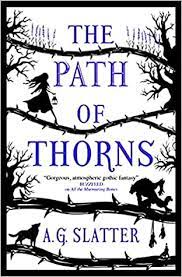
I read this courtesy of NetGalley. It’s out at the end of June, 2022.
You know those authors where you know you love their work but somehow they’re not automatically at the top of your mind and then you see a new book by them and you think, oh yeah I should read that; and then you do read it (perhaps eventually) and you think WHY DO I FORGET HOW MUCH I LOVE THEM?
Maybe that’s just me.
Sorry, AG Slatter. I really do love your work.
This novel is set in the world of Slatter’s mosaic novels – Sourdough and Other Stories, and The Bitterwood Bible and Other Recountings. You don’t have to know those stories to love and appreciate this one; they’re not about the same characters, or even necessarily the same places in the world. This is a world where magic is real, at least some of the time, but not everyone approves. Magic is mostly done (at least in these stories) by women, which feeds into the disapproval of that ‘not everyone’. It’s used for good and for ill and sometimes doing it for one reason ends up having the opposite consequences. In her Author’s Note, Slatter points that the world is a mishmash of the Victorian, Renaissance and Medieval – and asks readers not to go looking for historical accuracy. So there are moments that maybe kind of feel familiar from history, but they’re set with moments that really don’t.
What I particularly love about this and the other Sourdough stories is that they feel like fairytales, even though they’re definitely not tales that I know. There’s something about the ideas and themes – as Slatter suggests, “weird family dynamics, manipulation and lies, false faces, lost families and found, terrible acts and the potential for redemption”. There’s also something about the way Slatter writes, and here I am completely lost for words. I can’t tell you what words or phrases she uses to evoke a slightly eerie world, the sense that this is a world just slightly off from ours; that makes me a bit amazed that this is NEW work, rather than something that was told ages ago and has that patina of tradition, of being a well-worn and beloved story – of familiarity. And that last is particularly odd, frankly, because I really didn’t know what on earth was going to happen from page to page. She uses phrases and stories-within-stories that read like they SHOULD be as old and familiar as the wine-dark sea and Achilles’ rage, but … they’re not.
So: Asher goes to Morwood Grange, to be governess to three young children. She has a frightening experience on arrival, and brings with her some things that she immediately puts under a floorboard. And see, right from that, you just know things aren’t going to be straightforward. And so the story proceeds – making friends and enemies and figuring out how to do what she’s come to do; you already guessed that Asher didn’t come to Morwood accidentally, right? In some ways a bit claustrophobic – Asher mostly interacts with the family and few servants at Morwood – it’s saved from being TOO gothic the-house-is-trying-to-eat-me by occasional visits to the village and out into the grounds of the estate, and also through Asher’s occasional reminiscences, It’s an intense story, intensely inwards-focussed – and look, I read it in a day.
I loved it. A lot. It’s not always easy to read; the family is a deeply broken one, Asher’s not exactly perfect, and there are definitely actions that people regret (or should, but don’t). And yet, I loved it.
The Atlas Six
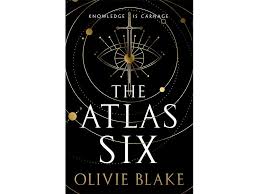
I read this courtesy of NetGalley.
This is one of those books where the originality lies primarily in the execution, rather than the initial premise. And this is in no way an insult! Reading a new take on old ideas is exciting.
The basics: six people with extraordinary gifts are chosen to learn about a secret institution. Things are, unsurprisingly, not what they seem – and there is a lot of interpersonal tension as well.
See? Not a radically new idea. But the execution and the details made this a deeply intriguing book.
The world is one where magic is real, and even the non-magic users know about. Hard to hide a magic university in the middle of New York, I suspect. Also, some people have used their talents to get (legally) spectacularly rich. Anyway: it seems most people don’t have astounding levels of magic. So the six people chosen to learn about the secrets are told they’re pretty much the strongest, most gifted magic-users of their generation. Great way to manage those egos right up. Anyway, they are invited to learn about the Library of Alexandria – now somewhat metaphorical, as it’s not in Alexandria, although it is still a library. And that’s one of the key drawcards: the right, and ability, to search the library for anything they want… if they get through the year.
So we have magic, and we have knowledge, and we have massive personal conflict – mostly because of the individual personalities. Intriguingly, the narrative moves between all six of the initiates, meaning that there’s not automatically one of them the reader is guided towards supporting. While some of them are absolutely unpleasant people, this multi-focus allows the reader to see their complexities and thus make the story that much more complex.
It’s a clever set up, and the twists are just as clever, and the characters are right on that borderline of horrible-but-not-so-horrible (unlike, say, Heathcliff). Clearest sign I enjoyed it? Can’t wait to read the sequel.
Kon-Tiki, by Thor Heyerdahl
I do love a good adventure/ travel story, so when I saw this in a secondhand book shop I thought – why would I not read the book that as far as I can tell, arguably started the modern version of ‘person goes on crazy adventure and writes about it’?
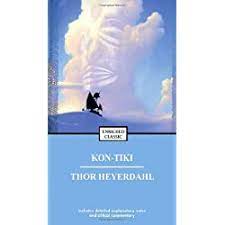
I am… ambivalent, now, having read it. Basically one part positive, two parts negative.
Positive: it really is a riveting story. Six men in 1947 on a balsa wood raft, sailing from Peru to Polynesia. They have a radio and a sextant, and modern clothes and sleeping bags; but their raft is genuinely balsa wood, held together with rope. They have no particularly good way to steer. It’s made (apparently) as accurately as they could to match the descriptions from Spanish conquerors to the area. They truly have remarkable experiences, and they went 100-odd days crossing the Pacific. That is epic, as are their encounters with a whale shark, various other wildlife, storms, and just life in general. For that aspect, I don’t regret reading it.
The negatives… well. To start with the journey itself – no, even before. The description of cutting down massive old balsa trees for the construction of the raft had me cringing. Then there’s the seemingly-wanton ‘fishing’ while they’re at sea: they’re hooking and killing far more shark and other fish than they eat, which is just awful. (It is kind of hilarious to read of the flying fish just randomly landing on the boat, I will admit, and eating those makes sense – especially when they’ve been piling up throughout the night.) Also, Thor at least is married and… in the entire book, no mention of the wife. Ever. Not even before the journey, when he’s in America trying to convince people of his theories.
And, yes, here’s the rub, the sticking point, the main problem. Thor goes on this journey to show that it would have been possible for humans to sail from South America to Polynesia, and thereby be the progenitors of at least some of the people living in those islands, and therefore responsible for the impressive statues and pyramids and other ‘advanced’ things that can be found on some islands. But not the Inca, oh no, and not the Olmec, or anyone else you might have heard of: rather, it was a white, bearded race who apparently came before the Inca. And were more civilised, and taught them everything and then got chased off. So… yeah. His entire premise is deeply, deeply racist. This also comes out in descriptions of the Polynesians and others. I’m privileged because I’m white; if a person of native South American – anywhere on that continent – or Polynesian or, I’m afraid, Jewish descent said they were thinking of reading this, I would want to have a good long conversation with them so that they knew what they were getting into. This absolutely means the entire book is problematic, and being a ripping adventure yarn in no way excuses it. It is written in 1947, which offers some context for why Heyerdahl thought it was appropriate to write such things and the publishers apparently had no problem with it – hey, no Polynesian is likely to read it, amiright? and why would they complain even if they did? etc.
Did it have fun bits to read? Totally. Is the book problematic? Absolutely. Did I buy the other two books he wrote, to try and show that Egyptians AND Mesopotamians got to South America by boat? I absolutely did and fully intend to read them to rip the theories to shreds.
Rocannon’s World
Many years ago I had this idea for essays about Ursula K Le Guin’s Hainish Cycle. They’ve been sitting around in my brain for ages, so I thought I’d post a short bit from the first one. Partly as a kick to myself, partly to see what other people think… if you’ve read Rocannon’s World I’d be interested to hear what you think (it’s still very draft!).
Narrative conventions: questioning “the hero”
Le Guin’s playing with narrative conventions begins in the Prologue. Semley’s experience fits a pattern for those who spend time with the fairies under the hill – one night with them being, in reality, much longer. However, although her story seems at first that of the hero on a quest, Semley definitely does not fit that pattern. Her quest is ultimately pointless, since she gains the jewel but loses her family. Thus Le Guin questions the very idea of the hero’s quest, with one objective met but devastating long-term consequences. Indeed, the idea of the hero has already been challenged through the fact that it is Semley, not Durhal her husband, who has the idea and the courage to undertake the journey.
As the main character, it might be expected that Rocannon would be the hero. However, he never plays into that role. It isn’t that he is a coward; he rejects Mogien’s suggestion that they find the ship given to the Clayfolk so that Rocannon can leave the planet, saying “I’m not going to run off eight years into the future and find out what happened next!” (27). However, he rarely plays a direct part in the action. He does participate in combat at one point, and gets in a shot at an enemy, but then himself gets shot through the leg. When he does manage to have an impact on events he is closer to an Odysseus than anything else, using words, silence and cunning to get his way – sometimes. For instance, when he is about to be burned at the stake, he uses his impermasuit to withstand the heat and refuses to speak to his captor Zgama. He doesn’t rescue himself, though, relying on a companion to do that; neither does he rescue his friends from the strange insect-like people, this time relying on the help of strangers to do so. When he and a companion are threatened by ruffians, he gives up Semley’s necklace rather than attempting to fight or connive his way out. Thus, while he is the protagonist, he is not heroic. Mogien is far more traditionally the hero, riding his wingsteed into battle and slaying enemies. Interestingly, there is never a comparison made between the two: Mogien, while not as knowledgeable as Rocannon, is never shown to be a thug; Rocannon is not lacking in manliness for not matching Mogien. Le Guin suggests that survival doesn’t necessarily have to do with heroism, and that there are multiple ways of being a man and being useful.
Story and reality
The Prologue opens with a question: “How can you tell the legend from the fact on these worlds that lie so many years away?” (3). It continues, “How can you tell fact from legend, truth from truth?” – proposing that legend is, in fact, a form of truth. The opening of the story proper furthers this theme: “So ends the first part of the legend; and all of it is true. Now for some facts, which are equally true, from the League Handbook for Galactic Area Eight” (22). Mythology and academic texts are thus given equal stature in the matter of ‘truth’.

 Randomly Yours, Alex