Gate Sinister, Tansy Rayner Roberts
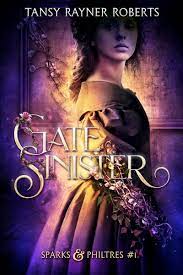
I received this book from the author, who is a friend of mine… for which reason if I didn’t like, I just wouldn’t have written a review! It comes out in January 2023.
It’s no secret I’m a fan of Tansy’s work. Hilariously, I was a fan long before I met her: I read Splashdance Silver at uni, and THEN I met her a convention and was completely overwhelmed and THEN she turned out to be, like, a real person.
ANYWAY.
This lovely novella has a lot of Tansy Trademarks. The story skips along at a smart pace, with the occasional aside to explain something. There is a very good line in banter – the sort of repartee that can only exist in stories because no one can be that good on their feet, and is one reason why I like reading these sorts of stories because I dream of being that fast on my feet. It’s a little bit dark, and honest about human nature while ultimately striking a hopeful note.
Tansy has a good line in using kind-of-historical settings for her work. The Creature Court series used her wealth of knowledge about the Roman Republic and Empire. Here, she’s using Victorian England, and giving it a fantastic twist – love potions are real, fairies are too but they’ve been banished, magic is real. She even uses a governess, and I know for a fact that she prefers Wuthering Heights over Jane Eyre (she’s wrong). Chapter headings lean into Georgian/Victorian styles, with headings like “In Which Toadstools Are False, Storybooks Are Essential, and a House has its Secrets” – which also implies the gothic overtones, because houses are creepy.
Overall, highly enjoyable, and I will take more stories about Flavia and her wards any day.
Seasonal Fears, by Seanan McGuire
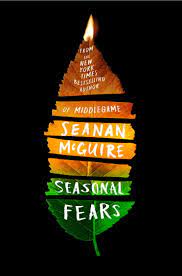
I received this book from the publisher, Tordotcom. It’s out now.
Officially this is a standalone novel set in the same universe asn Middlegame (which apparently I never reviewed). And officially that’s true; I haven’t read Middlegame since whatever year it was published and up for a Hugo, and I have a bad enough memory that it’s not quite like I never read it, but close. It would be more accurate to call it a companion novel, though – the other adjective used in the press release. Because some of the characters from the first do appear here, in the second; it’s not mandatory to know who they are, but I think it probably helps a lot to have some knowledge of how this world works. Although maybe not, since Middlegame does throw the reader into the hectic world of alchemy and anthropomorphised aspects of the universe.
Where the first novel was about trying to compel aspects of the universe to take human avatars, Seasonal Fears is kind of where the alchemists got their ideas: Summer and Winter have been incarnate for as long as humans have been projecting their humanity onto faceless and terrifying natural processes. So Harry and Melanie get caught up in an ages-old quest/epic/adventure. They have been living one for most of their lives, actually: she’s got a congenital heart condition and no one expected to live to 17; he’s been in love with her (and she with him) since they first met. So that’s one narrative they’re living; then another gets shoved on top. There’s road tripping, and meeting people who variously help and hinder, and dealing with the changes happening to them whether they like or not.
So it’s a coming of age novel, yes, with that fantastically wonderful Seanan McGuire touch. There’s nice banter, and a narrator who is sometimes ruthless and sometimes unbearably caring, and characters making bad choices for good reasons (and vice versa). There are parts of this novel that are truly vicious: there isn’t just one candidate for the seasons to become incarnate in… . And yet, and yet, there is also a glorious hopefulness. Not the sort of hopefulness that means everything will be easy and okay and no one will ever be hurt: but the sort of hopefulness that means you can live through, and with, difficulty; that life is worth it; that the world is worth the pain because there are good things in it.
I really enjoyed it.
Lost in the Moment and Found (Wayward Children, #8)
Read courtesy of NetGalley. It’s out in January 2023 (sorry).
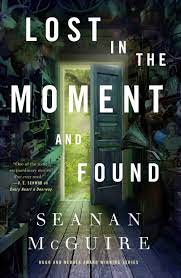
It’s a Wayward Children novella. It’s always an exciting moment.
One thing I that both makes me happy and sad with some of the recent novellas is that they’re standalone. I love that they provide new entry points for readers, and also that McGuire is exploring such interesting variations on the ‘there are Doors that lead to new worlds and young kids who need them can sometimes find them’ thing.
The only reason I’m sad is that I love many of the original cast and I will always want to know more about them. But that’s definitely about me and not about the books.
So! If this is your first Wayward Children, how awesome! And if it’s your 8th, how awesome is this series??
As McGuire herself does in the Author’s Note, I will point out that the lead character deals with an adult gaslighting and grooming them. McGuire wants very much to let readers know that Antsy runs before anything actually happens, and I deeply appreciate this reassurance. I also appreciated, as the story progressed, the narrator noting that Antsy’s fear of not being believed was in fact unfounded. Which is of little use to Antsy, of course, but perhaps of enormous use to a reader.
Antsy: unhappy at home, runs away, finds a Door… which leads her to a shop with a talking bird and a very old woman, which turns out to be a shop where lost things turn up (yes, all your odd socks; kittens and my favourite frog ear cuff, too, I expect). The bird and the woman and now Antsy catalogue what turns up, help people find lost things if they can, and sometimes sell things when they know they won’t be claimed. Many Doors open from the junk shop – which is a very different premise from what happens in most of the other stories – and Antsy goes through to visit markets and to explore. It is, of course, an adventure… and things do, of course, turn out to be not quite as they appear.
I love Antsy; I thoroughly enjoyed the story; McGuire is still doing great work in this series.
Super-Infinite: The Transformations of John Donne, by Katherine Rundell

Courtesy of Allex&Unwin, it’s on sale now ($34.99, hard cover, and it’s beautiful).
This book is wondrous – glorious – it’s poetic and soaring in its language, honest and brutal and passionate in its analysis of John Donne; a wonderful biography, a snapshot history of late Elizabethan/ Jacobean politics and drama, and an inspired defence and encomium for Donne’s poetry.
I loved it. Clearly.
I come to John Donne loving him for “Death be not proud”; I am not the greatest lover of poetry, but I know that piece by heart. I come to this book with some knowledge of the era, although not exhaustive. Neither of these things are necessary for an appreciation of this book – firstly, because Rundell chiefly praises Donne as the preeminent English poet of love (news to me), and also because Rundell gives a lovely, succinct explanation of all the things that have an impact on Donne’s life.
As a biography, the structure of this book is inspired. It’s largely chronological, thankfully, although bits of poetry and prose are scattered throughout to help illuminate Donne’s life. Each chapter, though, is structured around an aspect, or transformation, of Donne as a human. Early on these are the obvious changes, from child to youth and so on. But there’s also “The Convert (Perhaps)” – because Donne was born to a Catholic family in England when that could get you killed (like Donne’s own brother); and then the variety of positions Donne has, both personally: the Anticlimatically Married Man and Ambivalent Father; and professionally: The Flatterer, Clergyman, and (Unsuccessful) Diplomat. Throughout, Rundell’s conceit of Donne as a multifaceted man is born out – in his own experiences, and in writing. And his writing sings throughout, for all that – as Rundell points out, as people forget with Shakespeare and other contemporaries – there’s only one piece of Donne’s work in English in Donne’s own hand known to the 21st century. The rest has been put together by scholars over 400 years, and there are quibbles over words, so we’re really not entirely sure if what we have is what he meant (go look up the variations on Hamlet’s “To be, or not to be” speech for an idea of what scholars are dealing with).
As a biography, this is masterful. As literary criticism, it’s very readable and gives me a huge appreciation for Donne’s mastery of language; he was brilliant and in love with language and with humanity and, indeed, both life and death. Rundell is unflinching in examining his misogyny, too, placing it in historical context as well as its personal meaning.
And as a book, Rundell has herself written a gorgeous, poetic, masterful work. She has a marvellous turn of phrase (“the Habsurgs kings with enormous jaws and close friendships with the Pope”), she is simultaneously devoted to and clear-eyed about her subject, and she conveys her ‘act of evangelism’ about Donne and his work in a way that I wish more people were capable of.
It’s not often I get to read and review a book that makes me so unambiguously happy that it exists.
The Future is Female! Volume 2: 1970s
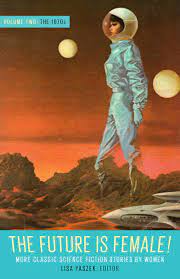
I read this courtesy of NetGalley. It’s out in October 2022.
Lisa Yaszek has put together another very fine set of stories that highlight the variety of science fiction that has been produced by women, this time in the 1970s. Arranged chronologically by publication date, this fiction has some stories that are angry, and some that are more on the whimsical side; some that (I think) could only have been written by a woman, and others that don’t particularly reflect a gendered authorship (and then there’s the James Tiptree, Jr). Some feel like classic SF, others are more experimental. I didn’t love them all. As a set, this is a really amazing way to showcase the variety of what women can write and have written.
Some I’ve read before: “When It Changed” (Joanna Russ) always gets me and I hope will always be discussed as part of science fiction in general, and not ever just relegated to ‘battle of the sexes’ conversations. I don’t understand why we don’t talk more about “The Girl who was Plugged In” (Tiptree) when we discuss cyberpunk; “The Screwfly Solution” (Raccoona Sheldon) is always completely horrific, and so is “Wives” (Lisa Tuttle), for very different reasons. I have always loved “Of Mist, and Grass, and Sand” (Vonda N. McIntyre) for its exploration of love and compassion – and same, in some ways, with “The Day before the Revolution” (Ursula K. Le Guin), although the latter is even more poignant; I always need to just stop and stare into the distance for a moment when I read it.
Of the others, there were several that stood out. I’ve read very little by Chelsea Quinn Yarbro; “Frog Pond” was very nicely paced, and the reveals built up beautifully. Kate Wilhelm’s “The Funeral” was quietly terrifying as the state of America was slowly revealed – and these two, next to each other, were particularly distressing to read in the current state of the world. “The Anthropologist” (Kathleen M Sidney) feels in some ways like it’s in conversation with Heinlein’s Stranger in a Strange Land, with its exploration of living between two very different worlds. And as someone who occasionally feels sad for Curiosity and Voyager etc, never being able to come home, “View from a Height” (Joan D Vinge) was something of a gut-punch. Gorgeous, but a bit harrowing.
… clearly, I think this anthology works for both people with some knowledge of the state of the 1970s field, and I believe it would also work for those who want an introduction to 1970s SF in general. It’s nicely comprehensive.
Matilda: Empress, Queen, Warrior

How exactly did I get to this age without reading a biography of Matilda??
Well… it’s not entirely my fault, because there just haven’t been that many. And oh, couldn’t we talk about the reasons for that. And in fact Catherine Hanley does discuss some of the reasons for the lack of historical focus on this astonishing woman, and puts in the historical context for how she was discussed 900 years ago as well.
Let me say upfront: it may be 900 years ago, but the THEFT of the English crown from Matilda by her cousin Stephen STILL MAKES ME MAD.
Matilda: oldest child of the English king; married at 8 to a foreign emperor; widowed; named her father’s heir (because her brother had drowned); crown STOLEN by Stephen; spends many years fighting Stephen for the right to be monarch of England; eventually manages to have her son named Stephen’s heir, lives to see her son crowned king (although not literally, because being present would have made all the menfolk feel a bit uncomfortable). Matilda was amazing.
Matilda’s epitaph places her in the context of three Henrys: her father (Henry I of England), her first husband (with a complicated set of titles but eventually crowned emperor of ‘the Empire’; his lands included what is today Germany and various other bits), and her oldest son (Henry II of England). This epitaph is not surprising given 12th century attitudes. It’s probably also not the surprising that she has continued to be placed in this context.
Hanley does a really great job of using the existing contemporary documents (all histories written by men, mostly monks, as well as charters and other such legal documents) to give a reasonable suggestion of what Matilda was doing, Matilda was responsible for; reasons for Matilda’s actions and how she worked within, as well as bucking against, 12-century expectations of a royal daughter/wife/mother.
This is why a feminist, and now gender, lens is so important for history. Matilda was often described as ‘haughty’ and other such words… for doing exactly what her father, in particular, was praised for doing. She makes a really nice point of how when Stephen’s queen (…also Matilda, it was as bad as Henry) acted in a masculine way on behalf of Stephen, it was praised; but do so for your OWN benefit, and you’re a ranting virago.
Filling in a gap in my knowledge, this book was priceless (my MA was on this Matilda’s grandmother, also Matilda; this Matilda’s daughter-in-law is Eleanor of Aquitaine). As a thoughtful look at a hugely important part of English medieval history, I think it’s accessible to general readers who are prepared to deal with the Henrys and Matildas.
Making Australian History: Anna Clark
Not a review book! One that I saw in the delightful bookshop in Queenscliff and barely even stopped as I walked past, grabbed it, and paid for it.
(Who am I, reading historiography about Australian history? Australian history? My how I have changed.)
Sometimes I forget how much I love historiography. And I really, truly love it. A history of history writing/making itself? How much more meta can you get?? And Clark writes just so beautifully. This entire book is a delight.
Clark aims to present a history of how Australian History (the capital H is discussed very frankly and thoughtfully) has been written over… a very long period of time; and also how the writing of Australian History has helped to construct that history. Clark is under no illusions about the reality that History writing is part of the colonial project, and I think one of the great ongoing themes here is how Clark starts to unravel, deconstruct, illuminate, and reflect on that very process.
(Do the adjectives give a sense of how much I enjoyed this book?)
Another of the great aspects of this book for me is that it’s not entirely chronological – something else that she discusses frankly in the introduction. Chapters are thematic, and vaguely chronological, and also generally chronological within the chapter; but chronology is not the be-all of history writing, important as it is. I deeply enjoyed that there were chapters on ’emotion’ and ‘gender’ that ranged across time, to show how those things have affected history writing at various points.
Each chapter has a focal text, one that Clark uses as an instrumental text (in a broad sense) to get at a particular idea. Which is precisely something that I’ve done in the classroom, and it works really beautifully in the book to draw out and illustrate particular ideas. It’s a really great way of managing the flow of the chapters.
… it’s just really great. I think it serves as a good, thoughtful introduction to how Australian History has been written, thought about, and itself produced the Australia we live in today. Clark uses the ‘whispers’ and alternate texts and sometimes things that haven’t always been considered as history to give a sense of just what can be meant by ‘Australian history’. You don’t need an in-depth knowledge of history, or historical theory, to enjoy this – although you do need to be prepared to really think about the ideas being presented.
Growing Up Weightless, John M Ford
I read this courtesy of NetGalley. The re-published edition, from Tor Books, is out in September 2022.
Honestly this book really shouldn’t work. It’s so full of lacunae it was like reading the second or third book in a series and not having the information to fill in the gaps. Another issue is the formatting, although I suspect that’s a matter of it being an e-ARC: there are sections where the POV suddenly changes but it’s not indicated by an extended break or anything like that. And if that’s an artistic choice rather than a formatting thing… well, I don’t particularly like it, but it did make me work harder and pay probably closer attention, so maybe that’s what Ford wanted for me. And thirdly, it’s not exactly a grand story. No explosions, no dramatic twists of fate for society, no incredible revelations.
And yet.
It shouldn’t work, but it does.
It’s not a grand story: it’s an intimate one, a growing-up story – as the title suggest, ‘growing up weightless’: it’s set on the moon, not all that far into the future but far enough that there’s a settled, indeed governmentally independent, colony. And as children have done since time immemorial, some of the children of the moon are unsettled, feeling like they don’t fit in and want more/different/other. And they’re also playing games: surprisingly substantial parts of this story are the kids playing a role-playing game, as outlaws in Sherwood Forest (do I love the idea that this milieu could continue to be attractive for coming generations? yes I do).
Matt, the main character, is born into an important luna family, and is feeling the pressure to figure out what he’ll do as an adult; he basically knows, but he’s afraid to tell anyone else. He loves his friends, and acting, and the role-playing game they’ve had going for many hours now; his relationship with his family is a bit fraught. The moon is somewhere that teens can travel around quite safely, especially within their own domes; there’s excellent train networks, so you can travel between domes too – and so they do. This is pretty much how the main action happens, such as it is. This is, on reflection, a fairly claustrophobic story, as befits one set on the moon.
Along – or perhaps slightly behind – Matt’s story is his father’s, and this is where even more lacunae exist. Albin’s relationships with various figures, the decisions that need to be made for the moon’s future, even how he feels about anyone – all of this is very shadowy. Which mirrors how Matt feels about his father, really, so again maybe that really makes sense and I’m only realising as I write this just how clever and deliberate Ford was.
It probably shouldn’t have worked, but it did, and I am once again grateful that Tor is re-publishing Ford’s work, so that people like me get to appreciate it.
The Atlas Paradox, Olivie Blake

Read courtesy of NetGalley; it’s due out in October 2022.
This review will have some spoilers for the first book, The Atlas Six. And you really need to read the first one. Do not come to this with no prior knowledge.
This is an example of one of those books where very quickly I am pretty sick of the bullsh!t of every single character, impatient with their childishness and arrogance and lack of ability to see beyond their own selfishness… and yet I kept reading. Partly for the characters – I like Libby (and let’s not analyse that particular sentiment), and to my amusement I like Nico, and of course I like Gideon; Reina I am intrigued by. The others I find very frustrating if occasionally intriguing. But I also keep reading because I just have no real idea where Blake is going with all of this. I don’t know whether the characters are going to actually come together, or not; whether they will work with Atlas, or not; whether the world is going to end, or not. And so despite my impatience and frustration – all, it must be said, indications that Blake is skilful at creating characters; I don’t tend to waste emotions on 2D characters – I devoured this book, and am now also impatient for the third book. This situation cannot be left where it is and I need to know how it resolves.
So the book opens with Libby gone, her colleagues initially assuming she’s dead and then realising that she’s just… gone. Using his abilities, Ezra has dropped her in the past, hoping to save her or save the world or… honestly who really knows, Ezra is so messed up. The others, back in the Library mansion, are meant to spend their year doing basically an Honours project, researching their own thing. As may be of little surprise to those who’ve read the first, mostly they just don’t bother because have you ever met another group of incredibly smart people who collectively had so little interest in actually doing the work they’re expected to do? Reina is not included in that indictment. And I guess Nico isn’t either but he’s Nico, and like all the others is definitely running to his own agenda. It will also come as no surprise that things go badly for pretty much everyone at different stages of the story. They don’t cope very well with that.
There’s an enormous depth, here: Blake hints at a lot with Atlas, and with Dalton, and with Reina and Parisa in particular. There’s also terrifying potential for what could eventually occur. Both of these novels have been very well-paced; Blake uses the multiple-narrator mode beautifully to explore the variety of characters and give hints at what’s in their brains. I think, actually, that it’s using that format which makes these novels so very compelling.
Enclave, by Claire G Coleman
I received this from the publisher, Hachette, at no cost.
If you’ve read Terra Nullius or The Old Lie, by Coleman, then I heartily recommend the same strategy as I used: just read the book. Don’t read this review, don’t read the blurb. You already have a sense of how Coleman writes, and what Coleman writes. The first two were very different, but you know how they’re similar; this is also very different, but it’s clearly a Coleman novel. If you were staggered by those first novels, then you really don’t need to anything else other than: it’s a new Coleman novel.
Still with me? Haven’t read either of the first two (but now you know you should because they’re amazing), or somehow not sure about this one? Christine lives in a walled city with no contact with the outside world. Everyone knows that the outside world is terrifying, full of violence and bad things; unlike their city, which is calm and peaceful and carefully surveilled for any trouble. Everyone who lives inside this city is white; the bussed-in servants are brown, but they’re nameless and just go about making houses liveable. Christine isn’t entirely happy – her best friend is missing and she doesn’t know what to do – and then does something unforgivable, and then everything changes.
It’s fantastic.


