Fairy tales. New ones.
Sometimes I forget how much I love reworkings of fairy tales. How crazy is that?
Ever since my mother (I think?) gave me a lovely little collection of twisted fairy tales – I have no idea what it was called, whether they were all by the same person, or whatever – I have been passionate about people taking well worn stories and twisting them. Sometimes slightly, sometimes extremely. But, it turns out, I forget this. And then I read Troll’s Eye View, and I remember… because sometimes the villain is absolutely the most interesting character, and sometimes they’re not actually a villain if you look at them a certain way. And I read To Spin a Darker Stair, and the prose is wondrous and the stories gripping.
But then I forget. And I have something like Paula Guran’s anthology Once Upon a Time: New Fairy Tales sitting there waiting… waiting… waiting to be read, and when I finally get around to reading the first one I think, why have I been waiting so long?
Maybe having written this, I am less likely to forget in future. I can hope.

I enjoyed every story in this anthology; some more than most, but there wasn’t a one that I flicked through impatiently. There’s a great range of stories. Yoon Ha Lee, whom I’m just discovering, brings a Korean-inspired story in “The Coin of Heart’s Desire” that fits into the “be careful what you wish for” zone; Cinda Williams Chima brings native American folklore into a “gritty industrial landscape” a little bit like Charles de Lint. Angela Slatter turns a princess into a bird in a story of revenge, while Priya Sharma, in “Egg,” wonders about all those stories where all the woman wants is a child… There are retellings, too: Genevieve Valentine plays with “The Snow Queen,” Jane Yolen and Ekaterina Sedia take “Sleeping Beauty” in two completely different directions (Sedia does it better, I think); Tanith Lee uses the one about the dancing princesses. Richard Bowes brings a sardonic Puss in Boots into the world of social media and Caitlin R Kiernan takes Little Red Riding Hood into space. Cory Skerry smashes “Beauty and the Beast” and AC Wise makes “The Six Swans” a rather darker story about desire and selfishness. Perhaps most profound is Erzebet Yellowboy, whose story means I will never, ever view the (step)mother in Snow White in the same way again.
This is a glorious anthology – one that you could sit down and read cover to cover, or dip in and out of.
You can get Once Upon a Time from Fishpond.
Midnight and Moonshine
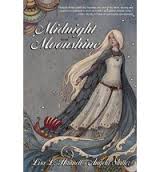
This book. Oh, this book.
It took me a few months to read this collection, this mosaic novel. This is no reflection on the quality of the book. Well, actually it is, but not the way you might think. See, I’d read a story, and then I’d be forced to close the book, sigh, and stare into space in order to wallow in the beauty of the prose. And then I’d have to go read something else, because (like with me and Gwyneth Jones’ Bold as Love series) sometimes too much beauty is painful and you need a break.
First off, look at that cover. Is she not glorious? are the colours not soothing and enticing? Created by the awesome Kathleen Jennings (who chronicles the saga of its production on her blog), I would absolutely have this on my wall. LOVE.
Angela Slatter and Lisa L Hannett created the contents. Writers who collaborate are even more of a mystery to me than authors who work alone, and to produce this sort of magic has to be just that – occult somehow. And they haven’t been content to just a straightforward story. Instead, as suggested above, this could be seen as a collection or a mosaic novel. A collection because it is made up of short stories that can basically stand by themselves. You could take one and put it in an anthology and it would still work ok. However – and here’s a metaphor I’m very pleased with – that’s like taking a candle out of a chandelier. Yes, it still sheds light. But when you put it with its fellow candles and they’re ringed with crystal, the whole effect is so much more just a few candles in one place. These thirteen stories, read together and in sequence (and wrapped in that art), are far more than the sum of their parts. Together, they create a history of an entire people: their origins, their interactions with humanity, their crises and triumphs, and the ongoing impact of a few families and their heirlooms. Thus, a mosaic novel – there is continuity, but it’s thematic and genetic; there’s only one character appears in or influences lots of the stories. I couldn’t help but be reminded of Edward Rutherford (London, Sarum) and James A Michener (The Source) following multiple generations in one place in order to fictively illustrate local history. Slatter and Hannett do just that… with magic. And Norse gods. Same amount of revenge though.
The premise, as set out in “Seeds,” is of Odin’s raven Munin (memory, here called Mymnir) surviving Ragnarok and setting out for Vinland (thought to be somewhere on the north-eastern corner of North America) with a few followers. Once she gets there, she creates an enclave and peoples it with servants, and sets out to rule it I guess like she learned from the Aesir she’s observed for however many centuries. Of course this does not go entirely well either for her or for her people. There’s love and betrayal, selflessness and vindictiveness; people get beaten up, rescued, married off, wooed… and some people even manage to make their own destinies. My estimate is that the stories take place over roughly a millennium, but that’s based entirely on the fact that that’s about how long ago it’s posited that Vikings did historically head off for Vinland and settle for a short span. The early stories take place in a sort of timeless, medieval-ish zone; from memory there are no dates in the first seven stories, and it feels like that sort of myth/fantasy where time itself is important but recording it is less so. Then, with “Midnight,” suddenly the external world exists and thrusts itself onto this dreamy place. From then on, time is relentless, and within 5 or 6 stories it’s the modern world. This development works mostly because although the stories do stand alone, there is continuity within families. Sometimes the names give them away, sometimes it’s an heirloom appearing, occasionally a reference to a past event. This often means that rather than having to struggle for a new emotional connection every time, the reader can build on the investment already made in the character’s family, from an earlier story. It’s the same reason Rutherford and Michener’s works can be successful.
And on top of all of this, the sheer beauty of the prose. I do not have the words to explain how delightful the words in this book are. It just all works.
Did I mention it’s an Australian production? Produced by Ticonderoga, in Perth.
You can get Midnight and Moonshine over at Fishpond. (Although it does ship from a US supplier.)
Sylvia Pankhurst
Recently I’ve been really getting into the history of the women’s suffrage movement in Britain. There are professional reasons for this, but the reality is it’s been a simmering interest for a very long time. I don’t remember what grade it was, but I know I did a research essay on Emmeline and Christabel Pankhurst at school – to my teacher’s complete not-surprise – and was quite inspired. It was probably the first time I had felt that voting was actually something I ought to be interested in. And every now and then when I get discouraged by Australian politics and wonder whether it’s worth voting… well, I remember that although it was easier in Australia, women all over the world fought incredibly hard to get someone like me the opportunity to cast a ballot. Who the heck am I to throw that back in their historical faces?
One of the books I got in a rash of purchasing last year was Sylvia Pankhurst: A Life in Radical Politics. I knew Sylvia had fallen out with her mother and sister, and she went on to form her own (somewhat amusingly named) suffrage organisation, ELFS (East London Federation of Suffragettes). Thanks to a biography of Emmeline Pankhurst I knew a bit more about her politics, and her daring/disgraceful child out of wedlock. I also knew, although I don’t remember why, that she was incredibly important to mid-century Ethiopia, of all (seemingly surprising) places. There is, though, a whole lot more to her than these nuggets.
Mary Davis states right out that her intention is not to write a standard biography. Instead, she is aiming to look particularly at feminism and socialism in Britain in the first half of the 20th century via Sylvia. (She calls her Sylvia throughout, and justifies this with pointing that there were four Pankhursts active at the same time as suffragettes, and Sylvia was not the most famous. She also acknowledges that this is a problematic choice, which delighted me for its frankness.) What this book does then is look first at the development of the WSPU (created by Emmeline and Christable Pankhurst, Sylvia also involved); and then how/why Sylvia broke away as her socialist views conflicted with her increasingly right-wing mother and sister. Sylvia worked to meld her feminism and socialism, although this was incredibly difficult – a whole bunch of trade unions wanted nothing to do with feminism or helping oppressed women. As in so many cases, some of the oppressed don’t want to change the system; they want to get to the top of it and take advantage of it. When women eventually got the right to vote (some in 1917, all in 1928) Sylvia was changing her focus to the proletariat – she was a firm supporter, early on, of the Russian Revolution, and was involved in the Communist Party (well, one of).
Socialism and feminism were, if not acceptable causes, at least ones that other people clearly identified with. But Sylvia was also committed to more intriguing causes, which had fewer proponents in Britain at least: like anti-racism, anti-imperialism and anti-facism. Her newspaper was apparently the first in Britain to have a black journalist write for it. She spoke out on Ethiopia’s behalf when Italy invaded. These things got her some flak, as can be imagined, in Britain. But Ethiopia invited her to live there in the 1950s, and Addis Ababa has a street named after her, and her son still lives there (or did in 1999 when the book was published).
I love a good bio. Sometimes they can wander aimlessly, and sometimes they can focus too much on one aspect of a life. Davis’ approach seems, to me, to be the best of both worlds. It doesn’t pretend to be exhaustive; it does focus on one aspect, but that’s the whole point. And I really liked that it pointed out some aspects of British history, too, like bits of labour history that don’t often make it into mainstream historical narratives. In fact this is pretty much a checklist for the history of oppression: workers and women and black people are all covered, and all shown to have vital and real histories. Who knew? This book is a really great way into these areas of history, especially the suffrage/socialism aspect (and it’s only 120 pages long!).
The Dream Archipelago

This collection of stories is characterised by non-completion. By ellipses, gaps, loss of memory, tantalising hints of more, general incompleteness. In the stories themselves, in the people, in the world.
This turned out not to be the book I thought I was reading. Having adored The Islanders, I thought I was getting an earlier novel set in the same place. Uh, no. This is a set of short stories (including a couple of novellas): some set in the Dream Archipelago, some just referencing it. So I was quite discontent when I read the first ‘chapter’ – The Equatorial Moment – and accepted it as setting the premise for the book… and then realised that The Negation was quite separate, although with strong links. Don’t worry; I got over my disappointment.
“The Equatorial Moment” is not a story. It’s a vignette, explaining the very odd thing about this world: that there is a time vortex, which means it’s the same time everywhere on the world at the same time. It also means that flying somewhere is a rather difficult business. It also sets up that this world is experiencing a war, which – far more than issues to do with time – informs the entirety of this collection. “The Trace of Him” is also a vignette, of a lover and a funeral, that doesn’t really seem to fit the rest of the collection. It’s set in the Dream Archipelago, but that’s all.
Some of these stories are directly about the war, and its impact on soldiers and civilians. “The Negation” is framed around a draftee and his experiences, but also around an author whose art might be subverted by the war. (Its connection to the Dream Archipelago is tenuous – the novel that the soldier loves is set there.) This story was the first taste of incompleteness that flavours the rest, as Priest suggests and hints but does not fulfil. It’s marvellous. “Whores,” too, examines soldiers and civilians, through a different lens. This time the soldier has been granted leave due to sickness which manifests as synaesthesia; the civilians are women who have become whores because of the exigencies of war. This aspect, that the women are not simply whores but that they became such for real, usually economic reasons, and that they might also have other concerns, was a delight. Too often whores (and slaves) just exist in the same way that horses or dogs do, with no reference to what came before. So that worked. And there’s a tantalising question over whether the soldier in these two stories is the same man or not. The last story in the collection, “The Discharge,” also brings together art and war and ellipses. It’s the fullest exploration of the war that’s been affecting this world for a ridiculous amount of time, and makes it clear that ridiculous is exactly what it is. But then the narrator ends up in the Dream Archipelago, and starts exploring art… a type of art that has a genuinely visceral impact on its viewer by messing with the hypothalamus. And the story takes on a whole other layer and attacks a whole other idea. It’s maddening and glorious and a bit creepy.
You know that thing where you’re reading along, and you’ve been assuming something about the race, gender, location or attitude of a character and then something happens and you have to go back and read everything again to see whether you were stupid and made a mistake, or whether the author has been deliberately messing with you? That was “The Miraculous Cairn” for me. And I’m pretty sure the answer is the latter. It’s set half on the mainland and half on an island; half in the present and half in the past; and it’s a horror story. One of those slow, creeping horror stories that might not be a horror story but probably is. Gave me the shivers, anyway, and is the exemplar of non-completion. It has nothing to do with the war. Neither does “The Cremation,” which is set more fully in the Archipelago and whose horror aspects stem directly from that fear of not knowing the local traditions and attitudes and behaviours. It works all too well. Also largely separate from the war is “The Watched,” whose horrific nature really only comes through in the last few pages. Before that, it definitely has its creepy elements but they’re not the focus (although on reflection perhaps that ought to have made it more creepy…). The tantalising gaps in this story are the sort of thing that in another author’s hands would just indicate a lack of imagination, or pages where they’ve simply deleted “MUST ADD MORE INFO HERE”. Instead, the reader is left just as much in the dark as Ordier about the society of the Qataari, his object of frustrated fascination. What makes the novella really work is that this fascination, while at the heart of the story, is not its sole preoccupation. Ordier – living in the Dream Archipelago but not a native, having left the mainland and his war-related work – lives a relatively ordinary life with a girlfriend whose job is demanding and disappointing, and we get many pages of relatively ordinary life along with Ordier’s growing obsession. This adds to the creepiness but it’s not just there as filler; actually I would have been happy reading about Ordier and Jenessa and their experiences, they’re so intriguing. Which is why it works as a novella.
Are they SF? Is this fantasy? No. The collection is set on a different world, yes; but there’s no exceptional technology – it would be easy to read much of it as set in a generic olde worlde rural setting until you get references to planes, grenade launchers and microwaves. There’s also no magic; the time vortex just exists, and except for stuffing around with air travel doesn’t actually impact on life. The people are human, with nothing special about them. This is just… a world. But I would still argue that it counts as speculative fiction, because I am contrary like that.
This is not the sort of collection I can imagine reading again. The stories are demanding, they’re frustrating, and I think they may only work once. But that once was pretty glorious.
Where Time Winds Blow
I have been a fan of Robert Holdstock for a while, both for the Mythago Wood series and his Merlin/Jason and the Argonauts books, which I still haven’t finished… oops… I’ve had this book on my shelf for a very long time, and as part of my effort to deplete the TBR pile I’ve finally got around to it.
Interestingly, this reminded me of two books. Firstly, the idea of a planet with weird time distortions of course calls to mind Dan Simmons’ Hyperion Cantos; this came first, and I can’t help wondering about influence. Secondly, there’s also a similarity to Kress’ Steal Across the Sky, this time in its attitude toward the alien. Aliens were a means to an end for Kress, allowing her to explore different aspects of humanity or society; VanderZande’s World allows Holdstock to do the same. The people are there because of the time winds that rips ng things from the past and the future and deposits them in the present (and presumably other times as well, but let’s not think too hard about that)… but this oddity is mostly just a vehicle for Holdstock to explore humanity.
Humanity have settled on this world partly to explore, and learn to understand the time winds, and partly to colonise. The first is the focus of the story, although the second is touched on and is one of the most interesting issues. The main narrative focuses on a rifter – a man whose purpose is to investigate the stuff appearing after the time wind has blown through. His world starts to go a bit pear-shaped when a new recruit joins his team. Holdstock is interested in how people deal with stress, and how this impacts on relationships, and gradually reveals more of Leo’s life and issues. Of course, things aren’t even as normal-life complex as they initially appear, and Holdstock makes the issues of the past come through in such a way that makes complete sense with what has already been revealed.
Alongside this narrative, Holdstock gives tantalising hints at the world he imagines. It would be human-compatible, but its organic life creates pollens that are toxic. There are two responses to this issue (well, three, because there are also the people who don’t bother to try and settle there): the colonists who are hoping to eventually evolve to the point of unassisted survival; and the manchanged, colonists who have artificially intervened into themselves in order to live without assistance now. The hostility between them is barely examined, but adds depth to the overall narrative as well as depressing believability.
The one problem I had with this book was about the last 20 pages. They felt rushed and forced, and wrapped up an issue in a way that neither felt integral nor necessary. So that left a slightly sour taste in my mouth, which is unfortunate given I enjoyed the rest of it.
Steal Across the Sky

There are interesting parallels between this and Mary Doria Russell’s The Sparrow. Both deal with humanity’s contact with aliens, and with the repercussions for humanity especially in the realm of religion. There are vast differences, of course – how contact is achieved, the type of people involved, and so on. I think Russell’s is better, overall; I appreciated the characters more, and I think it’s overall a more sober look at the repercussions for humanity. But I also think the two books are trying to do different things, and Kress has achieved something impressive in her novel.
Aliens have contacted humanity with the sole intention of Atoning for some crime they committed against us… ten thousand years ago. They don’t reveal what that crime is, nor how they intend to atone for it. Instead, they talk to anyone who can get the bandwidth to reach the moon, and set up a boring website asking for volunteers to act as Witnesses. Predictably, they get millions of applicants, of whom 21 are chosen to go to seven different planets – planets inhabited by the descendants of humanity kidnapped ten thousand years ago (cue Stargate music). This, however, is not the crime. Almost the first half of the novel focusses on Cam and Lucca, Witnesses sent to a binary planet system to live with their many-times-removed cousins in order to discover the thing that they will ‘know when they see it’, according to the Atoners. Intriguingly, numerous chapters are also given to one of those whom the Witnesses interact with, providing an at time painful glimpse into the arrogance and cluelessness of one Witness. Slight spoiler, which really isn’t: they discover the thing. They don’t really know it when they first see it. But, as the blurb promises – or threatens – the knowledge does change them, and at least some people back on Earth. The rest of the novel is working through the repercussions of that knowledge, this time largely switching focus to other Witnesses, and only occasionally returning to Cam and Lucca. And, similar to Kim Stanley Robinson so gloriously in 2312, chapters are punctuated with ephemera: conversation transcripts, Oprah interviews, advertisements, etc. These add a wonderful verisimilitude to the world that Kress imagines, only a decade away from now: many thing similar (yes, Oprah; also internet trolls); and some different. Kress throws in some lovely SF-ish moments – just enough to be incongruent, to remind the reader that this is not today.
What this book is not is an alien contact story. Yes, it deals with first contact, and yes the aliens are pivotal. But that’s exactly what they are: a pivot, a lever, a fulcrum. They are a point about which the plot revolves, but not the focus. They are almost completely opaque and don’t exist as characters at all. Rather, the focus is on humanity: how humans react, how humans interact. For an SF novel involving aliens and space travel this is a distinctly earthly novel. It’s also a bit depressing, but perhaps that’s a reflection of a near-future novel published in 2009. That’s not to say that it’s without hope, but… it’s not especially upbeat. Nonetheless, I did enjoy it overall. As mentioned above, Kress deals with the repercussions of the Witness discoveries on religion, as well as on other aspects of society. For this, and the fact that she treats religion seriously (even if it is only through Catholicism, which isn’t completely representative of Christianity let alone all religions on the planet… perhaps it is the most prevalent religion in the US, where it’s largely set? I don’t know), definite kudos. I still think Russell did it in a more nuanced manner, but it was also more of a focus for Russell than for Kress, who is writing a story that’s closer to thriller than philosophical treatise, whereas Russell is the opposite. And Kress does what I presume she set out to do: write an engaging, enjoyable, intriguing novel that combines off-beat characters – not all of whom are likeable – with a plot that keeps you flicking pages (I read it in a day…) and, cliches ahoy, a serious kicker at the end.
Steal Across the Sky can be bought at Fishpond.
Local suffrage history
This is quite impressive, for me: my mother bought me a book that I read before it got dust on it! (Think I’m exaggerating? See this review and this one for how I am a bad daughter.)
 Anyway, knowing that I am developing a keen interest in the history of women’s suffrage in Britain, Mum found me Burning to Get the Vote, a history of the suffrage campaign in Buckinghamshire.
There were two things that did not work for me in this book; one substantive, the other a niggle. The first is that I don’t know the area, and that definitely had an impact on my enjoyment. This is not really a reflection on the book itself, although a map would have gone some way to alleviating that issue and made it more accessible for non-Bucks readers, and especially non-UK readers. Instead it’s a reflection that probably, this history wasn’t imagined to have a general readership outside of the locality, and an academic one a bit more broadly. So I lived with that; I skimmed over the bits where Cartwright goes into detail about the actually location of various meetings – which is probably a delight to those people who know High Wycombe or Wendover or Aylesbury. The second, the niggle, is a style thing. There were a lot of commas that I felt were misused.
Those things aside, this volume has a lot going for it. Cartwright has clearly undertaken a monumental task in sifting through local newspapers to find references to suffrage (and anti-suffrage) activities in his area, as well as digging up minutes from meetings and some correspondence as well. This in itself I find fascinating: the suffragettes and suffragists (the terms, sometimes interchangeable, were often used to differentiate between militant and constitutional approaches) were often holding important enough meetings that they did feature in the media – despite not always getting big numbers to those meetings, and perhaps sometimes because of the opposition they met.
What this history does is set the national women’s suffrage campaign in a local context. So much of this story that gets popularly talked about is London, or perhaps Manchester, based – which is unsurprising because it’s where the Big Names (Pankhursts, Fawcett) were, and where a lot of the eye-catching activities (pilgrimages to Hyde Park, chaining to gates) occurred. But as I’m increasingly realising, this doesn’t cover the entire campaign. And how could it? Of course it is important to convince non-capital city residents of the righteousness of your cause! The leaders of the WSPU and other organisations all travelled around the country, drumming up support. They corresponded with the women (and men) organising local branches in small towns. Sometimes, they retreated to the countryside to recover from hunger strikes and force feeding. So this book should help Buckinghamshire people to understand their contribution to an important national movement, and it should make everyone else realise that history does occur in small towns, too. It should also be seen as a spur to people who are running similar campaigns at the moment. There is no doubt that many of the people (especially the women, I would suggest) who were involved in Buckinghamshire probably got quite disheartened over time; their numbers were never huge, the number of supporters was varied, there was active dislike and vitriol from the community… and it took a really long time. Cartwright believes that the first 20th century women’s suffrage meeting in the county was held in 1904 – although there was some action in the nineteenth century too; women got limited rights to vote in 1918 (over 30, married to a householder) and then voting rights on the same terms as men in 1928.
I liked that Cartwright went to some lengths to find out details about many of the women involved, which often involved finding their obituaries. I appreciated the extensive quotes – from newspapers largely – from the speeches made, and in debates with anti-suffrage campaigners. (The notion that the newspaper would quote so extensively from speakers is awesome.) And I also liked that he included a chapter on those anti-suffrage activities, to demonstrate the arguments that were being made and to show that the suffragists weren’t just battling indifference but serious opposition.
This book is not for the general reader – unless you’re from central Buckinghamshire, in which case definitely read it since you might be living in a house that was used for meetings! But it’s great if you want to see how local history can and should be interesting, or if you’re interested in suffrage history more generally. There is also a bonus for Australian readers: Muriel Matters, an Australian suffrage campaigner, worked quite a lot in the area and is mentioned several times.
Snuff
Way back when I was doing my undergrad degree, I did a subject called Popular Fiction. I was excited to be reading popular fiction and calling it work for uni! I was less excited when I got to the first tutorial to discover that, of about 20 of us, I think only 2 or 3 admitted to actually reading popular fiction regularly… everyone else said they were doing the subject “to know what other people read” (I paraphrase).* This made me a bit bullheaded. So did the lecturer insisting on differentiating between the reading/appreciating of literature, versus the consumption of popular fiction. This one still makes me angry, although I do wonder now how much the younger me missed nuances here; the lecturer was definitely cluey enough to understand Austen and Shakespeare as originating in the popular sphere. So perhaps I overreacted and/or misunderstood some aspect.
Anyway, over time I have come to terms with the fact that yes, actually, I am a consumer of popular culture, and that is OK. It does not make that culture bad, it does not mean that I am no appreciating it properly, etc etc. Basically I have grown up, and grown into my skin. So I am quite happy to say that hell yes I consume Terry Pratchett books. I devour them: I read them quickly, in concentrated blocks of time; they don’t require me to stop and worry over words or sentences that don’t make sense. That said, I tend to treat Literature (when I have to read it) in much the same way. At the very same time, though, as Anita Sarkeesian rightly insists, just because you enjoy a product of popular culture doesn’t mean it shouldn’t be critically analysed (again, I paraphrase).
This is the long way round to saying “I read Snuff! It was awesome!”
… and dealt with some big issues in clever ways, as you would expect. (There are some spoilers below.)
Pratchett has dealt with racism, via speciesism, before: human reactions to werewolves, vampires, dwarves, trolls, zombies, etc etc – these have all been coded as racial. And, from memory, generally done well (I could be wrong there; it’s been a while). In Snuff Pratchett makes this the central issue, because the main problem revolves around goblins and whether they ought to be treated as sentient, sapient, creatures. For a long time they have been regarded as vermin, and many people have treated them in ways matching that perception. But now Sam Vimes and family are off for a Holiday, and there are Hints that all is not well in the bucolic surrounds he finds himself in. Not least the difficulty of understanding crockett, and having to confront horses.
I’ve had to think carefully about the way Pratchett portrays the goblins. One of the crescendo moments is a goblin, Tears of the Mushroom, playing the harp for a huge crowd in Ankh-Morpok. That is, a member of a subjected race, wearing ‘civilised’ clothes, goes to the heart of civilisation and plays an instrument that is coded as approaching the zenith of musical accomplishment, and there impresses the (civilised) bigwigs. This could all be seen as uncomfortably close to recreating the classic idea of the western civilising mission.
… Except. Except that the goblins have already been shown, very clearly, to have their own culture and don’t need ‘civilising’. They have a rich language, evidenced clearly by their names (Tears of the Mushroom!); they make art (some of which is so precious that humans who regard the goblins as little better than animals will steal it); they care for one another and about justice. They are wretches in that they are wretched – through no fault of their own. And Tears of the Mushroom plays her own composition, and is in no way dismayed by the audience before her. By the time Tears of the Mushroom plays, the reader should be so convinced about the sentience and sapience of the goblins that any of the characters doubting it should cause serious eye-rolling. Many of the human characters are also convinced early on, which is also intended to convince the audience, just in case you missed all of the other very obvious signs.
Thus what Pratchett is doing is showing, to some extent, an example of the old westernising/civilising mission – there’s no doubt that’s what Miss Beadle is doing, whatever her intentions – and then… not entirely sending it up, but certainly undermining it, and definitely showing that is is quite unnecessary for the sake of the goblins themselves. Although maybe it’s necessary for the acknowledged-as-civilised, to make them realise what they are doing to this race.
There are other issues under examination here too. The place of landed gentry and inherited titles (written after all by Sir Pratchett), with a lovely sneaky homage to Jane Austen; and how a copper manages to love both his work and his family. Pratchett has delved into Sam Vimes’ head a few times in the recent books and I think his ideas about policing etc are utterly intriguing. I especially loved here the abstracted notion of the Street as something that stays with people like Vimes, and helps him to be who he is.
I love the Discworld. I think the books are, as a whole, getting better. I wish I thought there were many more to come.
*I was also less excited about having a Jackie Collins novel on the booklist. In three years of English at uni, this is one of the few books I just did not read.**
** One of the others was Charles Darwin’s Voyage of the Beagle.***
*** I also didn’t finish James Joyce’s Ulysses. Peh; bad taste in the mouth.
Tooth and Claw
Tooth and Claw is, by its own admission, a modern attempt at writing a Victorian novel. As it opens, the patriarch is dying, and the family have gathered. Soon enough there is a squabble over the inheritance: there’s not much wealth left, and the eldest two children are already established, so the younger three are meant to get the lion’s share to help them out. But the brother-in-law decides he disagrees with the interpretation of the will, and takes more than what the younger son, in particular, thinks is fair. He then begins court proceedings to deal with it. (The blurb on my copy calls this a search for “greedy remuneration,” but I thoroughly disagree with this interpretation.)
The family is gently-born, but with little wealth and a fairly small estate this isn’t overly much use. The younger son is struggling to make his way in the corporate world, and could use all the help he can get. His older brother is established as a parson in a good living, with a fairly generous benefactress, a wife, and some children; the older sister is married, with children and expecting more. The situation is of course most desperate for the two younger sisters. Without significant dowries, attracting suitable (and nice) husbands is going to be more difficult than pleasant… and it’s made more difficult for the older one when an unwanted suitor very nearly ruins her completely.
The story revolves mostly around the three younger siblings, although the older brother gets an occasional look-in. The sisters are parcelled off to their older siblings with hopes of finding suitors or at least not being too much in the way; the younger son goes back to his city life, and the things he’d rather his family not talk about.
… all right, all right. Those in the know are amused and eye-roll-y by this stage, everyone else is confused.
Everything I’ve written so far is true. But all of the characters? They’re dragons.
Yes. Dragons. Scales, claws, eating raw meat, flying, concerned about polishing their scales, sleeping on gold, breathing fire if they’re lucky, dragons. And it works. Walton takes some of the ideas of the Victorian novel and makes them real; her take on the blushing bride is brilliant. Her vision of menial dragons is perhaps the most shocking aspect – that their wings are tied down, such that they can never fly. This is a wonderful visual of the reality of life for many ‘in service’.
Also, dragons eat each other.
This is a great, fun story. It’s light-hearted overall with a serious social message (a few, really; perhaps closer to Gaskell than Austen?). The characters are approachable, the plot plays out nicely – it’s a delight to read.
Galactic Suburbia 91
 In which Alisa has a baby, and Alex & Tansy put a bow on it. Not the baby. The podcast!
Birth Announcement: Welcome to Mackenzie Charlotte & all our love and best wishes to the recovering and delighted new parents, Alisa and Chris.
World Fantasy Awards
British Fantasy Awards
Culture Consumed:
Alex: Feminist Frequency’s Tropes vs Women in Video Games; Ancillary Justice, Ann Leckie; Menial: Skilled Labor in SF, Kelly Jennings and Shay Darrach
Tansy: Nanowrimo! Cranford, Elizabeth Gaskell; Horrible Histories; Wife in Space by Neil Perryman, The Time Machine (Destiny of the Doctor), 1963: Fanfare of the Common Men, The Space Race, The Assassination Games; Night of the Doctor
INK BLACK MAGIC BY TANSY RAYNER ROBERTS available now from Fablecroft, Amazon & bookshops who order it in.
GOODREADS GIVEAWAY FOR INK BLACK MAGIC
Doctor Who Women on the Radio including Tansy
Pet subject: SFF for children (they cross genres more easily than adults, basically)
Alex: Victor Kelleher (especially Taronga); Playing Beatie Bow, Ruth Park; Riddle of the Trumpalar, Judy Bernard-Waite; The Hobbit, JRR Tolkien
Tansy: Diana Wynne Jones; Robyn Klein (Halfway Across the Galaxy and Turn Left); Which Witch, Eva Ibbotson; Margaret Mahy, Aliens in the Family and all her books about pirates; Ruth Chew; Five Children and It, E. Nesbit; Edward Eagar (Half Magic and Seven Day Magic – stories for kids who love to read and know how to manage a magical adventure!); comics like Gunnerkrigg Court, Zita the Space Girl, Betty & Veronica spin-offs. The Case of the Origami Yoda bridging fantasy and reality!
Also Possum Magic, Magic Pudding, and other Australian picture-book classics! From England, Charlie and Lola by Lauren Child and various books such as Fairy Shopping by Sally Gardner are appreciated for their gorgeous collage art as much as the stories.
Please send feedback to us at galacticsuburbia@gmail.com, follow us on Twitter at @galacticsuburbs, check out Galactic Suburbia Podcast on Facebook and don’t forget to leave a review on iTunes if you love us!

 Randomly Yours, Alex