In the Mouth of the Whale: a review
I have not read The Quiet War nor Gardens of the Sun, so no doubt I missed some of the A-HA! moments that other readers got. But the promotional copy said this could be read as a stand-alone, and I pretty much agree. McAuley explains pretty much everything – eventually, in some cases – that is clearly a hang-over from the other two novels, and the action certainly seems to stand by itself. I’m not sure whether I am now spoiled for those other two novels, or whether this will simply give me a different way of looking at them. Because I certainly intend to read them, which may be the biggest endorsement I can give of this novel. It makes me want to read more of the same universe.
 The novel is told from multiple perspectives in multiple places. There’s the Child, growing up in Brazil with what appears to be a fairly normal childhood, but which clearly is not – for a start she is referred to as “the Child,” and capital letters may as well be glowing and red as well as capitals; then there’s the fact that her part of the story is not told by an uninvolved third party or by herself, but by a ‘we’ who refer to the Child as “our dear mother, twice dead” (p4) and about whom too much knowledge has been lost. So, weird.
Then there’s Isak, who is introduced while harrowing a hell with Horse, his ‘kholop’ (possibly terminology from the other books?), and whose life is as esoteric and bizarre as one could hope in an SF novel. Something of an outcast but still devoted to his family and his job, talented, and rather good at getting into trouble and usually getting out of it. Hells are technological rather than spiritual, but there’s still something Dante-esque about them and their connection to the ‘real’ world.
Finally there’s Ori, who works “on the skin of the Whale” (p19), whose jobs seem as dangerous as Isak’s but with a lot less kudos. The Whale is a monumental craft orbiting… somewhere… and Ori and her kin are essentially enslaved workers, keeping it going for their masters. She’s got ambition but seemingly little hope of fulfilling it.
These three stories look, for a long time, like their intertwining is going to take quite some stretch of the imagination. But intertwine they do, of course, and it works. But aside from the plot, one of the very interesting aspects of this novel is the storytelling techniques used by McAuley. The Child’s story is told, very consciously told: the reader knows there is a narrator, because they break in every so often to comment on what is unknown or on various frustrations. Isak gets to tell his own story – he’s an active narrator, choosing what to tell. And Ori, the slave, is the subject of a faceless narrator, with no choice over what is told or not. Very, very clever.
The plot? Well, it’s set a long way in the future, and humanity has splintered into a number of different… I want to say genres, but that would be weird. I’ll go with subsets instead. They do not coexist peacefully, and there’s something that all of them want to control for very different reasons. And in their own way, the Child, Isak, and Ori all end up playing a part in the battle to control and use that object.
Each of the threads has some very interesting aspects to it along the way, of course. Through the Child McAuley explores a not-too-distant Earth, with gene modification and other such SFnal aspects but also family interactions and attitudes towards technology. Via Isak the theme of technology is continued, and how knowledge can or should be stored and used – and what it means to keep it safe. And in Ori the ideas of freedom and individuality are played out and explored.
Very enjoyable far-future SF, with quirky and fairly well-developed characters. Lots of fun to read.
Among Others: not a review
A friend asked me about this book the other day. She knows that I am into the Hugos, and she had heard people on Triple J – a radio station branding itself as the ‘youth station’ – talking about this as having won Best Novel. She said they described it as basically Harry Potter.
I imagine my reaction looked pretty funny, because I just. I can’t even. What?
Yes, there is a boarding school involved in both; yes, there is magic (…maybe?) involved in both.
But still. What?
 Anyway. I loved this book. I read it so long ago that it seems a bit pointless writing anything that pretends to be a review, so I won’t – I just want to note down a few thoughts.
For all that I loved it, I did not love it as much as others. I know it resonated strongly for a lot of people because it reflected their own experiences, of The Discovery of Science Fiction especially. Mine it does not. Partly this is an age thing: Morwenna, the narrator, who tells this book via diary entries, is doing stuff on my birthday. I mean my actual birth day. So there’s that. More significantly though, it does not record my experience of discovering science fiction. In specific terms, I haven’t read most of the authors and titles Morwenna reports discovering (and there are a few I hadn’t even heard of) – I had to promise myself that I will read the novel a second time with pen in hand, to stop myself from feeling bad about not keeping a list of books to read as I read it the first time. In more general terms, this isn’t how I came to it. I started more with fantasy, and I was also reading a broader range of stuff, in my teens. I can remember one kid at my school with whom I shared an interest in speculative fiction, and we never talked about it. So… yeh. For me this reads as a fantasy both in magical terms (which I still think might not necessarily be real) but perhaps even more in the finding-of-like-minds aspects. Outside of cons (and sometimes even there, let’s be honest) I’ve rarely had the sort of experience Walton describes for Morwenna. It’d be nice though.
I really enjoyed Morwenna’s voice, and the novel worked especially well as a diary. She often sounds a bit older than she is, but I think the diary format explains that (as well as her somewhat precocious nature, and her voracious reading lending her an excellent vocabulary): it makes sense for someone like her to be experimenting with language in a private forum, and giving herself permission to push her imagination and storytelling to its fullest extent. I liked her ambiguity – about herself and in her attitudes towards her parents, friends, and school. She has very sensible reasons to be concerned on some of those fronts, especially about her mother, that do not translate to ‘real life’ – but the general feelings can, and do.
I admit that I am surprised that it won the Hugo, given its competition. Everyone seemed to think that GRRM had it sown up; in a year without that, I would have thought Mieville would win hands down, but then I adored Embassytown immensely so possibly I’m biased. But no: a book with a smattering of magic that is all about the discovery of SF and SF fandom won. I think that’s rather lovely, actually, and obviously also reflects the voters themselves… although what it says about them, I’m not willing to speculate.
We Who Are About to…
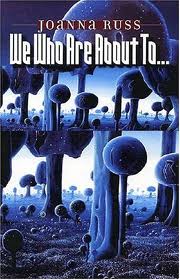 This is not an easy book to read. But it’s a Russ, so that’s not exactly a surprise, is it? She takes an SF trope – the idea that survivors of a crashed spaceship somehow colonise an uninhabited planet – and wreaks merry havoc.
This was apparently first published as two novellas (maybe even novelettes; the book is only 120 pages). By the end of the first half, all but one of the characters is dead. Surely the second half is going to show the sole remaining character that the planet is actually inhabited?
Yeah no. Not so much.
Told from the perspective of a woman who really doesn’t fit in with her fellow survivees, this is quite an uncomfortable read, for a lot of reasons. Firstly there’s the attitudes of each of the survivors: their entitlement, feelings of contempt, and the beginnings of a Lord of the Flies milieu. Then there’s the narrator herself, who while apparently more likeable – if only because the reader has insight into her thought processes – is still an uncompromising and actually rather difficult person to be around. And then there’s the plot, which is basically: crash; deal with each other; deal with being the only human on the planet. The end.
The other characters are very difficult to get your head around because we only see them from the narrator’s point of view, and for quite a limited amount of time. There’s a young girl, clearly spoiled and needy; her parents, who have all sorts of weird things going on with money and work and respectability that actually, when you deconstruct them, aren’t that weird and that makes it all the more uncomfortable (trophy spouse, use of marriage, etc). A jock in a universe that appears to have less use for such types, and a professor who appears to be the polar opposite and whose smugness speaks of all that’s wrong with academia. And two other women – quite different from each other, but sharing elements with our narrator, which makes her uncomfortable and serves to illuminate her character as the story progresses.
The narrator’s background is something of a jumble, which is unsurprising given that Russ writes much of the last half in almost a stream of consciousness. We learn a bit about her experimentation with niche religion and politics, a bit less about her relationships – platonic and sexual – and a bit more about her sheer determination in the face of difficulty. I don’t know that I liked her, but I certainly admired her.
The plot is definitely a secondary consideration here. While it is of extreme importance, because it’s the springboard for Russ’ investigation into character and because it’s an inversion of an SF trope, there’s so little to it (really taking place almost solely in the first half) that it must be secondary, I think. Which is not to suggest that it is poorly constructed or anything like that, of course. It’s confronting and minimal and all the more confronting for that.
This must have issued an important challenge to SF when first published – and still does, I think. It’s not easy, but it is worthwhile.
Galactic Suburbia 67
 In which we talk trolling, internet pile-ons and Twittiquette (it’s a word, right?) as well as Weird Tales, Analog, heavy metal, straight white YA dystopias and (this may shock you) Joanna Russ. You can get us from iTunes or from Galactic Suburbia.
News
Announcing the brand new Last Short Story podcast starring (so far) Jonathan and Mondy.
Tansy visits the Panel 2 Panel podcast to talk about comics with Kitty.
TPP event at Melbourne Writers Festival and Alisa’s Woman Achievers Award
Alisa’s report and Jason Nahrung‘s report.
The Weird Tales dramah:
Round up of links
Jeff VanderMeer’s take on it.
In happier news, Ann VanderMeer now editing at Tor.com
Stanley Schmidt steps down from Analog
When authors go bad (on social media) and reviewers get burned.
What Culture Have we Consumed?
Alisa: Glory in Death J D Robb; trying to read Matched by Ally Condie, Outer Alliance podcast on the lack of queerness in YA dystopias
Tansy: The Imaginarium of Doctor Parnassus; What Women Want by Nelly Thomas; Big Finish Audio – Invaders From Mars by Mark Gatiss & The Chimes of Midnight by Robert Shearman (2002)
Alex: Metal Evolution; We Who Are About to…, Joanna Russ; CSZ special on Joanna Russ; The Lost Books of the Odyssey, Zachary Mason
Please send feedback to us at galacticsuburbia@gmail.com, follow us on Twitter at @galacticsuburbs, check out Galactic Suburbia Podcast on Facebook and don’t forget to leave a review on iTunes if you love us!
What if there were more to The Odyssey?
 A number of reviews over on goodreads seem to have two things in common: the reviewer hasn’t read the source material, and they didn’t particularly enjoy this collection. I applaud someone for stepping out of their comfort zone, but I really don’t understand bagging something when the fundamental context isn’t understood. Because this really, really doesn’t stand stand with knowledge of The Iliad and The Odyssey, and it doesn’t pretend it even wants to.
I adored this collection, and I am fantastically thankful that I happened to pick it up a few years ago at the closing-down sale of my favourite bookshop (which has since reopened!). I’m not an author, but I would suggest that anyone who wants to write short fiction – and who has the background – should read this, because it does the short form in glorious, scintillating ways.
The Preface claims that this set of 44 stories translated from variations to the standard Homeric tale found in Oxyrhynchus. I’ll admit that for the first couple of stories I actually half-wondered whether this might possibly be true – I’d never heard of such a find, but Oxyrhynchus has been an incredible literary treasure trove; it’s not like I work consistently in the field so it’s feasible I might have missed hearing about it. I fairly quickly decided that this wasn’t the case, but it doesn’t matter in the slightest. I feel that Mason has stayed true to the core of the mythology, and what more could you want?
Some of the stories presented here are vignettes, others are more substantial stories. Most of them take aspects of The Odyssey and… shift them. Sometimes subtly, sometimes extravagantly, but almost always with that kernel that means it feels basically plausible to an archaic Greek mythological milieu. There are a few that stray beyond those bounds, but even those are wonderfully well written, so I don’t mind. They too help to build up sense of shifting possibilities, what-ifs and could-have-beens. There are a few stories that take aspects from other parts of Greek mythology and tie them, in convoluted but logical ways, to the Troy story; and just one or two that could feasibly be set outside of the 13th century BC, but not with any firm proof that they do so.
A review of all 44 stories would be tiresome and, in some cases, impossible without ruining the sheer pleasure of the reading act. Suffice it to say that Penelope gets some attention, Athene a bit more, and Calypso and Circe a lesser bit. Most of them involve travelling, which is naturally appropriate; some are in Troy and some on Ithaka. Sometimes Odysseus is triumphant, other times a coward, and occasionally seen through others’ eyes – like Polyphemus (sorry, bad joke). Once, Paris is Death. Occasionally, the reality of a two-decade absence is hinted at. Tragically, Hektor does not feature in any meaningful way.
This collection is wonderful and glorious and I loved it very much.
Brian Caswell: Merryll and Butterflies
I don’t know how, but I had forgotten about Brian Caswell until my sister linked My Sister Sif with Merryll of the Stones, and I realised that NO nostalgic trip to early adolescence would be complete, for me, without him.
 Merryll of the Stones has time travel, romance, dragons and other mythical creatures, and Wales. Also tragedy, but romance. Old book, and romance… yeh yeh ok, I actually am a total sap. Have we not realised that yet? Whatever.
Megan’s parents are killed in a car crash; she wakes up from a coma speaking Welsh, and conveniently having to go live with relatives in Wales. She meets unpleasant school girls, a mostly sympathetic but vague set of relatives, and the odd and intense Em. She then goes back in time to a period when Wales was being all mythological and warlike, and… there’s a prophecy, and mistaken identity, and struggling to find your way physically and mentally and emotionally, and it is JUST ALL AWESOME. Megan, so far as I recall, is an immensely sympathetic and believable character – not perfect, but aiming for the right; her relationships with the girls around her really resonated with me. Plus, yes, the awkwardness of her relationship with Em had a great appeal – dealing with his intensity and oddness, his secrecy and mystery but he’s neither a vampire NOR A STALKER. Just saying. And again plus, a really cool vision of ancient Wales. I’ve always had a thing for Wales and the Celts. This was absolutely one of my go-to books as a young girl. (And I currently can’t find my copy. I think my sister has stolen it.)
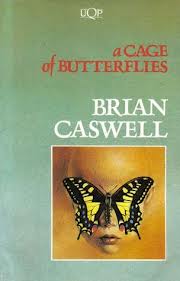 Cage of Butterflies is verrrry different in theme, but equally awesome and resonant in tone and characterisation. Super intelligent teens in a ‘think tank’ educational facility discover that just over there, in the bit of the institute they shouldn’t know about, is a bunch of babies with… abilities. Who do not like being kept in the institute and experimented on.
I remember this as being a bit more plot-driven than Merryll; the lead characters, Mikki and the boy whose name I’ve forgotten, have to find out about the Babies and then have to figure out what to do with/for them and then deal with some consequences (it has a bit of ‘much later…’ as the conclusion). And I definitely remember that as being exciting and tense the first time I read it. However, as with Merryll, the real draw is the characters themselves. Perhaps this won’t surprise anyone, but I was absolutely a square at school, and the idea of a place filled with really smart kids hanging out together and, while not necessarily just sitting around talking about books all day – there are still fights and awkwardness and general teen-type things – there’s no condemnation for being smart. That was a pretty exciting thing to read about. I liked the alternating point of view – girl and boy, who by the way rather like each other, ooh er, as well as working really, really well together and complimenting each other beautifully physically (the boy has, IIRC, something wrong with his legs…) and mentally (different strengths – and genuinely different, not better/gender based. Again, IIRC… maybe I’ve got rosy glasses towards this). It was a delight in general, is what I’m getting at.
Brian Caswell, I owe you a great debt for adding lovely gentle readable and believable romance and characters and story to my life.
Investigate Your Way Through Adolescence
There was a time in my life before speculative fiction ruled. Who knew?
I read a fair bit of Nancy Drew, but it hasn’t stayed with me. I don’t think my library had any Hardy Boys; I certainly never read them. That doesn’t mean I was at a loss for teen investigations, though. Oh no.
 #1. Trixie Belden
I was totally mad for Trixie Belden. I have no idea where I got them – probably an older friend of the family – but I know I read a loooot of them.
I used to imagine myself as one of their gang, and falling in love with Jim…! (or, since he was so clearly all over Trixie, I’d settle for Dan, the somewhat dour but very useful stable boy.) I loved that Trixie wasn’t the oldest, or male, but that she was clearly the leader of the group – even her older brother Brian usually followed her lead. Plus, adventures, and travelling around the country, and a cool group of friends with a variety of talents, and… yeh. Perfect. Plus plus, a lot of the investigations were actually very clever, and had neat little twists. Not that I remember very many of them, because they were a long time ago and I just read them one after another and they all blur together…
Words I would not know without Trixie Belden: jalopy. Also, that it was possible to have violet eyes (Di was not my favourite, but boy did I envy those eyes).
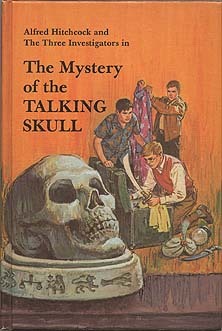 #2. Alfred Hitchcock and the Three Investigators.
A series that I quite literally could not get my hands on enough of (because the library didn’t stock them).
I loved the three different characters who made up the team: Jupiter – smart and ‘chubby’; Pete – nervous and athletic; and Bob, the studious one. To be honest I actually don’t remember enormous details about them in any specific book, but I remember enjoying their conversations immensely and thinking that it was awesome how they were all so different but worked so well together. I liked the settings of the books – I seem to recall quite a few being set in/around carnivals – and I adored the intricacies of the mysteries they got themselves involved in. I liked that Jupiter was regularly underestimated because he was fat but that I the reader was very smug in knowing that his brains made up for any perceived deficiency – and clearly the people who thought poorly of him were villains or redshirts because everyone good knows Jupe is the leader. Duh. I really liked Jupiter. Plus, again, fun twists to the plot, some of which I even hadn’t already guessed for myself.
I’m still quite the sucker for police procedurals – also Shadow Unit – and I think I can trace that back here.
My Sister Sif
Look, I’ll just admit it up front, ok? I was not a horse-y girl. I could not understand Saddle Club; even though I wasn’t very maternal as a young girl, I still preferred Babysitters’ Club books over the horsey ones. (I also did not understand the appeal of the Gymnasts books.) But what I lacked in love for equines I more than made up for in adoration of dolphins. Yes, I was That Girl. I wanted to be a marine biologist for aaaages – until I discovered that they usually spend their time studying plankton, and only the luckiest get to swim with dolphins and make a living from it. I had (… have) dolphin jewellery, and dolphin statuettes, and… yes, you get the picture.
 Unsurprisingly, this story captured my heart and made it ache. Terribly. For many varied and heartbreaking reasons.
Riko and Sif go from Australia to their family home on a Pacific island, where it’s revealed (to the audience) that they’re related to mer-people. Who have a connection to dolphins.
There’s romance – for Sif, with a scientist, and for Riko a somewhat confused attempt from what I remember as being a not-entirely-human character, but maybe that’s my memory. There’s adventure – people doing suspicious things on their island, especially. And there’s character. Riko is wonderfully realised – rebellious, envious of her sister and desperately loving and protective of her at the same time, practical and down to earth and determined. Sif is the more fey – physically, having more of a connection to their mer-relatives, as well as personality wise; this is, I realise, something of a Jane/Lizzie Bennett pairing. Hmm. And in the end, there’s also a lesson to be learnt, which is done blatantly but also in a ‘you’ve seen all of this, isn’t it obvious?’ way: Riko goes home determined to change society, beginning with the children, to make it more like dolphins and less likely to destroy the environment… as is happening around the island, and which has helped bring about the great tragedy in her life. Which is the bit that made me cry. Which is Sif dying.
I remember incredibly evocative descriptions of the people and the places, I remember desperately wanting to BE Riko and try to save Sif, and I remember trying to swim like the mer-people are described as doing, too, to my embarrassment. On which note, this was one of the first serious attempts at explaining merfolk that I remember reading, and it still strikes me that their attempt to include their land-bound brethren is a remarkable one – developing breathing apparatus and the like. I think I still want to be Riko.
I should re-read this. I’m quite sure the power of Riko and Sif has warded off the Suck Fairy.
It’s Tansy’s fault I’m reliving these childhood memories. See this post for her love of Grange Hill…
Riddle of the Trumpalar
I mentioned in my last post that Lord of the Rings was not my first conscious experience of speculative fiction. I know that I had read some before I got to that point. The first book that I can consciously remember reading that counts as fantasy is The Riddle of the Trumpalar, by Judy Bernard-Waite (who I know now was not one but three people).
 Oh how I loved this book with all my heart. I’m afraid to go back to it now, for fear of the suck fairy, but it had a powerful pull on the childhood imagination of me. Twins, living in Sydney, get sucked into a Moreton Bay fig, where they meet the Trumpalar, who is not quite your normal living-in-a-tree dryad figure… and then up end spat out in the early Sydney colony, and have to help out one of their (maybe convict? I forget. Probably Irish) ancestors.
It’s a little bit Playing Beattie Bow, really, isn’t it? I bet they all came out round about the bicentenary.
Anyway: twins! time travel! even history! (although I didn’t know I loved history at that stage.) I was living in the tropics at the time so I didn’t know Moreton Bay figs from a rose, but since moving south – as an adult! – I’ve had a bit of a Thing for them. And let’s be honest here, an enigmatic figure living in a tree rather predisposed me to fall in love with Legolas and Lothlorien. I remember really enjoying the interaction of the twins – a boy and a girl – with each other and with their ancestor. My fuzzy memory tells me that their parents were actually alive and both around, although of course they lived in the present – but their mum in particular was cool. The Trumpalar I also don’t remember very clearly, although the picture above – which was the copy that I had – also made a strong impression on me. Check out that flowing grey hair! The strength and nobility of that nose! He may have had a book-lined study inside the tree… or maybe that was just my imagination.
I blame this as the beginning of my affair with fantasy. Thanks, all three of you, Judy Bernard-Waite.
Lord of the Rings: a child’s memory
Tansy is doing a series of blog posts this week in honour of Book Week about childhood reading and everything around it, so I thought I would add a few thoughts myself. And I am starting with Lord of the Rings.
When I was 12, I was in competition with a friend: who could read the most in that year. We decided it would be on both pages read and total number of books read, but books had to have over 100 pages. Now I got my total books up fast because I was reading a lot of Babysitters Club (I know, right?). However, they were short, and I was mighty competitive back then. So I looked at my parents’ book shelves and I picked the fattest book I could. And why yes, it was LoTR.
I had read fantasy before- that’s another post- but I had definitely never read anything like this. I don’t actually rememeber whether I had read Hobbit first or not… something says not. Anyway, I was blown away. I imagined myself joining the fellowship, and Legolas was my first serious book crush. I loved it so much I read it in 20 days, which was quite quick work for 12 year old me… and important in making sure that I didn’t fall behind in the reading competition, too. I loved it so much that when I started working as a checkout chick, my first major purchase was my own, one volume, not-falling-apart copy – and that was SO exciting. I loved it so much that for a while there, I read it every year; I think I’ve got up to about a dozen or so. This is one book that has had a genuinely long-lasting impact.
Weird fact: I listened to a cassette of the Beach Boys a lot of the time while I read LoTR the first time, such that I had flashbacks to the mines of Moria and the forests of Lothlorien in response to Little Deuce Coupe and California Girls for years after.
For those who care, I don’t think my friend and I ever decided who had won our competition. I think we might have got sick of it.

 Randomly Yours, Alex