Change for the Machine

I’d kinda forgotten how much I love good cyberpunk until I read this and Trouble and her Friends. Turns out I really really like it.
Interestingly, in many ways this feels like a prequel to much of the cyberpunk I’ve read. The main contention is the invention of putting sockets into people’s heads to allow them to experience and manipulate the datelines (read: internet) more directly… the result of which, or something similar, is what Gibson and Scott and their friends are basically examining. So from a ‘getting started’ perspective I found this book really awesome, and in lots of other ways too.
Cadigan takes the ‘cast of thousands’ approach, using multiple perspectives (although always in third person) to show lots of different dimensions and angles to the story. There were times at which this was a bit confusing, but on reflection I wonder if this wasn’t done intentionally. There were quite a few chapters which shifted perspective where the new character could have been one of several, and it’s only revealed whose story we’re reading after a page or so. This contributed to the fairly frenetic feel that the entire book indulges in, which is largely appropriate given the madness that ensues in the second half of the story. It’s also very nice because the variety of characters and their individual stories give wonderful perspective and insight into different aspects of the story. Which I liked.
The world Cadigan has created is simultaneously a bit dated – it was published in 1991 – but, once some of the terms are translated, also quite recognisable. She talks of datalines and how people get their news; that’s basically souped-up data retrieval services and massively hyped up RSS readers that do the work for you. And then they use the sockets initially to rev up rock music videos, which is just such an hysterically funny idea that the sheer bizarreness just carried me away giggling and happily belief-suspended. Also, there’s a lot of drug use. Which is perhaps neither here nor there, but also certainly adds to the manicness.
The plot revolves around the introduction of sockets and what that might mean for society, with a whole lot of corporate hijinkery and espionage and hackery as well. There’s a father/daughter relationship that pops up every now and then – not something you see every day in this sort of futuristic novel – as well as, somewhat surprisingly when you see the characters, a love story that’s not very romantic in one way, but actually really is sweet in a fierce I’ll-deck-you sort of way. Plus a load of bizarre and whacked friendships and enmities that go a long way towards populating this world with dysfunctional but quite entertaining characters.
This was my first Cadigan novel. I’ll be coming back for more. (In fact I have Tea from an Empty Cup sitting on my shelf….)
Only Ever Always forever
 I’ve always been wary of reviewers who call authors ‘ambitious’. It seems like a potentially back-handed compliment; like, ambitious but didn’t succeed? Ambitious in the evil stab-you-in-the-back way?
I must call Only Ever Always ambitious. And I mean ambitious in try-anything, why-the-hell-not way. Because this is a novel that combines first, third, AND second-person narratives, and that’s pretty ambitious. And outrageous to even suggest. What’s awesome is that, although I found the first few shifts in perspectives a bit disconcerting, it most definitely works.
Russon gives us two different worlds, two sides of the same coin in many ways, where – to push the analogy perhaps too far – one side has been subjected to normal wear and tear, but the other side has been used much, much harder. In the first world is Claire, living a very recognisable life with recognisable griefs – no less grief for being recognisable, of course. In the second is Clara, living in a world where medicine is hard to find and four walls for one room is unusual, but still with its recognisable elements: powerful people pulling strings, and small people getting stuffed around. Somehow, Claire’s and Clara’s paths come within reach of each other… and things change.
The narrative structure is one of the most striking things about this book; it’s only 157 pages long, but those changes in POV are dramatic and confronting and, well, striking. And effective; to be in the position of a character and telling the story one moment, to having your story told at you, to then being only an observer – it works, at this length anyway, to make the characters and their stories all the more enticing and compelling. This would probably have been the case anyway, because setting Claire’s grief against Clara’s struggle to survive and the conjunctions between their worlds makes for a really engaging plot. And the character of the two girls – their similarities and differences – made them very engaging characters, too; Claire in particular was believable, with her attitudes towards her family and beloved objects.
Finally, let me say that this is a really interesting cross-over of fantasy and science fiction. The multiple-worlds thing can be either a fantasy or SF trope. The dystopic world that Clara inhabits makes this, I think, more of a science fiction than a fantasy, but really that’s splitting hairs. It could be read as either. And it’s brilliant either way.
Crossing the Universe: not as easy as it sounds

Girl. Boy. Spaceship. Murder. Deception. Totalitarian political system, manipulation, and art.
I loved this book a very, very great deal.
Like Leviathan Wakes (and it’s about the only thing the two books have in common, aside from the whole space thing), Across the Universe is a dual narrative, although here it’s two first-person voices. In this case, one POV is Amy: frozen in hibernation, accompanying her parents to a new planet to be amongst its first colonists. (Which may make you ask how she can be a narrator… just trust me on this one.) On the other hand is Elder, awake on the same ship Amy is sleeping on, part of the generation crew tasked with looking after the ship while it travels to the planet – a journey of some 300 years. The story revolves around Amy waking up ahead of time. Accidentally. And she’s cranky about it. As you would be. Amy’s awakening is a disruption on two significant levels: for Elder personally, because he finally has someone around of the same age but she’s like no one else he’s met; and for the ship, not least because it is mono-ethnic – an ethnicity that Amy quite clearly does not fit. Both Elder and the ship as a whole struggle to figure out how Amy can fit in. On a ship hurtling through space, with limited resources and no way to leave if you don’t like things, fitting in seems of paramount importance. So what does Amy do, what does Elder do, and why is Amy awake now anyway?
Along with a cracking pace and intriguing plot, there are some meaty issues to be dealt with. On the large scale, there’s the issue of how a generation ship could be made to work. This is a question that has frequently taxed SF; Elizabeth Bear’s Dust/Chill/Grail sequence is one example that goes in completely different directions from Revis. On the face of it life on the Godspeed looks like it works quite well, but very quickly it becomes obvious that perhaps there are cracks that have been papered over. Connected to this is the question of leadership, and what makes a good leader; Elder is learning from Eldest, and his reflections on what works and what does not are by no means trivial. On the more personal scale is how individuals deal with trauma, and expectations, and their own inner demons. Amy’s angst over whether to join her parents, and then how to cope with being woken early, is visceral and compelling. Elder’s disagreements with Eldest and how discoveries about the ship are in some ways less shattering, but have further-reaching consequences. And then there’s Harley, who I wish had had more of a presence in the novel. An artist, impacted by tragedy, and a better friend to both Elder and Amy than either to the other. His perspective, even though we get it solely through Amy and Elder, adds great richness. And poignancy.
Also, there is a love story. But not an easy one.
Plus, that cover! Beautiful!
There is some hand-wavey science-y stuff that doesn’t entirely make sense, and for the more technically-minded this may well be enough to throw you out of the story (Niall H!). I am not that person; I love my science but I am willing, for a good cause, to be very forgiving of hand-waving when it’s not too obvious (to me!) – and as you can see, this was a very good cause indeed (for me).
This is (of course) the first in a projected trilogy. I hope Revis can maintain the awesomeness.
(To make things even more fun, Beth Revis sounds like a totally awesome person. She was a teacher, who loved teaching! She likes Shakespeare for the dirty jokes and wrote her MA on CS Lewis’ Till We Have Faces (oh I must re-read that, I haven’t read it in such a long time). She is racing her mother to see which can get to the most (US) states! That says… quite a lot, really.)
Some slight spoilers in the comments.
Mappa Mundi

Really enjoyed the story as a whole. It opens with a series of vignettes, “Legends,” mostly set in the childhood of various characters. One of the games I played as I read was figuring out which character had had a legend (this shouldn’t have been very hard, given they are all named… but I have a poor memory and I read too fast, so you know. It worked for me). This was a really cool technique. However, the characters are not a strong point – more to the point, I think the female characters are not a strong point. Some of the men weren’t great either, but more of them were interesting and appealing and relate-able than women, for me.
The story as a whole is a compelling one, dealing as it does with mind-mapping and (potentially) -controlling technology. The world is a very near-future one – even closer than when Robson wrote it, actually, since some of the technology she throws in that in 2001 may have seemed quite ‘tomorrow’ is already here! Most of the story flows nicely, with only a few only-for-the-narrative moments, none of which were tooo jarring. It’s well-paced, and the shifting between characters works nicely to build tension and provide juxtaposition.
This review was written ages ago and I meant to add more, and then… time went on… and now of course I have forgotten what I was going to say. I was also going to link to Dreams and Speculation, the blog that hosted the 2011 Women in SF Book Club until it folded a couple of months ago, but the blog itself seems to have disappeared – which is sad, because we had a really interesting discussion on various aspects of this novel.
The Leviathan may be awake…
… but it’s not that impressive, as these things go.
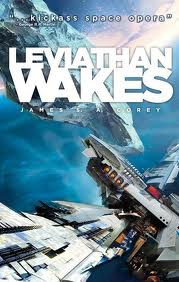 The inner solar system is quite well colonised, and humanity is beginning to move out into the outer reaches as well. Unsurprisingly, there is friction between the planets – and the asteroid colonies – in some of the same ways, I feel, as there was in Africa when European countries decided they wanted to establish colonies on that continent (without, happily, the mitigating issue of prior occupation). Who should have control – the people in the area or the people back home? How do you make decisions when communications suffer a significant lag – and when the conditions there are significantly different from the conditions here? And then you add in travel time, and rogue elements care of capitalism and free enterprise, and you have a rather chaotic system. On the scale of the solar system, even if you restrict yourself to the asteroid belt and in, that’s a very messy situation indeed. I really, really enjoyed the world-building here. The description of the living situation on the asteroids in particular was very compelling, and the way in which – for example – relying on external sources for all of your air and water would change people’s attitudes towards those fundamentals, and the corresponding cascading effects, was beautifully drawn. I also enjoyed that the focus was largely off-planet; it would have been a very different story had it been slightly more, well, grounded.
The notion of Earth/Mars rivalry is not a new one, of course; many authors who have suggested planetary colonisation have imagined at least political disputes, if not war, over issues such as governance and resources. Here, though, it is not the focus of the plot; more the background, and the catalyst, and eventually the binding factor in two quite different narratives. One of those narratives is a detective yarn that owes a lot to the noir: grizzled cop looking for missing girl, ends up getting involved in something much bigger than he expects. The other narrative is of a space-lovin’ ship’s captain who stumbles across the wrong derelict, and ends up getting himself chased from one end of the system to the other because of some rather delicate intel that he accidentally gets his hands on. Miller, the cop, and Holden, the captain, trade chapters throughout most of the book – although it’s all in third-person, so there’s still a barrier between reader and character. Their stories start in quite different places (literally and metaphorically), and spend the novel (550-odd pages) merging and twining and departing in clever and intriguing ways. James S.A Corey is actually Daniel Abraham and Ty Franck writing together (quite why you would go with a nomme de plume and then tell absolutely everyone about it confuses me; were they told that collaborations didn’t sell, or was it whimsy?), and I wonder whether each of them was largely responsible for one narrative – not that I could pick a difference in writing styles.
I had one big problem with this novel, which colours my view of it, and that was Miller’s developing preoccupation with Julie, the girl he is tasked with finding. Some of the reasons for why he might become obsessed with her are developed along the way, but it made me feel quite uncomfortable, and additionally I did not feel as though that discomfort was part of the intended effect. While other characters acknowledge that Miller has taken it a bit far, quite how creepy and weird that is is not made explicit. This was problematic for me, although not enough to make me stop reading.
My view, then, of Miller is tainted by his (non-)relationship with Julie. Overall he is one of those not-necessarily-likeable characters whom a reader nonetheless can (perhaps grudgingly) admire and appreciate (caveat above in mind), making hard choices and occasionally getting them wrong but standing by them, and his own morals, through various tribulations. And I did end up overall admiring him. Holden is a very different character, as is appropriate for a multi-point of view novel. He tends more towards action, although to say that one is brain and the other brawn is doing both a disservice. I think Holden is easier to like, as a person, although he certainly has his own faults. This may partly be because we see Holden interacting more positively with more people, particularly the crew of his ship, whom we also get to know somewhat; Holden’s story is largely theirs as well, and they are a disparate and motley group indeed. Their banter, and their cooperation, helped make Holden’s sections of the story more enjoyable for me than Miller’s.
The cover of my paperback has George RR Martin proclaiming this book as “Kickass space opera” and, much though I hesitate to quibble with GRRM, I feel I must. An enjoyable piece of SF, absolutely. I’ll probably read the sequels (this is the first of a trilogy, and it ends with a really awesome twist). While I am not especially one to quibble over sub-categorisation, for me this was not space opera. It was not… operatic enough. Not grandiose enough. The distances involved were too small, the plots too petty (in the sense of petite, rather than mean), the scope and implications not wide enough for it to count as such. Still, it was an enjoyable ride and it will be interesting to see where Corey/Abraham/Franck go with the story in the rest of the trilogy.
Galactic Suburbia 39
In which we defend Mary Sues everywhere, point at superheroes with their pants down, plan a Hugo Twitterparti and reveal which of the three of us is secretly a hardcore horror fan. But most importantly (according to Tansy), Alex is watching Blake’s 7 completely unspoiled and she loves Avon the best, hooray! You can get us from iTunes or download us from Galactic Suburbia.
News
The Mary Sue Conversation:
Zoe Marriott
Sarah Rees Brennan
Holly Black
Elizabeth Bear
“Sometimes a book is about a female character because there are female people in the world.”
What if Male Superheroes posed like Wonder Woman
Gender Bent Justice League
Bonus, superheroes without pants (except Wonder Woman)
Tansy: Lords & Ladies, Terry Pratchett; Love Songs for the Shy and Cynical, Rob Shearman; Rob on the Big Finish Podcast, Xena & the mystical pregnancy
Alex: Ship Breaker, Paolo Bacigalupi; Blake’s 7; Across the Universe, Beth Revis.
Featured Feedback:
Grant Watson (and our producer) pointed out to Tansy that Jason Todd died in “A Death in the Family” and not “The Killing Joke.” She is very sorry.
Kirstyn McDermott took us to task over our dismissive attitude to horror, and we decided to address her concerns and chew over our complicated relationship with the darker side of spec fic.
Please send feedback to us at galacticsuburbia@gmail.com, follow us on Twitter at @galacticsuburbs, check out Galactic Suburbia Podcast on Facebook and don’t forget to leave a review on iTunes if you love us!
Ship Breaker: not quite what I hoped for
I really enjoyed The Wind Up Girl. I know there are problems with it, and a lot of people have taken it apart, and I agree with at least some of those points. But still, I thought it was a breathtaking view of the world in the not-quite-near future. So I was looking forward to seeing what Bacigalupi would do with YA, and a loooot of people have been raving about this book. I’m sad, then, to say that I was disappointed.
It begins well: Nailer, a boy of indeterminate age, clambering through the wreck of a ship and scrabbling for copper to salvage and make the quote required by his work crew. It’s dangerous, unpleasant work, and that is carried very effectively indeed in the opening pages. In fact, the opening is the most effective – and affective – section of the whole novel: it conveys the reality of life for Nailer and others like him in stark simplicity, complete with dangerous working conditions and the possibility of betrayal. I certainly felt for Nailer in his circumstances, and this sympathy was probably the only thing that kept me reading to the end.
Living on a beach with a crowd of similarly destitute and desperate types, Nailer’s life is of course no picnic. It’s made worse when a massive storm comes in and threatens the entire beach, but starts to look up when the storm proves to have driven a modern, very expensive, clipper ship onto the rocks nearby. Naturally, there are complications, and events proceed neither as he expected nor, entirely, as he hoped. There is fighting, betrayal, hope, and agonising decisions as the story plays out. Through all of this, Nailer is exposed to both the better and worse sides of humanity (and the not-quite-human). It’s not quite a coming-of-age story, although given this is (I think) the beginning of a trilogy, perhaps it will evolve as such. It is a discovery-of-the-world story, and Nailer’s eyes – until this point restricted to an unpleasant family and a little-hope life of scavenging and starvation – are the perfect vehicle for Bacigalupi’s exploration of a dystopia where oil is scarce, oceans have risen, and the divide between rich and poor is even more obvious, in the USA, than it is (believed to be) today.
The world created is a compelling one, as dystopias like this, set not-that-far-away, in a world both familiar and unrecognisable thanks to the changes wrought by climate change (readers of The Wind Up Girl will know this is something Bacigalupi is fascinated by), can be. How the world might manage still to transport goods over the globe when there is next to no oil left is one of the big questions addressed here, as is how society would cope with the changes forced on it – and his answer (“not very well, for the poor”) is all too realistic. Unfortunately, the world-building was also one of the aspects I had a problem with. Too often I felt that new aspects of the world were thrust onto the reader with little forewarning, leaving me disoriented. It may not have been so bad had Nailer, our eyes, been equally jarred. Much of the time, though, he appeared to be comfortable with these ‘new’ parts of his world, as though it was what he had expected all along. This discontinuity was disconcerting.
The other issue I had was with the characters. Nailer’s development is fairly consistent with what we learn of him early on, and there is some lovely characterisation and discussion of his decision-making which genuinely felt real. Many of the other characters, however, are too far in the shade – they get too little light cast on their motivations, leaving them at best two-dimensional and Nailer having to carry the entire story himself… which he’s not quite up to. Nailer’s work crew, for example – a hodgepodge of ethnicities, religions and outlooks on life – are described well early on and then become largely irrelevant. The one exception is Pima, the boss girl. Yet even here, with Pima getting into the action much more than the other crew, the reader learns next to nothing about her thoughts or views on life. The same goes for a few of the other characters (explaining who they are would be a terrible spoiler, though, so I won’t go into details). This lack of depth in the characters was another of the disappointments.
My disappointment overall probably stems from the book having been over-hyped, and my own expectations of Bacigalupi. It is a well-realised world, and one that I am pleased to see being examined in a YA context – the possible results of oil scarcity and changes to the weather are definitely worth exploring. The plot is interesting enough, and there’s certainly a lot of action; there is some variety in the characters and their situations, which breaks at least some of the monotony stemming from being Nailer-focussed. But I don’t think I will be hanging out for the sequel.
Cryoburn, or The End of Bujold… so far
Tehani and I conclude our conversational reviews of Lois McMaster Bujold’s Vorkosigan series. There are LOTS of spoilers! (The rest can be read here.)
ALEX:
Well Tehani, I guess we actually have to bite the bullet and admit that we have come to the end of the Vorkosigan saga, as fas as has been published so far anyway.
TEHANI:
*sniff* I think we might have put this last review off a little, cos it’s THE END (so far, we can only hope!).
ALEX:
I KNOW I was putting this off! I have read somewhere that she is working on ANOTHER one, but given it took a decade to get from Diplomatic Immunity to this, there will be no holding of breath.
I’ll start off by sacrificing my reputation and saying that this is definitely not my favourite story – I would not want to come to Miles with this book, because I think that the first couple of chapters might have really turned me off! In fact for the first third or so I wasn’t overly impressed at all. It was a very abrupt beginning, the whole wandering-through-the-tunnels thing; being suddenly on a world that we’ve never experienced before, AND minus Ekaterin – to whom I had become so accustomed over the last few books – was quite disorienting. I had to keep reminding myself that I trusted Bujold’s story-telling and character-development skills in order to keep going.
TEHANI:
The beginning is a bit off-putting, for sure. There is precedent though, as it uses the same technique as in “Borders of Infinity”, dropping us into the middle of action we know nothing about. I thought it was very effective, especially given most people reading the book WILL know the characters, so you’re not coming into it blind. Having said that, you’re right in that if this was your first Miles book it would be a shock!
ALEX:
You’re right that it’s similar to “Borders.” Somehow though, that felt more… familiar maybe? Because Miles had been having similar-ish experiences. This time, though, it’s quite different from the last couple of books.
Anyway, as Bujold has started to implement over the last few books, we have multiple perspectives again in this novel; the other main one presented is that of the young boy, Jin, whom Miles befriends – or is befriended by, really. This was interesting and different for the Miles books, since previously it’s been the perspective of people we already know, or Ekaterin. It did make me like the young characters a bit more, and it was a different and otherwise impossible view of the world itself.
TEHANI:
And don’t forget Roic! The stoic armsman has a bigger role here, foreshadowed in his point of view narration of “Winterfair Gifts”. It’s interesting, because the first time I read Cryoburn, I absolutely raced through it, and was left with the impression when I talked about it later that it was Miles and Roic narrating, and that I hadn’t liked it. That first time, it felt like the two voices were too similar and there didn’t seem to be a purpose to the dual narrative perspective. THIS time though, I had a completely different opinion! I’d forgotten about Jin, and yes, I think that works really well – particularly interesting in that Miles is now a REAL DADDY and has a much better understanding of kids! But even the Roic POV worked better for me, and I think it was well done.
ALEX:
I do love me some Roic, I’ll admit. I like the adult-but-not-military-male point of view. And he’s a maybe a little less in awe of Miles, maybe? You’re right that Miles’ attitude towards Jin and his sister is maybe a bit more understanding than it was before, although he dealt with Nicky fairly well.
The plot is, on the surface, a standard investigative one – is a cryogenic company doing, or going to do, something dodgy on Komarr?
TEHANI:
Yep, but we don’t find this out until quite a long way into the book! For a goodly while, we’re really not certain what the heck Miles has been sent to do – doesn’t help that he finds himself an even more interesting mystery while on the planet, which occupies much of the storytelling 🙂
ALEX:
Oh that’s right! I forgot that – it just gets all so tied together in the end 🙂
Miles is sent to find out, on the pretence of attending a cryogenics conference – which also allows us to be reconnected with Raven, the very young clone who helped Miles a bit way back in Memory. Of course, this being Miles, the whole thing develops into something even more unsavoury. As with his meddling on Cetaganda, Miles ends up helping another planet discover something rather wrong at the heart of their system. In this case, on a world where cryogenic storage is close to being the accepted norm for every person (at least those who can afford it…), it turns out that a few decades ago the preserving fluid was faulty, so the people preserved then are actually, genuinely dead. This is bad enough, but is made worse – and far worse, perhaps, from the companies’ perspective – because in storing those bodies, the companies get the rights to the frozen people’s votes. So they are in effect exercising the rights of people who are dead. The whole situation on this planet is gerontocracy taken to a bizarre degree. Miles doesn’t exactly end this, but he certainly helps the world out. And foils the dastardly plans of the cryogenics corp, Chrysanthemum, to do the same on Komarr.
The story is made the more interesting with Mark and Kareen turning up to make a business investment, meaning we get to see the brothers interacting outside of the family sphere and with their respective businesses potentially either colliding or colluding.
TEHANI:
And I’d forgotten this entirely! That Mark and Kareen have a part (and quite an important one!) in the story. Was most odd rereading – almost like I hadn’t read it before at all!
ALEX:
That’s a good thing!
And then Mark and Miles travel together most of the way to Barrayar and… well, then we get to the bit where I cried just a little. Because after an entire book about death, and with Miles earlier brooding over what it would be like when he was finally told that his father had died, that’s exactly what happens. He is greeted by those three little words: “Count Vorkosigan, sir?” For me, this was a fairly heart-rending moment. When I read it, it had only been 7 weeks since I first met Aral, as he was capturing and falling in love with Cordelia. For him to them up and DIE so soon was… hard. And poor, poor Miles. I really appreciated the way Bujold then told the end of the story, in five discreet ‘drabbles’ – stories of exactly 100 words each. The different perspectives on Aral’s death and its aftermath were very compelling. I had more tears, actually, when it got to Gregor’s perspective, and his insistence that he be a pall-bearer because “the man has carried me since I was five years old … it’s my turn.” SO SAD.
TEHANI:
And I teared up even just reading THAT! Hits me every time. Even though Aral hasn’t played a huge role in the actual storytelling for most of the books, he always loomed so large in Miles’ life, in so many of his decisions (particularly to do with honour, and what it means to be a hero), that he seemed to be hugely present in every book. And how masterful is Bujold. Just three words reduce me to floods of tears – the connotation of what it means for Miles to be addressed that way is something only a seasoned campaigner in the Vorkosigan universe would be so affected by and it’s Bujold’s nod to the intelligence of her fans that she could end the chapter that way, knowing that we would KNOW what it meant. In some ways, I would have preferred the book without the drabbles, although they are indeed heartrending – but for me, I think they are there for the newbie reader, not us.
ALEX:
I thought the drabbles were the perfect conclusion, actually. It saved Bujold from the potential to be all saccharine and unbelievable by trying to do the funeral etc from Miles’ perspective, and allows us an insight into the other characters that we love.
TEHANI:
So where could it possibly go from here? What will happen to Cordelia, adrift in Barrayaran society as a widow? How will Miles handle life as the Count? Will Bujold write more novels? Should she? Who should they focus on?? Of all the threads Bujold has woven in her Vorkosigan tapestry, are there still some unfinished? (I think Ivan’s story isn’t yet done, myself, and maybe Mark and Kareen? And then there’s the children…). Do we WANT more?
ALEX:
A large part of me of course wants more, but… like you say, where would it go? I don’t know whether I want to know about Miles the Father and the stinky nappies, or Miles the Count and the Disappearing Money. I really don’t think I like Ivan enough to want an entire book about him, but I know you disagree rather violently! And if the focus were not Miles… well. That’s not really a Vorkosigan novel, is it? I can’t imagine another Cordelia novel, but I’d sure as hell read the heck out of it.
14 Vorkosigan novels in 7 weeks. I think I am officially an addict.
TEHANI:
YAY!
Galactic Suburbia 38
In which none of your fearless podcasters are impregnated by mysterious aliens for the duration of a single episode, nor do any of us experience a rapidly accelerated pregnancy or give birth to an otherworldly demon/alien/vampire. Also: Batgirl, Bujold and a cranky feminist rant or two. You can get us from iTunes or from Galactic Suburbia.
Cordwainer Smith Rediscovery Award – fascinating idea – given to a living writer for the first time, Katherine MacLean.
World Fantasy nominations, of course!
The Mystical Pregnancy trope – torture porn? Reproductive terrorism, exploiting women for being female. Violent degradation of women’s bodies for plot.
Vote For Top-100 Science Fiction, Fantasy Titles; Swedish Writing Fairy crunches the numbers.
Andromeda’s Offering Issue 1 – new fanzine to “open up new female voices in SF, raise the awareness of female SF writers and share ideas.”
(you can find them on Facebook)
Where are the women in the new DC Comics? Newsy; interview with Batgirl cosplayer.
SF Signal Episode 70 – 6 men talk about their favourite podcasts and illustrate what we mean by gender disparity in SF gatekeeping; Alisa makes reference to a recent Mind Meld.
What Culture Have we Consumed?
Alisa: Passage by Connie Willis; Red Glove by Holly Black; The Lifecycle of Software Objects by Ted Chiang.
Alex: Diplomatic Immunity and Cryoburn, Bujold; Chicks Dig Time Lords, ed. Lynne Thomas; The Sparrow, Mary Doria Russell; Shades of Milk and Honey, Mary Robinette Kowal; Songs of the Earth, Elspeth Cooper (abandoned). SF Squeecast.
Tansy Glenda Larke – Stormlord Rising; Malinda Lo – Huntress; Penni Russon – Only, Ever, Always
Feedback
We get to be Friday Hoydens!
Please send feedback to us at galacticsuburbia@gmail.com, follow us on Twitter at @galacticsuburbs, check out Galactic Suburbia Podcast on Facebook and don’t forget to leave a review on iTunes if you love us!
The Sparrow: a tale of religion and aliens

This book was recommended to me I think when I was lamenting the lack of religion in modern SF on Galactic Suburbia, and then also somewhat at random by my school librarian. Who then proceeded to buy it for school… but put it on my desk before putting it on the shelf. Truly I am looked after.
The premise behind it is one that, once stated, makes an enormous amount of sense when you consider the history of colonisation and exploration from a European perspective. Which group of people have, historically, often been the first into new, uncharted-by-white-folks areas? That would be the Jesuits. Of course. So, in 2019 when a signal is received from another planet, it is the Jesuits who finance and send the first interplanetary mission. As the history of Earth’s colonisation would also suggest, it is not an easy mission, and fraught with all sorts of difficulties – physical, emotional, mental, and spiritual.
The narrative follows two timelines: one from the time of the discovery of the radio signal, and the subsequent preparations to go to the new planet; the other, some 40 years later, with the one returnee being… interviewed… by his Jesuit brethren about what happened there. This is a difficult process for a variety of reasons: some pertaining to the priest (Emilio) himself, some to the interviewers, and others to the way the situation has been handled and reported. This second timeline is the most difficult to read, obviously, but in turn it has a big impact on the way in which the first has to be read. In the first, Emilio is not the man he has become in the second, so reading the two congruently gives the reader quite a sense of dissonance – which of course makes sense and adds to the experience of understanding just how this man changed, and why.
Did I mention it’s not an easy book to read?
Most of the characters are compelling, and usually in a good way. Emilio is probably the most enigmatic of them, right from the start. The rest of the crew who head off to the alien planet are more accessible, to a greater or lesser degree; most of the Jesuit investigators likewise, although we get to know them to a much lesser extent. There is a nice variety of character – different religious backgrounds being the greatest and most important example of diversity, given the book’s premise. I found most of the characters intensely believable, too, with one exception – and that exception I can’t really talk about without giving spoilers. Suffice to say, I hope, that I didn’t find that this took away from the book in the slightest.
In some ways this book can be seen as a meditation on the impact of European contact and colonisation on the rest of the world in the so-called Age of Discovery. Interestingly, and intriguingly, it looks at the impact on both the subject and the colonisers, which is I think something often missing from the literature (Heart of Darkness being an obvious parallel here). Connected to this, and really really interestingly from my perspective, is the fact that the impact of such an experience – right from the discovery of aliens to contact and the end result of that – on religious people is also front and centre. And taken seriously, and described in ways that I, as a Christian, found quite profound and… accessible, I guess. (The author discusses her own religiosity in an afterword, saying that she was a lapsed Catholic until she had children, at which point she started thinking about religion again and converted to Judaism.) I appreciated this attempt to grapple with what I think are incredibly important issues, and that are often overlooked in the genre.
There is a sequel, apparently, and I’m not sure what I think about that; it stands so starkly and brilliantly by itself that I would be reluctant to add to the ‘afterwards’. That said, this book is so beautifully written that I’m a bit in love with Russell’s prose and I think I could read every other bit of fiction that she’s put out there, so I guess I’ll be reading the sequel.

 Randomly Yours, Alex