Aussiecon4: Day 2
Friday started with Alisa, Tansy and myself walking over to the con and getting our heads around how we could keep a Galactic Suburbia recording to 50 minutes, because we were scheduled to record LIVE as a panel. First time doing it together, and we get an audience! Talk about intimidating. There were about 40 people in the audience, most of whom we didn’t know, so that was simultaneously encouraging and terrifying. We did manage to keep to 50 minutes, mainly because we were ruthless about the news section. It was a lot of fun! And we had matching tshirts courtesy of Finchy. It’ll be up live in the next week or so, once our dear producer gets home, has some sleep, and gets it online.
Next I headed to a reading by Garth Nix, but he was reading a story I’d finished just a few days before and I couldn’t summon enthusiasm. So I ducked out and went to a book launch, which was good to finally put more faces to names.
All of this was a way of killing time before I could go and interview the Foglios, which I was more nervous about than the live recording. I had a chat to young Jake, who gave me some questions to add to my own, and then we waited around… for a while… until Phil came back and we were good to go. The sound quality won’t be great, because we did it in the dealers’ room, and Jake will tell anyone who asks that I giggled too much (I did), but it was a lot of fun to do. It too will be online in the next week or so, once I compress it and get it to the GS producer.
The panel I most enjoyed for the day was on the under-appreciated characters in Lord of the Rings – that is, those whom the narrative underrates. Essentially this boiled down to Eowyn, Sam, and Faramir. The panellists were all excellent, and it was very cool to see other people with the same love of the book as myself. There was a fascinating discussion about the differences between the books and films, and why some of the changes were made, which I really enjoyed – particularly around Faramir and Arwen.
The evening’s entertainment began with a party at Crown for Voyager’s 15th birthday. It was all very swish – Tansy, Alisa and I frocked up in a baby change room/parents’ room we found that had huge cubicles! – and there were ever-so-tasty purple drinks, and little food. Again with the meeting interesting people, hearing interesting news (HarperVoyager to be the international brand), and hanging out with great people. We didn’t stay all that long because we had to hie ourselves back to the con for the awarding of the Ditmars and other Aussie awards, including the inaugural Norma K Hemming Award (the Norma). Reading list: Gene Thieves, by Maria Quinn. Overall we were pleased by the winners, I think – perhaps especially Helen winning the William Atheling Award for criticism, for Cabal.
From the Ditmars we headed back to Terri&Tehani’s apartment, and proceeded to eat a fair bit of junk food, drink some evil mudslides with McD’s softserve icecream thanks to Terri, and make a fair bit of noise. I got to hang out with Rob, meet Trent and Scottish Liz, and generally be with some of my favourite people. It was great… and even when we were told, around midnight, that there were complaints about the noise, it continued to be great, just quieter.
Aussiecon4: Day 1 #2
I didn’t have the energy to blog electronically during the con. Instead, I kept paper notes (outrageous, I know)…
My Aussiecon4 actually started on the Wednesday, when I hosted a full contingent of Strahans, the Tansy/Finchy mob, Tehani+baby Max, Alisa, Kathryn, and Alan. Half of them arrived at my place from the airport, so apparently having food and beverages on hand was welcome! I rather suspect that the supermarket over my fence was a very large drawcard, too. At any rate it was a marvellous way to start the weekend’s madness, with the people I was most looking forward to seeing.
Thursday started fairly early, heading to the apartments where all but the Strahans were staying to help the crew get boxes into two taxis and thence to the dealers’ room. An early highlight was heading up the escalator as Mondy and Rob Shearman were heading down – so I turned around, obviously, to catch up with them. I hadn’t seen either since Swancon 08, and it was great to see both the first day. Another highlight was helping Alisa, Tehani, and Terri (whom I finally met) in the dealers room, when Tansy’s eldest made a friend to play hide-n-seek with… who turned out to be the daughter of the Girl Genius creators! Minor fangirl moment there.
I flashed my newbie credentials by heading to the opening ceremony, which I quite enjoyed. As I walked in Holst’s Jupiter was blaring, which was a good sign. Someone had put a fair amount of work into a quite awesome series of film clips, which was basically Mad Max with spectacular bits of other movies thrown in and some clever voice-overs. Perhaps my favourite contrast was Hugo Weaving as Elrond, Agent Smith, and his Priscilla character. However, if as the voice-over suggested we’re really relying on Mel Gibson-as-Mad Max to save us all, I think we’re in trouble.
Heading back to the dealers room, I noticed that the Foglios had not brought a whole lot of hardcopy Girl Genius books and they were going fast. Tansy egged me on until I finally went around and bought myself one, complete with personalised sketch of Maxim (I heart Jagerkin) and autographs. Good thing I got one when I did (and one for Alisa’s sailor too), since they sold out in two hours….
Aside from hanging around the Twelfth Planet Press table gossiping, I also went to a panel on motherhood in SF&fantasy. There was some very thorough discussion of representations of motherhood in those genres, both in book and film, especially about the lack of women who manage to do both mothering and adventuring. I particularly liked the discussion of the problematic nature of Ripley and Sarah Connor. Reading list from this panel: Gwyneth Jones, Life; Pat Murphy, The Wild Girls; Eye of the Beholder, by someone whose name I didn’t catch.
The evening’s entertainment started with a book launch for Helen Merrick’s book The Secret Feminist Cabal, which I promise I will get around to reviewing soon. I’d met Helen earlier in the day – another fangirl moment! – so it was great to see the number of people who turned up to congratulate her on such an important work on feminisms and fandom. Plus, she signed the book I’d been carting around all day. ☺
Dinner was with a bunch of people, including Jake Flinthart. At 10, Jake Flinthart is an even bigger fan of Girl Genius than me, so we had a lovely time arguing about our favourite characters and where the plot is heading. I did make everyone walk a little bit too far for dinner, although to be fair their hotels and the convention itself is at the crappy end of town when it comes to food.
Marvellous day! I met heaps of other people, put faces to names, and generally exhausted myself.
Aussiecon4: day 1 #1
Just a quick update before I head back in for an exciting second day at Aussiecon4.
My absolute highlights were two very exciting fangirl moments: firstly, I met Helen Merrick, author of the brilliant Secret Feminist Cabal which I really must get around to reviewing. The other came when a little girl introduced herself to a friend’s daughter, and that girl’s parents came along to check everything was ok. Those parents were Phil and Kaja Foglio, creators of Girl Genius! Whom I had emailed about interviewing and was nervous as all get out about introducing myself to! So that was great, and relaxed, and I’m really looking forward to interviewing them now.
I also had a couple of people mention that they knew me from Galactic Suburbia, which was… overwhelming…
Speaking of which, must be off – we’re recording a live episode this morning!
Racial stereotyping and plot development: the Belgariad, book 2
Tehani and I continue our re-read of David Eddings’ The Belgariad. Tehani’s got it over here, if you’d like to read the comments she gets; there are more spoilers ahead!
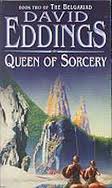
Queen of Sorcery: Book 2 of the Belgariad
David Eddings
Me
I’ve never figured out whether the title refers to Polgara or Salmissra, but that’s ok. Maybe it’s both of them.
Tehani
I reckon Polgara. Salmissra is a queen, but not a sorcerer really is she?
Me
But she’d like to be… and Polgara’s not a queen. Maybe it’s an amalgam of both of them??
One of the really interesting things about the Belgariad when I think about the stereotypes is that not only are the people stereotypes, but so are the nations. I think the Sendars are probably meant to be British: solid farmer-types, a mixture of every other race, practical and polite. The Nyissans – well, I’m fairly sure they’re meant to be the Egyptians: snakes, hot weather … and, I dunno, maybe the stereotypes of using poison? Y’know, I like the Nyissans. They’re so different from all the other cultural groups. And the countryside itself is also different – horribly represented, so far as I’m concerned, child of the tropics that I am, but nonetheless: I like it. The Chereks are Vikings. I haven’t figured out who the Drasnians are, but the Tolnedrans are Romans: they like building roads, they are inherently merchants, oh and they have legionnaires. And an Emperor.
Tehani
I actually wrote a mini-thesis on this when I was at uni! It was called “Representations of reality in fantasy fiction” or some such (much edited and published in an issue of Andromeda Spaceways some years ago!). Fun fact: my very first forays on the Internet were researching this topic, which gives you some idea how long ago that was… There’s a lot more on it in today’s digital world, and Wikipedia gave me this. Which tells us that Drasnians are kind of Western Russians with a twist of Renaissance Italians!
It’s an interesting thing Eddings did here, because by making the “evil” characters analogous to nations such as Egypt and the Middle East, it casts a social commentary of the time. Of course, Eddings might turn around and tell you it’s all completely unintentional, as Tolkien tried to claim of his own worldbuilding…
Me
Ooh, interesting! I’d have loved to write something like that!
All of this makes me think about the Brotherhood of Sorcerers, and it makes me wonder if they’re a little microcosm of ancient Greece – and Athens specifically. You know: philosophy, thinking more deeply than everyone around them… Belgarath as Socrates, maybe? Beldin as Diogenes, the original Cynic who lived in a tub on the streets? And … does that maybe make Belzedar Xenophon, going off to serve with both the Spartans and the Persians? Does that make the Angaraks Persians?? I’ve always considered the Angaraks to be Generic Racially Stereotyped Asians (GRSA) – after all, it was written in America, in the “eee Yellow Peril!!” ’80s. Maybe I’m just reading way too much into this.
Tehani
Wow, you’re good! The articles DOES suggest the Angaraks are Persians (with a hint of China in the worldbuilding). Well done!
Me
So, yes: the Angaraks. Often described as having slanted eyes, I recall, adding to the GRSA feel. I could start speculating on what nationality each of the sub-groups was meant to be based on, but that way leads to buying into some frightful racism, I think. I have always felt sorry for the Thulls, being roundly loathed by everyone.
On to the plot.
I think Garion getting kidnapped by Salmissra is about the most interesting thing to happen in these first two books. She is cool: the very idea of her is cool. A woman picked at childhood, trained to become exactly like the original Salmissra, and fed so many drugs to keep her looking young that weird things happen to her system. A genuine hedonist, someone so totally and utterly self-obsessed that the entire world basically revolves around her – at least within the palace. Hmm, sounds like a particularly misogynistic Roman way of thinking about Cleoptara…. Anyway, there are flunkies who make everything work, and Sadi is another reason why I like Salmissra. He is the consummate politician; in fact, he is basically the Nyissan Sir Humphrey, and there’s a certain glory in that.
Tehani
Sadi doesn’t get as big a showing here as he does later in the books though, right? He plays a much bigger role in other books in the series, and I didn’t realise that he was really only a bit player in this one. Which is in itself kind of cool, because it makes you realise that Eddings really was clever at utilising his established players.
Me
Yeh – I think I love Sadi here remembering what he becomes. He’s like an awesome, possibly-evil possibly-good (does that make him chaotic??) vizier.
When Garion is kidnapped, we also get two awesome appearances, with Polgara being Most Awesome and Terrifying, and Barak turning into Big Scary BearMan. They scare the crap out of all the Nyissans in the palace, and get the boy back. Hurrah. And the queen gets turned into a snake. That is cool.
One of the other major events of this book, and which has ongoing repercussions, is that Garion finally realises that he too possesses the ability to use the Will and the Word, and the first time he consciously exercises it is to kill someone. There are all sorts of things to be said about this occurrence, but one of the big ones is: there is no external judgement for what he does. Yes, he keeps beating himself up about it, but eventually that just goes away. Yes, Chamdar was a dreadful enemy. But still, the fact that Polgara is able to fool everyone about who actually did the deed (and later, when it’s revealed Garion can do magic, no one bothers to dig this story up), and that it doesn’t have ongoing repercussions? There’s one of the biggest indications that these are seriously fluffy fantasy books. Despite the fact that burning to death is a horrible, horrible way to go.
Tehani
That’s a really good point – throughout the books, there’s little consequence for the frequent death dealing and maiming. Yes, Garion is distressed by what happened, just as Durnik expressed his horror over killing a man in the first book, but they kind of just … get over it? Get used to it? I understand that it’s the medieval setting thing, and the brutality of life blah blah, but it’s also a little bit, hmmm, privileged? As in, because they are on the side of might and right, there are no consequences? Maybe I’m off base with that…
Me
No, I think you’re right on track. It is might is right, when right is might. And Belgarath, Garion et al are inherently good and therefore their actions are inherently good. Very privileged and problematic.
We have some more fun characters in this book. Greldik: The most stupendous ship’s captain in the history of narrative, with the possible exception of Odysseus. Always drunk, but always willing to take the crazy option and get through. Mandorallen: the ridiculous, most stereotyped – consciously stereotyped – knight since Don Quixote. (Actually, I only just thought of that. I’ve not read Cervantes, but I know a little about him. Mandorallen isn’t totally deluded, but maybe he’s what Quixote wanted to be?). It was really when Mandorallen got going – and Barak too – that I realised something quite remarkable about this series: it is so bloodthirsty. Limbs go flying, people get their throats cut, and there is general mayhem every few pages. And there’s no “oh, no one really got hurt.” No, people die, all over the place – and it’s not just Murgos, that dastardly race. Random Arendians frequently die, people who get in Polgara et al’s way frequently die, and there is a remarkable lack of scruples about death more generally.
Then we have Hettar, one of the less stereotyped characters. Not in his taciturn, “You killed my father, prepare to die!!!” attitude, but in terms of being the Sha-Dar, and communicating with horses. Again, being good with animals is nothing new, but I think Eddings gives it an interesting twist. And the fact that it is most definitely not linked to magic is also interesting; in other books, Belgarath would have been snooping in Hettar’s mind to figure out if he was somehow using the Will and the Word. But not here. Of the other members of the band – Lelldorin gets remarkably little airtime, really, for all that he’s meant to be Garion’s bosom-buddy. Durnik just hangs around in the background. And then there’s Ce’Nedra.
Ce’Nedra may be the most difficult character in this entire series for me to deal with. She’s so awful, so stereotyped, such a little princess – she drives me nuts! But… even this early on, she starts to show some interesting character traits. The fact that she is so manipulative is actually kind of interesting, as is the way she plays some of the other (male) characters. And her attitude towards Garion does actually have some complexity, which is nice. I remember her improving as the series goes on.
Tehani
Regarding the characters, I was reminded early in this book that one of Eddings’ real gifts is writing characters – we’re bombarded with a huge cast in this series, but each of them is quite unique, which makes them easily identifiable and great to read. And while they may be stereotypical, as we’ve noted already, they are actually still multi-dimensional and their characters have growth. Sometimes it’s an unfolding of personality which is actually due to backstory (such as for Polgara, Belgarath and Silk), others is actual new growth, as for Garion, Ce’Nedra and Durnik. Even bit characters, such as those random legionnaires or castle guards that the band come across and generally intimidate into submission have their part to play and do it well!
Me
Sadly, this book ends on a very frustrating note, for me. Barak is going to kill himself because he’s the BearMan and he finds that unbearably humiliating. Fair enough. Then Polgara tells him he’s going to have a son, and he decides that’s worth living for. Fair enough. But. BUT. There are so many things wrong here. Firstly, he has two daughters already: aren’t they worth living for? I wish I could see this as Eddings’ take on a character like Barak, but he’s already shown him to be the doting father of the two girls. Maybe it’s the surprise that there’s a third on the way that made him remember his family? … yeh, I doubt it. And then there’s how his wife Merel got pregnant. The suggestion is very, very strong that Barak forced his wife to have sex with him, when they met in Val Alorn. And he gets rewarded with a child – a son, no less. This makes me angry and sad by turns.
Nonetheless, I choose to continue.
Tehani
I totally didn’t notice Barak with the son thing when I was younger – I guess it wasn’t on my radar at all. But I sure did this time around, and yes, it’s a pretty backward idea. However, I think I disagree on the Merel thing. The way Merel is written in the last book suggests to me that she actually does like/love Barak, but it still hooked on the situation of their marriage. She is supportive of him when it counts, which speaks volumes. And, well, Polgara did have words with her… It is a lazy plot device though, I agree.
And I too continue – the books are getting a little fatter as they go on and the cast of characters continues to grow. I find myself looking for the breaks in the books that indicate the initial trilogy The Belgariad was supposed to be! And thoroughly enjoying the ride.
Getting the band together: the Belgariad, Book One
Tehani and I have decided to re-read The Belgariad, and – partly to justify that, partly because it’s fun to compare notes – we’re blogging a conversation about each book. We respond to each other in the post itself, but you can find Tehani’s post over here if you’d like to read the conversation going on in the comments. Also, there are spoilers!
Pawn of Prophecy: Book 1 of The Belgariad
David Eddings
Me
My introduction to David Eddings came when I was about 13. I think it may have been because of a boy… anyway, David Eddings was, aside from Tolkien which I didn’t think counted, my introduction to fantasy.
I loved it. I adored the characters, I thought Polgara was the greatest character, I basically recognised Garion, and… yeh, I was hooked.
I re-read the Belgariad and the Mallorean when I was in first year uni, so about age 18. I read one a day for ten days. I still enjoyed it. I don’t remember whether I had a different opinion of the characters and plot from my first read, but I certainly read the whole lot.
I’m nearly 31, now, and I decided to read them again for the first time since then. Actually, I re-read Polgara because I was craving something familiar and reassuring. And then I realised, actually, that I enjoyed it. I still liked Polgara, I still enjoyed the world, and it was indeed familiar and reassuring. So I decided to re-read Pawn of Prophecy, which is the only one of the two series that I actually own. (I do own Belgarath and Polgara. In fact, I gave Polgara to myself as a Christmas present the year it came out in hardback; signed it as being ‘from Santa’, confused the hell out of my family for all of about 30 seconds.)
Tehani
I was a relative latecomer to being a fantasy fan. When I was 19, a friend of mine handed me Magician by Raymond Feist and said I’d love it. I stayed up until 3AM on Christmas Eve and read pretty much right through Christmas Day. On Boxing Day, I handed it back to him and said he was right. Then he gave me the first book of The Tamuli, and said I should try that too. And then I was hooked.
I came to the Belgariad backwards, having read The Elenium and The Tamuli first, but that didn’t mean I enjoyed it any less that first time round, and it was a staple annual reread for about five years. When Alex said she was planning a re-read I thought that sounded like a great idea (despite the groaning shelves of To Be Read books) and I realised it’s been at least five years, possibly more, since I’ve read these. So it’s almost like reading them for the first time!
Me
Now that I am more familiar with fantasy tropes and stereotypes, I understand that Eddings is totally stereotypical. In fact, I also recently re-read the first book of the Elenium, and I realised that most of the knights could be directly mapped onto tropes from the Arthurian mythology. I don’t think the same applies to the Belgariad, but of course most of the characters are recognisable stereotypes from other places. Some of them are in Tolkien, some are in medieval and earlier mythology. Some have become stereotypes perhaps because of Eddings. And … sometimes that matters. Sometimes it doesn’t.
Tehani
I wonder though how many later fantasies have enforced the stereotype and so the characters now seem more stereotypical? At the time the Belgariad was published, was there that much quest fantasy around? I think also that because the Belgariad is essentially YA, the “tropes”, such as they are, are okay for the audience. A good introduction, if you will!
Me
Well, quests were all the rage in ancient and medieval literature, but I’m not sure whether they went out the window in the early modern period – it’s possible that happened, and that Tolkien and Eddings etc reintroduced the concept. I think you’re right about Eddings being a good introduction to the ideas, though.
Anyway, Pawn is essentially all about getting the band together. We’re introduced to the young man on a quest – although we don’t really know, early on, that he will be the central character. I don’t know whether I guessed, the first time I read it, that he would be the main character; it seems so obvious now. He’s a foolish young boy, who makes very silly mistakes and has some fairly shallow young friends; he lives an idyllic farm life, with all good things around him and an aunt who cares for him deeply. Then, of course, he’s ripped from that life and thrown into turmoil. He doesn’t know why, he doesn’t know what’s going to happen, and he’s forced to go along with it.
Tehani
And isn’t it done well? It all makes perfect sense, and it all happens at the right time for the story, I think. There’s enough set up for us to really start to get to know the characters, then BAM! All of a sudden things are afoot and happening, and they start to change before our eyes. I think it is one of Eddings’ biggest positives, the way the characters evolve in what seems a very natural way. Unlike so many of the modern fantasies, where characters start out from nothing and are all of a sudden all-powerful!
Me
Two things strike me about this section of the book. One, I think Eddings captures whiny teenage boys quite well, actually. Garion’s just tagging along, and he doesn’t know why, and he eventually gets roundly ticked off. Sounds much like most teenaged boys I’ve met.
The other is of course another stereotype of the genre: no one seems to go to the toilet. Although there’s reference to being tired, and occasionally to eating, making camp and a fire and generally living rough all seem remarkably easy. It doesn’t actually bug that much because I’m so used to it, but I did actually notice it this time. And it may also be because this time, I skipped over at least some of those sections… they’re just a bit boring. And don’t add much to the story.
Tehani
They do bathe though! Polgara insists on it regularly.
I read so quickly that I routinely skim that sort of stuff – I think it’s one of the reasons I used to enjoy re-reading books so much, as I’d missed so much the first (or second or third!) time! It didn’t strike me as too onerous in Pawn though. I think because the book is short (relatively speaking), so I didn’t mind those bits to plump it up.
Me
As for the other characters: I love Silk, and I always have. The thief, the guide – so witty, so clever, so always-after-the-profit. And so entertaining. Barak? The enormous Viking-type, keen to have the biggest warship in the Cherek navy. The kings and nobles? Well, at least they’re a bit different from one another. Again, they’re stereotypes, but they are interesting. I like King Anheg: he’s awesome. I really like that he looks stupid but is actually really, really smart.
Tehani
I’m also a Silk fan. In fact, as I was reading I really felt he was the most interesting character in this book. I love all the characters, but in this first one, Silk is the only one who is really fun, I thought.
Me
One of the most important aspects about the Belgariad is the magic – the Will and the Word. There’s not a whole lot in Pawn, but there’s enough to realise that magic is enormous in the context of the world, and presumably will be in the rest of the series. I quite liked the tantalising hints about magic in this introduction. And this leads, of course, to talking about Belgarath and Polgara.
I still hugely enjoy that Belgarath starts as a tramp, a storyteller, and no one really cares about him in that guise. I like that it’s an effort, sometimes, for him to prove who he is. I like that he’s a grumpy old man, that he hates ceremony, and that he’s so blunt with everyone. Polgara? She is still awesome. Yes, she stereotypically cooks for everyone: but she likes cooking, and you know, I’m fine with that. I like cooking, and I still get to be a feminist. She also has delightfully snarky dialogue, she’s calm under pressure, she puts up with her father and a whingey teenaged boy, all with immense grace. Plus, she’s tall, and beautiful, and intimidates every single person she tries to, and most of those she doesn’t.
Tehani
Polgara really IS awesome! I found myself admiring her even more than I remembered. Her inherent power and will, despite everything going on, in the face of the general patriarchy of the nobility, is awe-inspiring, and becomes even more so as her backstory unfolds and you begin to realise exactly what her very very long life has been like. She’s one of my favourite fantasy women of all time.
Me
I really enjoyed Pawn of Prophecy. Again. In fact, to the point that I decided to reread the entire series. Because as far as I remember, it only gets better. And yes, it has also made me realise that I am easily pleased, especially when it comes to nostalgia (and especially of the kind where the bad CG doesn’t interfere with my enjoyment. Terminator, I am looking at you).
Tehani
Yep, you didn’t have to talk real hard to convince me either – have Queen of Sorcery underway!
Day 30
Day 30 – What book are you reading right now?
So, I went away, and I considered automating this but I didn’t. So… when I should have answered this, I was reading the anthology The Beastly Bride, compiled by Ellen Datlow, and it was brilliant. But I read that in a day, so I’m not reading it right now.
What I am, at least in theory, reading at the moment, includes:
The Secret Feminist Cabal, by Helen Merrick, which I am hoping to finish before the semi-official launch of said book at AussieCon4 in OH MY GOSH less than a fortnight;
Legends of Australian Fantasy, an anthology from Jonathan Strahan and Jack Dann – I’ve read four stories so far, by Nix, Canavan, Marillier and Carmody, and I am loving it!
and
Holy Machine, by Chris Beckett, which I’ve only just started and really ought to hurry up and read in order to review it (hi, Alisa…).
Why yes, there are three books listed there. This is not actually an unusual situation for me.
Galactic Suburbia 14!
The episode is available to download from iTunes, and at Galactic Suburbia for download or streaming.
In which we rise above a chorus of dogs, babies and technological glitches to discuss Grand Conversations, why we have no opinions about Robert Heinlein, and why we’re crazy enough to be part of a project which means reading (almost) ALL the short stories.
News
Windup Girl by Paolo Bacigalupi wins Campbell Award.
Jeff VanderMeer announces the closure of the Best American Fantasy anthology series.
The WSFA shortlist for small press.
Controversy caused by Sarah Hoyt’s Tor article on why all those women who don’t like Heinlein are actually wrong
Hoyt also blogs here similarly, with a bit more revelation as to why she is so pro-Heinlein.
What have we been reading/listening to?
Alisa: Watching – District 9, Caprica, Scott Pilgrim
Reading – The Grand Conversation, Timmi DuChamp
Alex: Permutation City, Greg Egan; Galactic Suburbia, Lisa Yaszek; Shadow Unit; When it Changed, ed. Geoff Ryman; Swords and Dark Magic, ed. Jonathan Strahan
Tansy: Joanna Russ, How to Suppress Women’s Writing; Rosemary & Rue, Seanan McGuire, Clarkesworld, Strange Horizons,
Listening – Angry Robot #2 with Kaaron Warren & Lauren Beukes
Pet Subject
How To Find the Best Short Fiction, and the Not If You Were the Last Short Story On Earth Project (LSS)
Why we LSS
What we learned from LSS
What we’re looking for in a great short story, where to find them, and what we have liked so far this year.
Rich Horton is part of our inspiration.
Day 29
Day 29 – Saddest character death
Artax in the Swamp! There is nothing sadder than Atreyu trying desperately to get his horse out of the swamp, and not being able to do it. The movie made me cry every time I watched it (er, numerous times), and the book did too.
Also, the bunnies in Watership Down.
Best/most satisfying character death?
I’m usually pretty happy whenever the bad guy dies. I think, though, that Gollum’s death is best, in a twisted understanding of the word. Despite all the discussion of ‘deserving’ to die from Gandalf etc, he is overall a beastly (if awesome and complex) character. The fact that in dying he also saves the world is a marvellous, tricksy climax on Tolkien’s part.
Of course, if I wanted to read that question differently, I would have to say: Death, in the Discworld. Especially since hearing him voiced by Ian Richardson (“You might think that, but I couldn’t possibly comment”), and imagining him riding a motorbike instead of Binky… yeh, he’s my favourite Pratchett character.
Day 28
Day 28 – First favorite book or series obsession
The Belgariad, by David Eddings. I went through the entire lot very quickly. Also The Mallorean, the follow-up series.
That is, if we’re not counting The Babysitters Club, which I’d probably prefer that we didn’t… because I think I did waste a lot of money on those. Oh, so many books. And the super summer holiday bumper editions. Have I mentioned What Claudia Wore? A website devoted to extolling the fashion of that pre-teen clothes horse, Claudia Kishi, and also usually bemoaning Marianne’s atrocious style. Several things weird me out about this site: how much I have been enjoying reading it; how much I remember; how many books I apparently missed out on, because I got over the series waaay too soon, apparently.
Day 27
Day 27 – If a book contains ______, you will always read it!
Um. The name Alastair Reynolds? His name is enough to make me read an anthology, that’s for sure…
I don’t think I have a “will read”. I know full well that not all books with space ships in them appeal to me; I know that not all dragons, or elves, are going to be my thing; sadly, not even everything set in ancient Greece or Rome floats my boat.
It might be easier to say what I won’t read: vampires and werewolves. Although I make an exception for Gail Carriger.

 Randomly Yours, Alex