Black-Winged Angels
Continuing my Angela Slatter kick…
 “Baba Yaga is a woman who cannot be bound. She will bear no more children, she bow to the wishes of no man; she is independent, adrift from the world and its demands. The world, in ceasing to recognise her value, has granted her a freedom unknown to maids and mothers. Only the crone may stand alone.” (p135)
Angela Slatter’s exploration of the different ways women can be is one of the things I love most about her work, and it’s evident in this reprint collection. Most of the stories build on European fairytales or characters – Bluebeard, the Snow Queen, Melusine, the Little Match Girl. But the focus is different from the familiar story, because Slatter changes or explains the motivation, or centres on a different protagonist, or moves the setting and therefore the entire context… and she forces the reader to reconsider the telling of those stories, and what we can or should get out of them.
The quote above is one of my favourite parts of the whole collection, putting me immediately in mind of Ursula Le Guin’s reflections on being a ‘crone’, especially the essay “The Space Crone.” How often is old age meant to be something women should fear? And while Slatter’s Baba Yaga is by no means always happy with her status, she lives it.
This book is also a beautiful object. I have a hardback copy; the cover is black with a white cut-out illustration by Kathleen Jennings. Jennings’ artwork appears throughout the book, with each story having a dedicated picture – some quite simple, some incredibly complex. I love Jennings’ work and she beautifully complements Slatter’s ideas.
Vigil
A number of years ago, Angela Slatter wrote “Brisneyland by Night” for Twelfth Planet Press’ anthology Sprawl. It was excellent. Vigil is that story grown-up and turned into a novel, with at least two (I believe) more stories about Verity Fassbinder scheduled.
 This novel was sent to me by the publisher, as an uncorrected bound proof. Also, I had the enormous privilege of reading it in draft form, which I just can’t tell you how awesome that was. I have re-read it now partly because I have a bad memory and I knew the details had escaped me but that I loved it; partly because it’s Angela Slatter and she always withstands re-reading; and partly because it was sent as a review copy, so of course I had to. It was mostly the first two, though.
Verity Fassbinder “has her feet in two worlds” – that of the Normal, where there is definitely no magic and the only things that go bump in the night are trees in the wind and possums in the bins, and that of the Weyrd. With the Weyrd, things going bump in the night may well be very old, very cranky, and very powerful. Also, weird. Her father was Weyrd; he could change shape and he was a criminal, against both Normal laws and Weyrd customs.
Verity is a wonderfully attractive heroine. She inherited strength from her father but violence is not (always) her first recourse in a dangerous situation; she’s got a pretty short temper and little patience with bureaucracy and authority; she’s a fierce friend and protector of her neighbours, single mum Mel and daughter Lizzie; she lives in a clapped-out old house in Brisbane’s suburbs. She has little interest in fashion, she’s stubborn and determined, she’s willing to compromise and admit when she’s wrong. Basically she’s human, with flaws and problems and the sorts of characteristics I would absolutely love in a friend.
Slatter’s plot is not at all straightforward. She starts with the scenario from “Brisneyland” – children going missing – and builds layer upon layer of Weyrd problems that may or may not be connected. The death of a siren (hence the cover image), the disappearance of a young man, possibly random other deaths – all of which Fassbinder must solve, with varying levels of help and hindrance from a range of friends, acquaintances, enemies and bystanders. It’s a detective story with paranormal elements, and while that’s not a unique proposition it’s the setting and the side characters (and of course Verity herself) that make this wonderful.
Brisbane is by no means a fast-paced city. Slatter has jokes about the places that do or do not get flooded; there’s jokes and having to eat out before 8.30pm; there’s a distinctly slow-paced, I guess Australian feel to the whole situation. Moving this to an American city would make it very different, and lose a lot of its charm; I hope that translates to non-Australian readers.
Verity is aided by Ziggi, driving an entirely disreputable taxi and watching her with his third eye; she’s employed, kind of, by a Weyrd ex-boyfriend, Bela, who has some hidden depths and unexpected shallows. She’s helped and hindered in sometimes equal proportions by the Norn sisters – home of an addictive caramel marshmallow log that I wonder whether Slatter has actually made – and has all-too-frequent dealings with (Normal) Detective Inspector McIntyre, who may very well be my favourite of all the side characters (sorry Ziggi) for her ‘whisky-and-cigarettes voice’ and her even lower interest in putting on a good appearance than Verity. I really hope she continues to turn up throughout the series. I would swap her for Bela any day.
Vigil is fast-paced, quirky, full of twists, and thoroughly grounded in Brisbane (even if it is a somewhat imaginary Brisbane) and the reality of immigrant Australia. I love it and I want more Verity.
Sourdough and Other Stories
 Reading this has been a long time coming. I think I’ve owned it for a couple of years, but I’ve never quite got there before now… mostly because I knew that once I had read it, I would have read it, and then it wouldn’t be sitting there waiting to be read.
Yes, sometimes my brain is weird.
TL;DR: totally, totally worth it; wonderful and strange and making me moon-eyed. It is indeed like reading those fairy tales that were deemed Not Really Fit for young children and discovering that THAT is where the good stuff is.
Almost all of the narratives in this collection are connected in some way to other stories. Sometimes this is explicit: there are a couple of families for whom generations get stories. Others are more round-about, as a passing character in one gets developed in another. This goes too, of course, for The Bitterwood Bible in which Slatter has written prequel stories, of sorts. The fact that I read Bitterwood first meant I got to see some of the places where she went back and filled in gaps, fleshed out history, made connections clearer. The upshot is that reading the stories is a bit like moving to a small town. You meet one person and then another and only a few months later do you discover that those two have History; and then over time all the rest of the connections come tumbling out – except some of them still stay hidden, teased at the edge of perception. Sourdough and the world that Slatter has created here is exactly like that.
One of the things I fiercely love about the stories here and in Bitterwood is the focus on women – and that they are so very varied. Women are daughters, mothers, lovers, wives, friends, neighbours, enemies; they are skilled, bored, frustrated, vengeful, magical, lost, bewildered, smart, sacrificial, victims and heroes. They are human.
Seriously, just read this. Come back and thank me later.
The Dream-Quest of Vellitt Boe
 This book was sent to me by the publisher, at no cost.
A middle aged woman goes on an epic quest. You’ll want to be reading this in August when it’s released by Tor.com.
…no seriously, what more do you need to know?
Oh ok.
Vellitt is a mathematics professor at the only women’s college in her city. Although it’s not really “her” city – it’s just where her youthful ramblings ended up taking her. Anyway one night she discovers that one of the students has left – run away with a boy – and not just any boy, but one from the waking world. Because Vellitt’s world is a dreaming world, and things are not the same there as they in the waking world of Earth. Thus begins Vellitt’s quest.
I was fascinated by the world building here. It’s not entirely original – there are other stories where people know that they live in a secondary world or an imagined world or a story – but this dreaming world with its heavy sky and ninety seven stars and changeable distances and multitude of cranky, vicious gods is beautifully realised. I could imagine many stories set here but actually, I rather hope that Johnson just leaves this as a stand-alone jewel.
Johnson says that this was an attempt to re-imagine a Lovecraft story she loved as a child but whose racism and lack of women was clearly problematic. The story is completely and thoroughly Vellitt’s. She reminisces about her experiences travelling the wide world as a young woman, about the people she met and skills she learned; but she’s not pining for her youth. She’s entirely comfortable with her black and silver hair and with the experience age has brought. Vellitt deals with all the problems cast her way – sometimes well, sometimes with help, and sometimes she’s left shaking with fear and revulsion. She’s determined and pragmatic and I really like her.
Nightshades
This book was provided to me by the publisher at no cost.
 It’s fair to say that I’m not a huge vampire fan. I have read a few vampire books, I’ve seen a few vampire movies, but they’re not automatically my preference. So I acknowledge that I may not be the best judge of a vampire story. But anyway, here I go giving a review of one anyway.
Vampires, in this it’s-tomorrow story, have recently been acknowledged as existing in the real world. But unlike in Gail Carriger’s stories, they’re not making moves as a population group to be accepted by the general human population. In fact it’s not really clear what the purpose of the vampires is as a group. Which is fine, because that’s not Olson’s purpose in writing the story. Instead the story is focussed on two people: one an FBI agent who’s joining the newly created paranormal division, and the other… well, that would be telling.
Alex, the agent, is a ‘legacy agent’ – his mother was a big shot in the Bureau and he’s looking to live up to that. Well, that’s what I got from the start of the story, anyway. It was kind of ignored for the rest of the story, though, and while I can see that neither the story nor the man want people to keep harping on his past it also felt like a part of his character that just went nowhere. Overall, though, he was a competent agent and made some interesting choices.
The other character was more interesting, but I don’t want to say too much about her because that are some nice revelations that are part of the fun of the story.
This story is fast-moving and has some nice character moments. It’s clearly setting up for a sequence of stories about the way humanity reacts to those different from them, and also what consequences predators can have. I’m not sure at this stage whether I’d sign up for the rest of the series, simply because I have so many other books to read and I did not fall completely in love with any of the characters or the setting. But if you’re into vampire stories crossed with police procedural types, then this is probably just your thing.
I also want to note that I read this off the back of Umberto Eco’s Baudolino, and that was a REALLY weird back to back experience.
Radiance
This book was provided by the publisher at no cost.
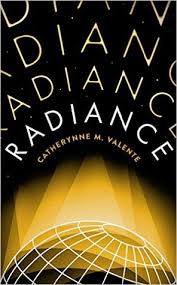 My big problem in writing this review will be making sure it makes sense and isn’t just full of incoherent hand-waving. Here area a few initial points that will establish my position:
a) I’m really glad I got to read this before finalising (coughstartingcough) my Hugo nominations.
b) Because I got old, this is the first book in ages that I’ve stayed up past midnight to finish (18yo me is shaking her head in disappointment). Letting me finish it in a day (although not a sitting).
c) When I read Illuminae, I was immensely pleased with the found-footage style, but thought I wouldn’t want it to become TOO common. And then I read this. And now: I’m happy for Catherynne Valente* to use any damn style she likes.
So. This book.
This book is wonderful.
The New York Times describes it as “a sleek rocket ship of a novel swaddled in ArtDeco decadence.” That’s pretty apt.
The overview: set in an alternate universe where the solar system’s planets are all inhabitable, and where interplanetary travel kicked off even before the Wright brothers were doing their thing in our universe, the twentieth century has developed rather differently from ours. The focus is on the film industry, but there are tantalising glimpses into politics as well (like a reference to the Tsar in the 1940s). Anyway, the film industry has mostly developed on the Moon, and it’s a mostly silent industry, because of issues over paying for the rights to sound technology. One of the focal characters, Severin, has grown up with a director-father and eventually goes into the industry herself… and something happened when she’s shooting on location.
That really doesn’t do the novel justice, of course. The story doesn’t develop in a linear manner; it starts at the end and jumps all over the place, gradually filling in gaps. Some of the ‘footage’ comes from Severin’s childhood, when her father filmed her; some from the films of Severin herself, or her father. Some of the documents are in the form of diaries, or gossip columns. There are even ads. And all of it comes together, ultimately, to describe a rich and intriguing solar system, full of the sorts of people in ours – good and bad, selfish and selfless, looking for glory or love. They’re just further apart, being on different planets. And there’s a mystery that just keeps getting deeper and deeper and draws you further in and it’s just, well, radiant.
The story is excellent. But Valente is doing more than telling a luscious story. She’s interrogating ideas of reality and of memory and truth. After all, are you sure that those memories of your third birthday are your memories, or are they a patchwork made from photos and maybe footage and family stories? And if the latter is true, does it matter? What is reality, when it’s mediated through a lens? But then, what is story-telling but putting words to fragmented memories and trying to make sense of the world – as Valente, of course, is doing here.
I love the worlds that Valente has created, with the names of towns and features on the different planets relating to different godly versions of the planet’s namesake. I love that each has a different personality, reflecting in part which nation has settled there but also developing separately – and that despite this being a largely human-friendly system, there are still issues of colonial attitudes and how to feed everyone.
I love the prose.
I half-want a huge sprawling set of stories set in this universe, but at the same time I want this one beautiful object to exist in pristine serenity all by itself.
Other books this reminded me of: Christopher Priest’s The Islanders because of the way the plot is gradually unveiled. Every story ever set on a tropical Venus. Kim Stanley Robinson’s 2312 because of the grand tour of the solar system.
Do not go into this book expecting ‘hard science’; this is not Greg Egan (although there are certainly some similarities in vibe). Don’t read it if you want a linear narrative. Do read it if you want to be swept up on a joyous sometimes confusing but breathtaking ride.
*Wordpress thinks her name is Catherine Valence, which is interesting enough but just no. Seriously.
Galactic Suburbia 136
 In which Alex and Tansy leap back into 2016 to talk Awards (it’s that season again!), comics, novellas, mysterious London novels and epic feminist canon.
Also, Molly Meldrum.
We’re on iTunes and over at Galactic Suburbia.
Locus Recommended Reading List.
BSFA Awards shortlist
Letters to Tiptree 99 cents! Bestseller on Amazon!
Tansy’s new podcast plug! Sheep Might Fly & Fake Geek Girl
Kickstarter for Ursula Le Guin documentary.
Nominating for Hugos (til end of March) don’t forget.
And Part 1 of the University of Oregon’s Tiptree Symposium, with Julie Phillips (Alex says: sorry not sorry, Tansy)
CULTURE CONSUMED:
Tansy: Hellcat by Kate Leth & Brittney Williams, Archie by Mark Waid & Fiona Staples, The Honey Month by Amal El-Mohtar, The Beatriceid by Kate Elliott, “Binti” by Nnedi Okorafor, “The Heart is Eaten Last” by Kameron Hurley (note: Kameron says any new Patreon subscriber automatically gets access to all the stories she has posted so far including this one – bargain at as little as $1 a month!)
Alex: Jonathan Strange and Mr Norrell, Susannah Clarke; Neverwhere, Neil Gaiman; The Just City, Jo Walton; Walk to the End of the World, Suzy McKee Charnas. MOLLY.
Skype number: 03 90164171 (within Australia) +613 90164171 (from overseas)
Please send feedback to us at galacticsuburbia@gmail.com, follow us on Twitter at @galacticsuburbs, check out Galactic Suburbia Podcast on Facebook, support us at Patreon and don’t forget to leave a review on iTunes if you love us!
Curtsies and Conspiracies
This is another hugely enjoyable book from Carriger. Once again our girl Sophronia is thrown into difficulties at her alleged finishing school. This time she has a lot more to do with the supernatural element of her world, especially the vampires. Of course there’s a lot of discussion of dresses and fashion and hats and reticules; she must figure out how to carry a knife without it being obvious, she must learn to bat her eyelids effectively, and how best to carry the implements required of a young lady in her position. I’m still surprised by how enjoyable I find yet another school focused book.
Most of this book is spent on the dirigible of Miss Geraldine’s finishing school. Some time is spent in classes, learning about domestic economy, poisoning, fainting and how to properly address vampires. But for Sophronia, much of her time is spent on the outside of the dirigible – climbing – as well as with the sooties down below and the dressing-as-a-boy Vieve. Interestingly the plot follows on from Etiquette and Espionage, in that the MacGuffin here is the same. Of course this time it’s not so much about finding the prototype as it is about figuring out what it can do, how it will do it, and who will control it. There’s a surprising amount of politics for a book that seems at least on the outside as being solely can send with fashion. I guess that’s kind of the point; that the two don’t have to be mutually exclusive and anyone who is thinks they are is likely to underestimates graduates of Miss Geraldine’s finishing school.
One of the big differences in this book compared to the original is that there’s a lot more boys. I’m not really sure what I think about this; on the one hand it’s obviously an important skill for girls like Sophronia and Dimity to learn – that is, how to deal with difficult yet handsome young man. And of course reappearing in this book is Soap, certainly one of my favorite characters although somewhat problematic given that he’s black and his nickname is Soap. On the other hand I really enjoyed the almost exclusively female cast of the first book; the fact that boys were not necessary for the book to proceed, the fact that the girls were perfectly capable of getting themselves into and out of scrapes generally without any male assistance (or hindrance) at all. While some of the ways that Sophronia dealt with her would-be suitors was entertaining, I did find myself enjoying the sections of the plot that solely involves the girls generally more enjoyable.
I continue to be fascinated by the development of this world that Carriger initially developed for the Alexia books. And of course I remain desperately keen to find out how this series will intersect with the earlier one. One of those intersections is quite obvious but I have no doubts that Carriger will provide some further surprises in the rest of the series.
Masks and Shadows
 This book was provided by the publisher at no cost.
The important thing to know about this book before reading it is that it is influenced by opera – eighteenth century opera, no less. So if noble ladies with fair arms and negligees, dramatic love affairs, and sinister secret societies – with generous serves of lavish description – is not your cup of tea, then this novel is not for you. And that’s ok; just pass it by, or pass it on.
The novel is set on the real-life estate of the Esterhazys, which I had to look up to check its historical authenticity. The Prince really did employ Haydn to work there, as depicted in the story, so it’s intriguing to know that it’s based on, or at least using, some aspects of fact (and the ruler at the time was Marie Theresa – Marie Antoinette’s mother. Can’t get away from those revolutions.)
There’s lots of different narrators and a few different narrative threads that weave through this story. There’s the musico (indelicately, a castrato), the young widow, the cast-off husband, the singers, the alchemists… and ultimately everything comes together. I quite liked the young widow, who was really the focus overall; she was sympathetic and made sense. Some of the others were a bit more opera-character-ish: amusing but less believable. Also less believable was the central (although not completely overwhelming) love story; not that the two people involved were unlikely, just the way it played out.
Overall this is a well-paced, fairly light read with some charming, and some dastardly, characters. It doesn’t take itself too seriously and it all only happens over a week or so, so it doesn’t have a chance to get bogged down.
The Emperor’s Railroad
 I received this from the publisher at no cost.
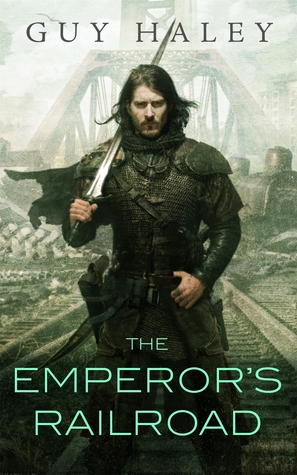
I’m not a huge zombie-story fan, so this story wasn’t really aimed at me. That said, turns out I can be quite a fan of your post-apocalyptic, back-to-vaguely-old-west-America stories, so that aspect was quite enjoyable. I do like the image of human creations being subsumed into nature.
Quinn, the hero of the story, is intriguing, and through him we get glimpses into the rest of the world that the story is set in. There are angels and dragons – I kept wondering whether this would turn out to be a fantasy or a science fiction story, and it’s not entirely resolved – and Quinn is a knight, commissioned by an angel but now on his own sort of quest. It’s a long time since I’ve read them but I was put in mind of the Terry Brooks Word&Void series; the child narrator, Abney, is fully aware that his world has extraordinary things in it but is still something of an innocent of the realities, while Quinn has seen too much.
Despite my not loving zombies, I did read and enjoy the whole story, so that says something for the characters and for the fairly fast-paced style.

 Randomly Yours, Alex