The Song from Somewhere Else
This book was sent to me by the publisher, Bloomsbury, at no cost. It will be out in Australia in December 2016; RRP $24.99 (hardback). Recommended ages 9-12.
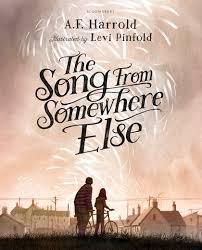 Uh, wow. This book is utterly beautiful and wonderful. Both the prose and the object itself.
The story: bullied girl one day gets rescued by the weird, despised kid. She goes back to his house where she hears haunting, enchanting music, so she goes back the next day. Things get weirder over the next couple of days – and worse, and better. There’s kind-of magic, and real friendship, and problems to overcome.
I smiled. I had tears. I audibly gasped.
This is one of those gentle, insistent, wonderful books that make me happy to be reading. It kinda reminded me of Patrick Rothfuss’ Slow Regard of Silent Things – there’s more plot here, but the sensibility somehow feels similar.
This is also one of those books where I think “by golly I hope I’m not one of those sorts of adults.” Harrold has captured Frank’s voice wonderfully, and an attitude towards adults – their jokes are embarrassing, they can’t or won’t help with bullies, they’re basically oblivious – that feels all too real.
Other things I love about Frank: she has regular cranky discussion with her stomach, which tells her to ignore interesting-if-maybe-dangerous things, points out that things are about to go badly, and occasionally ostentatiously ignores proceedings and reads a newspaper instead. Pure magic. Also, her name is Francesca Patel. One old lady makes some passing comment about “do they have tuna where you’re from?” but otherwise, that’s just her name and I have no idea what she or anyone in her family looks like.
Oh yes – she has a family. There was a slight undertone of Archer’s Goon here; not that the family gets involved, but that they’re present and loving. This is a really nice take on the ‘weird things are happening to the kid but the family has no idea’ trope, without the family seeming evil for their ignorance.
And the book itself? The version I have is a smallish hardback. The pictures, by Levi Pinfold, are gorgeous. Many of the pages have story-appropriate shadows about the edges, and the text largely stays away from them, which is really cute. The front cover gives you an idea of what the internal illustrations look like: as if they’re maybe done in pencil? I don’t know, I’m no artist, but they’re delicate and rely on shadow and light and they’re a wonderful complement to the text.
One slight warning: if you are distressed by descriptions of bullying then this may be just a bit too much for you. I have horrible memories of The Chocolate War and usually hate those sorts of books… and I found the treatment of Frank by the bullies quite nasty. But what makes it work here is that Frank, while definitely and understandably affected, isn’t completely ground down. She doesn’t pretend that everything is ok, and some days it affects her more than others, but she ends up coping. And my heart sang when, seeing one of the bullies having been attacked, she decides to help him: “This wasn’t about him, was it? It was about her and who she wanted to be. She wanted to be a better person. Better than him at least. And not because it was a competition, just because” (161). YES. Just because. I love it.
I have every intention of holding onto this book (… I don’t keep every book…) and putting it into the hands of any kid (and possibly adult) I can.
Imprudence

This is the second book about Prudence, daughter of Alexia Tarabotti and Conall Maccon of the Parasol Protectorate books. I’m pretty sure you’re only going to like these books (the first is Prudence) if ours already invested in the world and the characters.
This is a very silly book. There are silly amusing events, silly amusing misunderstandings, and very silly characters. I enjoyed it but… it is silly.
This book has a lot more about Alexia and Conall than the first Prudence book did – in fact the first third or so is explicitly about them and their relationship with Rue and what’s happening with them and the consequences for everyone. Then things proceed to be more about Rue and the crew of her ridiculous dirigible The Spotted Custard. The action is mostly well paced and the events follow one another smartly; there’s certainly no time for boredom.
As I said, I enjoyed this book but I would have liked it more if I had a better grasp of who Rue is. Perhaps I’m expecting her to be too much like her mother, which is a failing of other people as Rue has grown up and so I’m embarrassed to admit it. But I found her disconcerting because it feels like she vacillates between ‘I’d rather stay at home and have tea’ and ‘daring adventurer!!’ in a way that’s not particularly convincing. I wonder if this is partly because we see her as a toddler in the last Alexia book, and then in her first book she’s 20 – but there’s little filling-in-of-background, not that much explanation for how she came to be the sort of person she is (with the exception of being accepting of non-heterosexuality). So that was a detraction.
It’s a fun, bubbly read, with the sort of attention to dress and food detail that I’ve come to anticipate from Carriger. Not for the Carriger noob, but a nice light read for those fond enough of the world to want to revisit.
Galactic Suburbia 153
In which letters are written to Octavia Butler. Get us from iTunes or at Galactic Suburbia.
What’s New on the Internet?
British Fantasy Awards: Letters to Tiptree won one!
No Award on Conflux & Asian Flavours in SFF fandom.
Octavia project: Octavia Estelle Butler was born on 22 June, 1947, and died in 2006. In celebration of what would have been her 70th birthday in 2017, and in recognition of Butler’s enormous influence on speculative fiction, and African-American literature more generally, Twelfth Planet Press is publishing a selection of letters and essays written by science fiction and fantasy’s writers, editors, critics and fans.
We are looking for letters addressed to Butler, which should be between 1000 and 1500 words. We are paying 5cpw up to $USD75 for letters, to be paid on publication. We are looking for World First Publication Rights in English, and exclusivity for the first twelve months of publication.
Submissions: octaviaproject@twelfthplanetpress.com
More Butler stuff: Radio Imagination
Tansy’s new releases: Bounty (the final Fablecroft book) & Unmagical Boy Story
CULTURE CONSUMED:
Alisa: Jamberry & business training.
Alex: Once Upon A Time season 2; the Patternmaster series, Octavia Butler; The Starry Rift, James Tiptree Jr; Goldenhand, Garth Nix.
Tansy: The Life & Times of Angel Evans, by Meredith Debonnaire; DC Superhero Girls: Hero of the Year; Revolutionary Art: Writing For Social Justice webinar series; Hex – How to Be a Fan on iView; Labyrinth Board Game Facebook page; Dracula’s Feast on Kickstarter.
Please send feedback to us at galacticsuburbia@gmail.com, follow us on Twitter at @galacticsuburbs, check out Galactic Suburbia Podcast on Facebook, support us at Patreon and don’t forget to leave a review on iTunes if you love us!
Goldenhand
This book was sent to me by the publisher, Allen and Unwin, at no cost. It’s out now; RRP $24.99.
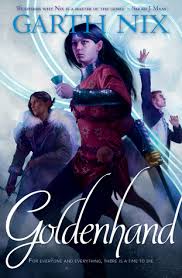 This BOOK! I’m so happy to have read this book! I’m so happy this book exists! (Spoilers for the other Old Kingdom books. Just go read them.)
I’ve been a fan of the Old Kingdom books for a long time. Not as long as they’ve existed – Sabriel came out about 20 years ago and I didn’t read it then – but long enough ago that when the prequel, Clariel, came out in 2014 I was a bit over the moon. So with Goldenhand being a direct sequel to Abhorsen, I’ve been pining for this book for a good while.
This is most definitely a sequel. I’m not sure how it would stand by itself – there’s not a lot of explanation of the whole necromancy by bells thing, nor of the Charter, and there’s a moment where Lirael is required to use her mirror and I was like wait, what? because it’s been a while since I read the other books. But really that’s all right because just READ ALL THE OTHERS ANYWAY.
Lirael is pining the loss of the Disreputable Dog, and trying to fit in with her newly discovered much older half-sister Sabriel and her family, and learning to be the Abhorsen. Something I loved about Lirael was how she always struggled to fit in as a Clayr, and I like that Nix hasn’t just made her magically (heh) well-adjusted. Meanwhile, of course, things aren’t entirely hunky dory in the rest of the kingdom: a nomad appears unexpectedly at the Greenwash Bridge, and even more unexpectedly proceeds to be attacked by other nomads and their awesomely freaky magical constructs. Cue mad flight down the river…
The book follows two tracks: Lirael, taking charge of Abhorsen business while Sabriel has a holiday (heh so cute), which means investigating a message about Nicholas Sayre and there being a magical creature on the wrong side of the Wall… and Ferin, the nomad messenger, whose endurance makes all the other characters look a bit weak and who just occasionally has a wicked sense of humour.
I love Ferin.
Nix’s writing is incredibly easy to read: it’s fast-paced, and it has lovely descriptions that allow you to imagine the place but not get bogged down in detail. I love the idea of the Charter and the additional development that the magic system gets here. In the interview with Nix that’s included in the book, he seems a bit bemused by how many people mention the gender balance in his books. But here’s the thing: when you’re reading about some guards being awesome in fighting and realise that any number of them are women, and that’s just so not a thing for this world, it still blows my mind. Multiple women in multiple sorts of roles: it can be done.
This is a wonderful addition to the Old Kingdom world and I’m so happy that it exists.
Galactic Suburbia 151
In which we consume culture and take names! get us from iTunes or at Galactic Suburbia.
WHAT’S NEW ON THE INTERNET?
Tansy’s novel Musketeer Space is half price this week on Kindle (and in other ebook stores)! Price goes back to normal on Wednesday.
CULTURE CONSUMED
Alisa: Vaginal Fantasy; Crosstalk, Connie Willis
Alex: Revenger, Alastair Reynolds; Crossroads of Canopy, Thoraiya Dyer; Stealing Snow, Danielle Paige – abandoned!; The Silk Roads, a New History of the World, Peter Frankopan
Tansy: Superior, Jessica Lack; Fangirl Happy Hour on Ghostbusters: Eps 49, 50 & 52
Please send feedback to us at galacticsuburbia@gmail.com, follow us on Twitter at @galacticsuburbs, check out Galactic Suburbia Podcast on Facebook, support us at Patreon and don’t forget to leave a review on iTunes if you love us!
Agatha H and the Voice of the Castle
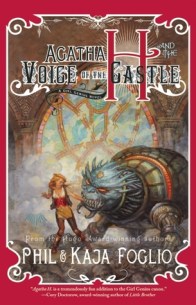 I was predisposed to liking this, of course, being a big Girl Genius fan from a number of years back. I don’t know whether I like the graphic novel or the written novel more; they’re obviously quite different media. I’m still not very good at reading graphic novels, despite a bit of practise – I’m not great at reading pictures.
Anyway, I already knew the story going in although there were a few twists that I had forgotten, which was nice. It’s still an amusing story with Agatha finding her feet as a Spark and as the Heterodyne; I like the relationships with Zeetha and Gil and Tarvek. Something this series has always done well is the secondary and supporting characters – frequently over the top but always enjoyable. I adore the Castle and its quirks – it’s a really nice way of illuminating the Heterodynes as a family, and of course adding some amusing danger along the way.
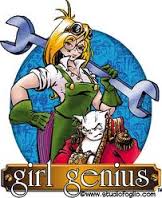 One curious and disappointing thing is the cover of this book. It looks like a page from one of the graphic novels, with one big difference. In the graphic novels, Agatha is buxom and curvaceous. But not on that cover. She’s verging on slender, which is really not Agatha. Bit disappointing really.
Crossroads of Canopy
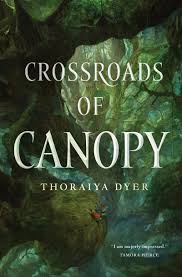 This book was sent to me by the author at no cost. She’s a friend: I have blown detergent bubbles with her Small One at Ditmar awards ceremonies and watched them burst on someone’s expensive suit. So it’s a very good thing that I really enjoyed this, because it would just have been awkward otherwise.
This is her debut novel, and it’s coming from Tor in January 2017 (the hardcover will be USD$25.99, which will be who knows how much in actual AUD by that stage).
So yes, I enjoyed it. I would absolutely have enjoyed it without any knowledge of the author, too, so I have no hesitation in recommending it. The characters are compelling, the world is fascinating, the narrative moves at a good clip while leaving breathing space for characterisation, important issues are touched on. I don’t know what else you might want… I mean, there’s no dragons or unicorns, but you can’t have everything… .
This is a forest world (… what we know of it…) where the trees must be many hundreds of metres high. Our protagonist, Unar, is born to Canopy – the most privileged section of the forest, being the closest to the sun. She is not born to the most privileged group there, but she gets herself into the service of a goddess and life improves. Plus, there’s slaves to reassure her that there are always people worse off than yourself. Of course, things do not go as swimmingly as Unar would hope, and she is forced to learn new things – do new things – and meet new people in order to survive. It’s a self-discovery narrative, in that the focus is the reader learning through Unar as she learns about herself and her society.
In Canopy, there are thirteen gods and goddesses, who are served in different niches and who die and then reincarnate and who enable magic in their acolytes. In Canopy, they fear those of the Understorey. In Canopy, there are very definitely still haves and have-nots.
There’s a lot of interesting things going on here, especially in the world-building. There are people living at different points on the trees, and basically location connects to class/privilege in a really physical way where you can see the in-world logic: closer to the sun makes you better than everyone else, naturally. Dyer, of course, sets this up to be questioned and undercut as Unar progresses through her story and learns more of life and her world. There’s little historical background about how this society became so (literally) stratified – just some teasers – so I’m looking forward to seeing that develop. But/And it’s not all as simple as it might appear…
Throughout, Dyer sets up delightfully complex relationships: parent and child, siblings, friends, acquaintances, enemies-who-work-together, lovers (straight and queer), slave and owner. Very few of them exist or progress in expected patterns, with betrayals likely, loyalty in unexpected places, and the odd bit of casual cruelty that makes the humanity ring just that bit more true. Sometimes people have a reason to be angry, and sometimes they Just Are – also adding to their humanity; sometimes people fall in love with completely unexpected people; sometimes bad things happen for no reason.
Something else that I loved and that really struck me in reading the description of the rainforest is the Australian nature of it. Non-Aussies will probably suspect that Dyer is just making up names of all the trees (some of them she has, I think). But blue quandongs are real, as are bloodwoods, as are ironbarks and tallowwood. Some of the nasty critters suggest that she’s taken a good long look at goannas and other monitors. I fully expect a demented cassowary to feature in some future book, and Dyer will barely have to change them at all to make them amongst the most terrifying creatures ever.
This is the start of a series, which is great because I look forward to seeing where Unar goes. But, happily, it also stands all by itself – so if publishing falls over in February (may that not be so) we won’t be stuck wondering about really serious issues. Of course, Dyer COULD pull a Carmody/Obernewtyn on us, but I’m pretty sure she wouldn’t do that to us. PRETTY sure.
I have two slight gripes: I don’t love the title – I don’t hate it, but I don’t feel it’s the most explanatory or gripping. There’s also a point towards the end that I felt was too rushed, where Unar very quickly grasped something that was not at all obvious to me, so it felt too hurried. But those are pretty minor quibbles.
Get this book when you can. You really want to.
Stealing Snow
 I received this book from the publisher, Bloomsbury, at no cost as an uncorrected proof. It comes out in October; RRP $16.99.
I abandoned this book, after reading just over half. It’s a hard thing to do, but it really wasn’t working for me and there are SO many books I want to read that I just don’t have time for books that don’t work.
Firstly, the press release says it’s for children 12+. I’m not sure I’d be happy with a 12 year old reading this: the protagonist has spent eleven years in a mental institute – since she was six – and there are some bits that I think may be a little scary for less mature readers. Anyway, that’s not a reason for me abandoning it.
The protagonist is part of the reason. I did not at any point feel any empathy towards Snow. There’s a bit too much repetition about her immediate woes (not being able to see the boy she really likes, who’s also in the institution), and a serious lack of development about either her history (she walked into a mirror and that was enough to get her committed?) or her personality more generally.
This is symptomatic of the book as a whole, actually: there is so little development of anything. Characters and places and events all occur in a vague world, sometimes with connections spelled out and sometimes not. Things happen far too fast – strange dreams! strange boy appearing! lover boy disappears!! a Tree!!! – and I was left completely bewildered, and not in a shivery-anticipation kinda way; in a ‘what the heck just happened?’ kinda way. It’s a portal fantasy, eventually, but whereas Foz Meadows deals nicely with the sort of confusion this would produce, Danielle Paige has Snow being confused for about ten seconds and then basically comfortable, with no explanation for how this is possible (i.e. treating it as a fantasy or whatever).
Also, the writing does not help the reading process. It’s not actively bad, but I was aware of reading – rather than being sucked into a world and ignoring the process, which really awesome writing enables.
I’m sad that this didn’t work out. I think the Snow Queen story has a lot of potential for reworking. In fact the day I received this my mother was visiting, and she had just started Michael Cunningham’s retelling of the story (very different from this), and I’d seen Frozen only about a week before. So there definitely is potential. And this version had potential… it just wasn’t achieved.
An Accident of Stars
This book was sent to me by the publisher at no cost.
 This is the first book of the Manifold World series. It’s a portal fantasy and a coming-of-age story, with an Australian schoolgirl following a woman who had helped her – and following her through a rift into another world.
Saffron’s life is a fairly normal one; it opens with a distinctly unpleasant experience with a boy at school harassing her, and a stranger supporting her as (sadly) almost no one else ever had. In going to thank the woman, her adventures start – and almost immediately they go bad, showing very early on that this is not going to be an easy experience for Saffron (although the language barrier is dealt with through a particularly convenient piece of magic). She eventually discovers that she’s wandered into a state whose politics are currently rather grim, and has fallen in with people who aren’t exactly the Most Popular Citizens. And then an escapee from the castle ends up finding them, and things get even more fraught, and adventures ensue.
Perhaps the most remarkable thing about this book is the sheer diversity of the characters. Most of the leads are female, with a couple of men. There’s a wide variety of sexual orientation, from bi to someone I think is aromantic. There’s a wide variety of skin colours – you know, like in the real world; a trans character; those who are religious and those who aren’t; the magical and the not; old and young; parents and not; and all the other personality quirks that individuals humans can have, from characters with sunny dispositions to those who consistently make you want to leave the room when they enter.
In terms of narrative, there is a lot going on in this book. There’s the experiences of Saffron, who has to deal with the strange world she’s in and the physical changes forced on her – how will she explain these when/if she gets home? (I was forcefully reminded of Seanan McGuire’s Every Heart a Doorway.) There’s Gwen, the world-walker, trying to manage this new girl as well as her own allegiances and secrets. There are a lot of conflicting allegiances because there’s a huge amount of politicking going on: both of the states where most of the action takes place are in difficult positions regarding their leaders, with people trying either actively or passively to change the status quo. Sometimes, indeed, I felt like there was too much going on. I liked that Saffron is forced to deal with the politics of the world she’s entered, and that the places she’s in are not presented as the only states, and that politics can be confusing. But sometimes I felt like the political situation wasn’t explained clearly enough – or, actually, that the problems with the system or the way that people were using the system weren’t explained clearly enough for me to care to the level that I ought.
It’s a fast-paced story, problems rarely being dealt with before more crop up; there’s magic that is difficult to use and requires training; there’s a bit of romance but not too much (for my tastes!). There’s a bit of traveling-around-the-place and camping but mostly it’s urban, and there’s a variety of perspectives used to present the narrative too.
I did enjoy reading it, although I’m not left desperately waiting for the next one. The book largely stands by itself – there’s a bit of cliffhanger at the end but in terms of the main narrative, it’s largely complete, which I appreciated.
You can get it from Fishpond.
Leviathan’s Blood
This is the sequel to The Godless, and will therefore have some spoilers for that first book. Like that one, this was sent to me by the author at no cost. 
Aaaaarrrrrgggghhh. The third book isn’t out until 2017.
The Godless basically ends with the siege of Mireea ending badly for our friends there, with additional problems like having killed a couple of very powerful men, while Buerelan’s friends are dead and the child-god is being distinctly creepy. So you just know that this second book is going to be completely full of happy, cheery adventures. Or not.
Peek’s pre-prologue is from a historian writing fifty years after the siege of Mireea, which I quite like as a conceit since it allows him to remind the audience of some of the major events with a bit of chronological distance that provides for the introspection and reflection of good historical writing. The prologue itself is deeply unsettling, since we’re introduced to someone who, sadly, doesn’t survive (sorry, but it is kind of obvious). And that’s because he’s in the wrong place at the wrong time: on the coast, when Aela Ren – the Innocent, who was pretty much a myth and a rumour in the first book – comes to shore. Which bodes for the entire novel.
The Godless followed a few different perspectives; Leviathan’s Blood steps it up a notch by adding more perspectives as the web of the story becomes increasingly complex. A lot of the story occurs in Yeflam, whence the survivors of Mireea have decamped as refugees – and I can’t help but think that Peek’s presentation of their situation, being stuck on an island with little provision and viewed with deep suspicion by the people of Yeflam – reflects current experiences of refugees, especially in relation to Australia. Ayae is having to deal with being a refugee again but also being in a unique position as someone cursed, or blessed, with a god’s power – and therefore viewed very differently by the people of Yeflam, whose state is largely ruled by such people (the Keepers). She, however, largely feels loyalty to the Mireeans and their ruler – as well as to Zaifyr, who is also in a difficult position, since he’s arrived in Yeflam as a prisoner for the murder of two Keepers. Which he knew would land him in hot water, to say the least. Then you’ve got Captain Heast, who may be my very, very favourite character since he’s so much the put-upon, battle-scarred, trying-to-be-moral, old soldier (huh… so I have a type then: Sparrowhawk; Mal Reynolds; Han Solo). And then there’s Buerelan, who probably has the most difficult narrative throughout this book, since it begins in such a hard place – blood-brother dead and cursed by the child-god – and it just gets worse as he goes to Ooila, the home from which he has been exiled for a very long time and where he knows he won’t get a great reception.
This series is definitely one of those thats fits into the Rather Gloomy side of epic fantasy. That’s not a negative, but I probably wouldn’t be giving it to someone who hasn’t read any since they enjoyed David and Leigh Eddings as a teen! There’s a lot of difficulty for our heroes, and often our heroes aren’t actually very heroic. Instead, they’re fallible and frustrated and human; not always likeable but almost always compelling.
There were points at which I felt like the narrative dragged a little, when it feels like we’re getting a bit bogged down in the details of how the Mireeans will get out of their difficult situation with Yeflam or the internal politicking of Zaifyr and his completely dysfunctional family. Having said that, all of those details add up to a very rich world – one where life isn’t all adventures and near-misses, but where understanding realpolitik is genuinely life and death, and buying farms can be a risky manoeuvre, and who you spend time with might actually change your life.
And thus, dammit, begins the long wait for the final book.
You can get it from Fishpond.


