Middlegame
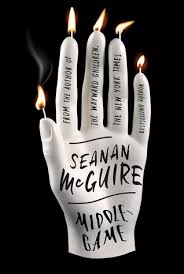
Received as part of the Hugo packet for 2020; Middlegame is up for Best Novel.
When a book is written with just enough information that I get a sense of where the plot’s going, and/or when the book is written beautifully, and I trust the author: then I really love a non-linear tale. This is not as non-linear as something like Kameron Hurley’s Light Brigade but it’s not exactly straightforward. I had absolutely no idea what it was about before charging on in, and that was quite a fun way to do it actually.
Alchemy in the 20th century; attempts to make universal forces incarnate in human children; somewhat gruesome violence, because the people doing the former two things are immoral and ruthless. Our central evil alchemist wants particularly to incarnate the ‘Doctrine of Ethos’, in two people – twins: one will be language, and the other will be maths. Which… there’s a lot in that. And the idea is that essentially those people will BE those things… eventually. When they are fully embodied.
Some of the novel is about the alchemists and their dastardly actions and what they want to achieve. Much of the novel, though, is about Roger and Dodger (yes there’s a reason for the names), and them growing up and how they interact with each other – or not. McGuire has said that it’s like a superhero origin story, which I can see; it’s a bildungsroman. How do you cope when you’re solving impossible maths problems at 9? When there’s a voice in your head that you’re pretty sure shouldn’t be there? And that’s on top of everything else about being a kid and being adopted and being a smart kid. Don’t even get me started about being a smart girl-kid whose smarts are in maths.
McGuire has said it took her a decade to get to the point where she felt capable of doing this story justice, and I can appreciate that. I’ve only read her InCryptid and Wayward Children series, which I adore – but they’re not as narratively complex as this, and I don’t get the sense that Toby Daye or the various Mira books are, either. To be able to hold all of what’s happening here in your head and make it actually make sense on paper would have to require a lot of work. And I think the prose is more wonderful, too. This is not to say that the other books are poorly written – not at all. This is more like Wayward Children than InCrytpid because that’s what the story calls for. There’s a… mythic? not-21st-century, perhaps more formal or timeless, feel to this story than the F1-paced InCrytpids.
The thing I really don’t get is why the Hand of Glory was chosen for the cover. Yes they make several appearances, but I wouldn’t have said that they are symbolic of the plot or even that they’re especially central to the narrative. It is, in fact, one reason why I hadn’t read the book before now; the cover really didn’t appeal – and when there are so many other books in the world, covers do actually make a difference sometimes.
I really enjoyed this. However, it’s up against Gideon the Ninth and A Memory Called Empire, and Light Brigade, and that’s just horrific competition.
By Force Alone
I have a long and increasingly cynical relationship with King Arthur, and all the stories around him. I read a fair bit of it as an adolescent – I even did subjects at uni about the mythology and so on. But as sometimes happens, I got cynical and impatient as I got old, and I haven’t read much new Arthur stuff in a long time.
I did re-read Susan Cooper recently, which was an excellent choice and is a bit more left-field than other Arthuriana so doesn’t really count. (Also, not new to me.)
 And then a friend started raving about this book and while he’s not prone to hyperbole I was a bit like… really? That good? But I was intrigued and so I bought it and…
By golly.
I’m not sure I can read another Arthur book ever.
This is it. This is everything.
Tidhar knows Arthuriana intimately. He’s referencing medieval romances. I’m pretty sure there are Mists of Avalon references, and Sword in the Stone. There’s the grail, sure, and the Green Knight, which is obscure but not that obscure… but there’s also the Questing Beast, and… and… yeh. So this is in no way someone coming in and thinking they’re reinventing Arthur (which has been done, and oh so badly). This is someone who knows Arthuriana deeply.
The thing I kept thinking of when reading this was A Knight’s Tale, that Heath Ledger break-out film. It used modern(ish) rock music in order to make the point about how people in the 14th century (the time of Chaucer) would have perceived music that 20th century ears hear as weird and ‘old’, and it used utterly modern language. By Force Alone is simultaneously utterly set in the 5th or 6th century – the Romans are gone, Britain is a by-water and non-existent in political terms, the Anglo-Saxons are coming (ignore the historical reality here) – but feels in some ways very 21st century: Arthur screaming ‘Come at me if you’re hard enough!’ Bully boys in London who want to be knighted, talking about being ‘made men’. Picts on the northern border being vicious.
Everyone, actually, being vicious.
This is a vicious book. There is no gallantry. There is no courtly love – which is right because the notion wasn’t really a thing until at least the 12th century and then honestly becomes part of nostalgia basically the next day. There is no honour except for what you can get; kings hold power by force alone; Galahad gets him nickname for quite, um, different reasons from how it’s usually told.
This book left me dazed. It starts with Vortigern and ends where every Arthur story ends. It covers so much at a break-neck speed that honestly it’s all you can do to hold on and see where this beast is going to end up. But it’s all completely controlled and Tidhar knows exactly what he’s doing. And what he’s doing is amazing. He’s setting a monumental myth in context, and exposing some of the nasty underbelly of nationalism and the Matter of Britain, as well as writing intriguing characters out of characters who are just so well known (what he did with Lancelot was… unexpected, and I’m curious to chase up whether it was based on stories I don’t remember or know; the Green Knight was the most amusingly outrageous). And he keeps the fantastical nature of Merlin and Morgan and makes that part of Britain itself… but in such a way it almost feels realistic. Almost.
This book is incredible.
Gender Identity and Sexuality…
 in Current Fantasy and Science Fiction.
I picked up this little anthology at Helsinki’s WorldCon, from Luna Press. I’d not heard of them before but I was and remain intrigued by their doing these non-fiction anthologies.
Yes, Helsinki was two years ago. Yes, I just got around to reading it.
As the name suggests, the essays deal with both issues of gender and of sexuality, primarily in fiction but also – and I loved it – in an analysis by Juliet E McKenna on the place of female-identifying authors across time in the publishing world. “The Myth of Meritocracy and the Reality of the Leaky Pipe and other obstacles in Science Fiction and Fantasy” made me think of Joanna Russ (as do so many of these sorts of conversations) and is well researched, persuasively argued, and did not – surprise! – leave me feeling completely hopeless. It’s a fascinating way to open the anthology.
Some of the essays meant more to me than others because in some I am familiar with the material, and with others less so. Kim Lakin-Smith’s “Doll Parts: Reflections of the Feminine Grotesque in France Hardinge’s Cuckoo Song and Neil Gaiman’s Coraline,” for instance, was truly fascinating but I couldn’t feel it as deeply as I might because I’ve not read either of the works (the Hardinge exactly because it’s billed as being horror). And it turns out I am even less up to date with fantasy than I thought, because AJ Dalton’s “Gender-identity and sexuality in current sub-genres of British fantasy literature: do we have a problem?” referenced sub-genres and authors I’ve not heard of. The essay itself was very interesting, don’t get me wrong, but I was unable to reflect on it meaningfully.
Of course, some essays I had little problem accessing. Both Jyrki Korea’s “What about Tauriel? From divine mothers to active heroines – the female roles in JRR Tolkien’s Legendarium and Peter Jackson’s movie adaptations” and Alina Hadîmbu’s “Newly added female chapters to blockbuster franchises: gender balancing in otherwise male-dominated fictional worlds or a greater purpose?” hit on issues and franchises very dear to my heart, and I greatly enjoyed reading the explorations of Tauriel and Arwen and Rey.
Let us not forget that this anthology includes an essay about Magic: The Gathering! Which is not something I would have thought was very interesting a year ago, but now I do! Rostislav Kurka (their name is meant to have a circle above the ‘u’ but my symbols don’t seem to include that one…) has helped me realise just how much more is going on in the fiction about M:TG than I realised, and how the cards’ art reflects and helps that too. So I also love that Luna Press saw M:TG as a legitimate topic for inclusion here; the essay absolutely fits the theme, and of course both the game and the fiction are a part of the speculative fiction world.
Other essays, I should point out, are more interested in a broad summary, rather than focusing on one genre or set of texts. Cheryl Morgan’s “Tipping the Fantastic: How the Transgender Tipping Point has influenced Science Fiction” was (as expected) a throughout examination of how trans characters have been presented in various stories, and what that means both for trans and cis readers and general diversity/understanding. Anna Milon’s “Bikini armour: women characters, readers and writers in male narratives” also made me think of Joanna Russ, and made me cranky, as you may imagine some of what is discussed from the title (it’s a good essay; it’s a frustrating topic).
Overall I think this is a great little anthology – and it is little, at 236 pages in about an A5 package. Obviously there is plenty more to be said, and part of me hopes that Luna does another one… although of course there are lots of other topics to cover, and they’ve got one on Evil and one on African fantasy and science fiction, so those are both excellent topics, too.
Ysabel, by Guy Gavriel Kay
 This is my first GGK and… I really don’t know what to make of it.
I mostly really liked it as I read, although there were some odd narrative quirks – like the omniscient narrator occasionally breaking in with prescient predictions about a character later reflecting on something as the end of childhood – that didn’t seem to have pay-off or point in the narrative. But those things aside I largely enjoyed the story as a whole… until the very end when something very weird and out of place happened that made me feel a bit ick about the whole thing.
Anyway, before that: Ned is in France with his photographer dad; meets another visiting American and has a weird encounter with a dude which then leads to more weird encounters and a progressively weirder journey around bits of France. There’s a love triangle ranging over enormous sweeps of time, eternal enmity, races against the clock, family secrets and family discoveries, and some slightly dubious mashing of history.
In general, I found the story generally enjoyable. I’ve no idea how accurate the geography of France is; apparently it was written while Kay was there, so hopefully there wasn’t too much licence taken? Overall the characters were interesting and plausible enough, and the pacing generally wasn’t too bad. It’s not a book to think too much about, though; the history aspect in particular is a bit silly and there are a few narrative holes that made me shake my head.
Also I hate the title. And I’m a bit bemused about it winning the 2008 World Fantasy Award for Best Novel. I don’t recognise the other nominees, but this … seems like an odd choice.
The big thing that irks me, though… (spoiler…)
Robots vs Fairies
 I am reminded, perhaps obviously, of Zombies vs Unicorns, the Justine Larbalestier and Holly Black anthology from several years ago. It’s the same sort of idea: which trope is better? Which sort of close-to-but-not-human species can authors have the most fun with, do most with, and so on? But more than zombies and unicorns, the authors in this anthology make powerful statements in their afterwords for why both robots and fairies can and do have such enduring power in our narratives. They are like us, but unlike. Robots are made by us; fairies live in parallel; both can be imagined to have legitimate grievances with humanity; both can potentially blend into humanity… and so on. Max Gladstone suggests robots are the future, and fairies are our roots.
So there’s a lot to explore in an anthology inviting authors to choose one of these archetypal features of our speculative fiction.
What surprised and amused me the most in this set of stories was the number of times authors decided to play with both. Seanan McGuire starts the ball rolling, and Catherynne M Valente finishes it; along the way, there are a couple of variations on Pinocchio that I didn’t always pick up – it’s not a significant story for me – as well as A Midsummer Night’s Dream; and other ruminations on how robots and fairies might be seen to fade into one another, one way or another. I really, really liked this aspect.
In fact, I liked this anthology in general. The stories are generally very well written, and there’s a marvellous balance of fun and heart-wrenching or somewhat horrifying, as well as often having significant points to make about humanity and how we interact with our world. McGuire’s views on theme parks were great fun to read; Ken Liu’s story on automation was chilling and brilliantly written (unsurprisingly). Sarah Gailey also contributed a supremely chilling story that I really wasn’t prepared for, and Madeline Ashby’s was haunting and lovely, and Maria Dahvana Headley got me with a rocknroll and fairies story that was always going to push my buttons.
Themed anthologies can be a fraught business. This one gets it right.
The Raven Tower
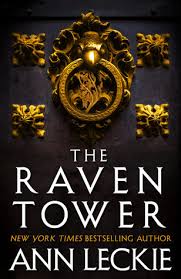 Things to keep in mind:
1. I’m a total Leckie fangirl
2. Like, seriously.
3. This is nothing like the Ancillary books at all.
4. Not even genre, let alone anything else.
I received this book from the publisher, Hachette, at no cost. It’s out now WHICH IS EXCELLENT NEWS FOR EVERYONE LET THERE BE REJOICING.
I’ll admit that when I heard Ann Leckie was doing a fantasy novel I was… discombobulated. I do like fantasy but I’ve read a lot less of it recently for various reasons, and when I thought of how the author of the Ancillary books might translate to fantasy I started thinking of lush epic fantasy which is fine but not what I’m enjoying at the moment.
HOW WRONG I WAS. I mean, seriously. What was I thinking.
For starters: this is a standalone book. That’s right folks, you can read this book and not have to wait for a sequel. Which is great.
Ok, look, I actually read this without reading the blurb or knowing anything about it, just going on trust. And I really truly believe that this was the best option – having now read the blurb, it kinda gives you an idea of what’s going on but as so often happens, I think it sets up the wrong ideas in the reader’s mind. So if you trust me, and you trust Ann Leckie, just go find this and read it without reading anything else about it.
But if not, you can keep reading.
Tides of the Titans
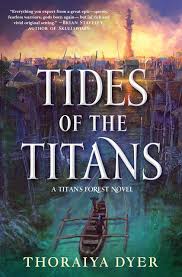 This book was sent to me by the author, at no cost. As were the previous books, Crossroads of Canopy and Echoes of Understorey. Because I am very lucky indeed.
This trilogy isn’t quite your standard trilogy because it doesn’t follow the same main characters throughout. Although the focal character is in the next two, she moves to the background; and the same happens between the second and third books. I really like this as a tactic because it means Dyer gets to explore the world of Titan’s Forest in much more complexity than might otherwise be possible – the three characters have such different roles in the Forest societies, and different motivations and personalities and so on. They interact with other characters in utterly different ways. But I also like that the three characters are all connected to each other, so we get to see family dynamics at play, and understand people from multiple perspectives.
I also like that none of the three main characters are particularly likeable; certainly not all the time. Don’t get me wrong – they’re compelling characters, and I generally understand why they think they have to do what they’re doing. But I frequently got exasperated with them for being selfish, or narrow-minded, or blinded by anger, or… other reasons. And this is a good thing, because it really is a fine line to walk to make me have a reaction like that but still be enjoying the character and the story overall. Dyer walks that line beautifully.
If you haven’t read the series yet, stop right here and go and do so: you really want to if you like complex societies and gods who aren’t that great really and live among humans, and quandongs and Australian trees getting even bigger than we let them get here, quests and revenge and family drama. Spoilers ahead for the first two books!
Merry Happy Valkyrie
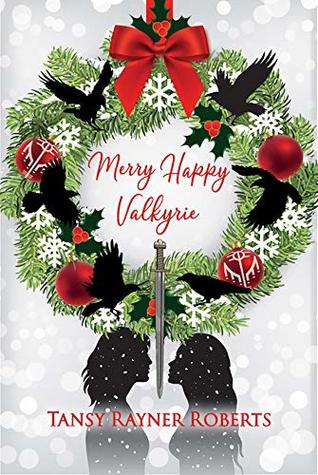 I wouldn’t necessarily call myself a Scrooge, although others might; I don’t put up Christmas decorations, I don’t wear baubles for earrings, I don’t watch Christmas movies (ok, Alisa made me watch Christmas Chronicles, but IT STARS KURT RUSSELL so it doesn’t count).
I don’t deliberately go and read Christmas stories. But this is a Tansy story, and I’d heard it played with some jokes about Tasmania and weather, so I figured I’d give it a go.
(I guess I should say that both Tansy and the publisher are friends of mine… but if I didn’t like it, I just wouldn’t say anything….)
Lief is a weather reporter, and lives in Hobart, but her hometown is Matilda – where it always snows at Christmas. Now, for the non-Australians, this is hilarious. Australian weather is always a bit unpredictable, especially in Tasmania, but the idea of guaranteed snow in December is outrageous. It has been known to snow in the hills near Melbourne, for instance, on Christmas Day… but the next year it was in the mid-30s C. Tasmania is more ridiculous (from 38C to snow in 5 days in January, and that’s just what I – as a visitor – have experienced)… but the idea of confidently predicting snow, in December? Uh, no.
Anyway, this is understandably intriguing, but less understandably hasn’t been closely reported on. Until now, when Lief is forced to go home for Christmas with a far-too-bubbly camerawoman in tow. Matilda doesn’t like visitors: there are far too many secrets that need to be kept. And when there’s not one but a whole truckload of strangers, and then weird things start happening – like earthquakes – clearly things are going to get real.
This is a very fun, and very enjoyable, and very intriguing, novella. It’s written in that Tansy style that means there’s a lot of banter and snark, some surprising description that really works, and at a brisk pace that means there’s no time for dawdling HURRY UP. Thoroughly enjoyable, and not just a Christmastime read.
Miranda in Milan
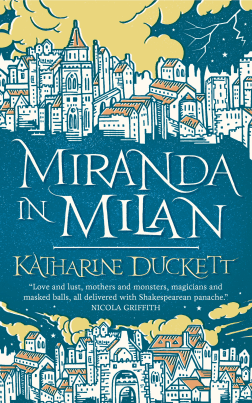 This novel (novella?) was sent to me to review by the publisher, Tor.com, at no cost. It will be out on 26 March, 2019.
Aside from King Lear, which I loathe, I probably dislike The Tempest more than any other Shakespeare play. I don’t know why; there’s nothing particular I can pinpoint. But I really, really dislike it.
It turns out, though, that stories of Miranda after the play are stories I can really get behind. So maybe this is part of the problem: in the play, I think Miranda is just a bit nothing. But For Meadows’ Coral Bones made me swoon for joy, and now Katharine Duckett’s Miranda in Milan similarly plays with the aftermath of Miranda’s return from the island – in a very different way from Meadows, but equally dealing with some of the issues that a young woman with such an upbringing might need to confront.
Here, Miranda is returned to Milan, and basically confined to the room – she’s only allowed out when wearing a veil, which she loathes. Her father is off reestablishing himself as duke, Ferdinand is in Naples, and she has no friends. Until suddenly she does develop a friendship, and she begins to discover some of what’s gone on in Milan that led to Prospero’s banishment – and, by extension, her own.
Nicola Griffith’s blurb is (unsurprisingly) apt: “Love and lust, mothers and monsters, magicians and masked balls…”. That’s about it. What is love and how do you know it, what makes a monster, and can magicians be trusted… Duckett writes about these things, and does it quite beautifully.
Sorry you have to wait til March to read it.
Summer in Orcus
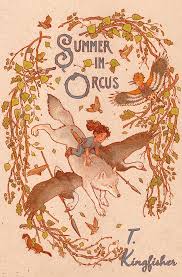 When I was looking through my ebooks and came across this one, I couldn’t for the life of me remember how I acquired it. Looking at the cover I thought it might be connected to Kathleen Jennings, but turns out it’s not her art – just similar. Then eventually I realised that it came in the Hugo packet, and I had run out of time to read it before voting was complete.
T. Kingfisher is, I discovered, a nomme de plume of Ursula Vernon. I’ve read some of Vernon’s short stories, but not enough to really have a sense of what her work is like. So I had no idea what I was getting myself in for with this story.
The answer is: whimsy, and delight.
Firstly, Summer is the main character, and that’s delightful. Secondly, she has a painful childhood, because her mother is needy and overly protective. I find this quite fascinating as a way of thinking about a parent in a fairytale-is story. Not absent, not careless, not hardhearted; but the sort of parent who makes their child feel bad for wanting independence, who needs constant reassurance, and who peculiarly demand their child to be more like the adult, offering comfort. So that’s an intriguing aspect that’s introduced immediately. Which is also something I like – this is aimed, I guess, at what Americans call ‘middle grade’ readers; Summer is 12 – and so there is little beating about the bush. The story proceeds at what would be well called a brisk pace. Indeed, and thirdly, Summer has met Baba Yaga and her chicken-legged house within three pages and is off on her adventure in Orcus in chapter 3, to find her heart’s desire. Summer’s not quite sure what her heart’s desire is, but assumes she’ll know it when she finds it.
Also, she has a talking weasel to accompany her.
I told you there was whimsy.
So there are talking animals and dryads and a land that’s kind of falling apart, dandy-ish birds and terrifying fortune-telling cheeses. People who are actively trying to destroy things and a wolf that’s not just a wolf, and Summer reflecting on whether her experience in Orcus will be like an experience in Narnia. And an antelope woman.
I loved it. A lot. Kingfisher’s prose is delightful, the characters are varied and only Reginald, the dandy bird, is faintly ridiculous. While it initially seems like it might be a relatively standard portal fantasy (which would have been fine), it reminded me more of Catherynne M Valente’s Fairyland books in their self-awareness than anything else. It’s also not completely standard in the way that Summer’s quest pans out, but no way am I spoiling that. Suffice to say it left me musing.
I really enjoyed the character interactions, and the places Summer visits. I liked that Summer wasn’t always sure what to do but that she was a resourceful and sensible girl – and sometimes that meant being quite scared, as was appropriate in some of the circumstances she found herself in. She deserves to have lots of people read about her adventures.

 Randomly Yours, Alex