Scorched Supper on New Niger
I got hold of a copy of this amazing novelette (I think? 17,000-ish words) from one of Galactic Suburbia’s wonderful listeners, who is the Editorial Director of a new digital publisher, Snackreads – he sent through a copy because he thought it would be up our collective alley.  To which the answer, I think, is OH YES.
A future where there are space ships carrying cargo between planets as easily as trucks do today… but where there is, for some unknown reason, a societal reaction (on some planets) against women having the freedom of movement to do things like be in space. Dee has taken over a freighting company from her formidable aunt, but is facing difficulties in the shape of her sister, her sister’s husband, and mounting debt. When she has to land on New Niger, things appear to be as desperate as they can be, so she ends up making a deal with a competitor… and things go from there.
The things I love about this story are many: I love Dee’s voice as she makes clear just how much it means to her, to be a pilot, and just how much she hates the idea of being trapped by her brother-in-law. I adore the idea of New Niger (although I must admit I don’t know how accurate Charnas is in her descriptions of Old Niger, and it may well be that there are some things that are offensive/otherwise wince-worthy, and if there are I’d love to hear it) – people of colour in space! Who would’ve thought it! I particularly love (although see previous brackets) the way that one character there, in particular, plays on racial stereotypes very consciously to her own advantage. The denouement had me quietly cackling with glee. I enjoyed the pace of the narrative, the action overall, the ‘domestic’ setting (family feuds) commenting on larger social realities…
I should get me some more Charnas to read, I guess.
Exile from Space: a short Judith Merril story

I’ve been wanting to read more Judith Merril since Helen Merrick’s Secret Feminist Cabal, since Merril features pretty prominently in the early years. The lady wrote “That only a Mother could love” – a seriously amazing piece of fiction that I’m sure Russ would have dismissed as ‘galactic suburbia’ but I think is staggering in its suggestion about life for the ordinary woman in The Future.
Anyway, “Exile from Space” – the basic story is young woman going to the city for the first time, but there’s clearly something a bit odd about this young woman because of how she talks about her education, and about other people… and it quickly becomes apparent that she has not been living with other humans, at least for her teen years. So although she herself is human and passes for human, she has to deal with all these weird things like eating, and shopping, and interacting with humans – such that she might as well be an alien. Oh, the many levels of ‘alien’. And then, of course, there’s a man…
Merril’s writing is delightful and elegant, and conveys the sheer weirdness of human existence simply and clearly. So many things we take for granted…. This story makes me wish I could find more of Merril’s work, but I keep coming up with nothing wherever I look. I got this story from The Gutenberg Project.
Galactic Suburbia Award
In our last episode (previously, on GS…), we announced the winner of the Galactic Suburbia Award for 2012. You can now read Elizabeth Lhuede’s acceptance speech over here at the podcast blog.
You can also see the full shortlist, complete with links so you can go and check out the awesomeness of everyone for yourself.
Galactic Suburbia is 3/4 of a century old
 In which we reveal the winner & shortlist of the Galactic Suburbia Award for activism and/ or communication that advances the feminist conversation in the field of speculative fiction in 2012. You can get us from iTunes or at Galactic Suburbia.
NEWS
Hugo Nominations close on Sunday, March 10, 2013
Chronos Awards also open: http://continuum.org.au/c9/chronos-awards/
Stranger with My Face Women in Horror Film Festival – 7-10 March in Hobart, Tasmania
Glitter and Madness Kickstarter – last days to support this anthology project!
CULTURE CONSUMED
ALISA: Editing – Asymmetry by Thoraiya Dyer; A Trifle Dead by Livia Day; reading the country you have never seen: essays and reviews by Joanna Russ
ALEX: Saga, Brian K Vaughan; Band of Gypsys, Gwyneth Jones; The James Tiptree Award Anthology vol 2.
TANSY: Cabin in the Woods, Small Blue Planet, “The Lady Astronaut of Mars” by Mary Robinette Kowal (novelette)
Please send feedback to us at galacticsuburbia@gmail.com, follow us on Twitter at @galacticsuburbs, check out Galactic Suburbia Podcast on Facebook and don’t forget to leave a review on iTunes if you love us!
First Galactic Suburbia ep for 2013!
 In which Alex touches Troy with her bare hand, Alisa discovers that the best part of Paris is not the part that’s underground, and Tansy cheats on both of them for love of Doctor Who (it was inevitable, really). You can get us from iTunes or at Galactic Suburbia.
WHAT WE DID ON OUR SUMMER HOLIDAY!
Alex: Turkey and Egypt
Alisa: Honeymoon in Paris
Tansy: adventures on the internet including the article “Historically Authentic Sexism in Fantasy. Let’s Unpack That” syndicated on Tor.com, selling Wet Shirt Mr Darcy for the Deepings Dolls, and Verity! (a Doctor Who podcast)
Hugo Nominations close on Sunday, March 10, 2013. We’ll be making recs over the next few episodes, though in the mean time check out Tansy’s post on Hugo Recs for Best Graphic Story.
The Galactic Suburbia Award: for activism and/ or communication that advances the feminist conversation in the field of speculative fiction in 2011 – to be announced in 2 weeks, get your nominations in quick! Check out last year’s winner and honours list to see the type of thing we want to hear about, or be reminded of!
Culture Consumed:
TANSY: Eureka Seasons 1-4; Captain Marvel by Kelly Due DeConnick, Dexter Soy & Emma Rios; Saga by Brian K Vaughan and Fiona Staples.
ALISA: The entire series of The Closer, Tara Sharp 1: Sharpshooter and 2: Sharp Turn.
ALEX: Abraham Lincoln, Vampire Hunter (the movie); Zendegi, Greg Egan; The Telling, Ursula le Guin… and how many books in total? Yes, Alisa really ran a book on this one.
AND!! Alisa’s exciting news!!
Happy Birthday to the Silent Producer, who totally missed us while we were away, and got a brand new episode to edit as his birthday present.
Please send feedback to us at galacticsuburbia@gmail.com, follow us on Twitter at @galacticsuburbs, check out Galactic Suburbia Podcast on Facebook and don’t forget to leave a review on iTunes if you love us!

Remnant Population
 As soon as I have written this review, I am throwing my copy in the bin.
Which is a tragedy, because I loved it.
So why the bin? Because page 122 proceeds to page 171, goes through to page 202, and then to page 155… and thence to the end. So I can never read this again, and can never lend my copy to anyone, and I cannot in good conscience even give it to a charity.
So sad.
But yes, I kept reading, even with missing 30 pages in the middle, because this book is ABSOLUTELY INCREDIBLE.
If there’s no country for old men, there’s barely even a nice quiet kitchen for old women. But this story is centred almost entirely on the experiences of one old woman, Ofelia – whom Ursula le Guin described as “one of the most probably heroines science fiction has ever known.”
I got hold of this last year as part of the Women in SF book club which sadly imploded in about May, as the host decided she couldn’t do it any more. Hence its sitting on my TBR shelf all this time. When I decided to finally read it a few days ago, I didn’t even read the blurb, I just jumped on in. Which can be a really awesome way of doing things, if you either trust the author or the recommender enough.
Ofelia is a widow, living with her sole remaining son and his rather unpleasant wife on Colony 3245.12. Sims Bancorp Company has the franchise for the planet (… what the?? Ah capitalism…), and the colonists are all basically contractors to them. So when the Company loses the franchise, because the colony isn’t doing well enough, all of the colonists have to leave. With 20kg of stuff each. After living there for forty years. In 30 days’ time. Ofelia, though, gets a very sneaky idea: what if she didn’t leave? What if she hid out until the shuttles have left, and just… stayed? Which she proceeds to do.
A good chunk of the story is concerned with Ofelia on her own, and how she physically copes with gardening and what she decides to make and so on. There is an interesting comparison to be made here between her experience and that of the woman in Joanna Russ’ “We Who Are About To…”. Very different situations, of course, but both women alone on a planet, and very different responses. Perhaps more intriguing is the decisions that Ofelia makes about herself, and the internal dialogue she has about those things: about doing what she wants and not what she doesn’t – wear clothes? plant certain things? and whatever else. Her reflections on her life, and the expectations on her as a daughter, a wife, a mother… a woman… are painful because they ring so true.
It’s a bit of a spoiler that Ofelia eventually discovers that she’s not alone on the planet, but the blurb reveals that (it turns out), so I don’t feel bad about saying it. The relationship between Ofelia and the aliens (who are after all the indigenous ones) is utterly captivating and real and compelling. And Ofelia never stops being an old woman: it’s not like she’s magically transformed into a Ripley, all brave and sacrificial, or any other somewhat-stereotyped female figure. She stays a bit cranky, and quite achy, and impatient; when the creatures turn up, she’s more cranky about losing her precious, precious solitude than anything else, and when they want to learn she has a moment of, “Again? But I’ve DONE the mother thing already!” – which I think is hilarious and totally appropriate.
Moon makes me think again about the way the elderly are treated in society, which I’m sure is at least part of the point. The way Ofelia is treated because she has no formal training, and because she is old, is horrible and cringe-worthy. The alternatives are joyous and far more honourable.
It’s a wonderfully written story, and even with missing 30 pages I loved it very much.
You can buy it here: Remnant Population: A Novel
Four Ways to Forgiveness, or, Ursula le Guin is the best
There is just no denying it: Ursula le Guin is one of the greatest writers of the last 50 years (at least), and I firmly believe that the only reason she does not get more recognition for her commentary on race, politics, and – especially – gender – is because she sets much of that discussion off world. But, as I’ve mentioned before, this makes the discussion both easier to read – it’s not my society being critiqued! – and harder-hitting, because when we see our faults in aliens… it hurts more, somehow. Or maybe that’s just le Guin’s genius.
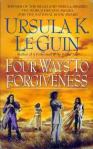
So. Here we have four interconnected short stories (although if we’re being technical I think the last two are probably closer to novellas). We have two planets, Werel and Yeowe. Yeowe was uninhabited until the Owners on Werel decided to start mining and farming it, for which they used the labour of their assets. Yes, Werel is a slave-owning society, and a capitalist one (I see what you did there, le Guin – very nice indeed – Marx needs a little chastising sometimes). And within the hierarchy of owner/owned there’s a gender hierarchy as well, with women being firmly the lowest section of each caste. Sounding familiar? Well yes, except that here lovely onyx skin is the most prized, and the paler you are – the more ‘dusty’ – the more obvious your slave status.
Me, I’m one of the palest of the pale whitefellas around. No way can I presume to comment on how people of colour would react to this inversion. For myself, I’ll admit that reading the derogatory term ‘dusty’ did not at first make sense (I thought it was referring to them living in the dirt and dust); and while it was uncomfortable in the context of slave/free, it’s awesome to read stories wherein black is desirable and beautiful… and it’s not a big deal.
The four stories all deal with the same basic issue and time: the consequences of a revolt of the ‘assets’ on Yeowe against the Corporation who owned them: consequences for the Owners and the assets, for men and women, and for the alien Ekumen observers (this fits into le Guin’s Hainish cycle). For me, while revolutions are interesting and all, it’s the aftermath that’s really the meat of history. What difference does it actually make? How long do changes take and how long do they hang around? Changing the world is one thing; changing attitudes and desires and beliefs quite another.
The first story, “Betrayals,” is set some time after the Liberation, in a nowhere town on Yeowe. It’s the story that has least to do with the Liberation itself, although it comes about as a result of it. It’s a tale of two old people – and how refreshing is that? – dealing with being old, and the changes in their world, and how frustrating the world can be when you’re not able or allowed to make big changes yourself any more… but you can still make small ones, that do make a difference. Bitterness and growth and love. Also gossip, and the downfall of heroes.
“Forgiveness Day” comes first from the perspective of a ‘space brat’ – a worldly (hmm, or not; she doesn’t really have a world) woman of the Ekumen sent to Werel to act as an observer there. Being an observer on tight-knit, inward-facing and closed-mouth Werel was always going to be a difficult task, but having a woman in that position – going out, rather than staying in the beza (woman’s side); her own property, rather than a man’s; speaking to men as their equal – is yet another kettle of proverbial. Solly deals with it rather bullishly, which is perfectly fair and understandable. What puts le Guin at the pinnacle is that she writes Solly completely sympathetically for maybe a quarter? of the story, and then relates the next section from the perspective of Teyeo, her bodyguard, of whom Solly has a very dim view but who again comes across as immensely sympathetic, and casts some shade on Solly; and then the rest is the two of them in rather a pickle. It’s a commanding story of attitudes and cultural perspectives, and change in the face of necessity. It also starts opening up Werel society to the reader, giving hints and clues about how and why it works, which while not making it likeable begins to make it comprehensible.
“A Man of the People” begins on Hain, with a young boy growing up in a sheltered, insular pueblo… who eventually gets impatient with the local knowledge available and longs for something bigger. Nearly half of the story takes place on Hain as Havzhida learns about universal knowledge and eventually becomes a member of the Hainish delegation to Yeowe. While the previous story showed Werel from an outsider’s perspective, seeing Yeowe post-Liberation from such a view is revealing too, not least because the gender hierarchy has been replicated. The rhetoric of freedom, of liberation, is a complex one, and le Guin makes some offerings on how to understand it in this and the next story in particular. I think this story is my favourite, at least partly because it shows how power doesn’t have to come from violence, and subversion doesn’t have to involve deceit. And the characters are wonderful and varied, and Havzhida is a willing observer – not insistent on participation where that might not be appropriate. Which is something that some activists might do well to understand.
Finally, “A Woman’s Liberation” is probably the most difficult to read of the lot. The first is post-Liberation Yeowe, so at least the theory of freedom is present; the second is Werel, where there is no freedom for ‘assets’ but Solly and Teyeo move freely (mostly); the third is post-Liberation Yeowe too, with Havzhida moving freely and women beginning to do so. “A Woman’s Liberation,” though, is from the perspective of a bondswoman – an asset – on Werel. She is thus doubly bonded, doubly enslaved, both to her Owner and to the men of her caste. This makes for a sometimes-painful reading experience – not gratuitous, not unnecessary, but painful nonetheless. Things do change, as the name suggests, but le Guin does not hide the fact that changing official status is difficult, and indeed is only one step in losing the ‘slave-mind’. Rakam is a glorious character who grows and struggles and is unrelentingly honest with the reader. She’s inspirational.
These stories are complex and challenging and absorbing and frustrating because they do not fill in all of the gaps. By the end a general sweep of the history and society of Werel and Yeowe has been revealed, but there is so much more that could be written! This is one of the peculiar gifts of le Guin, I think – she does not tell us everything. Only what we need to know. Which is about liberation, and freedom, and individuality, and community, and love.
Galactic Suburbia 73
 In which Alisa recovers from the brainsplosion that is World Fantasy Convention, Alex finally reads THAT Margo Lanagan story, and Tansy travels in three kinds of time. You can get us from iTunes or at Galactic Suburbia.
News
The WFC Report
Stop Reviewing Movies with Strong Female Leads!
at the Mary Sue
at Jezebel
at Bitch
Fake Geek Girls Unite:
Mary Sue Coverage 1 2 3
The New Statesman
Peter M Ball Pledges His Allegiance to the Fake Geek Army
What Culture Have we Consumed?
Alisa: Dexter S6 and S7; Episodes 2; In Treatment S1; The Shield S1; Remember Why You Fear Me, Robert Shearman; Hair Side, Flesh Side, Helen Marshall
Alex: Singing my Sister Down, Margo Lanagan; some Kij Johnson, from At the Mouth of the River of Bees; One Little Room, KJ Parker; Holmes Sherlock, Eleanor Arnason
Tansy: The Diviners, Libba Bray; All New X-Men #1; Chicks Unravel Time edited by Deborah Stanish & LM Myles.
Don’t forget to send us nominations for the GS Award: for activism and/or communication that advances the feminist conversation in the field of speculative fiction in 2012.
Check out our sibling podcast, Galactic Chat – in the latest episode, Sean interviews Joe Abercrombie.
We are running away for summer! Back at the start of February!
Please send feedback to us at galacticsuburbia@gmail.com, follow us on Twitter at @galacticsuburbs, check out Galactic Suburbia Podcast on Facebook and don’t forget to leave a review on iTunes if you love us.
This book made me angry
It’s rare that I read a book that actually makes me angry. Like, exclaim-out-loud angry.
It’s very rare that this happens with a history book.
This book had that impact on me.
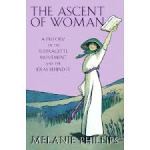
The book bills itself as “A history of the suffragette movement and the ideas behind it,” which sounded perfect for me – I was convinced there was a rich 19th century tradition of ideas and activity in Britain for the women’s suffrage movement to spring out of so, naturally, I was dead keen to read about it. And, truly, the first few chapters do do that. Phillips goes right back to the very awesome Mary Wollstonecraft and her writing around the French Revolution, like A Vindication of the Rights of Women (suck it, Edmund Burke, you got ripped). She discusses women’s involvement in the campaigns against ‘vice’ and other social reforms, and all of that was quite interesting. Middle class, but perhaps that’s where the information is mostly to be found? And, yeh, a lot of this sort of campaigning required free time, which women in the working classes did not have because they were, you know, working. So I could move past that (a bit).
Anyway, well and good. Then she got up to the 20th century and the really focussed suffrage stuff, and then… well, there were gasps and strangled cried and the savage use of pencil to underline unbelievable passages. There may have been mutterings not entirely under the breath. It’s fair to say that my husband expressed concern a few times.
Now, I had just read a biography of Emmeline Pankhurst, so that didn’t help matters, because Phillip is really, really anti-Pankhursts – both Emmeline and Christabel (Sylvia seems to get a pass). She makes wild claims about them and provides quite vicious descriptions such that – I’m sorry – I had to go back and check that this was written by a woman. I can’t believe this was written by a woman. They are described as having “pathological self-importance and [the] urge to martyrdom” (p236); Christabel had “histrionics” and was “the queen of melodrama” (p240); their relationship is described as “unhealthily close and introverted” (p254). I just… what? Seriously? In a book that would quite like to be passing itself off as a readable but serious history?
And this is where another of my frustrations came in. Phillips does use a number of primary sources, and has some extensive quotes from them, which is awesome. Tick! However – and this is a really huge problem for me – there is little consideration of the perspective being brought by those sources, and whether they might be problematic. Peeps, this is the sort of thing I teach my students at high school to consider. Consider: Phillips quotes from Teresa Billington-Greig, whose book Phillips herself describes as “coruscating and merciless” (p246). Phillips draws on this book until p250, but nowhere at all does she consider whether Billington-Greig might be bitter after splitting from the WSPU (run by the Pankhursts), or that it might have been intended to discredit the WSPU in favour of the Women’s Freedom League, which she founded after the split. This is poor, poor historical work. I don’t care that she is apparently “wearing her scholarship lightly,” as a review from the Irish Sunday Independent described it; that’s shoddy scholarship.
And then… ah, then. The conclusion. One of the things she’d pointed out throughout the book is the double standard that women were both too inferior to vote, because they’re women, but also too good and pure to be sullied by politics. Nasty. Anyway, in the Epilogue she says this:
The same double standard persists to this day, with women claiming ‘equality’ and yet insisting, for example, that mothers have prior claim over fathers to their children after divorce; or that women must be economically independent of their husbands, unless they separate, in which case men must turn back into breadwinners; or that if a man is violent to a woman or child, he is an irredeemable savage, but if a woman is violent towards a man or a child, she must be suffering from an emotional problem. (p316)
It’s fair to say that I still have trouble believing that paragraph.
So. Yeh. I learnt a few things about the context of the suffrage movement, so that’s good. I was also reminded just how important it is to demand a consideration of why something was written in the first place.
ETA: ooookay… thanks to Niall Harrison on Twitter, I now have a better understanding of Melanie Phillips. He directed me to this post, and I will not read any more on her blog than that for fear of heart and/or brain malfunctions. Right then.
Galactic Suburbia 72
In which a new listener is born, Canada gets a Stella too, and we review a bunch of great stuff including Black Widow, Infidel, Swordspoint and Big Finish’s special releases. You can get us from iTunes or at Galactic Suburbia.
News
Baby Announcement: Daniel Wessely is born!
WFA winners announced
Genrecon!
Tansy talks Genrecon on the Voyager blog
And again on her own blog
Jason Nahrung on what he got out of Genrecon
Neil Gaiman’s new Doctor Who episode will feature the Cybermen, Warwick Davis & Tamzin Outhwaite.
Boing Boing
io9
Canada is getting a Stella too – theirs is the Rosalind!
Galactic Chat – Rowena Cory Daniells
What Culture Have we Consumed?
Alex: Infidel, Kameron Hurley; The Deep (BBC series); Black Widow, Marjorie Liu; and books on women’s suffrage… (only on the day on which I post this!)
Tansy: Bitter Greens by Kate Forsyth, Swordspoint by Ellen Kushner; Big Finish Specials: UNIT Dominion, Love and War by Jacqueline Rayner & Paul Cornell; Voyage to Venus; Dorian Gray
Please send feedback to us at galacticsuburbia@gmail.com, follow us on Twitter at @galacticsuburbs, check out Galactic Suburbia Podcast on Facebook and don’t forget to leave a review on iTunes if you love us!

 Randomly Yours, Alex