Plantagenet Princes
I received this book to review via NetGalley.
The good things:
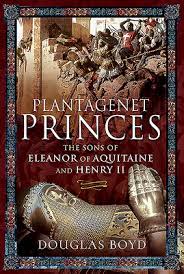
- The very concept. I love the idea of a book that covers all the Plantagenet fellas from Henry II to Richard III. Seeing their wildly varying careers one after the other points up just how outrageous and sometimes amazing and sometimes dreadful this lot could be. So great.
- Some of the context given. I appreciated the broader comments about the Crusades, for instance – and this lot were involved right up to Crusade #8, which I didn’t know before this. The book starts with a very general intro to the concept of being a knight, and then gives an overview of the first couple generations after the Conqueror. I didn’t need these, but for a reader less familiar with the era I’m sure it would be very welcome.
- Eleanor of Aquitaine. Any time I get to read about her, it’s a good day.
- It’s pretty straightforward to read.
The less good things:
(sigh)
- The author mentions an historian who claims the Bayeux Tapestry must have been designed by a man because there are penises embroidered on it. And just… leaves that comment sitting there.
- The author repeats that old saw about spices being used to cover the taste of rotting meat. Pretty sure that’s been debunked.
- The editing. Most significantly, the editing. First, there’s some odd things going on here with the structure. Clearly I read a review copy so I don’t know whether it’s still got some editing to go. But there were bits where I wasn’t sure if it was a typo or deliberately presenting variant spellings (Saladdin, and then Saladin); and there were several occasions where it felt like sentences were in completely the wrong place. Like, he would have a paragraph about an event; then the next event in the next paragraph, but suddenly the first event is mentioned completely out of context. And this got more frequent as the book progressed. Really quite confusing. And then additionally, several times there would be two men mentioned as being involved in something, and then “he” made some final gesture… and it was often unclear which “he” was being referenced.
Overall, I did enjoy this as a history of the family. It presents the princes in their context, shows how they’re connected and how they variously win and lose bits of their empire-not-an-empire. I suspect it would be a bit hard for someone with absolutely zero knowledge of the early Middle Ages, but then again if you’re picking this up you must have at least an ember of a passion for that time. The editing problems came close to killing the enjoyment a couple times, but I was able to bull past it.
Revelations: a novel about Margery Kempe and Julian of Norwich
I received this as a review copy from NetGalley.

A fictionalised account of the life of Margery of Kempe, generally regarded as being the author of the first autobiography in English. Mystic, wife, mother, pilgrim, accused heretic, all-round confounder of stereotypes and expectations. Margery always comes across as something quite extraordinary, beginning with the fact that we know anything about her at all – so few medieval women are known to the historical record, let alone in her own words. (Well, probably; she’s recorded as having dictated her account to a scribe. But I don’t think anyone seriously doubts that her words are her own.)
What Sharratt chooses to do in order to really bring Christianity and mysticism to the forefront is highlight Margery’s friendship with Julian of Norwich. They definitely did know each other, so that bit isn’t a problem. Julian was an anchorite – she took vows and was sealed up in a room that she never left, the better to contemplate God. She was also an author – the first named English female author, in fact. Her book was about revelations from God, concerning grace and love and the overwhelming affection that God has for creation; and she goes so far as to refer to ‘Mother God’, and call God’s love maternal. Sharratt makes her quite accessible, here, and the fate of her book is a significant part of the story – written as it was when England was terrified (and intrigued) by “Lollardy” – the idea of having the Bible in English and challenging the supremacy of priests as interpreters of God’s word, and various other things imputed to them.
Julian and Margery together certainly challenge the structure of the medieval Catholic Church. Margery, too, claimed to have visions, and Sharratt includes them as genuine and deeply affective experiences. Through Julian and Margery, Sharratt touches on some of the issues facing the Catholic Church throughout the Middles Ages – the role of priests and of communion and the accessibility of God to laypeople. The book doesn’t get especially deep into these issues, though. There are some truly despicable friars and priests, but also some genuinely loving and holy ones. Margery and Julian are certainly shown to be faithful daughters of God.
The one thing that troubled me here was some of the historical licence taken. Various true events have been included out of time for emotional impact: Margery witnessing the burning of Jan Hus, for instance. I don’t really see that this was necessary to heighten the tension, and I don’t think Margery needed to see someone being executed in order to have the reality of the dangers she faced brought home.
Overall, I enjoyed this book. It’s well written and a fast read (I read it in a single, admittedly uninterrupted, day). It’s useful for emphasising both the similarities of the Middle Ages to our own time, as well as the vast differences. I already knew a little about both Julian and Margery, so I don’t know what this would be like with no prior knowledge; I suspect it would be fine.
The Hunt for Mt Everest
I received this courtesy of NetGalley.
I am not a mountaineering or climbing person. I am, though, fascinated by tales of ‘discovery’ and history in general and finding out about bits I know nothing of.

‘Discovery’ in quotes because, of course, while this story is about the hunt for “Mt Everest”, it’s not like the mountain was unknown to the people of Tibet or Nepal or, I imagine, people in China or (what is now) India. And thankfully Storti makes this clear fairly often – that this is discovery only for westerners and, in particular, the British. Storti is under no illusions that some of the things done by the British in both India and Tibet were despicable, and I think he keeps an even hand in explaining the contemporary reasoning (I learned more about “the Great Game” of Britain v Russia in this one book than ever before; the 19th century is so not my period), while simultaneously not excusing or approving of, for instance, sending spies into Tibet when it was explicitly closed to foreigners.
So: the book! The overall point is the discovery that what the British decided to call Mt Everest turns out to be the highest peak in the world. (Yes, there’s a section on why it’s called Mt Everest, and the fact that didn’t even match contemporary expectations of using local names.) There’s a digression into the ‘discovery’ of mountains as beautiful – until the early 19th century they were generally dismissed as being a waste of space and just getting in the way; and also about the development of mountaineering as a hobby, and people climbing in the Alps. Also a whole bit about the great trigonometric survey of India, which was fascinating and absolutely relevant and also bonkers as an undertaking. Within all of that is the colonial attitude towards India, and towards Tibet in particular – the fact that Tibetans didn’t want the British within their borders and what some men did in contravention of that (Mr Younghouse, I’m looking at you, arrogant bastard). And eventually, there’s the expedition in 1921 that finally means westerners got a look at Mt Everest from close up.
Storti writes a really engaging narrative, explains issues clearly, and balances storytelling with historicity. As someone on the outside of mountaineering I’m unconvinced that George Mallory is more important than Edmund Hillary in the whole Everest saga, but I’ll allow him to champion the man now I know a bit more about him (interesting to read about, probably a right pain in the bum to actually spend time with).
This was a really fun book to read (well, fun and sometimes tragic, as is always the case with both mountaineering history and colonial history).
Forces of Nature
I received this book via NetGalley.
I’m a bit conflicted by this book.

On the one hand, it’s a pretty great introduction to women in science – and the fact that women have ALWAYS been “in science”, they’ve just been obscured (deliberately or not) on a personal level or an institutional one; by which I mean, “science” has been constructed as a discipline in order to leave the ladies out (eg midwifery isn’t really medicine). Recovering the presence of women is always good.
I LOVE that Marie Curie isn’t mentioned until the last chapter. Seriously: the authors make this choice an explicit one, explaining that she gets used as the exemplar and that’s not useful (and also people ignore a whole bunch of facts about her, too).
I liked that the authors aimed to go back to ancient women, despite the overwhelming lack of evidence (because patriarchy AND because time); they make a good case for ways in which ancient women would have been involved in scientific endeavour.
On the other hand…
I wasn’t always sure whether the authors were picking women as examples, or if they thought they were being exhaustive. If the latter, then they didn’t succeed – and surely they weren’t trying for that in a book intended for the general reading public – but I would have felt more comfortable if they had been clearer about their decision-making paradigms.
There were some sweeping statements about “women” and their access to education/lack thereof. Very occasionally there were comments about how class also interacted with gender – but I felt there was a serious lack of this latter point. Class had a HUGE impact on access to time, let alone equipment; this intersection should have been made much more obvious. As well, other discussions about women’s involvement in science has pointed out that gentlemen-scientists, for instance, often had female servants assisting; that’s not discussed here.
Occasionally, the authors do not walk the line I think they intend to. For instance, when Western Europe experiences a craze for natural history and botany, the latter in particular is seen as appropriate for women to be involved in, for various reasons. The authors point out that it was thought women were closer to nature, and therefore had an affinity for botany… and then seem to suggest that women really were better at botany? I was a bit confused about what the authors thought they were doing here.
This is, too, an overwhelmingly European (and eventually American, largely still of European descent) book. Not exclusively – there is mention of women in ancient Egypt (of course; that’s basically European in the way it’s often discussed!), and women medical practitioners in ancient China. There’s a Japanese scientist in the 20th century who did awesome things regarding ocean currents and nuclear fallout, a woman of mixed Irish/Mexican ancestry who was an archaeologist, and a few others. I would have liked to see an acknowledgement that evidence is overwhelming white, because colonialism (in Europe and America) and because… lack of access, or something? for Asia. Africa, South America, Australia…
I got whiplash when the discussion leapt from Algoanice, living in probably the first century BCE, to Hildegard, who was born in 1098 CE.
As a way of enlarging your understanding of women’s place in science over time, this is a fine place to start, as long as you remember the caveats about class and race.
The Bookseller of Florence
This is one of the best history books I’ve read in years.

It’s written superbly. The language is a delight – but not so clever or lyrical that it gets hard to read. The pace is just right, and the level of detail is an absolute delight: the right balance of fascinating without getting into ridiculous minutiae.
It’s wonderfully historical: it uses primary sources and historians to make arguments and illustrate points, and they’re all woven within the story seamlessly. It uses endnotes, so you don’t have footnotes cluttering the page but you still have the reassurance that the author has done the research!
It illuminates (heh) the context magnificently. The Renaissance, Italy, and Florence are really not my scene, beyond knowing a few names (Medici, Borgia. – and Sforza for some reason?). The author sets the general scene for all three so that I felt completely comfortable going in. The book is ostensibly about Vespasiona, the “king of booksellers”, who started as a fairly uneducated boy working in a book binder’s in Florence and became the man who could either track down a manuscript or have a beautiful new one made for you – where “you” could be a wealthy-enough person in Florence or, like, the Pope (a few of whom he knew by name, hello). Beyond being a biography, though (which would have been fascinating but not that long because info about his early life is lacking) this is almost a biography of TEXTS, as objects and sources of knowledge, in this crucial moment – the 15th century. Why was it crucial? Well, a bunch of ancient Greek texts were being rediscovered and translated – especially Plato, who was being brought into the Christian fold as Aristotle was two centuries before. There were changes in the way knowledge itself was perceived, and an increase in the number of people (let’s be honest, basically men, but still) who were chatting/arguing/ getting fiery about various bits of knowledge. OH, and THEN, Gutenberg and his crazy weird moveable type (NOT first invented by him, of course, that was happening over in Asia already, and the author acknowledges that) comes along. The way the author contextualises that, and discusses the stats about book publication (mss numbers rose when print came along – probably because of increasing literacy) – it’s all just an absolute delight.
The book balances political history, social history, and a bit of economic history to make a thoroughly well-rounded examination of the period. And it still manages to revolve around this one man, Vespasiano, who coordinated the production of beautiful books and magnificent libraries, who became an author himself in old age, and was probably a bit of a cranky old man about those new-fangled print books.
Gosh I loved this book.
Scourge of Henry VIII: the Life of Marie de Guise
I received this book courtesy of NetGalley.
I am ambivalent about this book.

The good things:
- Reclaim the women! I am always in favour of a book that highlights a woman who has either been forgotten, or whom history has portrayed in an unfavourable-because-patriarchy light. This book largely does that, going into details about Marie’s life, highlighting the reasons for the decisions that she made as well as the importance of those actions, not just her womb. These are really important things.
- It’s accessible. This is intended for a general readership: there are no footnotes, it opens with a list of people the reader can refer back to when the titles etc get to be too much, and it usually balances complex foreign policy decision-making with ease of reading.
The slightly uncomfortable things:
- The lack of footnotes etc means it’s not the most detailed of historical research: there’s not that many primary sources directly used, and no other historians are referenced, which makes me a bit queasy.
- There are some editing mistakes. Sentences that lack of a primary verb, probably because there are so many clauses that it’s easy to get lost; sentences where it’s unclear whether one person with multiple titles, or several different people, are being discussed.
- Marie’s apparently deliberately decision to remain single after James V’s death is lamented as sad for a woman in her 30s. But… she’s a widow twice over, she has the disastrous example of her mother-in-law to show how badly things can go for a widowed queen with an infant monarch. Why couldn’t this be a sensible political choice? Why couldn’t this be a relief to a woman whose life has been tied to the idea of marriage for more than two decades, usually not at her own decision? No evidence to suggest that she regretted this, and so… attributing emotions is a fraught business. It shouldn’t be done.
The negative things:
- At one point, Clegg describes Marie’s daughter Mary as having various ailments, and suggests they may be dismissed as nothing more than an anxiety related disorder. Uh. That’s… not good.
- The way Marie’s whole life is framed around men. Now I understand that to some extent, with the biography of a powerful woman in the sixteenth century this is unavoidable; her male relations were always going to play a huge part, especially early on, and any husband likewise. However, it felt like a lot of space was spent on men and their doings, sometimes only tangentially connected to Marie’s life. Perhaps this was for added context, but it just served to detract from making Marie the focus. The greatest example of this is the title. In a book of nearly 220 pages, Henry VIII dies on p140. Marie was on a list of possible wives but got away; she got in his way to some extent around the issue of young Mary marrying Prince Edward… but to call her the Scourge of Henry VIII is ridiculous. I guess it made a good title? But I was expecting to discover that she had actively, and over a long period, skewered Henry’s ambitions in the north. Yeh not so much.
Look, overall, for people wanting to find out more about Marie of Guise, this isn’t a bad option – not bad at all, in fact. Just beware that it’s by no means perfect.
The Brendan Voyage, and Tim Severin
Many years ago I randomly came across a book by Tim Severin – I think it was either his Jason or his Ulysses voyage. I was immediately in love: this was a man who takes a mythical journey, makes a ship according to what can be understood of the shipbuilding techniques from the time of the myth, and then sets out to recreate said journey. His point being to see what’s feasible, and to investigate to what extent aspects of the original journey can be matched up to what can be seen today (where ‘today’ is the 1970s, mostly).
Ever since that first encounter, I have sporadically checked secondhand shops to find more Tim Severin books like that first one. I’ve found a few – one of his first travelogues is following the tracks of Marco Polo by motorbike, undertaken long enough ago that he was able to get through Afghanistan but not into China. And just this year I finally came across The Brendan Voyage.

I had never heard of St Brendan and the stories about him and a few monks going to sea in a leather boat (a currach), and visiting various islands, on a voyage lasting months – in the 6th century AD. Severin does a good job of recounting the key points of the story, to give an indication of what he’s trying to emulate.
The first step must be to make the boat, and that in itself is a feat: he literally wants to go sailing in the Atlantic in a boat basically made of leather. Wooden struts, yes, but the hull just… cured leather. Before any construction, therefore, there’s research into what sort of leather and how it can work. Honestly I loved the story of the voyage, but I also really enjoyed the story of just finding the people to make the boat in the first place.
Clearly, the boat is eventually constructed, and the small crew sets out. And here I really appreciated Severin’s skill as a narrator: he doesn’t try to give a day-by-day account, when that’s not necessary. Instead, he gives a great sense of the overall vibe of the thing, and it’s genuinely gripping. After all, the boat is tiny, and we are talking the Atlantic here. As with the Jason and Ulysses stories, Severin is interested to see whether their journey can match up some of the odder, more mythical aspects of the Brendan story, and in many instances I think he makes a fair case. There is no doubt that the achievements of that little boat are remarkable – and show what could have been done by an even more experienced crew, back in the day.
Sutton Hoo and The Dig
Last year, I got to fulfil one of my longest-held, quite esoteric, dreams.
I got to visit Sutton Hoo.
I have been fascinated by this place for longer than I can remember. It’s the site of a ship burial and other grave mounds from the Anglo-Saxon period, and the origin of some of the most beautiful archaeological pieces dug up in England. Every time I’ve been to England I’ve wanted to visit, and it’s just never worked out. But this time – this time I made it work.
Making it work wasn’t easy. We had to catch two trains – one from Cambridge to Ipswich, and then another to Melton, the closest station. Except on the day we were travelling, our train to Ipswich was cancelled, so we caught a train to Ely in order to get a different train going to Ipswich. Ely is in the completely opposite direction from Melton. All of this took a bit over 2 hours.
Notice I said “we”. For reasons that are still beyond my ken, my friend living in Cambridge decided to accompany me, as did her somewhat-bemused husband whom I had known for exactly seven minutes at this point.
From the Melton station it’s about a half-hour walk to Sutton Hoo. Through a village, and then along a main road with dubious pedestrian access. But then… oh, then.

You see this, a replica of the ship that was buried. And you see the visitor’s centre with its replicas of the great treasures – all of which are now in the British Museum, because the original owner of the property made them a gift; which means I’ve seen the helmet and the shield and every else a number of times. But now I was actually there, where they were found. It’s fair to say my friends thought I was a bit off my nut.
Usually, I understand, visitors get to go up an observation tower, to see the grave mounds from on high. But this was unavailable on the day we visited. Instead, we got to walk amongst the grave mounds themselves – something that is usually not allowed, and won’t be allowed again. So that was remarkable. The whole setting is remarkable, and glorious. And I finally got there.

All of this came back to mind when I watched The Dig on Netflix. I was astonished, to be honest, that the story of an archaeological dig got made into a film with relatively big names – Ralph Fiennes and Carey Mulligan – and has had a fair bit of press. Maybe here in Australia I don’t appreciate that the British public actually does know about the finds there? I also didn’t know there was a novel about it, which is the source material for the film. They couldn’t film at Sutton Hoo – it’s open all year – but it certainly felt to me that they recreated the area well. And I know that aspects are dramatised; much of the personal friction is narrative rather than history. But the fact that they showed archaeologists being meticulous – no Indys here – and the excitement about tiny pieces of iron or gold was just wonderful. The entire film, in fact, is beautifully made. And the story, too – a meditation on death and the place of humans in history and the cosmos (the Fiennes character, Basil Brown, is also an amateur astronomer… well, “amateur”; he wrote about astronomical maps and atlases). The events are very consciously placed in the eve of WW2 – there’s constant reference to war coming, men being called up, and so on – which adds that extra layer of immediacy, needing to get on with things, and also of extraordinary events occurring: the find, and the war. Plus the illness of Edith Pretty, instigator of the whole dig.
Highly, highly recommended as a film. And if you are in, or can get to, England – go visit Sutton Hoo.
Dating Aphrodite

I found this book in a secondhand shop, in the travel writing section, when I was well in the mood for reading travel narratives. I figured a travel book that also discussed ancient history and mythology would be right up my alley. Unfortunately, the shop and the blurb are both a bit misleading: while Slattery does include some travel as part of the book, this is much more about having adventures in reading and thinking about ‘the ancient world’ rather than the travel itself. So that was one disappointment.
Overall, I think I mostly enjoyed the book. As that statement suggests, I am ambivalent – was while reading, still am. On the one hand, the cover irks me. It’s so … unnecessary. I assume part of the point is to make the mythology and history seem more real, vibrant, and let’s face it alluring, than might otherwise be supposed. But the original sculptor was already all about the male gaze and sexualising the statue; adding the tan lines feels gratuitous. And then there’s the fact that half her face is chopped off! There’s also the fact that Slattery’s whole purpose is to extol the benefits of reading ‘the classics’ and that access to such things should be available to all (in opposition to the old English-style curriculum where only toffy boys got access to Latin and Ancient Greek). In theory I have no problem with teaching about Stoicism and so on. But the problem starts when you then move further along that line and suggest it’s the only history worth knowing. Slattery doesn’t do that, but it’s a not hard to take his arguments and get to that point. It is, of course, largely male-dominated… unless you’re talking about Aphrodite, or throw in a brief reference to Sappho or Penelope.
I did not, though, hate the book. There were some really interesting bits! I liked the discussion of Apollo and Delphi and Pythia and Dionysus – although I feel Slattery missed an opportunity in not discussing the possible origins of Apollo and Dionysus, given Apollo is thought to have originated as an Eastern god, and Dionysus as more solidly home-grown ‘Greek’ (for all the problems with that word in the ancient world). The chapter about Ithaca was probably my favourite because it conformed most to what I was expecting, and wanting at the time: Slattery on Ithaca itself, and musing on The Odyssey, and the archaeological evidence for Odysseus on Ithaca, and how modern inhabitants feel about it.
I feel that this book probably only works for someone with at least some basic knowledge of Greek myth – although maybe I’m wrong, and Slattery explains things well enough for the complete novice. My knowledge of Stoicism and Epicurean ideas has never been that thorough and he does explain those in a way that I could understand.
As well, the book’s only 15 years old but I’m just not sure that it would get published today – in fact I was surprised to see that it came out in 2005, because it felt… older. And I think the lack of women has a lot to do with that. Plus, Slattery makes a case that the ancient Greek world had many things we value today – religious tolerance, being cosmopolitan, what he calls “Homeric impartiality” (the fact Hektor is the greatest hero in The Iliad despite not being Greek, and I am completely unconvinced about this demonstrating impartiality). Therefore, “we” can learn from the classics. I am unconvinced, even after reading the book, that that’s true. Partly because of the completely different contexts, and partly for vaguer feelings that this logic just doesn’t quite follow.
To the Finland Station

I have no idea why I bought this book, or when. I assume that I thought it was mostly about Lenin, and how he got to the point in April 1917 that he arrived at the Finland Station in Petrograd and revved up the Bolsheviks to commit further revolution.
It does have that. But a lot of the book is about the development of revolutionary sentiment more broadly in Europe in the 19th century… or the consequences of revolution… actually, thinking back, it’s a bit confused. And apparently it’s a great classic, which… I am unconvinced by. Maybe I’m out of the appropriate context to really appreciate it.
Turns out the book was written in 1940, which is all sorts of interesting given that it’s by an American, during World War 2 (although before American involvement), and before the Cold War. This date also means the style is not quite what I am used to, and therefore not always enjoyable or easy to read. And there are some seriously cringeworthy aspects too, like Wilson’s insistence on attributing certain things to a stereotyped national character, in both appearance and personality. And the worst times he does this are in relation to Jewish people – Marx, and Trotsky. I found it deeply distasteful; I can’t imagine what it would be like as, you know, a Jewish reader. (Well, I can; if you are Jewish, probably don’t read this.)
The first part of the book focuses on some French authors, the only one of whom I’ve heard of is Michelet. It examines their attitudes towards the French Revolution and suggests the ways that the 19th century changes how many French regarded their first revolution. I’m really not sure what the whole point of this section was, in retrospect. It was interesting to learn that attitudes changed, but I don’t really see how this led to the development of socialism. This development is the focus of the middle half, and was genuinely interesting – I think socialism is one of the most interesting of political ideologies and the different ways people have thought about it and considered its real-world application is fascinating. There is, of course, a significant amount of space devoted to Marx and Engels. I actually knew very little about the two men and their working relationship so that aspect was revelatory – Engels compelled to work as a bourgeois manager basically to support Marx! Marx a deeply unpleasant fellow (this does not surprise me)! I started getting my hopes up that Wilson wold give me a good overview of Marx&Engels’ communism; and while I do now understand the issue of dialectic materialism (… well, ish), without a more thorough grounding in Hegel I’m still in the dark about some of the finer points. As are most people, I think. Possibly including Marx.
The final section of the book is about Lenin and Trotsky (Ulyanov and Bronstein). I don’t know too much about the early lives of the men, so that biographical aspect was again quite interesting. Wilson was surprisingly favourable towards Lenin – the introduction to the book makes excuses for this, pointing out Wilson’s lack of access to sources given when he was writing, and providing some examples of Lenin being a right horror, as balance. I did not, in the end, feel like I got much more of a grasp of Lenin and Trotsky’s politics, which is interesting to reflect on.
I think I’m ok with having read this, having already read a lot around both the French and Russian Revolutions. I won’t be recommending it to anyone, though, except for historical reasons – that is, understanding what someone in 1940 thought about it all.

 Randomly Yours, Alex