Glamour in Glass (and spoilers)
Edited to correct a gaff in how I refer to the author!
This is an entirely spoilery, and probably rambly, discussion of Glamour in Glass. It will also spoil the first in the series, Shades of Milk and Honey.

It’s fair to say that I adored Shades of Milk and Honey, and was really looking forward to reading the sequel. I did not love it quite as much as the first, but I think that’s mostly because it wasn’t new – the joy in Shades was in its being so new and full of the discovery of glamour and how that changed, or didn’t, the Regency period in England. Also, and yes I know I’m a terrible romantic, but the thrill of boy-meeting-girl-meeting-boy, and the trials and tribulations that follow, make for a very different story (hopefully) from that about a married couple. Not better, just different.
Anyway, the premise here is that Vincent and Jane are married – yay! – and working together – yay! Their first big commission is a huge drawing room do for the Prince Regent (… who gets called Prinny by his friends, apparently. I mean, really?). I loved that they work together, and while she is quite nervous and a bit unsure of her place and feels overwhelmed by Vincent and his experience, his attitude is entirely embracing of her and her contributions.
From there, it’s off to the Continent for them, because the Ogre – aka Napoleon – has been sent off to his island retreat, and it’s safe to go visit France, I mean Belgium, I mean the Netherlands. Vincent has a fellow glamourist to visit, and this will also serve as a honeymoon. Of course, things do not progress as expected. Vincent gets all distant, which has Jane naturally worried; even in this alternate world Napoleon quickly escapes his island and attempts to regain the imperial crown; and Jane gets pregnant. Boo, hiss, yay. Right?
Boo: absolutely. Vincent is a total prat at various times in this novel, and I was totally with Jane is being bewildered and upset with him. I was pretty sure Kowal wouldn’t turn this into an adultery plot, and even Jane doesn’t worry that that’s the problem. In fact, it’s directly related to…
Napoleon (hiss). Ah, Napoleon. I wish we had met him in this novel, but he stays off stage. I thought Kowal did a really good with depicting the tension felt in Belgium in the immediately post-Napoleon period; it was such a contested piece of territory, and showing that some people feel violently pro-France/Napoleon, while others are decidedly anti, was done very nicely. I think this could have been explored more deeply, but then – it wasn’t really the issue for Jane, outsider that she is. More of an issue for her is…
Pregnancy. Which, it turns out, is not so much a ‘yay’ here, or at least at this time, because when you’re pregnant you’re not meant to do glamour. The one big disappointment for me in the whole novel is that why is never explored or explained. I had really hoped that Jane would discover that this was a great big lie, but alas… no. In fact, she may actually confirm it, because – spoilers! – she miscarries directly after using glamour in desperation to save Vincent. Now, it’s not clear that there is a causal relationship here, and Jane herself can think of various other reasons for it, but nonetheless. There it is. And I think this is a very interesting, and potentially problematic, aspect of the whole novel.
Now, never having been pregnant myself, it may be presumptuous of me to make any comment here. But anyway: firstly, I say again that I wish there were some explanation for why no glamour when up the duff. The fact that it’s so heavily a female art makes this particular issue an additionally… interesting one. And frustrating. Moving on to Jane’s case, though, I thought Kowal wrote her reaction to pregnancy really well. Jane herself is unsure whether she’s happy about it or not: partly because she’s not sure what Vincent’s reaction will be, and partly because it will mean giving up the work that she loves and loves undertaking with him. And not being able to work takes quite a toll on Jane’s self confidence, and on her perception of her relationship with Vincent, too. This seems quite realistic, to me, and feels neither melodramatic nor purely done for plot reasons. And then she miscarries, and this too is problematic – not just for the obvious grief reasons, but because Jane feels guilt, for two reasons: for having done glamour, which might have contributed, and also because one of her first reactions is relief because she can work again. Which of course sets off its own cycle of guilt, at appearing (to herself) to be cold and hard-hearted. And this too seems quite realistic to me. I do have experience of grief and it does do weird things to the head, and I totally understand having such a mixed, involuntary, reaction. So… yeh. Interesting stuff. Certainly interesting stuff to address in what seems like a fluffy just-add-magic, Regency romance.
I really, really hope the third book – which I think is coming out this year too – has ongoing repercussions for the miscarriage, since that would be the realistic thing to do.
It is, overall, a great novel – very fast paced and mostly intriguing characters. Also, the physical product is a bit quirky: I couldn’t find the info on the type, but I’m quite sure it is (or based one) the sort of type used in ‘olde style’ Austen novels, which is nice and certainly helps it feel like it came out before 2012! I’ve read a few complaints about it not dealing with race and class and… well, yes. That’s true. The race aspect doesn’t fuss or surprise me: this is set in 1815, so it doesn’t amaze me that Jane has no experience of black people, as slaves or servants or even in the abstract, like through abolitionists or whatever. She’s not the most worldly of people, and she’s not in London or another major city most of the time, either. As for class, it’s true that her attitude towards servants is entirely that of a woman of the lower gentry, accustomed to service. She is conscious of feeling overshadowed by fancy titled ladies, but not of her own position above others. Yet… I dunno. It didn’t bug me much, to be honest. There’s not a whole lot of ordering servants around and lording itself over others, precisely because she’s not in that overwhelmingly powerful position and neither are most of the people she associates with. So this could certainly have been a more complex novel, problematising all sorts of issues from the Regency period. But it also doesn’t pretend to be that novel. And I think that’s ok.
One final irk: working glamour may be a feminine art, but who are the preeminent glamourists who get the commissions? Men. Yah.
Robespierre: the democrat, the radical
It’s a running joke in my Revolutions class that I have a little history-crush on Peter McPhee – one that I do all I can to play up, in all honesty. Robespierre has not, however, been my particular revolutionary crush; that’s Danton. After reading this biography, I’m half tempted to switch my allegiances… but the larger than life Danton is still more alluring than the somewhat severe Robespierre.
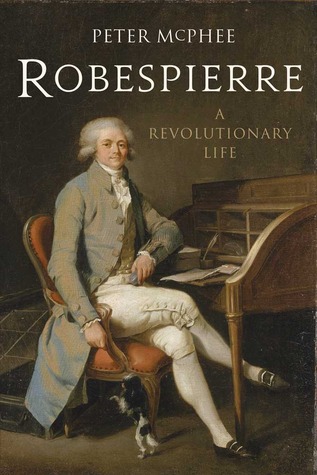
Anyway, this biography is exactly what I was hoping for. It’s clearly written and easy to read; I don’t know accessible it would be for someone with zero knowledge of the revolution, but I’m no expert and I had no trouble following it. It follows Robespierre’s life chronologically – indeed giving a bit of background on his family too – and provides what felt like an appropriate amount of background and contextual information on the realities of life throughout France, reasons for revolution, and attitudes among different groups for the duration of said revolution.
I’ve not read any of the other numerous biographies of “the Incorruptible,” and McPhee gives an interesting overview of them in his final chapter. I know that some have tended towards utter condemnation, but I didn’t realise that others turned into panegyrics. This one certainly comes down largely in favour of Robespierre as a man and a politician, demonstrating quite conclusively how consistent his ideals and desires were, even predating the revolution of 1789 that made at least some of those ideas acceptable. McPhee doesn’t shy away from the fact that lots of people died in the Terror, but does point out that in no way can the majority be laid at Robespierre’s feet – he was horrified by the actions of some deputies in rural France. He also doesn’t shy away from the likelihood that Robespierre was in fact going too far, by mid-1794, and may even have been tending towards paranoia.
If you’re at all interested in this period, or in how a leader can influence events, this is a really brilliant bio.
Love and Romanpunk: not a review
This is not a review. It can’t be, really. Partly because it’s by a friend – although I have reviewed Tansy’s work before, and that by other friends too (fortunately, I usually like it, so that’s no hardship). No, the main reason why this isn’t really a review is the dedication. It’s dedicated to meeee!! Tansy says that this is dedicated to Random Alex (heh), and that I am totally wrong for liking Marc Antony more than Octavian.
Of course, she is totally wrong about that. How could anyone appreciate a psychopathic megalomaniac, who played up his relationship with Caesar in order to capitalise on Roman sentimentality and killed opponents willy-nilly, who rewrote history to make him and his look better and changed laws to suit himself, and who was utterly ruthless when it came to his family? Especially when said ego-tripper is set in opposition to a man who evinced so much humanity that he loved a non-Roman woman and anticipated that his children with her would actually inherit from him, whose prowess in battle didn’t need to be eulogised by an imperial flunky, and whose generosity was legendary.
Ahem. So Tansy and I have some… issues. Clearly, however, she loves me despite our differences, and that’s very nice indeed. She did put me in a slightly awkward position, though, when I made her sign my copy: she said (in caps no less), that I HAVE TO LOVE THIS BOOK.
Oh yeh, no pressure.
I am, of course, a fan of Roman history. I studied at uni, and I even wrote my honours topic on Nero and his love of Greek things. Thinking about Tansy’s area of study, though – Roman imperial women – makes me realise that my study of Rome was entirely typical. That is, a bit of the Gracchi, Marius-Sulla-Caesar, a run through of the Empire… and a little bit of ‘daily life’ blah. Not a whole lot on women , really, except where they happen to be interesting either for genealogical reasons or because of their notoriety. Like Julia Agrippina Minor. I’ve always liked her.
The first story in this collection is “Julia Agrippina’s Secret Bestiary.” It gives a potted history of the Caesar family… with added monsters. I really enjoyed Tansy’s characterisation of the various members of this crazy family. She captures an essence, I think, of the various emperors and their wives/sisters/mothers that actually rings quite true. I particularly liked that although Gaius – Caligula – is shown to be a bit nuts eventually, he’s handled much more sensitively than most other fictional representations bother. Of course. And the monsters made a bizarre sort of sense; they fit in delightfully well with the overall vibe of the story.
The stories progress chronologically through what Tansy affectionately calls the Agrippinaverse. The second story is “Lamia Victoriana” – lamias being the Roman equivalent of female vampires. Here, in Victorian England, Fanny and Mary run away “with a debauched poet and his sister,” as the blurb has it, with the coda that “If it was the poet you are thinking of, the story would have ended far more happily, and with fewer people having their throats bitten out.” The blurb is, by the way, one of the most enticing and true to the story that I’ve read in a long time. It gives an accurate, and seductive, portrayal of each story, and teams that with snarky comments which perfectly fit the tart, sometimes lovingly exasperated, voice of the stories. This second story is the odd one out in some ways; it’s a great story, still, but it’s different in mood and tone from the other three. Darker.
“The Patrician” is the story written in a time most clearly like our own… if Australia had a recreated Roman city somewhere. This is in many ways the centrepiece of the collection. Clea Majora meets a stranger visiting her town, and gets drawn into an adventure even weirder than living in a town called Nova Ostia. There’s not much to say without giving away the awesome way in which the story develops. It’s brilliant. Everyone should read it. It stands by itself as well as being perfect within the context of the other stories.
Finally, the collection is rounded out with “Last of the Romanpunks.” Where the first story is basically historical fantasy, and the second riffs off the Gothic sensibilities of the Victorian era, and the third is beholden to urban fantasy, the fourth ventures into science fiction territory. Managing all four of those genres, clearly connecting the stories through characters and ideas but keeping the vibe of each distinct, is quite the feat. Anyway, Tansy decided to close the collection with a bang, since I think of this story as the most action-based of the four. And again, very enjoyable.
So… it wasn’t going to be a review, but I guess it sort of has. Oops.
Doomsday Book: the sf and the medieval
 This is the April book for the Women in SF Book Club. I’ve been trying to read each book a month ahead of time, here at the start of the year, because I just know I’ll fall behind at some point… and those who know me know that I am nothing if not a completionist and a perfectionist. It’s a failing. Eh.
I’ve never read a Connie Willis. I know, I know; another failing. Anyway, I picked this up from the library without knowing anything about it. The first thing I thought was OMG THIS IS HUGE (669 pages, to be exact). The second was HEY, this is actually a medieval book! I didn’t realise that… and it made me a bit wary, to be honest. I’ve just finished a masters in medieval history, and while that by no means makes me an expert in the time, it does make me wary when I don’t know how expert authors are, and whether I can trust them or not. I knew a few of my friends – especially Tansy – thought she was a wonderful author, so I wasn’t entirely dubious, but… you know…
So, I began. And to be honest, the first chapter did not work for me. I don’t mind being thrown into a world headfirst, but this was a bit nuts. And I’m not sure why, but none of the characters were immediately engaging, so I neither knew who they were nor (immediately) cared to find out. I was worried that this was going to be another book to struggle through so that I could an informed and scathing commentary when the Book Club came around (which is what will happen with Darkship Thieves tonight…ETA: now!).
But I kept reading.
At the end of the first chapter, Mr Dunworthy has seen his star pupil, Kivrin, sent off to the Middle Ages via a time machine (basically). In the second chapter, Dunworthy and his friends go off to the pub, concerned but trying to be positive about Kivrin’s chances; there’s some worry over how the whole event has been organised. And all of a sudden… I cared. I don’t know why. I can’t pinpoint a moment when the people began to matter, or when I began to be engaged with the individuals and their concerns. But I think it was in this second chapter, with the minutiae of life in Oxford; and then the third chapter, with Kivrin recalling how she got the gig to be sent back in time and then waking up in the Middle Ages. And the description of the environment, Kivrin’s reactions to it… it grabbed me by the scruff of the neck and forced me to keep reading. And keep reading. And I read the 669 pages in two days.
Some spoilers.
I really, really enjoyed the book. Obviously.
I initially expected that after the sending-back-in-time experience, there would be occasional flash-forwards to Dunworthy, but that mostly the book would be focussed on the medieval. I was wrong, of course. I’m not positive, but I think the book is almost evenly split between the near-future (from our perspective; it’s set in 2055, or so) and the past. I think I may actually have enjoyed the near-future section more than the medieval. It is riveting because there’s an illness – an influenza, perhaps the most obvious modern corollary of plague – rapidly taking hold of Oxford. When I first read the book I thought it was a much more recent publication than it actually is (1992) because of the way it imagines a population dealing with disease; it feels exactly like a book written post-swine flu. At any rate, it’s fascinating because although the disease is taking over the city, Willis is most interested in a couple of individuals and how they go about trying to ignore the disease and carry on with life – and, particularly, trying to figure out what has happened to Kivrin 700 years in the past. I enjoyed Dunworthy, and sympathised with his attempts at dealing with bureaucracy, and his concern for his student – although quite why he was just so concerned was unclear, and in fact a couple of times it made me a leedle uncomfortable, because it almost skirted the bounds of propriety. (Maybe that’s just me….)
The other reason I liked the near-future sections was for their utterly normal feel. The futuristic elements were quite muted: “the net”, whereby Kivrin was sent back in time (and others, too – it’s regarded as nearly normal); some aspects of government, such as the quarantine measures; and a few medical things that hardly warrant much attention. But it would be easy enough to ignore those, and read it as set in our contemporary world. It’s very believable and enjoyable.
Of the medieval sections I was, as mentioned above, more suspicious. I was beyond annoyed, by the way, with my copy of the book, which says on the front “Kivrin wanted to study the Black Death, not live it…” because actually NO, she was not interested in the Black Death, and by the way SPOILER!! since she only realises that she’s in the 1340s – twenty-odd years off the time she was expecting – MORE THAN HALFWAY THROUGH. Gah.
Anyway, I was pleasantly surprised with the medieval village Willis created. She didn’t try to do too much: staying in one village, with a fairly small number of people, and not really getting into the politics or anything was sensible on many levels, not least of which was allowing the reader to get to know and care about a smaller number of characters. I liked that Kivrin’s interpreting software didn’t work perfectly and that there were many surprises, large and small, about the realities of medieval life – things that historians do squabble about. Kivrin as a character didn’t really do much for me; she was likeable, and I sympathised when things went badly, but I didn’t ever entirely identify with her. Of the others, the only one for whom I felt much sympathy was the priest, Roche. The others were not developed enough for me to desperately want to understand. Perhaps the most telling part of my reading experience was that when the book flicked to the 21st century, I wasn’t that impatient to return to the 14th.
Tansy warned me that I would cry because of this book (actually, she told me to buy a box of tissues). I understand why she said this. However, I did not cry. There are probably a few reasons for this. The first might be that I was warned; the second may be that I am cold-hearted, as several people suggested! But third, and perhaps most to the point: I am a medieval historian. I know the reality of the Black Death. Nothing that happened to Kivrin, nothing that she experienced, was a revelation to me; there was no surprise in any of the events nor in people’s attitudes. I felt most sadness at some of the events in the near future. And fourth, I was also prevented from bawling because I read it too fast. I had to read it fast because I had to know what happened, but it meant that I didn’t form the emotional bond with the characters that I might have with a more leisurely read-through. Not that I’m regretting it; I thoroughly enjoyed the book and had enough of an emotional connection that I certainly regretted deaths and rejoiced at survivals. It’s also possible there’s a fifth reason that I didn’t cry: that Willis didn’t give me enough of the characters to make me want to cry. I think this is probably most true of the medieval characters; at least, they’re the ones I felt least attached to. I was closest to tears when I found that Dr Mary had died; that it happened while Dunworthy was unconscious, and that young nephew Colin has been so stoic through it all, was closest to being heart-breaking.
I think I understand why people rave about Willis. I have Blackout/All Clear on my to-read list, and it will definitely stay there… but it won’t get bumped up to must-read-or-will-cry level.
Danton: making it big in the revolutionary world
I read biographies far less often than someone of my historical bent would be supposed to. I often expect them to be dry – I’m not sure why – and I often prefer books on the minutiae of history, the stuff that often gets overlooked. That said, I have a soft spot for Alison Weir’s biographies – I’ve read most of her Tudor stuff, and I really liked her book on Isabella (“She-Wolf of France”).
One of my all-time favourites is a biography of John Dee, best known as an astrologer, alchemist and magician, but actually responsible for some pretty awesome science too. Against that is the fact that I have biographies of Dirk Bogarde (I am a big fan of the Doctor movies), Gandhi, Elizabeth I… and the Pythons autobiography… all sitting on my unread/true shelf (it’s a long story). I’d like to read more bios, they just don’t move up in the ‘must read’ queue.
This problem is exacerbated, for me, when it comes to reading of modern, controversial characters. Dee was controversial, and Isabella certainly was (and when I can get my hands on a good revisionist bio of King John, I am going to be all over it), but even I concede that arguing about them is slightly academic, although always with modern repercussions. I would desperately like to read a good biography of Trotsky – and Lenin, I guess, too – but who the heck am I going to trust? A popularist like Alison Weir? I don’t think so, sunshine. A historian of whose politics I know nothing? Problematic. I would love to read one written by Peter McPhee – God bless his Marxist soul – but I don’t think that’s going to happen.
And so we come to the fact that I have finally finished The Giant of the French Revolution. Danton: A Life, by David Lawday.

When I first started reading about the French Revolution I quickly decided that Danton was the man for me; Marat is too much a rabble rouser – although dying in the bath is sooo Greek tragedy – while Robespierre, with his insistence on continuing to wear ancien regime costume, clearly had gumption but his whole Republic-of-Virtue-or-die made me a bit uncomfortable. There are things about Danton that make me uncomfortable too, but… he’s so much larger than life, he had such energy, and he instructed his executioner to make sure to show his head to the crowd once it was off, because it was worth looking at. Plus, Gerard Depardieu plays him in a movie, and he was perfect.
So, the book. Lawday admits at the start that this is a slightly romanticised history, because Danton committed almost nothing to paper. There are no footnotes, although there are references at the back giving some indication of where ideas and quotes came from. And it is a bit romantic: Lawday sometimes lets himself go on flights of descriptive fancy about the streets of Paris and the countryside around Arcis, Danton’s birthplace; and he gets a bit smoochy over Danton and his wife Gabrielle’s relationship. The other romantic aspect, and the thing that annoyed me the most, was that Lawday’s vision of Danton as a hero apparently demanded that there be a genuine fiction-like villain for him to play against. Robespierre, the man probably responsible for Danton’s death, is the obvious candidate here, and Lawday goes out of his way to malign and belittle him as unmanly and insipid, in contrast to the testosterone-fuelled Danton. But what really, really got my back up was that Lawday also featured Manon Roland, wife of Danton’s fellow elected official Jean-Marie Roland. It seems clear that Mme Roland and Danton did not get along. Lawday, though, plays this up in sexualised and demeaning ways that were occasionally outright offensive. Having recently read Liberty, about the contribution of women to the Revolution – including Roland – this got my goat even more than it might have.
Sigh. Anyway, aside from that demonisation, I did really enjoy Danton. Lawday gives a good running explanation of the Revolution such that I didn’t get lost trying to figure out what else was going on at the time, and he does well at portraying Danton as intimately involved in most of the important events. Some of this may be exaggeration, but not all of it. It’s largely well written, although I’m not sure that I agree with The Economist that it’s “beautifully told”. It’s eminently readable, anyway, and captures the energy and urgency of the Revolution. I think this would be exceptionally good way in to the Revolution for someone with little knowledge of the events, but with a curiosity about people who shape events.
In other news, I am still struggling through Citizens. That is, in theory I am still reading it, but it’s at the top of my bookcase at the moment, not being read.
A revolutionary feminist
The idea of being a revolutionary feminist isn’t exactly a ground-breaking one. However, in this context, it is, because the woman I’m referring to is Inessa Armand.
Never heard of her? What a surprise.
Have you heard the one about how V.I. Lenin, married but childless, had a lover who was kinda involved in the Bolshevik party?
That would be Inessa. Except that she almost certainly wasn’t his lover, but she was deeply, thoughtfully, and passionately committed to the Bolshevik party.
There are very few books, it seems, that look at the role of women in the Russian Revolution. There have been a few books written about Aleksandra Kollontai, which I’m keen to get my hands on – but for Westerners especially, she’s a ‘fun’ topic because she spouted all sorts of daring philosophies like ‘free love’ and that abortions ought to be legal. I also have a book on my pile to read that collates the reminiscences of women from the early Soviet era. But, really, compared to the number of books on Lenin and Stalin and Tolstoy, let alone the minutiae of aspects of the Revolution, women get short shrift.
R.C Elwood confronted this in 1996 when he wrote about Armand. He is very open about how he came to write the book, which I like: he’d been struck by some seeming inconsistencies around what little was written about her, he suggested one of his students write a thesis on her, and then… essentially his imagination was captured. One of the problems that he faced is that almost none of her writing has been published. While you can go read almost every little note or letter that Mighty Lenin ever committed to paper, not so for Armand. While it appears that she started several articles, most never got published – and the fault for that appears to lie with Lenin, who was dismissive of her work. And while she probably wrote many letters to Lenin, given the 130+ that he is known to have written to her, they have neither been collected nor published (or hadn’t to 1996; I haven’t seen any evidence of them, anyway).
Elwood’s is a well written, and well structured, biography. (It might seem obvious how to structure a biography, but within standard chronology I have read some truly confusing stuff.) He tells Armand’s story in a straightforward manner, and didn’t seem to me to be making too many leaps of intuition. He also incorporates a fair amount of history about the situation in pre-revolutionary Russia, and the immediate after-effects of the October Revolution; as with Lenin, Armand wasn’t actually in the country for the February one. Sadly, for Armand herself and in thinking about how she might have continued to influence affairs, she died in 1920 – while the Civil War was still going, before War Communism was repealed and the NEP introduced. Thinking about it though, this might almost have been a good thing, since she didn’t have to face Stalin’s rise to power.
My one quibble is Elwood’s use of the term ‘feminist’. He never theorises what he actually means by that, and whether he is using the term in a modern or a contemporary way. He doesn’t spend much time – and none early on – discussing what was obviously a problem for the Bolsheviks: that most women who identified as feminist at this time were doing so from a bourgeois perspective. Consequently, there were real problems for women who identified both as Marxist and feminist, since Marxists said women’s issues were a class problem, not a gender one. Anyway, this leads to some sections where it sounds like Armand evolved from feminism to Marxism, which I would take issue with and I’m not sure was Elwood’s intention.
There are lots of things to like about this book, but perhaps my favourite is the chapter focussing on the historiography of the notion that Armand was Lenin’s lover. Elwood details what he reconstruct of the earliest suggestions of such a relationship, then looks at the actual evidence, and points out all the flaws and inconsistencies. Of course, as he acknowledges, it is a possibility he was wrong; they (with Lenin’s wife Krupskaia) did spend a lot of time in the same places, and they did write to each other a lot. But the weight of the evidence at the moment says they were not involved like that. Apparently you actually could be female and have an impact on politics other than through your sex life. Who knew?
Revolutionary women
So, a while ago on the Coode St podcast, Jonathan and Gary wondered what it would be like if you tried to write a history of sf through the female writers. I think this is a most interesting idea, and relates to my desire to find women writing space opera.
Which relates to a book I’ve just finished reading called Liberty: The Lives and Times of Six Women in Revolutionary France by Lucy Moore. I was expecting it to be a book essentially looking at six women, all very different, and their experiences in the French Revolution. However, what I got was so much more than that. Alongside the bios – and they were really interesting women, all of them – I got a full history of the Revolution itself, almost entirely from the point of view of women. And the really, really cool thing is that it totally, totally worked.
Women were involved at every level of the Revolution. It was working-class women who marched on the palace in 1789 and scared the king and queen terribly. Women were involved in planning and suggesting policy in the convention’s various incarnations, and getting it passed too, thanks to both direct action on the streets and more indirect action in the various salons. Women were directly impacted, of course, by changes made to the laws – although they were not accorded citizenship rights under the great Declaration – and, perhaps more interestingly, perhaps stereotypically, but nonetheless dramatically, fashion was also of huge importance. Especially in the streets of Paris, what you wore was an immediate sign of your allegiances. In a world where there were laws about how could wear what, having women on the street insisting that everyone wear the revolutionary cockade was pretty influential. As was when aristocratic women, formerly the paragons of incredibly expensive haute couture, wore clothes that wouldn’t look out of place on a sans coulotte.
The women under investigation were Germaine de Stael, Pauline Leon, Theroigne de Mericourt, Theresia de Fontenay, Manon Roland and Juliette Recamier (all names missing accents, since I can’t figure out how to add them in). Leon is perhaps the most interesting, in some ways, because she was the most definitely working-class. I had come across her (and Mme Roland) in Marge Piercy’s City of Darkness, City of Light – daughter of a chocolate maker, active on the streets and probably in violence. Mericourt had probably been a courtesan, and was also immensely visible on the streets. The other four were all basically aristocrats, on various levels and with differing views on politics – what they wanted to get out of politics, and how they went about doing it.
Each chapter is based around one woman, but Moore weaves so skilfully that she keeps the larger story of the Revolution moving, and brings in the narratives of the other women as well. It’s a marvellously well-written book, which I thoroughly enjoyed – even though I was reading it for school! – and it’s now covered in (appropriately pink!!) comments in the margins. Hugely recommended to anyone interested in the French Revolution or women in history more generally.
Books I’ve read recently
Ines of my Soul, by Isabel Allende. I don’t usually read historical fiction – at least, not such recent historical fiction! My mum raves about Allende; most of her other work is contemporary literature, so I’m unlikely to read it. This one, though, is about Ines Suarez, a real Spanish woman who heads off to South America in the 1500s, following her husband. She ends up going to Chile with the conquistadors, when they conquer and settle there. It’s written as though it’s a memoir – old Ines interrupts the story of young Ines at various points, and she speaks directly to her daughter at a number of points. It’s a really fascinating story on a number of levels. There is, apparently, very little info about Ines, so this is very definitely a fiction, but I understand that Allende did a huge amount of research beforehand, so the conditions she describes (at the very least) will be based on fact. Then, old Ines reflects a lot on the whole idea of memory and writing autobiographies, throwing doubt on her own memories at various points, so that’s an intriguing philosophical line. And the writing – well, I read this in a couple of days, which I often do, but her prose is simple delightful to read.
Flood, by Stephen Baxter. Not my favourite Baxter, but still pretty good. The world is flooding… and no, it’s not a global warming polemic. Time span is 2016 to 1052. Some good characters, and interesting social and political reflections.
Chaos Space, by Marianne de Pierres. The sequel to Dark Space, this follows a number of characters – some of whom have finally met up, so their stories start meshing, which makes it all a bit easier to keep straight. There is a lot of weird stuff going on in this universe, and a lot in the background which is only just being revealed in this, the second book. It’s a fairly awesome space opera, although some of the characters tick me off. Still one of the most intriguing aspects is that her main character is Latina; it made me realise just how Anglo a lot of the future is projected to be (at least in the stuff I’ve mostly read; maybe that’s just a reflection of me).
twenty-six lies/one truth, by Ben Peek. About the weirdest book I’ve read in a long time. 26 chapters, each with ten or so entries; each chapter has entries starting with the same letter. It’s roughly “autobiographical” – although like Ines, Peek has a lot to say about the unreliability of memory, and when you pair that with his many entries on fraudsters and hoaxes of the literary world, it’s clear he’s sending up the whole idea of autobiographical ‘truth’. It also reminded me of Eddie Burrup, the male Aboriginal artist who sold a lot of paintings and was then revealed to be the female, white Elizabeth Durack; she’s a distant relative. Anyway, twenty-six lies is confronting, absorbing, and disturbing – mostly in a good way. I read it in a few hours. Half way through I realised it doesn’t have to be read in a linear fashion, but I’m stuck in my ways so I just kept turning the pages. And, at the end, I realised that in fact it does work linearly – there are revelations towards the end that change the way you think about the rest of it. You could read it haphazardly, it would just change your reception of some of the things Peek reveals, although it wouldn’t spoil the story as it would your bog-standard narrative. I also like the cover – typewrite art by Andy Macrae, and the art by Anna Brown, which I recognised from the Nowhere Near Savannah webcomic Peek and Brown collaborated on.
At the moment… Chocolate: A Bittersweet Saga of Dark and Light, by Mort Rosenblum. I had thought this would be more about the history of chocolate, and it does have some of that, but it’s actually more about chocolate today – the chocolate masters, the chocolate producers, the scandals, the individuals, different perspectives around the world. It’s made me realise that I am in no way a chocolate connoisseur, and probably never will be – living in Australia, and not having the money to spend on it! It’s brilliantly written… and I think I will go back to it right now.
I have *the* most awesome friends
So, I’m nearly done at work – am taking next year off to start my MA.
As a first-year teacher, I got assigned a mentor. Julie is wonderful: competent, enthusiastic, no-nonsense and endlessly encouraging. And she is fond of pointing out that before I knew her, I was dumb as dogsh*t.
Today I got to my desk, and there was a present – wrapped in handmade paper, with Matilda of Flanders (the subject of my thesis) printed on it. Inside was a blue tshirt, which she had had screenprinted: “Eleventh Century Queens Rule.”
I am stoked, and wore it all day. Such a lovely gift!
The Other Boleyn Girl
I wonder if Anne really was as scheming and conniving as this movie makes out… I’m not sure which I think is more believable.
And George?? Seems to me that that’s taking the slander and propaganda put out at the time a little bit too seriously. I find it very difficult to believe that there was any suggestion of incest. It was simply too taboo, surely. (The actor, though – Jude from Across the Universe! – lovely.)
Poor Mary Boleyn. How horrid to be dealt with like that… and to have history all but ignore you, too, after all of that! She is the most interesting of them all, I think, from this portrayal: George is weak; Anne is something of a bitch; Mary is simply too good for her own safety. Natalie Portman is surprisingly good in this role, as is Scarlett Johanssen.
Their mother – whom I can only ever regard as Duckface, thanks to Four Weddings and a Funeral – is magnificent in this movie. Eric Bana… usually I’m a big fan, but he wasn’t wonderful for me here. Maybe because he has quite a bit part, focusing as it does on the women; maybe because filling the shoes of Henry VIII is a big ask, and he’s just not quite up to it – or the script isn’t.
I also hadn’t realised that the gap between Anne and Jane was quite so short as the movie implies, but I guess it makes sense since one of the reasons for getting rid of Anne was the overwhelming desire for a male heir, and Jane seemed like a good option (as, of course, she was. Poor Jane).
Sad: no mention of the allegation that Anne ordered a French sword for the execution because it would be sharper and therefore swifter.
The costumes are simply delightful; I enjoyed the music, too, and the sets.


