Speculative Orientalism, by Sang-Keun Yoo
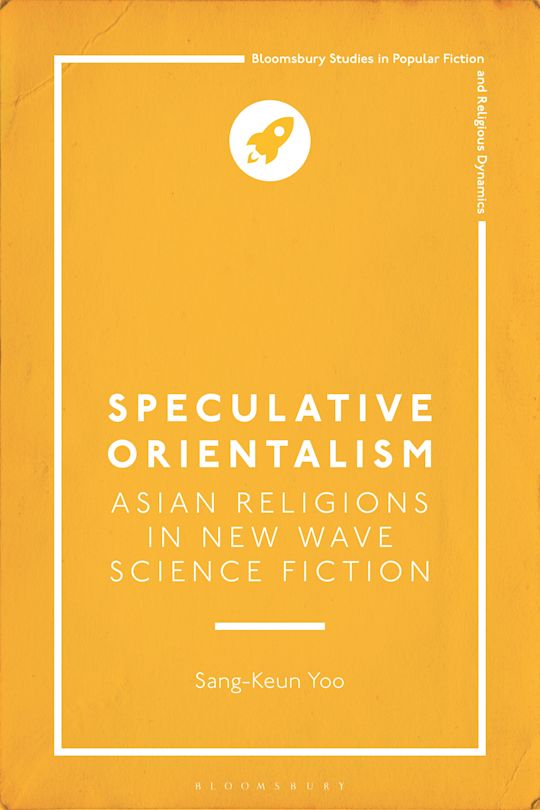
I read this courtesy of the publisher, Bloomsbury, who sent me the ebook. It’s out now.
It’s been a while since I read a book doing such serious literary analysis. And I don’t remember the last time I read one looking at such a range of science fiction authors, so that aspect alone was really awesome.
I believe that this book came from Yoo’s PhD thesis, and having read a few theses – and read a few books that have come out of theses – I can say that overall Yoo has done a good job translating what is necessary for a very specialised academic audience into what works for a slightly more general audience. There are a still a few bits – in particular, some repetitions – that I think are hold-overs from the thesis; they weren’t bad, as such, just not quite what I would expect from a book written first and foremost as a book.
I should note, though, that this is not a read-in-one-sitting, easy-going book. It requires you to actively pay attention, and think seriously about the words and ideas, because the ideas about ‘orientalism’ and Yoo’s points about how English and, in particular, American authors have used and changed orientalism, particularly as part of the New Wave – these aren’t entirely straightforward, and you want to follow the changes over time closely.
So, if you’re up for a serious read, this will suit you well!
I’ve been reading science fiction for a long time, but I am a child of the 80s, which means that “new wave” fiction was already ageing when I first became aware of it – and honestly I would still struggle to point out the real differences between pre-new wave, new wave, and post-new wave. Maybe I’m just not analytical enough? Whatever the case, one of the initial things that actually really worked for me was Yoo’s general introduction to what the new wave authors were doing, and why this was important, and what it looked like in both the UK and the USA. So that was one very useful result!
The meat of the book is looking at the – well, I hesitate to use ‘progression’ or ‘development,’ for their implications of positive change over time. I think Yoo does make a claim for progression, eventually, but it’s still a somewhat fraught term.
Let’s stick with ‘change.’ So, Yoo opens with looking at how William S Burroughs (whose work I have never read!) uses orientalism in his work: that is, references to “Asian” ideas, places, or things, whether that’s a generic “Asian” or a specific ethnicity like Chinese. Uh, spoiler? It reads as super racist. (Who am I kidding, it is super racist.) So that’s… fun.
The really serious analysis comes with next three chapters: Philip K. Dick (do I get kicked out of the club if I say I didn’t enjoy the few stories I’ve read); Samuel Delany (I’ve read a few! I refuse to read Dhalgren, though, on the grounds of too darned long), and Ursula K. Le Guin (I have read most). With these authors, Yoo traces the various influences on their writing – personal experiences, personal belief systems, and so on – and how this plays out across their fiction, and what this suggests about attitudes towards “Asian” ideas, in particular religiously and politically. Unsurprisingly, Le Guin’s use of Taoism is noted as the most nuanced and thoughtful use of those ideas, and as developing across her long career. I was also very interested to read about the African-American and Asian connections that were apparently being discussed in the 1960s, about which I knew nothing.
Overall? This is not a book for a casual reader. It is a book for someone who likes thinking about meaty issues, and who already has at least some familiarity with some of the works being discussed. I’m very pleased that I got to read it.
Every Day I Read, Hwang Bo-reum
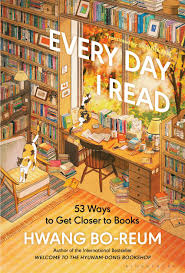
I received this book from the publisher, Bloomsbury, at no cost. It’s out now.
(Translated from Korean by Shanna Tan.)
I am not the audience for this book. That’s the main thing I took away from reading it. Perhaps as importantly, I don’t know – and I’m not sure the book itself knows – who the audience actually would be.
Sometimes the book’s purpose seems to be to give readers a way into, or back to, sharing the author’s love of reading. A worthy goal, of course – but I question whether most people who are struggling to find time to read (or to see it as a worthwhile activity) would pick up a book about that activity. So I was confused by that aspect – and also, that is not a problem for me, thus: I am not the audience for this book.
Sometimes the book’s purpose seems to be celebrating the joy that is reading, and this is one that I fully get behind (obviously). But the slides into didacticism – here are reasons for why reading is good for you! – felt very off-putting in that context.
The book is at its best when the author presents a sort of book biography. The books that have made an impact on her life, the times reading has helped her cope with difficult times in her life, and so on. I did also like the way she points out what reading a variety of books – bestsellers and not, short and long, staying within your preferred topics and venturing further afield – can be like. And yet… it also felt a bit pretentious. Again, maybe that’s me and my personal hang-ups, and maybe I still feel defensive about my preferred genres. But almost every book mentioned was a “classic” and there aren’t many books that could be called recent (aside from Murakami… and see “classic”). Pretty much all of the fiction is realist. And then there’s the dismissal of ebooks, conflating “reading online” with “reading electronic books”. And yes, perhaps many people do consume ebooks differently from how they read paper books. But many of us don’t.
Anyway. As noted, this is not a book for me. I hope it finds an English-language audience; I just don’t know who they will be.
Ocean: A History of the Atlantic before Columbus
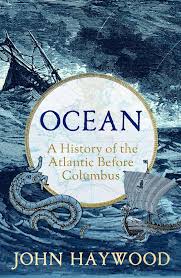
I read this courtesy of the publisher and NetGalley. It’s available now.
Broad sweeping history like this, even when done well, is both very intriguing and enjoyable to read, and occasionally frustrating. As long as you know what you’re reading, you can get around that.
To get the frustrating bit out of the way: the book focuses almost entirely on the European experience. It touches briefly on Africa, and even more briefly on the Americas, but largely through a European lens. Now, I am sure that this is partly a dearth of written records – but a significant portion of the book is about pre-history and/or relies on archaeology, so that doesn’t hold as a reason. I would have less of a problem with this if the book itself made clear it was “the European Atlantic,” but it doesn’t.
So, on the understanding that this book is largely about the European experience of the Atlantic before Columbus sailed across it, this is a pretty good book! It’s a survey, so it covers an enormous swathe of time and, within the European bounds, a broad range of cultures too – which does mean it doesn’t have really nitty-gritty detail, but that aspect is entirely expected.
Having recently visited Skara Brae, on Orkney, I was delighted to discover a section on that site, and to learn more about what it reveals of how Neolithic folks used the ocean. Haywood covers what we can know about how humans have eaten from the ocean (isotopes in bones, how amazing), as well as – when the literary sources exist – how they thought about it, used it in myths and stories, and so on. And then of course there’s sailing, for a variety of reasons and in a variety of vessels.
I left this book intrigued by the different ways people have used this ocean over time. I generally enjoyed Haywood’s writing style, and think this is accessible to the general reader.

 Randomly Yours, Alex