The Amazing Mrs Livesey
The publisher sent me this book at no cost.
 So Ethel Swindells – whose name is hilarious in context – had something like forty aliases, eight official marriages, five divorces (… think about that for a moment…), four children, and a few stints in prison. She gained goods on credit, borrowed money, passed fraudulent cheques, stole from numerous people, and tried very hard to live the high life whenever possible. She apparently got to be about 20 stone (c. 125kg), which is relevant because it meant she could be identified on the street more easily than not when there were outstanding warrants; she could be incredibly friendly and lovely and persuasive; she left all of her children when they were young; she made up amazing stories about her life, borrowing liberally from movie stars she admired. Reading the story of her life is horrifying, because she hurt and near-ruined a lot of people, but also fascinating, to see how one person could leave quite such a trail of destruction.
It’s not quite tragedy + time = comedy, but it does come close.
However, I’m conflicted on this book.
On the one hand: holy smokes, a book about a woman! One who wasn’t noble and wasn’t a saint and isn’t generally famous today! That’s pretty awesome.
On the other hand I was disappointed to have a suspicion confirmed by the Author’s Note – at the end of the book: that this is written “as narrative or factional history, real people and actual events… woven together with fictitious character names, and imagined conversations and actions to bridge occasional gaps in the storyline or account for unnamed people.” It was pretty obvious that that must have been what Nicholls was doing, since there was no way that the levels of detail she represented could exist about such a person, but it was annoying to find this at the end of the book; felt a bit like misrepresentation, actually, which is hilarious in a book about a conwoman. I have little problem with reconstructed conversation – I’m not so naive – but I would have liked a note about what the book was trying to do, up front. Additionally there’s one moment where the narrative acknowledges an unnamed character, but that’s all; I’m left wondering if there were others.
Also there were some annoying typos, which aren’t the fault of the story but always grate on me.
If you’re interested in semi-ordinary life in Britain and Australia during and between the world wars, this gives something of a glimpse. It’s not the best written book in the world, but it’s a fast read and it’s generally engaging and Mrs Livesey (… etc…) was clearly quite something.
Illuminae
 I’ve been meaning to read this book for ages… like since it came out. Heh.
When I bought it, the sales assistant was very pleased for me. She warned me that she’d got to 200 pages, worried that she wasn’t enjoying it, gave it another 50 pages… and then finished it at like 3am the next morning. So it was good to know that at least one other person found it a bit hard going and then BANG it got better.
That’s kinda how I found it too.
The overview: this is written in a ‘found footage’ format – emails, reconstructed IM chat, reports, etc. It’s reconstructing the events which have happened over the last twelve months from the moment that a bunch of space ships suddenly opened fire on a colony, and just a few people manage to escape courtesy of a UTA (United Terran Authority) ship that happened to be nearby. The focus is Kady Grant and her ex-boyfriend Ezra, whom she helps to escape because dude, she’s not that cold.
As I alluded to, there was definitely a bit of a dead patch for me; I was finding the interaction between Kady and Ezra a bit laboured. But it seriously picked up, and while I didn’t finish it in one sitting I came very close (about 80 pages one night, the rest the next day). I can completely understand why this has already been optioned for turning into a film.
I really liked the format. Although something I’ve very bad at is keeping an eye on the dates of things like emails or reports, it was an important thing to try and remember because checking the progress of events was sometimes vital, so I found myself going back a few pages sometimes to check on them. I loved the inclusion of things like the space ship specs, and there were a few sections where the authors and designers did some wonderful things with typography and format and it really added to the atmosphere and aesthetics. Giving the AI a very particular look – white type on black (except its direct speech, which was grey) was brilliant. Obviously this isn’t going to work for everyone, and it would be really dangerous to see this overdone – it would be so easy for it to become a cliche (maybe it already it is and I haven’t seen it? It’s still fresh for me) – but for now, I’m loving it.
As well as some fairly excellent action scenes, Kaufman and Kristoff also engage in some philosophical issues. The main one is that of AI sentience and how humanity might deal with it, deal with it going against their instruction/commands/ demands. It’s just slightly off-central – the plot doesn’t work without it but they could have had less introspection; I’m glad they didn’t, though, because for me it lifted the book just that bit into not-just-rolicking-fun.
Things I suspect Kaufman and Kristoff are fans of: Battlestar Galactica (the reboot); the Expanse series by James SA Corey; Arthur C Clarke’s 2001.
SPOILERS SPOILERS SPOILERS
Firstly, on formatting: having all of the names of the people who died on Copernicus actually listed? Slayed me. And then followed by pictures of the same? Magnificent touch. And then when I started picking out names of my friends from the Australian spec fic scene? SHEER BRILLIANCE I LOVE YOU.
So then there’s the twist. Oh. My. I really didn’t expect it: that the AI, AIDAN, has been mimicking Ezra for simply hours to lure Kady over to the Alexander to fix the problem it has that only ‘meat’ can deal with? That’s magnificent. I loved it. Because I’d been getting a bit sick of those two – and indeed I’m not completely over my annoyance at their relationship, although the revelation of why they broke up made it slightly better for them to get back together – and to then discover it was actually a ploy… Kaufman and Kristoff, NICE WORK.
I still don’t entirely love Kady and Ezra as a couple. I think this is partly an issue with me being old and cynical, because I think “17? 18? really?” – which is mostly my problem. But I’m not going to not read the rest of this series. I fully intend to read the heck out of the next book, that’s for sure, and shove this book into the hands of whoever I can find that’s just about old enough to appreciate it.
Walk to the End of the World
As with Le Guin’s The Word for World is Forest, if I had not known that this was highly regarded amongst feminist sf types I would have given this book up in the first couple of pages. Charnas is utterly devastating in her representation of men and their attitudes towards one another, and their attitudes towards women – “fems” – and towards history and power. While I don’t honestly think things would go this way, it still works as a horrifying critique and savage prophecy of the outcomes of patriarchy.
Charnas writes in a post-apocalyptic world where it seems that only a tiny proportion of white men, and fewer women, have survived to try and rebuild some sort of civilisation. And we know they are all white because there is specific mention of how excellent it is that one class of unmen – the Dirties – are gone, and in case the reader was really obtuse there’s a song enumerating just who the Dirties were. I cannot imagine reading this as a non-white person, given it was hard enough as a white woman. Anyway the destruction of the world has been blamed on the unmen – beasts, Dirties, and fems. The inclusion of beasts in this list is the most bizarre bit to me, because would men really have forgotten that animals were not human and had no connection to civilisation and therefore its destruction? I guess if there were no animals left and you were creating a story to apportion blame, you might. Anyway the Dirties apparently fought against the righteous actions of the true (white) men, and fems were witches who constantly fought against men because they’re agents of chaos and the void.
Not content with this level of terrifying prediction, Charnas also suggests that patriarchy would (d)evolve into ruthless competition between, basically, sons and fathers. To the point of de-identifying familial ties so there can be no seeking out and killing progenitor/descendent; and to the point of reinterpreting Christianity as the Son defying the Father and being punished as a result. (Which is magnificent and disturbing and just whoa.)
The story revolves around the quest of a son for his father – because he’s unique in knowing this information. At heart it’s a very simple and straightforward story but the world that Charnas has created for it is anything but. Through the quest the reader sees basically the entirety of the new civilisation, as well as how the various segments of society work and all the dangerous undercurrents that are at play. The four different points of view, giving very different perspectives, all work seamlessly to develop Charnas’ vision – which is really a warning.
This book is brilliant and terrifying and not for the faint of heart not because of violence to persons but because of violence to notions of civility and humanity. Well, mine anyway; maybe I’m just a bleeding heart liberal. I can’t imagine what would happen if an MRA dude read it; I’d be rather scared they’d miss the irony.
I actually read this as the first in the Radical Utopias omnibus. The next is The Female Man, and I’m not sure my brain can handle rereading that. The third is a Delany that I’m pretty sure I haven’t read, so I will certainly get to that soon.
The Einstein Intersection
 Oh Delany. You continue to impress and stagger me. And I don’t think I got some of the more subtle stuff that was going on here.
SLIGHT spoilers. I don’t think it would compromise your enjoyment of the book.
I really enjoyed this novel. It’s got such a clash of styles – sometimes the main character, Lobey, out-innocents Garion from the Eddings’ Belgariad series, and sometimes he participates in intense discussions of genetics. It’s got remarkable meta stuff going on, with excerpts at the start of each chapter from a really broad range of sources including, apparently, the author’s own diaries (are they real? were they really written in a diary but with the intention to include it in the novel? Just how meta and sneaky can Delany b- oh wait. Pretty sure the answer to that is obvious).
Delany is doing all sorts of sneaky things here with myth and legend. The AI whose acronym spells PHAEDRA, found at the end of a labyrinth… plus Christian stuff, plus American Old West stuff, plus I suspect some other stuff that I did not pick up on. And then there’s the meta-discussion ABOUT myth and legend and their place in society and 147 pages SERIOUSLY?
I ADORED the revelation that these are non-humans literally taking on the skins and myths of humans for some unrevealed purpose. It’s almost a cliche to talk about books where you’re just dropped into the middle of a much, much bigger story but by golly that’s true here. The level of opacity is breathtaking AND YET the story is still so very compelling.
Delany. Man.
Masks and Shadows
 This book was provided by the publisher at no cost.
The important thing to know about this book before reading it is that it is influenced by opera – eighteenth century opera, no less. So if noble ladies with fair arms and negligees, dramatic love affairs, and sinister secret societies – with generous serves of lavish description – is not your cup of tea, then this novel is not for you. And that’s ok; just pass it by, or pass it on.
The novel is set on the real-life estate of the Esterhazys, which I had to look up to check its historical authenticity. The Prince really did employ Haydn to work there, as depicted in the story, so it’s intriguing to know that it’s based on, or at least using, some aspects of fact (and the ruler at the time was Marie Theresa – Marie Antoinette’s mother. Can’t get away from those revolutions.)
There’s lots of different narrators and a few different narrative threads that weave through this story. There’s the musico (indelicately, a castrato), the young widow, the cast-off husband, the singers, the alchemists… and ultimately everything comes together. I quite liked the young widow, who was really the focus overall; she was sympathetic and made sense. Some of the others were a bit more opera-character-ish: amusing but less believable. Also less believable was the central (although not completely overwhelming) love story; not that the two people involved were unlikely, just the way it played out.
Overall this is a well-paced, fairly light read with some charming, and some dastardly, characters. It doesn’t take itself too seriously and it all only happens over a week or so, so it doesn’t have a chance to get bogged down.
The Emperor’s Railroad
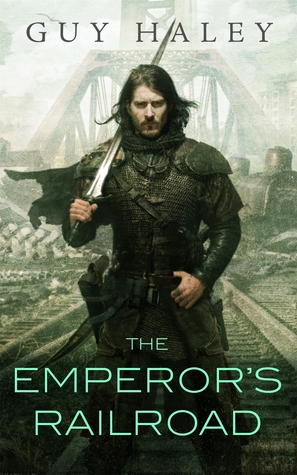 I received this from the publisher at no cost.
I’m not a huge zombie-story fan, so this story wasn’t really aimed at me. That said, turns out I can be quite a fan of your post-apocalyptic, back-to-vaguely-old-west-America stories, so that aspect was quite enjoyable. I do like the image of human creations being subsumed into nature.
Quinn, the hero of the story, is intriguing, and through him we get glimpses into the rest of the world that the story is set in. There are angels and dragons – I kept wondering whether this would turn out to be a fantasy or a science fiction story, and it’s not entirely resolved – and Quinn is a knight, commissioned by an angel but now on his own sort of quest. It’s a long time since I’ve read them but I was put in mind of the Terry Brooks Word&Void series; the child narrator, Abney, is fully aware that his world has extraordinary things in it but is still something of an innocent of the realities, while Quinn has seen too much.
Despite my not loving zombies, I did read and enjoy the whole story, so that says something for the characters and for the fairly fast-paced style.
The Jewel and her Lapidary
This was provided to me by the publisher at no cost.
I haven’t read it in a very long time, but I was immediately put in my mind of Anne McCaffrey’s Crystal Singer series, because part of the point of this story is that people can talk to, and be influenced by, gems. I seem to recall that things didn’t always go well for Killashandra and her friends, and of course this story only exists because things go wrong for the two main characters, and indeed their entire world (well, valley).
The good thing about this story is that it focuses on the relationship between two young women: a Jewel, youngest scion of the royal family, and her lapidary or bound servant. Their discussions about duty and oaths and what to do when faced with crisis were interesting enough.
However. There were a few things where the book just misses its mark.
For a start there’s no discussion about the morality or not of having a (literally) bound servant. Sima is not a slave, but it’s a near run thing. That made me uncomfortable.
Additionally, there were narrative aspects that could have worked but just didn’t quite get there. Firstly, there are some breaks in the narrative where a ‘modern’ travel guide apparently describes the area where the actual story is taking place – a tactic that can add unexpected depth or twists to stories, I’ve found – but these break-ins didn’t do that. They didn’t seem to match the story parts they were paired with, and they were too superficial to add much to the story. Secondly, while I’m not a reader who demands every part of a story be filled in, I felt like there were too many gaps in this story; too many times where I think the idea was that lucanae are alluring and tantalising but this was just frustrating and confusing.
Overall I didn’t mind the story but I didn’t feel that it had much substance to completely make up for the bits that frustrated.
The Just City
I hadn’t even heard of this book until Katharine mischievously sent me a copy because she wanted to know how I would feel about it. And my initial feels are: omg THERE BETTER BE A SEQUEL.
Is that what you were expecting, K?
 The premise: Athene (yes, she who sprang fully formed) wonders what would happen if humans attempted to put Plato’s Republic into action – with a little help from her, of course. So she gathers together a bunch of people from across time who have all prayed to her, perhaps inadvertently, after reading The Republic and wanting themselves to put it into practise. And they’re going to collect slave children, and they’re going to try out their city on a certain island that will eventually be destroyed by a volcano… (yes Athene is aware of how recursive this is I LOVE YOU JO WALTON).
Apollo, meanwhile, is confounded by Daphne wanting so much to get away from his tender advances that she was happy to be turned into a tree, so he decides to become mortal to explore ideas of volition and equal significance. And hanging out in the fledgling Republic of the philosopher-kings seems like an interesting and pragmatic way of doing so.
The book’s chapters switch between a few different characters. Apollo gets a few, but not most, which is good because I liked his perspective and seeing what life was like for a being with godly knowledge but human limitations, but it would have got old to have him as the focus. Instead, most of the chapters are from female perspectives. Lucia, renamed Simmea, is from what I take to be the early Christian period; she’s bought as a slave and taken to Thera, destined to be brought up in the first generation of true Republicans. Maia, originally Ethel, was born in Yorkshire in 1841. Well educated for a girl at the time she appears destined for the standard gloomy life of struggling middle class woman, until she happens to cry out to Athene… and she’s transported to Thera to act as one of the guardians, teaching the new generation how to be their best selves and eventually develop into Plato’s philosopher-kings (… well, some of them).
I’ve not read The Republic. In fact, I’ve never read anything of Plato’s in much depth or at much length (I’ve taken some Classics subjects so I must have read a bit… right?). This is not, however, a problem for reading this novel because Walton does a wonderful job of having her characters discuss the various issues and conundrums and ideas that Plato raises – all without it seeming like an info-dump. Just as setting up the city is an experiment for Athene, this book is a thought-experiment itself. This book reminded me in some ways of Ursula Le Guin’s The Dispossessed, because so much of it is conversation- and ideas-driven. There is some action, but it is not the focus – and most of the action is connected to the ideas, showing them in action in some way. And I never once found it boring.
Issues confronted:
Slavery, good or bad? And can you have the perfect society as suggested by Plato without slaves to do at least some of the jobs?
Individuals as ‘fit for purpose’: should someone else get to determine what you do for your  entire life? Should your worth be entirely determined by the work that you do?
How to be one’s best self: I could not help but think of Bill and Ted, of course. But it is also a deeply intriguing question: how do we help ourselves and those around us be excellent?
Censorship: can it be a good thing?
Who can you trust? How do you know? Are there levels of trust, or areas in which someone is trustworthy and others in which they aren’t?
There is JUST SO MUCH in this book I have only scratched the surface IT IS EXCELLENT.
Slight spoiler
The one off-note that didn’t really work for me was the rape early on of one of the guardians. While it was occasionally referenced later on and certainly had some impact on the woman involved, I didn’t really see why it needed to be a part of the narrative. And it seems weird to say that this is a minor quibble, given the topic, but overall I think it’s dealt with mostly ok; it just didn’t quite sit right with me.
Aaaaand in finding the image for this post I’ve just discovered that the second book already exists in the world AAAAAAAH *buys*. (Also buys a hard copy of The Just City, for re-reading and shoving into people’s hands. My mother MUST read this.) You can get The Just City from Fishpond.
Deadman’s Hand and Pieces of Hate
I received these from the publisher at no cost; the first was a freebie with the second.
Deadman’s Hand
The scene: Deadwood. I have no idea whether this was actually a real town but it appears to have become That Place Where Westerns Happen. The plot: a bad man needs killin’. This bad man happens to be some sort of demon, or shapeshifter, or something, named Temple; the one to do the killing is Gabriel, who seems to have been hunting Temple for a long time.
My favourite part about this story is the narrator. He’s not an entirely convincing Watson, all naive and stuff, but he does provide a really interesting perspective on the clash of two basically inhuman forces. It means that we get to see Gabriel as genuinely hurt and and hurting, which emphasises his grit when he gets back up again to confront Temple. It also means that we see the consequences for this sort of clash happening in a relatively normal little town. It’s a town that’s seen its share of killings, but nonetheless their appearance has an impact; and it has an impact on our narrator on a personal level, too. All of that made the story that bit more approachable, where otherwise it would have felt quite divorced from possibilities of empathy.
Written well enough, fast paced.
 Pieces of Hate
I was expecting another with an uninvolved narrator. So when it turned out to be Gabriel himself, I was surprised and a little disappointed. I can see why Lebbon did this; this story, which certainly felt much longer than the first (not sure if it really was), gave Gabriel’s backstory and motivation for his quest to kill Temple. But I think that this could have been done in discussion with someone else, perhaps while on the voyage to Port Royal (the scene this time: en route to, and briefly in, Port Royal). That would have made it seem a bit less like Gabriel was moping around, and simultaneously wallowing in his fury and hate which were a little distasteful. I’m not saying he shouldn’t be angry for what happened, just that I got impatient and a little bored with all of the WOE FOR ME bits.
There was a lot going on in this story that didn’t involve the search for Temple. Some of it was showing Gabriel to be a bad-ass, which actually I didn’t need; it’s clear he is, and I think it would have been more impressive to have the clash between him and Temple show his chops, rather than killing maiming… well, not innocents, but not-Temple. Gabriel knows that he’s no saint and doesn’t claim to be, but it is hard to really be on the side of someone who is not-quite-as-bad-as the villain.
It wasn’t a bad story, although the pacing felt a bit off; I’m not sure I care enough to read the third in the series.
Cadence: a memoir
Dear Mum
 You gave me Emma Ayres’ memoir Cadence a year ago. It’s only taken me a year to get around to reading it, which let’s be honest isn’t a bad turn around when it comes to your gifts and my reading them.
Anyway, you gave me this book for a number of reasons. I think you knew that Classic FM was our choice of alarm-clock-station; after quarrelling over whether it should be Triple M (him) or Triple J (me), and anyway then we both grew up. So for a long time it was Emma’s dulcet tones that let me know it was time to drag my carcass out of bed. Then there was the bicycle aspect: one of the chief points of the book is that Emma rides her bike from England to Hong Kong, and that reminded you of our bicycle trip around the UK. And then there was the music aspect, which clearly had nothing to do with me but I guess you thought might appeal to my trumpeter (but she’s viola and cello, and brass players and string players have something of a mutual animosity I think).
The first thing to note about this book is that it made me immensely grateful for my stable, boring childhood. Boring in that sense is a good thing. Because Emma did not have a boring childhood. Her father left the family when she was very young; her mother struggled immensely to provide for the family; her middle sister was very troubled/ bordering on dangerous. None of them issues I had to deal with. Also her mother signed her up for violin instead of cello, thus breaking her heart. You on the other hand allowed me to experiment with flute but probably were not surprised when I gave it up pretty quickly. Let’s be honest; I’m not exactly flautist material.
The book has a lot of potential… which phrase may be a clue to the fact that I didn’t adore it. Sorry.
The potential is in Emma’s life: the life of a musician isn’t inherently interesting but Emma did a lot of interesting things – studied in Berlin, played in Hong Kong – and she has a nice turn of phrase that makes even a non-musician interested in the learning to play music bits. Plus she keeps agonising about whether she wants to try her hand at cello, as an adult, which is a fairly major change to consider.
Then of course there’s the trip across Europe and Asia by bicycle, and all that entailed. She did it solo, and she attributes the many, many interesting conversations she had to this fact – and the fact that she was cycling with a violin strapped to her back. Turns out that even if you don’t speak the same language you can indicate your desire for a bit of Brahms with your lunch fairly easily.
In the last half or so of the book, Emma starts talking about the idea of cadence, which is apparently a big deal in music. (I must admit that there were a few bits that I skimmed over… because I just don’t get music-speak, so when she’s waxing lyrical about majors and minors and tones and fifths, my eyes glaze and I start thinking about lunch.) There’s perfect cadences and interrupted cadences and so on. Cadence is also important in cycling, and when you get a good cadence riding is a bit like flying. I think that what Emma was trying to convey in this memoir is that life has its cadences. Interrupted cadences can add to the richness of life, and so on. But… she only started talking about that towards the end. So it didn’t really work as a framing device.
I think this is the problem with the book overall. There’s a distinct lack of structure and form. Is it a book about her cycling adventure? Well, yes, but not entirely. In fact I felt a bit betrayed in the last chapter where she mentions that actually she got to Lahore, was so stuffed that she went home for a while, then flew back to Lahore to finish. Which is SO fine, I’ve got nothing invested in her finishing in one go, but… why not mention that say, chronologically? It’s also only at the end that you find out she’s been raising money for a charity. Which is weird. Anyway. It’s also about her making major life choices… but it’s not always framed around those, either. So I was frustrated by the meandering from childhood story to 20-something story to 30-something story with a lack of obvious connection. Like going from Brahms to Limp Bizkit and then to Howlin’ Wolf without an explanation as to why.
ANYway. Thanks for buying us this book. It’s not one I would have bought myself but I definitely don’t regret reading it. It only took me a day to read while I was camping.
Love
A

 Randomly Yours, Alex