The Forever War
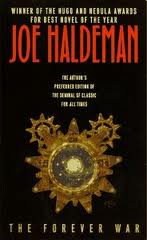 I didn’t really know what to expect when I picked this up. Someone had recommended it, so I was going in blind. I did read the introduction, which is an interesting look at the problems and possibilities of getting stories published and serialised and what that can mean for novels. It also gave me the tip that this could be, and has been, seen as a “Vietnam book.” Which of course influenced my reading of it, but not I think in a deleterious way; I think actually I appreciate it more for knowing its context (which should be no surprise, let’s be honest).
The focus of the story is William Mandela, an army conscript for a war against the first aliens humanity has come into contact with. He’s trained on various moons to fight an enemy whose capabilities, and indeed appearance, are completely unknown… and then does indeed fight said aliens, with less than convincing results. This fight is followed by what is, I think, one of the most important aspects of the entire novel: Mandela’s return to Earth.
Because this is not a story with faster than light travel (it does have wormhole travel), and the fight took place several light years away, while Mandela has aged months many, many years have passed at home. While in theory this is great for the pay which has been accumulating in his bank account, and also for years served, all of those problems you encounter when you’ve been away a few months and then go home? Compounded, multiplied, and then made even worse. I’m sure they’ve been written, but I’ve not come across another story that deals as convincingly with the time dilation problem as this one. Haldemann reflects on the personal consequences for the soldiers, as well as on how this would impact news coverage of the ‘war’ and other, broader, issues. It’s probably the aspect that will stick with me the longest, although it’s by no means the only interesting bit.
The story ends up following Mandela over more than a thousand years, which is remarkably ambitious in 250 pages. Haldemann is, thankfully, not foolish enough to imagine a static society over that period, and he imagines and experiments with various alternatives for Earth – which Mandela mostly just samples, since he generally can’t cope with being home and so ships out again. There are huge changes to Earth’s economy, to reflect an entire planet being on a war footing (and, of course, that getting co-opted…) – imagine a society whose currency is calculated in calories; there are changes to sexuality, in response to population issues (his theory on sexuality in the marines is an interesting one too – a corps that’s not equally gendered but where sex is expected to take place regularly and with multiple partners… I can’t figure out how this would have been regarded in the 1970s); and even different modes of consciousness. All of which is very clever and, again given how short it is, somewhat frustrating – in a book written today, I would bet this would actually be a trilogy, each distinct part of Mandela’s life covered in excruciating detail… ok maybe I prefer this version.
And call me a sap, but there’s also a rather wonderful, understated love story at the heart of Mandela’s adventures, and I’ll admit to getting a little teary at the end. WHATEVER.
The Vietnam connections? Oh yes. An unknown enemy and seriously unknown tactics; a country (actually in this case a planet) geared towards a war that most people at home don’t really understand; little comments about the propaganda and rhetoric used, as well as the first fight taking place on a jungle planet – it’s very clever, because Haldemann doesn’t shove it in your face but definitely draws rather pointed parallels. All of that said I think this is still a fairly relevant book, since there are still – and probably will be for a long time – these sorts of wars, on varying scales.
Plus, maybe one day we’ll have wormhole travel, and then we’ll have to figure out how to deal with the time dilation problems.
Emmeline Pankhurst: a niche in history
 I have always been a bit of a fan of Pankhurst. I can remember years back doing an assignment on her, which may have been at the very outset of my interest in feminism and is the reason why I am passionately devoted to the idea of women voting any time they can. So I was pretty happy to, finally, get around to reading this bio of a remarkable woman.
Purvis begins her account with a historiographical examination of the treatment Pankhurst has received over the last seventy years or so, which is illuminating – especially as it all really began with her daughter Sylvia’s account, which was rather bitter and very much tainted by the feud between the two, thanks both to family issues and a fundamental difference in opinion about politics (Sylvia moved/stayed quite far left and was heavily into socialist politics, Emmeline moved away from many of her socialist tendencies for various reasons). Many subsequent accounts have leaned too heavily (in Purvis’ view) on Sylvia’s story, while others have come from a decidedly ‘masculinist’ perspective and thus denigrated Emmeline’s achievements and intentions. Modern feminist historians have often been troubled by her at least partly because she moved towards a more conservative, imperial point of view during and after WW1, but Purvis is insistent that we take Emmeline on her own terms.
I really enjoyed this as a book and as a history. Purvis writes very engagingly and paints a captivating picture of an extraordinary time, an amazing woman, and the politics of the suffrage campaign especially. It appears to be a very well-researched history, with copious endnotes to back up her points that include reference to many, many letters to and from Emmeline and others in her circle, as well as newspaper accounts, court proceedings, diary entries and the like. It really makes me wish I could find The Suffragette, the WSPU’s newspaper, online somewhere. Someone get on that!
A potted bio of Emmeline’s life: interested in politics very early on, married at about 22 to the 40-something Richard Pankhurst, a lawyer who was a strong socialist and campaigner for women’s rights, among other things. She had five children, one of whom died very young, but/and she was always and still involved in campaigns and political work. Richard died when Emmeline was 40, leaving her with little money and four children to support – financial trouble continued to dog her until her death at 69. What she is most famous for, of course, is the setting up of the Women’s Social and Political Union, with her daughters but especially the eldest, Christabel – and that it eventually took the step into militancy in order to advance the cause of women’s suffrage. Window smashing, arson, destruction of paintings… all of these things were seen as much worse when committed by women. Purvis points out the success that various Irish politicians and agitators were having with similar tactics, and the fact that this got them an audience with English politicians and even the king. Not so much the women. The WSPU began in 1903; women gained limited suffrage in 1918, at the same time as men gained it with no property qualification (and women had to be 30, men 21). This was not, of course, the end of Emmeline’s life – she had started campaigning for women’s war work with WW1, and also expressing her concerns about sexual double standards and morality with the increase of VD. After the war she lectured around America and Canada on topics like public hygiene, avoiding VD, and the necessity of the British Empire. She died back in England not long after discovering Sylvia had had a son without getting married, pretty much destitute.
Just writing that down makes me exhausted. Emmeline comes across, in this book, as an amazingly energetic and passionate woman. She’s one of the reasons the Cat and Mouse Act was introduced: imprisoned suffragettes would hunger strike; be let out to recover; then get re-imprisoned. She went on hunger strike 13 times. She never wrote her speeches down but always spoke extempore; she travelled around Britain campaigning for and against political candidates, speaking at rallies, and trying to convince people about the necessity of women’s suffrage. She never wanted the vote just for its own sake; she was driven by the idea that women being able to vote would bring about the incredibly necessary changes to society that would prevent the exploitation of women, the horrors of poverty, and alleviate other social problems that she saw in her work as a Poor Law Guardian and on an education board. She worked as a registrar for births and deaths and was always shocked and saddened by teen girls coming to register the birth – and sometimes death – of their illegitimate children, often the result of incest.
This was not a woman driven by a desire to be a man, as so much of the anti-suffrage press claimed; she did not regard herself as better than men but as deserving of equal citizenship. Not least because working women had to pay taxes but could not influence how they were spent, and because she abhorred double standards and thought women’s influence could help solve many problems. (She was quite the optimist.) People at the time, and even her daughter Sylvia, often seemed to think that the cause had become almost more important than the object. It’s not hard to see how this could happen, to be honest, when you’re fighting for something that frequently gets you attacked – verbally, physically – and condemned by large sections of society. I’m personally torn on the notion of militancy, but I’m not torn on what I think of this woman. She’s a hero. I wish I’d known she has a statue near Westminster when we were in London, because I would absolutely have gone on pilgrimage.
This is highly recommended as a way of understanding the English suffrage movement – the militant side at least, because yes Millicent Fawcett and other ‘constitutional’ suffragettes are largely ignored, except as they interacted with Emmeline – as well as how late Victorian/Edwardian England society functioned. Plus, this is a woman who deserves to get as much recognition as possible. She devoted her life, her health, and even – arguably – her family and friendships to public service.
What if there were more to The Odyssey?
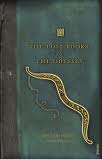 A number of reviews over on goodreads seem to have two things in common: the reviewer hasn’t read the source material, and they didn’t particularly enjoy this collection. I applaud someone for stepping out of their comfort zone, but I really don’t understand bagging something when the fundamental context isn’t understood. Because this really, really doesn’t stand stand with knowledge of The Iliad and The Odyssey, and it doesn’t pretend it even wants to.
I adored this collection, and I am fantastically thankful that I happened to pick it up a few years ago at the closing-down sale of my favourite bookshop (which has since reopened!). I’m not an author, but I would suggest that anyone who wants to write short fiction – and who has the background – should read this, because it does the short form in glorious, scintillating ways.
The Preface claims that this set of 44 stories translated from variations to the standard Homeric tale found in Oxyrhynchus. I’ll admit that for the first couple of stories I actually half-wondered whether this might possibly be true – I’d never heard of such a find, but Oxyrhynchus has been an incredible literary treasure trove; it’s not like I work consistently in the field so it’s feasible I might have missed hearing about it. I fairly quickly decided that this wasn’t the case, but it doesn’t matter in the slightest. I feel that Mason has stayed true to the core of the mythology, and what more could you want?
Some of the stories presented here are vignettes, others are more substantial stories. Most of them take aspects of The Odyssey and… shift them. Sometimes subtly, sometimes extravagantly, but almost always with that kernel that means it feels basically plausible to an archaic Greek mythological milieu. There are a few that stray beyond those bounds, but even those are wonderfully well written, so I don’t mind. They too help to build up sense of shifting possibilities, what-ifs and could-have-beens. There are a few stories that take aspects from other parts of Greek mythology and tie them, in convoluted but logical ways, to the Troy story; and just one or two that could feasibly be set outside of the 13th century BC, but not with any firm proof that they do so.
A review of all 44 stories would be tiresome and, in some cases, impossible without ruining the sheer pleasure of the reading act. Suffice it to say that Penelope gets some attention, Athene a bit more, and Calypso and Circe a lesser bit. Most of them involve travelling, which is naturally appropriate; some are in Troy and some on Ithaka. Sometimes Odysseus is triumphant, other times a coward, and occasionally seen through others’ eyes – like Polyphemus (sorry, bad joke). Once, Paris is Death. Occasionally, the reality of a two-decade absence is hinted at. Tragically, Hektor does not feature in any meaningful way.
This collection is wonderful and glorious and I loved it very much.
Existence: a review
 I believe this is the sort of novel that people might be thinking of when they suggest science fiction is ideas heavy but character and/or plot light. I’d never really understood that accusation of modern SF… until now. (I would have given it 3.5 if I could.)
It took me more than a fortnight to finish reading this. For fewer than 550 pages, that’s… well, for me that’s positively an age. I did consider giving up on it, several times in fact. But the ideas kept me coming back and made me determined to see it through, to see what Brin did with this sprawling, messy saga. And I think I’m glad that I did. Not absolutely positive, but probably.
Anyway, let me first talk about the positives. There are some really, really awesome ideas here. The basic premise that drives the plot is a first-contact one, but done in a fairly unusual way: a crystal snatched from orbit, activated by human touch and sunlight, that appears to contain alien life of some sort. The unfolding drama of the knowledge revealed – and how it changes, or at least develops, over time – and how humanity deals with it is a genuinely fascinating take on Fermi and all the other variations on “where are the aliens, what will they do when they get here, and how will we respond?” That’s the plot, boiled down to its essentials; and it was fairly intriguing.
Also intriguing was the world Brin set this alien contact against. If there’s a clear explanation of when this is occurring I missed it, but it seems to start only a few decades from now. Complete climate collapse has not occurred but is still very much on the cards; technology has continued to advance in leaps and bounds, towards smart-specs and similar toys imagined by cyberpunk so many decades ago but which still seem elusive in 2012; AI appears to have been achieved, along with other technological wizardry. I liked that there appeared to be variety in this world, in how people dealt with technology at least. I did not especially like the world itself, though – although this is not in itself one of the novel’s negatives. The world is not quite dysfunctional enough to be a dystopia – although that would perversely probably have been easier to read. Instead this is a world apparently divided into ten Estates not just determined by wealth but by allegiance to such abstracts as Science and The Media; a world where inequality is as, if not more, entrenched than today, with apparently few people acting against it, and added fears of technology on the one hand and the ‘Autism Plague’ on the other; frankly, a world that I hope does not come to pass. From an objective point of view, this is a fairly well-described world, although I am unconvinced of its realism.
The novel’s structure is linear chronologically and inconsistent in perspective. Numerous characters act as the focus over the 550 pages: the most prominent are a novelist, a journalist, a society lady, an astronaut, and a peasant. There are also excerpts of such non-plot devices as books and talk shows thrown in, which generally works. These different perspectives serve to give just that, of course – different perspectives on the world and on the events unfolding. Over the course of the novel, there was only one character that I particularly liked, and who did manage to get a word in for the entire length of the novel: the journalist, Tor. She had a fun role to play as the inquisitive, poking-nose-in type, despite various problems hampering her abilities.
This brings me to one of the problems in this novel – two, actually. One is the characters. Most of them weren’t necessarily unlikeable so much as they were unapproachable or uninteresting. Additionally there were a few characters who promised to be or do quite interesting things who just… disappeared. Their narrative stopped popping up, occasionally with little or no resolution to their particular quandary or arc. This was intensely frustrating. This is definitely not a novel for those who prefer their story to be character driven.
The second problem was the structure itself. It was often unclear, at the opening of a new section, exactly who was speaking or where the events were happening. Sometimes that was cleared up, and at other times it was left opaque and mysterious. And sometimes these mysteries resolved with later revelations, but there are still some bits that don’t seem to fit in at all, and really that just seems like a waste of words and my time.
Thirdly, there’s the world itself. I felt like Frank Poole, the dead astronaut who wakes up at the start of 3001: The Final Odyssey to find it’s a millennium later, and suffers a fair amount of culture shock. Now I love cyberpunk and far future stuff, so culture shock isn’t necessarily an unpleasant experience for me. But here, it just made me tired, and irritable. A new piece of technology? Cue eye-rolling and mutters of ‘really? more?’ – because it seems to be set in the near future (as someone one said, near future is within the reviewer’s lifetime), and therefore improbable. The technology may not have been so overwhelming, though, if it wasn’t for the language. Brin has messed with a lot of language to indicate how heavily reliant this version of the future is on computers, frequently turning ‘a’s into ‘ai’: aissistant, for example; or adding ‘v’, as in virtisement; or even combining both in vraiffiti. Add in a whole bunch of gobbledy acronyms (tsoosu=to see ourselves as other see us=viewing yourself through one of the innumerable cams in place in this world; hello, panopticon Big Brother), and I simply found it overwhelming.
Overall, then, this is a big-ideas novel that is let down by two-dimensional characterisation and what occasionally feels like deliberately obfuscating language.
Embassytown: a meandering not-review
These are some random thoughts, often connected to thoughts about other Mieville novels I’ve read; it’s not a thorough-going review, partly because there’s just so much going on that if I tried to write one, I would leave something out and end up feeling annoyed or inadequate; and partly because other people – including the awesome Ursula le Guin! – have already written those. So I won’t even pretend to put myself up there!
Anyway…
Mieville writes urban stories. Here, and in other novels – pretty much exclusively, at least insofar as I’ve come across. There are ‘agricultural’, or non-urban, areas on this world, but even they feel quite industrialised, by modern Earth standards; they’re tamed, and seem to exist almost exclusively to produce for the city, having no existence outside of that. This aspect is neither here nor there in terms of the story, but it is interesting in terms of his focus across the entire oeuvre. Or at least, I think so.
 Also in consideration of all of Mieville’s works that I’ve read comes this observation: they’re all about obsession. Kraken obsessed over belief and social structure; Perdido St Station was obsessed with race; The City and The City was consumed with an obsession for truth on the one hand and blindness on the other. I’m not saying these were exclusive themes or foci, but they were significant and informed the entirety of each story. Embassytown is obsessed with language: how language works, what it does, what it allows. I think this is one reason why I loved it so much – I love language, and thinking about language, and thinking about how language constructs our world view and indeed perhaps even our selves. And so, clearly, does Mieville. The consequences of an entire race thinking about how to lie – not being able to do so, what that means for every layer of society but also for history and story telling and so many other aspects of human society – was totally riveting.
That all sounds mighty highbrow. Of course, as with the other Mieville novels mentioned above, this one works on multiple levels. I think it would be perfectly possible to read this as… not quite a straightforward narrative, because the structure itself isn’t entirely linear and straightforward… but it can be read without your mind being forced off into the philosophical byways indicated above (yanno, if that’s your thing. Me, I like the byways. The nicest flowers are usually there.).
The story itself reflects a post-colonial attitude towards what might happen when humanity spreads its collective wings and goes spreading its presence across the galaxy, thanks to a wonderful take on FTL. It’s not quite the drug-fuelled flight of Dune, it’s not quite the worm-holes of countless SF novels and movies, it’s… something a bit wilder, a bit more out-there, a bit more mysterious and weird and awesome. Ahem. Anyway, Our Heroine escapes from her annoying backwater of a weird human colony, out to the exciting wide galaxy… only to end up at home after a while, and then things get really weird.
Home is the eponymous Embassytown, and the particularly weird bit is how humanity communicates to the indigenes. With difficulty, and two people at a time, is the answer. Confusing? Somewhat. Eventually awesome? Absolutely.
I must admit that I found the first few chapters quite a slog, and if I didn’t trust Mieville to turn on the awesome pretty soon I may not have powered on through. But I did, and my faith was rewarded (obviously). One of the difficulties was the non-linear nature of the narrative. Past/future/present being entangled, chapter by chapter, is not a problem for me – I am constantly intrigued by stories that reveal a conclusion and then explain how characters got there; it’s like studying history, for me. What was a bit of struggle was not having a clear idea of sequence, or even – at the start especially – a clear idea of who was doing what. Like a palimpsest, though, Mieville built up the history/contemporaneity gradually and skilfully and rewarded just that bit of perseverance.
I loved it. It got my Hugo vote. I enjoyed the characters, I loved the intrigue of the humanity/alien interaction, I really enjoyed the philosophical challenges of language and colonialism. LOVE.
Reign of Beasts: a belated review
It always takes me ages to review Tansy’s books, because there are so many things I want to say that they get in the way of each other and I know it will take ages and then I put it off and… you get to this point, where it’s five months since I read the book and I’ve forgotten half the things I wanted to say. So this is just a few comments, really, about things I enjoyed (because I did enjoy it, and there’s not much I didn’t).
Spoiler for book 1 and 2; why on earth would you read this review if you haven’t already read them?? Also, I’m friends with Tansy, if it makes a difference to you.
 Roberts takes a different narrative tack with this novel: she introduces a reminiscing point of view, the identity of whom is hidden for most of the book. Of course I think it’s obvious in hindsight, but there really were a number of people it could have been! It is clearly someone currently involved in the Creature Court, but who… yeh, that’s clever. This serves a really important purpose: the perspective of an outsider becoming an insider. Velody sort of performs this task in the first two books, but she is older than this perspective (at least at the start), and also comes from a different background – in terms of family, and class, and expectations too. Also gender. So seeing the Creature Court from this (also much earlier) view gives a whole new angle on the interactions between various characters, and the events preceding our events, too. This was a very excellent part of the novel.
I don’t think it’s a spoiler to say that there’s a lot of catastrophe in this novel. This should not be a surprise. Velody has returned with Garnet, which was always going to bring down ruination and destruction of one sort or another, on the city or the Court or both and/or the sky. Also, Rhian starts telling everyone that everything will be decided at Saturnalia, which is awfully soon when the novel opens. So, there’s that. Plus Garnet in full flight (heh, literally), other members of the Creature Court acting as only they can, and Rhian and Delphine… well. Acting as we’ve come to expect. Except when they don’t. Roberts does seem really interesting things character-wise that are quite unexpected but at the same time entirely in keeping. Which is awesome.
It might also be a slight spoiler to say that Velody actually leaves Aufleur for a brief period in this novel, which is another quite different and awesome aspect. Too often third books are merely, if awesome, conclusions to a series, following on from everything that has come before. Roberts manages to introduce entirely new elements of her world, which – as with the characters – are still entirely in keeping. Seeing more of this world, outside the jaded, familiar, decayed and corrupt Aufleur, adds a whole new dimension to our understanding of Aufleur and our characters – just as understanding its history does, with the new point of view.
Keep in mind that Roberts is a bit mean, and you won’t be surprised that few if any of her characters escape without scars (literally) from this novel. That said, it’s a worthy and brilliant conclusion to the trilogy, even if you might not be entirely happy with some of the resolutions. I mean, really, would you expect to be? It’s not like she has been in the two earlier novels.
Glamour in Glass (and spoilers)
Edited to correct a gaff in how I refer to the author!
This is an entirely spoilery, and probably rambly, discussion of Glamour in Glass. It will also spoil the first in the series, Shades of Milk and Honey.

It’s fair to say that I adored Shades of Milk and Honey, and was really looking forward to reading the sequel. I did not love it quite as much as the first, but I think that’s mostly because it wasn’t new – the joy in Shades was in its being so new and full of the discovery of glamour and how that changed, or didn’t, the Regency period in England. Also, and yes I know I’m a terrible romantic, but the thrill of boy-meeting-girl-meeting-boy, and the trials and tribulations that follow, make for a very different story (hopefully) from that about a married couple. Not better, just different.
Anyway, the premise here is that Vincent and Jane are married – yay! – and working together – yay! Their first big commission is a huge drawing room do for the Prince Regent (… who gets called Prinny by his friends, apparently. I mean, really?). I loved that they work together, and while she is quite nervous and a bit unsure of her place and feels overwhelmed by Vincent and his experience, his attitude is entirely embracing of her and her contributions.
From there, it’s off to the Continent for them, because the Ogre – aka Napoleon – has been sent off to his island retreat, and it’s safe to go visit France, I mean Belgium, I mean the Netherlands. Vincent has a fellow glamourist to visit, and this will also serve as a honeymoon. Of course, things do not progress as expected. Vincent gets all distant, which has Jane naturally worried; even in this alternate world Napoleon quickly escapes his island and attempts to regain the imperial crown; and Jane gets pregnant. Boo, hiss, yay. Right?
Boo: absolutely. Vincent is a total prat at various times in this novel, and I was totally with Jane is being bewildered and upset with him. I was pretty sure Kowal wouldn’t turn this into an adultery plot, and even Jane doesn’t worry that that’s the problem. In fact, it’s directly related to…
Napoleon (hiss). Ah, Napoleon. I wish we had met him in this novel, but he stays off stage. I thought Kowal did a really good with depicting the tension felt in Belgium in the immediately post-Napoleon period; it was such a contested piece of territory, and showing that some people feel violently pro-France/Napoleon, while others are decidedly anti, was done very nicely. I think this could have been explored more deeply, but then – it wasn’t really the issue for Jane, outsider that she is. More of an issue for her is…
Pregnancy. Which, it turns out, is not so much a ‘yay’ here, or at least at this time, because when you’re pregnant you’re not meant to do glamour. The one big disappointment for me in the whole novel is that why is never explored or explained. I had really hoped that Jane would discover that this was a great big lie, but alas… no. In fact, she may actually confirm it, because – spoilers! – she miscarries directly after using glamour in desperation to save Vincent. Now, it’s not clear that there is a causal relationship here, and Jane herself can think of various other reasons for it, but nonetheless. There it is. And I think this is a very interesting, and potentially problematic, aspect of the whole novel.
Now, never having been pregnant myself, it may be presumptuous of me to make any comment here. But anyway: firstly, I say again that I wish there were some explanation for why no glamour when up the duff. The fact that it’s so heavily a female art makes this particular issue an additionally… interesting one. And frustrating. Moving on to Jane’s case, though, I thought Kowal wrote her reaction to pregnancy really well. Jane herself is unsure whether she’s happy about it or not: partly because she’s not sure what Vincent’s reaction will be, and partly because it will mean giving up the work that she loves and loves undertaking with him. And not being able to work takes quite a toll on Jane’s self confidence, and on her perception of her relationship with Vincent, too. This seems quite realistic, to me, and feels neither melodramatic nor purely done for plot reasons. And then she miscarries, and this too is problematic – not just for the obvious grief reasons, but because Jane feels guilt, for two reasons: for having done glamour, which might have contributed, and also because one of her first reactions is relief because she can work again. Which of course sets off its own cycle of guilt, at appearing (to herself) to be cold and hard-hearted. And this too seems quite realistic to me. I do have experience of grief and it does do weird things to the head, and I totally understand having such a mixed, involuntary, reaction. So… yeh. Interesting stuff. Certainly interesting stuff to address in what seems like a fluffy just-add-magic, Regency romance.
I really, really hope the third book – which I think is coming out this year too – has ongoing repercussions for the miscarriage, since that would be the realistic thing to do.
It is, overall, a great novel – very fast paced and mostly intriguing characters. Also, the physical product is a bit quirky: I couldn’t find the info on the type, but I’m quite sure it is (or based one) the sort of type used in ‘olde style’ Austen novels, which is nice and certainly helps it feel like it came out before 2012! I’ve read a few complaints about it not dealing with race and class and… well, yes. That’s true. The race aspect doesn’t fuss or surprise me: this is set in 1815, so it doesn’t amaze me that Jane has no experience of black people, as slaves or servants or even in the abstract, like through abolitionists or whatever. She’s not the most worldly of people, and she’s not in London or another major city most of the time, either. As for class, it’s true that her attitude towards servants is entirely that of a woman of the lower gentry, accustomed to service. She is conscious of feeling overshadowed by fancy titled ladies, but not of her own position above others. Yet… I dunno. It didn’t bug me much, to be honest. There’s not a whole lot of ordering servants around and lording itself over others, precisely because she’s not in that overwhelmingly powerful position and neither are most of the people she associates with. So this could certainly have been a more complex novel, problematising all sorts of issues from the Regency period. But it also doesn’t pretend to be that novel. And I think that’s ok.
One final irk: working glamour may be a feminine art, but who are the preeminent glamourists who get the commissions? Men. Yah.
Ishtar: a review
 (Disclaimer: I know all three of these authors. Not that that would stop me from being dispassionate, of course…)
This is a set of three novellas, set in very distinct times, about the goddess Ishtar. Despite having the same theoretical focus, the three vary greatly in tone, style and actual focus. There are, nonetheless, a couple of clear threads that link them. The first is, of course, Ishtar herself. This is no Botticelli-esque Venus, no whimsical romanticised Aphrodite; all three authors present an Ishtar who is very clearly goddess of war and goddess of love/sexuality, and who embodies the struggles that each of those aspects brings – not to mention the way they work together. Coexistent with this is an attitude towards men that could perhaps be described as contempt, although that may be too harsh; disdain may be closer. Aside from Ishtar, the three stories are all categorised by a general sense of dread, of pessimism and darkness. These are not cheery tales.
I love a fiction book that comes with a bibliography, and Ishtar does just that. I suspect most of the research went into Kaaron Warren’s opening story, “The Five Loves of Ishtar” – although looking at the titles of the articles I can see resonances with the other two stories as well. Warren, though, in opening the set, has the task of placing Ishtar within her original context: ancient Mesopotamia. I know only a little of the history of that area; it certainly feels to me that Warren has captured the sense, if not of the historical area itself, then of how the area might have perceived itself in myth <i>and</i>history. Because Warren sets Ishtar within a place that feels real, where the gods and heroes do walk the earth and do interact with mortals. And she tells of Ishtar and her five loves through five generations of washerwomen, at once a domestic and lowly, yet also incredibly intimate, position. Ishtar’s loves come and go, from Tammuz the Green One in 3000BC to Ashurnasirpal in 883BC. There are some similarities between the five: jealousy, and a love of power, and a lack of understanding of Ishtar herself. To some extent, though, the men are just there to be foils to Ishtar – to provide evidence of time’s movement, since Ishtar changes little; to give Ishtar a canvas on which to act. Ishtar’s involvement with women is of great moment, and I think reveals more of Ishtar’s self. Her interactions with women giving birth, and with her washerwomen, shows a complex character that isn’t entirely comfortable in the world, but doesn’t really know how else to be. There are poignant moments of vulnerability (a goddess concerned about her appearance? unsure of whether she wants a child?), as well as startling moments of horror (the casual brutality of death and war, the creation of a horrific army). This is a complex story as befits a complex character and a complex history, too. Warren does it justice, and sets up the next two stories beautifully: after all, if this is Ishtar in the far ancient world, what might she be like today, let alone in the future?
Deb Biancotti has the task of placing Ishtar in the modern world, and actually for much of the novel Ishtar is not a physical presence; she is a rumour, a hidden force, a menacing shadow. “And the Dead Shall Outnumber the Living” takes place today, in Sydney, and is essentially a police procedural. Adrienne is a detective, and she has a rather nasty case to work on: several men found dead, with their bones smashes to smithereens, who all appear to have been sex-workers. Just the sort of trend that gives police headaches – especially when the cause of death is almost impossible to explain. In searching for clues, Adrienne reconnects with an old friend who used to be involved in the sex workers’ union; meets a priest and a gigolo-cum-witchdoctor type; and comes across a rather odd goddess cult, who are waiting for their goddess to reappear. All of these people give tantalising clues as to what might be going on, where ‘tantalising’ can also be synonymous with ‘frustrating’ and ‘hair-pullingly-ambiguous’. The reader, of course, might have some idea of what is going on – surely Ishtar has to turn up or be involved at some point – but that really doesn’t make a difference to the story itself. Adrienne is a powerful, compelling protagonist, into whose personal life the reader gets just enough insight to understand that while policing is of fundamental importance to her, it’s not quite all she is. She verges on manic sometimes; her determination and dedication is by turns admirable and somewhat frightening. The supporting cast is solid: Steve, her partner-in-policing, is different enough to riff off, with a family to be concerned about and a bit less narrowly focussed; Nina, the prostitute, is the old friend who can say pretty much anything to Adrienne and provides a wildly different perspective. This novella is the most straight-forward of the three, because of its police procedural nature; there is a mystery which must be worked out, and it seems bizarre and unlikely but then clues fall into place. It is the easiest and least demanding to read (which is by no means a slight on Warren or Sparks, or on Biancotti either), but don’t assume that makes it pleasant. Or that it has a nice ending.
One mythological, one mystery… and a post-apocalytpic tale on which to end. Cat Sparks rounds out the set with “The Sleeping and the Dead.” It starts in a blasted desert with a mechanical bull going mad, and really just continues in that trend. Exactly when and where this story takes place is unclear; I presumed it was Australia, but it doesn’t have to be, and it’s sometime in the future of Adrienne’s Sydney – probably within a generation, but that’s just my guess from a few hints here and there. The focus of this story is Doctor Anna, who lives in said desert with a bunch of very weird, fairly crazy nuns with a seriously disturbing ossuary. When one day some men come calling – well, crawling like dehydrated possibly-hallucinating men are wont to – things change; whether it will be for the better or the worse depends entirely on whose perspective you take. Where Warren’s story has an ancient world annals feel to it, and Biancotti’s is a straightforward novel, Sparks’ piece at times feels something like a dream. The narrative is basically straightforward but the links don’t always immediately make sense; and Anna’s obsession with Thomas doesn’t entirely make sense; and time doesn’t always seem to flow in the proper, ordered way it ought. The place of Ishtar in this story is the least obvious of the three; it does make sense towards the end and, credit where it’s definitely due, Sparks does a good job of tying her Ishtar back to Warren’s. I’m not sure how deliberate that was, since I have no idea how closely the three worked in developing their stories, but it certainly felt cohesive.
This is a really impressive set of stories, and they are most definitely worthy of the award nominations they’ve been receiving. I expect this to be a collection that I keep revisiting and, perhaps especially in the past and future Ishtars, I expect to keep finding new nuances and details cleverly hidden away. It would have been so easy to sanitise this goddess and make her palatable; I am so glad Warren, Biancotti, and Sparks had the vision to be true to what I think is the general vibe of the original mythology.
Breaking The Fourth Wall: a review
 This is the third book in Williams’ series about Dagmar Shaw (the others are This is Not a Game and Deep State). I guess therefore this review may contain spoilers for those two books, like the fact that she survives.
This one is not like the others because Dagmar is not the main protagonist. Instead, she moves onto the sidelines, becoming a somewhat shadowy, sometimes even fearsome, mover and shaker. I was a bit surprised by this change because Dagmar had worked so very well in the others; she’s a character I developed a great rapport with. To see her from the perspective of someone else – someone to whom she is a stranger, and quite strange – was disconcerting. It does mean that someone could very easily read this without having read the other two; having read the first two it meant that I had a greater trust than Sean, the narrator, could have in her. Which distanced me slightly from Sean, and meant that I kept expecting great things from Dagmar.
Sean is twenty-something and, as the novel opens, a contestant on Celebrity Pitfighter, which is exactly what you’re thinking it is, with the added bonus that every round, there’s a surprise handicap. When Sean enters the ring to face Jimmy Blogjoy (!), he steps into a ring covered in cottage cheese. Our Sean qualifies for this edifying programme because he was a child star on a show called Family Tree… a rather long time ago. Since then, he’s done bits and pieces, but the reality is that ‘washed up’ is a kind description. He is hampered partly by a condition called pedomorphosis, which he describes as meaning that “while the rest of [his] body has aged normally, [his] head has retained the features of an infant” (p34). Cute in a kid, decidedly odd in an adult. This is, however, not a problem for the part that Dagmar Shaw wants him to audition for.
In the first two novels, Dagmar was running Alternate Reality games: games that interacted with reality once you’d signed up for it, that worked on a mass level and created huge flashmobs, and which occasionally had real-world implications. With this novel, she has moved to Hollywood and is looking to make her first feature film, although not quite in the way that Sean and his agent expect. The plot therefore revolves around the making of the film, which has two parts: first, the outrageous plans Dagmar has for making the film and changing the very experience of film-watching; second, the dramas on and off set between cast and crew – both of which suggest Williams has some experience of Hollywood and its weirdness.
If this were all the novel offered, it would still be very entertaining. But twisted throughout the novel is a rather curious reflection on the realities of life for Sean, has-been child star. One of the awesome techniques Williams used in previous novels is forum threads between people interacting in Shaw’s AR games. There’s not quite as much scope for that here, but it’s replaced by entries from Sean’s blog – because really, what’s a has-been celebrity going to do but blog about his has-been-ness? They come complete with comments, from trolls to supporters to spam. In these entries, Sean reflects on how he got to where he is, and particularly about how he was screwed over by his parents. It’s a neat way to get into Sean’s head a little bit more.
There’s also the fact that someone appears to be trying to kill Sean, which becomes quite the mystery for him to unravel. Williams doesn’t overplay this aspect, but weaves it too throughout the main narrative.
As mentioned above, I thought I was getting another Dagmar novel, so there was a level of disappointment when she didn’t turn out to be as present as I’d hoped. Sean is not as likeable as Dagmar; he’s close to being alcoholic, and while he’s not quite the ruthless Hollywood shark that some of his friends are, he is well aware of how to play the game, and is generally willing to do just that. I found his cynicism and pessimism somewhat disheartening, if realistic. Happily, though, he’s not completely repellant. He’s a good friend – usually – and his devotion to acting as a craft, as a lifelong passion, is a joy. Most of the characters do not get particularly fleshed out. Sean’s agent is a sleaze and a huckster; many of the showbiz types on the periphery of Sean’s world are not quite caricatures – they’re individual enough to miss that – but neither do they have much impact. Even Dagmar is shadowy, occasionally looming large and at other times disappearing into the background.
Finally, it’s important to discuss the SFnal nature of the book. It’s very much what I think of as ‘tomorrow fiction’: the technology is only just out of reach (probably), and the world as a whole is intensely, sometimes miserably, recognisable. The main technological advance is in the Alternate Reality goggles and other such ‘ware, which allows the user to see and interact with content that has been posted not just on the net, but in the ‘real’ world’. Sadly, most of the time AR seems to be used for ads and porn (see? recognisable and miserable). It’s the sort of SF which doesn’t always feel like SF, but then a character uses technology or mentions a recent event that sounds plausible, but definitely hasn’t happened (…yet…).
It’s a fast read, it’s a well-structured and pacey read, and it’s a lot of fun.
Diamond Eyes
 I received this as a freebie at last year’s NatCon, and kept it to read because it was the second winner of the Norma K Hemming Award (“the Norma”). As an Australian award that seeks to recognise specfic literature that deals with gender, race, sexuality, class, and disability, it sounds like an award I would like to stay on top of. That said, I still haven’t managed to get hold of the first winner, Maria Quinn’s Gene Thieves… but I will, honest. Obviously, since the book won last year and I only read it last week, it didn’t zoom to the top of my TBR – but after the sequel, Hindsight, also won the Norma, I thought I ought to get on to it. Despite the fact that I had heard a number of less-than-positive comments about it.
First up, I’ll say that it’s readable. I know that sounds like very faint praise, but a few people had suggested that it wasn’t – readable, that is – and I disagree. The sentences make sense, the world building and general plot make sense, I wasn’t confused about who was who and doing what. So, there’s that.
The plot
Mira Chambers is in an institution, although for much of the book it wasn’t entirely clear why. Yes, she seems to be blind, but that doesn’t get you made a ward of the state. I figured out eventually that it’s because she’s an orphan… Anyway, back to the plot. Mira is nasty to the people who are meant to be looking after her, although as the novel opens she’s introduced to a new nurse, Ben, and there seems to be some hope that maybe he’ll be nicer and so will she. Their burgeoning friendship takes up a significant part of the novel. The plot also revolves around the revelation/investigation into the nature of Mira’s blindness (hint: she’s not really blind, in the can’t-see-anything sense… she just sees differently). Also, there’s a military conspiracy.
The characters
I didn’t like Mira much. Partly this is because she’s not very likeable for the first third or so, even when we get an insight into her reasoning and what she’s experienced in life; partly it’s because I didn’t feel like I ever got to understand her very well at all. And she wasn’t interestingly mysterious, either. For maybe the first half of the novel I couldn’t even figure out how old she was, and that bugged me because I couldn’t figure out whether the relationships around her – with nurses and fellow inmates – made sense or not.
I also didn’t like Ben much. At times too saccharine and at others too morose, he wasn’t consistent enough as a character for me to develop a rapport.
Most of the military characters were a bit silly, as were the science-types. The Matron was almost as inconsistent as Ben, when she could have been awesome because she is trying to change the system from the inside, and that takes guts and determination.
The best character, by far, was Freddy. Probably suffering (is that still the right way to describe it? I sought another word and came up blank… could be holiday brain) from multiple personalities, he is paradoxically quite a consistent character. I really enjoyed the way Bell wrote him, and the way she used him and his… gifts.
The world
It was unclear to me for much of the story where this was taking place. That’s not a problem in itself: I am very happy for novels to take place in an Everywhere (like the Portland of the Troubletwisters stories). However, it became a problem when all of a sudden maybe halfway through, real Australian places were being named and described like it was meant to make sense to the reader. And it didn’t. It’s also not clear when these things are taking place. I initially thought this was a near-future novel, but it increasingly became clear that it was meant to be today. Which is fine, it just confused me.
Overall…
I am conflicted. I must be honest and say that while I read the first 100 pages properly, I did skim the rest (about another 400 pages). That is, I read most of the dialogue, and I read some chapters completely, but there were significant sections where I let my eye scan down the page to see if anything interesting was going on. And much of the time, there wasn’t. However, I think that Bell has created an interesting gift/power/whatever for Mira (which I won’t spoil here), and I am actually tempted to read the sequel just to see where she goes with it.
The Norma
Having read the novel, I profess myself surprised that it won the Norma. Does it deal with gender? Well, the main character is a woman… please don’t lets pretend that’s enough. Race? Ben isn’t white, but that’s not central in the slightest nor dealt with except for an ‘oh really?’. Sexuality? No. Class? No. Disability? … ah. Mira is blind – or everyone thinks she is. But she can see, just differently. Someone suggested to me that actually she’s not disabled; she has a superpower instead. I’m not entirely convinced by that argument, since she is definitely hampered in living her normal life, which suggests that even if it is a power it’s a problematic one at best. Another way this possibly covers disability is the fact that Mira is considered psychologically disturbed by a number of the other characters, and so is Freddy and many of the other people at the institution. But just because that’s how they’re regarded, and even if that’s what they are, doesn’t necessarily make the story a good exploration of those issues. Woman on the Edge of Time does a good job of exploring what it means to be regarded as mad, and how society deals with that. I do not think Diamond Eyes does – and maybe Bell wasn’t setting out to deal with it. I am therefore left wondering whether there was so little published in Australia in 2010 that dealt with the issues the Norma wants to recognise, that this was the best there was? It’s an ok novel, but I don’t think it’s groundbreaking in the issues it wants to address.

 Randomly Yours, Alex