Shakespeare’s Sisters, Ramie Targoff
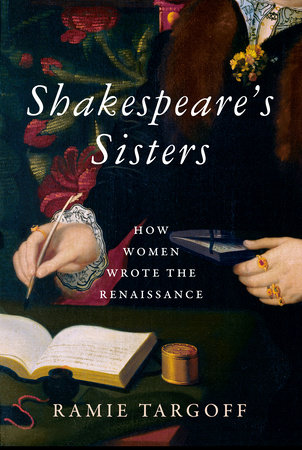
Read via NetGalley. It’s out now.
I’m here for pretty much any book that helps to prove Joanna Russ’ point that women have always written, and that society (men) have always tried to squash the memory of those women so that women don’t have a tradition to hold to. (See How to Suppress Women’s Writing.)
Mary Sidney, Aemilia Lanyer, Elizabeth Cary and Anne Clifford all overlapped for several decades in the late Elizabethan/ early Jacobean period in England – which, yes, means they also overlapped with Shakespeare. Hence the title, referencing Virginia Woolf’s warning that an imaginary sister of William’s, with equal talent, would have gone mad because she would not have been allowed to write. Targoff doesn’t claim it was always easy for these women to write – especially for Lanyer, the only non-aristocrat. What she does show, though, is the sheer determination of these women TO write. And they were often writing what would be classified as feminist work, too: biblical stories from a woman’s perspective, for instance. And they were also often getting themselves published – also a feminist, revolutionary move. A woman in public?? Horror!
Essentially this book is a short biography of each of the women, gneerally focusing on their education and then their writing – what they wrote, speculating on why they wrote, and how they managed to do so (finding the time, basically). There’s also an exploration of what happened to their work: some of it was published during their respective lifetimes; some of it was misattributed (another note connecting this to Russ: Mary Sidney’s work, in particular, was often attributed to her brother instead. Which is exactly one of the moves that Russ identifies in the suppression game). Some of it was lost and only came to light in the 20th century, or was only acknowledged as worthy then. Almost incidentally this is also a potted history of England in the time, because of who these women were – three of the four being aristocrats, one ending up the greatest heiress in England, and all having important family connections. You don’t need to know much about England in the period to understand what’s going on.
Targoff has written an excellent history here. There’s not TOO many names to keep track of; she has kept her sights firmly on the women as the centre of the narrative; she explains some otherwise confusing issues very neatly. Her style is a delight to read – very engaging and warm, she picks the interesting details to focus on, and basically I would not hesitate to pick up another book by her. This is an excellent introduction to four women whose work should play an important part in the history of English literature.
The Seven Wonders of the Ancient World

I received this book to review at no cost, from the publisher Hachette. It’s out now (trade paperback, $34.99).
As someone who has been keen on ancient history since forever, of course I was intrigued by a new book on the seven ancient wonders. And I’ve also read other work by Hughes, and enjoyed it, so that made me doubly intrigued.
Before I get into the book: of course there is controversy over this list. Hughes acknowledges that, and goes into quite a lot of detail about how the ‘canonical’ list came about – the first surviving mention of such a list, why lists were made, what other ‘wonders’ appeared on such lists in the ancient world of Greece and Rome, as well as what other monuments could be put on such a list were it made today. I appreciated this aspect a lot: it would have been easy to simply run with “the list everyone knows” (where ‘everyone’ is… you know), but she doesn’t. She puts it in context, and that’s an excellent thing.
In fact, context is the aspect of this book that I enjoyed the most. For each of the Wonders, Hughes discusses the geographical context – then and now; and the political, social, and religious contexts that enabled them to be made. This is pretty much what I was hoping for without realising it. And then she also talks about how people have reacted to, and riffed on, each of the Wonders since their construction, which is also a hugely important aspect of their continuing existence on the list.
- The Pyramids: the discussion of the exploration inside, by modern archaeologists, was particularly fascinating.
- The Hanging Gardens of Babylon: the discussion of whether they even existed, and if so where, and what ‘hanging’ actually meant, was intriguing.
- Temple of Artemis: I had no idea how big the structure was.
- Statue of Olympia: I had NO idea how big this allegedly was.
- Mausoleum of Halikarnassos: NOT HELLENIC! Did not know that.
- Colossus of Rhodes: also had no idea how big it allegedly was, nor the discussion around its placement.
These Fragile Graces, This Fugitive Heart

Read via NetGalley and the publisher, Tachyon. Out in March 2024.
A completely believable, dystopic Kansas City where the police and everything else are basically run by corporations and only for the rich (cue an Australian rant about modern USA, if you please).
An anarchic commune that’s attempting to be a place where people feel safe, and are allowed to be what and who they want – and which really gets up the nose some rich people.
A trans woman, Dora, who used to live in said commune, and left over differences of opinion about security, and has been making her way for the last few years as a security consultant.
And Dora’s ex-girlfriend, still living in the commune, who is found dead – allegedly of an overdose, but Dora discovers evidence of foul play.
This is a fast-paced thriller novella (novelette? not sure) that I devoured very quickly. Dora is complex, driven, committed, sometimes bitter, and absolutely determined to get answers, even when that might hurt herself or other people. The setting is believable and horrifying, drawn with broad strokes but enough detail that you can see Wasserstein has put a lot of thought into it; and it makes me wonder what modern KC-dwellers think of it, and if they can see the places she describes. It works as a thriller – there are twists and reveals – and just overall it’s very clever. Hugely enjoyable, and I look forward to seeing what else Wasserstein has up her sleeve.
Bespoke and Bespelled

I read this courtesy of NetGalley. It’s out now.
Marnie is:
- a New Zealander,
- living in LA, because she is
- working as a costume supervisor, and
- a stitch-witch: fabric loves her and wants to make her happy.
She is also: - 41,
- ‘generously proportioned’,
- currently single, and
- bi (or pan? unclear).
As the story opens, the show she’s working on has finished, and Marnie is hoping for a position not just as a costume supervisor, but as a designer. And so when a position comes up back home, adapting one of her favourite fantasy series for the big screen, she agrees.
Note: the little nods to what LOTR did for NZ are a delight.
Basically the story is about Marnie on the film set, dealing with a) her attracting to the leading man, and b) weird occurrences that have plagued the filming since it started in NZ, and which begin to seem like they’re not random or natural.
Coming to Healey off the back of the Olympus Inc books, this is exactly what I was hoping for. Cosy, comfortable, fast-paced: I read it in one evening and I have no regrets.
Deliciously Ella: Healthy made Simple

I was sent this book by the publisher, Hachette, at no cost. It’s out now; $34.99.
I had heard of Deliciously Ella, but have never seen the original book nor made use of the website. This is my first encounter with Ella Mills. And the first thing I should note here is that this book is not designed for me. I don’t need convincing that eating vegetable is a good idea, and I loathe the word “wholefoods”. While I know that all cookbooks are in some way aspirational, and advocating some sort of lifestyle (yes, yes, thinking about Nigella…), the sort of lifestyle being shown here is definitely not for me. There’s a lot of beige, a lot of jewellery while saving up food… and I rather object to using your kids as props in your book.
So, yes, I was rather suspicious going in, I’ll admit. However, the premise of the recipes themselves is one I can get behind: 30 minutes or fewer for every dish, no more than 10 ingredients, and no more than 5 steps for each dish. There’s absolutely a place for that sort of cooking, and if you can show me some clever combinations of ingredients, then I am 100% here for it.
The good:
- avocado and butter lettuce salad with a crunchy protein topping: Ok, I object to the ‘protein’ in the name, but I’ve now made this several times and I’m keeping it. Basically, avo and soft lettuce, with oil and Dijon dressing, and then toasted chickpeas, sunflower seeds, and pepitas on top. Genuinely delicious.
- 15-minute black dahl: some lentils, tomato paste, coconut cream and curry powder blitzed together, and then cook that with more lentils and onion and spinach. I was pleasantly surprised.
- creamy paneer-inspired tofu: look, I just made this with paneer. Spices and tomato and spinach and paneer. It was fine.
… there are a few other recipes in here I could imagine making, but the reality is that for me, there was really nothing new. If you were just starting out on the idea that you might want to cook for yourself, and wanted to make things that were fast and easy and you were pretty sure were healthy, then this would be a really great book. Also, lunches where you’re pickling onion?? Where the prep time is 15 minutes?? And the TIP is that you can make it a ‘packed lunch’? I know lots of people are working from home still, but surely that’s unrealistic.
I will note that I object to the inclusion of breakfasts in a book like this. Yes they’re “prep ahead” but that just means that you’re adding yet another thing to your to-do list for the night before, when this book is selling time-saving as one of its advantages. Suggesting that breakfast must include something you’ve made, rather than cereal or what have you, is a bit frustrating. Still, at least it does include a few treats, like biscuits, so it’s not completely on the ‘no fun food’ train.
Power to Yield and other stories

Bogi Takács (link to eir review site) sent me a copy of eir book, and I’m totally stoked I got my (electronic) hands on it. (This is eir personal site.)
Takács writes in a variety of styles across these stories. Some are fantastical, some more science-y, and many refuse classification. There are a few themes that recur: the question of identity – how we think about our own, what it informs it, how it changes the way the world approaches us – was what stood out the most, to me. There’s also a lot of questioning of authority and power, in terms of who has it, how it’s used, how it can or should be controlled/mitigated/ challenged. All of which is show that Takács doesn’t shy away from being provocative – but it’s never about just being provocative: there’s a purpose to it, because at heart it feels to me (an educator) that e is an educator – educating people about how the world and people do, could, and perhaps should function, through eir fiction. Which is not to say that the stories feel in the least bit didactic, or preachy, or anything like that! It’s more the vibe I took away from the collection as a whole.
A few favourites, not exhaustive:
“A Technical Term, Like Privilege” – not the sort of story I expect to be grabbed by, because it does have body horror as a fairly integral idea (this is me avoiding phrases like “I was absorbed by this story” because… well, story-reasons). However, the way Takács uses the issues of class and other privilege as part of the discussion is totally up my alley, and works brilliantly.
“Power to Yield” – I haven’t read any of Takács’ other Eren stories (except those collected here), so there were a few moments where I felt a bit adrift; nonetheless, it didn’t actually take away from my appreciation of the story and the characters. As with “A Technical Term,” this has more violence/ bodily harm than I would generally expect a story that I was moved by to include. But it does, and I was moved; this is a story that will stay with me a for a long time. How to build a new society, how to deal with what’s left from the old society, how to balance the needs/the good of the few and the whole… Takács doesn’t offer any easy answers to such questions, but it’s brilliant to see them confronted.
“Folded into Tendril and Leaf” – another one that includes bodily harm and warfare, and now I’m seeing an unexpected pattern! Anyway: magic, love, identity, dual perspectives; this is brilliant.
I read this collection quite slowly, because many of the stories require thinking and reflection and I didn’t want to short-change them, or myself, by simply powering through. Some of them are quite heavy in terms of the issues discussed (violence, various types of discrimination), and some are on the denser side in style (in a good way!), so ditto on the short-changing.
Multispecies Cities: Solarpunk Urban Futures
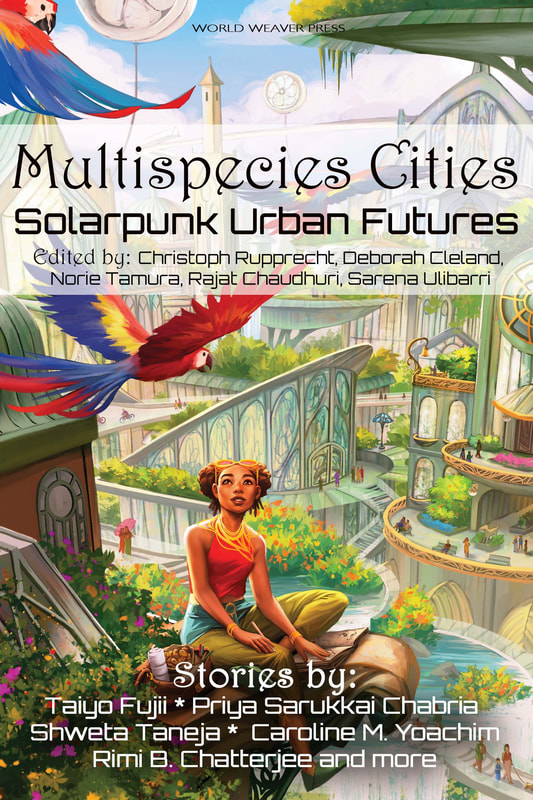
Yup, this one was also on special at World Weaver Press, so I grabbed it as well. I was completely intrigued by the idea of an urban focus for this sort of science fiction – that humans won’t have to abandon living in cities to survive the impacts of climate change, but they also don’t have to be the technological nightmarish warrens of Bladerunner etc. At the same time, they can’t be the same as they generally are now: where we restrict greenery to a few parks, loathe pigeons and rats as the carriers of disease, and so on. There are a few apartment buildings in my city that are starting to introduce the idea of green walls… that just needs to be taken much, much further. Which is part of what this anthology envisions.
As always, didn’t love every story, but as with Glass and Gardens there was no story that I thought was out of place. There’s a big variety in what the stories focus on – human stories that happen to intersect with animals, stories of the city itself, stories of animals and humans together. Where I said that previous anthology felt North-American heavy, this one has consciously set out to be different: there are, deliberately, a range of stories that explore the Asia-Pacific. I LOVE this.
There are a few stories where animals interact, in a deliberate way, with humans. Meyari McFarland’s “Old Man’s Sea” has orcas that have been modified for war, and how they might relate to the humans they now come across. Joel R Hunt has people whoa re able to jack into the minds of animals, in “In Two Minds,” and it’s about as horrific as you might imagine. “The Mammoth Steps” by Andrew Dana Hudson is along similar lines as Ray Nayler’s “The Tusks of Extinction,” with mammoths having been brought back and humans interacting with them… although Hudson’s version is a bit more hopeful. E.-H Nießler also has an orca-human interaction story, in “Crew;” he adds in a chatty octopus as well.
Shout out to Amen Chehelnabi and DK Mok, too: Aussies represent! Chehelnabi’s “Wandjina” is one of the grimmer stories, set basically in the middle of a bushfire, but manages to have hope in there too. Mok’s story “The Birdsong Fossil” is SO Australian, and also on the grimmer end, connecting visions of how science might be/is viewed with the de-extinction fascination; like Chehelnabi, it also ends hopefully, and is a fascinating way to conclude the entire anthology. (And Octavia Cade; NZ is totally Aussie-adjacent… plus her story “The Streams are Paved with Fish Traps” is brilliant.)
A really interesting, varied, anthology.
Glass and Gardens: Solarpunk Winters
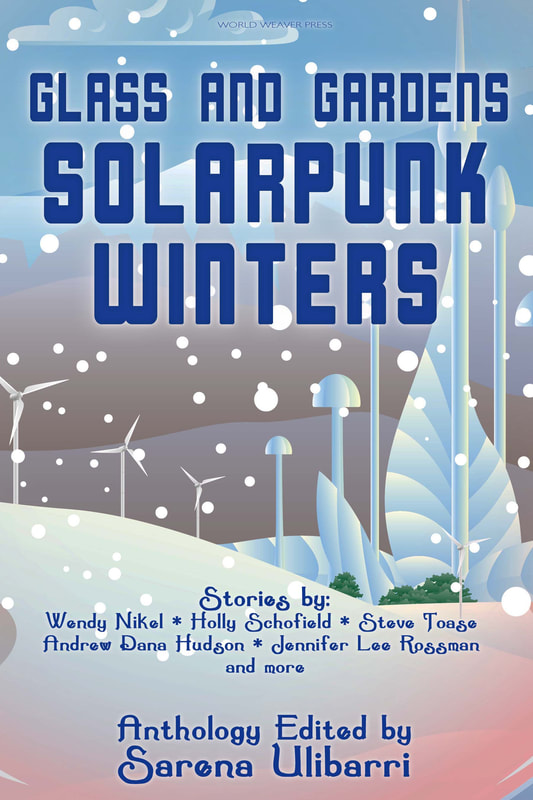
I’ve only recently come across the idea of ‘solarpunk’ – basically a hopeful take on humans living in a post-climate change world, as far as I can tell. I guess this is what ‘hopepunk’ also aims to be? maybe solarpunk is a bit more about the actual mechanics… I don’t know, I’m not going to claim the ability to set genre boundaries. ANYWAY, World Weaver Press has done a bunch of solarpunk anthologies, and a couple of them were on special the other day so I got them.
The first one I read was this, Glass and Gardens. Turns out I was in the right zone for some hopeful SF. As with all anthologies, I didn’t love every story – but also, there were no stories that left me wondering what the editor was thinking. They all fit the overall theme – how to be hopeful when winters have got more extreme or, in a couple of cases, the world has warmed so much that winter no longer happens, with equally disastrous consequences for the environment. It is heavily North American-focused, but honestly as an Australian this is just something I pretty much take for granted.
One thing I particularly liked was that while all of the stories were focused on humans, and what they are doing to live with/ mitigate/ work around climate change, there’s also a focus on how the climatic changes have affected the rest of the species on the planet. It’s s refreshing change and something that seems to be a trope within solarpunk from what I can tell – an acknowledgement that humans aren’t alone on the planet. So there’s Jennifer Lee Rossman’s “Oil and Ivory”, about narwhals and whether they’ll be able to travel underneath pack ice in the Arctic; bears and several other animals in “Set the Ice Free,” from Shel Graves; and several stories that have cities encouraging a lot more greenery and what could be called extreme eco-living compared to today.
An aspect that connects to the idea of hope is the prominence of art in these stories. Your dire post-apocalyptic world has no room for art and beauty. But Sandra Ulbrich Almazan has characters making clothes in a variety of ways in “A Shawl for Janice;” “On the Contrary, Yes” from Catherine F King is entirely focused on art and making art across multiple genres; Andrew Dana Hudson imagines ice-architecture as its own art form in “Black Ice City.”
This is a great anthology, and I look forward to reading more solarpunk.
The Tigris Expedition, Thor Heyerdahl

All of the things I said about The Ra Expeditions also apply here. Although this is happening in the late 1970s, so the racism is both a bit less, but also even less comfortable, if that’s possible.
Interestingly, I didn’t find this as historically problematic as Kon-Tiki or Ra. I think that’s mostly because he’s only sailing around places where there is actual archaeological evidence for contact – Mesopotamian stuff found in the Indus Valley, and vice versa – so there clearly was contact, although at how many degrees of separation is unclear from just those remnants. Although I did have to stop and laugh when Heyerdahl earnestly suggests that just because there’s a similarity between how a place name is said today, and how we think a word was said in a language nobody now speaks – well, that’s evidence that they might be the same place!
For real.
ANYWAY. I don’t need quite such an expurgated version of this book as with the other two, because the ideas and the language aren’t quite as offensive. And as with the other two, this is genuinely a fascinating adventure story. Getting the built made – of reeds, in Iraq – is another amazing story of ingenuity and the problems of materials etc in an area that really didn’t have ‘modern’ resources at the time. Was importing South American boatbuilders the most authentic way of doing it? Probably not. Anyway, then you’ve got eleven men on this little boat navigating the Arabian Gulf Persian Gulf Sumerian Gulf (there’s a whole thing about which name is appropriate), which is filled with enormous boats and isn’t all that easily navigable… and they go to Oman, and Bahrain, and Pakistan, and then back west – honestly it’s an amazing journey, with a lot of quite serious problems that they do manage to overcome. Heyerdahl is open about some of the friction experienced between the men – he has to be, given there’s someone with a camera filming them for much of the voyage – as well as their frustrations about what’s going on on land.
Would I recommend this wholeheartedly? No. Would I recommend it with reservations? Sure. Only to an historically literate reader, who’s in a place to deal with fairly stereotypical 1970s attitudes. It’s probably the best of the three in terms of not being problematic.
Left-handed and Sinister Booksellers, Garth Nix
Apparently I didn’t review The Left-handed Booksellers of London when I read it, which leaves me with questions… mostly “why??” and “what was I thinking??”
I have loved pretty much everything of Nix’s that I’ve read, and this was no exception. Set in a 1983 with a history that’s slightly tangential to our own world (Clementine Attlee had me HOWLING with laughter), it’s about a girl, Susan, who has a terrible experience with something otherworldly and gets rescued by a bookseller… but not as you know them. Merlin is a left-handed bookseller, meaning he gets directly involved in dealing with incursions of Old World powers and idiot mortals who decide to meddle in things they ought not to. Adventures and revelations and betrayals ensue. Susan isn’t who she thinks she is, the world isn’t as she thinks it is, etc. I love Susan, I love Merlin, everyone should read this.
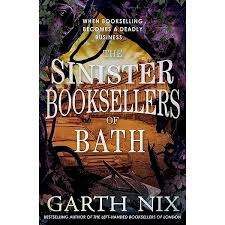
…ALL of which is why I have been looking forward to getting my hands on the sequel! It’s very much a sequel, don’t read this without the first (and why would you??). Susan continues trying to navigate in this newly expanded world she finds herself in; Merlin gets himself into some trouble early on and then they all spend the rest of the book investigating the consequences. Vivien, Merlin’s sister, is back, as are some of the assorted bookseller family members. There’s a mystery, there’s some mayhem, personal crises to be dealt with… and it’s all written as beautifully as Nix ever does. I loved it. A lot. I anticipate re-reading this, and trying to get it into other people’s hands if they’ve somehow slept through it.

 Randomly Yours, Alex