Terra Nullius
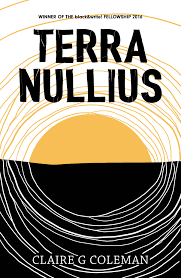 This book was sent to me by the publisher, Hachette, at no cost. It’s out now, RRP $29.99.
Terra nullius has a specific resonance for Australians who know anything about their history. It’s the legal fiction under which Britain decided they could colonise the land that’s now Australia, because it was ‘nobody’s land’ – that is, no one that the British recognised owned it. Because the British didn’t recognise the traditional owners as ‘owning’ the land, for a whole bunch of reasons. So for Claire G Coleman to use that as the name and premise of her book is brilliant, and pointed, and tells you a lot about what the book is on about before you even open it.
Coleman, who identifies with the South Coast Noongar people, won the black&write! writing fellowship in 2016 with this manuscript. The main reason why I think that’s awesome – aside from the obvious one that it’s a great book – is a bit spoiler-y, and that’s a bit of a problem with discussing this book at all…
The blurb talks about Natives, the Colony, and Settlers. It says “This is not Australia as we know it. This is not the Australia of our history. This TERRA NULLIUS is something new, but all too familiar.” Along with the fact that this is a didactic book (in no way a criticism) that does its message-work with clear prose, understandable characters, compassion and a lot of toughness… I can’t really say much more about the book without revealing what makes it something other than a book about Australian history. There’s runaways and enforced schooling and hiding from Settlers and Settlers complaining about the environment… and… other things.
I want to throw this book at all white Australians. And I would be fascinated to hear what non-Australians think, especially people living in other colonised lands. I don’t know enough about how that’s spoken of elsewhere to know whether the resonance would work in a non-Australian context… but I think there’s enough commonality for it not to be a completely foreign experience.
And now, for those of you who don’t mind spoilers:
Beneath the Sugar Sky
 This novella was sent to me by the publisher, Tor.com, at no cost.
And I’m really sorry but it’s not available until 9 January, 2018. I’m sorry about that because it’s really really good.
Down Among the Sticks and Bones is a prequel to Every Heart A Doorway ; this is Every Heart’s sequel, chronologically speaking. You could absolutely read this without reading the other two (although seriously, why would you not read Every Heart? It’s one of the best novellas I’ve read in… years); there are some spoilers for Every Heart in Beneath the Sugar Sky, because there’s passing reference to the events that occur, but they’re not enough to make this novella opaque.
For those just joining us: the premise is a question that’s obvious once it’s asked. What happens to those children who fall through doors into other lands when they come back to the mundane world? Some long to go back, some are traumatised terribly. Enter two schools to help out, one for each experience. Every Heart and now Beneath the Sugar Sky are focussed on the school for those children who want desperately to leave this world, because they just don’t fit; they crave a return to the world that wants them, that invited them. And so they attend Eleanor West’s School for Wayward Children… and wait. And hope.
Cora is new to the school, and quickly gets accidentally sucked into a quest. There’s travel to other worlds, battling usurpers, making friends, and trying to cope in worlds that really don’t suit you (how does someone driven by Logic survive in a world driven by Nonsense?). The story itself is charming and fast-paced and a lot of fun; unexpected and upbeat and delightful.
But it’s the characters that are really wonderful, and Cora in particular. She is described as fat fairly early on – descriptively, not pejoratively – and the rest of the story has moments where she deals with (expected) responses to her size based on past experience, with her own attitudes towards her size, and most importantly pointed reminders that size in no way correlates to personality or worth or any other marker of value. She has moments of triumph and moments of failure; she is a valuable member of the group; and the other people in the group, sensible humans that they are, never make her feel like anything but.
I just love this world so much. I love the idea that the other worlds can be mapped against different ‘directions’ (Logic and Nonsense and so on), that there is a system to their connections. But mostly I love the characters that McGuire is creating here, and the way these adolescents grapple with not belonging. I am hoping for many more such stories.
Provenance
 I received this book from the publisher at no cost.
I really really liked this book. It’s very different from the Ancillary books, despite being set in the same universe; the concerns are different and the setting is different. What’s not different is the awesomeness of the writing itself, and the sheer excellence of the story and that the characters are delightfully well-rounded and gripping.
I told you I liked it.
Some of the things I really liked are minorly spoilery, so they’re below, but at heart it’s a ripping good story with characters I genuinely cared about in a society that’s just different enough to be alien and similar enough to be familiar, with the differences being intriguing. There’s political shenanigans and surprising coincidences and sibling rivalry and questionable identities…. Also, if you have read the Ancillary books (in no way necessary, although there is a tangential spoiler for the books), it’s fun to see how other societies view the Radch (unsurprisingly, with suspicion).
It appears to be a stand-alone, in case unfinished trilogies put you off. I didn’t quite read it in a day, but close. I adore Imray, the main character, a lot.
These spoilers don’t spoil the story, but just in case you want to discover them yourself:
SPOILERS:
1. The gender stuff! Choosing your own gender and your own name! With THREE options, and no suggestion that there’s any link to any physical bits! Such a neat way of doing it. And it’s just… there… and doesn’t play a role in the plot itself, because really why should gender play a part in what someone can do? As I write this I realise that that’s actually really significant: Imray has chosen to be female but there’s no suggestion that she is impaired by that, and none of the non-binary folk are hampered by their choice either… they’re all just people.
2. The vestiges! I see this as a nod to the Roman lares, the household gods, and the fact that leading families would have remnants from their famous ancestors to boost their own standing. But of course heaps of people do this sort of thing – investing objects with numinous power – just look at celebrity objects that get sold for stupid amounts of money. I loved that even when the authenticity (provenance!) of objects was questioned, Imray realised that in one sense at least it doesn’t matter if an object is genuine, because of the way it accumulates power and authority thanks to how people think about it. I really, really enjoyed this aspect.
3. Imray herself. Her appearance is largely irrelevant to the plot, which I really only noticed the one of two times that it <i>was</i> mentioned, in passing. And those mentions were about things like a particular space suit not being designed with someone of her roundness in mind. This is a person who’s not tiny but… no one cares. Also, she cries several times – and is never criticised for it, never made to feel like that’s a weak, womanly thing to do. She tries not to cry, a few times, so as not to betray her emotions – but it’s not gendered.
Binti: The Night Masquerade
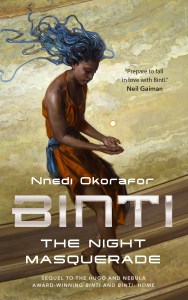 This novella was sent to me by the publisher, Tor.com, at no cost. It will be on sale in January 2018.
This story follows on from Binti and Binti: Home. You really need to have read them first, and you will really want to because they’re great.
Binti has changed: she changed by leaving home, she changed through her dreadful encounter with the Meduse, through her time at university, through her discovery about the truth of the Desert People. One of the major issues that she continues to deal with in this, the third and final story, is the ongoing consequence of those changes. Personally, and in her relationships with family and her wider community, and indeed the world. While there are broader things of concern going on, this is really the heart of Okorafor’s story and I really love it. She ends up feeling so many connections to so many people and groups; the question of how you please yourself, or everyone, is of ongoing concern.
Aside from her own personal tussles, this book is also focused on the ancient feud between the Khoush and the Meduse, which Binti discovers herself in the middle of. It’s been in the narrative since the start, since it instigated the events that made Binti who she is. Okorafor looks at how two large political entities might confront one another, as well as how that impacts on the non-involved around them.
All three Binti stories are wonderfully well written. Okorafor writes dialogue beautifully and she evokes the desert, here, powerfully. I do feel that this is the least satisfying of the stories overall, mostly because the conclusion felt slightly rushed and there were a couple of connections that didn’t flow as well as I expected. Nonetheless, it was a hugely enjoyable read and I definitely recommend reading all three.
Galactic Suburbia

photo credit: Paul Weimer
In which Alex & Tansy talk awards, culture & promote each other’s projects. Get us from iTunes or at Galactic Suburbia.
Continuum & the Ditmars.
Locus Awards: so many winners.
Mother of Invention: last day of Tansy’s Kickstarter campaign! Last chance to pledge!
Luminescent Threads pre-orders open now. The Book Riot review/interview is here!
How has Twelfth Planet Press has impacted on our listeners? Email galacticsuburbia@gmail.com to provide us with your anecdata!
CULTURE CONSUMED
Tansy: GLOW on Netflix
Alex: InCryptid short stories, Seanan McGuire
Tansy: One Con Glory, Sarah Kuhn
Alex: The Girl who Soared Over Fairyland and Cut the Moon in Two, Catherynne Valente
Tansy: Not Your Sidekick, C.B. Lee; Star Crossed by Barbara Dee
Alex: Agents of SHIELD
Tansy: Valentine, Jodi McAlister (@JodiMcA & #PaceysCreek on Twitter)
Please send feedback to us at galacticsuburbia@gmail.com, follow us on Twitter at @galacticsuburbs, check out Galactic Suburbia Podcast on Facebook, support us at Patreon – which now includes access to the ever so exclusive GS Slack – and don’t forget to leave a review on iTunes if you love us!
The Eternal Kingdom
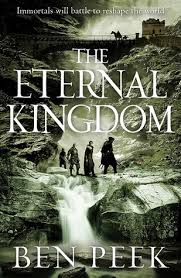 I received this as a review copy from the author, at no cost.
This is the third and last book in the Children trilogy (see here and here) by Ben Peek. It does not stand on its own because it is building on, drawing together, exploding, and generally messing with ideas and characters from the previous two books. If you enjoy epic fantasy with rather grim repercussions for its characters, detailed world building and surprising twists, then just stop reading now and go grab the earlier books. Seriously, it’s worth it; this is the sort of trilogy to read when you really want to get your teeth into a set of characters and be thrown completely into their lives. And look – the series is finished! So you don’t have to worry about being left in the lurch!
So, when we left the series last time the new god had just broken through properly and was causing some havoc. Where ‘some’ is ‘a significant amount’. And following through with our newly-named god, as she tries to claim paramount status in a world that’s not really sure if it wants her and what that would actually mean for the world, is the focus of the whole book. The looks different for different characters of course: Bueralan has his very personal struggles as well as being caught up in the politics of a new god, while Ayae isn’t particularly happy about being an intermediary between different groups and the other immortals are largely unknowable and definitely have their own agenda. And then there’s Heast, and the other characters we’ve come to appreciate over the earlier two books… the ones who aren’t dead yet, anyway. Well, mostly the ones who aren’t dead. Death has a somewhat… permeable… nature here.
I’m not going to lie, there are some unpleasant things that happen to characters throughout this book, and I was never sure who was going to survive and who wasn’t. It’s a measure of the books, though, that I cared about that fact. And I did. I really did. When the Innocent, murdering sunuva that he is, appeared on any page I was worried (and he appears quite a lot in this book, so I spent a lot of time chewing my [metaphorical] nails). And the new god, who has definitely shown herself to be largely reprehensible… well, continues on that track but of course maybe she’s not all that bad and ARGH how do I figure out what to actually think? Curse you Peek and your morally grey characters and novels!
You will probably find that this series plays on your emotions. You may find yourself yelling at Peek (I’m sure he can handle it) and various characters (most of them deserve it). If you buy just the first one… well, I am not to blame if you have to go and buy the next two in short order.
The Silent Invasion
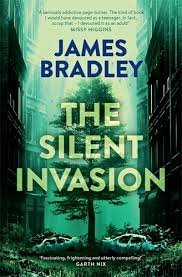 I think this is the first James Bradley book I’ve read, which is… a thing. If this is an indication of his calibre, I shall rectify that.
This is a near-future Australia. The entire world has been affected by alien spores that Change animals, plants and people – not everyone, but many of those who come into contact. And the spores seem to particularly like it hot and humid, so there’s been an exodus of people from the tropical parts of the world. Of course, this hasn’t been particularly well received by the temperate parts of the world. There are walls. And camps. And suspicion of foreigners.
All sounding a bit familiar, isn’t it.
The heart of the book is Callie, an adolescent whose father Changed some years ago and whose young sister is now exhibiting symptoms – because even in temperate Adelaide, you’re not safe from the spores. Rather than allow Gracie to be taken to Quarantine, Callie decides to run away with her to the Zone: the part of Australia that’s been sectioned off by a mighty Wall, to the north of which the Change runs riot. Cue adventure and desperation and bravery and hardship.
What is perhaps most intriguing about this book is the prologue. I mean, I really enjoyed the book, and Callie is a gutsy character, and I liked the depiction of Australia. But the prologue? It makes it clear that this desperate adventure across southern Australia is only the beginning of what will confront Callie across the trilogy. Because in the opening paragraph, she mentions “this alien beach,” and being “under a sky so full of stars that even the night shines”. There is something much weirder going on than just another version of the Triffids, or a slow invasion story. And while I enjoyed the look-after-the-sister story, I am really intrigued by what’s going to happen to Callie to lead her to this alien planet.
Bring on the next book.
Timekeepers
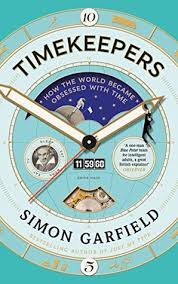 Even if you’re not that history books, but you are a keen observer of the world and how it works, this is a book I can highly recommend.
There were times (heh) when reading this that I wasn’t quite sure what book Simon Garfield was trying to write. Some of the things that he writes about didn’t immediately appear to connect to the idea of time. But when I considered the blurb, I decided that Garfield did indeed know exactly what he was doing. This is a book that considers the idea of time from a multitude of angles: “our attempts to measure it, control it, sell it, film it, perform it, immortalise it, re-invent it, and make it meaningful.”
I really, really enjoyed this book. Garfield writes in lovely, sometimes whimsical ways – not that his ideas are less than scientific when required, but that he has a lovely turn of phrase to make some difficult concepts approachable. And I really did enjoy the different ways that he approached time. I already knew about trains and train timetables essentially necessitating the development of time zones, but I didn’t have a problem with it being reiterated; I adore that he included discussion of the French Republican calendar and its attempt to decimalise, rationalise, time. Including questions of the metronome and how to play Beethoven’s Ninth and why a CD fits as much as it used to is just marvellous, and the question of just how many times someone can be shown, in film, hanging from a clock is one I had never considered. Also, the idea of a film that goes for 24 hours and is comprised of snippets from other films that together make 24 hours, each shown at the appropriate time of the day? Madness and genius have rarely been so close together. And that’s barely scratching the surface of the ideas that Garfield explores: how to make a watch, the four-minute mile, the modern drive for efficiency… yeh. This is a varied, delightfully jumbled, exploration of a topic that consumes a lot of modern Westerners.
Garfield is not suggesting he’s written the definitive book on time; far from it. There’s a wonderful Further Reading section that I’m afraid to look at because this is a rabbit hole I could very easily fall into. But it is a good introduction to pointing out that time is a lot more subjective, and invented, and dependent than we sometimes think.
Reading this is a good way to spend some time.
The Dark Forest
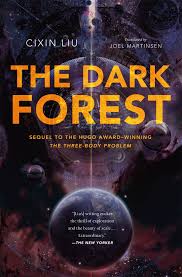 Book 2 of Cixin Liu’s trilogy that started with The Three-Body Problem.
You could probably read this without having read the first book – it’s been ages since I read Three-Body Problem and I didn’t remember a whole heap – but honestly, why would you? It’s such an amazing book that if you’re considering reading these at all (perhaps because the third one has just been nominated for a Hugo Award, which the first book won), seriously just go and read both of them.
So the world is going to be attacked by an alien space-navy… in four centuries. Meanwhile emissaries from those aliens are already here, because somewhat hand-wavy-science, and they’re both halting humanity’s exploration of science and potentially listening in to every single conversation we’re having. So what can be done to try and deal with the aliens, and not have them sabotage humanity’s plans? (The aliens have their human tools, of course, too.) You nominate four people to be Wallfacers: people who have authority to do anything as long as they justify it as “part of the plan”… and they don’t have to explain anything, because if they explain it then the aliens might find out.
Because nothing could go wrong with that plan.
And that’s only part of what this novel is about. There’s also love and loss and trauma and sheer human effrontery. It takes place in the near-isa future and then a few centuries after that. It mostly takes place in China with a few bits elsewhere. Lots of it is from the perspective of Luo Ji, who would really rather it wasn’t, thanks all the same.
Some of the things I really enjoyed and/or was intrigued by:
- The acknowledgement, and exploration, of the idea that when confronted with an alien enemy, one of the likely responses is defeatism. Even in the armed forces. This is actually quite refreshing, given how often Hollywood blockbusters like to present (usually American) soldier-heroes.
- The general lack of draaaamah. When things go bad, people react, but there’s not pages upon pages of people feeling sorry for themselves. Nonetheless, these are still generally real and believable, if restrained, characters who I enjoyed reading about and did feel that I got to know (somewhat, anyway). (And I’m not only referring to the Chinese characters when I say that; the USan and other characters also don’t go in for massive theatrics.)
- Shi Qiang. About the only main character to transition from Three-Body to this, and I love him. He’s so quirky and shrewd and insightful and human. (I can imagine Miller, from the Expanse, and Da Shi getting together and drinking way too much and sharing police stories for hours.)
- Zhang Beihai. What even was going on with that narrative arc? Fascinating and unexpected; every time he appeared on the page I didn’t even bother trying to figure out what was going to happen. Because I knew I would be wrong.
This is a great science fiction novel and I’m completely stoked for the third, although I can’t really fathom where it’s going to go. Do not read this unless you prepared for some pretty hard-core science discussion, and if you’d rather that your fiction has in-dpeth discussion of character motivation and lavish character reflection. Do read if you enjoy a brilliant SF story with breathtaking ideas.
Gemina
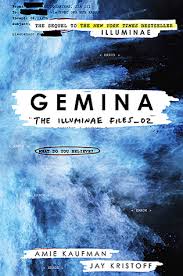 This is the sequel to the brilliant Illuminae. Intriguingly, though, it could definitely be read as a stand-alone book. There’s an entirely new set of main characters, and while the events do flow on from the initial ones they’re taking place in a completely different part of space. What little background knowledge might be useful is provided as part of the briefing documents.
Note: if you didn’t enjoy Illuminae (and I understand the style isn’t for everyone), don’t come to this one.
Like Illuminae, the novel is composed of ‘found’ documents, here presented as part of trial. Those documents are things like IM-chat transcripts; descriptions of video surveillance, complete with occasional snarky comments from the tech doing the description; logs of emails, and other communications; and a few other bits and pieces. It means that the narrative isn’t entirely linear, and this works really nicely – the story of what has happened, and what the characters are like, comes out slowly and… I guess organically. There’s a few bits where people are described in reports or get talked about, but in general we learn about them through their words and actions.
The setting for the main narrative is a space station, guarding a worm hole that has gates to several different systems. Something terrible happens, and things must be done by unlikely heroes. Exactly the depth of the Terrible Things and how they might be resolved are the focus of the story. There’s crawling through air vents and unlikely alliances, hacking both computer and physical, general death and destruction and mayhem, betrayals and banter. And it all happens over a really short space of time so that it feels quite desperate and breathless; when I had to put it down 50 pages from the end to go out for dinner (I’d read the rest of it that day), I was horrified at leaving everyone hanging.
This is an immensely fun book. I can imagine it working on reluctant readers – or those who think they only like graphic novels – once they got over the thickness of it, that is, since it’s a very graphic piece of work: each page is designed to look like what it’s meant to be, whether that’s a chat transcript or legal documents. Or excerpts from an adolescent girl’s diary. Each ‘chapter’ feels short and punchy because none of the documents are very long. It’s a clever pacing trick.
A very entertaining and enjoyable book. I am excited for the next instalment.

 Randomly Yours, Alex