The Black God’s Drums
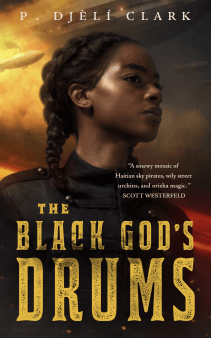 This novella was sent to me by the publisher, Tor.com, at no cost. It will be published on August 21.
As an Australian, I’m sure I only picked up the surface detail of what Clark is doing here in his alternative history of America. That was enough, though, to be both utterly intrigued by the world he’s imagined and to follow this awesome story that I really hope everyone goes out and grabs.
This is alternative history in two senses. One is that there’s airships and some other tech that doesn’t fit with what the nineteenth century actually had; a variation on steampunk I guess. The other is that, partly because of this technology, things went somewhat differently in Haiti after and during the slave revolt there, and when Napoleon tried to reimpose slavery; and, possibly connected to this although that’s unclear, things are also different in the USA: like it’s not the USA. This is post-Civil War, but instead of reconstruction, Confederates and the Union are still separate. Oh, and New Orleans is neutral, and basically seems to be operating as its own city-state.
There’s a lot going on here, and all of that is just background to understanding why our protagonist, Creeper, is trying to find someone to pass along some information to, and then ends up in an unexpected adventure.
This is a beautifully written novella, both fast-paced and with complex enough characters that I cared about them. Creeper is awesome, there are seriously odd nuns (I REALLY want a story about them please and thank you), and the captain of an airship who takes zero nonsense from anyone. Plus a scientist with dangerous knowledge in his head and… yeh, you get the picture. The characters are a multitude of colours and ethnicities and nationalities, as befits New Orleans as a neutral and open port; there’s really interesting discussion about old, African gods being brought to this new world, and what power they might have. This is alternative history that really works: it makes sense (see caveat above re: me and American history), and it challenges modern conservative white notions of what alternative history is; it also just straight-out challenges boring old racism pretty much just by its existence.
I loved it a lot and would be very happy to read more in this world.
Rogue Protocol
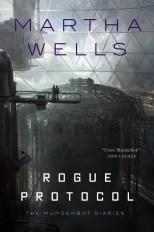 Yeh. So. Soon after I admitted I was slack about reviewing Artificial Condition, I received the ARC from Tor.com for Rogue Protocol… the third in the Murderbot series. So now I am being A BETTER REVIEWER. But also it doesn’t come out until August 7, sooo… sorry about that. Honest.
If you haven’t read the first two, you really want to. Don’t read this unless you have. SERIOUSLY a former Security bot whose hacked their governance system and is trying to figure out how to live in society and not get shut down or have humans run away from them: WHY HAVEN’T YOU READ THIS YET. Also, the first novella in the series won a Nebula on the weekend, so it’s not just me in love with the whole concept.
Murderbot has managed to get away from the annoying humans whom they ended up helping in their possibly pointless search for justice. Now Murderbot is on their own search for justice, hoping that getting evidence of Evil Deeds to help the person who helped emancipate them will… do some good. Or something. Unsurprisingly, Murderbot ends up having to help more hapless humans in difficult situations. Because Murderbot just can’t help it. I’m a history teacher; I will teach you history if the occasion calls for it. My mother will join committees. Lois Lane will look for the angle, Batman will growl, Han Solo will make a quip. Murderbot will help you in your possibly doomed quest for safety and/or justice. It’s just the way it goes.
A super superficial reading of this series would suggest that Murderbot is searching for their humanity. But that, as I said, is superficial and does Murderbot a disservice: they are not human and are not looking to be human. They are, though, searching for a meaning to their identity, and possibly a way to interact with humans on their own terms. Which may or may not involve compassion, using their skills in useful ways, or killing the people who get in their way.
I love Murderbot and, increasingly, I love the interactions they have with other AIs. I mean the humans are fine and all but it’s the AIs who are really interesting. In the last story, we had ART, as Murderbot termed them; ART was more than they appeared, and had very definite ideas about some things. Here… well. The situation is very different. Miki is a whole other level of difficult to deal with: I think reading this immediately after Artificial Condition is really fascinating in terms of what AI identity means. I can’t wait to see how Murderbot develops after these interactions.
Wells is doing a marvellous job of reinvigorating the entire AI genre. I welcome it.
Artificial Condition
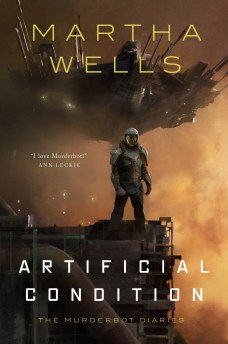 aka Murderbot Diaries part 2.
This novella was actually sent to me by the publisher um, quite a while ago. I read it then and I’ve talked about it on Galactic Suburbia but… my mind just hasn’t been in reviewing mode in the way it needs to be. So I feel bad. And now I’m reviewing it when it’s just come out. So at least if it sounds like your sort of thing, you can just go and buy it immediately?
Anyway, this follows directly on from All Systems Red, which is generally just known as Murderbot, after the character telling the story. If you haven’t read that, I don’t recommend reading this… but I DO recommend going and getting the first one, and THEN coming to this one, because what’s not to love about a robot that’s self-aware and knows that if the humans find out about that there’s going to be trouble, but maybe not as much trouble as if there’s not enough soap/space opera to watch in their downtime?
I might love Murderbot a lot.
Interestingly, I didn’t love this one quite as much as the first one. Don’t get me wrong, I devoured it and am very excited that there are more to come. But it wasn’t quite the same revelation as the first one – which is only to be expected.
Basically this is following Murderbot as they go off into the world (galaxy) alone, trying to figure out how not to be compromised, and also trying to figure out a bit of their past. For me, I think the best parts were Murderbot interacting with other AIs, and figuring out their limitations and how to interact with them without revealing too much. That whole negotiating yourself and others who are kind of like you and kind of really not.
It’s really, really great, even if it’s not quite peak swoon-worthy-ness like the first one. I can’t wait to read more of Murderbot as they figure out how to be what they want to be.
Echoes of Understorey
 I read and really enjoyed Crossroads of Canopy a while back, so when Thoraiya offered to send me a review copy of the sequel I was all YAASSSS GIMME. So yes, this is a review copy, and yes I know the author.
The world is Titan’s Forest, and there are classes within classes in this place. The population is divided in three: those who live in the Canopy, closest to the sunlight; those in the Understorey; and those on the Floor, who basically live in the dark. The first book was very focussed on the Canopy, even though a lot of it happened in the Understorey; this one is focussed on the Understorey, even though a lot of it happens in Canopy; I really hope that a) there’s a third book coming and b) it will give us more about Floor. But I said there are classes within classes: within each physical division, there are wealth divisions (I mean I assume this applies to Floor), too. This is one of the interesting things Dyer is doing: the books aren’t just about the lucky ones, easy as that would be, nor just about the lonely outsiders. Instead, it’s a mix, as life and society are, showing the uneasy ways in which people mingle across borders. In fact that’s the whole point of this second book: Imeris doesn’t feel like she fits either in Understorey or in Canopy, and the people around her are equally unsure. So she crosses between worlds, trying to find her place, as well as an existential threat to the societies more generally.
Imeris is a minor character in the first book, but the focus here; Unar, the protagonist of the first book, is significant but minor here. I like this a lot; it makes the society the overall focus, rather than just one character. It also means we get to see Unar as other people see her, which gives some of her actions in the first book different nuances. And honestly, much as I enjoyed Unar in general, Imeris is a generally easier character to read! She’s not quite as driven and proud and amoral… not that those things are inherently bad in a character, but I found Imeris more sympathetic in her desire to be normal, not heroic in the slightest. Unar’s ambition got… wearying… especially because of its toll on others.
At a macro level, Imeris is trying to deal with the problem of Kirrik, an issue left over from the end of the last book, basically as a way of getting everyone off her back so she can have a normal life. To do that she has to become an excellent warrior, even if she doesn’t especially want to. This leads to various clashes with people who don’t like or trust her, and she ends up being thrust into a difficult quest that’s not really something she wants to do. As so often happens. There’s setbacks and deaths and compromises and moments of happiness too. And there’s a lot about the the Canopian gods, too, who play a significant role in the organisation of Canopy, living as they do amongst their people. This book has some even more intriguing hints at what those gods have done to get their place in society, which is another reason why I’m reeaaallly hoping for a third book because I could not stand to be left not knowing what Dyer knows about those gods.
The book is beautifully written and deeply evocative of the natural environment. It made me happy every time I came across a plant that was clearly inspired by Australian flora – like tallowwood and quandong and floodgum.
I’m really happy these books exist.
The Descent of Monsters
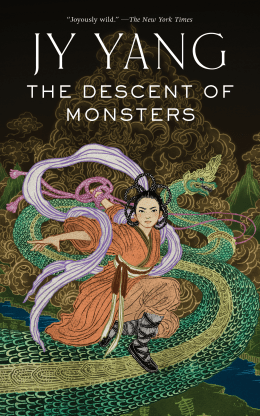 I was sent this as a review copy by the publishers, Tor.com. It will be available on July 31.
I could have had a review copy of Yang’s double novellas, The Black Tides of Heaven and The Red Threads of Fortune, but they came through when I was feeling a bit rushed and… look, I didn’t click the link, and I regretted it, ok? Because then they exploded and everyone was raving and I thought, yes I will get those eventually. And then I got the opportunity to review this sequel, and someone mentioned that not having read the first two made this one make less sense… so I bought Black and Red, and read those, so I could read this. Which is a long way around to say that all three of these books are excellent and amazing and you should definitely go buy the first two and then read this when you can. I do think that this one requires knowledge of the first two to make the most sense.
On which: in theory you can read Black and Red in either order. I read Black first and I cannot imagine doing it the other way around, maybe because my historian brain really insists on chronology. Your mileage, etc.
Tor.com calls this “silkpunk fantasy” which I guess is because it’s Asian-inspired instead of European-inspired. I don’t really know the origin of silkpunk, although I’ve come across it before (and yes I know silk originated in China). Interestingly, while I would classify it as fantasy it also has some elements of science fiction – this one perhaps more than the previous two – because one of the chief problems is that a research facility has committed atrocities and has also, um, kinda been destroyed. I don’t tend to think of people writing about research into magic-y sorts of things. (If you’ve got more recommendations about such ideas, SEND THEM MY WAY. Turns out this is something I really, really dig.)
This novella is written from a few different perspectives, using different styles – straight narrative, letters, official reports. The official investigation is being stymied because it’s not in the interests of the government to have it all come out, but the investigator refuses to give in. And this leads to characters from the previous novellas being dragged in, and wraps up some of the ends that I didn’t even realise were loose, especially from The Red Threads of Fortune.
Yang’s work is just… different from a lot of other stuff I’ve come across. The world building is fantastic – both the world itself, and the way it’s described. The characters are complex and refuse to be pigeon-holed; ‘diverse’ has almost come to be a non-descriptor, but it’s so relevant and important here. Motivations are complex, relationships are complex… it’s just great, ok? Black Tides is on the Hugo ballot this year. I won’t be surprised to see this on the ballot next year.
Underwater Ballroom Society
 On Galactic Suburbia a few weeks ago, Tansy mentioned that she was reading this anthology and that the first story had lots of references to rock and roll – much more my thing than hers. And then I saw Stephanie Burgis, one of the editors, talking about it on Twitter and, well, I managed to get myself a review copy. Whoo!
Over here at Book Smugglers you can find out how this anthology came together; basically, someone mentioned the underwater ballroom folly on Twitter, and BOOM.
Anyway, I quickly read the first story, and not only is it about rock music but it’s specifically about Robert Plant, of Led Zeppelin, which is only my favourite band ever AND I was about to go see Plant actually perform with his new(er) band, the Sensational Space Shifters. So I was in delighted stitches at all of the Led Zeppelin references throughout the story and basically that one piece is worth this entire anthology happening. But maybe that’s my particular bias shining through. Whatever.
The rest of the stories are quite different, with some not even being set on Earth; sometimes there’s magic, sometimes not; some are romantic, some are crime-solving, some are coming-of-age. The underwater ballroom is used quite differently, as you would expect, although it is pretty much central in all of the stories. It’s an enormously fun set of stories. Sometimes a themed anthology gets wearisome; that doesn’t happen here. I can definitely recommend it; it’s got a fairly diverse set of characters, too, which I liked. Give it to the older teen in your life who is getting impatient with everyday fantasy and fairy stories. And read it yourself, of course.
Time Was
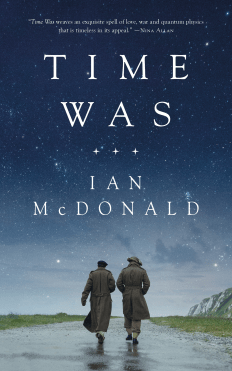
This novella was sent to me by the publisher, Tor.com, at no cost. It’s available from April 24.
I generally love Ian McDonald so when I found out Tor.com had bought one of his novellas I was pretty excited… and it is indeed excellent. It’s different from what I expected, although I don’t know what I expected, since Luna: New Moon is very different from The Dervish House, for instance.
The blurb calls it “A love story stitched across time and war, shaped by the power of books, and ultimately destroyed by it” and really I think you shouldn’t find out any more than that. The gradual unravelling of the mystery is part of the charm.
The story opens with a book collector and seller finding a letter pressed between the pages of a volume of poetry, and proceeds in fits and starts across time from there. It’s partly his story – of love and obsession and books – and partly that of the letter-writer. It’s about war and loss and love and obsession, and time. You’ll be a bit confused at first as the story skips to different times but it’s worth it.
I enjoyed the story that Emmett uncovered but I also really liked the way McDonald makes Emmett not just the finder of the story but gives him a story of his own – one that’s subservient to the mystery he’s unravelling not just for the sake of McDonald’s story but because he, Emmett, is obsessed. And has to deal with the consequences of that.
Definitely worth picking up when it’s available. A lovely story and beautifully written.
Octavia E Butler: Modern Master of SF
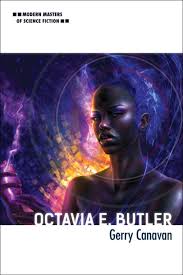 Gerry Canavan wrote a fabulous essay in Luminescent Threads about ‘disrespecting Octavia’ – about whether or not work in Butler’s archives that remains unpublished ought to be published now, against her wishes. It’s a thoughtful essay that acknowledges it’s not an easy question to consider, and makes the unpublished work sound fascinating while admitting its flaws.
I knew Canavan was writing a biography of Butler when we asked him to write for us, and I’d been meaning to get hold of it… well, all year. I finally did and I finally read it and it is exactly as wonderful as I had hoped.
To call it a biography isn’t quite accurate. It is that, to an extent; you certainly learn the outlines of Butler’s life, and Canavan is quite explicit in looking at the struggles Butler faced in finding the time to write, how much re-writing she did because she wasn’t happy with work at various points, and other aspects of her life like receiving the MacArthur fellowship and so on. But this is also an extended critique of Butler’s work – both published and unpublished, because one of the amazing things about this book is that Canavan had access to the many hundreds of boxes of papers that Butler left when she died so suddenly. They’re stored at the Huntington, and their finding guide alone is over 500 pages in length.
Makes me want to start printing out and filing emails.
Each of the chapters is based around a particular creative period in Butler’s life, which I liked because it foregrounds that the creative output is the focus of the book but/and that it happens in tandem with the actual events in Butler’s life. Canavan traces themes across her work, as well as the ways in which so much of her fiction (12 published novels and 9 short stories!) can be seen as connected to one another: through early drafts and plot ideas as well as the motivating ideas. It makes me desperately want to read some of that unpublished work when I read about what she was trying to do in them… although Doro/Jesus sounds a bit weird even for me.
This is not a long book and it’s not a dense book. It’s not a nitty-gritty, every-day-at-a-time biography, and it’s not a highly technical literary analysis – it’s far more approachable and engaging than either of those would be. This is a book for people who love Butler’s work and want to know more about her and her work. It works brilliantly.
100 Nasty Women of History
 This book was sent to me by the publisher, Hachette, at no cost. RRP $32.99 trade paperback; it’s available now.
This is a great idea for a book, obviously; it’s similar in concept to Cranky Ladies of History although with a more pointed political stick, given the timing.
So… look. I have a few issues with it. Some of these are particularly my issues and may not be a problem for other people. So let me start with the good things.
- There are women in here I’ve never heard of. And that includes in the historical section, not just in the more modern sections. That’s awesome. And is largely because…
- The women aren’t just European. That is also awesome. The opening section on Wonderful Ancient Weirdos includes Seondeok of Silla (Korea), Khayzoun (Yemen/ Baghdada), and Subh (Basque/Cordoba), as well as Sappho and Hatshepsut and others.
- It acknowledges some of the problems with sources, and that info about women can be hard to come at. Too true.
But. Hmm. I’m actually writing this review before I finish reading it, for two reasons. It’s going to take me a long time to read because each entry is only a couple of pages long, and I find that exhausting… and I’m not sure I actually will read the whole thing. But since I got it to review, I wanted to write something about it close to publication.
The above points are absolutely reasons to buy and flick through this book. It’s got a bit of swearing so it’s not quite right for ten year olds, but 15 years olds? oh yes. Do it. Have it on the shelf ready to pull out to point out just a few examples of women being awesome scientists or what have you. However… like I said. Some things rub me the wrong way.
- The introduction includes this: “Where there are mistakes, forgive me. I have done the best I can, and it turns out there is a lot of history out there which I have shoved into my eye sockets. processed through the lukewarm innards of my brain, and squeezed through my fingers. It’s inevitable that some things will have gotten lost on that perilous, squidgy journey” (4). And… it really made me uncomfortable. Why is she disparaging her intelligence? Why is she blase about mistakes? By all means acknowledge there may be some, and I know she’s being humourous, but this way of presenting just irked me.
- The first chapter is “Wonderful ancient weirdos”. I guess she was going for alliteration but these are powerful women she’s discussing, and she’s calling them weirdos? That’s sending the wrong message, in my book.
- Also on this chapter: ancient? Uh, no. Hatshepsut, sure. Sappho, yes. But Margery Kempe, Hildegard von Bingen, and the others are all medieval, or at best early medieval. These terms matter, for me, because the context is important. Everything before the Industrial Revolution is not ancient.
- I don’t love the language. No, this isn’t a tone argument. This is definitely the most idisyncratic complaint, and your mileage may well vary. For instance, Hildegard’s regime described thus: “The strict regime of the convent demanded that each day the nuns have… eight hours of manual labour, which entailed, I dunno, putting up retaining walls and stuff” (26). That’s irksome for me.
- Verging on not caring about historical accuracy: “This is my book, and everyone gets laid” (10), on whether Hatshepsut and her chief advisor were lovers. Just nooo.
- Historical accuracy again: I skipped to the chapter on Alexandra Kollontai, and I can’t tell you how pleased I am that she got a chapter! but it says that International Women’s Day was February 7th by the Russian calendar, in 1917… but it was Feb 23. That’s just careless. Also? “Sorry, New Zealand, I know you gave women [the right to vote] in 1893, but you’re just so little and far away” (376). Far away from whom? Are only Americans going to read this?
- The end of Seondeok’s chapter: “Ugh, men” (18).
- Also, they’re not arranged in chronological order, within their thematic chapters, and that drives me batty.
- Also not in order, this time alphabetical, is the Old People Glossary, which in itself (despite my comments on the language) is quote amusing. I’m fine with using modern slang in these sorts of biographies; I think it can make them much more approachable. But why, why would you not put the words in alphabetical order??
So… there you go. Decide for yourself how annoying these issues are vs having a handy reference to Kollontai and Rosa Luxembourg, Mergery Kempe and Sappho, Queen Nanny of the Maroons and Sojourner Truth, Hypatia and Nana Asma’u and 92 other women on the shelf.
Persepolis Rising
 I received this book from the publisher, Hachette, at no cost. It’s out now; RRP $32.99 for the trade paperback.
I love James SA Corey and his (their) capacity to write awesome words that simultaneously lift up the heart and rip it to shreds. Previously, on this topic, see these posts. If you’re already on the Expanse train, you don’t need to read a review; you probably already have a copy or you’ve got it lined up for Christmas or something. If you haven’t read them yet… well, if you’re into space opera and deeply compelling characters and an epic, long-running saga where the books get published on time (burn), and you’re not intimidated by this being book 7, you should just go get yourself Leviathan Wakes already and START READING.
I can’t talk about this book without spoiling the rest of the series. You’re warned.
… and further, perhaps with this book more than any other of the series, I can’t even really talk about the BOOK without spoiling it, and I want to give massive kudos to the blurb writer who managed not to spoil the first page which, folks, is such a game-changer that I had to re-read it a few times to actually grasp what it was telling me. My darling has seen the TV show and it’s killing me that I can’t tell him about the first page. This never happens, because we basically don’t ever read the same stuff, so I can spill my angst about characters or authors without spoiling him for things. But this time? Oh, no. Now he’s invested in the TV version and he doesn’t even want me discussing those things what happens to Miller.
So… the non-spoiler version is that as always we follow our redoubtable Roci and her crew. Unexpected and probably bad things happen to our solar system. I continue to really like Holden while simultaneously appreciating that he continues to be complicated, both as a person and in the way people view him; Naomi and Bobbie vie for my very favourite, while Amos and Alex aren’t too far off. I continue to want to be Avasarala when I grow up. I love the way that politics are presented – messy and fraught and difficult and lived-in and having serious consequences. This is not an easy future that Corey imagines for us. It’s just so damned human. Also, w00t for the Roman history overtones. There’s battles and there’s conspiracy and there’s making the wrong decisions and just being wonderfully human. Argh, I love it and it hurts my heart and I want the next book sooner than I’ll get it…
Spoiler below in case you’ve read it or don’t care…


