A biography of Olympe de Gouges
 Since I started learning about the French Revolution I’ve been fascinated by the women involved in it. The workers Pauline Leon and Claire Lacombe, the intriguing Theroigne de Mericourt, and of course Olympe de Gouges – who wrote the Declaration of Rights of Woman and the Citizeness, in answer to the Declaration of the Rights of Man and the Citizen. And ended up getting executed. There’s not a whole lot about Olympe in English, which I think is an absolute travesty, so when I went on a bit of book-buying spree of revolutionary books and came across this one, I decided I needed to own it.
I should have paid attention to how long it was. It’s only 100 pages of text, and given it cost $66 I’m a bit grumpy. I may still have bought it, but probably as an ebook instead.
I’m also a bit grumpy because of the content. Partly I’m sad because the translation isn’t excellent, so there are bits where I’m not sure if a sentence is a translation issue or a writing issue. Partly I’m annoyed because I think it would be very difficult to read and really get this book without knowledge of the French Revolution. That makes it inaccessible to people coming it at from a feminist history perspective rather than a French Rev one, which is doing Olympe a disservice. I would really have liked to see Mousset lay out more of the context of the revolution than simply mentioning some of the events that were happening around Olympe’s life.
Mostly though I’m dismayed at some of the ways that Mousset talks about Olympe’s life and writing. Some of this comes out of currently reading Joanna Russ’ How to Suppress Women’s Writing, as part of our Galactic Suburbia one-chapter-per-episode readalong. One of the things that Russ identifies is the idea that women’s writing is inherently personal, or autobiographical. Mousset frequently sees Olympe in the characters of her plays, and suggests that she is interested in the right of illegitimate children because she is one, in divorce because of an unhappy marriage, in housing for the elderly because her mother died destitute, and so on. As if it’s not possible to care about those things without some personal connection. I’m not denying that those issues may have played a part, but to suggest that this woman – who was clearly driven, intellectual, and passionately interested in making society a better place – was only inspired by things she experienced greatly weakens her commitment.
And then there’s the way that Mousset talks about her writing: “Her lack of culture forced her to constantly make reference to herself” (p31) – which I just don’t understand as a concept, and aren’t we all still in admiration of Shakespeare for probably not having the greatest education early on? Olympe explicitly presents herself in her writing at times, downplaying her achievements – but couldn’t this just be seen as a pose? Check this out:
“I haven’t the advantage of being schooled, and as I’ve already said, I know nothing, I will therefore not use the title Author, although I’ve already presented the Public with two plays, which it was kind enough to welcome. And, unable to imitate my colleagues in their talent and arrogance, I shall listen to the voice of modesty, which suits me in all respects.” (p33)
Doesn’t that just scream Olympe playing the pose of modest woman (which she was accused of not being), but also having a dig at male ‘colleagues’ for their arrogance? Maybe there’s extensive French scholarship to suggest that Olympe was always excruciatingly honest and never played a pose, but right now I’m not buying it. And Mousset follows up this quote by saying that “If there was one thing that she was absolutely not, that was modest!” – which… do we care? Would we make the same comment of a male author? After another passage where Olympe talks about her achievements, or lack of, Mousset says “It’s obvious here that Olympe is mocking herself” (p34), but again I can’t help but wonder if it’s all a pose to get the audience on side. And my irritation is compounded when Mousset comments that “If her lack of humility still seems irritating today, imagine how exasperating she must have been at the time!” (p37, my italics). To which I have no answer because I’m gobsmacked.
Olympe, writing and politically active in the late 1780s and early 1790s, seems like a forerunner of second wave feminism: “Whichever barriers may be encircling you, it is in your power to emancipate yourselves from them; you only have to wish to do so” (p1) – pretty sure enslaved women on what would soon be Haiti wouldn’t have agreed with this sentiment. (It should be noted that Olympe was passionately anti-slavery, to the point of one of her plays being banned for its anti-colonial message.) Mousset does present Olympe’s achievements in terms of her plays being performed, and outlines some of the ways in which she was involved in politics and Parisian society. Partly because she was a moderate in many ways as that became increasingly like an anti-revolutionary, and probably also because she was an outspoken woman, Olympe eventually ended up on the wrong side of the people in charge, and Mousset presents Olympe’s final two years quite well.
For me, this feels like an extensive early version that could easily be twice as long with added commentary on the French Revolution to give Olympe greater context. I do like the way that Mousset presents Olympe’s most well-known work today, the Declaration of Rights of Woman and the Citizeness, with some commentary on the way Olympe changed the wording from what had been adopted by the national government. But I’m not sure I could recommend this to someone – certainly not as an entry to the world of women’s involvement in the Revolution. (That book is Liberty: The Lives and Times of Six Women in Revolutionary France, By Lucy Moore.)
Icefall
 I do not love mountaineering. I do not like watching it, I do not like reading about it.
I loved this novella.
(Note: I am friends with the publisher, but that hasn’t impacted on my attitude.)
There is SO MUCH going on in this story, I’m not sure where to start. Obviously I’ve started with the fact that it involved mountaineering… but that doesn’t tell you much. This isn’t just a story about climbing mountains, it’s about an unbeaten mountain on a harsh planet, and it’s about the joys of climbing as well. I don’t understand those joys, but I got a glimmer of an idea about them from reading this.
There’s only so much mountaineering I would read, though, even from the greatest writer. What really sucked me in here is both the relationship between the characters and the voice of the narrator herself, Aisha. Her relationship with her wife, Maggie, seems straightforward and then slowly reveals all of those complexities and unexpected difficulties that characterise real relationships. Their interactions were loving and troubling and selfish and selfless… how they would react to each other was always a bit ambiguous, to me, and that definitely contributed to the tension.
Aisha, as the narrator, is the person in whose head the reader spends most time, and she’s an appropriately complex person. I loved that Gunn gives us flashbacks to establish a pretty profound backstory for her after we already have a sense of what she’s experiencing in the now. She’s dealing with old injuries – mental and physical – and she has to watch her beloved risk herself on that damned mountain, while also carrying around some old guilt and questions about identity and worries for the future. Basically I just wanted to sit there and pat her hand to make her feel a bit better about the world.
This is a novella, so it doesn’t take long to read. Which is a tragedy, but it also means it’s tightly paced – a few slower, character-driven parts, but always with the knowledge of time passing urgently in the story’s now. Gunn has put a lot of thought into the universe-building that just gets lightly touched on – just enough to make this seem very well-realised. I can well imagine more stories in the broader universe… and possibly more set on Icefall itself. Which I would read, but I may need a bit of space before doing so.
Definitely recommended. Buy here.
The Brink of Darkness
 This book was sent to me by the publisher, Bloomsbury, at no cost. It came out in August; $16.99.
I read the first book in this series, The Edge of Everything and according to my review I largely enjoyed it – I have to say I’d mostly forgotten the book by the time the sequel arrived. If you liked the first one you’re likely to enjoy this one, I think. If you’re not sure, then I have one word for you:
MELODRAMA.
Everything is DIRE and potentially life-altering and epic. X has gone; oh no! My friends are unhappy with me; oh no! etc. I did end up getting impatient with the book – mostly with the characters, but I wonder if it’s actually a pacing issue. Maybe I wouldn’t have had the time to roll my eyes at the melodrama if things had moved faster?
Spoilers for the first book
X is back in the Lowlands and of course things have changed because not only does he want to find his mother, but he also wants to be back with Zoe. Mild spoiler: I found the whole ‘searching for his mother’ thing overdone. There were definitely moments where I thought if he’d asked a different, obvious-to-me question, things would have been different. I also thought some of the revelations about the mother were a bit… meh. Unlikely, or unnecessary.
Zoe is still with her family but her house has been destroyed and she also has to be honest with her friends. I found some aspects of Zoe’s life believable but others not – there was veering between responsible and not that annoyed me.
Look, this isn’t a hard book to read, so it’s not like you’re devoting days of your life to it. I did end up skimming some sections because the conversations got a bit boring and I just wanted to find out how things resolved. But I am also not going to tell someone not to read it: it’s not terrible, it does have interesting and somewhat diverse characters (ish), and it has some interesting things to say about family and friendship that I largely liked. So I didn’t love it but I also didn’t loathe it. Ultimately it’s not really a book aimed at me – I am too old and have rarely enjoyed the sort of over-the-top drama this revels in, even when I was the age this is intended for – and that’s perfectly ok.
The Silence of the Girls
Perhaps unsurprisingly, my mother knows me very well. For my birthday this year, she sent me a book about the science inspiring Shelley’s Frankenstein, and Pat Barker’s The Silence of the Girls. Which I had never heard of but is described as telling the story go The Iliad through the voices of Briseis and other women.
 YES!
YES!
Spoilers, I guess, for the story of The Iliad. I mean it’s been 2500 years or so, but I guess not everyone knows who dies…
A version of The Iliad from Briseis’ POV is different from, for example, that told by Cassandra or Helen. I think this is a marvellous idea, since she’s right there at the heart of the quarrel that is itself the heart of the problems in this story. And the first part is largely what I was hoping for. It starts with Briseis being captured, along with other women, and there’s a marvellous moment where she looks at a slave woman who looks back, and Briseis knows she is thinking ‘now it’s your turn.’ And Briseis knows that’s fair, because she’s never given much thought to the slave women in her life, who themselves have been captured in war. She and the others get carted off to the Trojan beach, and she’s handed to Achilles, and she experiences the life of a slave woman. There are some remarkable moments where she reflects on being a thing, and how she finds it hard herself to think of herself as anything but a thing.
And then. Sigh.
After Briseis is taken from Achilles and given to Agamemnon suddenly we get these sections written from Achilles’ point of view. I’m confused and disappointed. I understand the need to examine that all-important turning point of the story, but why does it have to be through the words of the fellas who’ve always been the ones telling the story? The title of the novel itself starts to seem a bit of a mockery. Couldn’t Barker have inserted some other unnamed slave girl to tell the story that she watches going on in the tent, while cleaning up? Or couldn’t Briseis have heard patches of the story later – she does marry one of Achilles’ companions – and have that patchwork nature of the narrative be a feature? If the death of Hector could be told from inside the weaving room rather than being viewed then I don’t see why we had to be taken into the lives of Patroclus and Achilles and see it from their point of view. And the women find out about the death of Achilles from the wailing on the battlefield – it’s not like they have to view everything to know it! In fact couldn’t that be part of the exploration of the nature of being female, and a slave, in this context?
I think an exploration of masculinity through the lens of the Achilles/Patroclus friendship would be deeply interesting, told well, that is not the story for a book called The Silence of the Girls.
Another minor quibble is that this book is not sure what it thinks of the gods. I am reminded of the film Troy (which I quite liked, fight me): it only shows Thetis, and it hints at her connection to the sea but not her divinity, so it’s definitely a story about humanity men. Here, though… the plague is probably because of Apollo but not definitely. There’s a line about Athens wrapping Achilles in her aegis but it’s unclear whether that’s meant to be read metaphorically. But Achilles is seen as the son of a goddess and Thetis is definitely one, having gone back to the sea when Achilles was a child (also it’s partly her fault he’s a bit of a psychopath), and she really does come out of the sea at Troy. So the gods are real but not especially involved? And there’s no comment from Briseis or others about whether the gods can be trusted or whether slaves just don’t get to call on deities and expect to be heard.
With the sections from Achilles’ perspective, the book verges on becoming just another retelling of the story rather than keeping its promise of exploring the consequences of war for women. It definitely does do some of that exploration, and more than half of it is from Briseis’ perspective (I estimate). But by shoving Achilles back into the story that he has always dominated – and not even to reflect on Briseis et al, which would have been startling and perhaps worthy – Barker undercuts her own apparent intentions of allowing the previously silent girls to speak.
While it’s beautiful work I am disappointed.
Dark Emu
 Every non-indigenous Australian should read this book.
I would hope that an indigenous Australian read this book would experience a lot of punching the air and YEAH! and “that’s what grandma/uncle/cousin always said!” moments. I fear, though, that instead there would be a lot of anger (‘why weren’t we told?’), bewilderment (ditto), dismay (ditto, and ‘where is it now?’) and sheer sadness for what’s been lost – physically, and as knowledge – and for what’s been taken away.
People like me – not indigenous, benefiting from ancestors who colonised this land, taking it away from the original owners – should be humbled to learn what was here for tens of thousands of years, which we then screwed up, and denied knowledge of.
Dark Emu is Bruce Pascoe’s exploration of the evidence that Aboriganal Australians had far more agricultural experience, knowledge, and activity than tends to be acknowledged in the standard Australian story. The general line is that when the British arrived, they found nomadic inhabitants who followed game and picked fruit from trees. More recently, you might hear people talk about Aboriginals using fire to move game or set up places where game would come for easy hunting. Pascoe shows that the agricultural acitivites of Aboriginal Australians went far, far beyond that.
As as historian, I really liked the way Pascoe built the evidence for his argument here. One of the things that’s often said about it being hard for writing pre-British invasion history is that the original folk left so few records, and because modern white historians privilege writing. Pascoe does multiple things to that. Firstly, he discusses the archaeological record, which is there if you accept what you’re looking at. Secondly, he shows that there is writing to be used: it’s the journals and letters of white explorers, who simultaneously recorded what they saw indigenous Australians doing and denigrated them. And thirdly, he makes some excellent points about how modern writers categorise societies and civilisation. My favourite bit is in talking about the use of pottery. Just because ancient Greek, Roman, and Chinese civilisations used pottery doens’t make pottery a marker of civilisation… it makes pottery a marker of those civilisations, of a particular way of doing society. And Pascoe quotes Bill Gammage in drawing a distinction between farming, and being a farmer: “one is an activity, the other a lifestyle” (14). Brilliant.
I also want to mention how much I appreciated and enjoyed Pascoe’s style. This is not a dry historical account, with the author attempting or pretending to absent himself from the discussion. Instead, Pascoe is very much present – commenting on where sections have been updated with further information from various sources, pointing out how Australian farmers could benefit from the knowledge of how Australian Aboriginals did things, occasionally making snarky comments about the explorers’ notes. It’s a very honest history, since no author is truly objective and aloof from their topic.
Before the British arrived, indigenous Australians had extensive methods to cultivate food, both on land and as aquaculture; they had various means of preserving and saving food for later; and they lived in houses of various construction types. That most Australians today don’t know this is because things were destroyed by squatters or ignored by archaeologists, historians, and others. This book is an incredibly important addition to the way Australia today should view its past, and consider its future.
A Winter’s Promise
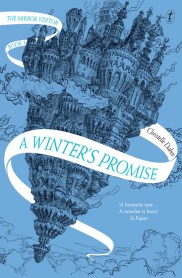 This book was sent to me by the Australian publisher, Text Publishing, at no cost. It’s out now; $22.99 for the paperback.
I’m torn. I really am. I read this in a Sunday, because it’s fairly well paced and most of the writing is quite lovely (which means kudos to Hildegarde Serle for the translation – there are a few clunky bits but I’m not sure whether that’s the translation or the translation, if you know what I mean). I really like the idea of the world – broken somehow, humans surviving on ‘arks’ that appear to floating (??) above the remnant of the Earth. And humans mostly have some sort of mind-powers, and there are ‘family spirits’ who appear to be the original settlers of these arks? or something, that’s not explored yet. (I haven’t read many reviews but I haven’t seen anyone compare it to NK Jemisin’s Broken Earth series yet – the books themselves are very different but there’s something of a parallel in what seems to have happened to the original Earth). I liked the main character, Ophelia – I’ve seen some dissing of her, and I get where most people are coming from, but I mostly enjoyed her and her flaws: her clumsiness has a cause, rather than being meant to be just an adorable trait, and she largely bears up under the weight of being pushed around by everyone. Yes, she’s often passive, but I sympathise with that in the context – she’s terrified, mostly alone, and kept ignorant. (There’s a similarity between her and Jupiter, from Jupiter Ascending.) Those things are others’ fault, not hers, and she does try some things to improve her situation. Also, she keeps regretfully thinking that she just doesn’t love her (arranged) fiancé, and I’m madly hoping she’ll be accepted as asexual and aromantic. There are some interesting other women in the book, but I can’t figure out how I feel about them mostly being various sorts of horrible, mostly revolving around being selfish.
So there are definitely good bits. But.
I do not agree with Elle, saying that this belongs on the same shelf as Harry Potter.
Firstly, pretty much everyone seems to have milky white skin. Not everyone’s skin tone is mentioned, so maaaaybe we’re meant to be that there’s not-white people? But that’s a pretty big stretch. And we’ve only been to two different arks so maaaaaybe there’s racial segregation? But that would also be problematic and it hasn’t been mentioned in this book and… yeh. It is disappointing to read this in a book today.
Then there’s the intended audience. This is being talked about as a YA but there’s a character who frankly declares his intention of seducing and ‘deflowering’ Ophelia because of being Thorn’s fiancé and… that’s not really called out. Sure, talk about sex in the book, and portray it as problematic even, but – that’s an adult man, a lot older than Ophelia, planning her seduction because that’s all he does with women. And that, friends, is gross.
On which topic: there is no romance in this book. Anyone who tells you otherwise read something quite different from what I did. I assume people are reading one of the characters as being a bit Mr Darcy, but… no.
I can’t help but wonder whether the people who are raving about this being something new, and unique, have read very much YA. The world is definitely lovely and intriguing but it’s not unique. The plot is a coming-of-age story – which I adore, but um is not unique. And so on. I’m not cautioning against reading this (unless the bit about the older man planning to seduce the young woman creeps you out which I would totally understand), but neither am I going to be seeking out the sequel.
Restoration: Angela Slatter
 This book was sent to me by the publisher, Jo Fletcher Books, at no cost. It was launched just a week or so ago – hooray!
I’m going to be smug and say this is actually the second time I’ve read this, because Slatter sent me a very early version which, as I say, makes me feel very smug indeed. I’ve loved Verity since I first came across her many years ago in the Twelfth Planet Press anthology Sprawl; that short story, “Brisneyland by Night,” morphed into the first book in this trilogy.
This post will contain spoilers for Vigil and Corpselight (which apparently I didn’t review?? What even, PastMe??). If you like urban fantasy, if you like banter, if you like angels and sirens and Weyrd and weird things, you really should just go and get them. Also it’s set in Brisbane, and I don’t know Brisbane but it seems to make an excellent backdrop for these shenanigans.
So. Verity has made a deal with a broken angel in order to save her mother, newly back from the apparently dead, and the rest of her newly created family. She has had to give up her job working as the go-between for the Weyrd and the normal, there are several Weyrd who loathe her, and the angel has stuck her with a sidekick-cum-informant who has been responsible for several atrocities in Verity’s life. So we just know that it’s going to be a bumpy ride, and of course that’s the case. Not that I was able to predict any of the narrative beats; it all took weird and wonderful turns, for Verity and for Brisbane and for the whole set really.
I continue to adore McIntyre. Also her police sidekick. And Ziggi. Also the sirens in general. … ok, so I just really like this whole crew, and I want to eat the food served by the Norns. But I do not want to actually live with any of them because that just seems like a recipe for disaster.
This is a fine end to the trilogy, if it has to only be a trilogy. Because delightfully there are definitely signs that there could be a book four, which I HEARTILY APPROVE. Also there is looots of room for short stories to fill in a whole bunch of back story. JUST SAYING.
Highly, and happily, recommended.
Early Riser: Jasper Fforde
 I received this book from the publisher, Hachette, at no cost. It’s out now; RRP $29.99.
If you tried reading one of the Thursday Next books and you hated everything about the whimsy of Fforde’s alternate world, just stop reading now: this book won’t be for you.
If you quite liked the early Next books and got a bit sad as they got sillier, keep reading.
If you’ve never read a Fforde book, you can keep reading too.
And if you’re a hardcore Fforde fan who’s been waiting… and waiting… and waiting for the sequel to Shades of Grey… well, this isn’t it, but it does mark Fforde’s return to writing after a hiatus of a few years, so: maybe it will arrive at some point?
This book is immediately recognisable as part of Fforde’s very particular way of constructing alternate worlds. There’s just enough recognisable from our world – what else would a Welsh near-zombie play but a Tom Jones song – but with some completely and wildly different things thrown in. In the Thursday Next world, the Crimean War never ended, and genetic manipulation means people have dodos as pets. Here, humanity hibernates. The vast majority of the population packs on fat, grows a winter pelt, and sleeps away the winter. Except, in more modern times, for the Winter Consuls – and a few dangerously antisocial types. The Winter Consuls help to keep things running through the winter; like keeping the antisocial types under control.
Charlie is the focal character – he’s just joined the Winter Consuls and is, of course, discovering that everything is not as it seems (whatasurprise). Through Charlie as novice, the reader learns about the Winter and how to survive, as well as about Morphenox – the drug that helps with hibernation, preventing the previously hideous losses, although only if you can afford it – and the various criminal and/or mythical types who also stay awake through winter. Oh and this isn’t just the winter of our world; this is the sort of winter that means mammoths are still alive and well. And global warming will mean something rather different.
It’s a very silly book in a lot of ways. There are silly/amusing jokes riffing off contemporary culture, and for some reason a massive painting of Clytemnestra. But at the same time, Fforde touches on all sorts of intriguing social ideas that might come about because of the hibernation – or simply from different ways of doing things. Like mandating childbearing, but providing the option to pass that responsibility off – to the willing or the desperate. Loss of population from hibernation means that society has developed coping mechanisms such as requiring every citizen to have at least general capabilities, and significant infrastructure to be commensurately accessible to those with those capabilities. Which does interesting things to notions of mastery, I think, although that’s not a huge part of the story. There’s clearly different things going on in terms of international politics, too, but it’s barely touched on.
I feel that Fforde is quite a divisive author. Readers are either willing to go along with his particular method of looking at the world and enjoy the ride, or the first couple of pages will make you angry or annoyed or bored. In general, I really enjoy his work. I think that milking too much out of one of his worlds leads to problems like the later Next books where things went beyond my tolerances – but that’s true of a lot of sequels. Fforde is doing what the best SFF does: making tweaks to the world and showing the consequences, and making the reader think about how those things reflect the world in which we actually live. And if there are jokes about ‘Winter cutlets’ and Carmen Miranda along the way, I’m up for it.
Too Big to Walk
 Buy this book, my beloved said. You love dinosaur science, he said! It’ll be great, he said.
I do love dinosaurs. I was intrigued by the ideas that Brian Ford presented. But I did not love this book. This book is at least three books, maybe more, in one. I’m not sure Ford realised that.
The blurb says that the book “reviews the latest scientific evidence” about dinosaurs to suggest that a lot of things palaeontologists are presenting “are no more than convent fictions.” Whoo, way to go with the controversy. And I would have loved the heck out of a well-argued, well-presented, scientific book about that. In fact, I did love those 80 or 100 pages of this 450-odd page book. But that leaves another 350 or so pages.
In those pages, Ford is doing something completely different. For a start, he’s presenting a history of how humans have interacted with dinosaurs – that is, a history of palaeontology, complete with the theories about some bones belonging to giant humans of the past and so on. Fascinating! but so totally irrelevant to a scientific book about dinosaurs that, to use an in-joke, it’s not even wrong. And then there’s the section on the discovery of continental drift and tectonic plates and so on. Also fascinating. In fact, I think I’ve read a book about that already. This time, not quite so irrelevant to a book about dinosaurs – Ford’s theory is that dinosaurs lived by wading in shallow lakes, and they went extinct with Pangea breaking up and the climate changing and the lakes evaporating – but it didn’t need 50 or so pages on the topic. It definitely didn’t need the entire history lesson on the topic; just a page or two on the facts would have been quite sufficient.
Lastly, there’s also an irritated article for a science journal lurking in here: one which details the ways in which Ford has been ignored and calumniated by the scientific world (in his view). I think that calling out established science, when you have a solid theory that fits the evidence, is a necessary and reasonable thing to do. Maybe it would even fit into a book about that new and exciting but controversial theory. (I’m no palaeontologist but Ford presents a compelling case that should surely actually be considered. But I don’t think it’s presented well here – in that I think it should have been more clearly separated out from a discussion of the science.
So. The theory is really interesting, and if what he says is true – like the astounding energy required to pump blood up to the head of one of those enormous herbivores with super long necks – then I’m not going to be surprised if in a couple decades it’s the standard, or at least viable, way of talking about dinosaurs. But this book was incredibly frustrating because it just didn’t know what it wanted to be.
The Buried Ark
 This book was sent to me by the publisher, Pan Macmillan Australia, at no cost. It’s out now.
This is the sequel to The Silent Invasion, which I’ve previously reviewed. It was excellent, which is why I was excited about getting this to review, and it lived up to expectations – in terms of suspense and character, anyway. I had no idea, and no expectations, about where the plot would go; as it turned out, I wouldn’t have been able to predict it even if I’d tried.
If you haven’t read The Silent Invasion, you should go off and do that. All you need to know is that it’s set in a very familiar Australia, except that spores from Somewhere Else have been infecting and affecting regions of the globe – starting in the tropics and moving to the temperate zones. Flora and fauna are being Changed, and so are humans. In response, in Australia, there are no-go zones and suspicions of people who might be affected. The central character, Callie, is trying to look after her little sister Gracie, who has somehow been infected. The book ends on an epic cliffhanger, hence my excitement about getting this book to resolve it. You really don’t want to read this without reading the first book; but it’s only around 250 pages, and it’s YA so it’s super fast-paced, and it’s definitely worthwhile.
Spoilers for those who’ve read The Silent Invasion
So, that cliffhanger! I’d forgotten exactly what had happened, at the end, so I re-read the last chapter before starting this sequel – which was an excellent idea because the first page is basically the next second after the last page of the first. Which I quite like, except it does make me curious about why they are separate books. I guess 500 pages are harder to sell to a YA market? Anyway: briefly things seem like they might be okay for Callie, even though she’s lost Gracie and Matt, but – as I’m sure you kinda expect – things do not eventuate into a happy garden of joy. Whatasurprise. Callie ends up heading back out of the Zone, which then becomes a ‘from frying pan into fire’ scenario. And then… well, it’s a little spoiler, but it’s a frying pan to fire to slowly boiling pot of water scenario: you know, where you don’t realise initially that things aren’t great until the water starts really heating up around you? Yeh. That. Callie meets new people, learns of new ways of trying to deal with the Change, briefly feels like life may actually go ok. Poor Callie.
There are more women in this novel than I remember from the first, but that may just be my memory; certainly Callie was moving relatively quickly, so she met a lot of people but they haven’t all stuck in my mind. She doesn’t meet that many of her own age, but that makes sense in the context of where she is. There’s one person that really sticks with me, because of his name: Dr Omelas. If you know Ursula Le Guin’s work, that may give you a slight idea about the sort of thing he’s involved with… if you have no idea what I’m referring to, don’t worry, it won’t affect your enjoyment of the story!
If you enjoyed The Silent Invasion, you definitely want to keep reading the trilogy. Go grab this! Support Australian authors!


