One Small Step
Soooo this anthology came out in 2013 aaaand I’ve only just got around to reading it. Um. Oops. I have no excuse for this. It just didn’t happen.
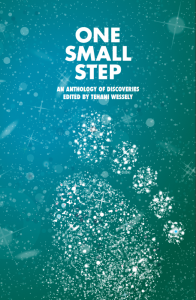 In my defence I read the whole thing last Sunday. That counts, right?
The subtitle is “An Anthology of Discoveries” and what’s really interesting is that this is such a broad anthology but yes, the theme of discovery – of place, or self, or strangers – is the unifying factor. Sometimes it’s obvious and sometimes it’s subtle; sometimes there are world-shattering consequences and sometimes not so much.
The other superbly interesting thing about this anthology is that it’s all women. From memory of Tehani discussing the process, pretty much accidentally so. And it’s not all just dresses and kissing! (Sorry; /sarcasm.) It’s basically a who’s who of established and emerging Australian writers, too, which is a total delight.
Some of these stories really, really worked for me. Michelle Marquardt’s “Always Greener” is a lovely SF story that ended up being simultaneously darker and more hopeful thanI expected (yes that’s a contradiction, too bad). And then to have it contrasted with the fantasy of Lisa Hannett and Angela Slatter’s “By Blood and Incantation” – which is not my favourite HannSlatt but is still quite good – neatly skewered expectations that it was going to be an SF anthology, pointing out that ‘discovery’ is a mighty broad concept. And then “Indigo Gold” by Deborah Biancotti! Detective Palmer!!! and !!! The Cat Sparks story is awesome (it feels like ages since I read a Cat Sparks story), Penelope Love is quietly sinister in “Original,” Faith Mudge does fairy tale things beautifully in “Winter’s Heart.” And the final story, “Morning Star” by DK Mok, is a magnificent SF bookend to match Marquardt but on a much grander, more extravagant scale.
This is a really fun anthology and I’m sorry it took me more than a year to read it. You can get it right here.
Drowned Vanilla
I read it in a day.
 I gave it to my mother for her birthday; she had previously loved A Trifle Dead. About this one, she says:
I was thoroughly entertained by this latest book from Livia Day. I appreciated her heroine’s inability to combine detective work, cooking skills and a complicated love life with aplomb! The plot kept me interested to the end; the recipes for summer drinks, gelato and ice cream almost made me want to spend more time in the kitchen, and her dealings with Bishop and Stewart made me want to take her aside for a maternal chat.
It’s just the sort of book I like for holiday reading while watching the cricket – enjoyable with no necessity for deep thinking!
Oh Ma.
As for me… well, I have moved somewhere and have room for some frivolous things, and after reading this I decided that yes indeed I did want an ice cream maker. I will, however, be making neither beer ice cream nor Shay’s butterscotch, for completely different reasons.
I am not maternal and so did not have the same reaction as my mother; instead it had me reading with one eye metaphorically closed as I waited for something to go deeply wrong.
As to the plot – I know I am no author when I hit the twists and turns and I am utterly amazed at the devious brain that comes up with the sorts of things that happen to Tabitha. Poor lass. Livia, you are So Mean.
Hobart and its surrounds come to life beautifully, if not quite as much a part of the plot as in A Trifle Dead. There is a love of food, a love of friends, and a general love of life evident in this book. Hugely enjoyable. You can get it from Twelfth Planet Press, hard copy or ebook.
Jean-Paul Marat
There are probably three figures in the French Revolution who most fascinate the well-informed everyperson. Georges Danton is my absolute favourite, for a bunch of complex reasons. Maximilien Robespierre is the one that a lot of people know of and blame for the Terror. I’ve read biographies of both of them in the last f ew years. And then there’s Jean-Paul Marat, often regarded as the epitome of demagoguery, inciting the poor uneducated masses to insane levels of violence.
 I’ll start with a drawback of this book. The first is a direct consequence of its size: at 155 pages, there’s not room to go into great detail about very much (Conner neglects to mention the massacre of the Swiss Guard in the second storming of the Tuileries, which struck me as odd but I’ll concede it didn’t directly have much to do with Marat). Unfortunately this is hard to remedy, as he himself points out that there are only two other biographies of the man in English – he wrote one and doesn’t think much of the other.
Something else that might be considered a drawback but which I found deeply interesting is the author’s perspective. This is a drawback if you forget that (or were never taught that) every historian does have a perspective, and they bring that to their writing. Conner brings this issue to the very front of this short biography by spending the introduction skewering the perspectives of earlier historians and the way they have treated Marat; he shows – convincingly in most cases – that the bad press regularly regurgitated about the man is fallacious and based largely on anti-Marat propaganda, and/or others’ political convictions (a favourite line: “The episode reveals nothing about Marat, but a great deal about how historians allow their social prejudices to affect their judgement” (p5)). There’s also an amazing excerpt from 1919 wherein Marat’s insanity is affirmed and then a comparison is made to contemporaries who parallel him – like Bolshevik sympathisers and women who “have failed in woman’s first and natural function” (p6). I laughed, I cried. All of this is matched by Conner’s own attitude, which is not really spelled out but nonetheless comes through clearly. I can’t imagine how this book was received by conservative Americans. The final pages imagines Marat’s ghost questioning the legacy of the French Revolution. His big thing (according to Conner) was the idea not just of political and legal equality (thanks to the French Revolution, at least in theory TICK) but economic and social equality – hence his championing of the sans culottes. Conner’s last paragraph reads:
Marat would surely be shocked and dismayed to learn that after more than 200 years his struggle for social revolution had lost none of its relevance and urgency. Where is the People’s Friend now, when we need him? (p155)
I can understand some people being dismayed by this authorial intrusion. But if you hadn’t got that Conner is a bit of a radical himself, then you haven’t been reading very carefully. And if you’re reading the biography and being dismayed by Marat’s politics, then you’re probably not going to agree with this anyway (NB I don’t mean his methods but his ideology).
This is a wonderfully readable biography of a quite astonishing man. Marat was a doctor and an experimental physicist and a journalist and a politician and an intensely passionate advocate for social change (even before the Revolution). He dealt with a chronic skin disease (it’s apparently unclear what this was), and police harassment (occasionally warrants were for possibly-real issues, sometimes it was plain censorship and targeting). He was too radical for his times and thus often a voice crying in the wilderness; he would still be regarded as too radical, I would suggest. Conner sets out his life neatly and clearly. There’s just enough detail about the French Revolution that I think you could read it cold… but I know too much to actually be a reliable judge of that. I’m really glad to add this aspect – the man who was revered by much of the menu peuple, who too often get ignored even in histories of the French Revolution where they had a fundamental role.
The Lies of Locke Lamora
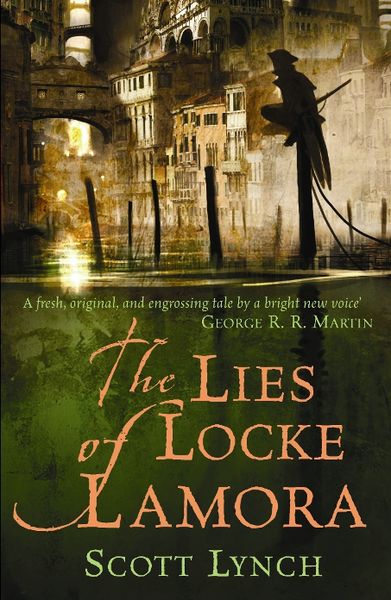 This has been on my radar for a while; when I finally added it to my Goodreads page, Katharine went a little mad and next thing I know it’s appeared in my mailbox.
Some slight spoilers below, although not that many and none too significant.
It took me about 4/5 of the book to figure it out, but finally I realised what Camorr reminds me of: it’s Ankh-Morpok at its grimiest. Maybe Ankh-Morpok crossed with Gotham? All the inhabitants are human, but it’s got that chaotic mad feel that Ankh-Morpok has… without the cheerfulness that Pratchett adds. The grimdark version of Ankh-Morpok? Dare I suggest the more realistic version of Ankh-Morpok… So anyway, I quite liked Camorr, although it’s not as ‘original’ as the George RR Martin quote on the front might suggest. This isn’t necessarily a bad thing – originality is great of course, but building on others can be too. I am also a bit puzzled about the inclusion of the ruins of some long-forgotten alien race. Yes they add to the cityscape, and the idea of Falselight is really cool, but I was kinda expecting a bit more to be made of the Elderglass. Actually I was expecting that Locke was going to be a descendant of that alien race (spoiler! he’s not… well ok, there are apparently another six books after this, so maybe that’s a reveal in the fifth?). So… yes, it’s cool and it does add to the knowledge that this is a complex and complicated world and Lynch has given it great thought. But there was both too little info – who were they? how long ago are we talking?? – and too much info, because there were these teasers all throughout about the glass (can’t be broken, except there’s this one Broken Tower OOOooh, etc).
Is it passé of me to comment on the laydees? Or, let’s be honest, the lack thereof. Locke’s ladylove is mentioned a couple of times – very much in passing – and is completely forgotten for more than half the book. That bugged me. I loved that there were what I think of ‘incidental women’ – guards and merchants and criminals were just as likely to be women as men, but the ones that Locke and his Merry Band of Bastards interact with are almost always men. There are two significant female nobles, and they are awesome and get to be competent and I like them a lot. Buuuut… it could have been better.
So far you might be thinking that I didn’t think much of the book. Actually, I really enjoyed it. Like, a lot. Someone suggested it was an Ocean’s 11 kinda story, and it definitely is – except see that comment about missing the cheerfulness of Pratchett? There are some magnificent one-liners, and the variety of hustles are breathtaking and occasionally hilarious, but this definitely falls on the grimmer end of the scale. It’s a bit of a spoiler I guess, but… people die. I hadn’t really expected that, with my George Clooney/ Brad Pitt expectations. Talk about a kick in the guts.
The plot? It’s a con. There’s one con that threads through the entire thing, and a number of others that crop up. There are external things that get in the way and need to be dealt with; there’s everyday life, there’s death and mayhem, there’s revenge and pain (lots of pain), no romance and a lot of bro-bonding. Oh, so much dude-platonic-love. The ties of brotherly love have rarely had their praises such so highly… and I’m not even being sarcastic at this point.
The protagonist is, of course, Locke Lamora. He’s in the line of Miles Vorkosigan and other such brains-over-brawn heroes: he can hold his own in a fight but he’s not really very good at it and ends up with a lot of cuts, bruises, black eyes and a serious lack of blood at various points. But of course he makes up for it with a devious, cunning brain that comes up with madcap, near-to-impossible schemes. It’s just lucky he has willing confederates to help him carry it out. I really liked Jean, his bruiser with brains best buddy. I was initially a bit wary of the way that he was described as fat, and that seems to be forgotten for bits of the book – I can’t figure out whether that was a good thing or not. But their relationship works; they work well together but they’re not completely reliant on each other.
The villains are… interesting. For a while I couldn’t even tell who the villain was going to be, or even if there was going to be one; after all, the main characters are thieves – let’s not kid ourselves, much as they like to talk about their own code of morality, Locke and his friends get a great deal of joy out of stealing from, conning, and generally making life miserable for many of the honest people of Camorr. But there is/are indeed villain/s – their number depends on how you want to view things like “I was doing what I was paid for” – who of course make our heroes look positively virtuous. I have to admit that I was a little disappointed by the driving force behind the villainy. It felt a little… small.
Ocean’s 11, yes – and 12 and 13. I was also reminded of Mission Impossible: Ghost Protocol (and the others, but that’s the one I’ve rewatched recently). It’s… well. Fun, yes, although with its fair share of rip-your-heart-out moments. It’s a good thing I got to the last fifty-odd pages with nothing else to do, because I just could not figure out where it was all going to end up and I nearly had to put the book down to breathe but I didn’t. I really enjoyed it.
You can get it from Fishpond.
The Tamuli
Earlier this year, Tehani, Jo and I read and reviewed The Elenium (The Diamond Throne, The Ruby Knight, Sapphire Rose). It was fun! We enjoyed them – again! So we decided to do the same for The Tamuli! … and that took a bit longer.
ALEX:
Dear readers,
Here’s an interesting thing. We’ve been writing these reviews in a Google document. This one, entitled Domes of Fire, has existed for a few months without anything being written in it. This is despite the fact that I think we would all have said that we enjoyed the second trilogy a lot, if not as much as the first, and that we all devoured the second trilogy on this re-read just like we did the first.
TEHANI:
Aw Alex. You don’t think all of us being crazy busy had anything to do with it? 🙂
ALEX:
It’s just that…well, there’s not really that much to say. We said most of it with the first trilogy, and the reality is that this second set, the Tamuli, is basically a reworking of the first.
TEHANI:
Heh, I like that Eddings pretty much acknowledges that about halfway through The Shining City:
“It has a sort of familiar ring to it, doesn’t it Sparhawk?” Kalten said with a tight grin. “Didn’t Martel – and Annias – have the same sort of notion?”
“Oh my goodness, yes,” Ehlana agreed. “I feel as if I’ve lived through all of this before.”
JO:
One will not point out similarities to the Belgariad either. Or the Mallorean. One will not.
ALEX:
Almost identical set of people, very similar set up – except just like any sequel, things are More Impressive and More Worse. Not just a puny god, but a serious one! Bhelliom’s not just an object but an imprisoned eternal spirit! Sparhawk is Amazing!!
…ok that one’s not that new.
What follows therefore is a general discussion of the entirety of the Tamuli – what we liked, what disappointed us, etc.
TEHANI:
I think part of the problem was that once we started reading, we just couldn’t stop – having glommed all six books in such short order made it super hard to separate this batch into separate reviews! So this one giant piece is a much more sensible idea.
JO:
Oh that’s absolutely it! I read all six in this big BINGE… and then you wanted me to sit down and be sensible about each one? Can’t I just say ‘yay’ Sparhawk? Also where are my notes…?
ALEX:
I quite like the opening to Domes of Fire proper, with Sparhawk riding through the streets but this time being recognised. It sets up the idea of familiarity and parallels with the first trilogy very neatly, and suggests that it’s all done deliberately. While I do recognise that this is somewhat lazy writing, I definitely understand the appeal of it for readers – because it appeals to me, when its done well: it’s the same reason why people like staying in the same hotel chain everywhere. Familiarity is comforting. I like reading for comfort sometimes.
JO:
I don’t see it as lazy at all. I see it as fanservice 🙂
TEHANI:
You know what else can be lazy writing? The “As you know, Bob” thing, which Eddings employs over and over to let us know/remind us what’s going on. AND I DON’T CARE THAT HE DOES! It’s still completely and utterly readable. I’m not sure what it says about me. Or maybe it’s just that even something “lazy” can actually be done well?
ALEX:
I think it’s done with humour, too, often, and that certainly helps his cause.
JO:
Yeah usually it’s just so much fun to read the ‘as you know’ doesn’t bother me as much as it should.
ALEX:
We are such fan girls.
So, straight into the issues: Danae manipulates a lot of people with kisses in these stories. It made me uncomfortable.
TEHANI:
Yeah. Despite the efforts to show women in positions of power, and able to WIELD that power, with Sephrenia, Xanetia, Ehlana, and even Aphrael/Danae herself and so on, there is still a lot of dodgy gender stuff going on.
ALEX:
Women and power… Ehlana comes into her own, but she does still get damsel’d – again. She shows herself quite resilient etc, but still… I’m really not sure what I think of Melidere. Great that she’s smart. Kinda fun the way she plays Stragen and all – you never see it but I have no doubt Stragen sees himself as a stud. Very uncomfortable about her manipulation of him into marriage. Urgh.
JO:
Yeah the gender stuff in these books really pissed me off by the end. SO MANY of the female characters are ‘strong’ because of their ability to manipulate the men around them. And do so ‘prettily’ so awww it’s actually ok. We got more ‘haha women are obsessed with marriage, poor men’ too.
ALEX:
Yes. Icky.
However and meanwhile, SEPHRENIA AND VANION 4EVA.
TEHANI:
They are so adorable! And I love that even though things get tough, they work things out. I also love they are a mature and completely lovely couple who appreciate and work with each others’ strengths!
ALEX:
And a Styric city! While there are some uncomfortable instances of racism that don’t get dealt with, I think this trilogy makes a sturdy – if, I don’t know, simplistic? – attempt at confronting it. Sparhawk confronting his own prejudices – being willing to protect meek and submissive Styrics but being affronted when they’re all assertive and happy – is a really nice moment.
JO:
Simplistic, definitely. But yes, at least it’s there.
TEHANI:
Yes! An excellently written scene. Very impressive to see this sort of examination of prejudice (however briefly) and the understanding that it can be unconscious and inherent to human nature, and challenging to deal with even when one is self-aware. Sparhawk’s conversation with Stragen where he says, “I just found something in myself that I don’t like.” is so short but encapsulates things very well.
ALEX:
Aw Sparhawk. Poor darling. Also? Older man learning about himself and still growing as a person? That is awesome.
JO:
Yes, very good point! That’s not something you usually see, is it. Older men are so often described as set in their ways etc. That’s a part of Sparhawk’s character I’d not noticed before. And it’s nice that he can be strong in ways like this, not just chopping off heads, but emotionally too.
TEHANI:
I particularly like how this comes around again later, when Vanion confronts Sephrenia about her behaviour towards the Delphae, and he says, “Nobody’s different! We have to believe that, because if we don’t, we deny our own humanity as well.”
ALEX:
And Sephrenia’s whole arc for the last novel or so is dealing with her prejudice against Xanetia and the Delphae.
That said, a “universal sisterhood of all women”?? Uh. No. Not until a lot of other issues are dealt with.
JO:
I have a BIG issue with Xanetia that I’d not noticed before, but this re-reading really hammered it home. She and her ability to read people’s minds are just one big plot device. After all the machinations and the foreshadowing, how do we bring the conspiracy out into the open? Xanetia reads people’s minds. BAM. How convenient.
I like her relationship with Sephrenia and the growth that Sephrenia goes through, but Xanetia herself… she’s just there to tell everyone who the bad guy really is so the story can progress. And it’s a revelation that isn’t earned, at all.
ALEX:
I quite like Xanetia – she’s kind of taken Sephrenia’s role as serene and helpful lady, in this series, because Sephrenia gets a bit more development. But yes, the mind-reading is a leedle too convenient.
JO:
Oh don’t get me wrong, I *like* Xanetia, because she’s an Eddings character so how can you not? I just find her mind reading abilities and their place in the plot a little bit of a cop-out. Same can be said for Bhelliom’s ability to jump around the world in the blink of an eye, but that doesn’t stop it being hilarious and cool.
ALEX:
Also meanwhile, I heart Bhlokw. And the Troll-Gods as a collective.
TEHANI:
They definitely grow on you! I really enjoyed how much more intelligent they are by the end than they are first presented. In fact, Eddings was actually rather clever there – when we first meet trolls, they are scarcely more than animals, but by the end of the series we have come to realise they are a complex culture with a firm religious beliefs and a strong sense of right and wrong. Fascinating really, if you’re looking at it from a tolerance and acceptance point of view…
JO:
Or he hadn’t thought that far ahead and just kinda shoe-horns the trolls into that role… but hey, maybe I’m a cynic.
TEHANI:
The whole religion thing in this trilogy is much more in-depth than in the Elenium I thought. There was more exploration of the idea that Danae is actually a goddess, but one among many, and that the gods and goddesses of Styricum are quite different from the other religions as well. I found some of the discussion, particularly pertaining to the Elene god, rather interesting.
ALEX:
There’s definitely more about religion here. The bits about the exquisite politeness between them – how hard it was to get the Atan god in the right frame of mind – is mostly endearing.
TEHANI:
The discussion of slavery in this series (focussed around the Atans and Mirtai in particular) is interesting. On one hand, that Atans are effectively a slave race, yet they are self-governing and pretty much are the means by which the Tamul empire works. However, Mirtai’s experience in slavery outside of this context was pretty horrific. I’m not sure how to unpack that juxtaposition.
ALEX:
It made me quite uncomfortable a lot of the time. The idea that the Atans had put themselves into slavery to look after themselves seemed way too disingenuous… and the fact that they basically rule themselves and that the ‘slavery’ is largely titular does nothing to make it feel better. Because SLAVERY. And as you say, it does lead to Mirtai having a seriously awful set of experiences.
JO:
Yeah, I agree with you there. It always made me feel uncomfortable. They whole “oh but they WANT to be slaves! They’re better off that way. No really, see if they weren’t slaves they’d all kill each other” made my skin crawl.
TEHANI:
It was good to see Eddings didn’t skip the class issues in this trilogy either. Khalad takes Kurik’s role in examining the nobility, but there are lots of instances where peasants are underestimated and aristocrats proven silly. Does it go too far, do you think?
ALEX:
I think it does, mostly because Our Heroes are almost all nobly born but they’re not idiots – which just adds to their exceptionalism. Which is now so overloaded it’s groaning.
JO:
Aristocrats who aren’t knights are usually the silly ones. Funny that.
ALEX:
Do you know, I don’t think I’d picked up that differentiation! and you are so right!!
TEHANI:
I originally read these trilogies in the wrong order, with the Tamuli first, and I still think that Eddings did a really great job with them. I didn’t ever feel when reading that I didn’t know the characters and it was never a problem figuring out what had gone before, or the dynamics of the relationships. Not because Eddings over-explained, but because the characters are so well-drawn. Take Kurik and Khalad for example. They essentially play the same role in the two trilogies, but they are still distinct people (and it’s lovely that Sparhawk never stops missing Kurik throughout the books). That’s not easy to achieve with a large cast.
JO:
It still breaks my brain that you read them out of order!
ALEX:
Me too!! That’s just… inconceivable 😉
Anyway – it would have been so easy to treat Kurik as “hey, remember that guy?” I’m so glad the Eddingses didn’t. I really like Khalad.
JO:
And the brief moment where we get to see Kurik again… *sniff*
TEHANI:
The way Bhelliom slowly grew a personality was sweet – I particularly liked the scene where Sparhawk has it create a wall to stop the trolls, and when Sparhawk compliments the wall, it gets all self-deprecating. I also enjoyed the point where Aphrael realises that it seems Bhelliom had actually manipulated her into the events of the world, rather than her machinations being at her own instigation.
ALEX:
Oh I do love Bhelliom. Referring to the Earth as its child is so cute! And that brief SF moment of showing other worlds, and the alien soldiers they’re fighting, is quite weird. The discussions of origins is fun.
JO:
Oh me too! Love how it starts off all formal and uber-god-like, but Sparhawk and the gang rub off on it. Soon enough its cracking jokes. Pure Eddings.
TEHANI:
Some favourite quotes:
“I wish she wouldn’t do that,” Stragen complained.
“What’s the problem?” Kalten asked him.
“She makes it seem as if the light in her eyes is the sun streaming in through the hole in the back of her head. I know she’s far more clever than that. I hate dishonest people.”
“You?”
“Let it lie, Kalten.” (Domes of Fire)
“Is she speaking for all of us?” Talen whispered to Berit. “I didn’t really have a girlhood, you know.” (Domes of Fire)
“You’re all just itching for the chance to do Elenish things to those border guards.”
“Did you want to do Elenish things to people, Ulath?” Kalten asked mildly.
“I was suggesting constructive Elenishism before we even got here.” (The Shining Ones)
“Thine Elenes are droll and frolicsome, Sephrenia of Ylara,” Xanetia said.
“I know, Anarae,” Sephrenia sighed. “It’s one of the burdens I bear.” (The Shining Ones)
“Knights, your Grace,” Komier mildly corrected his countryman. “We’re called Knights now. We used to be brigands, but now we’re behaving ourselves.” (The Hidden City)
ALEX:
omg I loved that we got more of the Preceptors in these books. Also eeee Bergsten!
JO:
Personally, I never understood the ending. Would you really give up godlike powers to live a normal life? I mean REALLY? Maybe that’s just me, but that’s never rung true to me. Hmm superamazingmagic or your ‘humanity’. I’ll take the powers thank you very much. (My husband informs me that yes, this is probably just me…)
TEHANI:
He knows you well…
ALEX:
It would have been a very different book if that had happened; Sparhawk would not have been the hero we know if he had kept the powers. I’m not saying I wouldn’t read that book, but I think it would have been super jarring. For all he’s awesome etc, there is an effort to make him at least a little humble, and certainly content with his station in life. Staying a godlike being would have been a serious curve ball.
JO:
Maybe I should change that to – I never understood Sparhawk’s choice at the end. I mean yeah, totally works from a character and story telling point of view but… god-like powers man! I’d keep ‘em 😀
TEHANI:
So the verdict? Clearly we still loved the experience of reading these novels again — not just a nostalgia trip but a genuine pleasure. And yet, with the weight of experience and a few years, we also can clearly see there are problematic elements with the books that we may not have noticed when we first fell in love with them, or they may not have seemed quite so concerning then. Is it okay to like books even though they are flawed?
JO:
This is pretty much what we decided for the first three, wasn’t it? Yep, flawed but still so much fun. I think it’s perfectly reasonable to like any media AND be aware of its flaws at the same time. I know that a big part of it for me is that I read these at just the right time and fell so completely in love with them. That feeling stays with me, flaws and all.
ALEX:
As you say, I think that loving any problematic thing is ok – we’re women, we kinda have to be ok with it on some level, right? Doesn’t mean we shouldn’t point out the flaws and work for things to be better, but nothing is going to be perfect and accepting that can sometimes be ok… I think? I hope so. Because while I may never read these again (although I wouldn’t rule it out!), this has been a fun ride.
Clariel
 Some spoilers for the Abhorsen trilogy at the start; spoilers for this book at the bottom, and flagged.
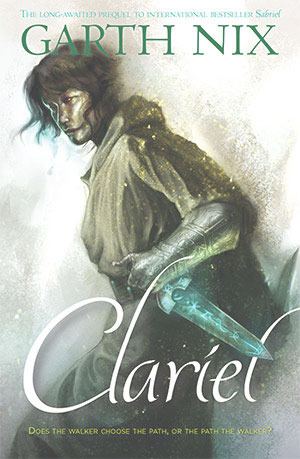
Clariel is another wonderful addition to the world of the Old Kingdom, with magic (good and bad), Abhorsens dealing with the dead, and a complex and compelling young woman growing up in a difficult world with a difficult family. There’s adventure and misadventure, a few friends, unwanted romance, moving to a new place and being forced to do what you don’t want to do. A lot of people – I’m going to assume, anyway – will be able to identify with Clariel being forced to go somewhere and consider a future that are neither of her own choosing; I could absolutely identify with her desire to just be left alone. The first is something that young adults are often dealing with in novels; the second is rarer, and it was really nice to see, rather than always having it suggested that gregariousness and being in groups is automatically a good thing and to be desired.
There was one thing that frustrated me enormously, and it has nothing to do with the plot and everything to do with my desire to see sentences constructed well: there were far, far too many comma splices. They prevent sentence flow and sometimes they actively interfere with meaning making. And now I can’t find any examples but THEY ARE THERE.
For those of us who know and love the ‘original’ Abhorsen trilogy, Clariel (set 600 years before Sabriel) is a little bit unbearable. While those books take place in an Old Kingdom bereft of a king, at least the Abhorsen is doing his job – and I submit that the Abhorsen making sure that the dead stay dead, and that necromancers aren’t being evil, is of more immediate import than a king making laws. Yes the lawlessness helps the necromancers, but at least the Charter Magic is strong and there is someone to combat the problems. … I found this excruciating.
And…
SPOILERS!!
When I first heard about this I thought it was a sequel, and I was kinda hoping for a continuation of Lirael. Then someone told me it was a prequel, and I immediately wondered if it was the story of Chlorr of the Mask given it’s suggested she was an Abhorsen and OMG I WAS RIGHT. I was SUPER excited to realise that Clariel would indeed eventually become Chlorr, and I loved how Nix made this more and more obvious but actually only confirms it right at the very end – in fact not in the story proper. Of course it’s pretty obvious when she puts on the mask. And I really love that this book absolutely stands alone… and actually now it occurs to me that I kinda wish Nix hadn’t confirmed her as Chlorr, because that’s a spoiler for people who come to this fresh. Sigh. Anyway, this is probably the darkest of the Abhorsen books so far, but perhaps only for those of us with knowledge of the future: it looks like Clariel could possibly avoid Free Magic, although of course that conniving Mogget certainly is going out of his way to make that not be the case. MOGGET. That treacherous beast. Imagine coming to Sabriel etc knowing what Mogget is actually capable of! That’s going to really influence your reading. I was intrigued that there was no connection with the non-magic world, given how wide-ranging it is otherwise, and the suggestion that the Old Kingdom and magical territory apparently extend quite a lot further than might be guessed from the original books. And how on EARTH does the Abhorsen family fall so far?!?
I’m excited that Nix is writing another in the Old Kingdom, too – this time following on from the original set!
Skyfall
 This review is part of Project Bond, wherein over the course of 2014 we watch all of the James Bond movies in production order.
Summary: in which EEE we finish Project Bond!! Also, M is a target, Bond is broken, and this time they’re fighting one of their own.
Alex: before I get into more details, I want to get my very great disappointment with this film out of the way. Now I love this film, but there is one thing that makes me see red. All of my notes – because I wrote them like this was a first-time viewing – refer to “the black woman” until right at the end, when the MI6 operative who’s been fairly important finally gets introduced. Her being nameless is not the problem, because it doesn’t get in the way of her competence. And the big reveal – that she is Moneypenny!!! – is not the problem and actually that is SO COOL. I am happy to have Moneypenny back in the franchise, and I am beyond excited to have her as a former field agent. My problem is with why she is now M’s secretary. Bond expresses surprise early on that she wants to go back into the field after she’s cocked up badly (that is, shot Bond instead of the villain), saying “it’s not for everyone.” And then, at the end, after proving that she’s cool under pressure and all of that, Moneypenny agrees that field work “isn’t for everyone.” And I KNOW that that’s true, and I don’t MIND that Moneypenny has chosen a different way of serving queen and country. What I have a problem with is that a) it’s only a woman shown making this choice; and b) more importantly, WHY she makes this choice is NEVER explained. It would have been so easy to have her wounded in the line of duty and make it impossible to keep being in the field; or, sensitively, to somehow show her not coping in the field.
I may still be angry about this.
Anyway. Overall, I really like Skyfall. Apparently it’s the highest grossing Bond yet. It’s not as good as Casino Royale, but it makes up for Quantum of Solace.
 I’ve loved the recent development of having M play a real role in the narrative, not just be a hand presenting an envelope, and this is taken to the ultimate here: M is the target of an ex-agent who is seeking to take down all of MI6 in revenge. M is tough as nails – shoot even if you think you might hit Bond; “to hell with dignity, I’ll leave when the job’s done” – as well as becoming more rounded: reference to a poetry-loving deceased husband, her lovely interactions with Bond’s gamekeeper Kincaid, making bombs from lightbulbs… I just love Dench. When I first saw the film I was really, really sad that they killed her off (that plus the Moneypenny issue made me very cranky), but I do accept that perhaps she wanted out of the franchise, and on reflection I have less problem with her going out in the field than simply retiring to get grumpy at her roses. (Actually, now I think about it I do believe she would have turned out like Helen Mirren in RED, and taken jobs on the side…). And while I’m talking about M, I like that Mallory is the new one. Yes it’s sad that we’re back to having a boy ordering a boy around; but Mallory has a proven track record (Northern Ireland, held by the IRA; saving M from Silva), and I like his spiky-with-respect relationship to Bond. I hope they get to keep Fiennes for the next one.
The narrative, of an ex-agent seeking revenge on MI6 in general and M in particular for selling him out, is not overly complicated (although getting there is; the first half feels far more devious than perhaps it needed to), but I found it thrilling nonetheless. Starting with someone stealing a list of NATO agents embedded in terrorist organisations, it looks like someone just out to make money, but then the information is revealed on YouTube… and Bond eventually finds his way to Silva and takes him into custody.
The concept that Silva wanted to be caught and taken to MI6’s new underground digs, that this was all “years in the planning,” is the first time in 23 films that I thought “well that’s a bit preposterous.”
 Silva is an interesting villain and is a call back to Alec Trevelyan. While Alec had decades of familial revenge on his mind, Silva’s is entirely personal: he was traded to the Chinese for other British agents before the Hong Kong transfer. So he was genuinely badly treated – and when he reveals that he did, eventually, take his cyanide but it didn’t kill him, instead horrible mutilating him (oh look, the villain is physically scarred) – well. I do feel some sympathy. Of course he has already shown that he’s a psychopath (killing Severine; plus he was going against orders already when M gave him up), and continues to do so (and seems a bit Oedipal towards M), so it’s not too much sympathy.
Despite the narrative being focussed on Silva and his angst, let’s be honest: Bond is the focus of this film in a way that he is in no other one except perhaps Casino Royale. He’s at his worst in this film, spending the first part ‘enjoying death’, as he tells M, and looking haggard; and then trying to get back into shape… it’s not often that I actually feel sympathy for Bond, but it happens here. And then there’s Skyfall. His family home. A bleak house in a bleak part of Scotland that he hasn’t been back to as an adult, that has been sold since he was declared dead, and is still being looked after by a cranky gamekeeper who delights in putting Bond in his place (“jumped up little shit”). And we see a gravestone that seems to confirm that Bond is actually his name, which I was doubting after the discussion about M saying Silva’s real name.
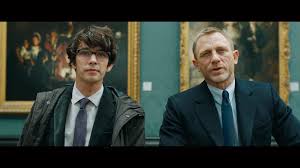 Meanwhile, Q is back! I love Ben Wishaw as Q. I like Bond’s shock at his youth and their developing camaraderie as Q is unruffled and gives as good as he gets; I love Q’s aplomb and that he is comfortable with his own genius (no false humility here) Swoon.
And I also love the theme song.
 James: Straight into the action, Bond with his gun drawn; cars and motorbikes in Istanbul, then onto a train with a Cat excavator as the finale to one of the more spectacular openings yet – Bond is shot and falls from the moving train to his apparent death in a raging river. The credits continue with the modern Bond graphic novel-style with daggers turning into crosses in a graveyard, blood and water. The Adelle penned and performed theme song harks back to the Shirley Bassey era. For the film nerds this is the movie where Bond ends up going digital – shot on an ARRI ALEXA – the end of an era.
We return from the credits with M writing Bond’s obituary while he’s living on a beach enjoying the company of a young lady and doing bar tricks for money. He looks quite grumpy though. Next Bond appears in M’s house (again) … “Where the hell have you been ?” – “Dead” … Testing … Testing … Training … Bond and Q … “A gun and a radio.” … “That’s it ?” … “Were you expecting an exploding pen? We don’t really go in for that anymore”. The cinematic style and the soundtrack is very Christopher Nolan, very Batman. Some things happen and then there is a car chase back in the DB5, out of secret storage with the classic Bond theme music to lead into the finale – many things blow up and M dies. 3.5 Martinis with a bitter twist.
John Kessel
 I have had this collection on my electronic TBR shelf since… well, the info at the start says it was being given away free when it first came out in 2008, so I guess for six years. And I have had no recollection as to why I might have wanted to grab it; I vaguely knew Kessel’s name but couldn’t associate anything with it. Until I got to the last story.
This is the author of “Pride and Prometheus,” which I read in 2008 (when it was published) and must absolutely have been the reason for me wanting more of his stuff. Because I really, really liked “Pride.”
The collection is an interesting assortment of stories. Some riff off others – Austen, obviously, and Orson Welles, and The Wizard of Oz, and just possibly Orson Scott Card’s Ender’s series, at least for part of one story, and maybe X-Men too. Other stories are straight “lit’ratyoor” with nary a scrap of speculative about them; “The Snake Girl” is a bittersweet undergraduate tale, for instance. Some I really didn’t connect with; “Every Angel is Terrifying” drags you in but it’s the sort of horrified fascination where you can’t look away. Others…
“The Last American” is one of those stories that is genuinely post-apocalyptic – there’s been gross climate change and massive die-offs due to disease – and dystopic; it’s the story of a man who was the president of America for 33 years, whose life spanned the 21st century. It’s told, though, as a review of someone’s new biography of the man, which has been constructed both as a sensory experience (normal) and with these odd inclusions of text – which is so not normal that you have to download a patch to allow you to experience it. This is the one with the Scott Card and X-Men resonances.
The centre of the collection (just about literally, perhaps metaphorically) is the “Lunar Quartet,” described somewhere in the opening as a ‘modern classic… about life on the moon.’ But it’s not life everywhere on the moon; it’s life in the Society of Cousins, which is run as a matriarchy. You are surnamed for your mother, fathers are largely irrelevant, men have the option of living on centrally provided subsistence which means they don’t get to vote… as a feminist I can tell you it sounds absolutely horrendous. It comes out that this is intended to curb men’s propensity for violence and domination, but it just ends up sounding like an incredibly restrictive society where you almost don’t blame some of the men for acting out. One of the stories is focussed on that, and I was also incredibly uncomfortable with the words coming out of the rebel’s mouth – it was horrid, repellant, appalling. So Kessel takes the opportunity to start a new human society and imagines its possibilities, and is pretty damned ruthless in the process. It’s almost enough to make you despair of hoping for real change. But I don’t think that’s what Kessel wants. I think he’s just being honest about how hard it’s going to be – and that crushing the spirit of half the population is never going to be the answer.
A good eclectic collection. Another one I can finally tick off my TBR list, which is very exciting, and all because I thought I was running out…
Uncanny #1
 Space unicorns, they did it! Uncanny was Kickstarted earlier this year.
The opening story is by Maria Dahvana Headley – “If You were a Tiger, I’d have to Wear White” – and I thought it was weird and clever and, indeed, uncanny while reading it and then I discovered just how much of it is true. It’s a reporter going to Jungleland (real) to interview the MGM lion (who really lived there, but probably not in a smoking jacket) and who ends up talking to Mabel Stark, the tiger tamer (real). Love and loss and memory; commercialism, culture and the crass.
Ken Liu’s “Presence” is sad and sweet and uncomfortable-making. One of those lovely sf pieces that brings together awesome tech with very real human stories.
“Late Nights at the Cape and Cane,” from Max Gladstone, isn’t really my thing. Nor was “Celia and the Conservation of Entropy” by Amelia Beamer.
Kat Howard’s “Migration” takes a quirky look at the idea of death and rebirth, while Christopher Barzak takes a Peter Pan story I had never heard of and updates it somewhat in “The Boy Who Grew Up.” And the fiction is rounded out by a reprint of a Jay Lake story, “Her Fingers like Whips, her Eyes like Razors” which also does interesting things with death – this time, challenging it, which I can’t help but imagine was inspired by Lake’s own cancer.
There are three poems included – from Neil Gaiman, Amal El-Mohtar, and Sonya Taaffe. I am not a connoisseur of poetry.
Then there’s the non-fiction. I have to say that my one disappointment with this first issue of the magazine is that there wasn’t more non-fiction, which I thought was going to be a bit of a Thing. Anyway, Sarah Kuhn talks by way of cosplaying as Sailor Mars about the reception of geeky women in fan spaces over the last few years, which felt like a round-up of some of the issues for people who haven’t been following it all closely. I did enjoy the discussion of becoming more and more involved in the Sailor fandom. Tansy Rayner Roberts’ “Does Sex mark Science Fiction ‘Soft’?” never answers its own question but does discuss the ways in which some in the sf scene have tried to banish stories with Too Much Sex/Kissing/Whatever out of sf… although they wouldn’t be accepted by romance immediately anyway. And Christopher J Garcia’s “The Ten Best Science Fiction and Fantasy Shorts on the Web” is a really great sort of article to include in a magazine like this and indeed makes its online nature an absolute positive. So too does the fact that the interview with Headley (there are interviews with Barzak and about Lake too) contains links to pictures of Stark. Overall this is a positive start to the magazine and I look forward to more.
Mitosis
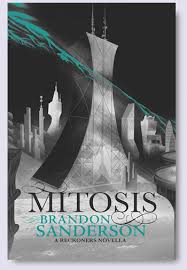 I haven’t read Steelheart so the characters and the problems in this short story didn’t mean as much to me as they would to someone who has read it. And it turns out that the story is actually half of this cute little number’s pages; the other half is a teaser for the second book in the series.
Still, I read it, and I think it does actually work as a stand-alone. There’s obviously a lot that’s gone on in the past, but that’s often true of a good short story. The one thing that could have been cleared up by a single additional sentence is the nature of the ‘Epics’, who are clearly the villains (usually) and clearly some sort of humans but… that’s all a bit obscure.
Anyway, it’s got a good pace and the setting – Newcago – is nicely set out. The narrator, David, is a bit of a nothing character to be honest; this is more about action than it is about character, but that’s not necessarily a bad thing. The villain was quite fun and I enjoyed Sanderson’s take on his particular ability.
This book was provided to me by the publisher.

 Randomly Yours, Alex