Clariel
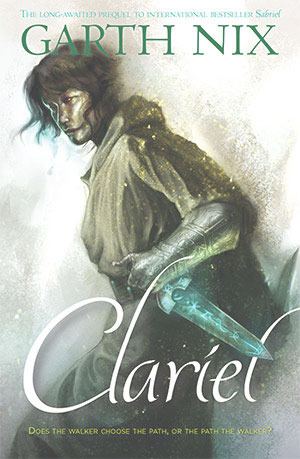 Some spoilers for the Abhorsen trilogy at the start; spoilers for this book at the bottom, and flagged.
Clariel is another wonderful addition to the world of the Old Kingdom, with magic (good and bad), Abhorsens dealing with the dead, and a complex and compelling young woman growing up in a difficult world with a difficult family. There’s adventure and misadventure, a few friends, unwanted romance, moving to a new place and being forced to do what you don’t want to do. A lot of people – I’m going to assume, anyway – will be able to identify with Clariel being forced to go somewhere and consider a future that are neither of her own choosing; I could absolutely identify with her desire to just be left alone. The first is something that young adults are often dealing with in novels; the second is rarer, and it was really nice to see, rather than always having it suggested that gregariousness and being in groups is automatically a good thing and to be desired.
There was one thing that frustrated me enormously, and it has nothing to do with the plot and everything to do with my desire to see sentences constructed well: there were far, far too many comma splices. They prevent sentence flow and sometimes they actively interfere with meaning making. And now I can’t find any examples but THEY ARE THERE.
For those of us who know and love the ‘original’ Abhorsen trilogy, Clariel (set 600 years before Sabriel) is a little bit unbearable. While those books take place in an Old Kingdom bereft of a king, at least the Abhorsen is doing his job – and I submit that the Abhorsen making sure that the dead stay dead, and that necromancers aren’t being evil, is of more immediate import than a king making laws. Yes the lawlessness helps the necromancers, but at least the Charter Magic is strong and there is someone to combat the problems. … I found this excruciating.
And…
SPOILERS!!
When I first heard about this I thought it was a sequel, and I was kinda hoping for a continuation of Lirael. Then someone told me it was a prequel, and I immediately wondered if it was the story of Chlorr of the Mask given it’s suggested she was an Abhorsen and OMG I WAS RIGHT. I was SUPER excited to realise that Clariel would indeed eventually become Chlorr, and I loved how Nix made this more and more obvious but actually only confirms it right at the very end – in fact not in the story proper. Of course it’s pretty obvious when she puts on the mask. And I really love that this book absolutely stands alone… and actually now it occurs to me that I kinda wish Nix hadn’t confirmed her as Chlorr, because that’s a spoiler for people who come to this fresh. Sigh. Anyway, this is probably the darkest of the Abhorsen books so far, but perhaps only for those of us with knowledge of the future: it looks like Clariel could possibly avoid Free Magic, although of course that conniving Mogget certainly is going out of his way to make that not be the case. MOGGET. That treacherous beast. Imagine coming to Sabriel etc knowing what Mogget is actually capable of! That’s going to really influence your reading. I was intrigued that there was no connection with the non-magic world, given how wide-ranging it is otherwise, and the suggestion that the Old Kingdom and magical territory apparently extend quite a lot further than might be guessed from the original books. And how on EARTH does the Abhorsen family fall so far?!?
I’m excited that Nix is writing another in the Old Kingdom, too – this time following on from the original set!
Skyfall
 This review is part of Project Bond, wherein over the course of 2014 we watch all of the James Bond movies in production order.
Summary: in which EEE we finish Project Bond!! Also, M is a target, Bond is broken, and this time they’re fighting one of their own.
Alex: before I get into more details, I want to get my very great disappointment with this film out of the way. Now I love this film, but there is one thing that makes me see red. All of my notes – because I wrote them like this was a first-time viewing – refer to “the black woman” until right at the end, when the MI6 operative who’s been fairly important finally gets introduced. Her being nameless is not the problem, because it doesn’t get in the way of her competence. And the big reveal – that she is Moneypenny!!! – is not the problem and actually that is SO COOL. I am happy to have Moneypenny back in the franchise, and I am beyond excited to have her as a former field agent. My problem is with why she is now M’s secretary. Bond expresses surprise early on that she wants to go back into the field after she’s cocked up badly (that is, shot Bond instead of the villain), saying “it’s not for everyone.” And then, at the end, after proving that she’s cool under pressure and all of that, Moneypenny agrees that field work “isn’t for everyone.” And I KNOW that that’s true, and I don’t MIND that Moneypenny has chosen a different way of serving queen and country. What I have a problem with is that a) it’s only a woman shown making this choice; and b) more importantly, WHY she makes this choice is NEVER explained. It would have been so easy to have her wounded in the line of duty and make it impossible to keep being in the field; or, sensitively, to somehow show her not coping in the field.
I may still be angry about this.
Anyway. Overall, I really like Skyfall. Apparently it’s the highest grossing Bond yet. It’s not as good as Casino Royale, but it makes up for Quantum of Solace.
 I’ve loved the recent development of having M play a real role in the narrative, not just be a hand presenting an envelope, and this is taken to the ultimate here: M is the target of an ex-agent who is seeking to take down all of MI6 in revenge. M is tough as nails – shoot even if you think you might hit Bond; “to hell with dignity, I’ll leave when the job’s done” – as well as becoming more rounded: reference to a poetry-loving deceased husband, her lovely interactions with Bond’s gamekeeper Kincaid, making bombs from lightbulbs… I just love Dench. When I first saw the film I was really, really sad that they killed her off (that plus the Moneypenny issue made me very cranky), but I do accept that perhaps she wanted out of the franchise, and on reflection I have less problem with her going out in the field than simply retiring to get grumpy at her roses. (Actually, now I think about it I do believe she would have turned out like Helen Mirren in RED, and taken jobs on the side…). And while I’m talking about M, I like that Mallory is the new one. Yes it’s sad that we’re back to having a boy ordering a boy around; but Mallory has a proven track record (Northern Ireland, held by the IRA; saving M from Silva), and I like his spiky-with-respect relationship to Bond. I hope they get to keep Fiennes for the next one.
The narrative, of an ex-agent seeking revenge on MI6 in general and M in particular for selling him out, is not overly complicated (although getting there is; the first half feels far more devious than perhaps it needed to), but I found it thrilling nonetheless. Starting with someone stealing a list of NATO agents embedded in terrorist organisations, it looks like someone just out to make money, but then the information is revealed on YouTube… and Bond eventually finds his way to Silva and takes him into custody.
The concept that Silva wanted to be caught and taken to MI6’s new underground digs, that this was all “years in the planning,” is the first time in 23 films that I thought “well that’s a bit preposterous.”
 Silva is an interesting villain and is a call back to Alec Trevelyan. While Alec had decades of familial revenge on his mind, Silva’s is entirely personal: he was traded to the Chinese for other British agents before the Hong Kong transfer. So he was genuinely badly treated – and when he reveals that he did, eventually, take his cyanide but it didn’t kill him, instead horrible mutilating him (oh look, the villain is physically scarred) – well. I do feel some sympathy. Of course he has already shown that he’s a psychopath (killing Severine; plus he was going against orders already when M gave him up), and continues to do so (and seems a bit Oedipal towards M), so it’s not too much sympathy.
Despite the narrative being focussed on Silva and his angst, let’s be honest: Bond is the focus of this film in a way that he is in no other one except perhaps Casino Royale. He’s at his worst in this film, spending the first part ‘enjoying death’, as he tells M, and looking haggard; and then trying to get back into shape… it’s not often that I actually feel sympathy for Bond, but it happens here. And then there’s Skyfall. His family home. A bleak house in a bleak part of Scotland that he hasn’t been back to as an adult, that has been sold since he was declared dead, and is still being looked after by a cranky gamekeeper who delights in putting Bond in his place (“jumped up little shit”). And we see a gravestone that seems to confirm that Bond is actually his name, which I was doubting after the discussion about M saying Silva’s real name.
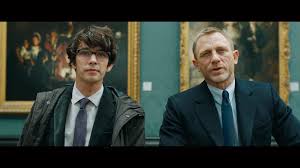 Meanwhile, Q is back! I love Ben Wishaw as Q. I like Bond’s shock at his youth and their developing camaraderie as Q is unruffled and gives as good as he gets; I love Q’s aplomb and that he is comfortable with his own genius (no false humility here) Swoon.
And I also love the theme song.
 James: Straight into the action, Bond with his gun drawn; cars and motorbikes in Istanbul, then onto a train with a Cat excavator as the finale to one of the more spectacular openings yet – Bond is shot and falls from the moving train to his apparent death in a raging river. The credits continue with the modern Bond graphic novel-style with daggers turning into crosses in a graveyard, blood and water. The Adelle penned and performed theme song harks back to the Shirley Bassey era. For the film nerds this is the movie where Bond ends up going digital – shot on an ARRI ALEXA – the end of an era.
We return from the credits with M writing Bond’s obituary while he’s living on a beach enjoying the company of a young lady and doing bar tricks for money. He looks quite grumpy though. Next Bond appears in M’s house (again) … “Where the hell have you been ?” – “Dead” … Testing … Testing … Training … Bond and Q … “A gun and a radio.” … “That’s it ?” … “Were you expecting an exploding pen? We don’t really go in for that anymore”. The cinematic style and the soundtrack is very Christopher Nolan, very Batman. Some things happen and then there is a car chase back in the DB5, out of secret storage with the classic Bond theme music to lead into the finale – many things blow up and M dies. 3.5 Martinis with a bitter twist.
John Kessel
 I have had this collection on my electronic TBR shelf since… well, the info at the start says it was being given away free when it first came out in 2008, so I guess for six years. And I have had no recollection as to why I might have wanted to grab it; I vaguely knew Kessel’s name but couldn’t associate anything with it. Until I got to the last story.
This is the author of “Pride and Prometheus,” which I read in 2008 (when it was published) and must absolutely have been the reason for me wanting more of his stuff. Because I really, really liked “Pride.”
The collection is an interesting assortment of stories. Some riff off others – Austen, obviously, and Orson Welles, and The Wizard of Oz, and just possibly Orson Scott Card’s Ender’s series, at least for part of one story, and maybe X-Men too. Other stories are straight “lit’ratyoor” with nary a scrap of speculative about them; “The Snake Girl” is a bittersweet undergraduate tale, for instance. Some I really didn’t connect with; “Every Angel is Terrifying” drags you in but it’s the sort of horrified fascination where you can’t look away. Others…
“The Last American” is one of those stories that is genuinely post-apocalyptic – there’s been gross climate change and massive die-offs due to disease – and dystopic; it’s the story of a man who was the president of America for 33 years, whose life spanned the 21st century. It’s told, though, as a review of someone’s new biography of the man, which has been constructed both as a sensory experience (normal) and with these odd inclusions of text – which is so not normal that you have to download a patch to allow you to experience it. This is the one with the Scott Card and X-Men resonances.
The centre of the collection (just about literally, perhaps metaphorically) is the “Lunar Quartet,” described somewhere in the opening as a ‘modern classic… about life on the moon.’ But it’s not life everywhere on the moon; it’s life in the Society of Cousins, which is run as a matriarchy. You are surnamed for your mother, fathers are largely irrelevant, men have the option of living on centrally provided subsistence which means they don’t get to vote… as a feminist I can tell you it sounds absolutely horrendous. It comes out that this is intended to curb men’s propensity for violence and domination, but it just ends up sounding like an incredibly restrictive society where you almost don’t blame some of the men for acting out. One of the stories is focussed on that, and I was also incredibly uncomfortable with the words coming out of the rebel’s mouth – it was horrid, repellant, appalling. So Kessel takes the opportunity to start a new human society and imagines its possibilities, and is pretty damned ruthless in the process. It’s almost enough to make you despair of hoping for real change. But I don’t think that’s what Kessel wants. I think he’s just being honest about how hard it’s going to be – and that crushing the spirit of half the population is never going to be the answer.
A good eclectic collection. Another one I can finally tick off my TBR list, which is very exciting, and all because I thought I was running out…
Uncanny #1
 Space unicorns, they did it! Uncanny was Kickstarted earlier this year.
The opening story is by Maria Dahvana Headley – “If You were a Tiger, I’d have to Wear White” – and I thought it was weird and clever and, indeed, uncanny while reading it and then I discovered just how much of it is true. It’s a reporter going to Jungleland (real) to interview the MGM lion (who really lived there, but probably not in a smoking jacket) and who ends up talking to Mabel Stark, the tiger tamer (real). Love and loss and memory; commercialism, culture and the crass.
Ken Liu’s “Presence” is sad and sweet and uncomfortable-making. One of those lovely sf pieces that brings together awesome tech with very real human stories.
“Late Nights at the Cape and Cane,” from Max Gladstone, isn’t really my thing. Nor was “Celia and the Conservation of Entropy” by Amelia Beamer.
Kat Howard’s “Migration” takes a quirky look at the idea of death and rebirth, while Christopher Barzak takes a Peter Pan story I had never heard of and updates it somewhat in “The Boy Who Grew Up.” And the fiction is rounded out by a reprint of a Jay Lake story, “Her Fingers like Whips, her Eyes like Razors” which also does interesting things with death – this time, challenging it, which I can’t help but imagine was inspired by Lake’s own cancer.
There are three poems included – from Neil Gaiman, Amal El-Mohtar, and Sonya Taaffe. I am not a connoisseur of poetry.
Then there’s the non-fiction. I have to say that my one disappointment with this first issue of the magazine is that there wasn’t more non-fiction, which I thought was going to be a bit of a Thing. Anyway, Sarah Kuhn talks by way of cosplaying as Sailor Mars about the reception of geeky women in fan spaces over the last few years, which felt like a round-up of some of the issues for people who haven’t been following it all closely. I did enjoy the discussion of becoming more and more involved in the Sailor fandom. Tansy Rayner Roberts’ “Does Sex mark Science Fiction ‘Soft’?” never answers its own question but does discuss the ways in which some in the sf scene have tried to banish stories with Too Much Sex/Kissing/Whatever out of sf… although they wouldn’t be accepted by romance immediately anyway. And Christopher J Garcia’s “The Ten Best Science Fiction and Fantasy Shorts on the Web” is a really great sort of article to include in a magazine like this and indeed makes its online nature an absolute positive. So too does the fact that the interview with Headley (there are interviews with Barzak and about Lake too) contains links to pictures of Stark. Overall this is a positive start to the magazine and I look forward to more.
Mitosis
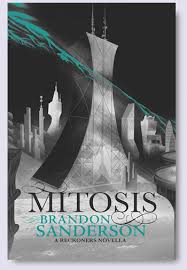 I haven’t read Steelheart so the characters and the problems in this short story didn’t mean as much to me as they would to someone who has read it. And it turns out that the story is actually half of this cute little number’s pages; the other half is a teaser for the second book in the series.
Still, I read it, and I think it does actually work as a stand-alone. There’s obviously a lot that’s gone on in the past, but that’s often true of a good short story. The one thing that could have been cleared up by a single additional sentence is the nature of the ‘Epics’, who are clearly the villains (usually) and clearly some sort of humans but… that’s all a bit obscure.
Anyway, it’s got a good pace and the setting – Newcago – is nicely set out. The narrator, David, is a bit of a nothing character to be honest; this is more about action than it is about character, but that’s not necessarily a bad thing. The villain was quite fun and I enjoyed Sanderson’s take on his particular ability.
This book was provided to me by the publisher.
Troll: A Love Story
 I am torn.
On the one hand, this is a beautifully written story that deals with some fascinating issues. And trolls are real.
On the other hand, I was uncomfortable with the implications of some of the relationships.
So, the first hand: it is lovely, and made all the more impressive by the fact that it’s translated – that can never be an easy task. I love the fact that it alternates story with ‘non-fiction’ grabs from pseudo-websites, dusty old tomes, poems and mythology – some of those are real, I’m pretty sure – and newspaper reports. I know that some people find this annoying; don’t read the book if that’s you. And I know that sometimes it really doesn’t work. But here I lay claim that it adds wonderfully to the depth surrounding the central idea of trolls being a real animal, known to science for the last century or so, and that this story is seeking to add to what humanity knows about Felipithecus trollius. Additionally, although there is a central narrator – Angel – as the story proceeds more of the incidental characters get to add their own perspectives, also in the first person. I know some people have found this changing around to be irritating or confusing, but at least in my edition each chapter clearly labels who is speaking, so rather than confusing I found that it added to the richness of the novel.
Sinisalo raises a diverse range of issues in her story, some more central than others. Trust and love and manipulation; ethics in art and journalism and business; the relationship between humanity and the natural world; mail-order brides, sex as power, desire as all-consuming. Angel, the central narrator, finds a wounded young troll and decides to care for it… which leads to encounters with a neighbour, an ex-lover, a would-be lover, and an object of his affection. Plus a business opportunity.
Which leads me to the other hand. And from this point on, SPOILERS.
Firstly, I know Angel ended up feeling ashamed of taking advantage of the troll, but it was still an unpleasant thing to do – taking advantage of Pessi’s trust in him for entirely mercantile purposes. Given how much Sinisalo works to make Pessi seem if not human then certainly above the animal, I really didn’t like it. Again, I’m sure that was the point, but it doesn’t matter; I still read it, and felt uncomfortable.
And then there’s the implications of the relationship between Pessi and Angel. Perhaps it’s prudish but I was very uncomfortable by Angel’s sexual reaction to Pessi. This is partly because Pessi is coded as being quite young, so the power differential of age exists; partly that Pessi is clearly in a submissive position with regard to Angel in tribal terms, so again the power differential; partly, hello different species – where Pessi is <i>not</i>, especially at first, coded as being as capable/sentient as a human. I know that Sinisalo is trying to problematise issues of desire and sexuality – Palomita’s experience as a mail-order bride is certainly not meant to be endorsed but is still far more socially acceptable – but… it was a problem for me.
Lastly, the ending. I knew it was coming – that Sinisalo was working up to the idea that trolls were either evolving, and catching up with humanity, or that they had always been that clever and were now coming out of the forest and starting to demonstrate it. I really liked it, and but for the sexual relationship stuff I really liked the ambiguity of what was going to happen to Angel, too.
I think, on balance, that I really liked this book. Sinisalo is certainly doing intriguing things, and she does write beautifully.
You can get Troll from Fishpond.
The Slow Regard of Silent Things
 In his Foreword, Rothfuss points that that people may not want to read this book. It’s not an ordinary book; there’s no plot. There’s no explanation of who Auri is, who she is anticipating, or even where she is. It’s probably not the first thing by Rothfuss that you want to read.
But.
But it is a beautiful object, but it’s a haunting chronicle of six days, but Auri is indeed a bit of the sun.
It’s a beautiful object: I have a hardcover version, and the cover picture is all shadows and moonlight and flowers and Auri’s silhouette. Nate Taylor’s black and white pictures are strewn throughout like the objects that Auri finds, and the text makes way for them so they work together companionably. I’d like to see more books with pictures in them, like this.
It’s not a novel, or a novella (150 pages in this wee format); it’s a chronicle. It outlines Auri’s actions and thoughts for six days. Some days are good, some days are bad. Some days Auri manages to fix rooms and objects so that they are just so and some days she doesn’t have anything to eat. Some days she makes soap. Some days she weeps.
Auri is the only character in this chronicle. In watching her for six days, the reader learns only fragments of her past and nothing of her future. We learn that she is a joyful creature – she grins all the time, and that mostly didn’t get annoying – but she is also deeply broken, and she knows she is broken and feels it keenly. And she knows that the world is broken, too, and she wants desperately to put it to rights, one little bit at a time – finding a place for a bottle, feeding another’s imagination, making soap properly. Anticipating a visitor and fretting about having the right gift.
Auri’s entire life revolves around doing things properly, and making the world right, and not wanting things for herself. I was at points humbled by her, and her willing and joyful self-sacrifice; at times enraged on her behalf, because clearly something has happened to make her so completely self-effacing. At times I was horrified – she has so little to eat – and at time intrigued, as when she contemplates her soap and knows that while it would be perfectly serviceable without perfume and other additions, how joyless to live in a world that was simply <i>enough</i>.
There’s something like 16 pages of making soap. Sounds crazy, I know. Trust me, it works. Or, you know, don’t trust me, because this isn’t your sort of book anyway. That’s fine. I really liked it. (I really liked the first two of Kingkiller Chronicles: The Name of the Wind, then The Wise Man’s Fear.)
This book was provided to me by the publisher at no cost. You can get it from Fishpond.
Jan Morris’ Journeys
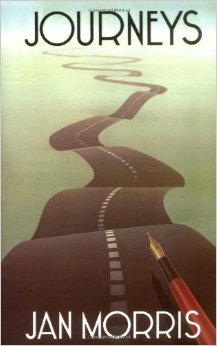 Reading a collection of travel essays written in the early 1980s is a surreal experience. So I’ll break this discussion into two parts: by golly I love Morris’ writing, and the essays themselves.
By golly I love the way Jan Morris writes. She constructs beautiful, evocative sentences. Describing the approach to Wells: “As one descends from the spooky heights of Mendip, haunted by speleologists and Roman snails, it lies there in the lee of the hills infinitely snug and wholesome.” On travelling to China for the first time: “Of course, wherever you are in the world, China stands figuratively there, a dim tremendous presence somewhere across the horizon, sending out its coded messages, exerting its ancient magnetism over the continents.” I’m no writer; I don’t have the ability to assess what makes great prose great. (There’s a great piece of graffiti near my house that says “I know art, but I don’t know what I like.”) I do know that I enjoy Morris’ writing, that I find her descriptions absorbing and sometimes moving, and that some of the books I read would be improved by their authors having read and considered Morris’ style.
Separating the form from the content should not be read as a negative about the content, don’t worry.
The first essay is about Sydney, and as an Australian this was really, really interesting. I felt there were parts that Morris exaggerated, and I was a bit uncomfortable with “Kev,” the white-collar worker standing in for Everyday Aussie, and she pokes a bit of fun at Sydney attitudes and expectations. Now, all of these are standard in a travel essay, sure. But I’ve never read a travel essay by a professional like Morris about somewhere that I kind of know – I don’t actually know Sydney very well, but Morris writes about Sydney as representative of the entire country (to which true Melbournians recoil in horror…). So I enjoyed the essay – she says some very true things, very appropriate things, and of course it’s well written. But it also meant that when I read her other essays, of places I have never been (of every other place she mentions, I’ve only been to Wells), I was aware that a native of those places may well have the same reaction as I did to the Sydney essay. Which made for an intriguing experience: not completely immersed in the narrative or the description, but interrogating her assumptions and elisions and emphases. For this sort of writing, I think my experience was actually enhanced.
This is Morris’ fourth book of essays. None of them have dates attached; the publication details simply explain that most appeared in Rolling Stone, a few in other publications. It came out in 1984 and there’a reference somewhere to 1977, so I presume they all date to that general time; the historian in me really wants dates on each one! There are several essays on parts of the US: my zero interest in Las Vegas succeeded in plummeting even lower, although Santa Fe intrigues; a few on Europe – she’s not a huge fan of Stockholm yet somehow I am now more interested in going, and Cetinje in Yugoslavia (now Montenegro) absolutely fascinates. And the Indian and Chinese essays are probably the most intriguing, and most problematic, in terms of how people and places are viewed.
I love Morris’ work and may well make it an ambition to collect most of what she has written.
Upgrade me now

What do you do when you have a major heart attack and you’re also creator/sustainer of Clarkesworld? You decide to edit an anthology. Natch. (Read an interview with Neil Clarke here.) And you decide to make the theme of that anthology cyborgs, because you are now one yourself. Thus, Upgraded.
Now, before you go all ‘hmm, themed anthology’ side-eye on me, just steady on. In some stories, being a cyborg is the point; in others it is incidental. Sometimes being a cyborg is a good thing, a positive addition, welcomed. Others, it is something to be dreaded, confronted, Dealt With. Sometimes being a cyborg makes you better, and sometimes it seems to make you less. Cyborg-ness ranges from fully integrated and augmented body modifications to one seemingly small addition. Augmentation might be for aesthetics, or employment; for someone else’s sake or your own. It ranges from being socially acceptable to being almost beyond the pale.
Some stories happen tomorrow, here; some of them are way over there, temporally and physically. Sometimes there are aliens. Sometimes there are robots. Sometimes they are in love stories, detective stories, war stories, family stories. Not all the cyborgs are attractive characters. Sometimes they become cyborgs before our very eyes, and sometimes they’ve been cyborg so long it’s just what they are. Sometimes they were actually made that way from the start.
These stories feature men, and women, and sometimes genders are unstated. There are white characters and black characters and a variety of ethnicities. One of the central issues is that of disability, dealing with it and changing it and how those around you react to it. There’s queer and straight and none-of-your-business. Authors are from a variety of backgrounds, too.
So sure, it’s a themed anthology. But this is no Drunk Zombie Raccoons in Upstate New York. This is a vibrant, fun, intriguing and varied set of stories that have a basic concept in common.
The stories. Well, let me say upfront that I was so destroyed by Rachel Swirsky’s “Tender” that I had to put the book down and go to sleep. No more reading for me that night. As for the rest, here’s a sampler: Yoon Ha Lee’s “Always the Harvest” is creepy and disconcerting and sets a really great tone for the anthology – it’s the opening story – by being completely unlike any of the others. Ken Liu’s story is also deeply disconcerting because (very mild spoiler here) it is absolutely not the story you think it is. Alex Dally McFarlane does wonderful things with maps, while Peter Watts taps into the zeitgeist to suggest uncomfortable things about the military. And I have a feeling I know something Greg Egan might have read before writing “Seventh Sight” but I’m not going to mention it here because that would be way too much of a spoiler.
This is a really great anthology, with stories that absolutely stand as marvellous science fiction quite apart from their brethren. You can get it from Fishpond!
Mothership
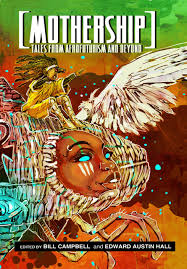 When I finished reading the first story in Mothership, a little voice in my head said “Was that really the story to start this anthology with? I mean, sure it’s got a black protagonist, but is that enough?”
And then the rest of me took a step back, looked horrified, and said: “Have you learned nothing from Pam Noles’ essay “Shame”? And from the entire Kaleidoscope project? The story has a black protagonist. That’s entirely the point.”
And then I sat, aghast at my own white ignorance, and felt ashamed.
And then I kept reading, because that’s the obvious way to combat such an attitude and is at least part of the point of this project and why I supported its production.
There’s a really wide variety of fiction in this anthology. Some skirt the edge of being ‘speculative’ (Rabih Alameddine’s “The Half-Wall”) while others hurtle over the edge and throw themselves at it. I didn’t click with every story (Greg Tate’s “Angels + Cannibals Unite” really didn’t work for me, and nor did Ran Walker’s “The Voyeur”), but many of them were absolutely breathtaking.
Nisi Shawl’s “Good Boy” – one of the only stories that really qualifies for the ‘mothership’ appellation by being set in space – is a glorious fun romp.
“The Aphotic Ghost”, by Carlos Hernandez, did not go where I was expecting and was utterly absorbing.
SP Somtow’s “The Pavilion of Frozen Women” has a wonderful line in bringing together several quite disparate cultures and tying them together into a fairly creepy thriller.
NK Jemisin does intriguing things with the notion of online communities in “Too many yesterdays, not enough tomorrows.”
“Life-Pod” is Vandana Singh’s haunting reflection on family and identity and connection.
In “Between Islands,” Jaymee Goh suggests how different things might have been for the British in colonising Melaka and surrounds with different technology…
Tenea D Johnson’s “The Taken” is a profound reflection on contemporary issues and problems stemming from the historical transportation of enslaved African to America… I don’t even inhabit the culture that’s dealing with it.
One of the intriguing things about this anthology is that it’s not focussed on African-American fiction, which I had basically expected thanks to the title’s reference to P Funk and Afrofuturism. Instead, there are stories here that draw on Egyptian, Native American, Caribbean (I think? I’m Australian, sorry!!), Japanese and Malaysian (again, I think) traditions and cultures – and those are just the ones that I (think I) could identify. There are definitely others that draw on other Asian cultures (I think there’s an Indonesian one?). The author bios don’t universally identify where the authors are from, so that doesn’t assist in figuring out what might have influenced them… which is not a complaint, by the way, because so what? (in the most prosaic ‘fiction is fiction’ sense). So it’s a really broad understanding of what falls into “Tales from Afrofuturism and beyond” – much more inclusive therefore than, for example, many anthologies of the last few years, let alone decades.
This is an good anthology, period. That it’s exploring and accomplishing a particular political aim is icing on the cake. You can get it from Fishpond!


