The Bitterwood Bible
Sourdough and Other Stories by Angela Slatter has been on my radar for ages, but somehow I’ve just never got around to reading it. For a while I didn’t realise it was available as an ebook – and Tartarus Press does lovely hard copies, but they’re a leedle expensive for a book you’re taking a chance on. And I also wasn’t sure that these stories were ones that I would really connect with. I mean, yes, I loved “Brisneyland by Night” in Sprawl, and a few others Slatter has written – especially with Lisa L Hannett – and Midnight and Moonshine made me cry with its beauty, but… I just wasn’t sure. And then I found out that Slatter had a set of ‘prequel’ type stories coming out, so I thought I should read those first.
 Halfway through reading The Bitterwood Bible and Other Recountings, I finally bought myself Sourdough because there is no way I can now not read that collection. Because I am absolutely an Angela Slatter convert.
The stories collected here are not quite a mosaic in the same way that Midnight and Moonshine are. There, each story was clearly connected – most often by family, which made it seem a generational saga. Here, while there are a couple of stories that feature the same protagonist, a few more with recurring cameos, and most set in the same place or with the same background characters, it’s more like a series of stories set in a couple of distinct suburbs or small towns. Of course you’re going to get the same bars, or neighbourhood characters, or landmarks mentioned; that just makes sense. But the narratives themselves aren’t necessarily connected… although sometimes they are. And these locales that Slatter has invented are very believable. They’re well-realised, and they’re familiar in that fairy-tale sort of way. Because these are indeed a sort of fairy tale. There’s not a whole lot of magic; what there is is generally a quiet, dare I say domestic without it being in the slightest derogatory, magic; no flashiness or gaudiness here, no winning of wars. That would draw too much attention, and drawing attention in these stories is generally A Bad Thing. The women – and the protagonists are almost all women – mostly want to be left alone, to get on with their lives. Sometimes they’re forced to interact with the world, or with other people, that they’d rather not; because they need to achieve some specific goal, or because they’re being manipulated, or they otherwise have no choice. But you certainly get the feeling that most of them would just prefer never to be in the limelight, not to be a household name… not to stand out.
There are scribes and poisoners, seamstresses and pirates, teachers and coffin-makers and servants. They are mothers and daughters and child-free and orphan, young and old and neither; rural and urban, rich and poor. They have varying degrees of agency and control, varying chances of living after and of living happily ever after.
This is a wonderful collection of stories. They can and should be read and enjoyed separately; they can and should be read and enjoyed together, making a whole even greater than its parts. Oh, and Kathleen Jennings’ lovely little illustrations throughout are a delightful addition; I imagine they’re even more impressive in print, but electronically they’re still fine.
This review is part of the Australian Women’s Writers 2014 challenge.
1968: a biography
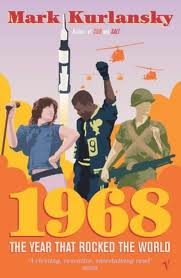 This book came out a decade ago. I think I’ve owned it for that same length of time – I seem to recall getting it as a freebie at some readers’ night at a bookshop. I’d adored everything else by Kurlansky that I’d read, so it seemed like a good deal at the time. And then it just… got lost in the pile of books that I own and haven’t got around to reading. As happens all too often. Plus, I overlooked it because after all, 1968 is really quite recent, yeh? And modern history… well, it’s just politics. And there’s more interesting stuff to read than politics.
I’m not sure what made me pick it up last week. Possibly something I’d been talking about with someone, or I wanted to check something. Who knows; doesn’t matter. What matters is I read the introduction and I was hooked. Kurlansky talks about four significant factors that made 1968 stand out: the example of the civil rights movement in the US speaking to a generation that felt alienated and who despised a war being waged by a massive nation against a small one, and all of it occurring at a time when television was becoming a potent force. It’s not a unique year – I’m sure you could write this sort of insightful ‘biography’ for most years, of the twentieth century especially. But it really is a significant year.
(A little quibble about the cover: the Rolling Stones aren’t mentioned, so why put Mick with either Tommie Smith or John Carlos, who used the Black Power salute at the Mexico Games, and a soldier in Vietnam, and a rocket? It doesn’t really make sense. If they wanted to symbolise the student movement, then surely Abbie Hoffmann or a SDCC poster or similar would have done the trick. It irked me. )
From the point of view of a historian, Kurlansky is quite open about the impossibility of his being completely objective, and in fact rejects the idea of any historian doing so. He was born in 1948 and hence experienced a little bit of what he’s writing about, especially the anti-Vietnam stuff. This comes through in how he writes, but how much that’s a problem is going to depend on how hungry you are for that impossibly elusive objectivity – and how hard you find it to sift the presentation of information to find whatever you think is ‘true’. I think that the medium for conveying the message is worth it, and you just read with that in mind.
And this book is worth reading both for the style – which is intensely readable – and for the content. Kurlansky eschews too many footnotes (and in fact makes that endnotes, and without numbers in the text), so it reads less like a formal history and more as an engaging narrative. Yes the historian in me occasionally frowned at some of the things he says without appearing to back it up. That’s what you get for more conversational-style history… and actually that suggests what this book is like: it felt more like the book of the series. I can easily imagine each of the chapters here being turned into an episode of television.
The absorbing nature of the narrative is aided by the astonishing story that’s being told. Bare bones: Martin Luther King Jr and Robert F Kennedy are both killed in this year; there are student riots/protests/movements all over the US and the birth/growth of significant student movements, as well as in France, Germany, Mexico, Poland and Czechoslovakia, sometimes accompanied by workers’ movements; the Olympic Games in Mexico; attempt at revolution in Czechoslovakia that’s put down by Soviet tanks; civil war in Nigeria; unrest in Israel; the Tet Offensive in Vietnam; Nixon winning the US election; Apollo 8; race issues, gender issues, political issues… . Yeh. It was a big year.
Kurlansky does a wonderful job of putting actions in different places in perspective – connecting them to one another. This is particularly true of the discussion around the student movement, which is really the heart of the book. And there’s something to be warned about: although there is quite a good discussion (IMO) of the Polish and Czech experience, especially, this is still at heart an American book. The Nigeria/Biafra ‘conflict’ is dealt with seriously and soberly, but it doesn’t get nearly as much air time as the attempts at student sit-ins around American universities. Is that a problem? Depends on what you’re wanting out of the book. And it depends on what you think actually made more of an impact around the world at the time, and since then. The by-line is “The year that rocked the world.” Did American students flagrantly defying authorities, and students being beaten by police, ‘rock the world’ more than a million people dying in Biafra? … unfortunately, possibly yes, for several reasons – not least of which is the one that Kurlansky himself spends quite some time discussing: television. There were cameras rolling when students got beaten in the streets of Chicago and New York. Not so much in Nigeria. Plus, the reality is that America had and continues to have more of an impact on world attitudes and trends that Nigeria does – for good or ill, in terms of ascertaining impact it doesn’t matter. My point is more that if you want a book that balances every country’s experience equally, this is not for you. It’s more than the history of one nation but less than a complete history of the world. So check your expectations first.
This is a really fabulous book for bringing out the important issues and the people of this one year. He sets the events and the people into context – casually dropping in Yasir Arafat and Bill Clinton, among others, for future connections, as well as giving background on Martin Luther King and the development of Palestinian identity and the Nigerian conflict and issues in Czechoslovakia. It’s not quite a history of the entire decade but it’s more than just a history of a year.
I love that this book ends with optimism. 1968 itself is such a torrid confusion of hope and despair that going from “racism, poverty, the wars in Vietnam, the Middle East, and Biafra” to the picture of our little blue and white and green marble, as seen from Apollo 8 going around the moon, seems peculiarly appropriate. And then to conclude with Dante – “Through a round aperture I saw appear / Some of the beautiful things that Heaven bears, / Where we came forth, and once more saw the stars.”
This book can be found on Fishpond.
Landline: review
 This book was provided to me by the publisher.
I’ve never read anything else by Rainbow Rowell, but a lot of the Goodreads reviews talk about her style being really easy – and it is. I started reading this late one afternoon and I’d read the first 100 pages before I realised what had happened. The story is well-paced; officially it takes less than a week, although there are serious flashbacks that kinda make that a lie. The prose flows – lots of familiar-sounding dialogue, enough detail to sketch in believable places and people. I’m not great at explaining how prose works. All I know is that this was delightful to read, and partly that was the words themselves.
The premise: Georgie has the chance at a dream job – but she’ll have to work over Christmas. Husband and kids go off on their family holiday without her. Georgie discovers that the old landline at her mum’s house somehow allows her talk to her husband – but him from the past. The novel is then filled with the minutiae of daily life: work and memories and family relationships and that worrying and gnawing at problems that gets so familiar when you’re old and have lots of worrying to do.
The best thing about this story is that it’s about a woman thinking about, and worrying about, her marriage. That sounds very self-indulgent and maybe a bit dull or stupid, but bear with me. It’s refreshing to read about a woman confronting problems like this and not taking all the blame, not taking a convenient way out, and not having things magically solved. (Maybe there are lots of books like this – in fact I’m sure there are – but they’re not on my radar.) Yes, there were a few points where I got a little uncomfortable about what might almost be being suggested about her (‘letting herself go’, etc), but for me at least they never quite got to the really problematic point; they were redeemed by some thought or action that pulled it back, didn’t make her the villain for not having time to buy new bras, and so on. And I liked that the focus was on the bit after the happily-ever-after – the bit after marriage, and after kids, and things aren’t entirely wonderful but they’re also not entirely horrid, they’re just… life. But they can still be better, and yes life and marriage require work and that’s ok.
Georgie was pretty easy to identify with, and all the surrounding characters were too. At times I wondered if Rowell was trying too hard to be ‘inclusive’ – but then I realised that just maybe I was overthinking it, that actually there wasn’t a huge amount of diversity (although to be fair the cast isn’t that big), and that none of the ‘minority’ characters were such just to make a statement. (See how my brain gets me caught up in tangles?) Also, the pugs are hilarious.
Self interrogation:
I was going to start this review by saying “this isn’t the sort of book I normally read.” Which is basically true, but why start with that line? And I started thinking about the answer to that question. And then I thought about starting this review with this self interrogation… and I realised that that was still front-and-centring the issue, rather than the novel. It’s one worth talking about but it’s entirely too self-indulgent to make it the first bit. So, here it is, at the end.
This is not the sort of book I normally read. Because it is, first and foremost, a romance. And I don’t think of myself as someone who reads romance, even though actually I love ‘good’ romance in my novels and movies – by which I mean it’s realistic but/and sweet but not saccharine, and – most especially, in my head – not the focus of the story. So why was I so keen to defend myself? Because despite all the time I spend thinking about why reading SF isn’t a bad thing to do, I still automatically feel like I have to barricade myself away from that genre – the female one, the one that everyone else bashes when they’re not bashing romance – even though I am well, well aware – in my head – that oh my goodness there are so many things wrong in thinking/acting like that. And the other thing is that this is absolutely SF. If we’re happy to accept John Chu’s “The Water that Falls on you from Nowhere” as SF – and heck, we should be – then so is this. That short story is all about a romantic relationship and how it works out with the family; the SFnal element is water that, literally, falls on you from nowhere. It’s never explained. So this, a story that’s about a romantic relationship and family, where the main character has access to a phone that allows to talk to someone 15 years ago? This is absolutely SF. Was I more embarrassed because this was written by a woman, and therefore more clearly can be classified as a romance? Because it’s a novel rather than a short story from an obviously SF venue? Who knows. At any rate, I’m not embarrassed by having read it, because it’s one of the easiest – pleasant, fast, cosy – books I’ve read in ages.
The Ruby Knight
 EDDINGS RE-READ: The Ruby Knight, BOOK TWO OF THE ELENIUM
Because we just don’t have enough to do, Tehani, Joanne and I have decided to re-read The Elenium and The Tamuli trilogies by David (and Leigh) Eddings, and – partly to justify that, partly because it’s fun to compare notes – we’re blogging a conversation about each book. We respond to each other in the post itself, but you can find Tehani’s post over here and Jo’s post here if you’d like to read the conversation going on in the comments. Also, there are spoilers!
ALEX:
Sparhawk starts this book a) immediately after the end of the first one, and b) wanting someone to jump him, so that he can get all violent on some unsuspecting footpad. I don’t think I was really paying attention to that sort of thing when I was a teen. He’s actually not a very nice man a lot of the time, and that makes me sad.
JO:
It is a bit sad isn’t it 😦 Sparhawk’s most common reaction seems to be violence, and the narrative and tone celebrates that part of him.
TEHANI:
Alex, you say “not a very nice man” but I never read it that way (and still don’t, I guess!) – he’s a product of his culture and his time. They seem to quite happily wreak havoc on people at the drop of a hat, and he IS a knight, trained to battle!
ALEX:
OK, maybe I don’t have to be quite so sad about him – that he’s a product of his time – but still his active desire for violence does act, for me now, against my lionising of him as a teenager. He is flawed, and I’m troubled because Jo is exactly right – the narrative celebrates him and his anger/violent tendencies.
TEHANI:
You’re both completely right. I still choose to read it in the context of the book, AND STICK MY HEAD IN THE SAND. Damn. That’s the problem with rereading with a few more brains behind us, isn’t it?!
ALEX:
Something we didn’t note in our review of The Diamond Throne is that the book is prefaced by a short excerpt from a ‘history’. This is a really neat way of building up back story and developing the world without having to info-dump – although of course the Eddings pair don’t really have an issue with info-dumps; after all, why else assign a novice knight to teach a young thief history? Anyway, I still like it, and it does show that there has been a fair bit of thought put into the world, even if much of it simplistic.
JO:
Yeah I enjoy these histories too. Good way to set the scene, highlight anything that’s going to be important for the book (like Lake Randera) and do a quick recap. They definitely like an info-dump, but at least the Eddings do it with style and humour!
TEHANI:
I reckon there’s reams of world-building behind these books, especially if the work that we see in The Rivan Codex (for the Belgariad/Mallorean world) is any context!
JO:
I enjoyed this book a lot more than I expected. I remembered The Ruby Knight as a very ‘middle book’, just basically a long build up to finding Bhelliom and saving Ehlana. But on the reread it was a lot more engaging than that. Maybe it’s because Eddings has the space here to really get into the characters, and I love these characters so much that I enjoyed that to no end.
TEHANI:
It really does boggle me that even though I’ve read this several times, I still don’t get bored of this long questy-ride-alonging. It really IS a middle book, and nothing terribly much happens, but it’s still a really enjoyable read! Bizarre. Is it nostalgia that makes it so, or some quality about the book that means I don’t chuck it across the room like I would most other “middle books” that really just march in place?
ALEX:
I found this one a bit more boring than I remembered – it really is just them wandering around. I totally still enjoyed the character development, and it is banter-ific, but on this re-read I got a bit impatient with the lack of actual plot movement.
JO:
They’re also very good at throwing everything in Sparhawk’s way. I mean, this is basically a quest book. We even have a ‘fellowship’ don’t we – Sephrenia mentions how important it is to have a certain number of people on the quest, it’s all about symmetry. But from the outset, everything that can go wrong does, and all of this does a great job of increasing the tension. Not only that, but characters we meet in the beginning and/or middle come back towards the end, which makes these side-quests feel a little less side-questy. By the time Sparhawk and Co. get roped into Wargun’s army I just wanted to scream because they were so close and it is so not fair! But I do love it when characters get put through the wringer like that. Nothing’s easy.
TEHANI:
Masochist! But I’m right there with you – wouldn’t be any fun if things just went to plan, right?
ALEX:
omg when I got to that and remembered that they were being co-opted I think I might actually have groaned out loud. GET ON WITH IT.
TEHANI:
I like that there’s a few points in this book that smack back at the classism – Wat and his fellows teach Sparhawk a thing or two: “Not meanin’ no offence, yer worship, but you gentle-folk think that us commoners don’ know nothin’, but when y’ stack us all together, there’s not very much in this world we don’t know.”
Ulath backs this up some chapters later: “Sometimes I think this whole nobility business is a farce anyway. Men are men – titled or not. I don’t think God cares, so why should we?”
“You’re going to stir up a revolution talking like that, Ulath.”
“Maybe it’s time for one.”
ALEX:
Tehani, you beat me to it – I LOVE that bit; I metaphorically punched the air.
JO:
Go Ulath! 🙂
TEHANI:
Unfortunately, there is also some nasty gender stuff – it doesn’t stem from our heroes, but isn’t challenged by them, and is somewhat supported by them to an extent (Kurik emphasises the nasty noble’s words by drawing his sword in this exchange):
“Mother will punish you.”
The noble’s laugh was chilling. “Your mother has begun to tire me, Jaken,” he said. “She’s self-indulgent, shrewish and more than a little stupid. She’s turned you into something I’d rather not look at. Besides, she’s not very attractive any more. I think I’ll send her to a nunnery for the rest of her life. The prayer and fasting may bring her closer to heaven, and the amendment of her spirit is my duty as a loving husband, wouldn’t you say?”
(more follows on p. 217 – of my copy…)
ALEX:
urgh. Hate that.
JO:
And it’s ok that he feels this way because it was an ‘arranged marriage’. Poor bloke, getting stuck in an arranged marriage like that. *flat stare* There are a lot of comments in these books about women being obsessed with marriage and men ‘escaping’.
ALEX:
And there’s other uncomfortable gender moments, too, like the serving girls in the tavern often being blonde, busty, and none too bright… *sigh* And then there’s Kring, who asks whether it’s ok to loot, commit arson, and/or rape when they partake in war with the Church Knights.
TEHANI:
Oh, so many uncomfortable moments…
JO:
Yeah I’d totally forgotten that about Kring. I was so excited to see him, because I always liked him, but that took the wind out of my sails a bit.
TEHANI:
But Kring kind of changes, I think (though later on) and that element is quite lost later. However, it does NOT do well to realise which culture the Peloi are intended to represent. Oh, the casual racism…
ALEX:
On the topic of racism – every time Sephrenia rolls her eyes and says “Elenes,” I can’t help but think of the bit in The Mummy where Jonathan says “Americans” in that insulting tone of voice (which I can’t find on YouTube, darn it).
TEHANI:
I think Sephrenia is quite within her rights saying it in that EXACT tone of voice!
ALEX:
Also, Ghwerig being ‘misshapen’ isn’t quite suggested as the reason for his being evil, but it’s pretty close – and keeps cropping up throughout the series. I can’t imagine how that makes a non-able-bodied reader feel, given it makes even me gnash my teeth.
TEHANI:
You know, I never actually read it that way – it mustn’t be quite as overt as some of the other uncomfortable things. But of course, now you’ve pointed it out, yes, I completely see it.
JO:
Oh hey I never really noticed that either! But now that you mention it, I can’t unsee it. Which says a lot. Why do I see all the gender stuff immediately, but this passed me by? Of course there’s a long literary tradition of physical deformities = spiritual ones. That’s no excuse. I must be more aware in my reading.
TEHANI:
Kurik’s acknowledgment of Talen (p. 392) made me cry as much as it did Talen!
ALEX:
You softy. I didn’t cry in THAT bit…
JO:
Oh no, the bit that always made me cry is still to come…
ALEX:
Mine too.
Apropos of nothing, did either of you find it a bit odd that Kurik checks on Sparhawk in the middle of the night?? I bet there’s fanfic out there…
TEHANI:
There’s fanfic out there for EVERYTHING! I didn’t think it odd, though I did love the naked man-hug in the early pages of the first book! (go on, go check, I’ll wait…) 🙂
JO:
I am NOT going to go looking for fan fic. I am NOT…
ALEX:
Oh, I don’t need to check, Tehani, I remember 😀
Also, do you remember whether you suspected Flute of being actually divine before the great revelation at the end of this story? I’m not sure! I hope I did…
TEHANI:
Well, I read these completely backwards (Tamuli before Elenium), so I was spoiled for that already I’m afraid!
JO:
Tehani that breaks my brain.
I had suspicions about Flute from very early on. I remember being very impressed with myself at the time. I reread it now and think how could you not? They do kinda hit you over the head with it :p
TEHANI:
I think by now we’ve read WAY too much in the field to be surprised by something like that – but a newish reader to the genre? Maybe they wouldn’t pick it!
Well, being the middle book of the trilogy, there isn’t really much by way of plot to chat about, I guess, so shall we move along? Perhaps faster than the plot of the book itself… 🙂
JO:
We should talk about plot shouldn’t we 🙂
Sooo… As usual the book opens up with Sparhawk travelling through Cimmura at night in the fog. Notice how often that happens in these books?
TEHANI:
Yes, you’re right! It’s a trend in the books, for sure.
JO:
I quite like the repetition. He’s got both rings, and now he knows he needs Bhelliom to cure Ehlana and it’s time for the sapphire rose to be found again anyway. The fellowship head off on their quest for the magic jewel and have adventures along the way, including being stuck in the middle of a siege, dealing with Count Ghasek’s possessed sister, raising the dead and finally fighting the Seeker who has been chasing them all this time.
Eventually they make it to Ghwerig’s cave – after the introduction of Milord Stragen, another favourite character – fight and defeat the troll. Flute is revealed as the child-Goddess Aphrael, and gives Bhelliom over to Sparhawk.
Was that the kind of thing you had in mind? 😉
TEHANI:
This is why YOU’RE the writer…! Nicely summed up indeed. The Count Ghasek storyline was a bit of a tough one. On one hand, Ghasek seemed like a nice enough chap. On the other, the motives behind his sister’s madness, well, not great to examine that too closely, I think.
JO:
Although I did appreciate the throwback to book one – Eddings could have introduced any old character here, but Bellina is the woman Sparhawk and Sephrenia witnessed going into that evil Zemoch house.
TEHANI:
Well seeded indeed…
ALEX:
GET ON WITH THE STORY, EDDINGS PEOPLE!
The Diamond Throne
 EDDINGS RE-READ: The Diamond Throne, BOOK ONE OF THE ELENIUM
Because we just don’t have enough to do, Tehani, Joanne and I have decided to re-read The Elenium and The Tamuli trilogies by David (and Leigh) Eddings, and – partly to justify that, partly because it’s fun to compare notes – we’re blogging a conversation about each book. We respond to each other in the post itself, but you can find Tehani’s post over here and Jo’s post here if you’d like to read the conversation going on in the comments. Also, there are spoilers!
TEHANI:
I was feeling a little book-weary yesterday so thought I might as well start my reading for this conversational review series, given it’s usually a soothing experience. Within a single PAGE, I was reaching for Twitter, because SO MUCH of the book cried out to be tweeted! Great one-liners, the introduction of favourite characters, and, sadly, some of the not so awesome bits as well. I was having a grand time pulling out 140 character lines (#EddingsReread if you’re interested), but the response from the ether was amazing! So many people hold these books firmly in their reading history, and it was just lovely to hear their instant nostalgia.
ALEX:
And I read those tweets and everything was SO FAMILIAR that I immediately started reading as well. And finished a day later.
JO:
Ok. A) You people read too quickly! B) Tehani those tweets were enough to start me feeling all nostalgic. I was in the middle of cooking dinner and had to put everything down, run upstairs and dig the books out of their box hidden in the back of the wardrobe.
TEHANI:
I am not at all repentant! 🙂 Also, did you both find this a super easy read? Is it the style, or just that I’ve read it several times before? It really was like sinking into a warm fluffy hug, hitting the pages of this book again. I actually can’t remember the last time I read it, but it’s got to be over a decade, yet I felt instantly at home again. Eddings was one of the authors who caused my addiction to the genre, and even in the very first chapters, it’s easy to see why. The light and breezy writing style is instantly accessible, and the way we’re thrown straight into the action, with our hero Sparhawk leading us through, makes the book start with a bang.
ALEX:
Reading that first page was a little bit like going back to my high school, many years after graduating. It just felt so familiar, and comfortable. And like high school, I know it’s not without problems – but it’s still somewhere that has a lot of ME wrapped up in it. I also don’t remember when I last read these, but it’s not for aaaaages… And yes, super easy to read. TOO easy! ;D
JO:
Oh yes, absolutely. As soon as I started reading it all came back to me. I remembered the moment I found The Diamond Throne in the library, and the first chapter and intro of Sparhawk hooked me instantly. While I think as a teenager I identified the most with Polgara from the Belgariad (I wanted to BE her) I have always loved Sparhawk.
ALEX:
Polgara is still one of my absolute favourite characters! Sparhawk is too, though – one of the great characters for me in my early teen years. I adored that he was older, and cynical, and world-weary. When I was 14 I thought I was all of those things…now that I am 34 I still absolutely empathise! This story also shows that his cynicism is cut with a very large streak of sappiness, which I think serves to make him just a bit more relatable. His love for Sephrenia, his respect for Vanion and Dolmant and Kurik – he’s actually a fairly well-rounded character, as these things go. His habit of calling people ‘friend’ and ‘neighbour’ is why I call everyone ‘mate’ to this day. True story. I also adore the relationship he has with Faran, that ugly roan brute; I love Faran unconditionally.
TEHANI:
He is so pragmatic, completely prepared for violence at all times, and yet from the very early pages where he gives the street girl some coins and calls her “little sister”, we see he’s an absolute marshmallow inside. I’m with you Alex, I adore him.
JO:
I have an admission to make. I still love him, but Sparhawk’s making me a little uncomfortable in this reread. For all his neighbours and his giving money to the scrawny whore, I’m starting to feel like he’s a bit of a bully. He gets what he wants because he can and does threaten violence if he doesn’t get it…and it feels like Eddings thinks this is ok because he’s Sparhawk. He’s a Pandion (not only a Pandion but the best of them, as we are repeatedly reminded) and the people he threatens are ‘evil’ anyway so no harm done… I dunno, it’s just made me feel a bit squeamish this time round.
TEHANI:
That’s a really good point. I’ve had a similar discussion with my Doctor Who reviewing buddies Tansy and David about David Tennant’s Doctor – he does and says some pretty awful things, but we accept it generally without question a) because he’s the Doctor, but more importantly b) because David Tennant plays him so charismatically. Sparhawk has the same sort of issues – we know (or are given by the narrative to believe) that he’s on the side of right, and that he is the Champion, therefore we accept his behaviour because it’s presented as being for the right reasons.
ALEX:
*sigh* you are of course both correct – Sparhawk’s use of “might is right” is totally accepted by the novel because he is so awesome. And if that’s not an abuse of power, right there, then nothing is.
On a more positive note, I think I like all of the other characters, too. Sephrenia is delightful although definitely not rounded out enough here…and I do have a problem with her “we Styrics are so simple and you Elenes are so complex” thing. I want to believe that she’s just serving back to the Elenes what they believe about themselves, so that she can manipulate them, but I’m not sure if that’s knowledge of the rest of the series or wishful thinking (more on that below). Talen is already totally amusing and reminds me a lot of Silk, from the Belgariad, which is unsurprising. The Merry Men really are dreamy; Ulath and his blonde plaits will always be my favourite, because who doesn’t love the quiet cryptic type?
TEHANI:
And I adore Kalten, because he’s always needling Sparhawk yet they clearly love each other. Talen was a definite favourite from early on too, and Kurik is marvellous – a definite father figure, or maybe more an uncle…
ALEX:
The classism and the racism…ouch. The Rendors are meant to be Arab analogues, right? Because everyone knows that living in the heat makes your brain go soft. OUCH. Also, why have I always thought the Styrics were analogues for Jews? Is it just that the Elenes burning their villages is frighteningly similar to pogroms in Christian Europe in the Middle Ages? (But of course there’s no religious similarity at all, and the only ‘real’ similarity is the refusal of pork.)
JO: I always thought that about the Styrics too.
TEHANI:
Oh yes, that was the first thing I picked up on in terms of the negative stereotypes – completely over my head when I read these in my late teens, front and centre now. I actually wrote a uni paper on representations of reality in Eddings and Feist, but I’ve sure learned a lot since then! I could easily IDENTIFY the real world correlations, but did I notice the negative aspects of this? No I did NOT. *sigh* Bad past me, bad!
This time around, the classism was just as interesting too – I think I was so indoctrinated into the usual process of high fantasy in my 20s that this would never have even occurred to me to see. This time though, Sephrenia’s derision about the intelligence “common” Elenes and Styrics is, ugh, just awful. And when it’s other races as WELL as commoners, well, that’s terrible.
ALEX:
The class aspect is ugly as all get out. When they’re in the council chamber confronting Vanion, Dolmant – the lovely, gentle Dolmant – says why believe an untitled merchant (his words!) and a runaway serf over and above the honorable Preceptor (code: titled)? Now we know that those are both lying, but that’s beside the point. I dunno, Dolmant, maybe because truth and honesty aren’t actually the privileges of the wealthy and titled?
JO:
Oh goodness yes. I have to admit this is something that passed me by the first time I read these. Maybe because in the world Eddings writes it does feel so natural. Which is disturbing.
TEHANI:
It really is, isn’t it! And once you see, you can’t unsee…
ALEX:
This is one of the first real instances I remember of the Crystal Dragon Jesus trope – taking what can be broadly recognised as a version of the medieval Catholic Church and transporting it to a secondary fantasy world.
TEHANI:
I’ve not heard of the “Crystal Dragon Jesus trope” – please elaborate?
JO:
Neither have I!
ALEX:
Instead of creating your own religious system for your magical fantasy world, you take the broad brush strokes of (usually) the medieval Catholic Church – because hey, everyone knows that medieval stuff is bad, plus Catholics are easy to laugh at, right? It generally involves a monotheistic religion with a convoluted hierarchy, seemingly-pious churchmen (and only men) who are meant to be celibate but often aren’t, because that also makes them easier to turn into evil characters. The only thing that the Eddings missed is the saviour/messiah/ someone who sacrificed themselves bit, of the religion. It irks me because it is so lazy.
JO:
I did not know there was a term for that 🙂
ALEX:
Tehani, you said there was a Lord of the Rings reference early on – did you mean Ghwerig the Troll-Dwarf being like both Sauron and Gollum, with the whole rings thing? (Also, how did Ghwerig ‘casually’ smash a diamond?) There’s also a Hamlet reference, at the end, when Sparhawk comes across Annias praying in the chapel and chooses not to kill him.
TEHANI:
Yes, exactly! I missed the Hamlet reference, and I think there were a couple of others in there!
I could hand-wave the diamond smashing – I figured if he was working under the influence of the gods, he could pretty much do anything!
JO:
You know, there’s a lot of repetition in this book. It almost feels like any time anything happens, it has to be reported back to the group in the next scene, and discussed. Same goes for any time they meet a new character, we have a recap of events up until this point. All done with amusing dialogue, of course. But still!
TEHANI:
You’re right, but it’s so breezily written I hardly notice it! I do quite like the way travelling actually takes a significant amount of time, even when that slows down the action.
ALEX:
Thanks to your tweets, Tehani, I noticed every single time the word ‘peculiar’ was used.
JO:
By the end there I was getting a little sick of “I’m (terribly) disappointed in you, ___.” Or something similar. I noticed it a couple of times then couldn’t unsee it!
TEHANI:
Yes, Eddings has several “tics” of writing that once you notice them, you ALWAYS see them! “Flat stares” are my favourite 🙂
JO:
Particularly when they come from Faran. I love that horse and his flat stares.
TEHANI:
That horse is practically human.
ALEX:
That horse and his prancing make me happy.
JO:
I’m having a strange and conflicted reaction to the female characters in these books. On the one hand, they are such wonderful strong people. Sephrenia is powerful, but that’s almost not what makes her strong – rather her pacifism compared to the bloodthirsty knights around her, and her determination to do her duty to her goddess. And her relationship with Vanion. Ehlana’s still encased in diamond at this point, but the effect she had on Sparhawk pretty much says it all! Even Arissa has her own desires and knows her own mind. But…but… I dunno, something feels off to me. Maybe because there are few of them? Maybe Lillias’ rather large hissy fit soured it all for me. I just don’t know. Would love your reactions.
TEHANI:
I actually thought the Lillias thing was reasonably well handled – it was made pretty clear it was a cultural “norm” rather than her personal feelings, which made it okay for me, I guess. The female characters are interesting though; I wonder if it’s because they are constantly stamping their feet at the men and pretending to be less powerful than they are to get their own way that’s the problem? Possibly I’m getting ahead of myself though – this is only the first book!
ALEX:
I loved Lillias’ melodramatic turn – and that Sparhawk played to it for her sake. I am conflicted about Sephrenia: are the knights looking after her because they love her, or because they see her as weak? Or is that an “and” situation? I don’t like Arissa but I admire her strength. For me, I think it’s that this is such a boys world the women feel a bit out of place. The other female character of course is Flute, and she’s quite funny, but one thing I wanted to point out: she ‘somehow’ escapes the convent where they leave her, and meets the crew further on…and no one goes back to tell the convent she’s ok?! Seriously??
TEHANI:
Don’t look too hard Alex, there’s all SORTS of little nitpicks like that! I think we’re almost ready to move on to the next book. I don’t suppose it really matters that we’ve not talked about the plot, right? It’s your basic high fantasy quest, with lashings of barriers thrown into our hero’s journey, a cast of thousands (seriously, it gets quite large in the end…) and lots fun dialogue that means you completely don’t notice that sometimes nothing really happens for several pages *cough chapters cough*.
ALEX:
Things happen! Characters develop! Banter is committed! 😀
JO:
Yeah, what more could you possibly want? Lots of riding horses to get to places. Things go wrong for our heroes all the time. I do think Eddings is good at that in particular. Just when you think they might finally achieve something, *bam* something goes wrong. Usually involving Martel. And yes, lots of banter. Banter is awesome.
TEHANI:
Hey, have you two seen this? http://42geekstreet.com/fantasy-casting-agency-the-diamond-throne-the-elenium/
ALEX:
omg. How awesome. One big nitpick: they CANNOT make David Wenham Martel! Nononononono. No. Kalten maybe?
JO:
LOL ‘who could play Sparhawk in a movie’ is my husband’s favourite pastime. It drives me nuts.
Also, Gerard Butler? Gerard Butler? That’s it, I quit the internet. *walks away from the internet*
TEHANI:
What’s WRONG with Gerard Butler! *wanders off whistling* See you both back here for the next exciting instalment of our reread!
The Reluctant Swordsman
This is not the sort of book I would have picked up of my own accord. But a friend loaned me the entire series, and I felt obligated to give it a go, since we usually have similar tastes.
 This is a fairly standard portal fantasy. The main character is dying in our world and then wakes up in the body of a remarkable swordsman in another. Intriguingly, we get very little of Wallie’s life in the ‘real’ world. We know he’s an engineer, has no family, and… that’s about it. The focus is entirely on The World.
Of course, the swordsman/Wallie has a task to complete, and there are many and significant obstacles to that. This book is basically a getting-the-band-together story, as Wallie figures out what he has to do (which he doesn’t really know even by the end of the novel), and gets his people together – an appropriately motley group for an unlikely hero (well, an unlikely hero’s mind, anyway).
Wallie himself I am largely indifferent towards at this stage. He’s an excuse to explore different aspects of the world, and question some of its aspects (more on that later). He’s approachable enough, and hasn’t done anything quite as repellant as Thomas Covenant manages in his first fifteen minutes. Of the other characters, his sidekick has a phenomenal memory and developing sword skills; his slave girl will hopefully develop a personality; and the elderly priest is the one that I hold out most hope for, of being snarky and clever.
The novel suggests a world where gods exist and interact with people – sometimes – and although I guess a direct intervention from a god would have an impact, I found Wallie’s change from sceptic to fervent believer a bit fast. I am interested to see how this aspect develops. I’m also intrigued by the notion of unstable geography which strongly connects to the idea of the Goddess; I think this may be the most interesting facet of the world building so far. The rest of the world building… well. There’s slaves, and Wallie reacts strongly against this initially, but he does then go and buy one. Admittedly he does so for noble reasons, and he really likes her, honest!… still. That’s playing into the system, right? There could have been more conscience wrestling about that. And any moral objections raised are rather undercut by Duncan later in the novel when another character buys a slavewoman entirely based on her voluptuous appearance, and this is upheld as humorous in the first instance and then later as advantageous to the plot. This is a problem for me.
I may read the next one, just to see whether Duncan manages to do anything clever or original. I’m not really holding out much hope, to be honest. It would probably have been an enjoyable book when I was 15, but now I’m feeling a little bit too cynical and well-read.
Diaspora, Greg Egan
The same caveat applies to this book as to every other Egan novel. If you are neither inherently fascinated by mathematics and physics taken past the bleeding edge, nor willing to tolerate possibly pages of physics discussion that you don’t get, then don’t read this novel. It’s not the book, it’s you – and that’s ok, it’s just not worth your while getting frustrated.
That said, if you’re willing to dive in, I think this is another of Egan’s awesome novels. Spoilers coming.
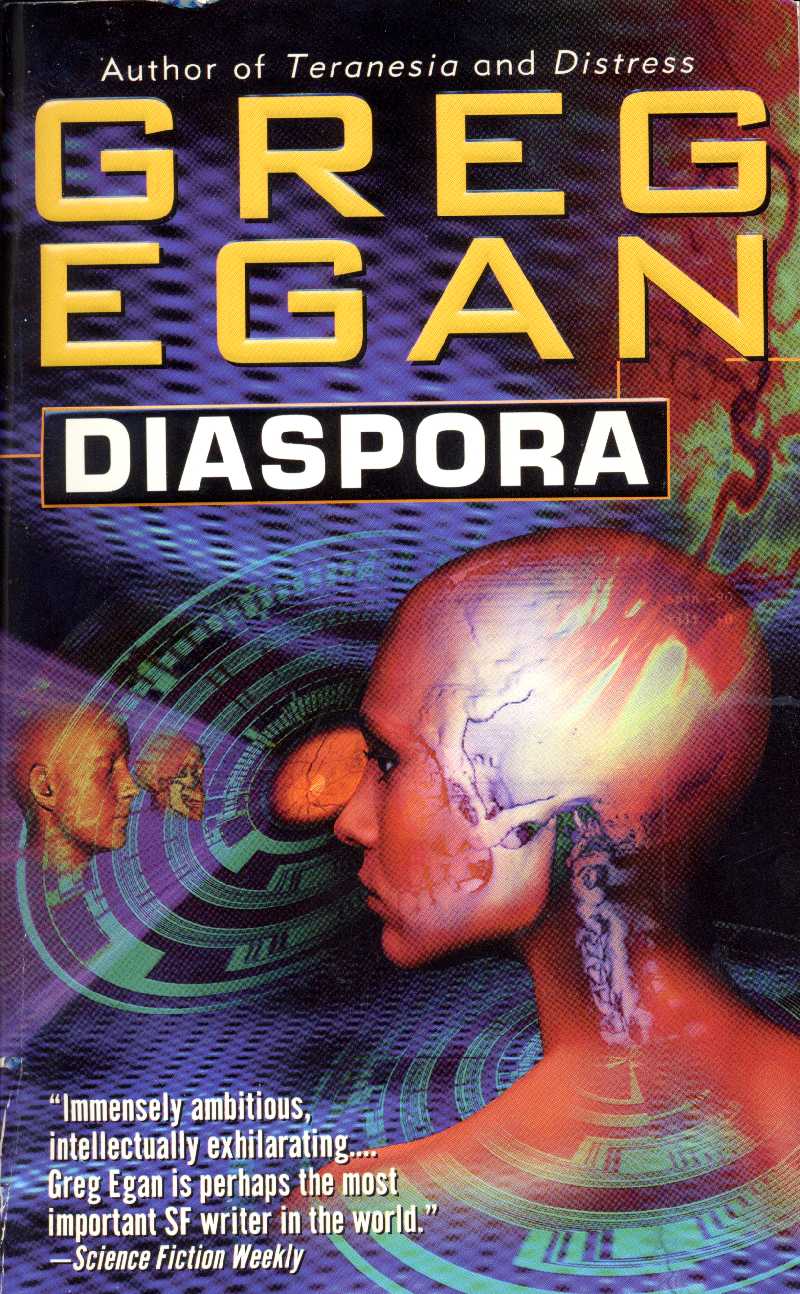 The premise is that at the end of the 30th century, there are some humans we would see as ‘normal’ – called fleshers here; there are more ‘people’ who inhabit the polises, which are basically massive computers – so yes, they’re virtual, from our current perspective. And there are also gleisners, who inhabit robot bodies. The plot is driven by the perspective of a couple of polis citizens; indeed it begins with the creation of an ‘orphan’, a citizen in a polis created with no input from any parental guidelines but by the polis itself, basically to test new possibilities. This orphan, who becomes Yatima, is a primary protagonist.
Some reviewers over on goodreads have been frustrated by the lack of fiction, or plot, in this story, and I can see where they’re coming from. However, there is a plot, and even if sometimes it takes something of a backseat to the ideas – well, that’s kinda the deal with an Egan story. But it’s not superfluous in any way. So what is it? Well, a gleisner astronomical survey indicates that two neutron stars are about to collapse into each other, several million years earlier than they ought to. They’re frighteningly close to the earth, and it does indeed do very bad things to the planet when the gamma rays etc get here. From this, eventually, there is a diaspora as people (broadly understood) attempt to understand this event and how to survive future ones and also, just Going Out into the universe as humanity has always dreamed of doing. Interesting things are discovered, of course.
This brings me to a rant about the blurb. It suggests that Yatima is searching for a world where no “acts of God” will occur. Um, no. If anyone is searching for that it’s Orlando, a flesher who goes into a polis after the catastrophe. But even that does absolutely no justice to anyone’s motivation. So… all I can think is that the blurber had no idea what to say about the book, and was told to focus on the plot (which they didn’t understand) rather than the ideas. This is my contempt you’re feeling right now.
And then there are the big questions Egan plays with. Some of these are things he’s actively working through over the novel, while others are things he simply takes for granted. For me, as always, his approach to gender is the most striking on a plot level. Because it’s one of the issues he simply takes for granted. Humanity living in a software-created virtual world? Why on earth would they keep to rigid binary (yes I know, all the caveats about it not actually being binary) understandings of gender? So most of the polis citizens are referred to as “ve” – and things happen to “ver” while belongings are “vis”, which is very neat. There are some who are gendered; Orlando, perhaps understandably, can’t shed his original gendered self perception; there are some polis-born citizens who also insist on it, and they’re regarded as frankly a bit weird. I adore this aspect.
The virtual nature of much of the story could lead to a complete divorcing from the physical, which is an issue I’ve been thinking a lot about since reading Nike Sulway’s Tiptree speech: the issue of divorcing matter and mind. However, I think Egan does a good job here of not doing so – and indeed of interrogating the issue. The polis inhabitants do still interact with matter, and it is important to them; there are discussions about the importance, or not, of interacting with the real and whether postulating crazy things like more dimensions than we can see or interact with is just offensive. Most polis citizens respect the material world even if they experience it differently from fleshers. And the diaspora, even if it takes places as (basically) flying computers, also interacts with the real and physical in important, fundamental and profound ways. So, go you, Egan, for not just going the lazy cyberpunk route.
Did I mention that this book takes place quite seriously over about two millennia, and then speeds up at the end to encompass even more time? What a head spin.
Some of the physics stuff he discusses: astronomy – especially the neutron star bits; extrasolar planets; alien life, including evolution and non-carbon-based possibilities; wormholes; quarks, leptons, fermions etc; and the possibility of other universes and how they would interact, or not, with the one we inhabit.
On that note, I can’t help but feel that this must to some extent be Egan’s answer to, or take, on Flatland. Indeed he references the idea of “flatland” at one stage. Because some of the characters are forced to interact with beings existing in 5 dimensions, and how are you going to do that? So that’s a really nice aspect for those who have read that somewhat obscure adventure into dimensional maths.
Some of the other ideas that Egan confronts: human evolution, both ‘natural’ and deliberate, and what that will mean for the various branches communicating with each other; the place of art and of mathematics; cloning, and its possibilities; parenthood and the nature of being an orphan; individuality and community.
I told you this was a dense, complex, and – I mean it – ambitious work, right? You can get it from Fishpond.
Glow
This book was provided to me by the publisher at no cost.
 I am not the target audience of this novel. It revolves almost entirely around the drug-taking sub-culture in south London, and that’s definitely not my scene. Nor am I particularly enamored of the brisk yet also sometimes fastidiously detailed sex scenes, nor the veering between sparse details on one page and then extravagant description on another. I admit I skimmed portions of the novel.
The fact that I skimmed is actually a back handed compliment, because I did actually want to finish it. My description of it revolving around drugs is true, but a bit unfair, because the drugs are merely a gateway (if you will) into a story about modern colonialism: that is, how the corporations do it. It’s a thriller, so there’s chases and double crosses and sell-outs; shifty people and honest people and people who got caught in the cross fire. There’s also a pirate radio station, raves, and a dog. And the main character’s biology works on a 25-hour cycle; I still haven’t figured out whether I think this is entirely a gimmick, or if it’s a clever little bit of character development. I guess it could be both, but I am leaning towards ‘gimmick’ because except for making him want to sleep at odd hours (uh, like a lot of twenty-somethings) and function well in the middle of the night sometimes, it didn’t have that much impact.
If you are less squeamish (or prudish?) than me about drugs, and want a fairly fast paced thriller that includes corporate evilness, you could do worse than this. But calling Beauman one of the top new British novelists is, based on this example, a bit much.
Bikes. In. Spaaaaace
This should be being talked about more.
 I came across Elly Blue courtesy of the Kickstarter folks featuring her in their weekly newsletter – as a result of which I now always take the time to at least skim that email, just in case there are other little nuggets of pure gold. Blue publishes a quarterly zine that focusses on “the feminist bicycle revolution,” and if that doesn’t sound awesome then I… have no other words. Taking the Lane looks at different aspects of cycling culture, and the original Bikes in Space was meant to be just a fiction edition of the zine. And then, from what I can tell from her website, it kinda grew. Such that this issue was published outside of the quarterly schedule (I believe), and as a book rather than as a zine. And there’s a third volume in the works.
It’s a cute little product – goes well with the Twelve Planets books; I don’t know who did the physical publishing but it feels nice and well-made. I love the cover! And the stories… well.
“Racing the Drones” is a nod to bike couriers everywhere, and the advantages they have over other forms of delivery. “The Sassy Chassis Lassies and the Devolution Revolution” makes comment on road etiquette – and the frequent lack of it from cars – as well as the freedom offered by bikes. “Winning is Everything” looks at a woman defying a male status quo, while “Grandma Takes Off” features a very awesome older lady. I have named my bicycle, so “Tabula Rasa” – about forming an emotional connection to your ride – worked for me; “Bikes to New Sarjun” is incomplete but takes up the idea of bicycles and charity and government intransigence. And Elly Blue herself addresses that bane of the cyclist’s life, butt-dialling.
“From an Interview with the Famed Roller Sara Zephyr Cain” is one of my absolute favourite stories. There is so much going on here, like hints at some sort of post-apocalyptic world, and tantalising ideas of genetic modification. But more profoundly, it’s a discussion about gender – choosing it, and dealing with people’s reactions to that. I’d love to hear what transwomen think of the story. Another of my favourites was “Midnight Ride,” which takes as its theme the freedom offered by cycling – and whether that can be inclusive (it is a little sentimental but/and I think it’s done nicely). And then there’s “The Bicycle Maker,” a lovely little story set well into the future, where humanity – at some point before they disappeared – delegated bicycle-making to a machine of some sort. And what’s that machine to do when there are no humans to ride its bikes?
But I don’t like bikes!
Tch. Come on. The bikes are always present, but they don’t necessarily play a huge role in the plot; sometimes they are simply there as transportation – although, of course, the use of bikes is often in itself a political statement. Which is part of the point of this anthology. Trust me, this is not a legit excuse.
You can buy this (and its predecessor, which I got as part of the Kickstarter and haven’t read yet) over here.
For Your Eyes Only
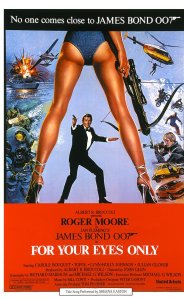 This review is part of Project Bond, wherein over the course of 2014 we watch all of the James Bond movies in production order.
Summary: in which Tywin Lannister Charles Dance has a non-speaking role as a thug, Walter Donovan Grand Master Pycelle Julian Glover is a double-dealing villain, and James Bond refuses to have sex with a young woman. There’s a plot in there somewhere, too.
Alex: First of all: WHAT THE HELL is with that promo poster?? There is… I can’t… there are no words.
 Second of all: I’m really sorry, Moonraker. It turns out I maligned you, because there is a worse theme song than yours, and it’s this one. I don’t remember 1981 except that I got a brother, so I don’t know whether Sheena Easton was just All That, but this is the first (…and only?) Bond in which the singer actually makes an appearance in the credits sequence (I was going to say that she’s lucky to be wearing clothes, because none of the rest of the women are, but actually I’m not sure I can say, definitively, that she is). And it’s just… forgettable.
This movie has perhaps the oddest, and weakest, opening of any Bond. Bond goes to put roses on Theresa Bond’s grave, and then his helicopter is hijacked by a bald man whose face we never, in a wheelchair. This is clearly meant to be Telly Savalas’ Blofeld, and I guess that means Bond throwing him (wheelchair and all) down an industrial chimney is meant to be just retribution or something? It’s weird, and without context quite uncomfortable. The helicopter aerobatics, and the cinematography of that section, is indeed spectacular.
Anyway, the film itself is about attempts to recover an ATAC – device that orders submarines to launch ballistic missiles – from the ocean floor off Albania. Of course the Russians want it as much as the Brits want it. This leads to the Havelocks – underwater archaeologists – being killed, in front of their daughter Melina’s eyes, which in turn leads to this masterclass in acting (you have to imagine the camera steadily getting closer in):
 … and also leads Melina to declare that Greek women, “like Elektra,” always want revenge. Because that worked out so well for Elektra.
 Bond ends up working with a Greek businessman, Kristatos (Julia Glover), who tells him that his former comrade in arms (Columba, played by Topol) is responsible. But surprise! It turns out to have been Kristatos all along! Columba is just an honest smuggler – he would never deal in heroin, or deal with those Ruskies. While we’re here: Columba is totally adorable. Always with the munching on pistachios!
I’m a bit worried that I am acquiring an immunity to Roger Moore, because I actually rather liked this film. This feels like a problem. There were still lots of issues – I’m getting there! – but the plot itself mostly worked (except for Melina leaving an oxygen tank on the ocean floor for no reason at the start of the film, and then OH LOOK it’s there when they need it at the end… oh right, and that bit where the parrot disclosed where the villains were heading). The pacing was pretty good, and – oh heck – even Moore was ok. In the accompanying features, Michael Wilson makes the point that they felt like Bond needed to literally and figuratively “come back to Earth” after Moonraker, and so they made this… dare I say it… grittier. So perhaps this is approaching the feel of my first Bond, Brosnan? Or yeh, maybe I’m infected with something.
 But it’s not all sunshine and skittles! Of course I got cranky! Where to start… hmm… how about Moneypenny? Sprung putting on some lippy at the time she’s expecting Bond. Now I love Lois Maxwell a lot, but she has aged a lot since she started as Moneypenny, and while I have no problem with older ladies flirting with anyone they like (in a responsible, consensual manner), I do have a problem with the writers making her look pathetic at lusting after a man for nigh on 20 years, like this. She’s better handing out the snark and being arch. Then there’s Bibi – oh Bibi. A young, bubbly, blonde, ice skater – Kristatos’ ‘protege’ (aaaand all the eyebrows shoot up). Lynn-Holly Johnson is a fine enough actress given the circumstances, but Bibi actually has no role in this film. Actually no role. She serves no plot purpose. She does two things for characters: first, she makes Bond look marginally less like a womaniser because he refuses to sleep with her (oh so magnanimous), and then – when we already know Kristatos is the villain – she has the throw-away line “I know what you want. You’re too old for me.” So she makes one man look good, and one look bad. But those things are already established by other aspects of the film, so she’s irrelevant. Except, as James points out, as eye-candy…. There’s a “countess,” Lisl, whose role consists of sex for Bond and a bit of information on the side, and then she’s killed. The main woman, though, is Melina. She gets involved because she wants revenge (see above); she helps Bond out of difficult situations a few times, and he rewards her by bullying her out of her plans. I would have no problem with Bond saying “look lady, I’m trained for this, plus I have no compunction about killing, so maybe I could help you not die in getting revenge?” But Bond ordering her to leave, without explaining who he actually is – yeh, that’s just rude and high-handed. I was also cranky at the scene in the sleigh where they’re giving conflicting orders to the driver and the driver listens to Bond. And when they stop arguing, he looks over his shoulder and sighs “Amore!” um NO. Really NO. Anyway, she gets to be competent – she’s a skilled scuba diver, she knows her father’s codes, she navigates the 2-man sub, and she’s a dab hand with a cross bow. So that’s something.
Worth noting: M is “on holidays” while these events take place, so Bond has to deal with the Minister and some random flunky. And this is because Bernard Lee died at the start of 1981, so presumably he was already sick and/or too old while filming was going on. Very sad, and I’m therefore on fire to see whether/how they replace M for the next four movies, given the glory that is Dame Judi Dench with Brosnan.
James: Is this the part where I write about all the awesome stereotypically boy parts of the film which Alex has neglected ? Why yes it is. Basically this is everything that happened in the film anyway. First the car … a 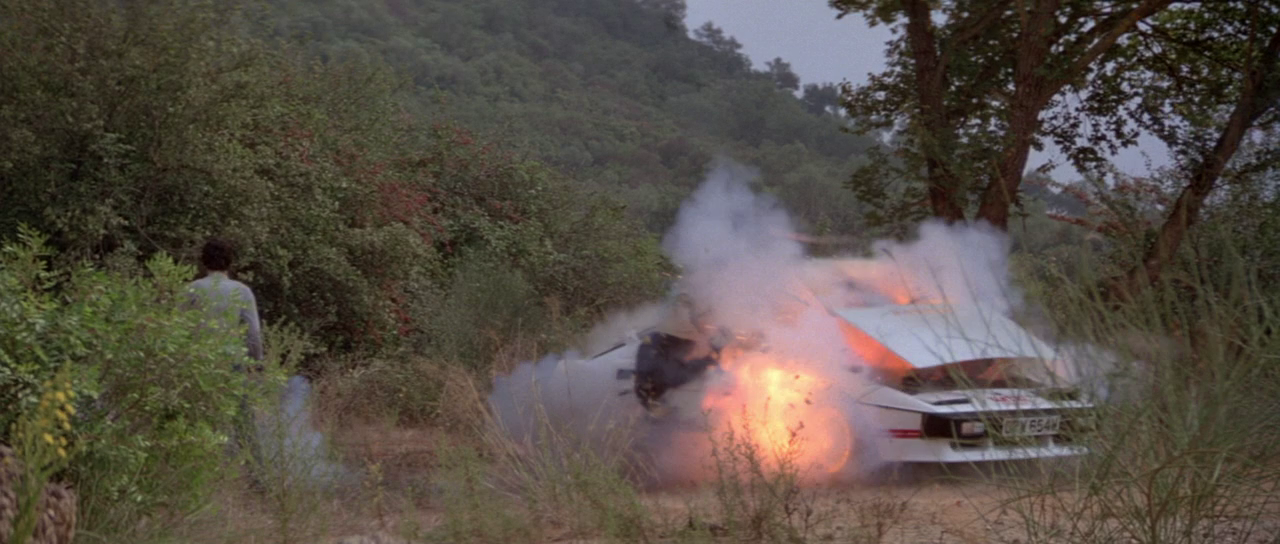 Lotus Esprit Turbo which meets a quick end in the film when one of the thugs trips the ‘car alarm’ and self-destructs the car – angular, 80s and cool.
Next we have a winter sports montage chase scene where Bond and his pursuers take part in four or five winter olympic events on a mix of skis, motorbikes and feet; the ski jump and the luge are the highlights. Out of the snow and into the water via the  Neptune mini sub searching for the secret (but tracked by the Russians and quite obviously not secret) British ship with the ATAC – this section of the film culminates in a hilarious fight against an enemy with a comically HUGE diving suit getting his head literally blown off by a limpet mine Bond just happens to have from the ATAC unit.
 Finally we get some modern technology too in the form of Q’s new
  identigraph system which takes a series of very Tron (or is it logo writer) graphics and suddenly punches out a face on a 9pin dot-matrix impact printer using nothing but ASCII characters (with the identity and dossier also of course). The movie finished up with a suspense filled infiltration of a cliff top monastery, culminating with a dying
  Columbo saving Bond and Melina from Kristatos, saving her from the previously mentioned revenge task of digging two graves. Oh, wait…
  Bond and Melina kiss at the end; come on it’s James Bond people.
2.5 Martinis


