The Man with the Golden Gun
This review is part of Project Bond, wherein over the course of 2014 we watch all of the James Bond movies in production order.
 Summary: in which Bond meets his assassin-y match and there’s something about solar power? Also, Bond seems surprisingly disinterested in teh ladeez. With bonus Christopher Lee!
Alex: another Bond that I’d never seen before! So that was exciting! … which was something, at least, since this is another film that took us two sittings. Partly that was tiredness on our part, but partly that was because this film so soooo slooooow. Better than Live and Let Die, but slow nonetheless. Probably the most exciting part of the entire film was thinking, “hey, Scaramanga looks familiar. He actually looks a bit like Christopher Lee!” And then realising omg it IS Christopher Lee!!
I’m being slightly unfair, I guess. Let me start then with ways in which this film shows its cleverness. I had always thought that the theme song for this, sung by Lulu (does that make it the most pop song of the lot? does she beat Madonna and A-ha?), was an amusing conflation of the villain with Bond. Turns out that all of the lines are actually applicable to Scaramanga, right down to the “Love is required/ Whenever he’s hired / It comes just before the ki-ill.” But the entire film is actually intent on making the similarities between Scaramanga and Bond quite clear. Scaramanga himself draws the parallel – “Ours is the loneliest profession” – noting somewhat tartly that the main difference is that he makes good money from it, as opposed to Bond. Bond of course defends himself by saying he only kills on HM’s government’s orders, but that’s after quite a strong assertion of kinship from Scaramanga, and I must say Bond comes off as less than convincing. So I do really like that the film is problematising Bond’s position as ‘licensed to kill’.
 Let’s talk about Scaramanga, since we already are. He’s shown in the prologue and immediately established as evil, because he’s physically different from the norm: he has “a superfluous papilla or mammary gland,” as Bond – that supercilious snob – so pretentiously puts it (he means a third nipple). He also has a servant named Nick Nack, a cordon bleu-trained chef who happens to be a dwarf. Again, this clearly places Scaramanga in the villain category for the Bond universe, because who else would tolerate a ‘freak’? This sort of ableism and Othering is really, really wearing. Anyway, from a narrative perspective Scaramanga and his servant are intriguing. Nick Nack allows an assassin – whom he’s paid – into Scaramanga’s inner sanctum. The assassin and Scaramanga proceed to play hide and seek, with Nick Nack sadistically commenting from behind the scenes. Turns out, this is a game they play – Nick Nack will inherit everything if Scaramanga is killed. So Scaramanga is fearless and rates his own abilities, but is also very keen to keep honing his skills. And he’s obsessed with his beautiful hand-crafted golden gun.
Backtrack: to plot. Bond takes on the task of chasing Scaramanga down when a golden bullet with ‘007’ inscribed on it arrives at HQ. Scaramanga turns out to be connected in some way to Bond’s earlier assignment, tracking down a solar energy scientist, who appears to have gone rogue and maybe defected to the Chinese? This was unclear to me. There’s also a Thai businessman, Hai Fat, somehow connected to everything; his appearance really confused me because I thought Bond went from Macau to mainland China, but it turned out that he went to Thailand. Hai Fat ends up dead, Bond and Scaramanga fight – partly over who’s a better assassin, partly over who is better – the one who makes money or the one with ‘morals’ – and partly over Scaramanga having access to solar power that will not only power lots of batteries but can also (natch) be turned into a laaaaaserrrr. Um, the end. Oh, except for Bond zipping Nick Nack into a suitcase, because that’s always hilarious.
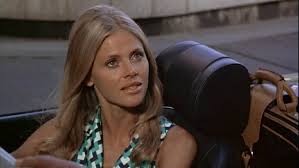 There are three women in this film, and they have far less significant roles than in the last couple of films. They’re even more boring than Solitaire, who at least got reasonable airtime. There’s Goodnight (yes, seriously), an MI6 agent that Bond’s slept with previously. At one point she gets feisty, declaring “Killing a few hours as one of your passing fancies isn’t quite my scene” – but it’s ruined by the incredibly thick layer of Vaseline on the lens, and that she ends up in his bed very soon thereafter (“My hard-to-get act didn’t last very long” – I kid you not, that’s what she says). This in turn is ruined when Ms Anders walks in. She’s Scaramanga’s latest lover, who is actually responsible for the 007 bullet. She initially seems to be awesome – Bond surprises her in the shower, but she gets out all cool and calm with a gun in hand, demanding her robe – but goes all to pieces quickly. Mind you, this is after Bond has been very rough with her, so maybe I’m being too harsh. When Anders walks in, Bond puts Goodnight in the cupboard… then when Anders leaves, Bond apologises with “next time.” Goodnight is further shown to be incompetent when she leans on a master override switch that will destroy Scaramanga’s base, with her and Bond still left inside – Bond gets very cranky, as if she did it deliberately. The other woman in the film? A bellydancer, from whom Bond plucks a bellybutton charm with his mouth. Yes, really.
Racially… well, again we at least have non-Anglos being played by non-Anglos. I really enjoyed Soon-Tek Oh, playing a Chinese agent in Macau and Thailand (even if Oh is Korean…) – he was great, even if they did give him some cringe-worthy stereotyped moments like he and his nieces being ace karate experts. He’s a good sidekick and hurrah! doesn’t die. Richard Loo, playing Hai Fat, does die but he’s a villain and is done in by his ally, and what do you expect anyway? I don’t think there’s anything mean said about him for not being white, which is at least a bare minimum. Oh, and as befits Bond the Great White Messiah, he’s quite good at fighting karate experts – he ignores the expectations of respect, and kicks his opponent while he’s bowing. 
The very weirdest thing about this entire movie is the inclusion of JW, the absolutely appalling, tobacco-chewing/spitting, nigh-unintelligible good ol’ southern boy sheriff from Live and Let Die. How is it even possible that he was popular enough as a character to be worth imagining as someone who would take a trip to Thailand? So that he could see Bond and end up ‘helping’ him? Every scene he was in made me want to throw something at the screen.
Graceling
Reading this was like eating M&Ms. Stopping was very hard. I began it one evening at 8pm. I finally forced myself to go to bed at 10pm. I had read about 200 pages. The prose is just that easy to read.
 This secondary world of Cashore’s isn’t a place where magic happens. It is, though, a place where some people are born Graced: they have a skill, or a thing, that they are superbly, unbeatably, good at. You might be a Graced chef, or a Graced archer; be Graced with mind-reading, some sort of prescience, or being able to eat rocks. I was about to write that I would like to be Graced with memory, but then I remembered the books I’ve read where characters never forget anything and I realise that would be appalling. Perhaps I would like to be Graced with pastry-making. Or with patience. Perhaps pattern recognition.
Anyway, you can tell someone is Graced before they act because they have eyes of different colours. Sometimes this happens as soon as the baby is born; sometimes it takes months, even years, for the eye-colour to settle in. In most parts of the Seven Kingdoms, those who are Graced are automatically feared, and become the property of the King. When you are already the king’s niece and your Grace is fighting… well, Katsa was screwed from the moment she threw her first punch as an under-ten. She’s been fighting for, and being a one-person bully gang in aid of, her uncle for a long time now. But she’s starting to try working around and under the king – helping out people where she can – and this has to come to a head at some point.
The story is a quest for knowledge and for self-identity. Katsa’s age is unclear – she’s certainly late teens if not 20s – and it’s not quite a coming-of-age; she’s cynical and knows about the world already. But while embarking on a quest to help a friend discover the truth about a family member, she definitely learns more about herself and how to be in the world. This search for identity is a current through the whole story, but it’s not overwhelmingly dominant; there are some reflective moments, but there are a lot of moments of action too, for readers like me who usually prefer that sort of story. And the actual quest means that Cashore gets to introduce us to bits of the Seven Kingdoms, which is always fun. I enjoyed the developing friendship between Katsa and Po, I liked the secondary characters, I liked that there were a few plot twists and that while it’s not a light and breezy story, it’s also not grim and gloomy (I have no problem with either, I just like that this one was at the lighter end).
There are a few failings. The ten-year-old is unbelievable enough that I thought she was going to end up being Graced with something that made her wiser than her years. Some of the secondary characters, especially Katsa’s cousin, could have withstood a bit more character development. Over on Goodreads I briefly saw two complaints. One is that it’s an enjoyable book except for the “raging feminist agenda.” I am bewildered by this. Is it a raging feminist agenda to have a supremely competent female lead, to suggest a woman can be a monarch, to not have a female character desperate to get married, to allow characters sex before marriage, to have female characters who don’t care that much about clothes? If so, AWESOME I WANT MORE. Me, I just see that as, y’know, reflecting the real world. The other complaint is about the romance – spoiler! There is one! (If you didn’t know that, you could read the cover quote which claims it has “a knee-weakening romance that easily rivals that of Twilight” … Thanks, LA Times. I have nothing to say.) That reviewer, I think, has an interesting point to make which is that (SLIGHT SPOILER HERE) Katsa’s refusal to consider marrying Po means that what they have isn’t really love, because love is meant to be sacrificial. She is NOT saying they ought to just get married – at least as far as I understand it (here, read it yourself – it’s the one written by Miss Clark). However, while I see her point, I think I disagree. I think Katsa is willing to be with Po forever, and that especially at this point it’s not not-love for her to be keeping her options open, and being wary. Or maybe I’m just too dewy-eyed.
There are two other books in the not-quite-series, but I don’t think I will hurry to get either. While I loved this book, it’s the writing and the characters that I adored. I’m not so fussed about other people in the world and their carryings-on.
(Another books from the stash of unread books, busted!)
You can get Graceling from Fishpond.
Hav
 I have never, in my life, read a book two times in a row. Until I read Hav. This was possible because Hav is not a novel in the ordinary sense. It’s a travel memoir to a fictional place that could easily exist; it’s a meditation on East meeting West, on history and culture and modernity; it’s about being a stranger in somewhere simultaneously familiar and alien. And it has some of the most wonderful prose I’ve come across.
This section from Hav illuminates many of the aspects that make the book so wonderful.
[The boats] often use their sails, and when one comes into the harbour on a southern wind, canvas bulging, flag streaming, keeling gloriously with a slap-slap of waves on its prow and its bare brown-torsoed Greeks exuberantly laughing and shouting to each other, it is as though young navigators have found their way to Hav out of the bright heroic past. (p66)
This. It’s beautiful, for a start. It suggests that conjunction of somewhere existing both in the present and, somehow, in the past that makes Hav so intriguing. And it’s quoted back at its author in the second part of the book, as an indication of her own understanding of Hav.
(We’re all about the meta.)
Two thirds of the book was written and published in the 1980s. According to Ursula le Guin, who wrote the introduction, it led to people going to their travel agents looking to book a ticket to Hav because it was so convincing. Now, it really is convincing, but at the same time there are aspects that make it quite clear that Hav is a fiction. Like the fact that you’ve never seen it on a map, maybe? I was confused by that until I look Jan Morris up, and discovered that she has written many actual travel books (under that name and as James Morris). So I concede that perhaps if you knew her earlier work, you could be forgiven for some confusion if not quite that much. Anyway, the last third was written in the early 21st century, and sees Morris going back to Hav after the Intervention – which was just starting as she left last time. And this allows Morris to explore a whole other aspect of culture and development.
“Last Letters from Hav” are entries written between March and August, with Morris arriving in Hav at the start and being bustled out as trouble brews at the end. In between, she does what any travel writer does: she stays in interesting places, she visits the important and not-so-important places in the city, she talks to people, she reminisces about what other people have said about the place. I’ve been having a great deal of difficulty writing this review because the books is absolutely busting at the scenes with themes, with commentary, with historical (a)musings. There’s multiculturalism and colonialism and identity – the losing and finding and historical nature of and doubt around. There’s appropriation on a massive scale – see previous note – and getting on with the business of life. There’s ordinary mystery and profound mystery, religion and politics and architecture and this book had me in RAPTURES. Can you tell?
Hav is a city-state in a world that really doesn’t have them any more. It’s got an uneasy relationship with Turkey, its only (?) land neighbour, but a seemingly thriving one with certain Arab nations and perhaps the Chinese. It’s basically meant to be somewhere like the Dardanelles – although the geography isn’t quite right – because it’s a big deal that this was where Achilles and his Myrmidons came ashore. And the Spartans too, apparently. And, later, Arab merchants, and Venetian merchants, and it’s one of very few venerable Chinese merchant settlements outside of Asia. See how Morris twists history and makes it just believable? There really were moments where I could believe this was real. Because her discussion of history is modern, too: the Brits wanted to colonise it; Hav was shared by France, Italy and Germany under a League of Nations mandate; Hitler might have visited, and Hemingway did. Morris talks to people who are flotsam from this era; and also to a man claiming to be the 125th Caliph. Also a casino manager, members of the ‘troglodyte’ race who live in the nearby mountains, the local philosophers, and some bureaucrats. She visits odd monuments, the Conveyor Bridge (I admit I had to ask someone whether that was actually possible, because I was teetering on the edge of What Do I Believe?), and the Electric Ferry. I don’t believe that this book could have been written by anyone other than an established travel writer, because her eye and ear for (even imaginary) detail is breathtaking.
The second section is much shorter and deals with only a week or so, some two decades later when Morris is invited back to Hav after the Intervention. “Hav of the Myrmidons” does all of the same things as “Last Letters,” with additional meditation on the nature of change and tourism and the impossibility of an outsider ever really understanding the internal workings of a foreign city. There’s also the inevitable nature of change, and the sinister side of globalisation with imported labour and native populations made to relocate – which, intriguingly, is given a possibly positive spin. Morris’ books is either revered or believed to be banned in Hav, depending on who she speaks to (it’s one of the bureaucrats who reveres it that quotes the passage above at her, as part of the reason for why she was asked back). But things have changed. Most of the glorious many-centuries-in-one-place nature of former Hav is gone, replaced with new and forbidding and disorienting architecture. Like the massive Myrmidon tower, surmounted by an M – but no one really knows who or what the Myrmidons are, or meant to be, in this context. Some things of old Hav have been retained, but sanitised, bent to a new understanding of the world. Tourists are allowed, but only in a defined space – which leads to another bit I wanted to quote, because I think it’s an indication of a travel writer’s despair:
“The thing is… one feels so safe here. The security’s really marvellous, it’s all so clean and friendly, and, well, everything we’re used to really. We’ve met several old friends here, and just feel comfortable in this environment. We shall certainly be coming again, won’t we darling?” “Oh, a hundred percent. I think it’s bloody marvellous what they’ve achieved, when you remember what happened here.” (p196)
Thus spake an older English couple with no intention of leaving the resort.
Hav puts me in mind of China Mieville’s The City and the City, and Christopher Priest’s The Islanders, both of which do a similar thing with inventing places that ring so amazingly true. The Priest is clearly fictional but written as a travel book; the Mieville is a fiction but set in a city that purports to be real. I guess Hav conflates the two.
This review gets nowhere near what I really want to say about Hav. I am so glad that it exists, and that I have read it. And now I will force it into the hands of anybody I possibly can… although I admit to some trepidation that maybe other people won’t like it as much as I do. (I haven’t been able to look at any Goodreads reviews for that reason.) I may have used the word intriguing too many times, and I may have given in to hyperbole, but I don’t care. I love this book and want to hold it to my heart FOREVER.
(Another of the books that has been languishing on my shelves for far too long, unread. WHAT OTHER GEMS ARE WAITING FOR ME??)
You can get Hav from Fishpond.
Black Ice
It’s the exacting details in this book that means it has dated so dreadfully that for all it’s an interesting enough story, I just can’t imagine anyone born after about 1980 enjoying it. Except possibly for its historical value.
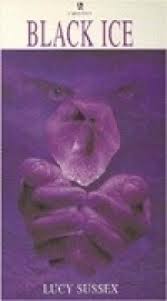 There are two plots entwined here: a ghost story, and a technology story. And they’re packaged with a family drama, just to give the main character another headache.
The ghost story aspect holds up, as one would expect, in that it’s not context-reliant; you could have the same story set in 1850 or 2050. Syb’s new house is always cold, and the new housekeeper Hille starts talking spooky things as soon as she moves in. Hille wears an amethyst and claims to see ghosts, or spirits, all over the place. Syb is dubious, but….
The technology aspect, though – oh, I giggled. This was published in 1997. Syb is really lucky because she has an email address and can dial up the internet with her modem any time she likes. She wins a competition and gets an internet camera. People are able to get hold of each other’s email addresses quite easily, there’s only a few websites to search for on any one topic, and hacking is a breeze. I have no doubt that Sussex was going for close-to-bleeding-edge experience with this story, and going for serious verisimilitude with the intricate details. But all of that means that it really hasn’t travelled well. Which is a shame, because Sussex does write well and engagingly.
The inside cover calls it a Children’s Book; it’s what I would consider the younger end of YA. Syb’s parents are going through a rough patch, and this is dealt with brusquely but (and?) sensibly. It’s a “this is not the end of the world” attitude, but not “this doesn’t matter.” Intriguingly given how many such novels get rid of the parents completely, Sussex does it a bit differently: the mum goes away but stays in contact via email; the dad is always a bit absent in his attitude but is always present and still relevant. Also, the romance interests are just barely present but more usually as an irritant than anything else.
This book was read as part of my read-all-the-books-I-own-but-haven’t-read effort, and conveniently also contributes to the Australian Women Writers challenge for 2014.
River of Gods
 One of the central yet peripheral things in many characters’ lives in this remarkable novel is the ‘soapi’ Town and Country. It’s the Indian version of Neighbours, or Eastenders. And in some senses this show – banal and humdrum, focussed on banal and humdrum activities, just like those shows that have enormous and devoted followings today – is emblematic of River of Gods itself. It is neither banal, nor humdrum; but much of it is concerned with surprisingly mundane and domestic issues, which become absorbing and riveting partly because of the skill of the author, partly because of the allure of the exotic: the exotic of the future, and the exotic of a country other than my own.
(Is it wrong to be enchanted by the exotic? And by exotic I simply mean other-than-my-familiar… which is, surely, an inherent part of the appeal of much fantasy and science fiction. Perhaps Other would be a less loaded term than exotic, at that. Hmm.)
River of Gods is set in 2047; the cover proclaims “Happy birthday, India.” Which becomes rather ironic, and somewhat sad, when it turns out that India as it exists in the early 21st century doesn’t exist in McDonald’s vision of its future: it has fractured into several, often rival, states. The political aspect is rarely front and centre in the novel; although it consumes at least one of the characters, McDonald focusses on his larger life, rather than simply making him a political animal.
See how I’m struggling to get on with this review? It’s hard to figure out where to start, what to say. Perhaps I should begin with “I adored this novel,” and attempt to explain why…
I adored this novel. You can stop reading now if you like.
Structure
The novel itself is split into five parts, each of them named for some aspect of Hindu mythology. It’s entirely possible that I have missed some deeper meaning here that relates to the novel’s structure, but I didn’t have much access to the internet while I was reading it so I wasn’t able to chase up meanings. The first part sets up the rest of the novel, introducing all but one of the main characters. Each of them gets their own chapter (in the third person), and the issues set up here continue across the novel with occasional intersections with other characters or their issues. Shiv is a crook, involved in various nefarious deals; Mr Nandha is a Krishna Cop, concerned with the regulation of aeais (AIs). Shaheen Badoor Khan is deep in the political regime of Bharat, Najia an ambitious journalist, and Lisa is a polymath scientist concerned with alternate versions of Earth’s development. Add to that a dropout scientist, a set designer for Town and Country, and a wannabe stand-up comic forced to go home to the family business. Parvati, married to Mr Nandha, is introduced later. Through their individual experiences, the novel tells the story of the world over a couple of weeks in 2047, with India as the focus.
Plot
Family trouble, political intrigue, criminals to chase, and AIs to try and understand. Also an alien artefact.
Each of the characters has a story. For some of them, the novel encompasses crisis and resolution. For others, we’re brought in halfway through, while for yet others we’re made to leave before the resolution. Some of these stories are exactly the sorts of domestic stories that are the fundamentals of soapies today: love and family and betrayal. (Please note I am in no way using ‘domestic’ in a derogatory sense here. Domestic stories are different from, for example, politically-focussed stories: Much Ado about Nothing is domestic, Macbeth – despite some domestic scenes – is not.) Other aspects are more detective story or political thriller. It does need a bit of adjustment to jump between them, but each chapter heading clearly tells you who the focus is, so it’s not that hard.
Language
McDonald uses Indian slang and terms throughout the novel. I didn’t realise until I was a third or so in that there’s a Glossary at the back (it is mentioned in the contents pages, but who reads the contents pages of a novel?), but even then not all of the words are explained. Most of the time the words – especially the slang – are understandable within context; I don’t need the exact translation to understand when someone is using profanity. Now, I have absolutely no idea whether McDonald is using the slang and other terms in appropriate ways. I’m willing to assume that he hasn’t made too many stupid and insensitive mistakes because he’s seemed to do well in the other, non-Western, novels of his that I’ve read – but if I’m completely wrong here I would like to know, so drop me a line if I need to be put right.
I loved the language. It was a little bit like reading a Greg Egan novel; if you’re put off by not being able to understand absolutely everything, this is not the novel for you (and I’m sad for you). And McDonald writes in an utterly captivating manner that meant putting this novel down was occasionally painful.
Characters As mentioned above, the novel focusses on a great range of people (and it passes the Bechdel test, if not spectacularly), which is a fine way to demonstrate the depth of the world-building. I’m not in love with how some of the female characters were portrayed (and some of the sex scenes seemed out of character with the rest of the novel), but other women were presented realistically. The men and women were just as likely to be competent or not, ruthless or not, etc. There’s only one main character who stays at home, with no job, and she’s female – but this makes sense in the context of 2047 India: there’s more men than women (one to five), so those women who want to work have trouble doing so because the men are favoured.
One of the most intriguing characters, both for who yt is and for yts storyline, is Tal. See that “yt”? Tal is a nute, surgically altered to have no genitals and psychologically/mentally altered to change the neurological aspects of yts previous gender. How Tal comes to physically be thus is briefly discussed, but why is not – so private a decision that the reader isn’t invited in. I have no idea how a reader who identifies non-cis would read Tal and those like yt. As an outsider looking in, I thought yt was treated like every other character and while yts nature was absolutely necessary for elements of the plot, it didn’t feel like a MacGuffin. While yt is treated as a freak by some, this is never (I think) portrayed as an acceptable attitude; and yt’s treated as an ordinary co-worker or neighbour by others. Yts other-ness isn’t treated as something added in just to add spice to the narrative, but as a genuine choice that ought to be available to people who so choose to change their own bodies. A minority, and one occasionally feared and derided, but legitimate.
Issues and themes
There are many. The place of women, as mentioned briefly above. The place of AIs – how do you legislate against them, how do you police that, and what are likely to be the ramifications? Climate change is a major factor, looming large in the background, because the monsoon hasn’t come to India in quite a while and this is, of course, disastrous. The development of new technology features. How to exist as a minority, and how to live as a fish out of water.
Overall, this is another great novel by Ian McDonald and I’m looking forward to reading Cyberabad, his set of short stories set in the same universe. You can buy it from Fishpond.
A Million Suns
I loved Across the Universe, the first of Beth Revis’ series about a generation ship. I was really excited about the sequel and bought it ages ago… and have only now read it, as part of my Read the Books I Own but Haven’t Read thing.
Sadly, I was disappointed.
 Spoilers for Across the Universe and A Million Suns.
The story picks up pretty much where the first one left off, again alternating between Amy – awakened before time on a generation ship that’s meant to be racing towards a new planet for colonisation – and Elder, now officially the one who’s in charge of the ship and the one who woke up Amy when he wasn’t meant to (which, the more I think about it, CREEPY. Which gets addressed briefly here but not enough). The book revolves around the issues confronting the population now that they’re off the drug that’s been in the water, keeping them all nicely docile, which also means that they can now realise that they’re being led by a sixteen year old boy (an issue which is only briefly addressed).
The good: I continue to like the exploration of generation ship issues. While I have some problems with how it’s done, it’s nonetheless good to see it done at all. If you’ve grown up in a tin can, it makes sense that at least some people are going to find the idea of not having walls utterly terrifying. It also makes sense that some people are going to resent begin, effectively, just a means to an end – why do stuff for people, and a destination, that you’ll never see? I was glad that Revis addressed some of the issues of resources and the problem of being a closed system, even if not in great detail.
I liked that people started thinking about political change. I can’t decide whether that happened too quickly or not, but it amused me greatly to see the French Revolution being referenced.
There are some pleasing aspects in Amy and Elder’s relationship. I really like the discussion of whether, if you only have one possible choice, falling in love with that person is real. There are too many examples of that just happening, as if OF COURSE I love you because you’re in front of me. Of course, this ignores the fact that people don’t necessarily fall in love with people of their own age – as demonstrated by Victria – which makes Amy’s flailing about do I/don’t I a bit precious. As mentioned above I really liked that Elder’s fascination with frozen Amy was revealed to Amy, even if it was only briefly an issue for her when I think it should have been more significant.
Overall, the writing is smooth; it’s not hard to read.
The bad: look, I don’t think I’ll read the third. That should tell you enough.
Amy and Elder both drove me nuts at different points. Amy whinges a lot, and Elder is alternately arrogant and fearful and it didn’t always make sense in context. Their relationship bugged me, especially towards the end – and I got annoyed because much of the story is about their relationship. When I realised that really, this is a love story that happens to be set in space, I got a bit less annoyed. Because that’s totally fine: it’s not what I was expecting or hoping for, but it’s a perfectly fine choice for Revis to make. Except that the story of their love just didn’t interest me that much – but that’s an issue of story telling rather than story choice.
To move on to the plot – Orion setting clues for Amy so that she finds out the truth about the ship was just ridiculous. It makes no sense for Orion to have done that, since I don’t think it’s suggested anywhere that he was sadistic. One clue, leading Amy to discover a video of Orion explaining the truth about the Godspeed, would have made sense. Or leading her to the space suits so that she could go out and see the truth for herself – that would have been fine too. But this convoluted trail that relied on Amy, a seventeen year old, having read certain stories and paying any attention to the shelving of books… seriously. No.
And the great reveal? I absolutely guessed that the ship was stationery, having already arrived. I think that the idea of people refusing to go down because of wild animals is weak, and the suggestion that people would not have earlier made exactly the decision that’s made at the end of the novel – of splitting the population – is ludicrous. The only thing that kept me reading this was to find out how the generation ship aspect was dealt with; I do not care enough to read about the population trying to make their way on the dirt.
The Crooked Letter
I’ve read this as part of my great Read Everything I Own but Haven’t Read Yet pledge, which I’m hoping to make serious inroads into this year. We’ll see…
 I got this a number of years ago as part of a show bag at a Swancon. I had read some Williams before, but not much. Since then I have read large chunks of his SF, but – until now – none of his fantasy except for the Troubletwisters books with Garth Nix. (It’s actually been a while since I read much fantasy at all, which is curious to realise.)
Slight spoilers!
Williams clearly has a thing for twins. In this, the twins are mirrors of one another, down to one of them having his heart on the righthand side of his chest. Their names are Seth and Hadrian – and I’ll admit to being a bit disappointed with the name choice, given that both lend themselves to some nice tricksy name-association, just not with each other. Moving on… Seth and Hadrian are on holidays in Europe. They end up travelling with a girl, Ellis, and then everything gets weird when one of them is stabbed. That’s not the weird part, though – the weird part is the non-stabbed one waking up and realising that the world is very, very different from when he last had his eyes open. And then things just get worse. For both of the twins.
There are some really nice elements to this story. Overall I thought the twins’ relationship was a well-developed one, nearly perfectly balanced between love and… not hatred, but perhaps despair at being tied to this same person in so many ways for so long. Occasionally I got a bit bored by the whinging, but perhaps that’s teenagers for you. The cherry-picking of mythology and characters from all over the world was a nice touch – it certainly avoided being eurocentric, which is always nice to see, and plays into a bit of a Jungian idea of the great subconscious with these commons themes that can (maybe) be seen. And I especially loved that Hadrian’s adventures mostly took place in a city – THE city, the great underlying city, what every city dreams of being. While I do love me some epic horse-riding and camping out, grand fantasy played out on city streets also has a lot of appeal.*
There are, though, some aspects that grated. Hadrian’s absolute insistence on finding Ellis – and that people are willing to help – strained credibility: HELLO, everyone ELSE appears to be dead, so how exactly are you planning on finding one probably-dead girl in the great uber-city? I was hoping right from the start that Ellis was going to turn out to be more than just a girl, and that all of the non-humans knew it, since that would excuse it to some extent. The first was correct but not the second, so my annoyance with that plot element still exists. Sometimes the mashing of multiple mythologies did not gel for me, and the explanation of the Three Realms really didn’t work for me. I can’t explain why; I don’t think it’s my faith getting in the way, since it rarely does with this sort of fantasy (that is, the sort that’s clearly playing with pagan ideas, rather than Crystal Dragon Jesus types).
I did finish it, which means I did enjoy it even if I didn’t adore it. I own the second Books of the Cataclysm, The Blood Debt. While it’s not next on my list, I will definitely be reading it at some point… and from there I’ll see whether I get around to the other trilogy that this is actually a prequel to, the Books of the Change.
You can get The Crooked Letter from Fishpond.
*Hmm. Do I need to read Lord of the Rings again sometime? I’m getting an itch…
Greg Egan: Quarantine
I think – in all my vast understanding of the world – that one of the things that really sets Greg Egan apart is his willingness to drive real physics to its ruthless end.
This is not to say anything against his plots or his characters. On the contrary, I think Egan does utterly absorbing plots and some remarkable characters. But so do other SF writers. There are few others, though, who combine this with a determination to take real-world physics and drive them a long, long way.
 Quarantine is a case in point. Take the idea that quantum mechanics suggests, that of collapsing probabilities as a wave function and the role of the observer in doing so. (Dear scientists, if I have just or am about to claim the equivalent of the Dark Ages being a real thing, please let me know and forgive me at the same time.) This leads to the many-worlds theory, whereby every action spawns alternate worlds where that action was done differently.
Now extrapolate to its ruthless conclusion.
Now add a detective thriller plot.
Now add a world in which there are no stars – they went out some decades ago.
Add the ability to mod your brain (turn off boredom, modulate emotions, change memories and attachments).
Add a world where Arnhem Land has become an autonomous nation and offered part of its land to become New Hong Kong.
… and you begin to get an idea of what Quarantine is like. Seriously, just a few of those things could make for a great novel. But they’re all there. Some are just part of the world-building, some are fundamental to the plot, all work cohesively together to produce a book that I read in a day (it’s only 250 pages, ok? And there are no formulae in this one, unlike the Orthogonal books).
I am never bored by Greg Egan, I am never impatient with Greg Egan, I am consistently surprised by Greg Egan. This is another good one.
You can get Quarantine from Fishpond.
Freedom and Necessity
So there’s this girl I’ve known for about half of my life. She’s been foisting books on me for most of that time. Sometimes that works out really well; she threw a comic fantasy at me by a new Tasmanian author once, someone called Tansy Rayner Roberts, and that’s turned out ok. At other times, I have been less… enthused. Because much of what she has directed me to has been romance.
(Long time readers of this book, cue the eye-rolling.)
Mea culpa: I have been a member of that set who poo-poohed romance as a genre. I have been dismissive of the covers and presumed they genuinely represented the contents; I have dismissed romance as not worth reading; I have dismissed the people who loved reading it. The fact that some of my friends enjoyed reading it confused me no end, because how could they be part of that group? I dismissed it as mere escapism… even as I bared my teeth at people who did the same to me over reading science fiction.
I am not proud. I am still getting over this attitude. And what both makes this attitude bizarre and helped me get over it was, at the time grumpily, actually reading most of the books I was directed to… and realising that they were well-written. Yes there’s crap romance; there’s really crap SF too. This should be no surprise. Also, I finally admitted that I quite like good romance aspects to my SF&F, and that that is okay. Part of my problem had been dealing with rather anti-girl and anti-feminine aspects of my own character (this is something that’s years in the discarding).
Anyway, she gave me Freedom and Necessity, and… the world changed.
The aforementioned friend recently sent me a copy of Freedom and Necessity which she rescued just for me, thinking I should read it again. Oh, how I love this book.
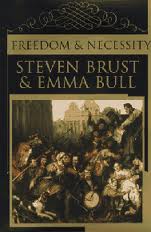 It’s 1849, and the convulsions that threw Europe into confusion in 1848 – attempted revolutions all over the place – have mostly simmered down. The Chartist movement in England (wanting outrageous things like manhood suffrage, paying politicians – so you don’t have to be rich to stand for election – and a secret ballot) has also mostly been contained. James Cobham wakes up at a rural pub with, he writes to his cousin, no memory of the last two months, during which time he has been presumed dead by drowning.
The entire novel is constructed via letters and a few diary entries. This does mean an occasionally improbable concession towards memories being excellent, but also raises the intriguing possibility of unreliable narrators all the way through. Also, the friend pointed out that reading it on the days the letters are written is both a fascinating and excruciating experience – the latter because the urge to keep reading is just. so. strong.
There are four main letter-writers. James; his cousin Richard; James’ step-sister and Richard’s paramour, Kitty; and Susan, also a cousin. The family is aristocratic in that way that doesn’t entirely make sense for a modern Australian – they’re not dukes, but they are wealthy and landed. James has been the family’s black sheep for a long time and clearly has a dubious past; Richard is something of a dilettante and scandalous for living with Kitty; Kitty seems flighty and wilful, at least at first; and Susan is sensible, determined, and intimidatingly modern.
Susan is my favourite. Susan is on visiting terms with Friedrich Engels.
The plot wheels between political machinations, dastardly plots of a political and a personal nature, family in-fighting, pseudo-druidical secret societies, fairly in-depth philosophical arguments, and falling in love. The fact that it is written as letters between different people means there are four distinct voices, with their own personal ambitions, hang-ups, and secrets; people don’t have all the same knowledge at the same time; and sometimes letters don’t get to their intended recipient at the hoped-for time, leading to… well. You can imagine.
I love the romance aspect; I love the historical aspect; I love the thriller aspect. There are serious arguments about Hegel that leave me bewildered. This book is delightfully well-rounded, and I am so very thankful to Kate for giving it to me so I can read it again and again, and loan it to Very Special People.
(Kate, by the way, is the creator of incredible jams and chutneys from local Tasmanian ingredients. If you’re keen on suchlike, search her out on Twitter – @justaddmoon – seriously awesome! /end plug)
You can get it”> from Fishpond!
You only Live Twice
This review is part of Project Bond, wherein over the course of 2014 we watch all of the James Bond movies in production order.

Summary: in which Bond dies, resurrects, and foils SPECTRE’s attempts to start a war between the US and USSR by eating their spacecraft. Also, he becomes a Japanese man. And gets married.
Alex: I love this theme song.
Once again, this movie sees James Bond become a science fictional film. The opening sequence is of Gemini 16, an American spacecraft, with its astronauts preparing for EVA. And then oh no! it gets swallowed by another spacecraft which appeared from nowhere! The USSR is, of course, blamed; the UK politely dissents with this assessment, but the US ignore their Anglo cousins.
Cut to credits. (And the revelation that the screenplay was written by Roald Dahl!)
I’ve made the point before about so much of Bond being set outside of England, and it’s only today that I realised that of course Bond is part of MI6 – the international arm of the British secret service. So of course he’s in exotic locales. This time, it’s Japan, and when Moneypenny throws Bond a book of Instant Japanese, he primly reminds her that he took Oriental Languages at Cambridge… which is, I think, one of the first time we get any information about Bond’s background. It’s interesting to think that after five films we know so little about our hero: no knowledge of his family background, his interests (aside from drinking and womanising)… nada. Apparently the Mystery Man was genuinely thought to be intriguing enough that it wasn’t necessary.
For an ambiguously SFnal film, Japan of the 1960s is an intriguing setting. Tokyo as a city is shown to be a place of, on the one hand, neon lights, while on the other traditional sumo wrestling. This dichotomy of future/past is repeated throughout. There are more security cameras than in the previous four films together, I think, and the head of Japanese security – “Tiger” – has cool round screens for showing scenes. He also has a private train and is disappointed that M doesn’t. The head of Osato Chemicals – the ostensible villain – has electric shutters and an X-ray machine in his desk.
On the other hand, there’s sumo wrestling and ninjas. In fact, there’s a remarkable amount of (Anglo-mediated) Japanese culture in this film, including a fake marriage ceremony that was both irrelevant to the plot and slowed the pace to a dead stop. I wonder whether this was because the opportunity of showcasing Japanese rituals was deemed worth it – and, indeed, exotic enough that it would work for 60s viewers? Screening “the Other” often has cachet, I know. From a gender perspective traditional Japan is suggested to be deeply sexist: Tiger gravely tells Bond that in Japan, “men always come first. Women always come second”… while four women in their underwear are washing them (“never do for yourself what someone else can,” or words to that effect). So that’s a thing.
There’s nothing really new about the gender politics here. The two Japanese women with whom Bond works are highly competent, but/and both fall in love with him. On reflection this makes Bond remarkably cold, since he’s making movies on the second – Kissy – just a week or so after Aki, for whom he seemed quite affectionate, has been killed. There’s also a female villain (number 11), whom he maybe sleeps with but certainly appears to have used his magical powers on, but then she does actually try to kill him. She’s a distinctly confused character, actually, and I was quite disappointed that they didn’t make her entirely straightforward (like Rosa in From Russia with Love). Also, Bond comments that Japanese girls “taste different” from their English counterparts. Er… wha??
The race element is present here, also. The absolutely worst moment is that Bond “becomes Japanese” in order to… I’m not sure what. He proceeds to train as a ninja, so maybe the appearance is really important? Basically he gets a bad haircut, has it dyed black, and gets some prosthetics on his eyes. It’s unconvincing. It is also, happily, the only case of yellow-face, so that’s positive. In terms of deaths, of the main characters only Aki – non-white and female – dies. I really expected Tiger to die, too, but happily he survives. And in looking up the cast I discovered that Tetsuro Tamba started acting in 1953, and had his last role in 2006. In that time, he was had 265 roles! By comparison, Connery’s credits go from 1954 to 2012, and come to 93.
Finally, it’s important to note that it turns out to be SPECTRE behind the eating-spacecraft thing; they’ve done it to a Russian craft, too, and their express purpose is to instigate a war between the US and USSR. Quite why… I’m not sure. Hoping to be
 the phoenix rising from the ashes and taking over the world? Because mayhem is its own reward? But that’s almost beside the point when we actually get the great reveal: Number 1 is Ernst Stavro Blofeld (played by Donald Pleasance), and he introduces himself to James Bond. So we see his face. And, as almost always with a Bond villain, he is disfigured: his right hand is damaged somehow (and is thus literally sinister), and he also has scarring around one eye. Nothing like making an obvious play on the whole physical/moral connection, is there? I can’t help but be a bit sad that the mystery has gone out from Number 1. Being faceless is far more intriguing than being scarred, in an Ultimate Villain. (I’d also like to take this opportunity to point out that a Supervillain Organisation that relies on its ultimate boss for such instructions as “lower the shutters” when the rocket is about to take off has some serious management issues.)
James: It was a little incongruous when the ninja had to use explosives to break through the obviously chicken wire and plastic roof over the volcano lair, but otherwise quite an enjoyable film. Also, what’s not to love about Little Nellie, the helicopter with rockets, flame thrower, machine guns and aerial land mines which can fit in 4 stylish Louis Vuitton suitcases and be brought in at a moments notice by Q. For the movie nerds, I’m not sure the blu-ray transfer was quite as magical as some of the earlier films, but perhaps the novelty has worn off. 3 Martinis.

 Randomly Yours, Alex
