Abaddon’s Gate

HOOOORAAAAAAAAY.
(Some spoilers below for Leviathan Wakes and Caliban’s War. READ THEM.)
The last line of Caliban’s War was an absolute killer, because I read it when it was first published which meant that the next book was about a year away and GOODNESS ME it was a cliffhanger. So I preordered this as soon as I could and happily, it arrived about a week before I went on holidays. I very carefully put it on a shelf where it wasn’t tempting me to read it… and then this week, on holidays, I cracked it open and devoured it in one day. And it was worth the wait. Oh yes. Thank you, James Corey.*
At the end of Caliban’s War, the protomolecule has been doing weird things on Venus, the Mao-Kwik company has been busted for attempting to weaponise it, and Miller – who died, going with the protomolecule to Venus – has just appeared to James Holden, who has once again (somewhat accidentally) been fundamental to saving the universe (well, the solar system). The conclusion to the series has the protomolecule and its… construction project… out near Uranus’ orbit (it’s basically gone on its own little Grand Tour of the system… and now I’m imagining the Ring being made out of Lego. Oops). Earth and Mars are once again sitting in an uneasy truce with each other, with the Outer Planets Alliance (OPA) not sure where it fits. Meanwhile James Holden is almost happy with his crew (but we all know that won’t last)…. While some of the early story takes place on-planet (or moon), most of it happens on board space ships of varying sizes, which is a big change from the earlier two where Earth and Ganymede in particular played important roles. Much of it also happens a significant time-delay away from official decision-making bodies, highlighting the issues of merely light-speed communication when people are many light-hours apart.
As with the first two books, this is told from multiple perspectives. The only one that is continuous across the three is Holden, master of the Rocinante (and OH! I just GOT the name, in making sure I was spelling it correctly. Don Quixote’s horse!!) and generally known across the solar system as a truth-telling, occasionally annoying, bad-ass. I love Holden. He is far from perfect, but he does the very best he can by his crew – who have, as a group, come a delightfully long way from their dysfunctional beginnings in Leviathan. (They’re still somewhat dysfunctional as individuals, but they work exceptionally well as a team.) He’s finally it together properly with Naomi, he’s getting good above-board work to keep the ship flying (… hmmm. It now occurs to me that there are some distinct similarities between Holden and Malcolm Reynolds. Huh.), and he really is trying to leave his solar-system-shaking days behind him. Honest. The fact that Miller – ghost? or something? – keeps bugging him… well, that’s a sign he’d rather ignore. Pity we all know that’s not going to work.
There are three other narrative streams, and (as with the other books) they have distinctly different parts to play in the story. Melba – not her real name – has one driving ambition, and it is not a nice one. Hers is a really interesting exploration of how an individual impacts on wider events. Holden’s story does, too, except that the way he impacts on wider events is usually accidental – or at least begins that way, as he is driven to bigger events, all to get back to his nice comfortable leave-me-alone life. Melba, though, doesn’t really care what impact she has on other people as long as her goal is achieved. Her development over the novel is the greatest of any character – or perhaps it just seems that way as the reader gets deeper into her head over the course of it.
Melba’s opposite in many ways is Anna, a Methodist minister who’s been out on a Jovian moon with her wife and daughter for two years. Let me say here that one of the most awesome things about this story is the way it takes religion seriously, and as a genuine force to be considered in medium-term science fiction. The religious figures are not perfect, and nor should they be – Corey is representing humanity in its fullness here. But Anna has conversations about the spiritual impact of the protomolecule’s existence, about what it means if there are aliens for those who hold to Christianity (are they fallen, like humanity? if so, does that mean that Christ died for them?) – and that’s fine, that’s acceptable. I can’t express how happy it makes me to see religion acknowledged like that. Anyway – Anna ends up on a ship heading out to the Ring. She gets to play a really important role on a personal level with a lot of people, but she herself basically stays the same over the course of the events.
Fourthly, and acting in some ways as Holden’s opposite, is Bull. An Earther in service to the OPA because of the charisma of its leader, Fred Johnson, Bull is on board the OPA ship going to investigate the Ring as security chief. I really like Bull. He is honest about himself and his limits, he tries hard to get the job done, and he’s willing to take the consequences when they’re in service to a worthwhile cause. It was a small event concerning Bull that brought a tear to my eye, which is not something I expected in a grandiose space tale like this one. Bull has a very tough job, especially as an Earther in charge of a largely Belter (that is, people from the asteroid belt, not from Earth or Mars) crew.
This issue of racism is an intriguing one throughout the series. I think (in my whitey-white way, I hope) that Corey* has done a very good job of showing the colonisation of the solar system as a multi-ethnic business; there are a few lines where someone is described along the lines of “if he was from Earth, he’d be [X]; here, he was a Belter.” The names are a delightful mash of multiple European, Asian, and African backgrounds (maybe South American as well, but I have less familiarity there and can’t be sure to pick it up). Sadly, but realistically, there is still xenophobia – and it’s based largely on where you were born. Planetary birth? You’re a duster, to a Belter. Born in the asteroids or on a moon? You’re a skinny, to an Earth- or Mars-born. And given the political situation – two wars between Earth and Mars, the Outer Planetary Alliance only recently (and that sketchily) graduating from terrorist organisation – place of birth can still be seen as having a significant impact on your politics and views on a range of important issues, like who gets to be boss of the inner solar system. I think Corey does a very good job of showing these issues in a sympathetic, not condemning but not condoning, manner.
This is a brilliant end to an exciting series. There is action, there is drama; there are explosions and chases, personal confrontations as well as planetary ones. Women and men both play important roles, the solar system is not white, and James Holden finally find out what the hell Miller wants with him.
You can get Abaddon’s Gate from Fishpond.
*Yes, I know that James Corey is actually two people.
Iain M Banks, The Hydrogen Sonata, and musings

I read this a long time ago now. It’s been sitting on my shelf at first glaring at me to review it, then looking at me sullenly, and more recently not even bothering to meet me eyes. The reason it’s taken me so long to write anything? I guess partly there was a lot I wanted to say – much of which I have now forgotten, to my chagrin, but it does kinda make a review easier to write. Partly, so many other people have written about it that what could I possibly offer? Not much, really. So why am I doing so now? Well, it was a review book so I would feel bad (… badder…) if I didn’t; and even if others have said these things more eloquently than I, at any rate I get some of my thoughts onto paper (… the screen…).
And now, well, Iain M Banks has died. I think Jonathan Strahan’s reflections say a lot; my own interactions are more recent, and don’t include any Iain Banks stuff (yet). So it feels both more pressing to record my thoughts, and less important. Anyway…
Many of the Culture novels talk about species which have Sublimed; moved on to another plane of existence, which isn’t heaven since it doesn’t exactly or necessarily involve death, but does mean that individuals or species no longer interact with the mundane, physical world. The suggestion is that Subliming is the apex of civilisation, what everyone should be aiming for personally and as a civilisation. As I write this I realise there’s a material/spiritual dichotomy going on here – not that Subliming is spiritual necessarily, but still that tension is present: that getting rid of the physical being is highly desirable. Interesting. This idea has never been the focus of a Culture novel… until now.
The Gzilt, as a collective, are going to Sublime. They’re doing the civilisation-level equivalent of writing their last will and testament, mostly attempting to leave their affairs in order, while some are having the end-of-the-world parties you expect if an asteroid is rapidly approaching. But of course, this is Banks. So things do not go smoothly; there is conflict over who will benefit from their departure (I’m reminded of a poem I read at school, “Where there’s a will there’s a sobbing relation”), and also over the very decision to Sublime. Not everything part of the narrative appears to impact of the Gzilt directly, at first – there are multiple narrative threads going on – but of course they all get tied up eventually. Mostly, quite nicely, and sometimes in wonderfully sneaky ways.
I know some people have complained that this is bloated; that it could have done with some editing. It’s 517 pages, in the trade paperback; probably it could have been shorter, but hello let me introduce you to Patrick Rothfuss or George RR Martin – Banks had nothing on them. Which is not to say that he should be left alone, just that it could be worse! And I will admit that actually? I don’t mind the bloat when it comes from the hand of someone like Banks. (I will out myself here to say that yes, I enjoyed the ridiculous length of Harry Potter and the Order of the Phoenix, and I loved The Wise Man’s Fear. Sue me.) I never once got bored with what Banks was spinning. As the narratives went weird places and the threads appeared to be going in disparate directions, I went along for the ride because I had great faith – which proved worthy – that Banks would reel it all in and everything would have a point. Of course he probably didn’t need all the side alleys. But… so what? Part of me wants to say “if you don’t want to read a long book, don’t read it.” That’s not an entirely useful point of view, I know. And there are some books where even I can see that long meandering sidetracks do indeed detract from the story. For me, this isn’t one of them.
Overall? Fans of the Culture should get on with reading it if they haven’t already. Fans of serious mind-bending SF who haven’t read any Culture could start here, but I would probably recommend Use of Weapons or one of the other earlier ones first. It’s probably also not a great jumping on point for someone who’s never read SF before, although for someone with enough willingness it would be a wild ride…
You can get The Hydrogen Sonata from Fishpond.
Without a Summer: the third Glamourist History
The following has spoilers for Shades of Milk and Honey and Glamour in Glass, I guess. Seriously, why haven’t you read them yet?

I read this quite a long time ago, and I have no real excuse for not having reviewed it earlier; it’s certainly no reflection on the story. Is it a good story? Yes. Does it fit in well with the other two Glamour novels? Yes. I think that this is the sort of book you don’t need to read the review of, if you’ve already read the others or like the idea of Jane Austen with magic (basically). Actually that’s not quite right… this one, in particular, is more like Elizabeth Gaskell with magic – and I say that having only watched film/TV versions of Gaskell, but given she’s described as Austen with ethics (that is, a more explicit examination of society and ethics than Austen), I feel I can make that claim. Because here Kowal does get into some discussion of class, in particular, and race as well.
The idea of a year ‘without a summer’ is actually based on fact; 1816 was a year that felt summer-less, because of the effects of volcanic ash from an eruption in the ‘East Indies’ as Kowal describes it. For the sake of the novel, Kowal introduces the idea of blaming this on coldmongers – people whose glamour is particularly attuned to making cold, so they get jobs doing things like keeping food or rooms cool. The story has both political aspects – which revolves especially around class – and personal aspects, which also revolves around class and race but also around family relationships.
The political: this is a time of Luddites, and issues of unemployment; tie in the cold, and fear of glamourists, and there’s a very dangerous situation brewing. It would be hard to talk about that without giving away some of the details whose revelation is part of the delight of the story, so I won’t. Suffice to say that the concerns Kowal raises fit perfectly into the period, and complement the personal issues going on for Jane and Vincent perfectly.
The personal: Jane and Vincent are faced with a number of issues to deal with, and to my delight not all of them are dealt with easily. The one that most struck me, by the end, was Jane’s relationship with her sister Melody. Pride and Prejudice hints at the difficulty of older and younger sisters relating, as does Sense and Sensibility – but these tend to show the older as being in the right, and the younger as needing to be tamed in some way. Kowal does very clever things here with that trope; Jane and Melody’s relationship is more realistic, and more painful, than in the Austens – and this makes the story the more uncomfortable and real as a result. Secondly, there’s the introduction of Vincent’s family. They’ve been less than shadows to this point; all that we’ve known is that Vincent has cut himself off in order to be a glamourist, and his family don’t approve – and that they’re from High Standing. They arrive with a vengeance here, and Kowal spares no mercy. Vincent definitely comes out of the whole thing as a more impressive man for overcoming the family issues that he was dealt.
Some of the other issues facing the pair mingle with the political. In particular, they are confronted by race issues, both because many of the coldmongers – whose problems they can hardly help themselves from being involved with, touching as it does on glamour more generally – are black, and because one of the families they end up heavily involved with are Irish. This may seem strange to those without knowledge of how the United Kingdom worked in the nineteenth century; but as Kowal points out in her afterword, at this time “the notion of ‘white’ excluded not only people of Anglo-African or Anglo-Indian descent but also Irish” (356). Some of Jane’s own prejudices are confronted, along with those of London at large – not comfortably, but I think, for the reader anyway (at least, this white reader; I won’t try to imagine how to read it as someone confronted with racism on a regular basis) in a sympathetic manner. That is, not that the racism is easy to read, but the confronting of it is more like what 21st century tolerant sensibilities would prefer.
I’m sure I had more to say when I originally read this, but – the characters remain engaging and delightful, Kowal continues to find genuine circumstances for them to interact with, and her style remains a delight to read. I’m not sure if I want more stories here; there would surely be a danger of Jane and Vincent turning into the unexpected epicentre of everything interesting in 19th-century England, which would end up being silly. And would insist on bringing up the issue of pregnancy and children… which might not be a bad thing, I just can’t think how it would be done. But then, I’m not an author. Maybe I should just Kowal to know what is best for her characters…
You can get Without a Summer from Fishpond.
Cloud Castles: the re-read
Spoilers for the first two books, Chase the Morning and Gates of Noon – although really, there’s three books, surely it’s no spoiler to say that Stephen survives and has further adventures?
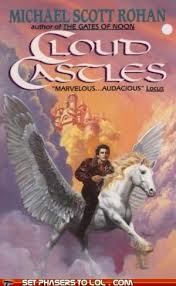 Stephen Fisher, no longer quite such the hollow man as previously; oh look, the brief love and forgiveness of his ex-girlfriend has worked not quite a miracle, but certainly wrought some change. Whodathunkit. When this novel opens, Stephen is in an intriguing position: he remembers the Spiral all the time when he’s in the Core, he’s deliberately had many adventures there – but his life in the Core isn’t harsh or empty enough to give it up. In fact, he’s now the head of his company and he’s got a brand new, very interesting project on the go. No on-going relationship, but still – he’s not the hollow, use-and-leave type that once was. Which is good, right?
The ultimate reveal is brilliantly constructed. Up to that point… well, the story threatens to feel a bit samey. In fact, it is: there’s challenge from the Spiral affecting Stephen’s life in the Core, and he goes out and faces it and there are ups and downs, and something Big from out near the Rim challenges Life As We Know It. All of these things happened in the previous novels, and they happen here too. But the great thing about Rohan’s writing is that it still manages to be interesting and thoroughly enjoyable. For instance, in the mythos he’s mined: there’s been voodoo; and Asian myth from Buddhism to Hindu to animism; and here, Rohan brings it back to Europe. In terms of action, the first two books were similar in involving ships; here, the focus shifts to the possibilities of air travel (AIRSHIPS!). And I swear Rohan must himself have taken up fencing between Gates of Noon and this book, because the fights seemed to get a whole lot more technical… which I kinda skimmed occasionally. And while some of the side characters are the same – really, who could ever get sick of Mall? Really? And there are new characters too: happily, to my mind, especially another woman, who gets a bit more fleshed out than Claire or Jacquie ever managed to be in the previous books.
Yes, there’s some annoying repetition with Stephen bemoaning his life – but Gates of Noon was definitely the worst for that, and his growing/filling up has largely curbed that. And yes, the portrayal of women is not always great – Stephen occasionally has a ‘private’ leer which the reader is privy to – but Mall gets to be Amazing. This could be problematic, because clearly it’s not realistic and it’s annoying if the only woman has to be so much better than any of the men to warrant any air time: but it does entirely fit the idea of Mall being over 400 years old, and moving outwards on the Spiral, and therefore – like Jyp is, to a lesser extent – becoming… clarified. And she’s not the only woman, which helps.
So I firmly believe these books deserve their space on my shelf.
The Golden Day: a review
I picked this book up at The Moat, a bar/restaurant slightly underneath the Victorian State Library. It has a shelf of books that can be taken by customers on the proviso that at some stage, you put one in yourself – although a further proviso is “No Dan Brown” (seriously it 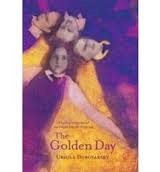 says that on the sign). Anyway I’d heard of Dubosarsky and never read any of her stuff, and the cover was immediately entrancing – look at that purple! and the gold is luminous!
There’s a little bit of Picnic at Hanging Rock around this book, which Dubosarsky herself acknowledges, as well as a lot of inspiration from art – especially that of Charles Blackman, whose paintings and drawings provide the chapter headings. It also, she says, draws on her own memories of being a Sydney schoolgirl.
Eleven little girls have a somewhat peculiar teacher, who takes them out of school down to the nearby gardens, to consider the world and attempt poetry and to listen to a gardener-cum-poet, Morgan. (It’s fair to say that there were a lot of alarm bells for me as a teacher with this book! The 60s were truly a different world…) But something happens – something unexpected and terrible, but probably not what you’re thinking: let me spoil this slightly and say nothing happens to the girls themselves, IT’S OK Tansy can read this if she hasn’t already.
While the ongoing repercussions of the Serious Event colour the entire book, Dubosarsky works other issues in, in the same way that such issues would probably be experienced by your average kid. It opens on the day Ronald Ryan is hanged (the last such event in Australia); the Vietnam War is ongoing. Closer to home, things are not entirely well in the homes of at least one of the girls, although exactly what is going on is never fleshed out; the reader sees glimpses in the way that a casual schoolfriend sees glimpses, only when they’re allowed or by accident.
It’s a very short book – 150 pages of well-spaced type. It’s a delightfully written book, with evocative descriptions of schoolrooms and gardens and slightly creepy creeks. Dubosarsky captures the innocence and bewilderment and childish cunning of children very nicely too; a student would have no trouble seeing themselves in this novel, in the attitudes and expectations of the schoolyard. It’s also potentially a frustrating book. It begins in 1967, with the girls about 10 years old; it covers about a fortnight in their lives, mostly in the schoolroom with occasional forays outside. It then jumps to one afternoon in 1975, with four of the girls sitting their final HSC exam, and a final intriguing addendum to their experience eight years earlier. The story is left ajar – not quite open, not quite closed… I guess this is fitting since the girls themselves are on the cusp of adulthood, so their lives at this point are liminal, balancing between two aspects.
The Golden Day is intriguing, and luminous like its cover; I have no doubt this will stay with me into the future. Especially when considering excursions.
You can buy The Golden Day at Fishpond.
A history of blue
Did you know blue has been the favourite colour of Westerners over the last couple of centuries?
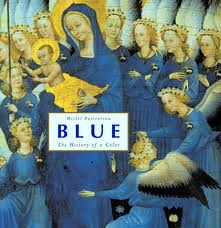 This book is and intriguing idea, although not entirely well executed. I enjoyed the broad sweep of time that Pastoureau attempted to cover – the Neolithic and ancient use of colour very briefly, the medieval world and on in a bit more detail – because the comparison across hundreds of years is fascinating. Unsurprisingly though, this was also one of its downfalls, since the occasional times it treated an idea or subject in detail it felt out of place; and the lack of detail in some areas annoyed me. In some ways this felt, perhaps deliberately, like this was a preparatory work; a number of times Pastoureau raised questions as areas requiring further research, or mentioned medieval manuscripts that have yet to be transliterated or studied in any fashion.
In appearance this is halfway between a history book and a coffee table number. It’s beautifully presented, and the pictures themselves are delightful – most pages have one or two, sometimes three, pictures, illustrating some pertinent point about where and how blue was being used, or other uses of colour at relevant points. But the text is too dense to really work as an art book, while it’s not long enough somehow for it to feel like a really serious treatment of the subject – especially not over such a vast span of time.
As a history book, I remain unconvinced by some of Pastoureau’s suggestions about how blue worked in culture. The lack of blue in very early art, Neolithic right through to much ancient illustration, is curious but I didn’t entirely buy his explanation for its lack of symbolism and therefore appearance and I’m not sure why. Perhaps it just didn’t feel explained enough to accept such a radical idea. This problem permeated much of the text, in fact; the sober, moral overtones that blue acquired thanks to the Protestants, as well as the issues discussed around its symbolism in the later medieval period, were presented as a little bit too definitive, a little bit too unarguable, for me to be entirely comfortable. Clearly Pastoureau was not setting out to write the definitive work on the colour; he himself points out that a vast amount more work needs to be done in a whole range of areas before such a thing is possible. And perhaps it’s also a fault of translation; maybe there was a bit more uncertainty in the original French?
Anyway, overall this is a fascinating book that has made me think about colour and its uses, but not entirely satisfactory.
Zendegi: a Greg Egan novel
My e-copy of this book categorises it as “Fantasy; short stories.” It is neither. Rather, it is a near-future novel about politics, virtual reality, religion, family relationships, and death.
No, it is not a Patrick Rothfuss or George RR Martin-style tome. It is elegant.
Two strands: Nasim is an Iranian woman living in America, working on the mapping of individual finch brains to try and create a generic brain map. Martin is an Australian journalist working in Iran, who gets to cover escalating political unrest. (This book was published in 2010….) Flick forward several years, and Nasim is living in Iran and now working on Zendegi, a virtual-reality platform used by millions of people, mostly for entertainment. Martin is still in Iran, married with a son. I trusted that the two strands would eventually cross, but I really couldn’t figure out how. The answer is both ‘cleverly’ and ‘via tragedy’ (Egan, you are nasty).
I am in serious danger of becoming quite the Egan fangirl. Just so you all know.
Egan does a marvellous job here of entwining the intimate and domestic with large-scale societal issues. Personal tragedies are neither hyped up to become world-ending nor elided as insignificant. The plot moves carefully between, for example, Zendegi as entertainment for a six year old and Zendegi as bleeding-edge technology – and how the company can deal with competitors. Egan portrays politics as they are seen by a slightly-above-average interested citizen, rather than focussing on politicians; he touches on religion as it might be experienced, rather than trying to show rights and wrongs. He’s a sensitive and compassionate author, but did I mention nasty? Also, I think he writes women well, which is something I’m coming to appreciate more and more. Nasim’s feelings of anxiety over having left Iran, and wanting to return, read realistically. In fact, overall human attitudes and relationships read as believable: complex and contradictory and frustrating and glorious.
In a more classically cyberpunk novel, Zendegi would get far more of the focus that it does here; characters don’t actually spend that much time in the virtual world, for example. It is incredibly significant for both Martin and Nasim by the end, but still I am a little surprised by its use as the title. I think Egan has hit on a more likely way for virtual entertainment to encroach on our lives than most early cyberpunkers did – more subtle, and perhaps more insidious for the fact. It’s really nicely presented.
This is a novel brimful of complex and challenging ideas that is an absolute, pretty much effortless, delight to read.
You can buy Zendegi from Fishpond.
Scorched Supper on New Niger
I got hold of a copy of this amazing novelette (I think? 17,000-ish words) from one of Galactic Suburbia’s wonderful listeners, who is the Editorial Director of a new digital publisher, Snackreads – he sent through a copy because he thought it would be up our collective alley.  To which the answer, I think, is OH YES.
A future where there are space ships carrying cargo between planets as easily as trucks do today… but where there is, for some unknown reason, a societal reaction (on some planets) against women having the freedom of movement to do things like be in space. Dee has taken over a freighting company from her formidable aunt, but is facing difficulties in the shape of her sister, her sister’s husband, and mounting debt. When she has to land on New Niger, things appear to be as desperate as they can be, so she ends up making a deal with a competitor… and things go from there.
The things I love about this story are many: I love Dee’s voice as she makes clear just how much it means to her, to be a pilot, and just how much she hates the idea of being trapped by her brother-in-law. I adore the idea of New Niger (although I must admit I don’t know how accurate Charnas is in her descriptions of Old Niger, and it may well be that there are some things that are offensive/otherwise wince-worthy, and if there are I’d love to hear it) – people of colour in space! Who would’ve thought it! I particularly love (although see previous brackets) the way that one character there, in particular, plays on racial stereotypes very consciously to her own advantage. The denouement had me quietly cackling with glee. I enjoyed the pace of the narrative, the action overall, the ‘domestic’ setting (family feuds) commenting on larger social realities…
I should get me some more Charnas to read, I guess.
Exile from Space: a short Judith Merril story

I’ve been wanting to read more Judith Merril since Helen Merrick’s Secret Feminist Cabal, since Merril features pretty prominently in the early years. The lady wrote “That only a Mother could love” – a seriously amazing piece of fiction that I’m sure Russ would have dismissed as ‘galactic suburbia’ but I think is staggering in its suggestion about life for the ordinary woman in The Future.
Anyway, “Exile from Space” – the basic story is young woman going to the city for the first time, but there’s clearly something a bit odd about this young woman because of how she talks about her education, and about other people… and it quickly becomes apparent that she has not been living with other humans, at least for her teen years. So although she herself is human and passes for human, she has to deal with all these weird things like eating, and shopping, and interacting with humans – such that she might as well be an alien. Oh, the many levels of ‘alien’. And then, of course, there’s a man…
Merril’s writing is delightful and elegant, and conveys the sheer weirdness of human existence simply and clearly. So many things we take for granted…. This story makes me wish I could find more of Merril’s work, but I keep coming up with nothing wherever I look. I got this story from The Gutenberg Project.
Dreaming Metal
I missed a first-in-the-series, here, which is a bit frustrating; I’m usually pretty good about not doing that. Anyway, if it’s going to bug you like it annoys me, go read Dreamships first. This one will wait.
Scott likes tackling hard topics, and here she’s asking – when does intelligence become intelligence? When can, in crude terms, a computer be regarded as a being in its own right? Does there have to be a deliberate effort on the part of humans for it to happen, or could it develop accidentally? And when we finally find that silicone intelligence shares the same space as us… what will be our reaction? Because we have such a good track record of dealing with humans with different perspectives from our own, let alone an entirely different type of intelligence. Scott presents some intriguing suggestions to these questions – and a few answers, but nothing completely definitive. It’s nicely tantalising, in a lot of ways.
I generally love Scott’s worlds, and this is no different. Humanity has spread to several planets; this story is set on Persephone. For all that there’s some seriously upgraded tech, and that it’s set an unknown distance into the future, it still feels recognisably human. Like, after initial freak-out-edness, it seems like I could probably live on Persephone. This is probably helped by the fact that the story revolves around people whose own lives revolve around that rather ubiquitous human characteristic, a love of music. Initial events are spurred on by the death of much-loved music star, and one of the main characters has a souped-up illusions show at one of the ‘Empires’ – which I think are basically futuristic theatres, catering to a variety of entertainments, from rock music to vaudeville (or their futuristic equivalents). I love this idea that the human desire to be entertained, on the one hand, and the equally pressing desire to express oneself in public somehow, will continue into the future – it’s something that doesn’t get enough airplay in SF I think.
Another aspect of the world-building that I really appreciated is that it’s clearly not a monoculture. I think this is the one main area where not having read Dreamships was a problem (aside from a couple of plot points that I managed to catch up on); the use of ‘coolie’ and ‘yanqui’ and other terms clearly referring to ethnic background didn’t always make sense to me – or, where I could but out the basic meaning (like with those two), it sometimes took me a while to figure out all the subtleties, like whose allegiances lay where and who felt which grievances. Nonetheless – this is a future that is not overwhelmingly white, where cultures have continued to develop and take on bits and pieces of older traditions and moosh them together, and where people can live on the same planet and not be identical. Also, where a common expletive is “Elvis Christ”.
The plot? Assassinations, destruction of property, intrigue, romance – all revolving around that idea of artificial intelligence, how it might come about, what should be done about it if it does, whether machines taking over from humanity in any area is a good thing, and all of those good things.
Scott writes beautifully. She switches between characters effortlessly and gives each a distinct voice. She matches a great plot with hard questions and does wonderful service to both. It’s not quite as cyberpunk as, say, Trouble and Her Friends, but it’s wonderful science fiction.

 Randomly Yours, Alex