Bitter Seeds: a review

First things first: this is not an Alisa book (WW2 references and events), nor is it a Tansy book (there are children, and babies, and things are not always nice).
This is not, actually, what I would immediately think of as an Alex book, either. I don’t tend to go in for WW2 alternative histories. I don’t object to them, but I don’t have the fascination for Nazis that still seems to occur in Western culture. (Seriously, what is WITH that? Can’t we move on?) I also don’t have the deep understanding of WW2 tactics and dramatis personae that enables me to pick the subtle alterations that can be made. Nonetheless, I got it for review, and the front cover phrase – “An unnatural power. An unstoppable force” – was intriguing, as was Cory Doctorow’s description of it as “Mad English warlocks battling twisted Nazi psychics.”
That is, indeed, the premise of the plot. A German scientist (I use the term in its broadest, amoral sense) has been experimenting with the aim of creating – you guessed it – superhumans. The English find out about it, or bits of it anyway, and in response start trying to figure out what their defence can possibly be. The answer is… not very nice. There’s an element of ‘doing wrong in order to do good’ about a lot of the English response, which causes some of the characters some angst but occasionally didn’t seem to worry them nearly as much as it ought. My reaction to this vacillated. On the one hand, a bit more hand-wringing (or more effective equivalent) would have increased the humanity of the characters; on the other hand, I fully understand that war can and does change perception and attitude, and perhaps what Tregillis is being is brutally realistic. Whichever, it often makes for somewhat unpleasant reading.
The story begins with three significant events in 1920, then jumps to 1939 and continues on to 1941. The 1920 prologue introduces three significant characters and their assorted others. Two children arrive at a deserted German farm (spooky); a group of children steal from a backyard vegetable garden and their ringleader gets rather more than he expects from the garden’s owner (amusing); and the very young scion of a noble family learns rather more than he wants about his odd grandfather (spooky, again). The German children, of course, are subjects for the German doctor’s experiments and – slight spoiler? – both live to become agents in service of the doctor and his patron, Himmler. The young ringleader is taken under the gardener’s wing and joins the Royal Navy and then the Secret Intelligence Service (you know James Bond started off in the navy, right?), and is the one who starts cracking the nut that is the weird German actions. And the other gentleman… well, that would be a spoiler, so I won’t explain him. But he definitely crops up again. Of these characters it is fair to say that none are especially loveable, or even likeable, most of the time. The English secret agent, Marsh, is initially the most approachable, but that doesn’t last. They each have moments where sympathy is definitely appropriate, but half the time they’d go and do something or say something that, if not actively making me dislike them, certainly made me ambivalent. That’s not necessarily a bad thing in a character, but it certainly made the reading experience more wearisome than others.
The plot basically follows the development of WW2, with added supernatural/psychic/weird elements that naturally alter how some things pan out. I think Tregillis has thought out the repercussions of these new weapons quite well, but then I’m no military historian so my approval is definitely suspect. As with any war, things get more and more unpleasant as time goes on. This is not a nice novel. People get hurt, and not always the right people.
Bitter Seeds is well written and a very examination of the way psychic weapons could alter warfare. It’s also a fairly bleak look at how people react under stress. It’s very well written – engaging, well paced, and with well-timed shifts between characters. All of that said, I don’t see myself seeking out the sequel. I don’t think I could handle the fact that I am quite sure the story can only get bleaker before it maybe, possibly, gets brighter – and sometimes the brighter doesn’t entirely make up for the bleak. So, enjoyable, but not really my sort of thing after all.
You can buy Bitter Seeds at Fishpond.
Etiquette and Espionage: a review

“Young ladies ought to be seen and not heard, except when they’re climbing over dirigibles or looking for secret information. Unless the being seen bit is part of a misdirection.”
This advice pretty much sums up what Mademoiselle Geraldine’s Finishing Academy for Young Ladies of Quality is all about. They learn music and etiquette, along with eyelash-fluttering and the language of parasols, but all of it goes into the service of turning out young ladies who are capable of stealing, finding, maiming, subverting or even killing anything or anyone as required. With decorum, modesty, and a poise that befits their position. Woe betide any stain on a petticoat hem.
Gail Carriger has returned to the world she created in the Alexia Tarabotti (two of which I’ve reviewed here), although this appears – from various internal hints – to be set before Alexia’s thrilling adventures into how to dress to deal with the supernatural. This means that this is a decidedly other version of Victorian England; one in which mechanical servants are completely de rigeur, as is having both a werewolf and a vampire on the faculty of said Finishing School. There are trains but there are also dirigibles; there is no telegraph, but it’s ok – there’s still lots of fashion.
For fans of Carriger’s previous work, I should mention some of the differences, the foremost being in the main character. Sophronia is fourteen, and therefore – despite a propensity towards precociousness – very different in outlook from the adult Alexia. Attached to this is that Sophronia is a student, and therefore at least nominally restricted in her movements, unlike Alexia.And, while Alexia’s adventures revolve around the supernatural because of her unusual preternatural status, the supernatural is just there for Sophronia – to be admired or scared of occasionally, but not intersecting with her everyday life in much of a way (although Captain Niall is a spunk). None of these comments are intended to be in any way a complaint about this new novel; it’s just good to clear the air for fans of the previous work.
So, Sophronia. Imagine getting settled with that for a first name. She’s the youngest daughter but somewhere-in-the-middle child of the Temminnick household, consistently getting into trouble and generally causing small-to-medium mayhem (landing a trifle on a lady’s head doesn’t quite count as major mayhem, since said lady was a duchess or anything). This mayhem is naturally upsetting to her mother, mostly because it means that Sophronia is not acting like a lady and generally ends up looking very unlike a lady (custard is unbecoming). Thus, to finishing school, much to her sister Petunia’s relief (… I think I would rather Sophronia as my name) and Sophronia’s dismay. Fortunately, the journey to the school itself contains adventure, and Sophronia begins to suspect that this school may not be quite what she was expecting. And then she reaches the school itself, and the very buildings indicate that this is quite something else.
The plot revolves around good old fashioned intrigue amongst students and staff, as well as an external threat. As with any good school-based novel there’s a deal of sussing-out the good eggs from the bad, figuring out which teachers can be manipulated in which ways, and poking at the edges of the rules to see which break and which bend. The first is just complex enough to be interesting, even amongst Sophronia’s group of ‘debuts’ (first-years) – there’s only 6. The second is complicated by the fact that the staff are naturally quite good at the things they teach – diversion, for example, and manipulation, and generally devious behaviour. And the third – well, that’s where the fun lies, isn’t it?
The Alexia novels have been referred to as ‘bustlepunk’, and it’s fair to say that you have to have a genuine fascination with, or high tolerance for, descriptions of clothing, toilette in general, and eating to really enjoy those novels. The same applies here, although it’s laid on a little less thick – we’re mostly dealing with young teenaged girls after all, with little interaction with outside society (which doesn’t mean they can get away with not having their hair and nails perfect, nor that they can ever be seen less than fully clothed (inc several petticoats)). Sophronia is an interesting perspective to share, in this case, because her previous attitude was definitely one of scowling at the notion of ‘ladylike’. This changes over time, but the reasons for her change in attitude are also shown – and it’s not that catching a husband suddenly assumes an enormous significance for her. This slight undercutting of the social expectations of a Victorian lady was nice to see.
My one complaint, and fortunately it does not crop up very often, is something that also bugged me in a couple of the Alexia novels, and that’s the attitude towards class. Just occasionally there are comments about those not in the rarified ranks of quail-tay. Usually those comments come from unpleasant characters, but – unlike the comments on social expectations – they are not undercut to show the unpleasant snobbery inherent in such words. It’s somewhat mollified by Sophronia’s unconventional friendship with some Downstairs types, who – glory! – actually manage to be quite useful, but still… the comments rankled.
Overall, this is a rocking, enjoyable novel. Steampunk for the sake of the plot, not the aesthetic; spunky female lead (this definitely passes the Bechdel test); and a satisfactorily intriguing plot. Yes I am looking forward to the sequel… which, given this has only just come out, is something of a problem for me.
You can get Etiquette and Espionage from Fishpond.
Request for comment: review books
Some of the books I discuss here are ones that I have received from publishers. This was especially the case when I was reviewing for the now sadly closed Australian Speculative Fiction in Focus. I have, however, rarely (if ever?) made this clear in my comments. Not from a desire to hide that fact, or in any way be deceitful; rather it’s never a habit I got into, and sometimes I forget the provenance of a book I really want to read! Some book bloggers do a very good job of announcing it (I think of Sean the Blogonaut). So what I’m wondering is… does it make a difference? Should I make a conscious effort to notify my readers of when a book was given to me gratis by a publisher or author? I’d be very interested in your thoughts.
Saga: a graphic novel

Look, I’ll be honest: when Tansy wrote her blog post with some recommendations for the Hugo graphic novels category, and mentioned this one, and then made a rather pointed comment about me having to read it, I kinda skimmed the post because I don’t NEED another graphic novel to be reading! This is meant to be my year of reading books I already OWN! So, you know, I was just going to… not pay much attention… 😀
Then, Tansy discussed said graphic novel on Galactic Suburbia, and made it sound even more compelling – comparing it very favourably to the Deathstalker series, which she just KNOWS is bound to pique my interest.
I went and downloaded the first instalment. (I know there’s controversy around paper vs electronic comics, but I don’t want to start buying hard copy comics – I already struggle to find space for my books, this would just be another imposition. Plus, convenience.) And then I downloaded the next one. And then… yeh. So now I am as addicted as that nasty Tansy KNEW I would be. Maybe I should send her the bill. I do, though, disagree slightly with her comparison – I think the relationship is closer to that of Hawk and Fisher than Deathstalker.
Look closely at the cover and you’ll see why Tansy was smitten so quickly. That’s a mixed race (species) couple, with the woman breastfeeding a baby. And this image was on the very first issue. Remarkable, no? The story itself is actually told from the point of view of the baby herself, which is a clever little quirk and – as Tansy pointed out with some relief – it means you know that THE BABY SURVIVES. This is a good thing. The couple themselves are soldiers from opposite sides of a galaxy-spanning war, which has been going on for more years than people care to remember. She’s got wings; he’s got horns; they’re both soldiers. Their relationship – once discovered – is naturally one that does not bring joy to their respective authorities. Especially after the revelation of the abomination that is their mixed-species child.
I am still coming to terms with the idea that I have to genuinely consider the art when I read graphic novels. First, I don’t have an instinctive love of the visual medium; second, I don’t always feel that the art is… integral?… to the comics I read. It is vital in Girl Genius but seems less so in the new Captain Marvel or Hawkeye. Maybe that just makes me a bad comic-book reader. At any rate, Fiona Staples’ art is wonderful and rich and nuanced and definitely adds to the story overall. Alana and Marko – the couple – are drawn with great expression and realism. Maybe the art works here because there’s such a range of characters and species and settings – which is more like Girl Genius and less like Captain Marvel and Hawkeye. Eh; that’s probably an indefensible proposition. Probably I just need to pay more attention to the art in those stories, like I do with Saga.
There have been 9 issues as I write. Brian K Vaughan has said that there’s a definite arc he has in mind for the story, but it’s not clear how long that will take. This could be a long term commitment, TANSY. So far, there have been mercenaries; ghost-girl nannies; subversive romance novels; attempted assassinations; robot-headed folks; in-laws; magic; blasters; secrets revealed; rocketship forests; space travel; and the sorts of domestic interludes that we’ve been complaining don’t turn up often enough in science fiction and fantasy but that clearly MUST if these people are to be believed and their relationships to function. It’s a science fiction and fantasy heroic domestic adventure. It’s Mad About You meets Guess Who’s Coming to Dinner. In space. With magic.
I second the nomination of this as a nominee for Best Graphic Novel 🙂
You can buy Saga Vol 1 here; it collects issues #1-6.
Remnant Population
 As soon as I have written this review, I am throwing my copy in the bin.
Which is a tragedy, because I loved it.
So why the bin? Because page 122 proceeds to page 171, goes through to page 202, and then to page 155… and thence to the end. So I can never read this again, and can never lend my copy to anyone, and I cannot in good conscience even give it to a charity.
So sad.
But yes, I kept reading, even with missing 30 pages in the middle, because this book is ABSOLUTELY INCREDIBLE.
If there’s no country for old men, there’s barely even a nice quiet kitchen for old women. But this story is centred almost entirely on the experiences of one old woman, Ofelia – whom Ursula le Guin described as “one of the most probably heroines science fiction has ever known.”
I got hold of this last year as part of the Women in SF book club which sadly imploded in about May, as the host decided she couldn’t do it any more. Hence its sitting on my TBR shelf all this time. When I decided to finally read it a few days ago, I didn’t even read the blurb, I just jumped on in. Which can be a really awesome way of doing things, if you either trust the author or the recommender enough.
Ofelia is a widow, living with her sole remaining son and his rather unpleasant wife on Colony 3245.12. Sims Bancorp Company has the franchise for the planet (… what the?? Ah capitalism…), and the colonists are all basically contractors to them. So when the Company loses the franchise, because the colony isn’t doing well enough, all of the colonists have to leave. With 20kg of stuff each. After living there for forty years. In 30 days’ time. Ofelia, though, gets a very sneaky idea: what if she didn’t leave? What if she hid out until the shuttles have left, and just… stayed? Which she proceeds to do.
A good chunk of the story is concerned with Ofelia on her own, and how she physically copes with gardening and what she decides to make and so on. There is an interesting comparison to be made here between her experience and that of the woman in Joanna Russ’ “We Who Are About To…”. Very different situations, of course, but both women alone on a planet, and very different responses. Perhaps more intriguing is the decisions that Ofelia makes about herself, and the internal dialogue she has about those things: about doing what she wants and not what she doesn’t – wear clothes? plant certain things? and whatever else. Her reflections on her life, and the expectations on her as a daughter, a wife, a mother… a woman… are painful because they ring so true.
It’s a bit of a spoiler that Ofelia eventually discovers that she’s not alone on the planet, but the blurb reveals that (it turns out), so I don’t feel bad about saying it. The relationship between Ofelia and the aliens (who are after all the indigenous ones) is utterly captivating and real and compelling. And Ofelia never stops being an old woman: it’s not like she’s magically transformed into a Ripley, all brave and sacrificial, or any other somewhat-stereotyped female figure. She stays a bit cranky, and quite achy, and impatient; when the creatures turn up, she’s more cranky about losing her precious, precious solitude than anything else, and when they want to learn she has a moment of, “Again? But I’ve DONE the mother thing already!” – which I think is hilarious and totally appropriate.
Moon makes me think again about the way the elderly are treated in society, which I’m sure is at least part of the point. The way Ofelia is treated because she has no formal training, and because she is old, is horrible and cringe-worthy. The alternatives are joyous and far more honourable.
It’s a wonderfully written story, and even with missing 30 pages I loved it very much.
You can buy it here: Remnant Population: A Novel
Amazons of Black Sparta: a review
 My mother gave me this book for Christmas 2010, I think after hearing about it on the radio? I’ve had great intentions of reading it since then, of course, but until now they have gone the way of many other good intentions. The other day, though – at least partly inspired by Tansy’s post about ‘Historically Authentic Sexism in Fantasy’ (which also appeared over at Tor.com, although be warned that one of the first comments is ‘most readers of SF are men’ and…I don’t even) – I decided it was time to read it. (There’s also been a bunch of great stuff written about the historical position of powerful women, as queens and warriors etc recently, calling out people who say women have had basically no part in the Great Historical Narrative That Is Mankind.)
This is a book of history. It appears to be thoroughly researched and meticulously end-noted. Alpern constantly refers to his sources, comparing the differences in their perspectives and attempting to explain them based on time, possible prejudice, and other aspects. This is particularly relevant and important because the sources come from a span of two centuries or so, sometimes using second-hand sources, and occasionally coming long after the actual events.
The book is about genuinely documented, real-life warrior women, who were pretty much automatically called Amazons by European observers, in the kingdom of Dahomey, on Africa’s western coast. And these are not from some far-off misty time; no, they date from the late 1700s at the very latest, and last saw action against the dastardly French when those colonisers decided to fight against and take Dahomey… in 1892. They were experts at the use of muskets and spears and – my favourite – the giant razor: said to have weighed 20 pounds or more, it had a blade 24-36 inches long that folded into a wooden handle. It was wielded with both hands and was particularly good for decapitations.
It’s not quite the book I was expecting. I think I was anticipating that was more narrative-driven, but only the last quarter or so fits that bill. The first three quarters read more like a catalogue: the recruitment, training, weapons, and everyday life of these women. The narrative comes when Alpern documents the battles that the ‘warrioresses’ took part in – first against other local tribes for a variety of reasons, then in two set of skirmishes/pitched battles with the French.
There are a lot of fascinating parts to this book – like the fact that the women as warriors may have originated in them being elephant hunters, and the fact that Dahomey had a lot of symmetry going on with women having parallel offices etc to the male hierarchy. One awesome, somewhat incidental bit – and this is for the fabric fetishists – is that the warrior women may have been involved in creating a gigantic patchwork, along with other palace women. It was composed of samples of every type of fabric imported into the kingdom or made locally. At one stage it was apparently up to 400 yards by 10 feet, and exactly it was intended for is unclear. The other mighty fact in the story is that pretty much everyone acknowledges that the women were mighty warriors, as good or better than their male counterparts, and generally even fiercer in actual battle: like, they were the last to retreat, and on a couple of occasions it was only women who got past the enemy’s barricades. And before anyone even thinks it, apparently the enemy generally did not realise that they were facing women, at least in the early battles, so no it’s not because they let the women in (besides, they were CARRYING MUSKETS or other guns – who would be stupid to let in anyone carrying a GUN? (hmm, perhaps this is a little close to the bone today)).
A very interesting read, and a fascinating period of history in general and in specific.
Four Ways to Forgiveness, or, Ursula le Guin is the best
There is just no denying it: Ursula le Guin is one of the greatest writers of the last 50 years (at least), and I firmly believe that the only reason she does not get more recognition for her commentary on race, politics, and – especially – gender – is because she sets much of that discussion off world. But, as I’ve mentioned before, this makes the discussion both easier to read – it’s not my society being critiqued! – and harder-hitting, because when we see our faults in aliens… it hurts more, somehow. Or maybe that’s just le Guin’s genius.
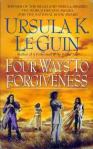
So. Here we have four interconnected short stories (although if we’re being technical I think the last two are probably closer to novellas). We have two planets, Werel and Yeowe. Yeowe was uninhabited until the Owners on Werel decided to start mining and farming it, for which they used the labour of their assets. Yes, Werel is a slave-owning society, and a capitalist one (I see what you did there, le Guin – very nice indeed – Marx needs a little chastising sometimes). And within the hierarchy of owner/owned there’s a gender hierarchy as well, with women being firmly the lowest section of each caste. Sounding familiar? Well yes, except that here lovely onyx skin is the most prized, and the paler you are – the more ‘dusty’ – the more obvious your slave status.
Me, I’m one of the palest of the pale whitefellas around. No way can I presume to comment on how people of colour would react to this inversion. For myself, I’ll admit that reading the derogatory term ‘dusty’ did not at first make sense (I thought it was referring to them living in the dirt and dust); and while it was uncomfortable in the context of slave/free, it’s awesome to read stories wherein black is desirable and beautiful… and it’s not a big deal.
The four stories all deal with the same basic issue and time: the consequences of a revolt of the ‘assets’ on Yeowe against the Corporation who owned them: consequences for the Owners and the assets, for men and women, and for the alien Ekumen observers (this fits into le Guin’s Hainish cycle). For me, while revolutions are interesting and all, it’s the aftermath that’s really the meat of history. What difference does it actually make? How long do changes take and how long do they hang around? Changing the world is one thing; changing attitudes and desires and beliefs quite another.
The first story, “Betrayals,” is set some time after the Liberation, in a nowhere town on Yeowe. It’s the story that has least to do with the Liberation itself, although it comes about as a result of it. It’s a tale of two old people – and how refreshing is that? – dealing with being old, and the changes in their world, and how frustrating the world can be when you’re not able or allowed to make big changes yourself any more… but you can still make small ones, that do make a difference. Bitterness and growth and love. Also gossip, and the downfall of heroes.
“Forgiveness Day” comes first from the perspective of a ‘space brat’ – a worldly (hmm, or not; she doesn’t really have a world) woman of the Ekumen sent to Werel to act as an observer there. Being an observer on tight-knit, inward-facing and closed-mouth Werel was always going to be a difficult task, but having a woman in that position – going out, rather than staying in the beza (woman’s side); her own property, rather than a man’s; speaking to men as their equal – is yet another kettle of proverbial. Solly deals with it rather bullishly, which is perfectly fair and understandable. What puts le Guin at the pinnacle is that she writes Solly completely sympathetically for maybe a quarter? of the story, and then relates the next section from the perspective of Teyeo, her bodyguard, of whom Solly has a very dim view but who again comes across as immensely sympathetic, and casts some shade on Solly; and then the rest is the two of them in rather a pickle. It’s a commanding story of attitudes and cultural perspectives, and change in the face of necessity. It also starts opening up Werel society to the reader, giving hints and clues about how and why it works, which while not making it likeable begins to make it comprehensible.
“A Man of the People” begins on Hain, with a young boy growing up in a sheltered, insular pueblo… who eventually gets impatient with the local knowledge available and longs for something bigger. Nearly half of the story takes place on Hain as Havzhida learns about universal knowledge and eventually becomes a member of the Hainish delegation to Yeowe. While the previous story showed Werel from an outsider’s perspective, seeing Yeowe post-Liberation from such a view is revealing too, not least because the gender hierarchy has been replicated. The rhetoric of freedom, of liberation, is a complex one, and le Guin makes some offerings on how to understand it in this and the next story in particular. I think this story is my favourite, at least partly because it shows how power doesn’t have to come from violence, and subversion doesn’t have to involve deceit. And the characters are wonderful and varied, and Havzhida is a willing observer – not insistent on participation where that might not be appropriate. Which is something that some activists might do well to understand.
Finally, “A Woman’s Liberation” is probably the most difficult to read of the lot. The first is post-Liberation Yeowe, so at least the theory of freedom is present; the second is Werel, where there is no freedom for ‘assets’ but Solly and Teyeo move freely (mostly); the third is post-Liberation Yeowe too, with Havzhida moving freely and women beginning to do so. “A Woman’s Liberation,” though, is from the perspective of a bondswoman – an asset – on Werel. She is thus doubly bonded, doubly enslaved, both to her Owner and to the men of her caste. This makes for a sometimes-painful reading experience – not gratuitous, not unnecessary, but painful nonetheless. Things do change, as the name suggests, but le Guin does not hide the fact that changing official status is difficult, and indeed is only one step in losing the ‘slave-mind’. Rakam is a glorious character who grows and struggles and is unrelentingly honest with the reader. She’s inspirational.
These stories are complex and challenging and absorbing and frustrating because they do not fill in all of the gaps. By the end a general sweep of the history and society of Werel and Yeowe has been revealed, but there is so much more that could be written! This is one of the peculiar gifts of le Guin, I think – she does not tell us everything. Only what we need to know. Which is about liberation, and freedom, and individuality, and community, and love.
China Mountain Zhang
I’m conflicted about what to think about this lovely novel. On the one hand, there’s a part of me that thinks “it’s lovely, but it’s not that original.” This is partly because gay characters aren’t unusual in SF any more. Of course, there’s still not a huge number of them, so having a gay protagonist is indeed a good and challenging and different thing. I’m not sure what else makes this novel feel… familiar, I think, rather than avant garde or edgy; perhaps it’s that it doesn’t push the SF element, so the place does indeed feel close to home. And I usually like my novels to have that aspect of challenging edginess to them. Of course, this one does have those elements; they’re just not that outrageously obvious.
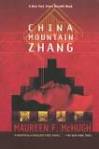 There are some novels that feel ‘pushy’ – I do hesitate to use the word, because of the negative connotations, but books like Alastair Reynolds’ Revelation Space sequence or Iain M Banks’ Culture novels are pushy SF; they make the SFnal features a front and centre part of the story, with the rest of the story necessarily incorporating giant AI minds or space ships. China Mountain Zhang does not make the fact that these events are happening at an unspecified time in the future an upfront-and-obvious part of the story; it’s fundamental to the events, yes, but McHugh unfolds it gently and quietly and innocently: “Oh, you didn’t realise my story was set in a post-socialist revolution America? What did you think was going on?”
The whole novel could be described as gentle and quiet. Even big events in characters’ lives are somewhat down-played. Even though the reader gets events from different characters’ perspectives, there is a feeling of detachment that lends a certain remoteness to it all; a certain in-the-larger-scheme-of-things attitude. Which in a bizarre way I think often emphasises the losses, especially, that each of the characters experiences.
This is in many ways a story of loss – actually a series of stories of loss. Half of the chapters focus on Zhang, the titular character, and follow his life across several years as he tries to find his way through the minefields of being gay when that’s basically unspeakable, of being ABC (American Born Chinese) when being Chinese-born is the way to the best jobs, and the other lesser and greater difficulties of growing up and moving around and fitting in. The alternate chapters do not always seem to fit in, although of course there are ties that bind. A kite-flyer who’s down and out; a goat-herder on Mars; a new-to-Mars immigrant; a Chinese-born woman in America. All with losses and experiences and fierce joys that are so different from Zhang’s but that clearly fit into this remarkable world that McHugh has created.
Because while Zhang is a compelling character, for me it really was the world-building here that fascinated and still has me thinking. I can well imagine that a non-SF lover could read this novel without being overwhelmed by the SF elements, which is for me always an interesting exercise to consider; yes there’s people on Mars, but the considerations of life there are generally so mundane, as of course they would (will?) be for any sizeable population, that you could almost overlook that. There are other SF elements that I really loved – like the system that allows a user to design buildings and other things – but really the most shocking aspect is the one that very little real attention until the last chapter: that little fact that America is now a Socialist nation, and has effectively become a client state of China. Knowing only a few Americans well, and having had very few political discussions with them, I am still well aware of how outrageous using the s-word to describe any aspect of their politics is. I cannot begin to imagine how McHugh’s book was received by the general public – if any of them were aware of it – in 1992. Just like I can’t imagine how people read le Guin’s The Dispossessed in the 1970s.
I really enjoyed it. It’s an easy read that sucks you in and gently smacks you over the head.
On reviewing classics and historical movies, or, I saw Argo
It’s an interesting question, isn’t it, about whether it’s necessary to alert people to possible spoilers for works that are regarded as classics, or that are based on historical events. Someone was apparently complaining, over in the comments for the Lizzie Bennet Diaries, about other commenters spoiling the story. I dunno; Pride and Prejudice has surely passed its statute of limitations on that sort of thing? And I do know of a man who was in Vietnam (as in, the country and the war) at the time of the Apollo 13 crisis, so when the movie came out, he didn’t actually know what happened – and initially thought it was fiction.
What about other historical events? A movie about Cleopatra? – she kills herself, spoiler! JFK? – the president dies! About WW2? – the Germans win!
Or other classics? Hamlet? – everybody dies! The Trojan War? – Hektor and Achilles die at Troy, while Agamemnon gets killed by his wife! (except that – what the HELL, Wolfgang Petersen? Seriously? What is Clytemnestra going to do now, live happily ever after with Aegisthus? You deprived yourself of making the Oresteia! Are you mad? I wanted Angelina Jolie for Clytemnestra, Helena Bonham Carter as Elektra, and Karl Urban as Orestes! Someone, make it happen…)
This line of thought has come about because I saw Argo last night, and my modern history is poor enough that actually, I wasn’t sure whether the hostages got out or not. I thought I knew, but wasn’t positive, and also wasn’t sure whether I wanted TO know before going in.
Overall, it’s a really wonderful film. Incredibly tense; my companion was anxious throughout the whole thing, because her modern history is worse than mine, apparently. I though the cinematography was just awesome and nicely done to feel genuinely early-80s. I’m not quite up enough on my rock history to be sure that all of the music was era-appropriate, but I was ridiculously pleased when they put on (actually put on, on a record player) Led Zeppelin (Levee’s Gonna Break, fwiw). I thought all of the actors were great, and Affleck was outstanding, even under all of that hair. During the credits, they brought up pictures of the actual people involved, to show that they had cast people (and, obviously, used good make up) to make the principles actually look like their person.
Except. And this is my one gripe.
Affleck’s character’s name is skated over, in the film. He goes by Kevin Harkins while in Iran; he does at one point tell someone that his name is Tony Mendez. I didn’t think much of it at the time. During the credits, there’s a shot of the real Mendez – Antonio Mendez. Yes, he would indeed be Latino. And Affleck certainly does not look Hispanic. So I really am disappointed that Affleck, who directed the film as well, didn’t have the balls to cast an Hispanic actor in the role, and take on a lesser role for himself; perhaps the section chief.
Also, I don’t know whether it was shot in Tehran (I’m going to go with ‘no’), but it certainly makes it look like a gorgeous city.
ASif! closes its… doors? pages?
It’s with a sad (albeit understanding) heart that I pass on the message that ASif! is closing down.
What? You don’t know about Australian Speculative Fiction in Focus? The website that started eight years ago with a view to reviewing Australian works of speculative fiction, and – perhaps most intriguingly – aiming to give most works two reviews, thus giving context and a broader perspective? Well heck, get over to what I still consider to be the new site (although I think it’s been up and running on WordPress for, what, a year? two?) and browse their wares! It has long since branched out into international works as well as national – not least I think because that’s what was sent our way by publishers – but it is still pretty Australian-heavy. Plus, there are retro reviews from the old site, so you can see what we were thinking some years ago too!
… so yes, I say our. I’ve written reviews for ASif! for… I don’t know how long. Some years. I could probably go back and see when my earliest review was, but that might make me scared. Or cringe. Whatever, it has been a tremendous experience. I’ve been writing the odd review for very many years (back to high school), but this was the first time I got the chance to do it somewhat-regularly. More than that, thanks to the email list… well. I allowed myself to get roped into Last Short Story some fewer number of years ago, which in turn led to going to this thing called a convention, and – yeh. Galactic Suburbia would be a different beast if not for ASif; I wouldn’t be on it, for a start, since I wouldn’t know Alisa or Tansy (I would have heard of Tansy, of course, because I already had, but it would be a far-off fan-girling).
Anyway. It is certainly the right call for Alisa to have made; she has the most incredible number of calls on her time, and has had for as long as I have known her. It makes sense to tidy things, and projects should definitely have end-points rather than continuing on just because.
No more reviews after the end of this year. Vale, ASif!

 Randomly Yours, Alex