New York 2140
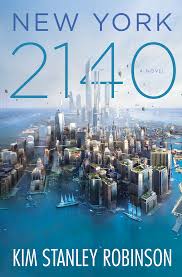 This book was sent to me by the publisher, Hachette, at no cost. It’s out now; RRP $29.99 (480 pages).
I adored Kim Stanley Robinson’s 2312 and after reading this I have an overwhelming itch to go read it again. Partly because this reminded of that earlier work, and partly because it reminded me just how very good Robinson can be (as I thought of 2312).
As the name suggests, the book opens in 2140, and is set almost entirely in New York. There’s been catastrophic sea level rise, due to melting polar ice mostly, and of course this has had a huge impact on coastal towns. While Manhattan isn’t quite an exemplar for all coastal cities, it does provide an intriguing setting for such a book – and of course New York is, as the narrative acknowledges, a very particular and, perhaps, unique city in terms of how inhabitants and others around the world relate to it. Sydney probably wouldn’t get you quite such a response.
Things I loved about this book:
- The different narrative points of view. Each one is clearly different from the others, with a unique voice and style: told from the first or third person; mostly through dialogue or action; individuals or pairs. I love this as a method of conveying a multitude of perspectives, both moving the narrative forward and allowing the reader to meet, identify with, and consider different sorts of people.
- Speaking of, I adore “that citizen”. That citizen gets their own chapter in each section and is basically there to explain the history of the world up to this point, and how New York and the USA work, and comment on aspects of New York’s social and cultural history. They are deeply knowledgeable and deeply cynical and deeply aware of the narrative they are a part of. To whit:
-
People sometimes say no one saw it coming, but no, wrong: they did. Paleoclimatologists looked at the modern situation and saw CO2 levels screaming up… and they searched the geological record for the best analogs to this unprecedented event, and they said, Whoa. They said, Holy shit. People! they said. Sea level rise! … They put it in bumper sticker terms: massive sea level rise sure to follow our unprecedented release of CO2! They published their papers… a few canny and deeply thoughtful sci-fi writers wrote up lurid accounts of such an eventuality, and the rest of civilisation went on torching the planet like a Burning Man pyromasterpiece. (p140)
Seriously. I alternately giggled and sighed reading a lot of that citizen‘s accounts. They also make snarky comments about surveillance states, growing throughout the 21st century, when being called “a police state… would have been aspirational” (p207) and the capabilities of industry to make drastic adjustments when it’s financially necessary. They are also deeply unimpressed by people who dismiss “info-dumps” in narratives while, of course, demonstrating exactly how to do them in splendid, self-aware, and necessary ways.
- Speaking of being self-aware, and something else that made me recall 2312, is what I guess might be Tuckerisation. One of the characers is Inspector Gen Octaviasdottir. Which I thought was nice, until I got to this description: “Tall black woman, as tall as he was, rather massive, with a sharp look and a reserved manner” (p29) – and then I realised who Robinson was tipping the hat too, and … I was moved. I know some don’t love this, but when it’s done in such a way that both people who get the reference appreciate it and it doesn’t prevent those who don’t see it from appreciating the story… well. I enjoy it. Robinson also has “delanydens” – places where there was lots of “intergender” and “indeterminate gender” and where “it was best not to look too closely at what was happening in the corners” (p183) – so again, don’t know who Delany is? doesn’t really impact on your understanding of the context. And another of my favourites: “russrage” – “at the ugly cynicism of whoever or whatever it was doing” the things that made people unsafe (p273). Of course I’m lucky to get these; I haven’t read any Calvino so “calvinocity” doesn’t have that extra layer for me.
- While the background of the narrative is the massive changes that have happened in New York and indeed continue to happen in the novel, a lot of the story is actually pretty small scale… dare I say, domestic. It felt like there was as much attention given to the antics of two young boys and their friendship with an old man, and the beginnings and difficulties of love, as to the possible relocation of polar bears and massive system defrauding. I really, really like this. Robinson suggests that even as places change around us, humanity adapts and remains fundamentally the same.
- It’s remarkably optimistic: that humanity can adapt and cope with the difficulties we face – yes they’re our fault, as a species, but we can keep going and maybe, maybe, make things better. Or at least not worse. And individuals can still have worthwhile lives amidst the problems. That’s pretty important.
- I just love the writing. It’s smooth and elegant and… readable. I really, really, really enjoyed this book. Yes, it has gone on my “Possible Hugos 2018” list.
The Martian
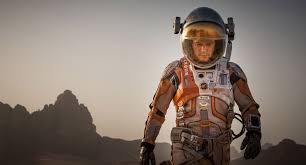 The final in our Great Scott! reviewing adventure.
The Martian
Ridley (2015)
A: Basically this is our reward for getting through the others. We saw it twice in the cinema…
J: Mars has never been rendered more beautifully.
A: or realistically. I love that this is not the first mission, but well into the history of Martian exploration.
I also love the banter. And that the Commander is definite in her commitment to safety because THAT’S HOW IT SHOULD BE.
J: If this was really a NASA mission that whole conversation about aborting or not would not happen.
A: I think being on a different planet is going to have an impact on attitudes to command structures.
I love the cinematography of the storm.
J: Yup, it does a really good job of intense and frenetic without being shaky cam or hard to watch.
A: There’s a touch of the ‘do we sacrifice everything for one man’ but I like the grim reality of … no, of course you don’t. Continue reading →
Sisters of Tomorrow
This book was sent to me by the publisher, Wesleyan University Press, at no cost. It’s available now.
 It’s no secret that I like science fiction and history and am feminist, so books like this are like a perfect conjunction for me. I’ve previously read Helen Merrick’s Secret Feminist Cabal, and Justine Larbalestier’s Battle of the Sexes in Science Fiction AND Daughter of Earth, which is a compilation of early female SF writers. So I’ve got a bit of background knowledge – not that you need it at all for this anthology, because Lisa Yaszek and Patrick B Sharp set the scene magnificently in their intro to the book and to the chapters.
Here’s the thing that makes this book really special: while the biggest section is on the authors, because they include some stories – including a fairly long novelette – the editors don’t stop there. They also have sections on the female poets, and artists, and journalists, and editors of the 30s and 40s. This blew my mind. I’d vaguely heard of Margaret Brundage, I think? But I certainly didn’t realise that there were women active and influential in all of those spheres. Yaszek and Sharp also cross into the amateur magazines, where women were also hugely important in the development of “understandings of science, society, and SF in different arenas of SF production” (xxiii). If you’re interested in early science fiction at all, if you’re interested in women in literature, if you’re interested in the history of SF – this is an excellent anthology.
Proof of Concept
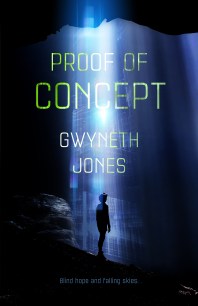 This novella was sent to me by the publisher, Tor.com, at no cost. It will be out on 11 April, 2017.
Um. Wow. No seriously. Terrifying and amazing and absolutely captivating.
Jones is saying a lot about modern society in this novella and most of it isn’t very nice. She’s also presenting a compelling story and believable characters and… this is yet more evidence that novellas are a fantastic length for stories.
There’s been a lot of discussion recently about how facebook mediates news and how people who only get their news from facebook can end up in an echo-chamber, essentially, with their own opinions endlessly reflected back to them. Jones presents GAM: Global Audience Mediation. An avatar, the AI of GAM, asks questions for news broadcasts – it’s “the statistical sum of… real-time responses” from the global audience (4). It’s crowd-sourced journalism, where presumably minority views and questions get drowned out in the fantastically huge audience. No room for dissenting voices then. Then there’s the broadcasts of the VLDMT (Very Long Duration Mission Training) – in theory Earth 2-like training situations for people who might go on interstellar missions, but effectively ending up like reality tv – Big Brother in extremis.
And this isn’t even really what the story is about. They’re just creepy incidental issues that Jones throws in to show that this is a real and believable future story. I love Gwyneth Jones.
What the story is actually about is getting off Earth as the population and climactic situation gets progressively worse and worse. There are two solutions being proposed: the VLDMT people imagine a space ship, while Margrethe Patel is working on a method of hyperspatial travel that shifts within 4D information space. (Happily, Jones is not Greg Egan, so there’s no vector diagrams to attempt to understand.) The two groups come together when an enormous abyss is discovered under Poland and it appears to offer a place to practise for both groups. They need complete isolation from the rest of the planet, and things go from there…
Did I mention that the focal character, Kir, has an AI in her head? Yeh. There’s a huge amount going on here.
I loved Kir and how she faces the various problems – like annoying people and difficult work – that confront her. I was gutted by how Jones imagines this possible future, and I was enthralled by what she imagines as solutions. If you like science fiction you need to read this story. When it’s available.
Long Hidden
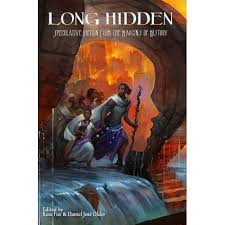 A book that celebrates the marginalised throughout history. The women. The black. The brown. The queer. The trans. The freaks.
Stories that give the marginalised agency, even when they’re oppressed; purpose, even when they’re condemned; existence, even when they’re ignored.
I loved this anthology. I at least liked, if not loved, every single story.
Every story is set in a historical time and place: parts of the Americas, Asia, Africa, Europe. They deal with real instances of marginalisation and oppression: sometimes minorities within hostile communities, sometimes systemic social oppression. In each story the characters are those whose stories have tended not to be told in Official History – at least not until the last few decades, and still slowly at that. In some cases the stories are triumphant; in some cases the stories tell of loss and woe. But almost always there’s an element of optimism, or hope. That through oppression, defiant humanity shines through. That despite others trying to remove that humanity, the marginalised know that they are human, and deserving of dignity. Even if in this instance, they’re not accorded it. I found it an unexpectedly uplifting anthology.
It reminded me of Cranky Ladies of History, for its agenda of shining light into often unlit areas of history. But the difference is that this is consciously speculative fiction about the margins. Most often that’s expressed as magical ability of various kinds, rooted in real religious systems or within individual humans; or there’s the occasional science fictional element. Sometimes it’s zombies or shape-changing, or magical/otherworldly creatures. Sometimes the speculative element is central to the story, and sometimes it’s just there, part of the world. It’s always done well.
Everyone should read this anthology.
Swarm
This book was sent to me by the publisher, Allen & Unwin, at no cost. It’s available now; RRP $19.99.
When I read the first book in this series, Zeroes, I was a bit underwhelmed. I felt like it didn’t fully deliver on its promises – not quite dramatic enough, somehow, or heroic, or problematic. I didn’t hate it… I was just a bit disappointed. So while I was very excited to receive the sequel to review, I experienced some trepidation.
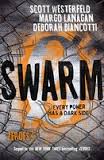 And then I picked it up. And then I couldn’t put it down. And I read the entire thing in an afternoon… and, ahem, evening; it’s been a while since I read past my bedtime in order to finish a book.
Folks, the sequel is better than the first. Shocking, I know. Continue reading →
The Martian

I’m honestly not sure whether I would have kept on with this book without having the context of the film. Probably? The will-he-survive narrative is a gripping one, after all, and it’s so different from superficially similar narratives. But I was surprised, while reading, to see how different this is from the film. I don’t mean different in terms of plot, although there are a couple of differences – but nothing significant. I mean different in terms of … richness, I guess. Detail. I guess it’s not fair to compare a visual medium with a print one, but some writers manage to convey a richness of detail – not always in a lot of words (Okorafor, Le Guin). Weir is not that person – well, not in this book anyway.
Anyway, I did enjoy it – partly because I’d been wanting to read the source material having loved the film. I liked the science-heavy nature of it: there’s a lot of discussion about chemistry but it didn’t get to Greg Egan levels (I love Egan but even I glaze over at vector diagrams in my SF). Mark Watney is a somewhat less engaging character when he’s just talking to you, rather than accompanied by Matt Damon’s facial expressions – maybe I was spoiled in that regard by the film, but BookWatney has less of a sense of humour, I think. There’s still some nice interactions between the different characters, which I enjoyed, and at least some of the diversity that I enjoyed in the film is present in the book.
Also, because I love this stuff: I am now absolutely convinced that they cast Sean Bean in his role SOLELY for the purpose of that one LOTR joke, and no one will ever convince me otherwise. Plus there’s no way, despite what my beloved thinks about my obsession with conspiracy theories, that it was accidental that two characters who talk together about Watney’s communication access are called “Chuck” and “Morris”.
Recommended for people who like some science in their science fiction. Kudos to the developers of the film for seeing the potential in this book.
Children of the New World
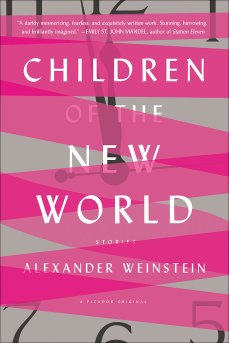 This book was sent to me by the publisher at no cost. It will be out on 31 October; RRP $22.99.
This collection of short stories reminded me a bit of Rob Shearman’s work. These aren’t quite as weird as Shearman’s (in the ‘New Weird’ sense, not just really quite strange), but there’s a similarity in the focus on everyday details in a weird, sometimes science fictional setting; an emphasis on relationships and humanity amidst technology and worlds (both local and global) falling apart.
I’ll bet this doesn’t often get talked about as science fiction; I bet it gets discussed as literary fiction, like The Book of Strange New Things. But for me, it’s definitely sf. Continue reading →
Galactic Suburbia 153
In which letters are written to Octavia Butler. Get us from iTunes or at Galactic Suburbia.
What’s New on the Internet?
British Fantasy Awards: Letters to Tiptree won one!
No Award on Conflux & Asian Flavours in SFF fandom.
Octavia project: Octavia Estelle Butler was born on 22 June, 1947, and died in 2006. In celebration of what would have been her 70th birthday in 2017, and in recognition of Butler’s enormous influence on speculative fiction, and African-American literature more generally, Twelfth Planet Press is publishing a selection of letters and essays written by science fiction and fantasy’s writers, editors, critics and fans.
We are looking for letters addressed to Butler, which should be between 1000 and 1500 words. We are paying 5cpw up to $USD75 for letters, to be paid on publication. We are looking for World First Publication Rights in English, and exclusivity for the first twelve months of publication.
Submissions: octaviaproject@twelfthplanetpress.com
More Butler stuff: Radio Imagination
Tansy’s new releases: Bounty (the final Fablecroft book) & Unmagical Boy Story
CULTURE CONSUMED:
Alisa: Jamberry & business training.
Alex: Once Upon A Time season 2; the Patternmaster series, Octavia Butler; The Starry Rift, James Tiptree Jr; Goldenhand, Garth Nix.
Tansy: The Life & Times of Angel Evans, by Meredith Debonnaire; DC Superhero Girls: Hero of the Year; Revolutionary Art: Writing For Social Justice webinar series; Hex – How to Be a Fan on iView; Labyrinth Board Game Facebook page; Dracula’s Feast on Kickstarter.
Please send feedback to us at galacticsuburbia@gmail.com, follow us on Twitter at @galacticsuburbs, check out Galactic Suburbia Podcast on Facebook, support us at Patreon and don’t forget to leave a review on iTunes if you love us!
Binti: Home
 This novella was sent to me by the publisher at no cost. It will be out on 31 January 2017.
What does it mean to go home?
What does home mean?
What does it mean to belong?
If others don’t accept you, can you belong?
Do genetics equal identity?
If you change, are you still yourself?
What makes people family?
Binti featured Binti leaving home and changing in some fairly drastic ways. Here, Binti goes home, for a bunch of complicated reasons, and is forced to confront the sorts of questions I’ve asked above. She’s forced to confront aspects of herself that have changed – and been changed – and, perhaps more difficult, how her family react to this. She’s also confronted with some unpleasant truths about home and family, all in (in my e-version) about 90 pages.
It’s a bold and striking story of humanity and tradition in the context of an alien-rich galaxy. It’s beautifully written (of course) and there’s a huge amount of tantalising detail that Okorafor just… doesn’t explain much. This in no way impacts on the story; it’s an indicator of rich Okorafor’s writing is. Binti is a wonderful character and I’m so glad to have another part of her story told. I suspect there may be at least one more story coming… .
Also, look at that cover! How awesome is that!
Highly recommended, likely to be on award ballots next year.

 Randomly Yours, Alex