Farscape episode 4
 Each week on a Sunday afternoon, join Alex (of Randomly Yours, Alex) and Katharine (of the unpronounceable Ventureadlaxre), as they re-watch the Australian-American sci-fi show Farscape, notable for the Jim Henson animatronic puppets, the excellent mish-mash of accents, and the best OTP ship of all time.
Season One, Episode Four: Throne for a Loss
Summary: A plan goes wrong and Crichton, Aeryn and D’Argo all have to go rescue the little twerp, Rygel. What a surprise.
K: I do like how to a certain aspect Aeryn lets John waffle on and doesn’t tell him to shut up. And almost tries to understand him half the time.
A: I think John’s habit of just repeating Earth references as if a greater number of exemplar will help an alien understand, for example, Clint Eastwood, is embarrassing and ludicrous.
So Moya is Serenity now? Hauling cargo?
K: Big damn heroes!
A: Big. Damn. Heroes. Continue reading →
Galactic Suburbia 145
In which we all had a very exciting weekend. You can get us from iTunes or at Galactic Suburbia.
Launched & pre-launched at Continuum: Defying Doomsday and Something New Can Come Into This World
Tansy & the Silent Producer totally got married!
British Fantasy Award shortlist
CULTURE CONSUMED:
Alisa: The Martian, Trepalium
Tansy: The Geek Feminist Revolution by Kameron Hurley, Cleverman, UnReal, Which Witch by Eva Ibbotson
Alex: Angela Slatter binge: Vigil, Bitterwood Bible and Other Recountings, Sourdough and Other Stories, Black-Winged Angels. Also Revolution School (ep 1 until July 6)
Alex’s new podcast! Acts of Kitchen
Tansy’s new superhero story at The Book Smugglers: Kid Dark Against the Machine
On superheroes, kids, gender and role models: Tansy’s Inspiration & Influences
Please send feedback to us at galacticsuburbia@gmail.com, follow us on Twitter at @galacticsuburbs, check out Galactic Suburbia Podcast on Facebook, support us at Patreon and don’t forget to leave a review on iTunes if you love us!
FarScape: S1, e3
Each week on a Sunday afternoon, join Alex (of Randomly Yours, Alex) and Katharine (of the unpronounceable Ventureadlaxre), as they re-watch the Australian-American sci-fi show Farscape, notable for the Jim Henson animatronic puppets, the excellent mish-mash of accents, and the best OTP ship of all time.
Season One, Episode Three: Exodus from Genesis
Summary
What appears to be a beautiful shimmering golden cloud out in space turns out to contain nasty creepy-crawlies who need to spawn, and in doing so, take over the ship aggressively.
As though that’s not difficult enough, Peacekeepers catch up with our merry crew once again…
A: Rygel, your hubris knows no bounds.
K: I do want a hover chair though. And they do really do excellent things with the animatronics.
A: Ah, more Alien Craziness! This time, Freaky Worms for Cleaning Your Teeth. Continue reading →
Farscape: S1, e2
Season One, Episode Two: I, ET
In the previous episode they removed Moya’s control collar – unlike other tv shows, this has some continuity where it seems like that’s only caused more problems. The removal has activated a homing signal which means Peacekeepers could be tracking them down at any moment. Although Leviathans are not known for being able to land and take off from planets, the crew risk it, and bury Moya in a bog. They then need to search for something that can dull Moya’s pain as they rip more Peacekeeper tech from her.
A: John has an excellent line in eye-facial-winky-crinkliness while the Peacekeeper alarm is going and MAN they could have turned it off faster! I love that Aeryn comments on the facial shenanigans, too, plus “I’m new to all this escaped prisoner crap” ahaha.
K: How scary would that be though – on the run, somewhere in space, at the mercy of the ship itself who is also under attack. I’d be freaking out!
A: Oh absolutely – for John – but not our Aeryn, nuhuh. Continue reading →
The Great Farscape Rewatch begins
Each week on a Sunday afternoon, join Alex (of Randomly Yours, Alex) and Katharine (of the unpronounceable Ventureadlaxre), as they re-watch the Australian-American sci-fi show Farscape, notable for the Jim Henson animatronic puppets, the excellent mish-mash of accents, and the best OTP-ship of all time.
Season One, Episode One: Through the Eye of the Needle
In which John Crichton, scientist and astronaut, somehow finds himself flung to a weird corner of the universe and meets a whole bunch of aliens. He has some trouble adapting and manages to score himself a nemesis.
K: Drat I thought that this opened in Australia, but him talking to those people and then seeing them later in Canaveral makes me think nope, Florida. Dammit. So the start isn’t nearly as interesting to me at all then :p
A: yeh, definitely America. I love Dad. I also love the idea of going into space being a relatively straightforward event – it’s the experiment that’s weird, not the launch.
The opening music is SO WEIRD. I actually don’t love it – I find it too discordant, and almost distressing. It also doesn’t really fit the show, in my mind. Continue reading →
The Diary of River Song
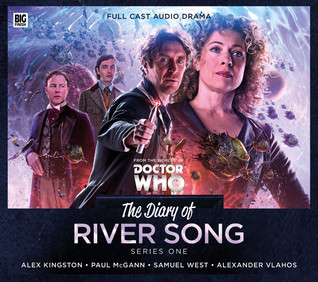 This is my first real audio book and it was because of Tansy. I feel there are a lot of people who say things like that.
Did anyone else think that the music was distinctly James Bond-ish? I got a really strong Bond vibe from it.
I have no idea whether this is standard Big Finish format, so for those not in the know: there are four 1-hour long interconnected stories. It begins with River Song having taken a position as an archeology professor (of course) who rather reluctantly gets pulled out of her office and out onto a dig in somewhere fake, Mesopotamia-ish. Bad things happen. In the next story, River is back in space, and slowly the connection to the first story is fleshed out – it’s not all fully explained until the last story. Of course the story gets bigger and more complex as the four ‘diary entries’ unfold.
Having seen the Christmas special about the husbands of River Song, I shouldn’t have been surprised by how cold River is in some of the situations presented here, but I was. I still have a somewhat childish, old fashioned view of the Doctor – that he doesn’t hurt anyone, and works for the good of everyone except maybe Daleks – and ascribe this to River as well for I-don’t-know-why. So some of the callous responses from River were… unexpected. I’m not saying I hated them, because I don’t think I did, but I was surprised.
Alex Kingston has a wonderful voice and in general did very well in this format. Most of the other actors were equally good, and I thought the production qualities were also excellent.
This has not turned me into a raving Big Finish fan, but I am glad I listened to it.
The Medusa Chronicles
This book was sent to me by the publisher at no cost.
 So. This book. When I heard that Alastair Reynolds and Stephen Baxter were collaborating, I was beside myself. This is two of my great SF loves coming together. It’s Robert Plant and Jim Morrison jamming.
At the back of my mind was the reminder that I haven’t quite adored Baxter’s latest novels, and that Reynolds’ latest novels have been quite different from his early ones too. NONETHELESS. Plant and Morrison, folks.
I really liked it… but I didn’t love it. It feels… old fashioned.
The premise: building on Arthur C Clarke’s “A Meeting with Medusa,” Baxter and Reynolds take the main character, Howard Falcon, who is a cyborg due to a serious crash years before, and extend him way into the future. This is a future where humanity is incredibly suspicious of machines and artificial intelligence, and Falcon – being the incredibly weird hybrid that he is – is often at the receiving end of that suspicion. But it also means that he’s useful as a mediator when humanity’s machines start developing consciousness, which means he’s there at the birth of that intelligence, which means he continues to be useful as an intermediary. This becomes the story of Falcon’s life, and thus the story of The Medusa Chronicles.
I did like it because I like thinking about humanity in the solar system and how that might work (this is another one where there’s looming interplanetary conflict, so apparently that’s unavoidable). I liked the whimsical attachment to the notion of ballooning as inspiration for astronauts and Jovian exploration. And I also like stories of the development of artificial intelligence and the consequences of that for humanity, although I did feel like that wasn’t explored enough here.
The novel feels a bit old-fashioned because I can’t quite fathom humanity being suspicious of machines. I assume this reflects the novels and other media I’ve been consuming – I mean yes, be suspicious, but surely only after they’ve shown that they want to kill us and use our bodies as compost? There’s also a significant level of info-dumping, which isn’t always a problem for me but can be a barrier, I know, for others. And, too, there’s a lack of significant character development. The reader gets to know Falcon almost by default, as our point of view, but most of the others – like Hope Dhoni, Falcon’s medical expert for much of his incredibly prolonged life – are almost faceless, ciphers.
There are some lovely moments and a few odd moments in the novel. The odd moments are especially where Falcon makes reference to old literature or films and wonders if anyone will get the reference – for example, to Tolkien – and yet Project Silenus is thus named because of Euripides, and in explaining the naming he doesn’t have to explain who Euripides is. I’m unconvinced about the longevity of Euripides over Tolkien (we’re talking centuries here), although I guess Euripides does have form. Some of the lovely moments are in the alternate history of NASA and thus humanity in space that Baxter and Reynolds present. Here, the threat of an asteroid completely changes the direction of the Apollo programme and has consequences for humanity going to Mars and beyond; the authors reference real astronauts, like Frank Borman and Charlie Duke, but give them a slightly different career path (and there’s no reference to ‘any similarity to real people is purely coincidental’ or however the line runs, in the fine print).
Overall this is a pretty good science fiction novel, but it’s not one of my favourites for the year.
Galactic Suburbia 142!
In which the Hugo shortlist is more controversial as ever, but in the mean time we’ve been reading & watching some great things. You can get us at iTunes or at Galactic Suburbia.
MANY APOLOGIES for sound issues on this episode – we didn’t catch an accidental microphone shift which means some background noise which should have been muted were not.
What’s New on the Internet?
Hugo Shortlist
Effect of slate nominations on Hugo Shortlist at File 770.com
The Rebirth of Rapunzel winners: Margaret Eve & Kate Laidley, we hope you enjoy your book prizes!
CULTURE CONSUMED
Alex: Rebirth of Rapunzel, Kate Forsyth; The Moon is a Harsh Mistress, Robert Heinlein; Defying Doomsday, Tsana Dolichva and Holly Kench; The Dream-Quest of Vellitt Boe, Kij Johnson
Alisa: Every Heart a Doorway; Comedians in Cars Getting Coffee; Orphan Black
Tansy: Deirdre Hall is the Devil, presented by Jodi McAlister; Teen Wolf, Downton Abbey, Doctor Horrible’s Singalong Blog, Buffy Season 1
Skype number: 03 90164171 (within Australia) +613 90164171 (from overseas)
Please send feedback to us at galacticsuburbia@gmail.com, follow us on Twitter at @galacticsuburbs, check out Galactic Suburbia Podcast on Facebook, support us at Patreon and don’t forget to leave a review on iTunes if you love us!
Defying Doomsday
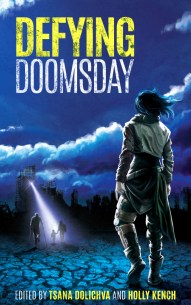 I supported this book through its Kickstarter campaign and I am so excited that it is finally here. You can pre-order now and get your own copy on May 30.
“People with disability already live in a post-apocalyptic world,” says Robert Hoge in his Introduction to this volume. The central character of every story in this anthology has some sort of disability or chronic illness – but the point of the story is not that. The point is people getting on with surviving the apocalypse. Some do it with more grace than others; some do it with a lot more swearing and crankiness (I’m not saying that’s bad; looking at you, Jane, by KL Evangelista). Some do it almost alone, others with a few people, still others with lots of people around (which can be good and bad). The apocalypses (apocalypi?) they face are also incredibly varied, from comets hitting the planet to various climate-related problems to aliens to disease to we-have-no-idea; the settings include Australia, New Zealand, the Netherlands, the moon, space, and indeterminate.
The first four stories give an excellent indication of what the anthology as a whole is like. Corinne Duyvis opens the anthology brilliantly with a story that includes a comet, refugees, spina bifida, food intolerances, teen stardom and adult condescension. “And The Rest of Us Wait” sets a really high bar. Next, Stephanie Gunn throws in “To Take into the Air My Quiet Breath” which combines cystic fibrosis, sisterhood, influenza, and taking desperate chances. Seanan McGuire serves up a story that somehow manages to combine being really quite cold and practical with moments of warmth; the protagonist has mild schizophrenia and autism, and not only does she have to deal with surviving a seriously bizarre problem with the rain but also one of the girls who used to tease her. No. Fair. And then Tansy Rayner Roberts does banter and romance with “Did We Break the End of the World”? Roberts somehow makes looting not seem quite so bad and THEN she does something REALLY unexpected at the end to actually explain her apocalypse which I should have seen it coming and totally did not.
So that’s the opening. A focus on teenagers, and I guess this could count as YA? But some of the protagonists in other stories are adults, so I don’t know what that does to the classification. At any rate I’d be happy to give it to mid-teens with an understanding that yes, there is some swearing, but as if that’s a problem. They should maybe skip “Spider-Silk, Strong as Steel” if arachnophobia is a problem, though.
Tsana Dolichva and Holly Kench have created an excellent anthology here. The fact that each protagonist has a disability or chronic illness isn’t quite beside the point, but it kind of is: that is, most of the time while reading the stories I wasn’t thinking “oh, poor blind/deaf/handless/whatever person!” I was thinking “I want to be with that person when doomsday comes down because they’ve got this survival thing down like nothing else.” Of course I’m not suggesting that these stories could or should have been written with able-bodied protags, or that the disabilities have been added in to be PC (which, remember, isn’t actually a bad thing). Instead what this anthology shows is that being diverse and inclusive isn’t bad for fiction. In fact it’s great for fiction. It’s an important reminder to (currently, mostly) able-bodied types like me that HELLO you are not the only people; and for people living with disability and illness this is of enormous importance, because it reminds them that (unlike what we see in many other books and films) they’re not automatically destined to die in the opening scenes of an apocalypse. They have stories and they’re important, like everybody else who’s not a straight white (able-bodied) man.
Accessing the Future
 I supported this anthology through its IndieGogo campaign, because I support the idea of diverse voices in literature. I hope for the day where we can just have anthologies of science fiction that contain both able-bodied and disable-bodied characters throughout where the point is the character and their actions (this applies to gender, sexuality, colour, all the many ways in which people are diverse) but given that this is not yet that day, it’s great to see anthologies like this (and Twelfth Planet’s forthcoming Defying Doomsday) making the point that having spina bifida or being blind or autistic doesn’t prevent people from being, y’know, people. And therefore existing in the future.
Well, probably. One of the interesting questions raised in a few of these stories, and indeed by people in lots of contexts, is whether/how disability will exist in the future. Pregnant friends remind me of the testing that’s done to see whether the foetus is ‘normal’; there are implants and prosthetics… and many able-bodied/ perceived ‘normal’ people would see that doing away with disability (generally in the ‘fixing’ sense but I guess more sinisterly in the ‘getting rid of’ sense) is surely a good thing? Because ‘normal’. I’m not familiar with all the discussion around this, because I don’t inherently need to be, but I know that it’s an arena that needs to be seriously discussed. I think anthologies like this help to do that.
The stories here present people dealing with different sorts of disabilities – some physical, others mental, or emotional – and with different sorts of reactions: uncaring, wanting to ‘fix’, accepting. There are very different worlds, different points in the future, and different ways of dealing with the problems before the protagonists. In most cases the protag’s disability isn’t the point; it’s part of their character, of course, and sometimes it hinders them in their negotiating with the world, but there’s no fixation on the disability itself. Continue reading →

 Randomly Yours, Alex