Nemesis Games
Previously, in The Expanse: Leviathan Wakes; Caliban’s War; Abaddon’s Gate; Cibola Burn.
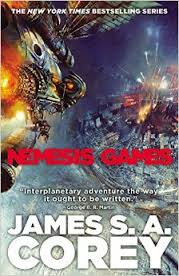 Basically my entire review of this book consists of JAMES COREY YOU ARE TOO MEAN FOR WORDS WHY FOR DID YOU DO THAT?!
Spoilers for the first four. Duh.
The preceding books have mostly focussed on Holden and someone else, or a few other someones, doing important things in the solar system. This time there are four points of view: Holden, Amos, Alex, and Naomi. This should have warned me about what was coming, but somehow my brain refused to process the obvious reason for doing this.
Corey splits up the crew of the Roci.
Splits. Them. Up.
I mean, it was bad enough when half the crew went onto the surface of a planet in the last book. Of course sometimes one or more have gone off on their own individual missions. But never before have the four been pursuing largely separate ends, separate from one another. It was devastating.
Where Cibola was focussed on the early attempts at colonising a new planet through the gate, this is focussed squarely on the repercussions of such colonising for the solar system itself. After all, why bother terraforming a planet when there are planets already ready to be colonised, where you can walk on the surface? Why break your back mining asteroids when there’s minerals on the worlds where you can breathe the air? … but then what happens to those places that had people working on them, who then leave?
It’s kind of an epic version of a gold rush.
Overall this is another excellent, page-turning, enthralling novel and I cannot wait for the sixth (and final, I think) volume.
I have one quibble. Continue reading →
Extra(ordinary) people
 Oh Joanna.
Five narratives, loosely connected by brief snatches of conversation between a schoolkid and their tutor on history. Each story different – thematically, stylistically – each story offering different perceptions on humanity and difference and survival.
I’d read “Souls” before – I have it as an Ace double with Tiptree’s “Houston, Houston, Do You Read?” The Abbess Radegunde is a remarkable woman – highly educated, linguistically talented, devoted to God and her flock of nuns – and then one day the Vikings come a-raiding. And things change, but definitely not in the way the Norsemen were expecting. How can you judge the people around you? What are you willing to sacrifice? How do you know who you are? I love that this story seems like one sort of story and then KAPOW it’s a very different one.
I found “The Mystery of the Young Gentleman” quite hard to come to grips with, and even on reflection it’s still not entirely clear. Partly this stems from language: someone refers to the narrator as an ‘invert’, and I wasn’t entirely clear what that meant although I knew it had insulting sexual/gender overtones; I’m still not clear whether the speaker intended it to mean homosexuality or cross-dressing. In the context, probably either-or. Anyway, the story is written by the titular young man, as a series of letters although we don’t know who the recipient will be. He’s travelling across the Atlantic with a young Spanish girl pretending to be his niece, and there’s a nosy doctor and a few other passengers. Like I said I’m still not entirely sure what was going on here – whether the young man was rescuing a girl like himself, where both of them are like Radegund from the previous story? Maybe. Despite my lack of complete comprehension I did still enjoy the story in a very Russ-type way: it challenges ideas of gender and sex and sexuality and identity and appearance and how much information you need for a story, anyway. Also what sort of stories ought to be read by young women.
“Bodies” goes well into the future and was probably the most opaque of the five stories, for me (possibly not helped by reading while camping, but anwyay…). This is also written as a letter, but this time we know who is being addressed – James – and the writer is reflecting on the time when they met (after he had been pulled from the past/resurrected/ reconstructed) and the immediate aftermath. It’s also concerned with sexuality and gender identity – James has had a bad life because of his, and adjusting to a future where he is actually allowed to be himself is difficult. In some ways I was put in mind of Marge Piercy’s Woman on the Edge of Time in terms of how hard it might be a for a 20th-century mind to cope with something approaching a utopia (especially someone who has been oppressed), because we’re suspicious and guarded.
“What did you do during the revolution, Grandma?” is a bit Greg Egan and a bit Ursula Le Guin and a bit James Tiptree Jr. What if our universe exists on a hypersphere and the point where we happen to exist is the point where cause and effect happen to equal 1? Which means there are other universes where cause and effect does not equal 1… and then what would happen if you could access those other places? What would humans do? … it’s a pretty weird story. I am intrigued by the conceit although I don’t think Russ plays it out as much as she might. Again she goes in for human stories rather than the maths looking at cause and effect in humanity, and love and sex and confusion.
Finally, with “Everyday Depressions”, I nearly cried. It, too, is epistolary – it opens with “Dear Susanillamilla” – and it’s about the letter-writer hashing out the plot and characters for a novel she (I presume) is thinking of writing. The bit that made me cry was when the heroine’s mother is named Alice Tiptree, of the Sheldons of Deepdene. The entire collection opens with a quote from Alice Sheldon:
“I began thinking of you as pnongl. People” – [said the alien] “it’s dreadful, you think a place is just wild and then there’re people – “
I can’t help but see similarities in the way Russ wrote to Alice Sheldon in the style of these letters, and in Sheldon’s letters back. The development of the gothic novel the writer is proposing to write also just makes me ache, in knowing the Russ/Sheldon connections – and also of course Russ’ own discussions about the gothic story. This little story is an absolute gem if you know those connections, and still amusing and lovely even if you don’t.
Oh, Joanna.
Marrow
 I got this after reading Robert Reed’s collection The Greatship, which consists of course of stories all set on said Greatship. This novel takes some of those stories and characters and turns them into a more complex story.
The basic idea is that many centuries ago, humanity were lucky enough to be the ones to first spy this enormous ship hurtling between the galaxies, about to encounter the Milky Way. They sent out ships and claimed it, and after a while started to allow other sentient beings to come on board too – as passengers.
When Reed says Great, he means Great. In one of the short stories the ship is described as being roughly the size of Uranus – and entirely inhabited inside, which just gives the most mammoth scale. The title gives some indication what the focus of the story is….
There is nothing straightforward about this novel. Basically, the plot goes: twist – twist – double cross – twist – surprise! – twist – twist – KAPOW. It certainly kept me intrigued.
The one real problem I had with the book is the same one I had with the short stories. With functionally immortal human characters, Reed has no compunction about stretching the story over centuries – or millennia. And my brain just can’t deal with those sorts of spans of time, it seems, when the characters are basically standing still. (Because while the Greatship is, indeed, a ship, the point is not really the journey as it is on ships in, say, Alastair Reynolds’ books that also span a long time.) So sometimes I converted the years into days, and sometimes I just blanked on the number and read ‘an awfully long time’. And the specific time doesn’t really matter too much, so that worked out.
I guess you could call this ‘hard’ science fiction because there’s some stuff about science and all. I mention this because Reed’s bio says he’s got a reputation for ‘cutting-edge hard science fiction’. But the reality is that this story isn’t really about the science or engineering aspects of the problems facing the crew of the ship; it’s about the crew themselves, and how they react in situations and how they deal with each other and others they encounter. The rest of the bio does admit that his ‘hard science fiction’ is ‘bound together by strong characters and intricate plots’ which sounds to me like trying to avoid the idea that a man can write excellent science fiction that is, gasp, character and/or plot driven rather than entirely science-centric. This is me rolling my eyes.
Yesterday’s Kin
I got this from the Strange Horizons fundraising drive; I wanted to read more Nancy Kress  because her After the Fall, Before the Fall, During the Fall was just so darned good. Also to keep up my efforts to keep reading female authors.
This is a really clever alien contact story, which like so many of the good ones tells the reader more about humanity than about any putative alien species.
Here, an alien ship arrives – apparently from the direction of Deneb, although not actually – and eventually tells the humans that the Earth is heading for a ‘spore cloud’ that will have disastrous consequences. The aliens are here both to warn the Earth and to seek answers to the problem of the spores, which will get to their planet some time later.
The story is told by Marianne, a geneticist who gets involved in the work with the aliens, and her estranged son Noah. They bring completely different perspectives to the story, of course, which are nicely complementary; they also allow Kress to explore family issues which are crucial to the story she’s telling.
The science is really a important part of the story: how scientists work, what risks they can and should take, what everyday life in the lab is like (boring). Neither more nor less important is the social aspect. How does a mother deal with children who are different from her – and how do they deal with her? How can the world deal with knowing that there are aliens out there, and that a disaster is approaching? And then there’s the politics too: this is set in a US that has become increasingly isolationist, a powerful border security force and many people wanting heavy tariffs on imports and restricted migration – and how does that play with the arrival of aliens?
At 189 pages, this is a short novel; it’s fast-paced, easy to read, and wonderfully engaging.
The Quantum Thief
By Hannu Rajaniemi
I’ve had the sequel to this sitting on my TBR pile for a looong time, but I knew I had to reread this first hence the procrastinating. I wasn’t delaying because I was worried, just that rereading sometimes feels so decadent…
Anyway I’ve done it now and if anything this book has improved with a second reading. I did love it the first time but remember feeling hopelessly and helplessly lost a few times. That was largely gone on this reading not because I remembered things – I didn’t because I basically never do – but because I remembered it making sense so I had confidence in it and myself. I did also remember just a few things after my memory was jolted which certainly helped.
So there’s a thief, and someone who needs help; there’s a colony in Mars where everyone has extreme privacy measures and you get to choose who sees what – plus Time is currency. There’s been serious inter-solar-system issues with humanity splitting into many different factions and there are some very serious questions about what is real and whether you can even ask that question my god you’re so baseline human urgh. Brains can be hacked and bodies can be hacked and sometimes bodies are just a costume. But seriously there’s something that needs to be stolen and that’s what matters.
Memory, reality, time, love, death. All the good bits
Runtime
By SB Divya, from Tor.com in May.
This book was provided by the publisher at no cost.
Things I liked about this story:
Technology was not at an end. It’s a small thing, but often stories set “tomorrow” forget that technology keeps developing. There’s a line in here about consumer tech not being ready for something but it soon would be – and I was very happy to read that.
The family relationships were complex and largely believable.
Struggling against a new class system that is completely rigged against you.
Enhanced ultra marathons.
The story telling itself.
The different genders.
Things that I didn’t love:
Mum seemed a bit too harsh, but maybe that’s just my bias? Could be. It made me uncomfortable but actually maybe that’s the point.
There’s a discussion about “nats” – naturals I presume – that got a bit too… didactic, for the context. It made me impatient to get back to the story because it felt like it was interrupting rather than advancing the plot or the central ideas.
Overall it’s a fun, fairly compressed story.
Radiance
This book was provided by the publisher at no cost.
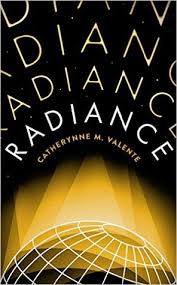 My big problem in writing this review will be making sure it makes sense and isn’t just full of incoherent hand-waving. Here area a few initial points that will establish my position:
a) I’m really glad I got to read this before finalising (coughstartingcough) my Hugo nominations.
b) Because I got old, this is the first book in ages that I’ve stayed up past midnight to finish (18yo me is shaking her head in disappointment). Letting me finish it in a day (although not a sitting).
c) When I read Illuminae, I was immensely pleased with the found-footage style, but thought I wouldn’t want it to become TOO common. And then I read this. And now: I’m happy for Catherynne Valente* to use any damn style she likes.
So. This book.
This book is wonderful.
The New York Times describes it as “a sleek rocket ship of a novel swaddled in ArtDeco decadence.” That’s pretty apt.
The overview: set in an alternate universe where the solar system’s planets are all inhabitable, and where interplanetary travel kicked off even before the Wright brothers were doing their thing in our universe, the twentieth century has developed rather differently from ours. The focus is on the film industry, but there are tantalising glimpses into politics as well (like a reference to the Tsar in the 1940s). Anyway, the film industry has mostly developed on the Moon, and it’s a mostly silent industry, because of issues over paying for the rights to sound technology. One of the focal characters, Severin, has grown up with a director-father and eventually goes into the industry herself… and something happened when she’s shooting on location.
That really doesn’t do the novel justice, of course. The story doesn’t develop in a linear manner; it starts at the end and jumps all over the place, gradually filling in gaps. Some of the ‘footage’ comes from Severin’s childhood, when her father filmed her; some from the films of Severin herself, or her father. Some of the documents are in the form of diaries, or gossip columns. There are even ads. And all of it comes together, ultimately, to describe a rich and intriguing solar system, full of the sorts of people in ours – good and bad, selfish and selfless, looking for glory or love. They’re just further apart, being on different planets. And there’s a mystery that just keeps getting deeper and deeper and draws you further in and it’s just, well, radiant.
The story is excellent. But Valente is doing more than telling a luscious story. She’s interrogating ideas of reality and of memory and truth. After all, are you sure that those memories of your third birthday are your memories, or are they a patchwork made from photos and maybe footage and family stories? And if the latter is true, does it matter? What is reality, when it’s mediated through a lens? But then, what is story-telling but putting words to fragmented memories and trying to make sense of the world – as Valente, of course, is doing here.
I love the worlds that Valente has created, with the names of towns and features on the different planets relating to different godly versions of the planet’s namesake. I love that each has a different personality, reflecting in part which nation has settled there but also developing separately – and that despite this being a largely human-friendly system, there are still issues of colonial attitudes and how to feed everyone.
I love the prose.
I half-want a huge sprawling set of stories set in this universe, but at the same time I want this one beautiful object to exist in pristine serenity all by itself.
Other books this reminded me of: Christopher Priest’s The Islanders because of the way the plot is gradually unveiled. Every story ever set on a tropical Venus. Kim Stanley Robinson’s 2312 because of the grand tour of the solar system.
Do not go into this book expecting ‘hard science’; this is not Greg Egan (although there are certainly some similarities in vibe). Don’t read it if you want a linear narrative. Do read it if you want to be swept up on a joyous sometimes confusing but breathtaking ride.
*Wordpress thinks her name is Catherine Valence, which is interesting enough but just no. Seriously.
Illuminae
 I’ve been meaning to read this book for ages… like since it came out. Heh.
When I bought it, the sales assistant was very pleased for me. She warned me that she’d got to 200 pages, worried that she wasn’t enjoying it, gave it another 50 pages… and then finished it at like 3am the next morning. So it was good to know that at least one other person found it a bit hard going and then BANG it got better.
That’s kinda how I found it too.
The overview: this is written in a ‘found footage’ format – emails, reconstructed IM chat, reports, etc. It’s reconstructing the events which have happened over the last twelve months from the moment that a bunch of space ships suddenly opened fire on a colony, and just a few people manage to escape courtesy of a UTA (United Terran Authority) ship that happened to be nearby. The focus is Kady Grant and her ex-boyfriend Ezra, whom she helps to escape because dude, she’s not that cold.
As I alluded to, there was definitely a bit of a dead patch for me; I was finding the interaction between Kady and Ezra a bit laboured. But it seriously picked up, and while I didn’t finish it in one sitting I came very close (about 80 pages one night, the rest the next day). I can completely understand why this has already been optioned for turning into a film.
I really liked the format. Although something I’ve very bad at is keeping an eye on the dates of things like emails or reports, it was an important thing to try and remember because checking the progress of events was sometimes vital, so I found myself going back a few pages sometimes to check on them. I loved the inclusion of things like the space ship specs, and there were a few sections where the authors and designers did some wonderful things with typography and format and it really added to the atmosphere and aesthetics. Giving the AI a very particular look – white type on black (except its direct speech, which was grey) was brilliant. Obviously this isn’t going to work for everyone, and it would be really dangerous to see this overdone – it would be so easy for it to become a cliche (maybe it already it is and I haven’t seen it? It’s still fresh for me) – but for now, I’m loving it.
As well as some fairly excellent action scenes, Kaufman and Kristoff also engage in some philosophical issues. The main one is that of AI sentience and how humanity might deal with it, deal with it going against their instruction/commands/ demands. It’s just slightly off-central – the plot doesn’t work without it but they could have had less introspection; I’m glad they didn’t, though, because for me it lifted the book just that bit into not-just-rolicking-fun.
Things I suspect Kaufman and Kristoff are fans of: Battlestar Galactica (the reboot); the Expanse series by James SA Corey; Arthur C Clarke’s 2001.
SPOILERS SPOILERS SPOILERS
Firstly, on formatting: having all of the names of the people who died on Copernicus actually listed? Slayed me. And then followed by pictures of the same? Magnificent touch. And then when I started picking out names of my friends from the Australian spec fic scene? SHEER BRILLIANCE I LOVE YOU.
So then there’s the twist. Oh. My. I really didn’t expect it: that the AI, AIDAN, has been mimicking Ezra for simply hours to lure Kady over to the Alexander to fix the problem it has that only ‘meat’ can deal with? That’s magnificent. I loved it. Because I’d been getting a bit sick of those two – and indeed I’m not completely over my annoyance at their relationship, although the revelation of why they broke up made it slightly better for them to get back together – and to then discover it was actually a ploy… Kaufman and Kristoff, NICE WORK.
I still don’t entirely love Kady and Ezra as a couple. I think this is partly an issue with me being old and cynical, because I think “17? 18? really?” – which is mostly my problem. But I’m not going to not read the rest of this series. I fully intend to read the heck out of the next book, that’s for sure, and shove this book into the hands of whoever I can find that’s just about old enough to appreciate it.
Galactic Suburbia 136
 In which Alex and Tansy leap back into 2016 to talk Awards (it’s that season again!), comics, novellas, mysterious London novels and epic feminist canon.
Also, Molly Meldrum.
We’re on iTunes and over at Galactic Suburbia.
Locus Recommended Reading List.
BSFA Awards shortlist
Letters to Tiptree 99 cents! Bestseller on Amazon!
Tansy’s new podcast plug! Sheep Might Fly & Fake Geek Girl
Kickstarter for Ursula Le Guin documentary.
Nominating for Hugos (til end of March) don’t forget.
And Part 1 of the University of Oregon’s Tiptree Symposium, with Julie Phillips (Alex says: sorry not sorry, Tansy)
CULTURE CONSUMED:
Tansy: Hellcat by Kate Leth & Brittney Williams, Archie by Mark Waid & Fiona Staples, The Honey Month by Amal El-Mohtar, The Beatriceid by Kate Elliott, “Binti” by Nnedi Okorafor, “The Heart is Eaten Last” by Kameron Hurley (note: Kameron says any new Patreon subscriber automatically gets access to all the stories she has posted so far including this one – bargain at as little as $1 a month!)
Alex: Jonathan Strange and Mr Norrell, Susannah Clarke; Neverwhere, Neil Gaiman; The Just City, Jo Walton; Walk to the End of the World, Suzy McKee Charnas. MOLLY.
Skype number: 03 90164171 (within Australia) +613 90164171 (from overseas)
Please send feedback to us at galacticsuburbia@gmail.com, follow us on Twitter at @galacticsuburbs, check out Galactic Suburbia Podcast on Facebook, support us at Patreon and don’t forget to leave a review on iTunes if you love us!
Walk to the End of the World
As with Le Guin’s The Word for World is Forest, if I had not known that this was highly regarded amongst feminist sf types I would have given this book up in the first couple of pages. Charnas is utterly devastating in her representation of men and their attitudes towards one another, and their attitudes towards women – “fems” – and towards history and power. While I don’t honestly think things would go this way, it still works as a horrifying critique and savage prophecy of the outcomes of patriarchy.
Charnas writes in a post-apocalyptic world where it seems that only a tiny proportion of white men, and fewer women, have survived to try and rebuild some sort of civilisation. And we know they are all white because there is specific mention of how excellent it is that one class of unmen – the Dirties – are gone, and in case the reader was really obtuse there’s a song enumerating just who the Dirties were. I cannot imagine reading this as a non-white person, given it was hard enough as a white woman. Anyway the destruction of the world has been blamed on the unmen – beasts, Dirties, and fems. The inclusion of beasts in this list is the most bizarre bit to me, because would men really have forgotten that animals were not human and had no connection to civilisation and therefore its destruction? I guess if there were no animals left and you were creating a story to apportion blame, you might. Anyway the Dirties apparently fought against the righteous actions of the true (white) men, and fems were witches who constantly fought against men because they’re agents of chaos and the void.
Not content with this level of terrifying prediction, Charnas also suggests that patriarchy would (d)evolve into ruthless competition between, basically, sons and fathers. To the point of de-identifying familial ties so there can be no seeking out and killing progenitor/descendent; and to the point of reinterpreting Christianity as the Son defying the Father and being punished as a result. (Which is magnificent and disturbing and just whoa.)
The story revolves around the quest of a son for his father – because he’s unique in knowing this information. At heart it’s a very simple and straightforward story but the world that Charnas has created for it is anything but. Through the quest the reader sees basically the entirety of the new civilisation, as well as how the various segments of society work and all the dangerous undercurrents that are at play. The four different points of view, giving very different perspectives, all work seamlessly to develop Charnas’ vision – which is really a warning.
This book is brilliant and terrifying and not for the faint of heart not because of violence to persons but because of violence to notions of civility and humanity. Well, mine anyway; maybe I’m just a bleeding heart liberal. I can’t imagine what would happen if an MRA dude read it; I’d be rather scared they’d miss the irony.
I actually read this as the first in the Radical Utopias omnibus. The next is The Female Man, and I’m not sure my brain can handle rereading that. The third is a Delany that I’m pretty sure I haven’t read, so I will certainly get to that soon.

 Randomly Yours, Alex