Endymion
I have a ludicrous number of books that I physically own but have not read.* Yet I have indeed indulged in some re-reading recently; specifically, the last two of Dan Simmons’ Hyperion Cantos.

This post includes some spoilers for the first two books in the series.
Endymion begins nearly 300 years after the end of Fall of Hyperion, when the farcasters were destroyed, along with a number of planets, and various nefarious things had been revealed about the TechnoCore. Brawne Lamia was pregnant to the cybrid John Keats, all sorts of weird things seemed to be promised by the AIs, and the Shrike – the 3m-tall, made-of-metal, makes-the-Terminator-look-pathetic Shrike – was Up To No Good. And it opens with the accusation “You are reading this for the wrong reason.”
Who me?
Choosing to reveal the end-point of your story at the start can be a risky business. Sure, pointing out that they’re “star-cross’d lovers” can make for that spine-tingly dread and anticipation that can sometimes be very enjoyable. But it can backfire, too, if you don’t care enough about the characters to want to know how they got there (cough, Romeo and Juliet). Here, we know that the narrator is under a death sentence, and that he has been the lover of someone thought of as a messiah. That’s… bold. He does also seem to verge on being a bit of a whinger.
Fortunately, things get better. The story itself is somewhat like Hyperion, in that it’s a journey story. Raul Endymion is tasked with finding and protecting a child, Aenea, which he does through fire and sand and the Shrike. He and she (and another friend) then proceed to travel to various worlds, learning about each other and their galaxy and getting a bit of a sense of what’s ahead of them. Simmons is good at describing new planets, and at making them varied; he has imagined enormous challenges for humanity in colonising different worlds, and knows that yes humanity probably would make a go of living on a planet much like the Arctic tundra, or a jungle, or a desert. Why not? We do here on this planet.
I’d read the book if that was all there was to it, as long as the characters and dialogue were intriguing enough. Raul is an entertaining enough narrator, with some really nice asides about the realities of being a hero (ie he’s not); Aenea acts too old for her age, but that’s explained by her experiences, I think. Simmons goes beyond the simple journey-narrative, though; he also gives the reader insight into some of the other characters, and here’s one of his master strokes: the man tasked to hunt Aenea is not portrayed as a monster. It would have been too easy to do that; after all, we’re meant to be entirely on her side, and against the Pax (on which, more below). Simmons, though, makes him sympathetic, so that while being appalled by some of his actions there’s a certain admiration for his tenacity, and sympathy for his trials. I like this aspect a lot; I’m largely impatient with straight-forward villainy these days.
The other really intriguing aspect of the Hyperion Cantos is the world-building, on the macro scale. In the first two books, most human worlds are under the Hegemony; connected by farcasters and communicating via the fatline (FTL, haha), accessing a datasphere thanks to the TechnoCore, and generally living the high life (well… if you’ve got the money. There is still poverty and misery on a massive scale). Here, not only has that ease of communication disappeared, but the Catholic Church has risen to immense importance once again thanks to one thing: the cruciform that Father Paul Dure discovered, which – once implanted – allows the bearer to be resurrected after death. Many, many times. This, not unnaturally, gets them a lot of converts. It also gets them a lot of temporal, not just spiritual, power (why yes, much like medieval Europe, now you mention it). Their dominion is known as the Pax.
This is one of the few books that I’ve read that seriously considers religion in a space-faring age (and not just Catholicism; there’s also Judaism, and Islam, and Buddhism, and new religions too. Protestants only get one mention, and it’s a fleeting one – “Protestant sects” – in the next book… which makes me sad). The hierarchy of the Church is unpleasant and there’s a lot of greed and ambition; but Simmons does also show priests and parishioners who are genuine in their faith, for which I am glad. Again, complexity; so much more intriguing than simplicity.
My love for this book is possibly somewhat unreasoning. Yes, I think it goes on a bit, and some of the Raul-Aenea bits are maybe indulgent. But I can’t read this with genuinely critical eyes; the Suck Fairy has not visited, so I’ve still got my initial rosy-coloured glasses in place from the first time I read it. LOVE.
*Ludicrous by my standards, and by the shelf space in my house. I understand that my physical TBR pile is laughable when compared with the entire bookcases of certain other people, not looking at anyone specifically, Alisa and Tansy.
ASif! closes its… doors? pages?
It’s with a sad (albeit understanding) heart that I pass on the message that ASif! is closing down.
What? You don’t know about Australian Speculative Fiction in Focus? The website that started eight years ago with a view to reviewing Australian works of speculative fiction, and – perhaps most intriguingly – aiming to give most works two reviews, thus giving context and a broader perspective? Well heck, get over to what I still consider to be the new site (although I think it’s been up and running on WordPress for, what, a year? two?) and browse their wares! It has long since branched out into international works as well as national – not least I think because that’s what was sent our way by publishers – but it is still pretty Australian-heavy. Plus, there are retro reviews from the old site, so you can see what we were thinking some years ago too!
… so yes, I say our. I’ve written reviews for ASif! for… I don’t know how long. Some years. I could probably go back and see when my earliest review was, but that might make me scared. Or cringe. Whatever, it has been a tremendous experience. I’ve been writing the odd review for very many years (back to high school), but this was the first time I got the chance to do it somewhat-regularly. More than that, thanks to the email list… well. I allowed myself to get roped into Last Short Story some fewer number of years ago, which in turn led to going to this thing called a convention, and – yeh. Galactic Suburbia would be a different beast if not for ASif; I wouldn’t be on it, for a start, since I wouldn’t know Alisa or Tansy (I would have heard of Tansy, of course, because I already had, but it would be a far-off fan-girling).
Anyway. It is certainly the right call for Alisa to have made; she has the most incredible number of calls on her time, and has had for as long as I have known her. It makes sense to tidy things, and projects should definitely have end-points rather than continuing on just because.
No more reviews after the end of this year. Vale, ASif!
Galactic Suburbia 73
 In which Alisa recovers from the brainsplosion that is World Fantasy Convention, Alex finally reads THAT Margo Lanagan story, and Tansy travels in three kinds of time. You can get us from iTunes or at Galactic Suburbia.
News
The WFC Report
Stop Reviewing Movies with Strong Female Leads!
at the Mary Sue
at Jezebel
at Bitch
Fake Geek Girls Unite:
Mary Sue Coverage 1 2 3
The New Statesman
Peter M Ball Pledges His Allegiance to the Fake Geek Army
What Culture Have we Consumed?
Alisa: Dexter S6 and S7; Episodes 2; In Treatment S1; The Shield S1; Remember Why You Fear Me, Robert Shearman; Hair Side, Flesh Side, Helen Marshall
Alex: Singing my Sister Down, Margo Lanagan; some Kij Johnson, from At the Mouth of the River of Bees; One Little Room, KJ Parker; Holmes Sherlock, Eleanor Arnason
Tansy: The Diviners, Libba Bray; All New X-Men #1; Chicks Unravel Time edited by Deborah Stanish & LM Myles.
Don’t forget to send us nominations for the GS Award: for activism and/or communication that advances the feminist conversation in the field of speculative fiction in 2012.
Check out our sibling podcast, Galactic Chat – in the latest episode, Sean interviews Joe Abercrombie.
We are running away for summer! Back at the start of February!
Please send feedback to us at galacticsuburbia@gmail.com, follow us on Twitter at @galacticsuburbs, check out Galactic Suburbia Podcast on Facebook and don’t forget to leave a review on iTunes if you love us.
An open letter to Nyxnissa so Dasheem
Dear Nyx*

Truly you are one of the most brutal women in fiction. No – scratch that – you are one of the most brutal people in fiction.
The fact that you are a woman has an impact, I guess, because for all the Ripleys and River Tams, seeing women kick butt is still a bit exceptional. And of course, you don’t just kick butt. You actively seek out mercenary jobs that are likely to involve very large amounts of death and gore. You may not always relish inflicting pain, but neither do you beat yourself up about it. I think this is one of the things that makes you seem quite so brutal. Other violent actors tend to fall into two categories: the mindless thug, usually a lackey; or the somewhat tragic hero, forced to violence by circumstances.** You fit neither mould. By no means a thug, if not exactly burdened by overthinking situations, you’re such as heck no lackey. And while it might be difficult for you to change your circumstances now, with all your skills being tied up in your bel dame training, you both chose that life originally and are making no attempt to change things anyway. Quite to the contrary – you’re working as hard as you can, or can be bothered, to get back in with bel dames, so you can continue on with your violent lifestyle legitimately rather than taking shadow jobs. You are good at this job (as witnessed by the fact that you’re still alive, fourteen or so years after being kicked out of the bel dames and still pursuing the mercenary scene), so why not keep doing it while it keeps doing it?
A psychologist or psychiatrist would no doubt have a field day analysing and investigating you. Upbringing? One of a litter born to a woman who made her living, as far as I can tell, bearing children for Nasheen – men for the ongoing war with Chenja, women to keep society still running. Not a whole lot of familial love going on there I imagine, although you do seem to have felt some affection for your siblings at various points. Work history? Joined the bel dames to be trained as a government assassin. Jobs including finding boys who don’t want to go to the front and making them go; stopping people who are trying to do nasty, nasty things with biological weapons, sometimes involving the bodies of dead soldiers. Plus assassinations when they’re required. Oh, and the odd black job on the side… like carrying illegal bug tech in your womb… I mean, What the hell, lady?? Then you’re kicked out and you go on the market as a freelancer. Sure, why not.
Plus, your planet relies on bug tech. That’s surely enough to send anyone over the edge… although obviously you’re used to it, so the idea of bugs as medicine and bugs as furniture-producers and bug juice as fuel isn’t strange to you in the least. But it’s sure strange to me and it’s one of the more off-putting sides of your story. That and the lots of death as people try to kill you and you kill them back.
And it must be said that you’re not just brutal in your work, you’re also brutal in your relationships. You don’t really seem to believe in friendship. Perhaps it’s just too annoying and too much of a demand on your energy. Don’t get me wrong, I understand that you have good working relationships – your crew in Infidel, Suha and Eshe, are fine and seem generally committed to you, but let’s be honest here – they’re not exactly a top quality crew. A kid and an addict? What does that say about you? And what happened to your crew from God’s War? Yeh, maybe it’s best not to talk about that. Maybe a bit too raw still, since they’re all gone a long, long way away from you, for a variety of reasons but all at least partly because you are dangerous and unpleasant to be around.
So… why then do I keep reading? Why am I so excited that Rapture has been published so I can maybe get some closure? Hmm, perhaps that’s exactly the reason. Perhaps I’m hoping for some redemption for you, although what that would look like I don’t know and now that I write that, actually perhaps redemption would be a betrayal of everything you’ve stood for. You sure can’t be sent off to pasture, to grow bugs or something. I can’t imagine there will be marriage or a steady partnership in your future, and definitely no babies. Restoration to the bel dames perhaps? Going on a killing spree and killing all of the bel dames? Now that would be interesting. Maybe you could be responsible for stopping the war with Chenja! – although that would leave you totally at a loss. Maybe that would be appropriate.
Perhaps you will die. That would make a brutal sort of sense.
I keep reading your stories because for all you’re brutal, you’re also magnetic. Your brutality is part of that magnetism – and I might have done you a disservice in describing you as brutal all the time, because it’s not like you go around randomly kicking puppies or cuffing children or belting your crew. You only use violence where it’s necessary… if sometimes you’re a bit enthusiastic. But you are also a good boss, or try to be; you’re loyal, even if sometimes that comes across (sorry) a bit brutally – especially when it comes to being patriotic. And you’re unpredictable, which is an entertaining trait in a character (it can be damn terrifying in a real friend, though).
So… thanks. Thanks for keeping on trying even when it’s really hard. Thanks for keeping on. And thanks, Kameron Hurley, for this amazing character. I can’t imagine she was easy to write, and I imagine she was also pretty hard to sell to a publisher – bug tech! irredeemably tough chick! – so thanks, too, Night Shade Books. You rock.
With respect
Alex
*Nyx is a character created by Kameron Hurley, featured in God’s War, Infidel, and Rapture.
** Yes, this is a generalisation. It’s my letter, go away.
Galactic Suburbia 72
In which a new listener is born, Canada gets a Stella too, and we review a bunch of great stuff including Black Widow, Infidel, Swordspoint and Big Finish’s special releases. You can get us from iTunes or at Galactic Suburbia.
News
Baby Announcement: Daniel Wessely is born!
WFA winners announced
Genrecon!
Tansy talks Genrecon on the Voyager blog
And again on her own blog
Jason Nahrung on what he got out of Genrecon
Neil Gaiman’s new Doctor Who episode will feature the Cybermen, Warwick Davis & Tamzin Outhwaite.
Boing Boing
io9
Canada is getting a Stella too – theirs is the Rosalind!
Galactic Chat – Rowena Cory Daniells
What Culture Have we Consumed?
Alex: Infidel, Kameron Hurley; The Deep (BBC series); Black Widow, Marjorie Liu; and books on women’s suffrage… (only on the day on which I post this!)
Tansy: Bitter Greens by Kate Forsyth, Swordspoint by Ellen Kushner; Big Finish Specials: UNIT Dominion, Love and War by Jacqueline Rayner & Paul Cornell; Voyage to Venus; Dorian Gray
Please send feedback to us at galacticsuburbia@gmail.com, follow us on Twitter at @galacticsuburbs, check out Galactic Suburbia Podcast on Facebook and don’t forget to leave a review on iTunes if you love us!
Midnight Lamp – not really a review
Spoilers for the first two books, because it can’t be otherwise.
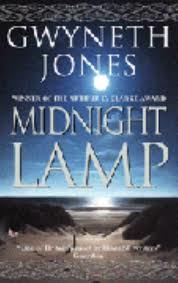 I actually don’t think I can write an adequate review of this book without massive spoilers in general – and really, how do you review the third in a series of five, and do justice to it and the characters and everything else? So why am I writing a review? – mostly because I just want to note having read it, and remind people that THEY SHOULD READ THE SERIES.
This series is monumental, and much as I want to rush through and devour the last two I think it is a good idea that I leave a little time between them. Without that space I would just fall into Gwyneth Jones’ world and be lost for a while. And I’m not sure that would be entirely healthy, because being like Fiorinda, Ax and Sage is not a healthy place to be. Fi is suffering in the aftermath of the death of Rufus O’Niall and the murky, difficult discovery/growth/development of her ?magical abilities (they’re definitely magical, but they’re also kinda maybe something else). Sage is in a weird place in the aftermath of Rufus’ death and his own experimentation with the Zen State, and is even more conflicted than Fi over the status of his relationship with the other two. And then there’s Ax, kinda caught between them and kinda leading them on, reluctant to use his political clout but desperate to change and improve things nonetheless.
This part of the epic is different from the others in being set in Mexico and America, which brings some large changes: for a start, the trio are popular but not idolised; feted but not mobbed. For another, the USA was not affected by the technological losses and massive shifts in attitude that impacted on the UK with Dissolution Summer and the internet viruses, so this feels a bit more familiar, a bit more ‘real life’. Which is actually a bit weird when you’re used to having the heroes in a recognisably other place. There are also more fractures between the central trio and their band, their merry band, of cohorts – understandable after a few years of high-stress, high-weird life.
Many things happen. There are tragedies, averted and not; there are adrenaline-laced adventures; there are still, reflective moments of contentment. Characters develop and some change a lot.
You have to read the first one, and then you’ll probably be hooked.
Heir to the Empire (review)
I read my first Star Wars book. AND I LIKED IT.
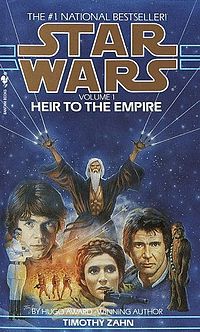 Set a few years after the events of The Return of the Jedi, Han and Leia are married and expecting twins, while Luke is trying to figure out how to be the best Jedi he can. All three – but especially Leia – are trying to figure out how you go from being rebels to being politicians and actually make a galactic empire work, which any revolutionary will tell you is damn hard work. The story here is partly about that, which could make for a rather dreary story of political machinations, but is largely driven by the fact that not everyone is happy with the overthrow of the Emperor, OH NO PRECIOUS THEY’RE NOT. Grand Admiral Thrawn is devoted to the idea that he is a fitting heir to the Emperor, and he’s got some spaceships and a bunch of soldiers and some rather tricksy plans to try and accomplish just that.
Look, it’s no Ursula le Guin or Gwyneth Jones. But it is, surprisingly to me, really quite enjoyable. I think Zahn captured Han and Luke’s personas and dialogue quirks quite nicely – Leia felt a bit ‘newer’, mostly because I think she actually got a bit more air time as a real human being here than she did in any of the films. So that’s nice. I did enjoy the interplay between Han and Leia as they continue to adjust to married life; Han is accepting and generally supportive of Leia’s political role, if frequently concerned that she’s pushing herself far too hard.
One of the more intriguing aspects of this as a novel is that it takes full advantage of being in third person, and carries on the tradition of the films, by showing the actions of the villains as well as the heroes (and various apparently chaotic-neutral characters) in rather surprising detail. So while the reader doesn’t know exactly all of Thrawn’s devious schemes, we get to read about his attempts to find and recruit his own Jedi dude; plus there’s Talon Karrde, who I’d never heard of before but kinda fills the slightly-dubious-businessman-cum-smuggler that Han no longer has, thanks to going completely straight, and many of whose machinations the reader is privy to.
I don’t have the sequels yet, but I do intend to read them. I’m not in a screaming hurry, but I am dead keen. I’ve heard these are the best of the expanded universe, but I admit that I’ll probably seek out more, at some stage. Trying to balance a desire for adventure with the requirement to be a serious politician is intriguing.
Did I mention that I think this counts as my first media tie-in novel? How exciting.
The Forever War
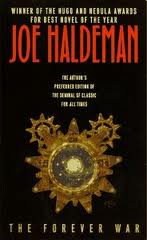 I didn’t really know what to expect when I picked this up. Someone had recommended it, so I was going in blind. I did read the introduction, which is an interesting look at the problems and possibilities of getting stories published and serialised and what that can mean for novels. It also gave me the tip that this could be, and has been, seen as a “Vietnam book.” Which of course influenced my reading of it, but not I think in a deleterious way; I think actually I appreciate it more for knowing its context (which should be no surprise, let’s be honest).
The focus of the story is William Mandela, an army conscript for a war against the first aliens humanity has come into contact with. He’s trained on various moons to fight an enemy whose capabilities, and indeed appearance, are completely unknown… and then does indeed fight said aliens, with less than convincing results. This fight is followed by what is, I think, one of the most important aspects of the entire novel: Mandela’s return to Earth.
Because this is not a story with faster than light travel (it does have wormhole travel), and the fight took place several light years away, while Mandela has aged months many, many years have passed at home. While in theory this is great for the pay which has been accumulating in his bank account, and also for years served, all of those problems you encounter when you’ve been away a few months and then go home? Compounded, multiplied, and then made even worse. I’m sure they’ve been written, but I’ve not come across another story that deals as convincingly with the time dilation problem as this one. Haldemann reflects on the personal consequences for the soldiers, as well as on how this would impact news coverage of the ‘war’ and other, broader, issues. It’s probably the aspect that will stick with me the longest, although it’s by no means the only interesting bit.
The story ends up following Mandela over more than a thousand years, which is remarkably ambitious in 250 pages. Haldemann is, thankfully, not foolish enough to imagine a static society over that period, and he imagines and experiments with various alternatives for Earth – which Mandela mostly just samples, since he generally can’t cope with being home and so ships out again. There are huge changes to Earth’s economy, to reflect an entire planet being on a war footing (and, of course, that getting co-opted…) – imagine a society whose currency is calculated in calories; there are changes to sexuality, in response to population issues (his theory on sexuality in the marines is an interesting one too – a corps that’s not equally gendered but where sex is expected to take place regularly and with multiple partners… I can’t figure out how this would have been regarded in the 1970s); and even different modes of consciousness. All of which is very clever and, again given how short it is, somewhat frustrating – in a book written today, I would bet this would actually be a trilogy, each distinct part of Mandela’s life covered in excruciating detail… ok maybe I prefer this version.
And call me a sap, but there’s also a rather wonderful, understated love story at the heart of Mandela’s adventures, and I’ll admit to getting a little teary at the end. WHATEVER.
The Vietnam connections? Oh yes. An unknown enemy and seriously unknown tactics; a country (actually in this case a planet) geared towards a war that most people at home don’t really understand; little comments about the propaganda and rhetoric used, as well as the first fight taking place on a jungle planet – it’s very clever, because Haldemann doesn’t shove it in your face but definitely draws rather pointed parallels. All of that said I think this is still a fairly relevant book, since there are still – and probably will be for a long time – these sorts of wars, on varying scales.
Plus, maybe one day we’ll have wormhole travel, and then we’ll have to figure out how to deal with the time dilation problems.
The Deep: a BBC submarine series
Note: some spoilers here. Not huge ones.
 I’m loving my BBC iplayer subscription, because it turns out there’s a bunch of BBC science fiction that hasn’t been picked up by Australian tv. Outrageous! The series we’ve just finished is The Deep, a submarine adventure under the Arctic. Be warned: if you don’t want your characters to be hurt, don’t watch this. If you don’t like the uncertainty of Spooks then this is probably not the show for you. Just saying.
The series opens with a marine biologist (I think), Catherine, in a little sub around a thermal vent in the Arctic. And something goes wrong. Flick forward six months and the biologist’s husband Clem is about to go out on a new mission to the same area to continue her mission… but then they get politely hijacked and told they have to go looking into what happened to Catherine and her crew. Basically the rest of the story – there’s five episodes – follows the deep-sea, under-ice adventures of the Orpheus (hello, classical imagery). One spoiler I think it’s important to put up front is this: from the first episode, I found it impossible to tell whether this was going to turn into a version of The Abyss, with aliens or Atlanteans responsible for the mishaps. But no. Instead, this is very much a science fiction thriller, with the story firmly entrenched in human politics, human problems, and very real human ambition and greed.
The story: is tightly, and I thought largely well, written. There are a few sub-plots but they are all ultimately tied into the over-arching issue of survival, immediately and long-term. There are betrayals and tragedies, unexpected friendships and some really, really cool twists.
The characters: largely enjoyable, if not always likeable. Frances (Minnie Driver) is the captain, generally as autocratic as she needs to be but occasionally lets personal considerations get in the way. I do not think that this a reflection of her being a woman – and I thought long and hard about that – there are plenty of examples of men acting likewise, and she is certainly never decried within the show for being weak as a consequence of having boobs. James Nesbitt is Clem, the engineer on the Orpheus, who is a bit mad with grief at being a widower and definitely the most irrational of the lot; there are times where he acts really quite irresponsibly, making me uncomfortable. But he’s sympathetic as well as unpredictable, and probably one of my favourites. The other main character is Samson (Goran Visnjic), whose accent bothered me greatly because I could never place it. I could never quite figure out his exact role on the boat, either, since he seemed to take on medical roles, and be the driver of the mini-sub, as well as doing some biological research stuff. It’s possible I just missed which one was his primary occupation. Anyway, Samson was for me the hardest character to bond with – he’s got various personal conflicts, and seemed to vacillate personality-wise. Of the minor characters Tobias Menzies as Raymond, the salvage/insurance dude along for the ride to investigate what happened to Catherine et al, is most awesome. He’s really hard to pin down regarding motives and attitude – really cleverly written – and Menzies is brilliant.
I can really recommend this if you’re after 5 compulsive hours of submerged adventure. And I do mean compulsive; the end of episode three made me immediately need to watch episode four because it was such a cliff-hanger. It’s not a completely happy story, by any means, but it’s worth it.
Galactic Suburbia 71
 In which Tansy & Alex talk sexism, steampunk, Samuel Delaney and tiny baby Avengers fighting tiny baby X-Men. Also, feedback from listeners! You can get us from iTunes or at Galactic Suburbia.
News
Pornokitsch on the Mammoth Best New Horror introduction
Twelfth Planet Press announces Best YA SF anthology – Alisa & Tehani reading for this in 2013 and we hope it doesn’t break them.
The Fantasy Pin-Up Calendar Thing
The Calendar itself
Tansy’s post – when fantasy art embarrasses us all
Skepchick asks us to Please Stop Making Calendars
NK Jemisin on her involvement in the project
Sexism in the Skeptic Community – what happened after she spoke out
What Culture Have we Consumed?
Alex: Edge of Infinity, ed. Jonathan Strahan; Babel-17, Samuel Delaney; The Contrary Gardener by Christopher Rowe in Eclipse Online
Tansy: Wilful Impropriety, Ekaterina Sedia (ed); Hawkeye #1-3, Matt Fraction, David Aja; “A-Babies Vs. X-Babies” one-shot written by Skottie Young with art by Guruhiru
FEEDBACK
Suzy McKee Charnas story at SnackReads
Please send feedback to us at galacticsuburbia@gmail.com, follow us on Twitter at @galacticsuburbs, check out Galactic Suburbia Podcast on Facebook and don’t forget to leave a review on iTunes if you love us!


