The Last Gleaming of Kobol
 BSG rewatch: 1.12 and 1.13 (Parts 1 and 2)
Part 1
This episode opens with a marvellous montage: Boomer contemplating suicide, Helo facing off with Caprica-Sharon knowing she is a Cylon, Starbuck and Baltar in bed together but she calls for Lee…. All very unpleasant things to confront our (anti-)heroes. Baltar kinda-sorta convinces Boomer to kill herself, but it doesn’t work, which is unpleasant. There’s a wonderful scene, too, where Baltar has an argument with both the President and Six, simultaneously. Very clever, and very funny too – telling the President not to think of him as a play-thing??
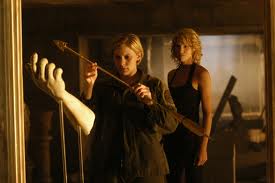
Then, of course, things get really serious when the President has another vision, and the planet that has recently been discovered is revealed as Kobol: the Garden of Eden-equivalent, where the Scriptures report that the gods and men lived together in harmony. Because of that, the President is adamant that Starbuck should jump back to Caprica and retrieve the Arrow of Apollo so they can find their way to Earth. Adama, nor unsurprisingly and not illegitimately, finds this an immensely hard sell. The President goes behind his back, requesting Starbuck do it without orders… which she does. This is more than just Starbuck being capricious and anti-authoritarian; our girl is deeply religious, in her own way, and the betrayal she feels when she discovers Adama doesn’t actually know where Earth is hits her hard. This has all sort of ramifications for the fleet, of course, as well as for the individuals as people and political agents. Which is why it’s a two-parter, I guess…
Part 2
Because Adama perceives the President as having interfered in military matters, he demands her resignation and when she refuses, he orders a boarding party onto Colonial One to take her into custody. This, of course, is a totally shocking move, given that he had initially said he had no interest in a military dictatorship; we like and admire Adama; and, as viewers, we are predisposed to assume that the President is right. And when the boarding party get to the President, and Apollo changes his mind and pulls his gun on Tigh? Outrageous. Putting the President in jail is almost an anticlimax after what was effectively a mutiny from the all-round good-military-guy Apollo. But that is of course where she ends up… and Apollo too.
At the same time as this drama is unfolding, there are four other narratives going on. One is that Caprica-Sharon, who is still with Helo although kinda his prisoner, reveals that she is pregnant. WHO WOULD HAVE GUESSED. They end up meeting up with Starbuck, who has made it to Caprica, found the Arrow of Apollo, gets her ass seriously handed to her by a Six… and only isn’t killed because they fall off a ledge, and Six dies instead. So that’s all very exciting; it’s touching to see Helo and Starbuck reunited, as they’re clearly very good friends, but Starbuck’s reaction to Sharon is a bit overwrought.
Third, Boomer is well enough to undertake a very dangerous mission: blow up the baseship orbiting Kobol. She does so, but in the process ends up seeing her sisters and realises that she really is a Cylon. She has a great deal of difficulty with this discovery, of course, and is even more distraught when she gets back to Galactica aaaaand then she shoots the Commander. OOPS. Programming took over.
Lastly, we have the team that crashlanded on Kobol. This is all very stressful of course but the weirdest and most intriguing aspect is Baltar hallucinating the Forum as a complete building, and Six informing him that he will soon be looking after a baby. Baltar as a father?! Lords of Kobol, save us from our fate.
Thus ends season 1. I’m fairly sure that we didn’t have any time delay before getting to season 2 the first time around, and I’m awfully glad of that because this is SERIOUSLY a cliffhanger. Will Helo hate Caprica-Sharon forever? Can she actually have a baby? Is the Commander going to die of his wounds? How long will the President be in the brig? Will Starbuck get the Arrow back to Kobol? And will Starbuck and Apollo ever manage to get it on?!
BSG stats:
- Starbuck in the brig: 1
- Baltar in the brig: 1
- Women Baltar shows interest in (not including Six): 4
- Women Baltar actually gets to sleep with: 2
- Baltar religious conversions: 2
- Different sexy dresses worn by Caprica-Six: 9
- Apollo sides with President against Dad: 3
- Number of Cylons viewers know about: 4
- Number of Cylons humans know about: 2
- Roslin has a vision: 3
- People deliberately thrown out the airlock: 1 (+1 threat)
- Ships lost: 1
- Ellen gets suggestive: 3
- Starbuck and Apollo do fisticuffs: 1
Out of the box is where I live
BSG rewatch, 1.09 -1.11
Tigh Me Up, Tigh Me Down
Oh Ellen. Ellen Ellen Ellen… your return to Tigh’s life just makes things so much more complicated. And you are such a complicated character yourself. Of course, you don’t seem complicated at the start; you seem like a lush, and a bit of a nymphomaniac frankly. There is probably no other character in the entire show who makes me as uncomfortable as you, every single time I see you. It’s all very well and good for Saul to be overjoyed at your return… but to immediately start sowing dissent between him and Adama? Trying to crack on to Lee? Ew.
We also get the first real signs of the distrust sown by Leoben coming to fruition, in the suspicion between the President and the Commander. With the Cylon-detector finally on line, apparently, Baltar is made to go back and forth between determining whether Ellen or Adama is a Cylon. And he declares neither of them is, but whether that’s the truth is of course completely unknown. We certainly know Baltar is untrustworthy….
This is also the episode where Starbuck stumbles upon Baltar and Six having sex… although of course Six isn’t actually there… oops. Also, EW.
The Hand of God
This is the ‘searching for tylium’ episode. The fleet is desperately short of fuel, so – as with the search for water – we have raptors out looking for asteroids that are tylium-rich. They find one… and it’s crawling with Cylons. Of course. Starbuck (whose quote is the title of this post) is still recovering from her broken leg, so rather than leading the crazy-ass mission she gets to experience the joys of command; she does so because her crazy-ass thinking is exactly what’s required for this attack to succeed. They use ships as a decoy, and things look to be going badly… and then Starbuck and Adama pull out their Sekrit Plan, and hurrah! everything goes well. Apollo gets to act the outrageous one for a change, proving himself to himself and his father. And there’s a lovely Star Wars-esque moment with Apollo flying up a fairly narrow tunnel.
Oh, and back on Caprica, Sharon spews….
It’s a run of the mill episode, really, where “run of the mill” involves an exciting and tension-filled action sequence, some frisson between the President and the Commander, and a few flashes to poor old Helo and Caprica-Sharon hiding out from the big bad Cylons.
Colonial Day
Oooh, a political episode! The quorum of 12 get together, and Tom Zarek gazumps the Pres by demanding that there be an election for VP. Which makes sense, and of course it looks like Zarek will be the man… until the Pres does the dirty on her original candidate, and replaces him with Baltar, who ends up winning. URGH. I really like Zarek in this episode; I love that the writers gave him really attractive politics – well, to me anyway; basically he comes across as a socialist. It’s all about the good of the community, and that’s fun. It certainly complicates his relationship with the President no end, because you can’t really argue against those things; you have to argue against the man himself, and that just gets a bit messy and uncomfortable after a while. Meanwhile, Baltar actually gets a real-world outlet for his overdeveloped libido, and Ellen just keeps on being lewd.
Also meanwhile, back on Caprica… Cylon-Sharon is no longer spewing but starving – GOSH I wonder what THAT could mean – and then Helo discovers that she’s actually a Cylon. OH NOES! Whatever shall we do!
There’s also an assassination attempt, proving that even with fewer than 50,000 people in the population there are still utter nutters out there who are willing to murder for their beliefs… or money…
BSG stats:
- Starbuck in the brig: 1
- Baltar in the brig: 1
- Women Baltar shows interest in (not including Six): 3
- Women Baltar actually gets to sleep with: 1
- Baltar religious conversions: 2
- Different sexy dresses worn by Caprica-Six: 6
- Apollo sides with President against Dad: 2
- Number of Cylons viewers know about: 4
- Number of Cylons humans know about: 2
- Roslin has a vision: 2
- People deliberately thrown out the airlock: 1 (+1 threat)
- Ships lost: 1
- Ellen gets suggestive: 3
Revelation Space
 I just love this book. I really really do.
I seem to remember that when I first read it, I found it a bit confusing – albeit in a good way – because there were lots of POV changes. I wonder now whether that’s one of the other books, because while there are flicks between POVs they converged more rapidly than I had expected and the connections seemed more obvious… but perhaps that is actually a function of me remembering, if barely, where at least some of the connections lay. One of the great things about having a relatively poor memory is that having read this some 5 or 6 years ago, there were stacks of things that there were once again a total surprise for me.
There’s a nice variety of characters here. Male and female, baseline-human and definitely not, and a mix of motives and attitudes. I have two favourites, and they’re the two most obvious: Sylveste and Volyova. Sylveste because he’s just a bit like Indiana Jones; he is, after all, inherently an archaeologist, who gets caught up in adventures. He’s also one of the most sublimely arrogant characters out there, in that fascinatingly entertaining way that only someone who is right so often that the arrogance seems appropriate can get away with. Like House or Holmes, I guess. Not quite diametrically opposed, but still radically different, is Volyova. She’s not quite a sociopath but she’s way more at home with weapons than other people. She gets some wonderful lines in the book, and I always enjoyed the sections told from her perspective; Reynolds gave her a marvellously dry wit and a drive for achievement as strong as Sylveste’s, with marginally less arrogance. I quite liked the POV switches, actually, even – perhaps, bizarrely, especially when – they were done seemingly mid-action sequence. The switch always added something to the scene, an understanding or a perception that could not have come from the initial character. I also liked that there wasn’t an omniscient narrator; it meant that events and revelations came slowly, ambiguously, enthrallingly.
The plot? Oh, the usual; humanity spread across the galaxy, encountering alien artefacts but where is everybody else, along with tantalising hints at what has happened to humanity as they spread – the alterations to baseline humanity are some of the intriguing of those; I love the Ultras and their chimeric alterations, heading towards being truly cybernetic beings. There are small-scale dramas and intrigues – love, abandonment, family drama – mixed in with the galaxy-impacting revelations, making this a seriously awesome representative of space opera. In fact it might have been the first book I ever read that made me genuinely consider space opera a sub-genre, and realise that I totally adore it. It might not be the absolutely most original plot in the world, but the revelations at the end were certainly new ideas for me, and the writing itself is so complex-but-clear that it doesn’t matter that it’s a play on the Fermi paradox; as an SF idea I think it has plenty of scope left anyway.
There are some slightly clunky bits in the narrative and the flow of the writing – a few bits where there is a bit too much info-dump via dialogue for example – but for a first novel, it’s a seriously awesome one. I am just itching to go read the rest of the Revelation Space books… they’re sitting there waiting for me…
Transformation Space
 I have been waiting for this book for a long time, not least because I had thought it was a trilogy, rather than a quadrilogy. Here, we finally get a conclusion to the intricate plots that de Pierres has been developing and tangling over the series: Mira Fedor and her pregnancy, Trin and his semi-willing followers on Araldis, Tekton and his bizarre free-mind/logic-mind… and my favourite, Jo-Jo Rasterovich, the deep-space miner irrevocably changed by his encounter with the entity, Sole, who – it becomes increasingly clear – has something to do with everything that’s going on.
In terms of plot, there is little that is absolutely new in Transformation Space. It’s a book of climaxes, of revelations, of explanations and conclusions. That’s how it should be, and it certainly doesn’t mean that it’s boring. As with the preceding three books, de Pierres writes a relentless action story, with few breathing spaces for the characters or the reader. This is unsurprising, given that Mirror Space concluded with the revelation that a Post-Species fleet was moving into Orion space, and the suggestion that this was somehow connected to the invasion of the planet Araldis.
The use of multiple strands of narrative, used to such great effect in the previous books, is continued here; and even when the narrative swings over to Trin and his followers, forced to hide away and spend all their energy hiding and foraging, it’s not exactly relaxing, as tempers run high and eventually boil over. Other strands are more event-based. A new strand is introduced, that of Balbao, in charge of the installation commissioned to examine Sole; things go radically wrong, leading to them eventually teaming up with Lasper Farr. (Anyone familiar with the preceding books will know that such a match is bound to end badly, or at least chaotically.) Even Mira gets a fairly action-oriented story, as she gives birth and then must decide what she and the biozoon Insignia are going to do about the Post-Species fleet and Mira’s own planet. While occasionally in the other books it was sometimes disorienting to switch rapidly between characters and places, I was fairly comfortable with it by this stage. Plus, there was more convergence than ever, with various characters finally coming together or with storylines coming to a natural conclusion.
The characters are a fascinating aspect of this series for me. Half the time I can’t figure out whether I care about many, or indeed any, of them. I have never found Mira particularly engaging as a character; although sympathetic, I was frequently annoyed at what I saw as a lack of gumption. I was pleased that this book finally saw her exercising more agency, and holding her own against various other forceful personalities. This development makes sense, too, over the story; coming from a restrictive world like Araldis, a feisty female character would have been unbelievable. As she is away from that environment for longer, and is exposed to different attitudes and forced to look after herself, she responds and grows appropriately. As for the other characters: I have never felt much sympathy for Trin, the spoilt little rich kid forced to become a leader, and that didn’t change. Tekton, the arrogant tyro drawn away from studying Sole, continued to be repulsive yet oddly charming (a description I’m quite sure he’d be immensely flattered by), and I really enjoyed that he was even more active, rather than largely reactive, this time. The same cannot be said, I think, for Thales, who continued basically to be the hapless scholar; although he is involved in important events, he rarely seemed to be directly involved with them. Rather, he was more like flotsam on the tide, being pushed around and only occasionally interacting. This actually makes him quite an interesting character, I think, given how rarely such a character is male – and an educated male at that. There are other characters, of course, but it would be boring to go through all of them; they are marvellously varied, with few stereotypes and frequent surprises. I just don’t find many of them actually likeable. This makes it quite odd, I guess, that I really enjoyed this book and the entire series. It’s a tribute to the skilful writing, and the utterly intriguing plot.
The Sentients of Orion is a complex, highly textured and riveting space opera. It’s set across an entire galaxy populated by ‘humanesques’ and other, more alien beings; the action veers from intense family drama to planet-wrecking destruction. It considers genetic engineering, religion, politics, personal responsibility and the different forms love can take. It’s both character and plot-driven, and the conclusion totally astounded me. This is a series that has changed my way of thinking about space opera, and the characters that populate it.
The Dispossessed: An Ambiguous Utopia
 I have loved Ursula le Guin for a long time; I think we read A Wizard of Earthsea for school, and when I discovered there were sequels – many years later – I was very happy indeed. But it wasn’t until many years after that that I discovered she had written a lot of serious, awesome, adult work too. It took me ages to get to The Left Hand of Darkness, which now rates as one of the best SF books ever for me, and I have slowly been getting to her others. Happily, The Dispossessed is the February book for the Women of SF Book Club – a perfect opportunity.
A spoiler-filled, and whimsical, discussion
Narrative
The conceit of calling this post ‘spoilery’ makes me laugh, since the plot itself is so simple – and there’s really nothing to spoil. A man goes from one planet to another; learns some stuff; gets involved in some political stuff; goes home. Has flashbacks about meeting his partner and about his evil boss. That is, Shevek – a highly-regarded physicist – leaves his planet Anarres and goes to its sister-planet Urras to further his research. Anarres was colonised 170 years before by people fleeing Urras, determined to set a society with no property or ownership (a philosophy called Odonianism). In alternating chapters we get his experiences on Urras – learning what it is to be ‘propertarian’ and then getting involved in the beginnings of a revolution – and then his life to that point on Anarres, involving a stick-in-the-mud physicist, meeting his partner Takver, and Shevek coming to terms with his own attitude towards Odonianism. I was a bit sad that it ended with Shevek landing back on Anarres, though; I would have liked to see the reaction to his return. I guess leaving it ambiguous is part of the point.
I would not be surprised to find that a lot of people find this a very boring book, because the plot is indeed quite slow, and straightforward, and really almost nothing happens. But the point, of course, is that this is not a plot-driven book; while the plot itself is actually interesting and I enjoyed it, it’s there – I think – to enable the character-driven and politics-driven book.
I loved the past/future back and forth of the chapters. To see where Shevek ends up, while also seeing how he got there, is a fascinating narrative trick. It almost denies causality, in some way, which ties in very neatly with Shevek’s own thoughts and dealings with time and temporality: we know he got together with Takver before he meets her, we know he becomes an immensely important physicist before he becomes one. On p162 of my copy, he suggests that “The way to see how beautiful life is, is from the vantage point of death.” Although Shevek isn’t dead at the start of the book, I think we best appreciate his experiences on Uras by looking from the vantage point of Antarres… and vice versa.
Characters
Shevek is not entirely likeable, but almost always admirable – with one horrendous exception, where he possibly rapes Vea (I think it’s unclear whether he does or not). Interestingly, the fact that all we know of Vea’s behaviour is from Shevek’s point of view – coloured by his naivety – made me quite surprised when it appeared that Vea was not, actually, interested in ‘copulation’ there and then. Anyway, he has those outsider/loner characteristics that so often seem necessary for making an interesting character, even if ultimately he ends up appearing like the most ‘inside’ Odonian politics. Most of the other characters are mere sketches – even his partner Takver. This is not to say that they are caricatures or stereotypes; more, perhaps, that being entirely fleshed out is unnecessary for the story to take place.
Politics
Undoubtedly some readers will see this book as overly polemical. But tying it all in with the science, and some intense personal relationships, tempers the politics in my mind; and besides, when it’s as well-written as this, and as critical, passionate, and searing as this, polemical definitely has its place. I love that this was written in 1975 and it’s a critique – almost a damnation – of both capitalism (called propertarianism) and perhaps the ultimate expression of communism (Odonianism). USSR-type communism comes in for a brief condemnation, too, via a discussion Shevek has with the physicist from Thu, Chifoilisk. At times, both Anarres and Urras appear to be fine places to live: Urras is very familiar, while Anarres comes across as so worthy – or maybe that’s just me and my left-leaning sensibilities (it will be very interesting to see how the American readers in the book club respond…). Then on the other hand, Urras is so stifling, its attitudes towards women so 1950s-esque – and the government’s response to a mass, peaceful, demonstration is so extreme – that I shudder to think Australia could be like that. In turn, Anarres feels so poor, and has its own brand of stifling and unpleasant, that neither appears as a utopia; hence the subtitle given to the book, I guess. I think I would still opt for Anarres, given the opportunity to pick – despite le Guin warning that it too is imperfect, in its application of Odo’s philosophy.
Odonianism as a philosophy
I need to think more about what le Guin is suggesting here, I think. It has aspects of Marxism, especially of its Leninist interpretation; the ‘free love’ aspect (copulation brings no lasting attachment necessarily, has no moral component, sex is not dirty) was advocated to some extent by the Russian Alexandra Kollontai (a Bolshevik) and is also familiar from Brave New World…. Attempting to rid humans of all feelings of ownerships feels like a hopeless task to me, but it’s interesting to see how le Guin imagines it might be undertaken; her point that language itself would have to change is brilliant. On that note, the idea of making the word for work also the word for play is quite revolutionary and truly intriguing. It would have an enormous impact on people’s attitudes.
The science
I haven’t done physics in a very long time. I am sure that a physicist reading this could get frustrated by the vagueness of le Guin’s science if they wanted to, and no doubt pick holes in her ideas of simultaneity etc if they really wanted to. For me, it was techy enough that it gave Shevek and his friends the semblance of true science, without totally losing me. More interestingly, though, as a whole, is the fact that she ties the ideas of physics into ideas of morality and responsibility. How utterly awesome and mind-boggling. Too often ‘pure’ science is seen, and even sees itself, as devoid of political or moral connection. I don’t agree with that, and I’ve never seen it argued so well and passionately in fiction before.
What it made me think
Well, a lot of things, really. The sympathy I feel for Marxism is of course tempered by my knowledge of the USSR, China, etc. But Anarres shows a different way of how things could be. While things are not shown as perfect, by any means, and that the philosophy can be bent, there is still a feeling that it could work – with the will and intention of people who truly hold to Odonian philosophy, working in genuine solidarity. On a more personal level, the idea of working with time, rather than against it, was more provocative than almost anything else, given that I am already a sympathiser of the political ideas.
Overall
I got it from the library. I think I need to own it now. It ought to sit next to Naomi Klein’s No Logo.
And they have a plan: BSG rewatch 1.6-8
 (I made the mistake of googling Gaius Baltar to find an image, and am now slightly scarred by the cosplay pics I found of Baltar and Six…)
1.6: Litmus
We get a bit of Helo on Caprica, but mostly it’s about a Cylon (the not-actually-a-PR-agent one) getting aboard Galactica and blowing himself up, and then the ensuing investigation and trial. The deck gang get into a tizz trying to protect the Chief, because he was off having forbidden nooky with Boomer at the time. I don’t remember whether I picked up on it last time, but of course it turns out that the bomber stole the explosives from Galactica itself, and almost certainly got to them via the hatch combing that Boomer left open. Given her previous experience of unwittingly planting explosives, this is clearly meant to indicate that Boomer’s Cylon-self has once again come to the fore. Ultimately, one of Tyrol’s gang cops the fall for him and winds up in the brig. Tyrol has a meltdown over this, tells Boomer it’s all over and tries to get Adama to change the sentence. Adama gives him a bit of a lecture on leadership and refuses, mostly because he needs Tyrol to keep the Raptors and Vipers running which is… in some ways a terribly weak excuse for allowing a travesty of justice to continue. I can understand why he did it, and perhaps allow that the circumstances might warrant it, but being in such a situation where justice takes a backseat is a harsh harsh thing.
Much of the episode is taken up with Sgt Hadrian interviewing people and then bringing them before the tribunal. I love Hadrian. She’s a total hard-ass, and I’m amazed to discover that she’s only in two eps – this, and Act of Contrition. I had it in my mind that she was there far more often, as Master of Arms! Sad that I don’t have more of her to look forward to. Anyway, she asks right off the bat that the inquiry not be subject to the commander’s oversight, and to his credit Adama barely blinks before granting it. Of course, when he himself gets dragged before it, things are a little different and he reacts very poorly. The viewer is, I think, put in quite a difficult position: do we side with Adama, that cuddly yet prickly military man we all love, because we know the truth about Boomer and Tyrol and we know Hadrian is barking up the wrong tree? Or do we side with Hadrian, who after all is running a very thorough, sensible inquiry, and the questions she is asking are important, and the Commander really shouldn’t be negating an independent tribunal anyway? Deep stuff. I love it.
1.7: Six Degree of Separation
Again we get a bit of Helo/Caprica-Boomer action, and this time they actually get it on!, the episode is really all about Baltar getting accused of being a Cylon-collaborator and destroying the defence mainframe on Caprica. This is a marvellously intricate piece of plotting for several reasons: he was, of course, responsible for that, just not in the way he’s accused; and the woman accusing him, Shelly, is none other than another Number Six, and therefore a Cylon. This viewer, at least, got a bit carried away and dizzy with all the delicious irony. It’s a great episode: Tricia Helfer gets a slightly different role, although she’s still a bit of a sex-goddess trying to seduce Adama – which naturally doesn’t work; we get to see Baltar totally melt down again, which is usually entertaining; and we get a wonderfully snarky conversation between Roslin and Baltar showing Roslin’s true feelings for the creepy little scientist.
This episode also really starts the ball rolling on one of the things I find most interesting about the whole show: the religious aspects. Now Baltar has had something of a conversion to Cylon monotheism before this, but even at that time it felt pretty forced. There has been some mention, but no real discussion, of the Lords of Kobol – the pantheon of the humans. Here, admittedly when he’s facing the death penalty, Baltar appears to undergo a genuine (at least for him) conversion to the Cylon God. There has been endless discussion about the religious nature of BSG, and I’m not going to get into the aspects of Mormonism that are or aren’t in here, because I’m not conversant enough in it to add anything relevant. But I find it fascinating and somewhat refreshing to watch a show where religion isn’t just for the savages and the backward; it’s a genuine part of the whole society – even if most of the characters seem functionally agnostic, perhaps like much of Western society. And that the Cylons have developed (had revealed to them??) monotheism is deeply intriguing, and Six’s devotion in particular likewise. There are things which are deeply problematic, of course, from Baltar’s conversion right up to the apparent idea that monotheism and pantheism are completely unable to coexist. Still, it adds a depth and philosophical nature to the show that I think helps make it some of the best TV of the last decade.
1.8 Flesh and Bone
Again with the little bit of Helo and Caprica-Boomer at the start, but really their narrative seems to be included just so we don’t forget about that little bit of human/Cylon action goin’ down. The focus in this episode is back to Starbuck, hooray! and her interrogation of Leoben, which gets particularly… um, heated… when he declares that he’s planted an atomic bomb somewhere in the fleet. This is a hard-hitting episode that really starts to ask the hard questions about the humanity, or sentience, or life-y-ness in general of the human-looking Cylons and what that means about how you can treat them. Because Starbuck has absolutely no compunctions about brutally torturing Leoben, and presumably neither do the guards; and while Roslin appears scandalised by this and attempts to communicate with him, she ultimately – and totally callously – has him sent out the airlock. I found the torture section quite hard to watch, which I guess it was meant to be, and of course it brings up the whole ‘how far to save lots of people’ argument. And on top of all of that you get Leoben messing with Starbuck’s mind, suggesting he knows a whole lot about her and making comments about her background that for the viewer put Starbuck in quite a different, and quite a wounded, light. It’s a masterful episode for one that – to a much greater extent than any other yet – largely takes place in just one room.
It’s a really, really good episode. Tough, and hard to watch, but good.
And now, something I meant to do at the start but forgot, and a blatant rip-off (I guess we could pretend it’s an homage) of Tansy’s Xena stats. Because it’s such an amusing idea.
BSG stats:
- Starbuck in the brig: 1
- Baltar in the brig: 1
- Women Baltar shows interest in (not including Six): 2
- Women Baltar actually gets to sleep with: 0
- Baltar religious conversions: 2
- Different sexy dresses worn by Caprica-Six: 2
- Apollo sides with President against Dad: 2
- Number of Cylons viewers know about: 4
- Number of Cylons humans know about: 2
- Roslin has a vision: 1
- People deliberately thrown out the airlock: 1
- Ships lost: 1
Australia Day podcast
In what is starting to look suspiciously like a trend, Tansy and I joined Jonathan for an Australia Day podcast yesterday, in between various other engagements. We were sad not to have other eminent Australian podcasters join us, but when you’ve got three hours between east and west as well as things like sleeping in and bbqing… well. It just gets hard to organise. Anyway, we valiantly carried on, discussing what it’s like to be an Australian specfic author, whether there is an Australian ‘tone’, and what we’re looking forward to on the Aussie scene in the coming year. You can listen to it here or, I think, get it from iTunes by going to Jonathan’s regular podcast, Notes from Coode St.
(It should be noted that Jonathan calls his post “The Sounds of Now,” and he threatened to put a little Gangajang at the start of the podcast. I was trying to figure out some INXS or Wolfmother-appropriate title, but… nah.)
Dervish House
 I have long been enamoured of Turkey. Actually, strictly speaking I have long been enamoured of the idea of Turkey: the decadence, the luxury, the it’s very different there. Over the last number of years I have come to the realisation that this idea, or dream, of the country is a very European one, and a very colonial one in many regards – it’s a view of “the East” that has existed in “the West” at least since the Romans had their snooty ideas about Egypt and Persia. Despite being well aware of its source, and feeling uncomfortable about that, there is still an allure in those incredibly not-politically-correct views. And that’s the point, of course: the allure comes from the (alleged) exotic nature of somewhere very ‘different’ (from Western Europe), and difference is always attractive. (The point, too, was that by identifying certain things like decadence as traits from over there, the viewer could take the prim moral stance and still enjoy it. But I digress….)
I got to thinking about these sorts of things in reading The Dervish House because it is set in near-future Istanbul: a city in many ways very similar to those of Western Europe, America, and Australia that I am familiar with, but with enough differences – real differences – that it retains an aura of the exotic. The story could, with some changes of course, be set in any city really. But setting it in Istanbul allows McDonald to do many things, not least of which is imbuing his setting with a deep sense of history that the relatively new cities of America and Australia just don’t have. Istanbul is very much a character in this novel; the complexity of the city itself – geographically, historically – is deeply important to the plot and the characters. There is even a character whose main interest in life is mapping the social history of the city, an idea I find very attractive.
The Dervish House is a simultaneously dense and frantic novel. In 472 pages McDonald covers five days in the life of the city, from the point of view of six main characters. An old Greek man, a young Turkish invalid, a successful businesswoman, an ambitious businesswoman, a no-hoper and a stockmarket player: with this cast, McDonald creates a vibrant city. Some of their stories interweave with one another, at one point or another, while others appear tangential; all combine to give a rich, rich view of the near future. Their plots are wonderfully varied: there’s romance, there’s adventure, there’s corporate espionage and shady deals and antiquarian detective work; religious fanaticism, world-weariness, wild success and disappointments. At times the writing is so dense that I had a little trouble following it, but the sheer beauty of it – along with the compelling sense that I needed to know what was going to happen – meant that wasn’t too much of a hassle.
One of the things that fascinated me about this book is that reading it as an SF reader, it’s clearly SF; there are enough references to nanotechnology and other futuristic things to ensure that. However, the date isn’t made clear until about two-thirds of the way through the book, and the technology isn’t really central, so it ought to have broader mainstream appeal, too.
BSG: I still won’t watch the opening credits
You know, where they do the “on this episode” flashes? Doesn’t matter that I’ve seen it all before; I still Will. Not. Watch. I hide my eyes and everything. Also, it annoys me a lot that they included that on the DVD versions.
1.3: Bastille Day
I don’t think I realised what the title of this episode was when I first watched it. It’s incredibly resonant, of course, and for me at the moment even more so – I’m teaching the French Rev this year, again, and I’ve been furiously reading books about it. Bastille Day, for those vague on the details, is popularly seen as the ‘official’ beginning of the French Revolution: a crowd of people in Paris stormed the Bastille, a prison regarded as a symbol of the king’s oppression in the middle of Paris. The irony, of course, is that when they got in there were only about 7 inmates – and none of them were in for political reasons. (If you follow Schama, it’s also indicative of the violence that escalated basically until Napoleon took control). Here, of course, although there are 1500 prisoners who have presumably committed a variety of crimes, the focus is entirely on one: Tom Zarek. (And when I discovered that he was Apollo in the original series, my mind nearly exploded.) Freedom fighter or terrorist, Zarek manages to capture (our) Apollo and friends when they come to ask the prisoners to do hard labour to get water for the fleet. And what he demands is elections across the fleet. The very fact that it was called Bastille Day is indicative, I think, of where the sympathies of the show’s creators lie; most people regard the day as a good thing in the progression towards democracy. And so, when this possibly evil man is demanding exactly the sorts of things that reasonable people have been demanding in Sudan, Zimbabwe and Burma the last few years… well. The writers are not making this an easy show to watch.
Also, I love the ending, where Apollo has to face up to his father and the President and announce he has committed them to elections. It’s exactly like a kid being hauled up before his parents.
1.4: Act of Contrition
It’s all about Starbuck. She may get a bit annoying in places, over four seasons, but this show is just all about Starbuck here.
To start the episode with a flash of Starbuck falling through atmosphere is very clever – the fact that they don’t make it clear whether this is a flashback, or a dream, or what adds significantly to the tension. The further flashbacks to her with Zac, and then her first meeting with the Commanders – when we the viewers already know what she did and how guilty she feels – are superb and very effective. I really appreciate how conflicted they make Starbuck; it’s not overdone, and it doesn’t come out in every single action, but it’s clearly always there. As it would be. It also tells you something about the show that in the fourth episode they have one of the main characters possibly die. No punches pulled.
This episode also has Roslin chatting to the fleet doctor about her breast cancer. I’m still not entirely sure what I make of that particular plot point. Of course it leads to the whole ‘dying leader’ thing, and it has a slight side discussion of ‘alternative’ vs mainstream medicine, plus the whole ‘how to deal with terminal illness’ thing. It also makes her more vulnerable and human, which I like; it matches, I guess, with Adama’s grief over Zac.
So this one finishes as a cliffhanger; Starbuck has fallen on to the planet, oh nooo!! We had only planned to watch two episodes… but we couldn’t just LEAVE her there.
1.5: You Can’t go Home Again
Ah, the rescue of Starbuck. Which is awesome because she rescues herself; that’s my girl. I love, love, love that the Cylon raider is a genuine cyborg, and I am willing to overlook all of the issues of how Starbuck learns to control the thing for the very fact that she does, and it’s so very awesome.
The other fascinating aspect is how Starbuck’s absence affects both Adama men – they can’t handle it. Roslin suggests it’s because she’s their last connection to Zac; I think it’s also guilt, especially from Adama Sr, that he drove her to the point of having to be (more) rash. And for Apollo… yes well, we know where that particular relationship goes (if you’ve seen it that is. If you haven’t, why are you reading this?). Roslin also highlights the military vs civilian issue that is going to continue plaguing the fleet: the military (well, Adama) making decisions that affect everyone, but aren’t necessarily the right ones to make for everyone.
Finally, it totally freaks me out that they smoke onboard a spaceship. WTH??
The 24th episode of Galactic Suburbia
In which we flit over the first shortlist of the year and some charitable links, sweep though a fortnight of culture consumed, and then leap with both feet into the pet subject of Inside Indie Press. You can download or stream us from Galactic Suburbia, or get us from iTunes.
News
BSFA Awards Shortlists
QLD Flood fundraisers for writers & readers: After the Rain; Authors for Queensland auction; QWC appeal launches Saturday, on Twitter at @writersonrafts
What Culture Have we Consumed?
Tansy: no books for me, shockingly! More Big Finish audio plays.
Alex: Agatha H and the Airship City, Phil and Kaja Foglio; Transformation Space, Marianne de Pierres; Dust, Elizabeth Bear; two stories from James Tiptree’s Her Smoke Rose Up Forever (spoilery discussion); The Name of the Wind, Patrick Rothfuss. Also begun a rewatch of BSG…
Alisa: No Ordinary Family; Dexter season 5
(diversion on the subject of Whether Alisa Should Watch Doctor Who)
Pet Subject: Inside Indie Press
Big news in TPP space is the closure of Speakeasy.
Is there an obvious point at which a project becomes a non-viable project?
How do you know that you’re ditching a project just because the stories don’t fit your particular idea/viewpoint?
The older books are harder to use as examples because lots of things about them were learning.
Horn – first to break even BUT I got caught on the selling to bookstores so i ended up having to sell 80% of the print run after review and buzz copies (1/4 of the print run) to break even.
Pay scales, writing contracts, competing with the US indies…
Please send feedback to us at galacticsuburbia@gmail.com, follow us on Twitter at @galacticsuburbs, check out Galactic Suburbia Podcast on Facebook and don’t forget to leave a review on iTunes if you love us!

 Randomly Yours, Alex