Re-reading the Culture: The Player of Games
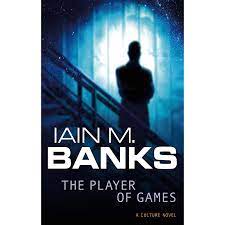
Again, it’s been a super long time since I read this. I had a vague memory of one of the twists, but basically it was like reading it for the first time. And it’s astonishing.
Gurgeh is a games player. He lives in the Culture, so all of his basic needs are taken care of; he has no concern for shelter, food, medical treatment, or anything else at all. There Culture isn’t a monetary society, so he can be or do anything at all. And what Gurgeh does is play games. All and any games. And he is one of the greatest games players the Culture has ever known. Probably not the greatest at any one game – but that’s because he’s good at all of them.
So eventually, Special Circumstances comes knocking. Contact are the group responsible for dealing with interactions with new alien species that the Culture comes across, and SC are… well, they’re basically the secret services branch. Because what the Culture doesn’t really like to advertise, or even admit to themselves, is that they are inveterate meddlers. They believe they have the right way of doing things, and that places like the Empire of Azad who are still that – an empire, although multi-planet – are desperately backward. SC recruit who they need, and Gurgeh is needed because the Empire of Azad is functionally ruled through the playing of a game that’s so intrinsic to the society that it gives it its name. Gurgeh has two years – the travel time to reach Azad – to learn how to play…
I’m pretty sure when I first read the Culture novels that I basically accepted the Culture as what they would say about themselves; helping other societies to better themselves, which may sometimes require breaking eggs for omelettes, etc. I wasn’t quite so naive that I didn’t see it as problematic, but I think I assumed I was meant to be entirely on the Culture’s side. I have, happily, become a more nuanced reader since then. As a post-scarcity society where anything and everything is available, accessible, and largely permissible, living in the Culture is indeed a wonderful thing. The problem comes when it assumes that everyone else must want, and need, to be like them. When you’re inside that society, of course this makes sense! Why would you not want people to be able to express themselves as fully as possible? And when the realities of Azad society are shown, aren’t there indeed issues that should and could be dealt with? Of course! … and yet… colonialism, imperialism, external imposition of outsider norms…
The Player of Games is fantastic. Banks’ exploration of societies and politics and individual mentalities, the influence of context on behaviour, the extreme but logical consequence of actions: they’re all nuanced and precise. And devastating. It’s never particularly easy to read a Banks novel. Worth it, though.
Re-reading the Culture: Use of Weapons

I read read a lot of Iain M Banks’ novels, but apparently the only ones I’ve properly reviewed here is Player of Games and Surface Detail. So that’s a bit weird; maybe I always felt like I didn’t have the words for it. I must have mentioned them on Galactic Suburbia, so maybe that got it out of my system.
My review for Player tells me that I read my first Culture novel, Consider Phlebas, while visiting the UK for the first time over Christmas 2006. So that’s a mighty long time ago, now, but I still remember the bit from Phlebas that freaked me out quite considerably and made me reluctant to trust Banks at all. Clearly I got over that, but I’m honestly reluctant to go back and read it because of those couple of pages. I will, at some point… because I think I might do a complete re-read of the Culture. Not in any order, since that’s one of the great advantages of these novels – they’re all standalone, like Reed’s Great Ship series. It does amuse me that the books got fatter and fatter over time, so I might pick based on what other reading deadlines I might have.
So! Use of Weapons. I love it. I love the structure, although it also drives me completely wild trying to figure out WHEN the different chapters for together, not to mention which of the characters in the various timelines are actually the same people. I’m always fascinated by how people write non-linear stories: did Banks write two stories and then cut and paste the various chapters? Did they just come out in this order, and he always knew what Zakalwe was up to? Who knows! And in the first few chapters, the reader has basically no idea what’s going on and or how any of it will fit together. But there’s something about Banks’ writing – something in his style, in his easy-to-read and yet challenging prose, that just… makes you keep reading.
One of the things I keep realising about Banks is how easily he sucks you in – look! this society is great; look! these political ideas are straightforward; look! the drone will always make sensible decisions – and then whoosh the carpet is pulled out from under your feet and you’re left unbalanced, bewildered, not really sure what’s going on except realising that things have changed just enough that the world is unmoored. And still you keep reading.
We see very little of the Culture itself, in this relatively early novel. We learn that they have a penchant for interfering in other people’s business; that they take their ideas of morality very seriously, but also that they’re ruthless in ‘the needs of the many’ or ‘the greatest good’; and, of course, that their technology is stupendous: the machine intelligence that is Skaffen-Amtiskaw, the ships that traverse phenomenal distances, and so on.
For all of that, this is still a very human story. Revenge, justice, forgiveness, family, shame – these are the driving factors. It’s horrific, and brutal; it’s also compassionate, in a weird way. Is it hopeful because of its suggestion that tech and galaxy-spanning empires will not change humanity all that much? I’m really not sure.
Every Version of You, Grace Chan
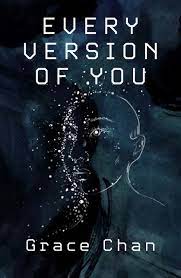
Am I slightly embarrassed that a new Australian SF novel has taken more than six months to cross my radar? Yes I am. However, I have now read it, and I love it, and I think everyone should read it.
I think it was Donna Haraway who noted that in the early days of cyberpunk, male writers were often unconcerned with the body, while female writers actually paid attention to what might happen to the meat sacks if we all got more interested in uploading our consciousness than caring for the physical. Sure that’s changed a bit over the intervening decades (although… not entirely), but it’s also a challenge that Chan confronts head on.
It’s the late 21st century. Climate change is slowly but surely wreaking havoc on the world. Tao-Yi lives in Melbourne – and it’s a wonderfully recognisable Melbourne, and made me have those feelings that The Courier’s New Bicycle and A Wrong turn at the Office of Unmade Lists also gave me: “oh yes! Places I know can feature in fiction!” Richmond and Berwick and the CBD… anyway. It’s Melbourne and I know it but of course it’s also different. People are spending increasing amounts of time in Gaia, a virtual reality world. To spend time there you get into pods that sound creepily like the ones humans are in in The Matrix, and they nourish your body while your consciousness is having near-real-world experiences in Gaia. It’s not a perfect simulacrum but it’s improving all the time; people have jobs there and do art there and go on dates. For people like Navin, Tao-Yi’s partner, it’s a welcome relief from a body that doesn’t work like it should. Tao-Yi spends a lot of time there – of course she does, so does everyone – but she’s also focused on the physical world, where her mother is ageing and ailing, and where there still seem to be things that are worth experiencing.
And then someone creates the ability to fully upload the consciousness, forever severed from the original physical body.
Chan is doing a lot in this novel, and she does it beautifully. It’s not “VR stops physical ailments being a problem!”, but it’s also sensitive and thoughtful to the real importance and consequences of those issues. It’s not “upload before the world is doomed” or “upload because the world is doomed”… but it takes those questions seriously. It’s not “there is only one right choice,” it’s not “this is a solution to all problems,” nor “if you love me, you’ll…”. Chan is instead taking the complicated road. Her characters say yes to a lot of things, and they say no to a lot of things as well. And yet for all that there aren’t easy answers, it’s also not a convoluted philosophical treatise on mind over matter. It’s thoughtful, and it’s emotional, and it’s earnest. It’s also totally readable – I could have read it in a day pretty easily – and the characters are intensely relatable.
I loved it. It’s so Australian, and it’s a brilliant example of what cyberpunk can be today. I am now waiting very expectantly for more from Grace Chan.
(Also, that cover. Glorious.)
Jewel Box: a collection from E. Lily Yu
I’m afraid this is coming from Erewhon Books in October 2023. Which is a long time to wait (I read it c/ the publisher and NetGalley) and TLDR: it’s going to be worth waiting for.
I have a bad habit: I forget the names of short story writers much more easily, and much faster, than I forget the names of novelists. I don’t think it’s because I value one more than the other, but perhaps reading things in anthologies I pay slightly less attention to the author’s name.
Whatever the reason, I always forget that E. Lily Yu is a spectacular author whose work I love very, very much. Fortunately, this collection has reminded me of that fact with all the subtlety of a shovel to the face. Pretty much every story in this collection is wonderful and thought-provoking and I am beyond happy that I got to read it and see all of this wonderful work in one place.
A few highlights:
“The View from the Top of the Stair” – a woman (I think) whose great passion in life is staircases, who gets an inheritance that allows her to indulge her passion, and what life can be like when you get to be at least somewhat fulfilled. The passion is never mocked, it’s not a tragic story of ‘never what you wish for’, and it’s also not at all what you expect.
“The Time Invariance of Snow” – one of the stories I remembered that I had already read, as I was reading. A truly remarkable spin on the Snow Queen: it opens with the heading “The Devil and The Physicist”, which gives a small indication of how Yu is approaching the ideas.
“Courtship Displays of the American Birder” – heartbreaking and beautiful and lyrical.
“The Witch of Orion Waste and the Boy Knight” – witches and knights and dragons, but not at all as you think you know them.
“Braid of Days and Wake of Nights” – after reading this one, I had to go stare at a wall for a while. Friendship and cancer and unicorns, going on when everything is awful and finding magic in the mundane.
“Ilse, who saw clearly” – is not the story I was expecting from the opening; stolen eyes and a girl who doesn’t fit in, learning a craft and then still not fitting in… another one that left me unable to just blithely go on to the next story.
“The Cartographer Wasps and the Anarchist Bees” – almost certainly my introduction to Yu’s work. Wasps who are conquerors and map-makers, bees who get conquered and some of them become anarchists… it doesn’t tell you everything about Yu’s work but I suspect if this one doesn’t work for you, then I suspect her work in general won’t.
This collection is magnificent. “Jewel Box” indeed.
The Archive Undying, Emma Mieko Candon
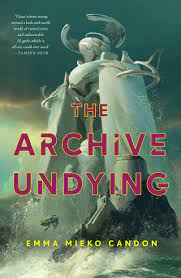
I read this book courtesy of the publisher, Tordotcom, via NetGalley. It’s out in June 2023.
I read really weird books. That goes without saying. This book is one of the weirdest I’ve read in a long, long time.
Think Jeff Vandermeer Annihilation weird.
I loved it, don’t get me wrong. There were moments where I had almost no sense of what was going on, but I did enjoy reading it. I think the problem was usually in not being clear who the narrator was – there are (I think!) a couple of first-person POVs, and (just to confuse things), a few bits where the narrator is actually telling the story in the second person… and I wasn’t always sure who that person was, either. I’ll be interested to know whether the official copy will have different fonts to make that clearer, or whether the ambiguity is part of the narrative.
Honestly, given the story itself, I wouldn’t be surprised if that confusion is part of the whole deal. There’s a lot of confusion here – bodily and relationally and politically.
So there are mechas, and there used to be AIs but they’ve been corrupted; there’s a human polity which seems to want to be in charge, but quite how or why is unclear. (At times I wondered whether I had missed the first book in the series, because there were what seemed like significant ellipses that would make sense if there was presumed knowledge I didn’t have… but no, this is the first book in what might be a series.) There are humans who used to be connected in some way to the AIs, and who are either to be avoided or to followed, depending on your attitude towards the AIs. Most importantly, there’s Sunai, who could not be self-destructive if he tried. He’s a salvage-rat, who gets a job to go with a rig to do… something he can’t remember, actually, because he was very, very drunk when he agreed to it. And when he does remember, it turns out to be yet another bad idea, but he goes along with it mostly because of Veyadi Lut, whom he likes a lot more than he thinks he should. Things go from there. Often badly, generally surprisingly, and with consequences for more than just Sunai.
This is a hefty novel – 416 pages in ebook, according to Goodreads. So as you can imagine, there’s a lot that goes on; at the halfway point I thought we must have been coming up on the conclusion, and then everything went sideways again, and something had to be done – note I don’t say “things had to be made right”. It’s not bereft of hope, but it’s one of those stories where what you thought would be the best outcome isn’t what happens, and where a lot of the things that seem like the very opposite of the best outcome do happen. And yet… I wasn’t miserable at the end.
I’ll be cautious who I recommend this to, and in what situation – do not read this if you want a perfectly comprehensible novel that demands nothing from you as the reader. Do read it if you want a novel take on giant mecha, the place of AIs, and an intriguing narrative structure that requires you to actually pay attention. I will be paying attention to Candon’s work from now on.
Hopeland, by Ian McDonald
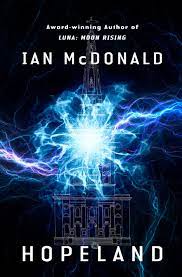
I was sent this by the publisher, Tor, at no cost. It’s out in late Feb, 2023.
My first reaction was and is: What. On. Earth.
What did I just read?
I mean, aside from “something wonderful”, which is easy and true, but gives no information.
Seriously though I was a third of the way through this book and still had no idea what sort of book I was reading. I was barely even sure of the genre.
Fantasy? – maybe?
Science fiction? – basically yes, but only once I was about halfway through?
Maybe just… fiction? But there were definitely some bits that were too weird to entirely count as mainstream, not-speculative, fiction. Also, it’s Ian McDonald.
I’ll admit I hadn’t read the blurb. It’s Ian McDonald, and it’s called Hopeland… why would I read the blurb? So part of my confusion is my own fault. But having now looked at the blurb it’s actually of little to no use in explaining what on earth this is about, so I don’t feel too bad.
So… the story starts in London, in 2011, during the riots. It’s not about the riots, but they certainly set a scene. Raisa meets Amon entirely accidentally – she’s racing across roof tops, he’s looking for a micro-gig he’s meant to be playing at. He helps her win, she invites him to a party with her family, and… it basically goes from there. Occasionally together, often apart, Raisa and Amon live through the next several decades. And see, it’s not like they become hugely important politicians or scientists or celebrities – this isn’t the story of hugely significant people. It’s a story of two people – and their families – living through the consequences of climate change and everything else in the world right now. They have their impact, it’s true, and sometimes on a large scale, but more often in the pebble-and-avalanche way.
It’s utterly, utterly compelling.
Raisa’s family are the Hopelands – more than a family, really; not a nation, certainly not an ethnicity or religion although with aspects of the latter. It takes the notion of ‘found family’ to extraordinary and glorious places and challenged a lot of how I think about family, how it’s constructed and what it’s for. Amon is a Brightbourne, a very different family but with its own legacy to contribute (and his family is where I started wondering if this was a fantasy of some sort).
I want more stories like this. It’s about the very near future so it deals with climate change – and manages to come out hopeful, ultimately, but not saccharine in any way. It’s about people and their failures and their determination to do better, to make themselves and the world better and leave it better for their kids. England, Ireland, Iceland, Polynesia; young people, old people, challenging gender binaries, and playing with Tesla coils. This book is just amazing.
Despatches from the Frontiers of the Female Mind – anthology
WHAT.
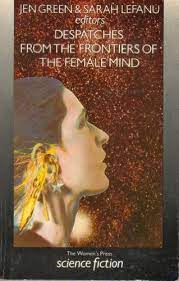
I didn’t know this book existed until this year. It was published in 1985.
The list of contributors is just… I mean:
Joanna Russ (the only reprint)
Gwyneth Jones
Tanith Lee
Pamela Zoline
Mary Gentle
Lisa Tuttle
Raccoona Sheldon! …
and that’s just the names that I immediately recognised.
It’s nearly 40 years old, so some of the stories have aged, I guess? But honestly the general issues in discussion still feel pretty real. Zoline’s “Instructions for Exiting this Building in Case of Fire” – children kidnapped and swapped to stop a nuclear apocalypse – still feels like a chillingly appropriate concept. Josephine Saxton’s view of advertising is hideous and, again, not as laughably far-fetched as I might like (it is ridiculous, but also… ads…). Beverley Ireland’s “Long Shift” is remarkable for its focus on a single woman, just doing her job; I wouldn’t have been surprised to see this published today. Pearlie McNeill is (was?) Australian, and I’ve never heard of her! Apparently this was her only piece of fiction? – SF, anyway. And this is where Raccoona Sheldon’s “Morality Meat” was first published, which is… a moment.
There are very few poor stories here. This is an amazing anthology.
After the Dragons – Cynthia Zhang
SOMEONE gave me a voucher to buy books for my birthday, and I was stumped. I love a voucher but then I get all – I must buy The Right Thing! I don’t want to waste it! So what books to buy?? And then I remembered that (at that stage) the Ursula K Le Guin Prize shortlist had just been announced, so there was an answer to that question: I bought a bunch from that list. And After the Dragons is one of them.

In the cover quote, Mary Robinette Kowal describes this book as having “quiet intimacy”, and that’s so right. It’s not about epic events (like She Who Became the Sun); it’s about the everyday joys and tragedies, in a world with lots of problems.
It’s set in a kind of tomorrow – it’s not far future – but in a world sideways to ours, because there are dragons. Not epic mythological dragons for slaying – it’s unclear whether those were ever real even here – but small, say pet-size. Indeed sometimes they are kept as pets… and as with kittens and puppies, sometimes they get dumped by their owners. And sometimes they just live as wild animals, and that means having to adjust to living in urban areas and with humans. Which doesn’t always go well. I was thinking about Anne McCaffrey’s Pern – still probably the fictional dragons my mind goes to first – and these are more the fire-lizards of Dragonsdawn rather than the later, genetically altered dragons.
For all that the dragons are there, this world is very much ours. There’s climate issues, there’s political tension, there’s racism; poverty and illness and family trouble on the personal level. The story is told from the perspectives of Beijing resident Kai – Xiang Kaifie – an artist, carer for dragons, and ill; and Eli, Elijah Ahmed, biracial American student visiting the hometown of his deceased grandmother, who gets drawn into Kai’s world of rescuing street dragons.
As I said, this is not epic. It’s low stakes on a global scale, although high stakes on a personal one: health and love and relationships and what the future holds are all immensely important to the people involved. It hints at troubling systemic issues but always focuses on the people at its heart. If you need a relief from world-shattering events this is a good choice, although I’m not promising that it’s all sunshine and light (it’s not). But it is a delight, and it is definitely worth your time.
Can’t wait to read more from Cynthia Zhang.
The Employees: A workplace novel of the 22nd century

When the Ursula K Le Guin Prize shortlist was announced, I was intrigued. I hadn’t heard of most of the titles, and I happened to have a book voucher from someone for my birthday, so I promptly went ahead and bought a number of the books.
This is the first one I’ve read. And it’s amazing. And it was also shortlisted for the Booker Prize??
It’s 136 pages in length. Not all of those pages are filled, because the bulk of the book is made up of employee statements… and as anyone who’s ever looked at employee feedback will be unsurprised to learn, some people have written a couple of pages and a few have written just one sentence. And that’s it – that’s what you learn of this 22nd century workplace. It’s almost entirely from employee feedback.
It’s brilliant. There are devastating gaps, and hints at terrible and wonderful things. There are touching moments of humanity and grim reflections on work and the workplace. Have you seen Severance? It’s not exactly like that but if you put them together you are forced to start thinking more about corporate workplaces than perhaps the managers would like us to.
The workplace is the Six-Thousand Ship, and the employees are its crew. Where are they? Not quite sure; that is, it’s around a planet called New Discovery, and it’s not near Earth, but other than that – no details. Some of the crew are human, while others are humanoid: some who were born, others who were made. There’s sometimes tension between the two groups, and sometimes camaraderie. Most of their work is what you’d expect on a spaceship, but some of it isn’t. Some of the complaints are also what you’d expect – around isolation, for instance – but some of the comments centre around objects that are never fully explained, from New Discovery itself. It’s deeply familiar, because some Ravn suggests aspects of work won’t change no matter the situation, and simultaneously quite alien.
It’s very, very, clever; absorbing, wrenching, sometimes disturbing, and I loved it.
The Future is Female! Volume 2: 1970s
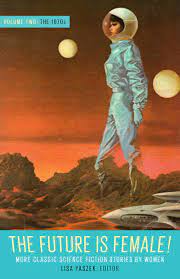
I read this courtesy of NetGalley. It’s out in October 2022.
Lisa Yaszek has put together another very fine set of stories that highlight the variety of science fiction that has been produced by women, this time in the 1970s. Arranged chronologically by publication date, this fiction has some stories that are angry, and some that are more on the whimsical side; some that (I think) could only have been written by a woman, and others that don’t particularly reflect a gendered authorship (and then there’s the James Tiptree, Jr). Some feel like classic SF, others are more experimental. I didn’t love them all. As a set, this is a really amazing way to showcase the variety of what women can write and have written.
Some I’ve read before: “When It Changed” (Joanna Russ) always gets me and I hope will always be discussed as part of science fiction in general, and not ever just relegated to ‘battle of the sexes’ conversations. I don’t understand why we don’t talk more about “The Girl who was Plugged In” (Tiptree) when we discuss cyberpunk; “The Screwfly Solution” (Raccoona Sheldon) is always completely horrific, and so is “Wives” (Lisa Tuttle), for very different reasons. I have always loved “Of Mist, and Grass, and Sand” (Vonda N. McIntyre) for its exploration of love and compassion – and same, in some ways, with “The Day before the Revolution” (Ursula K. Le Guin), although the latter is even more poignant; I always need to just stop and stare into the distance for a moment when I read it.
Of the others, there were several that stood out. I’ve read very little by Chelsea Quinn Yarbro; “Frog Pond” was very nicely paced, and the reveals built up beautifully. Kate Wilhelm’s “The Funeral” was quietly terrifying as the state of America was slowly revealed – and these two, next to each other, were particularly distressing to read in the current state of the world. “The Anthropologist” (Kathleen M Sidney) feels in some ways like it’s in conversation with Heinlein’s Stranger in a Strange Land, with its exploration of living between two very different worlds. And as someone who occasionally feels sad for Curiosity and Voyager etc, never being able to come home, “View from a Height” (Joan D Vinge) was something of a gut-punch. Gorgeous, but a bit harrowing.
… clearly, I think this anthology works for both people with some knowledge of the state of the 1970s field, and I believe it would also work for those who want an introduction to 1970s SF in general. It’s nicely comprehensive.

 Randomly Yours, Alex