Ode to the Half-Broken
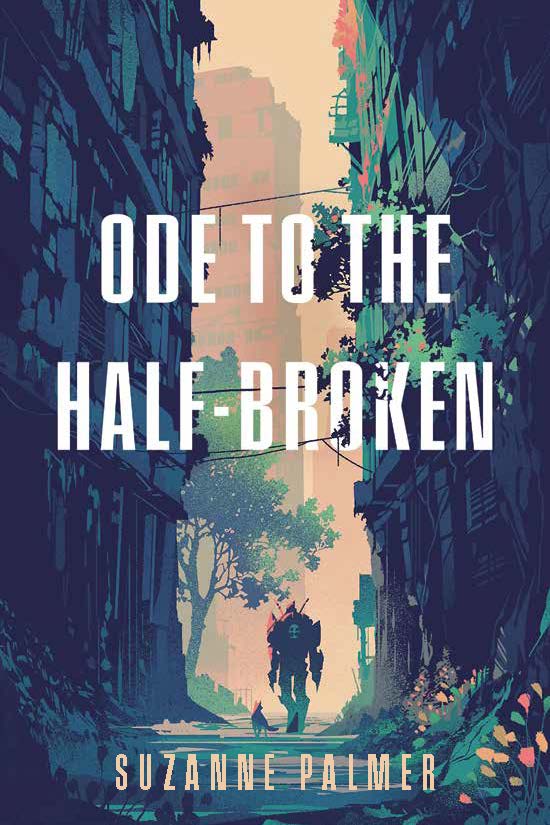
Several people have been raving about this for a few months, and I finally got around to reading it. (As with the Isabel J Kim, I am not late to reading this – it only came out in May! They were early.) If you are even vaguely interested in sentient robots, post-collapse of the existing world, getting-a-ragtag-team-together stories, with a healthy dollop of snark, you just want to stop reading this now and go read the book.
The (deliberately, consciously) unnamed narrator wakes up having lost 36 hours, in a bathtub, with their leg missing. They’re a robot so that’s not life-threatening – the electromagnets in the tub are a bigger problem – but they’re still human-shaped, so it’s going to present a locomotive issue. Once they finally get out of the tub – there’s a talking dog involved, it’s not as twee as it sounds, not least because the dog would be angry at having the word applied to them – our narrator’s mission is straightforward: find whichever bastard stole their leg and retrieve it. Which of course necessitates figuring out some stopgap (heh) for the missing leg, which means talking to a lot more folks than they’ve talked to in about two decades, and leaving their home which ditto.
This is the getting-the-team-together aspect, because of course some of the folks they meet over time end up joining in, for reasons of their own. Our narrator’s quest ends up being much more than they bargained for (of course). Their world has a lot of robots, of varying sizes, abilities, intelligence levels, and attitudes towards both other robots and humans. There are humans, but it’s a lot fewer than there are now.
That’s only half the narrative, though. The other half is set some indeterminate time in the past – that is, it starts in 2037, but we don’t know when the leg-stealing occurs. In this past, Dr Milton has figured out how to create mindchips, which will enable sentience to form – as has happened with our robot narrator. Milton is interested in the science but not the business, which is bad because it means other people who have taken over the business in ways that he did not expect or desire. This part of the narrative covers several years, and gives a glimpse into how things got to where they are in the “now” of the rest of the book.
There are some obvious parallels to be drawn between this robot and Murderbot, which I’m sure other folks have drawn. Both wish to have nothing to do with gender; both have issues with names. Both would prefer to just be left alone – this narrator has been working on entomology for decades rather than watching soap operas, but really, that’s basically Desperate Ant-wives. Both end up interacting with humans in ways they would rather not; most of the time I think Palmer’s character is less anti-social than Murderbot, but I’m ambivalent about that. This is not to say that they’re the same, of course! But both Palmer and Wells are riffing on a long genealogy of robots/AIs and the variety of ways they might interact with humans, and other robots, if you don’t choose the Skynet option.
Again, the short version is that I enjoyed this enormously. I liked the writing itself, I was intrigued by the characters, some of the villains were excellent villains and others were suitably ambivalent and complex. Our main narrator totally won my heart, and the revelations about their history were beautifully presented, drip-fed at a rate that didn’t make me bored or anxious. 100% will read again.


