Manners and Mutiny
 This book was provided to me by the publisher at no cost.
Firstly? I do not love this cover. It’s far too old to be Sophronia, which I don’t remember being a problem with the other covers. The crossbow is appropriate, at least. I am also not wild about the yellow.
Fortunately I do not tend to judge books by covers; at least, not books in a series I have been enjoying and whose author I tend to trust.
Zeroes
This book was provided to me by the publisher at no cost.
 I wanted to adore this book. I really enjoyed it, but I didn’t adore it. I’m trying to work through why…
Some general comments and then spoilers will be flagged.
The premise is one of superheroes, where the heroes are adolescents and most of them don’t feel, or want to be, heroic. Their ‘powers’ aren’t obvious (no one is turning green) and sometimes they don’t seem particularly useful, either. At some point in the past they’ve discovered each other and tried to work together, to see whether and how they might become a team… but then it turned sour, and they haven’t really worked together for a year. But when one of them is caught up with the police (his own fault, really), he asks for help and things go from there. Up, and down, and twisty-windy. The plot revolves around accidentally stolen drug money, a bank robbery gone very wrong, people in the wrong place and a bunch of teenagers trying to fix things and occasionally messing up.
We get chapters from each of the Zeroes, although not always alternating; the story begins from the perspective of Ethan (Scam), then Kelsie gets the fourth chapter and then gradually the others are introduced. This structure is exactly as useful as it seems, with multiple perspectives on events and people and ideas. It was an aspect I really liked, but it also contributed to one of the reasons I didn’t adore the book (I didn’t fall in love with any of the characters; more on that below). The characters are nicely varied: girls and boys, different ethnic backgrounds, one blind, families of different structures (those that we see anyway). They definitely have different personalities, which are not entirely tied to their ‘powers’ – which is great. There is some connection (Kelsie can work a crowd and loves going out dancing, for instance), but the question of cause and consequence isn’t tied down.
I liked that the action takes place over just a week; there’s no interest here in dragging a story out. It’s fast-paced over all, as it needs to be when there’s scary underworld types involved and things need to get fixed pronto. There are a few adults around – more parents are mentioned and briefly involved than you might expect in a teens-save-the-world story – but they don’t get in the way of said teens getting into a lot of trouble. The story is set in Cambria, which it turns out is really a name for a town in the US; I don’t know whether it’s intended to be set in the real town or not, but at any rate it’s a dinky little town rather than NY or Chicago, say, which I think is an interesting choice. It lets the characters develop their powers before having to deal with The Big Smoke, I guess (bets on that happening in a later novel?). There’s little real world building – it’s the America of today, and the city itself plays little part in the story, so there’s no need to make it really come alive.
Now, SPOILERS.
Rampant
By Diana Peterfreund
Sadly I did not love this book as much as I had hoped. Partly this is me, partly it is the book.
I had read the novella, Errant, so I thought I kinda knew what the story was going to be about. But Errant is set… I forget when, some time in the past. Rampant is not; it’s about a girl in modern America learning about unicorns. Which is fine, it was just a bit of a surprise. I had t read the blurb, deliberately; I didn’t want any spoilers since I figured it was going to be the sort of book I’d like anyway.
Killer unicorns? How can that not be awesome? That’s what it’s about, by the way. Unicorns are real and they hunt animals and people. Only certain people can hunt them in return. This is the learning-about-your-abilities book. If that’s your thing, feel free to ignore my whinging! Just go read it; it’s certainly enjoyable enough that I wouldn’t dissuade potential readers automatically.
Anyway, what I really had not expected was how much the book would be focussed in sex. Not having it, how people feel about you if you do or don’t, etc (do American teens really feel pressured to have sex before they leave high school??). It does make sense, given that Peterfreund has kept the virginity aspect for her unicorn hunters, but… it felt like it got in the way of what I was expecting, which was learning about unicorn hunting and dealing with that aspect of your nature. Which, yes, virginity is part of that. But there was a lot of going on dates and agonising which I guess just isn’t what I was interested in reading.
So I’m willing to agree that in that aspect, definitely a problem of my expectations. And I did like the discussion around rape, attitudes towards and reactions to, although the victim seemed to deal with it faster than I would expect. (Not that I want intense victiming either, necessarily.)
On the book’s side, I felt that the plot went a bit too fast sometimes; fast enough that things got a bit improbable (yes yes, around the killer unicorns bits) and too convenient. In the characters I especially found Astrid’s mother a bit much; a bit ridiculous.
For all its faults I will definitely read the sequel, Ascendant, at some point.
Archer’s Goon
 Yes, that Archer’s Goon.
I really do not understand how I missed Diana Wynne Jones as a child. It’s not like I was too old for her stuff when it was coming out. It’s not like there weren’t libraries in my town. There were even bookshops! … but there it is. I didn’t read my first Jones until a couple of years ago – a Chrestomanci – and I’ve been hearing about Archer’s Goon for ages. And now I’ve finally read it.
Yes, it is magnificent. Yes, I loved it. Yes, I will be foisting it onto every young person when I think they’re not quite ready for it.
If, like me, you haven’t read it – well, just do so. It’s about a family whose house gets gently invaded by a very large man with a very small head who insists that Dad has to write 2000 words, Or Else. And things go on from there with discovering that the town really does not run the way they thought it did. Which naturally leads to Adventures. And those adventures were genuinely absorbing and often unexpected and always wonderfully written.
So what did I really like?
Firstly, the family situation. The adventures centre on the son, Howard, but Mum and Dad are absolutely present and important and relevant. I love the family dynamics, actually; that Mum and Dad are so different, Dad is so magnificently obstinate and Mum is wonderfully competent; that they have a raging row which does not result in them considering divorce; that they complement one another and generally work together. And then there’s Awful. Seriously a family who nickname their daughter Awful and still go out of their way to make sure she’s ok – this family is so REAL. I love them.
I love the Goon. When people were talking about the book I couldn’t for the life of me figure out what the title meant. Clearly goon can mean henchman, but it didn’t seem to fit here; then there’s the Aussie slang term for cheap wine, and that really didn’t seem to fit… so I was lost. Discovering that actually it did mean henchman was a surprise, but made sense once I realised that Archer was of course a person. Anyway, I liked the Goon a lot. Especially his dialogue.
And I liked the plot. I loved that Jones did not explain absolutely everything about Archer’s family and their place in the town; you just need to accept that this is what Howard and his family know, so of course it’s what the reader knows. We regularly deal with events that we don’t have complete context for, so why must it be different in a novel? Going around visiting the different members of the family to investigate what’s going on is of course a familiar trope; it reminded me of Garth Nix’s Keys to the Kingdom series (which of course is a series, not a stand-alone, something else which is a bit different in Jones), amongst others. There’s nothing wrong with using this trope, of course – it’s used so often because it does let the author show you stuff about the world and reveal the plot in bits and pieces. And Jones does it so well.
Finally, in looking around for a picture of the cover, I discovered that it was a TV show – which I vaguely remember someone talking about at some stage. Is it wrong that I immediately got the Round the Twist theme song in my head? (Roger Lloyd Pack as Dad is SHEER BRILLIANCE.)
The Girl who Circumnavigated, etc
Neil Gaiman said this book was a “glorious balancing act between modernism and the Victorian fairy tale, done with heart and wisdom.”
Yes.
 I love a sneaky, omniscient narrator who takes liberties with speaking directly to the reader. Especially when they’re not condescending to the reader but takes us into their confidence, presumes we are as intelligent as they are, and goes out of their way to be warm and inclusive.
I love a story where the girl who goes to Fairyland is chosen because she is irascible and short-tempered sometimes. Not because she is good or pretty.
I adore the concept of all children being Heartless in some degree or other. I adore Wyveraries (wyverns and libraries having babies, why not?), although a land of Autumn doesn’t really translate to the Australian experience – especially not for a girl who grew up in the tropics, where leaves don’t really turn red, let alone fall off branches – unless there’s a mighty storm.
I do actually really like whimsy, when the wide-eyed joy is balanced with just enough cynicism that is self-aware enough not to get in the way.
I like it when heroines are sensible and determined, when they know they’re in a story and try to decide how to be in that story, and when they get to be brave and afraid at the same time.
I liked this story more than I expected. I liked the pictures, too.
Prudence
 I just love Carriger’s work. I love her attention to detail, I love her wild ideas, I love the banter.
An important thing to note: you could absolutely read this without reading the Alexia Tarabotti novels. While they are set in the same universe, this novel gives you enough background information about the older characters to be going on with. And although, as is only natural, Prudence does reflect on her mother, it’s not an overwhelming part of her character – and one of the most awesome things is that Prudence is NOT her mother. And isn’t even the antithesis of her. Instead, she is very definitely herself.
The plot, briefly: Prudence goes to India and gets into all sorts of shenanigans while preparing to go, while on the way, and while there. Said shenanigans involve numerous supernatural creatures, a couple of boys, her best friend Primrose, several hats, and a rather large dirigible named The Spotted Custard. There is copious amounts of tea, a great deal of banter and snark, a tinge of British imperialism critique, and a lot of dresses.
The set of characters Carriger has brought together bode well for future books in the series; they fall into tropes, but they also have their amusing quirks and individuality. The best friend, Primrose, is very concerned about niceties of language and dress and manners; she’s also intelligent, socially sensitive, and I’m fairly sure she’s quite ruthless. Her twin is Percy, absent-minded professor type with loony ideas; he’s probably the least developed in this novel, but I trust will come properly into his own in the future. The fourth in the quartet is Quesnal, whose family I won’t reveal because that would be a bit of a spoiler but made me happy. He’s the engineering one, more practically-minded than the others, but also French – which in a novel like this is taken by the characters themselves to mean that he’s more emotional and sensuous (in good ways) than the more prim British.
Oh, and Prudence of course. Her family situation has meant that she is quite worldly in some ways, while still naive in others – and she knows it. She’s curious and game for adventure, intelligent and witty, and aware of her own faults. Perhaps the most intriguing part about her is her conscious use of character. She pays attention to those around her and she deliberately adopts mannerisms – mostly from her parents – that she thinks will help her in different situations. This idea of re-negotiating identity, in effect, is fascinating.
I love that Carriger is exploring more of the world that she created initially in Soulless. I love that we’ve now got a young adolescent perspective (in The Finishing School books), the 20-something perspective (here, in The Custard Protocol books), and the… 30-40, I guess? perspective (Parasol Protectorate). If I started re-reading the last again, maybe a book every six months, I could get myself thoroughly chronologically confused.
I’m really looking forward to the next book in this series (Imprudence).
Note: I had a… discussion… with some friends about whether there’s a typo on the first page, where Prudence is described as inspiring “immanent dread” in people. Given who and what she is, I think this spelling of ‘immanent’ is fine. However, I was disappointed to find a number of typos throughout the book. I’m not silly enough to blame Carriger for this and it doesn’t really subtract from my enjoyment of the novel itself, but I am quite disappointed by finding them and they do detract somewhat from my reading experience.
The Summer Prince
 Sometime in the future, when things have gone very pear-shaped, there’s a thriving city in what used to be Brazil. They’re ruled by a queen and the aunties. There’s a king, too; but he dies every year, thanks to a ritual that goes back to the setting up of the settlement and issues around who caused the world’s problems and oh yes there was a plague, too. Plus, there’s life-prolonging treatments so you’re a child, in the ideas of society, for a really long time. And we all know how people respond to the idea of being treated like a child when they think they’re totally adult and ought to be consulted on, like, stuff.
With this as the basis, now add a girl who has parental issues and a deep, deep desire to do something serious – something political – with her art. Things can’t help but get explosive, right? ART. Let’s rock the world with art. Make political statements and confront the authorities and be provocative so they can’t ignore us any more. And if they don’t like it let’s do it some more.
I was somewhat reminded of Osiris, by EJ Swift – just a bit in the post-apocalyptic nature of the world. The issues are different, in that the haves and have-nots are differently conceived, as is the outside world. But it’s still interesting to see visions of the future like this getting explored in different ways.
It’s a fast-paced ride, and very easy to read. Johnson juggles love and sex and sexuality, tradition, art, technology, family relationships, despair and hope and ambition. And right up until the very end I had no idea how Johnson was going to be able to bring it to a satisfactory conclusion – satisfactory for me, that is. And she pulls off something very clever indeed.
This was my first taste of Johnson’s novels. I am fully intending to read more.
All Men of Genius
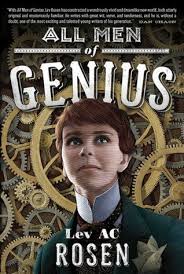
Rosen takes a large dose of Shakespeare (As You Like it, specifically); adds a liberal dose of mad science and a pinch of Ada Lovelace; shakes gently, and decants the resulting mixture in fairly smooth prose to produce a generally enjoyable book, with a somewhat abrupt and disappointing finish.
The first thing to know about me and this book is that with one exception (Much Ado About Nothing, thank you Kenneth and Emma), I basically loathe Shakespeare’s comedies. I do not like twins. I do not like mistaken identity. I do not care. I will not go and watch a comedy if I have a choice do not even try.
Rosen, however, made me care, because finally there is a good reason for identity swapping rather than just the amusement of seeing a man in a skirt pretending to be a man (oh HA HA geroffthastage). But taking your brother’s identity in order to get into the most prestigious science academy in London in order to make crazy beautiful science with the full intention of revealing yourself as a lady at the end of your first year? VIOLET I LOVE YOU.
The fact that your brother is gay and you don’t have a problem with that is just extra cute and an additional bit of sticking it to the establishment.
I liked it. If you like slightly artificial prose (not as jaunty as Gail Carriger but that sort of thing) and some seriously mad science, this is a fun book. There are lots of gears. And talking rabbits. No really, it’s funny, if lacking in ethics. Also invisible cats, difficult decisions, and cranky professors.
Thoughts for people who’ve read the book: SPOILERS AHOY!
I really enjoyed Violet’s interactions with the other students, overall; it’s a slightly grown-up version of boarding school romps, basically (like, the drinking is legal). I was really pleased that Rosen allowed Jack and Violet to be and remain good friends – I guess it helped that Jack had his sights firmly fixed on Cecily – and that it turns out Drew knew she was female for a while and it just didn’t matter. Hooray for cross-gender friendships!
I generally liked Cecily. I liked that she was good at science, and wanted to be good at science. I was bemused by her attachment to the rabbit, since it made this intelligent young woman seem like she was about six. I also generally liked Miriam, and I was fascinated by her status as a dark-skinned, widowed, Jew… but it did feel a bit tokenistic. That is, I am perfectly fine with her being all of those things, but Rosen begins to explore the ramifications of those aspects of her identity aaaaaand doesn’t fulfil the promise.
Other things that didn’t work so well:
The relationship between Violet and the duke is a bit ugh. The age difference is icky. The ‘but I don’t think I’m an invert!’ (Rosen’s word, presumably – I hope! – historically appropriate) attitude from the duke after kissing Violet-as-Ashton skirted, and may have fallen into, problematic (I’m cis, I’m no judge).
The switching of voices. What for, Rosen? The fact that it doesn’t properly start until well into the book makes it particularly weird. I liked Fiona well enough but I really didn’t need her perspective, nor that of the duke, nor Cecily or Miriam’s, unless they were all going to be as thoroughly explored as Violet’s. Which they’re not. And Ashton is distinctly left out, really, which makes no sense.
The ending. The marriage happens waaay too fast – or it could have happened in as few pages but there needed to be a bit more about how it all got resolved, and wait a minute isn’t she a bit young??
Tehanu
It’s official. I like the Tenar-focussed books more than the Sparrowhawk-focussed ones. Don’t get me wrong – I adore Ged, and I love the quests and the excitement of A Wizard and The Farthest Shore. But there’s something wonderful about Tenar as a character, and there’s something wonderful about the more inwardly-focussed and (is this silly?) more relatable stories of Tenar’s life, that makes my heart ache with joy.
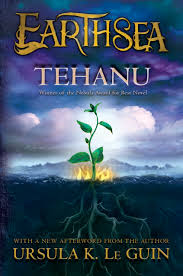 I can only imagine the wild joy that Tehanu must have been greeted with when it was released in 1990, 17 years after The Farthest Shore. Intriguingly, it begins before that story has finished – there is a problem with magic, and eventually Ged is delivered to Gont by the dragon Kalessin, but that’s not even the start of the story.
The story really begins with The Tombs of Atuan, and more even than The Farthest Shore continues A Wizard this is basically the second half of Tenar’s story. We skip the bits about being a wife and a mother… I don’t believe that’s because Le Guin sees those bits as unimportant, but perhaps because this bit – the being a widow stage – allows for more freedom of story, and even perhaps because this bit is told less often. There’s an ironic comment at some point about how once she got old, Tenar disappeared to men’s eyes. I adore how much this story is about being old, and getting on with life, and old =/ dead.
So Tenar is a widow, and she’s in charge of her dead husband’s farm because her son is off being a sailor, and she takes in a young girl who has been left for dead after being severely burnt. There’s a lot in the story about perceptions of physical appearance – whether through age or this sort of physical impairment. There’s also a lot about why men (humanity in general I suppose, but the major focus is on men) do what they do, and the child’s situation is emblematic of all of this. As is Tenar’s steadfast, generous, stubborn heart in caring for Therru as her own. Ged does turn up, eventually, but he doesn’t take Tenar on adventures. This time, he is drawn into her world, in an inversion of their first encounter. This time, it’s he that’s struggling with his identity and his purpose in life, and Tenar who takes him in hand.
There is adventure, of a sort – nasty men and even an encounter with the king – but they’re blips in an ordinary life, a brush with celebrity. The very end of the story is a different matter (which: !!!), but still the resolution is in keeping with Tenar’s desire for an ordinary life. There’s more interest in goats, and spinning; in peach trees; in small-town relationships – especially between women – and understanding changed-but-the-same friends. I have to say that in writing in this I experienced a twinge of concern, that perhaps I’m not selling this to – yes, you guessed it – male readers. And then I realised how I was feeling and nearly despaired. Of course I think men should read this, in the sense that I think everyone should because it’s saying such deep things about life and because it’s written so gorgeously. If men – and indeed women – choose not to read this because they think they only enjoy adventures, well, their loss.
Because Le Guin is saying a great deal about ‘real life’ in this book. In her discussion about where power lies, and what power is; about the relationship between men and women in terms of power and trust; about motherhood and what it means; about the nature of knowledge; and perhaps even a suggestion of how to live ‘the good life’.These themes are another way in which the continuity between this and The Tombs is evident. I don’t particularly like some of what she has to say about men’s and women’s power, and I’m not sure that I’m even meant to agree with or like it, but it’s still intriguing.
I adore this book.
Comment on revelation about Ged: SPOILER!!
I am deeply fascinated and intrigued by Le Guin’s revelation that wizards are essentially sexless – neutered in some way by magic. Hmmm, the terminology here may get me in trouble. At any rate, he’s basically not experienced adolescence. I can only imagine that she was asked whether Tenar and Ged had had sex in the boat en route to Havnor, and this is her explanation of why not! It’s a very cunning way of helping to partly explain the lack of women on Roke – that is, no wives or girlfriends – as well as reassuring the readers about wizards not using their powers for manipulation.
Waistcoats and Weaponry
I received this book from the publisher.
There are spoilers ahead for the first two books of this series, Etiquette and Espionage and Curtsies and Conspiracies. I’m also going to talk about the very end of this book, but I’ll let you know when that’s about to happen.
 I continue to be impressed by the fact that the problem set up in the first book, about the mysterious crystalline valve, has continued to be a significant plot point across the three books of the series so far. Aside from a simple continuity of characters, this makes the series feel more cohesive than it otherwise might and it’s something I especially did not expect from an adventures-at-school book. Sorry for doubting you, Carriger. It does of course continue to develop, until here we start to see how the valve might actually be used nefariously. The other intriguing, if fleeting, piece of continuity is Professor Braithwope’s mental instability, caused either by the snapping of his vampiric tether or his experience in the aether. It would have been nice to see a bit more resolution of this, but I’m glad he hasn’t simply been abandoned.
The focus of the series, of course, is the growing friendship of the girls – Sophronia and Dimity especially, but Agatha and Sidheag as well. (Sophronia is the central protagonist throughout; Dimity got a starring role in C&C; Sidheag has her turn in this book… which surely means that the fourth book will finally give us some Agatha love? She’s absolutely the most mysterious at this point – apparently from great wealth, there’s no hint about why she’s at Miss Geraldine’s, and given her apparently mouse-like character how could she ever survive as an intelligencer? So that’s something to hope for.) Sophronia and Dimity continue to be inseparable; I was concerned that Dimity was just going to be the slightly dopey sidekick, but again I should have trusted Carriger; she’s definitely got a mind of her own, and although she doesn’t try that hard to stop Sophronia being mad, she doesn’t just go along blindly. I was glad to see more of Sidheag, while feeling sorry for the reason behind it. Solid female friendships are a lovely lovely thing.
One of my disappointments with this book is the same as in Curtsies and Conspiracies: the boys. There’s a lot of anguishing over Lord Mersey and Soap. Felix is a useful person to know but he’s a right pain in the butt and I got pretty sick of him, it must be said; his overly familiar and pushy attitude towards Sophronia was irritating and bordering on offensive. I like Soap. I can appreciate the we’re-just-friends narrative, as well as everyone rolling their eyes at the idea that Sophronia is so naive. I really appreciate that this is a cross-race and – perhaps even more pertinently – cross-class friendship/might-be romance. Felix vs Soap isn’t much fun, though, bordering on possessiveness sometimes. Sophronia doesn’t really put up with it, which is good, but it still bugged me.
But not as much as the ending… thus SPOILERS NOW. (So skip the next paragraph or just know that I did enjoy it and still look forward to the fourth book later this year.)
I knew that there was going to be some drama involving werewolves and Soap wanting to change from about the middle of the book. As soon as there were guns pulled at the end I got that sinking feeling and yup, then Soap got shot right while Lord Slaughter happened to be standing there. Oh what a surprise. At least it wasn’t in protecting Sophronia directly. I did like that Sophronia saved her friend, and was wonderfully gallant in standing up to Slaughter and demanding he try – and that she stood by her promise to be indentured to him (HOO BOY). But… there’s still something about this turn of events that makes me uncomfortable. I’m glad Soap was saved, and yes he wanted to be a werewolf, but this is not on his terms. I can’t express it much better than this: it just wasn’t quite right.
I did like it, I really want to find out where Sophronia goes now, and I REALLY want a book featuring Agatha. You can get this one from Fishpond.

 Randomly Yours, Alex