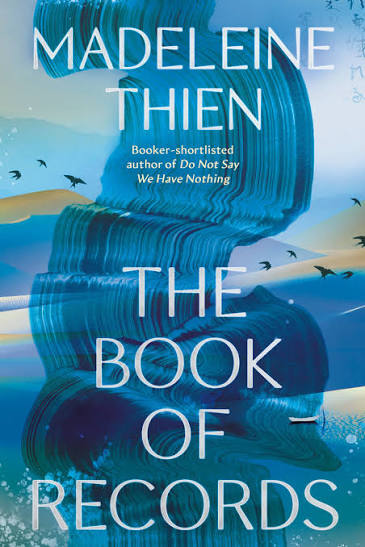
I feel like a fraud even trying to write a review of this book. I don’t think I have anything particularly coherent to say – I’m sure that since it came out last year, people who actually know something about Hannah Arendt and Baruch Spinoza and Du Fu have made all sorts of thoughtful, insightful, comments about how they’re portrayed there. And I’m sure literary critics have written fabulous words about how the book is structured; and philosophers have examined what it has to say about time, and love, and freedom, and choice.
I don’t really have anything to add. But I do want to add my tiny little flag, waving, to say that this is an amazing book and people should read it.
Somehow this passed me by last year – I hadn’t heard of it until I came across the Tadeusz Bradecki Prize 2026, for which the book was shortlisted this year. This prize is for a book that does clever things with nonfiction, and that’s exactly what Thien has written.
A young girl and her father, fleeing Foshan in China for environmental reasons, arrive at a liminal space called The Sea where people from across the world end up as they leave one place and go somewhere else. They stay much longer than most, however, because of her Lina’s father’s illness. As she tries to understand this new place, she has little to comfort her, except for three books her father snatched up as they fled: biographies of Arendt, Spinoza, and Du Fu. Eventually she meets three adults who are prepared to spend time with her, and tell her stories – especially when they see these books, because (and it’s a slight spoiler, but I already knew it going in and it actually improved the reading experience for me, so there you are) these three are Arendt, Spinoza, and Du Fu. And they share the stories of their lives and fill in what those books missed.
The choice of these three people is a fascinating one, and one that I am not fully equipped to analyse. Arendt and Spinoza in particular have some similarities that require more understanding than I have to untangle, in their approaches to life and philosophy – plus, Arendt studied Spinoza herself. The inclusion of Du Fu is probably a more surprising choice from the point of view of most Western readers… actually who am I kidding, lots of Western readers haven’t heard of Arendt or Spinoza either, or know basically nothing about them (and I know only slightly less than nothing, so I’m not exempt from this criticism!). Anyway, they all faced immense trauma – the Holocaust, the plague and being exiled from your community, famine and civil war – and all created art before, through, and after. One of the balancing acts Thien manages here is not minimising any of those horrors, but also not making the book only about them; instead she keeps pointing to the living that goes on around them.
All of this is also relevant to Lina, whose own life has been upended – her family torn in half – for reasons she really doesn’t comprehend.
This is, at best, a surface level explanation of the novel. It sounds weighty and I guess it is; there are definitely bits that I didn’t understand because I just don’t know enough philosophy. But it was still a remarkable book, and I hope lots of people will come to it.


