Galactic Suburbia #44
I felt pretty off my game for this podcast, unfortunately; I think I burbled more than usual when talking about the books I read, and fear I even waded into incoherence. Tansy and Alisa are, as always, very interesting, though…
News
Our Sisters in Crime, Still Fighting
Wonder Woman gets a father (yesthisisnews)
Alisa’s news: Thief of Lives by Lucy Sussex now available as e-book
Tansy’s news: publishing date for Reign of Beasts and the Creature Court Fashion Challenge Contest
What Culture Have we Consumed?
Alex: The Fall of Hyperion, Dan Simmons; Yarn, Jon Armstrong; Thief of Lives, Lucy Sussex; Yellow Blue Tibia, Adam Roberts; The Word for World is Forest, Ursula le Guin; Eyes like Stars, Lisa Mantchev
Tansy: The Courier’s New Bicycle, Kim Westwood; Thief of Lives, Lucy Sussex; Catwoman: Crooked Little Town, by Ed Brubaker; Fablecroft blog series On Indie Press wraps up; Sofanauts interviews Paul Cornell; Two Minute Timelord round-table about Season 6 Doctor Who
Alisa: Doctor Who. Shorts: The Book of Phoenix (Excerpted from The Great Book) – Nnedi Okorafor (Clarkesworld March); Younger Women – Karen Fowler (Subterranean Summer), Valley of the Girls – Kelly Link (Subterranean Summer)
Please send feedback to us at galacticsuburbia@gmail.com, follow us on Twitter at @galacticsuburbs, check out Galactic Suburbia Podcast on Facebook and don’t forget to leave a review on iTunes if you love us!
Disappointment with Star Wars
With the new series, that is; it’s not really possible for someone of my generation and temperament to be disappointed with the original. I’m far too blinkered.
Anyway, this is something that I have been thinking about for years – oh, ever since I originally saw the new trilogy, really. Now there are lots – lots – of things that annoyed me, and most of them have been discussed at length and with more elegance than I could manage. But the one thing that irks me every time (aside from Padme’s clothing…) is this:
Lucas introduces Owen and Boru.
He introduces Chewbacca.
He introduces the Hutts, and Bobba Fett.
But there is no Han Solo.
Seriously? No mention? No “oh look there’s a smuggler, he’s got his nephew Han with him learning the ropes”?
Bugs me a lot. Just saying.
Monster #2

This one is even funnier-looking! It was some random wool I bought as waste yarn but I thought I’d give it a go on this little dude, who is officially Coco the Canister Monster. It’s 8 ply wool, and she fits in my palm! I think the arms are overstuffed, but overall I’m pleased… especially since J figured out how to make her less Dogbert-like….
One completed monster

This is Harold. I made him. Well, J cut out the eyes and the mouth, but from my template.
His feet are big for his body, and he is certainly very gangly, but I’m pretty happy with him overall. Hopefully the young recipient will not be freaked out.
Gardens

This is my new vegetable patch, out the front of our house. I’ve been suggesting this for a while and we finally got around to removing some trees and doing it… well, the nice men we hired removed the trees and did it, anyway. This was ready and waiting for us when we got home from our holiday, which was a very nice surprise. We then had to do a Bunnings run, for a dripper system and trellis for along the fence, which you can see in the pic, rather handily installed by the husband. I’ve decided to try doing most stuff from seed, and from heirloom varieties where I can, because then I can collect seeds for next year… and rather than doing my usual bullish thing, I’ve decided to go a bit slowly. So I have tomatoes in a seed tray, and I’ve planted basil and rocket seeds; I’ll build up the rest of the bed over the next month or so, I guess. I have ideas of what I would like to grow, I just need to source it.
There’s also some herbs in the dirt at the front: thyme, oregano, sage. I’m waiting to see how well they grow out there; I may weaken and buy more to bulk it out, if it doesn’t seem to be spreading as fast as I might hope! 😀
Making a monster
I have never been a crafty person. I was into cross-stitching for a long time and still have the occasional burst; I like it because you just follow a pattern, and there’s no imagination required. I mainly have bursts of interest in winter these days as a friend gave me an ENORMOUS cross-stitch pattern of three frogs yeeears ago that’s still not finished… although every time I pick it up I discover old mistakes, which there is no way I am fixing.
ANYway, I decided recently to give knitting a go. A lot of my friends seem to have picked up the craze (Gina, aka Clutterpunk, in particular), not to mention those like Alisa who have been doing it apparently all their lives. How hard can it be?? … yeh, this is how my brain works. Drives my husband up the wall.
I started with a brown scarf, because I’ve been wanting one for ages:
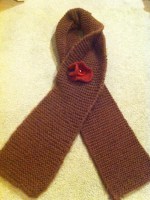
When I first made it it wasn’t quite long enough, so I stole Gina’s idea and bought a brooch.

Then I decided to learn purl and ended up making another scarf in stockinette, which I later found out was a bad idea because it doesn’t stay flat… hello another brooch.

Anyway, then I went a little nuts and bought a couple of books of different patterns etc. I got Stitch&Bitch, since it seems to be the one everyone raves about… and I bought one for making knitted monsters. Because I love scarves, but even I can have a surfeit of scarves (although I do have plans for learning to cable). So I decided to start on a monster.
 This is his body, made using the Magic Loop method on circular needles. His butt was done with double-pointed needles, and yes I managed to knit the wrong way out so it’s wrong-way-round. It’s all about Individuality.
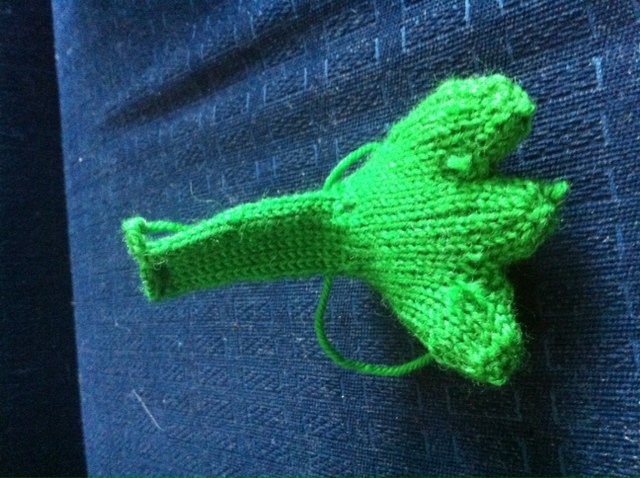 A foot. Learning how to do this foot caused me – and the long-suffering husband – a large amount of angst. Truly, the teacher in me absolutely LOATHES the learner in me, because I am Not A Good Student. Still, now that it’s done I’m quite smug about this little foot. Now to make another, and also two arms… how hard can it be?
Retribution Falls: a review
I received this book to review for ASif!
 I read about the first 150 pages of this 373-page novel properly. I mostly read about the next 100 or so, then skimmed the final 100-odd in case something interesting happened. It didn’t.
The setting is a world where dirigibles are kept up thanks to some element or compound called aerium and electricity is available but by no means universally accepted. The story seems to be entirely set within an enormous mountain range with lots of convenient valleys and hidey-holes for freebooters such as the main characters, with little suggestion of what else what might make up the world (they do visit an icy waste, but it wasn’t clear to me how this worked with the rest of the geography).
The story opens with Frey, captain of an airship and small-time/some-time pirate, being threatened by another lowlife, along with one of his crew. Frey is something of an idealist, in a weird sort of way; all he wants is to be able to captain his ship and fly where he wants. He doesn’t have the heart of a pirate, but takes on shady deals to keep skin and bone together. Also, the travel seems to be good for meeting women. The rest of his crew, whom we meet in the first few pages, have backgrounds in varying shades of grey; they are none of them keen to share their stories, and although the Ketty Jay is far from perfect, it’s a pretty good place to get away from the past, literally and metaphorically. There’s a crazy flyboy, a mysterious navigator, a drunk surgeon, a mysterious upper-crust passenger… as the crew showed their colours, I began to feel like they and the situation as a whole was oddly familiar. Then I realised that it was. They are the crew of the Serenity, from the short-lived TV show Firefly. But not as interesting, not as unique in their characterisation. The captain, Frey, was the most annoying and flat of the lot. I began to suspect that this was not the sort of story I was really going to enjoy when Frey was reminiscing about how close he had come to marriage in the past, and congratulated himself on escaping those dreadful bonds while fooling the woman into thinking he was going along with it, and still sleeping with the woman. With no irony or other commentary in the story about this being a poor way to treat her. This was accompanied by such protestations as the idea that women “forced [men] to lie to them” (128) in talking of sex and marriage. If you are likely to find this, a seemingly throw-away commentary on the relationships between men and women, insulting, then this is not the book for you. It might be argued that this is a minor point, but Frey’s view on women as a whole – especially those he wants to sleep with – permeates the whole book, and besides it is insulting.
As if inspired a tad too much by Firefly, Retribution Falls proceeds in an episodic fashion that was intensely irritating to read. There was connection and continuity between the various set-pieces, but each took place in a new location and the travelling there was generally treated with little interesting detail – there was simply An Arrival (thunk). Some of these individual set-pieces were well constructed, and gave some of the other members of the Ketty Jay depth and interest such that I began to care about them, Crake (the upper-crust passenger) in particular. He is a daemonist, meaning that somehow he manipulates daemons (which I think are like spirits) in order to do… things. It seems akin to enslaving them into objects so that those objects Do Things. He became interesting as he developed a rapport with various other crew members, and as his backstory was revealed. But he still wasn’t that intriguing.
Most of the set-pieces eventually contribute (some in roundabout ways) to the development of the conspiracy which ultimately drives the story. However, getting there took too long and I had already lost interest by the time the scope was revealed. It turns out to have ramifications for the entirety of the… area? (it’s ruled by an Archduke but I’m not sure whether it’s an archduchy or a country or what) – but so little time is spent establishing how big this area is, how many people care about its system of government, how many people are ruled by it, or anything else that might have been relevant that I just didn’t care.
Another aspect of the world-building which lets the novel as a whole down is the religion of the Awakeners. The portrayal of religion in fantasy is a particular bug-bear of mine. It annoys me when a religion is either badly explained or not mysterious enough, and it really annoys me when a religion is whitewashed as stupid and/or evil without adequate reason. There is some discussion here of how the Awakeners began, but no indication of why or how they have risen to a place of prominence. Various characters are shown to be contemptuous of it, but without properly discussing issues such as atheism or agnosticism that would make such rejection of organised religion make sense. Instead, it feels like another aspect of this world that was poorly thought through.
Overall, I was very disappointed in this novel, and do not intend to read the sequels that I am sure are planned.
Galactic Suburbia 42*
In which we discuss Orson Scott Card’s Hamlet, the agent who said no way to gay YA, Tansy’s Blake’s 7 dolls, the superhero who fights with her hair, and Alisa works through her issues with Doctor Who. You can get us on iTunes or download/stream us from Galactic Suburbia.
News
Subterranean Press address email complaints about “Hamlet’s Father” by Orson Scott Card (and the Rain Taxi review that started it)
The other big Internet Thing – agent says no gay in YA dystopia please & authors speak out
New podcast – Live and Sassy
Twelfth Planet Press opening for novel submissions
What Culture Have we Consumed?
Alex: Retribution Falls, Chris Wooding; Blake’s 7; Hyperion, Dan Simmons.
Tansy: Torchwood (non spoilery), Justice League comics (the new 52), The Business of Death by Trent Jamieson
Alisa: Podcasts: Locus Roundtable (Gail Carriger and Francesca Myman; Kathleen Goonan, Eileen Gunn and Gary K Wolfe); Eurocon 2011 Gender in SF&F Panel; The Outer Alliance Podcast Episode 11, Season 3 Doctor Who
[Book calling for papers on the topic of race and Doctor Who]
Please send feedback to us at galacticsuburbia@gmail.com, follow us on Twitter at @galacticsuburbs, check out Galactic Suburbia Podcast on Facebook and don’t forget to leave a review on iTunes if you love us!
* Alisa and Tansy recorded no. 41 without me, as a Spoilerific Book Club episode about The Hunger Games trilogy. It’s on iTunes or at the website if you’re interested.
Hyperion
This is my second time reading this book, and happily it was as wonderful and intriguing this time as the first. Of course, I am older and at least a little more knowledgeable this time, so I think I’m actually getting more out of it.
Firstly let me admit to my own blindness the first time I read it: I don’t think I picked up on the resonances with The Canterbury Tales, which is just embarrassing… although at that stage I’m not sure I’d read any of that poem, so perhaps that excuses me slightly! But still, the pilgrims’ stories are each labelled as such, so you would think that I would have picked up on it. But no. There is also – and I guess this is really only obvious right at the very end, but it doesn’t spoil the story – a bizarrely amusing parallel to The Wizard of Oz.
This is is a story set in the 28th century AD, when Earth is no more and humanity has spread to the near reaches of the stars in the Hegira. Multiple planets have been colonised, technology has advanced, there are sentient AIs… and there are still divisions, squabbles, and politics. Sad, but tragically believable. The plot itself revolves around seven pilgrims who have been chosen to visit the Time Tombs at a time of war between the Hegemony – to which most planets belong – and the Ousters, a renegade human faction. The Time Tombs are on Hyperion, they are protected by a terrifying something called the Shrike, and it all goes from there.
Fascinatingly enough, most of the book itself is not taken up with the pilgrimage. Instead, in the spirit of Chaucer, the pilgrims share their stories with each other in an effort to understand both why they have each been chosen and what might happen when they are arrive. Their stories are very different – a military officer, a diplomat, a private investigator, an academic, a Catholic priest, a spaceship captain, and a poet – but they all have common elements of pain and loss and tragedy. And a connection to Hyperion.
I love the different elements that Simmons combines in this book, through the device of the background stories being told through a deliberate and completely plot-appropritate info-dump. I love the mystery of Hyperion, I love the mix of characters, I am enthralled by the diversity of world tied to a somewhat pessimistic view of humanity itself. One of the things that I really love about the book is its exploration of religion and its place in this future. The first story is that told by Father Hoyt, the priest, and it deals very honestly with the issues that do and will face the Church in confronting technological change and everything else the future promises. I appreciate that he imagines a place for such faith, even in a dwindling and sometimes confused manner. And the academic, Sol, is Jewish, and his story ties in many elements and ideas of Judaism. I hope that a Jewish person reading it would have the same reaction to his portrayal as I did to Hoyt (although I am not Catholic). As well as these Old Earth religious hangovers, Simmons also imagines a plethora of brand-new religions based on all sorts of different things. Which is cool.
I am a bit sad that there is only one female pilgrim amongst the seven. Simmons does imagine an improvement in gender relations overall; the CEO of the Hegemony is female, there are female soldiers, etc. He also does not imagine an entirely Anglo future, either; I don’t know whether the pilgrims are ever described in terms of skin tone, although a few of them are described as ‘paling’ and other such giveaways. But many of the worlds have non-Anglo names and predominant cultures. I think his idea of the great Hegira is that humans will have colonised in like-cultural groups, as a number of SF writers have prophesied, and I guess I see the sense in that. But with the ‘farcasting’ technology of the Hegemony, people are able to move around even more easily amongst these planets than we currently do on Earth, so there is a great deal of intermingling.
The other really clever aspect to Hyperion is its connection to the poet John Keats. Hyperion was a Titan of Greek mythology, is a moon of Saturn, and an abandoned poem of Keats’ about the Titans. He tried again with “Fall of Hyperion,” which is also the name of this Hyperion’s sequel. There are nods to Keats in a number of the stories, and I’m sure I missed a few of them. I loved this idea of incorporating a 19th-century poet into a story set a millennium after his death.
I have a lot of books for review on my shelf at the moment, so I haven’t decided whether to read the sequel yet… heh. Who am I kidding.
Lord Avon. And some other people.
The Discovery of Blake’s 7 (complete with spoilers)
1.11: Bounty
I didn’t get to see all of this episode because the disc was a bit broked and kept skipping. I saw most of Blake and Cally going to convince an ex-president of a non-Federatation planet that he ought to return to his planet and stop it being subsumed by the Feds, and I saw that the Liberator was under possible attack… but I had no idea by whom until quite near the end. I had thought Zen the computer was acting very strangely and that we were about to find out more about the shifty AI! But no. Sigh. It was just ordinary run of the mill space pirates.
I am enjoying Blake and Cally working together. Her telepathy is of course an enormous boon, and presumably is one of the reasons she is so often used on missions requiring scouting etc – not that she can ‘hear’ guards or anything, but she can warn Blake when they are near. As well as that, though, she is resourceful and good at fighting. Of the other characters, Vila is a coward and Gan has the limiter chip and Avon is still not entirely trustworthy and Jenna has to fly the ship, so she’s a good choice for all of those reasons too. And there’s no flirtation. In this episode, I enjoyed their interaction with the ex-president, too, especially his infatuation with mid-20th-century Earth stuff. It’s a neat little device used to show how weird things we take for granted today might seem in the future; Blake’s reaction to an automobile was priceless.
Overall this is a fairly by-the-numbers episode I think. It shows how tricksy and sly the Federation can be in getting other planets under its sway, it shows how resourceful the crew is… but that’s about it.
1.12: Deliverance
It had to happen at some stage, I suppose. Avon being mistaken for a god, that is.
I think I’m beginning to figure out the general format for this show, and it often involves two parallel plots. With a crew of seven – even if one of them is constrained to the ship (I presume!) by virtue of being its computer, there are a limited number of plots that genuinely utilises every single one of them in a one-track story. So, two plots. In this case, after watching a spaceship ditch on a planet, the crew rescues one survivor and transports him back to the Liberator… while losing Jenna at the same time. So Blake and Cally stay on the ship, looking after the survivor and then being held hostage by him as he forces them to redirect the Liberator onto the course he had previously been following.
Meanwhile, on the planet, Vila, Gan and Avon are searching for Jenna, who has been kidnapped by a bunch of savages; the boys are saved by a mysterious woman in a cave who, naturally enough, greets Avon as a god. They manage to rescue Jenna and help out the mysterious woman, who is somehow part of a group of people who had been waiting for someone with just Avon’s talents to help them launch their own spaceship, packed with frozen embryos and seeds, towards a planet some 500-odd years away. Totally makes sense in context.
Once again it’s Avon who gets to be the most complex and interesting in this episode. For a start, his determination to save Jenna is a bit surprising – he has seemed mostly callous towards all of them previously – and is an indication that perhaps finally he is starting to feel some companionship towards the others. Mostly, though, it’s in how he treats his apparently divinity. Of course he makes light of it at times, and of course at other times there’s a glint in his eye that suggests he could get used to that sort of thing. But he does not, actually, take advantage of it at all. Instead he does exactly what the woman asks, fulfilling the prophecy and her dreams. It shows him to be a remarkably… moral, I guess, and peculiarly honest man. And there’s a wonderful exchange with Blake towards the end, where Blake asks him in an amused tone what he thought of being regarded as a god, and Avon asks back – somewhat archly, somewhat sarcastically – “Don’t you know?” or words to that effect. Blake looks at him, and acknowledges his point, and admits that he doesn’t much like it either.
So there’s one episode left in this series, and of course it’s on the next disc, so I hope Bigpond hurries up and sends it to me. I’m wildly excited to find out whether this is the sort of series that goes in for cliffhangers.

 Randomly Yours, Alex