Shakespeare, sex, and drugs
 I read this because it was the book picked by Mondy for March’s Writer and the Critic podcast, on which I was the guest (which is full of spoilers for the book). It’s kinda my sort of book… and kinda really not.
I am a Shakespeare Fan. I love me some Bard. Not the comedies, though; I love the tragedies and the histories. Oh, and Much Ado, but that’s a whole ‘nother story (one involving Kenneth and Emma and Ben Elton and Michael Keaton and Keanu…). So, a book that alternates chapters about Will Shakespeare Greenberg, aspiring Masters student at UCal, with the late-teen years of William Shakespeare in Stratford-upon-Avon, is in theory a very appealing one to me. And Winfield clearly knows (or got to know) his Shakespeare: there are allusions, and direct quotes, in I think every single chapter – and they all seemed effortless, too. I enjoyed the development of sixteenth-century Stratford. I’m not entirely convinced by man-whore Shakespeare, but I see the point from a narrative point of view, and it’s not a completely ridiculous suggestion. Overall it was a reasonably interesting portrayal of his early adulthood.
On the other hand, there was Will Greenberg. A book published in 2008 choosing the mid-1980s as its setting is kinda weird, although I understand why: Winfield was drawing (perhaps tenuous) connections between the persecution of Catholics by Elizabeth with the crackdown on drugs by the Reagan administration. The portrayal of a Masters student of literature was hugely stereotypical, sadly – although again I see the point from a narrative point of view, especially in terms of the drug use. It doesn’t help the view of Arts students in general though, and the idea that marvellous ideas come in a flash of lightning or drug overdose is just annoying and unhelpful. It may be that I am a prude, but I got bored by the descriptions of drug use and the explicit sexual content; it got in the way of telling the story.
So… not really my thing, actually. Certainly well written, in the early modern bits in particular; as a former history/lit student myself I found the brief discussion of literary theory, especially the bagging of New Historicism, pretty funny (I am a big fan of Stephen Greenblatt, one of the original proponents). But the characters weren’t that engaging and the story wasn’t that compelling.
Betrayer of Worlds
This review initially appeared at Dreams and Speculations. Thanks to TJ for having me as a guest reviewer!
 Title: Betrayer of Worlds Title: Betrayer of WorldsAuthor: Larry Niven and Edward M Lerner Format: HC Page Count: 315 Genre: SF Publisher: Tor Pub. Date: 2010 ISBN-13: 9780765326089 Series: sort of the fourth in the series of prequels to Ringworld Rating: 6 out of 10 |
Summary:
Louis Wu is dragooned by the alien Nessus into trying to help his species, the Puppeteers, from the possible menace of another species, the Gw’oth. Meanwhile all sorts of machinations are going on within the various species, with potentially disastrous results for all of them.
Brief Version:
I was expecting a grand space opera/adventure. What I got was something that tried to be that but instead left me cold, with no connection to characters and caring little for the outcome.
Review:
The publishers claim that this book can stand alone. It proclaims itself a “Prelude to Ringworld,” but there is no mention on the jacket that there are three other books that fall in the same category, all of them covering events chronologically preceding this one. While it is true that enough back story is given that events and references (mostly) make sense, that back story cannot help but feel frankly tedious. And sometimes there just wasn’t enough explanation for various characters’ motivations or desires to make sense. I think the publishers would have been better marketing this as the fourth in a series, allowing relationships and character nuances to therefore develops organically – and readers like myself, coming in late, be damned.
This review is necessarily biased by the fact that I have read no other Ringworld book. I have no doubt that those who have read the other prequels, or even those who have read the original series, would be more forgiving of its flaws and more understanding of subtleties that no doubt passed me by. Nonetheless, a discussion of the plot and some of the characters:
It’s a fairly complex plot, with multiple changes in viewpoint and numerous crosses and double-crosses. There are humans, Puppeteers (they prefer Citizens) and the Gw’oth; there are stationary planets as well as the Fleet of Worlds belonging to the Puppeteers; there are spies, and mercenaries, and politicians. Bad things happen. Some good things happen, but not many. With few exceptions, though, there was little development of motivation for the Evil Deeds. Additionally, the plot sometimes bypassed ‘fast-paced’ straight to ‘chaotic and jumpy’.
It was the characters that seriously let me down. Louis Wu, aka Nathan Graynor, is a seriously boring lead human. He’s meant to be the one that the reader can genuinely identify with… but he was so dull. He largely lacks motivation and personality; he’s haunted by family memories that are poorly explained; and he mopes a lot. He also gets off a drug addiction so annoyingly fast that it simply screamed Plot Device.
The Puppeteers – so named by humans, apparently, because their double heads look like sock puppets! – could have been very interesting indeed. I don’t recall ever reading about a species whose distinguishing characteristic is ingrained cowardice: cowardice such that they flee a disaster still many thousands of years into their future. But… this is a species with space-faring capabilities; a species whose only limbs are their (three) legs – they manipulate things with their lips and tongues. It is totally unclear to me how they developed any technology at all with those two characteristics; perhaps it’s covered in another book, but it made them quite implausible to me. I did like that they took classical human names when interacting with our species – it was a nice touch – but there was so little presented of their society that really, I did not care.
The main redeeming feature of this book are the Gw’oth, as a society. Wily undersea critters that I imagine look a bit like anemones – they certainly have wavy tentacle bits – they are divided in this story between two planets, one a traditional monarch-ruled society, the other essentially a science-based, Enlightenment-type place. In the latter, the Gw’otesht – essentially a gestalt of made of numerous individuals – are finally accepted as legitimate members of society. This species is genuinely intriguing, and their motivations and desires made the most sense of all.
Two other things bugged me about Betrayer of Worlds. First, the madey-uppy slang. It felt forced and silly. Second, the women, and lack thereof. The first female who gets any real amount of page-space falls into bed with Louis. There’s a female merc, and some female Gw’oth who have a genuine, if cameo, role. And the place of women or reproduction in Puppeteer society is totally opaque; there’s a mention of Companions, who might become Brides if necessary, but that’s it.
So… yeh. I finished it, but I will admit that I skimmed for the last hundred or so pages; I wanted to know how it resolved – and there were some surprises, which pleased me – but overall, the writing did not warrant a thorough read and the required use of my time.
Rating: 6 of 10
I acknowledge being biased by my lack of knowledge about the rest of the series. However, that should not make as much of a difference as it did to feeling a connection – or emotion at all – towards the characters. It should, in a good book, make me itch to go read the rest of the series. Sadly, the writing and characterisation let what could have been quite a good story down. I may one day track down the original Ringworld, and if it’s amazing I might try the others, but they by no means go to the top of my (teetering, slightly perilous) to be read pile.
Darkship Thieves

This is the March book for the Women of SF Book Club, and I was really quite excited about reading it. Check out that cover! It’s a 2010 book, but it looks delightfully pulpy, doesn’t it? I was rather hoping that, being written by a woman and with a woman like that on the cover, this was going to be a good, maybe feminist, take on the old pulps: a good adventure with a strong, doughty female character as the lead. After the first two book club books – Dust and The Dispossessed – I was hoping that this book would be a bit more plot-heavy, a bit more adventure-y, a bit more… classic SF, I guess.
I was disappointed.
Some spoilers ahead.
I was disappointed from the outset, because the lead character – Athena Hera Sinistra – seems rather too preoccupied with her body, and especially her boobs. Now I have no problem with characters being concerned with body image; it’s an entirely appropriate subject matter to be dealt with. But this novel is written in the first person, and I found Sinistra’s discussion of her own body rather too much like what might come from a fairly juvenile male writer; it felt uncomfortably like she was objectifying herself, and not in an ironic way. Sinistra disappointed for most of the novel, frankly. She had the makings of a very interesting character: headstrong, with a difficult family life, some awesomely non-stereotypical skills, and a habit of kicking men in the balls. But… but. She suffered from a rather egregious problem, which was not really her fault: poor writing. She just was not believable. What could have been entertaining snark fell flat; what could have been an ironic take on the adventuring spacefarer that I was anticipating fell flat; what could have been a fascinating look at a strong woman in a man’s world just got boring. And the other characters suffered from the same problem; they were far too 2D for the book to be engaging.*
Despite the book being set some fuzzy many years in the future, the world is indeed still a man’s world – even more than it is today. That’s a little disappointing, and it’s not actually explained very well why that should be the case. And this was another aspect that was disappointing: the world-building. The small amount of history that is dished out over the course of the entire novel is really quite fascinating, and it was one of my favourite parts; I would probably read the book about her posited 21st/22nd century. But the world as it exists in this novel… doesn’t get fleshed out enough. The world of the darkship thieves – where Athena finds herself for a while – is an interesting contrast to Earth, both in the novel and today, but it too isn’t fleshed out very much. Coming after The Dispossessed I was perhaps always going to be let down by the lack of politics, but there’s little explanation at all for how the place manages to exist, and less about why it exists as it does.
I was disappointed by the plot, and that’s really what makes me sad. I could handle the characters being a bit flat, and I could handle skimpy world-building, if only the plot had zinged along at an exciting pace and had really great climaxes, reveals, and drama. But it didn’t. It’s not that the plot dragged; its problem was quite the opposite. Events happened at such a dizzying pace, in some sections, that you barely had time to draw breath – but they weren’t events that should have happened that quickly. I can understand a battle, or a series of decisions, happening at a breathtaking pace – if they’re well-written. Here, they were often events that would have been better off either being given very little space and therefore importance, or attended to with more leisurely writing and attention to detail. Rather than feeling absorbed by the plot and borne along by it, I felt thrown around and sometimes thrown out altogether. It left me disgruntled. And the twist at the end, about what Athena is? I saw it coming way too early. I don’t usually pick twists, and I like it that way: I enjoy being surprised by the author. So that the bid ta-da was not so big saddened me all over again.
Finally, I was disappointed by the romance. If the romance had had any sizzle, if there had been any genuine suggestion that there would not be romance and then it happened in a really awesome way, I would have been able to regard the story with some fondness. But it was obvious from the get-go that the characters were going to get it on… and then they finally did, but there were no fireworks, and no passion; it wasn’t even one of those delightful feelings-creeping-up-on-you scenarios. In a word: boring.
I was disappointed to be so disappointed. I really, really wanted to like this book. Of course, I’ve loved the first two books of the Book Club where many people have loathed both, so it will be fun to be the disgruntled one for a change…
This may be one of the snarkiest reviews I have ever written. I did indeed finish the book, because I was really hoping it would redeem itself. It didn’t. I actually skim-read the final hundred pages or so…
* Yes, that’s right people; I just totally dissed a book on account of the characters being too 2D. I know! Perhaps I am finally getting more sophisticated! … keep reading…
Galactic Suburbia: the birthday episode

A Galactic Suburbs CAKE (for the ingredients)


The First Rule about the YA Mafia is that you don’t talk about the YA Mafia:
http://blackholly.livejournal.com/148264.html
http://justinelarbalestier.com/blog/2011/03/03/ya-mafias-other-things-you-dont-need-to-worry-about/
http://gwendabond.typepad.com/bondgirl/2011/03/secret-cabals-are-overrated.html
http://karenhealey.livejournal.com/925514.html
http://whatever.scalzi.com/2011/03/04/dear-new-writer-im-sorry-i-dont-have-time-to-crush-you
http://allycarter.abeedoo.com/blog/cliques-and-cabals
The conversation is starting to turn into something else, which is more about the power writers do/do not have to help or hinder each other’s careers.
http://sarahtales.livejournal.com/182357.html
Gender bias at Midnight Echo.
Tiptree Book Club begins with Maureen McHugh’s “Useless Things”.
Announcing Galactic Chat.
Competition: tell us your favourite moment of GS from the last year and win a book!
(Glitter Rose, signed by Marianne de Pierres (limited print run hard copy)
Bold as Love, by Gwyneth Jones
Siren Beat/Roadkill by Tansy (and Rob Shearman))
What Culture Have we Consumed?
Alex: Darkship Thieves, Sarah Hoyt; Betrayer of Worlds, Larry Niven and Edward M Lerner (to be reviewed at Dreams and Speculation)
Tansy: Running Through Corridors, Robert Shearman & Toby Hadoke
Alisa: TED Talks and general update
Pet Subject
What has been a highlight of the year for us?
Has it been what we expected?
Have we achieved what we wanted to achieve? (What did we want to achieve?)
Please send feedback to us at galacticsuburbia@gmail.com, follow us on Twitter at @galacticsuburbs, check out Galactic Suburbia Podcast on Facebook and don’t forget to leave a review on iTunes if you love us!
Genesis, by Bernard Beckett
 Oh. My.
A librarian friend shoved this into my hands when I mention enjoying science fiction, and to be honest I was a bit dubious – I’d never heard of Beckett, for a start. Anyway, I started reading it last night and… I couldn’t put it down. Quite seriously. I read it in one hit. Now, it’s YA, and it’s only 145 pages, but still – I considered going to sleep at one point, but I picked it right back up again and kept on reading. Totally addictive.
This review has some spoilers
In one sense, the book’s story happens over only five hours: the five hours of Anaximander’s examination to try and get into The Academy. Her special topic is the life of Adam Forde, on which she expects to get grilled by the three Examiners for the whole time. Her first surprise comes when they ask her about the early years of The Republic, and she has to scrabble for her memory of history. Then they finally come to Adam, and the formative moments of his life, and she is comfortable in what she knows – although she also knows that some of her theories are controversial. Things do not, of course, proceed exactly as she had anticipated…
On another level, the examination is a clever way of recounting a fairly large whack of the book’s immediate history, without it feeling overwhelmingly like an info-dump, and weaving a story through those events. Anax and her Examiners, it is revealed, live in almost a post-apocalyptic world. The setting, New Zealand, is apparently the only place to have survived a dreadful war and subsequent plagues, all thanks to a far-seeing and eventually quite ruthless business man, Plato. He insisted on NZ’s quarantine, enforced by a great sea fence. The society which eventually developed – or was designed – centres on people’s usefulness to society, and their talents as determined by genetic testing. Adam Forde had been tested as being a Philosopher – the highest grade possible. But when he acts against his training – allowing a refugee girl past the sea fence – things start to get out of control. And then he is asked to interact with an Artificial Intelligence, to help it learn.
On yet another level, of course, the book is a searching and illuminating examination of what it means to be human, what it means to construct a society and what things we are willing to give up to have a safe society, how important safety and comfort are and at what price they should be bought… you know, all the easy topics. It’s not done cavalierly; I am staggered by how much depth Beckett managed to cram into this little book.
Perhaps the most clever aspect of the book is that you could simply read the story, and it’s quite engaging. You could read it and understand some of what Beckett is discussing about society, and it’s riveting. And then, when you start understanding the classical allusions, things get really interesting: Anaximander was one of the earliest Greek philosophers, apparently teaching Pythagoras and getting all into the scientific mode of thought. Her teacher in the book is Pericles – he who led Athens during part of her Golden Age, fostering democracy, beginning the Parthenon, and involved with the war on Sparta. The society of The Republic (set up by Plato? this is one of the more blatant references, and perhaps it was done deliberately to trigger the classical connections) is a lot like Sparta, and like what the original Plato suggested too. This is a very, very clever set up – but not so clever as to be overwhelmed by smugness.
The conclusion is… well, I am still thinking about it. This is where it gets REALLY spoilery!
I began to guess at the twist when the Examiners were pushing Anax about the Final Dilemma, and the discussions between Art (the AI) and Adam. I realised there just had to be some great reveal coming up, and that Anax and the Examiners were actually descendants of Art simply made sense. It didn’t lessen the tension, though – and it in no way prepared me for Pericles’ actions in the very last paragraph. I can’t believe I managed to sleep after that; it was, truly, gut-wrenching. Also, having finally looked carefully at the front cover (above), I am saddened: there wouldn’t be nearly as much of a surprise if you noticed before reading that those are orang utan hands.
This is a magnificent book, and I can’t believe I had never heard about it. I think I may have to try and buy it so I can shove it into other, unsuspecting hands.
Galactic Suburbia 26!
In which Tansy and Alex soldier on womanfully without their lost comrade, to catch up on three weeks of publishing news, the Nebulas, books, books, and more books, and tackle the crunchy pet subject of Australian SFF Publishing in its entirety: how do Australian specfic readers get their books? Who publishes them and how do we buy them? (Realised too late this is a pretty massive topic – please email us to tell us what we got wrong and what we left out!) We can be downloaded or streamed from Galactic Suburbia, or through iTunes.
News
Bitchgate round up; also a Scott Westerfeld interview on the topic.
LJ Smith, author of bestselling 20 year book series The Vampire Diaries fired by her publisher, who will hire a new writer to continue the books.
Interesting post by Tobias Buckell on ebooks (love the bit where he zooms out on the graph).
Borders and Angus and Robertson go into receivership.
RIP Nicholas Courtney!
What Culture Have we Consumed?
Alex: Life, Gwyneth Jones; The Dispossessed, Ursula K. Le Guin; Revelation Space, and Chasm City, Alastair Reynolds
Tansy: Debris (due Autumn (?) 2011) by Jo Anderton;
The Secret Files of the Diogenes Club, Kim Newman; Across the Universe, by Beth Revis.
Pet Subject: How do Australians Buy SpecFic Books?
This comes from a request by Niall Harrison to learn about the other side of Aussie specfic – the mainstream/Big Name Publishers, how Australians buy books, etc.
Big Name Australian Publishers (who handle SFF)
HarperCollins Voyager
Hachette Livre/Orbit (incl Gollancz, Picador, Little Brown etc)
Allen & Unwin
Random House
Pan Macmillan
The Cost of Australian Books/Australian editions – GST, the fight against parallel importation.
Chain Stores – Borders, Big W, Collins, ABC, Dymocks, Angus & Robertson (Borders & A&R now in receivership but not all shops company owned – many will close)
Online Shopping – local and overseas (Amazon, Book Depository, Fishpond, BetterWorldBooks)
Indie/SFF Specialist Bookshops
Hobart: Ellison Hawker
Melbourne: Minotaur and Swords and Sorcery (Reader’s Feast also has a well-picked if smallish selection).
Perth: Planet and Fantastic Planet, White Dwarf and a few more new and not so new
Sydney: Galaxy, Infinitas
Brisbane: Pulp Fiction Books
(who did we forget? Tell us!)
Feedback: Tehani from Perth, Cat from Wollongong & Shane from Redfern.
Please send feedback to us at galacticsuburbia@gmail.com, follow us on Twitter at @galacticsuburbs, check out Galactic Suburbia Podcast on Facebook and don’t forget to leave a review on iTunes if you love us!
Chasm City
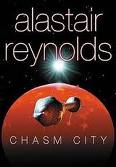 As with Revelation Space, this is the second time I’ve read Chasm City – and the first time was some years ago. Consequently, while there were a few things I remembered quite well, I still managed to be surprised by some of the twists and turns of the plot. This time, there were more occasions on which I picked up hints and allusions; I was quite proud of guessing what might be going on until I remembered that I’d already the thing…
Some spoilers follow
It’s another awesome space opera from Reynolds. One of the things which I had misremembered – and perhaps it applies more to one or both of the other Revelation Space books I’ve not reread yet – is the amount of cross-over between the stories. There are some allusions to ideas and people from Revelation Space here, but they are both very definitely stand-alone novels. And I like that; it’s a universe, rather than a series. I really liked that it ended with Tanner clearly talking to Khouri, which is one of the opening scenes from Revelation; it felt quite neat for readers of both books.
This book has quite a different feel from Revelation, which is interesting to see – to change from just your first to your second, particularly within the same universe, seems… game? Anyway, it is largely told with a first-person narrator – with occasional flashbacks to an historical character – and consequently the story is mostly linear (with the exception of those flashbacks, and the narrator’s own thinking about his past). I enjoy a narrator – particularly one, as in this instance, who is a bit unreliable. In fact I enjoyed most of the characters in this novel; there aren’t many, with the exception of the narrator (Tanner) who are particularly deeply developed, but they are certainly all individuated without becoming cliches. There’s a nice range of female and male characters, doing a range of different activities and with a range of different motivations – I think I said a similar thing about <i>Revelation</i>, but it’s true and it’s one of the appealing things about Reynolds.
The settings for Chasm are great. We’re in about the same time period as in Revelation, so chunks of the galaxy have been colonised, but there’s no FTL so getting places is still damn hard work. There are two prime locales: Chasm City itself, of course, on the planet Yellowstone, and the planet of Sky’s Edge. These are two radically different places, so Reynolds gets to indulge in two quite different visions of what interplanetary colonisation might look like. In thinking about that issue, I utterly adored the slow revelation about how the colonisation of Sky’s Edge came about; the slow generation-ships thing is enthralling, for me, and thinking about the lengths people might go to to get an edge is intriguing. I particularly enjoyed the slow but steady revelation and discussion of Sky Haussman’s character; that you start the novel knowing he was characterised as both a hero and a villain, and slowly that image is problematised… yeh, it really works for me. And Sky’s actions of course present an immense ethical quandary – which the reader can’t help but approach with the knowledge that it caused a centuries-long war on the planet itself. Chasm City, of course, is a wonderfully outrageous city, and I loved that Reynolds opened with an excerpt from a document explaining how the city has been affected by a plague – so the reader has that extra bit of information, and thus an advantage over Tanner. For me, it heightened the sympathy the reader could feel for him. And the plague itself iconic: something that affected the machinery of the place doesn’t seem disastrous, until you remember that this is a society using nano, with therefore machinery in everything – and everyone…. There are so many possibilities inherent in that idea.
The plot itself has a kinda revenge tragedy thing going on, which can be a bit tedious but in this instance is skilfully drawn out and well played, too. In fact there are numerous side-plots that at times could threaten to overwhelm the central point – the revenge – but ultimately Reynolds draws them all together and reveals that actually, he knew what he was doing all the time (of course).
It’s another of my favourites. Not quite as comforting as Revelation, in that the stuff about Gideon is rather off-putting, but familiar and relaxing nonetheless. And a damn good story.
Revelation Space
 I just love this book. I really really do.
I seem to remember that when I first read it, I found it a bit confusing – albeit in a good way – because there were lots of POV changes. I wonder now whether that’s one of the other books, because while there are flicks between POVs they converged more rapidly than I had expected and the connections seemed more obvious… but perhaps that is actually a function of me remembering, if barely, where at least some of the connections lay. One of the great things about having a relatively poor memory is that having read this some 5 or 6 years ago, there were stacks of things that there were once again a total surprise for me.
There’s a nice variety of characters here. Male and female, baseline-human and definitely not, and a mix of motives and attitudes. I have two favourites, and they’re the two most obvious: Sylveste and Volyova. Sylveste because he’s just a bit like Indiana Jones; he is, after all, inherently an archaeologist, who gets caught up in adventures. He’s also one of the most sublimely arrogant characters out there, in that fascinatingly entertaining way that only someone who is right so often that the arrogance seems appropriate can get away with. Like House or Holmes, I guess. Not quite diametrically opposed, but still radically different, is Volyova. She’s not quite a sociopath but she’s way more at home with weapons than other people. She gets some wonderful lines in the book, and I always enjoyed the sections told from her perspective; Reynolds gave her a marvellously dry wit and a drive for achievement as strong as Sylveste’s, with marginally less arrogance. I quite liked the POV switches, actually, even – perhaps, bizarrely, especially when – they were done seemingly mid-action sequence. The switch always added something to the scene, an understanding or a perception that could not have come from the initial character. I also liked that there wasn’t an omniscient narrator; it meant that events and revelations came slowly, ambiguously, enthrallingly.
The plot? Oh, the usual; humanity spread across the galaxy, encountering alien artefacts but where is everybody else, along with tantalising hints at what has happened to humanity as they spread – the alterations to baseline humanity are some of the intriguing of those; I love the Ultras and their chimeric alterations, heading towards being truly cybernetic beings. There are small-scale dramas and intrigues – love, abandonment, family drama – mixed in with the galaxy-impacting revelations, making this a seriously awesome representative of space opera. In fact it might have been the first book I ever read that made me genuinely consider space opera a sub-genre, and realise that I totally adore it. It might not be the absolutely most original plot in the world, but the revelations at the end were certainly new ideas for me, and the writing itself is so complex-but-clear that it doesn’t matter that it’s a play on the Fermi paradox; as an SF idea I think it has plenty of scope left anyway.
There are some slightly clunky bits in the narrative and the flow of the writing – a few bits where there is a bit too much info-dump via dialogue for example – but for a first novel, it’s a seriously awesome one. I am just itching to go read the rest of the Revelation Space books… they’re sitting there waiting for me…
A quarter-century of Galactic Suburbia
In which we hit and run the Locus Recommended Reading List, tackle e-books and piracy, and delve into the knotty issue of religion in science fiction. You can download or stream us at Galactic Suburbia, or subscribe to us on iTunes.
News
Locus Recommended Reading List – hot off the press!
Philip K Dick shortlist.
First annual Geek Girl Con in Seattle.
Cloud-delivered ebooks from Readings/SPUNC; comments from Benjamin Solah; and a response to comments on the internet about the cloud publishing.
Discussion of ebook piracy: Jim Hines found out the world is not the USA and the rest of the world does not experience publishing nor this ebook revolution apace with the USA. (Hines’ original post here). Charles Tan responds; Karen Healey says I was wrong and I’m sorry.
Weird Tales revamp (new website; pay rate to 5 cents per word; and implemented a new submissions portal for potential contributors).
Feedback (we love feedback)
Sean, Thoraiya, Niall
Pet Subject
The place of religion in science fiction. A Jew, a Christian, and a lapsed pagan discuss.
Modern religions, made up religions, machine religions… or no religions? What place can/does/should religion play in sf?
Jo Walton on religion in SF!
“There’s the kind of SF where the writer is themselves a member of some religion and this imbues their writing… .
Secondly, there’s theological SF… where the writer rigorously extrapolates science fictionally the consequences of some religious dogma being true. …
Thirdly, there’s the story as analogy thing… .
Fourthly, there’s using the way religions have worked in history and extrapolating that into the future.”
Please send feedback to us at galacticsuburbia@gmail.com, follow us on Twitter at @galacticsuburbs, check out Galactic Suburbia Podcast on Facebook and don’t forget to leave a review on iTunes if you love us!
Transformation Space
 I have been waiting for this book for a long time, not least because I had thought it was a trilogy, rather than a quadrilogy. Here, we finally get a conclusion to the intricate plots that de Pierres has been developing and tangling over the series: Mira Fedor and her pregnancy, Trin and his semi-willing followers on Araldis, Tekton and his bizarre free-mind/logic-mind… and my favourite, Jo-Jo Rasterovich, the deep-space miner irrevocably changed by his encounter with the entity, Sole, who – it becomes increasingly clear – has something to do with everything that’s going on.
In terms of plot, there is little that is absolutely new in Transformation Space. It’s a book of climaxes, of revelations, of explanations and conclusions. That’s how it should be, and it certainly doesn’t mean that it’s boring. As with the preceding three books, de Pierres writes a relentless action story, with few breathing spaces for the characters or the reader. This is unsurprising, given that Mirror Space concluded with the revelation that a Post-Species fleet was moving into Orion space, and the suggestion that this was somehow connected to the invasion of the planet Araldis.
The use of multiple strands of narrative, used to such great effect in the previous books, is continued here; and even when the narrative swings over to Trin and his followers, forced to hide away and spend all their energy hiding and foraging, it’s not exactly relaxing, as tempers run high and eventually boil over. Other strands are more event-based. A new strand is introduced, that of Balbao, in charge of the installation commissioned to examine Sole; things go radically wrong, leading to them eventually teaming up with Lasper Farr. (Anyone familiar with the preceding books will know that such a match is bound to end badly, or at least chaotically.) Even Mira gets a fairly action-oriented story, as she gives birth and then must decide what she and the biozoon Insignia are going to do about the Post-Species fleet and Mira’s own planet. While occasionally in the other books it was sometimes disorienting to switch rapidly between characters and places, I was fairly comfortable with it by this stage. Plus, there was more convergence than ever, with various characters finally coming together or with storylines coming to a natural conclusion.
The characters are a fascinating aspect of this series for me. Half the time I can’t figure out whether I care about many, or indeed any, of them. I have never found Mira particularly engaging as a character; although sympathetic, I was frequently annoyed at what I saw as a lack of gumption. I was pleased that this book finally saw her exercising more agency, and holding her own against various other forceful personalities. This development makes sense, too, over the story; coming from a restrictive world like Araldis, a feisty female character would have been unbelievable. As she is away from that environment for longer, and is exposed to different attitudes and forced to look after herself, she responds and grows appropriately. As for the other characters: I have never felt much sympathy for Trin, the spoilt little rich kid forced to become a leader, and that didn’t change. Tekton, the arrogant tyro drawn away from studying Sole, continued to be repulsive yet oddly charming (a description I’m quite sure he’d be immensely flattered by), and I really enjoyed that he was even more active, rather than largely reactive, this time. The same cannot be said, I think, for Thales, who continued basically to be the hapless scholar; although he is involved in important events, he rarely seemed to be directly involved with them. Rather, he was more like flotsam on the tide, being pushed around and only occasionally interacting. This actually makes him quite an interesting character, I think, given how rarely such a character is male – and an educated male at that. There are other characters, of course, but it would be boring to go through all of them; they are marvellously varied, with few stereotypes and frequent surprises. I just don’t find many of them actually likeable. This makes it quite odd, I guess, that I really enjoyed this book and the entire series. It’s a tribute to the skilful writing, and the utterly intriguing plot.
The Sentients of Orion is a complex, highly textured and riveting space opera. It’s set across an entire galaxy populated by ‘humanesques’ and other, more alien beings; the action veers from intense family drama to planet-wrecking destruction. It considers genetic engineering, religion, politics, personal responsibility and the different forms love can take. It’s both character and plot-driven, and the conclusion totally astounded me. This is a series that has changed my way of thinking about space opera, and the characters that populate it.


