Bold as Love
It’s Women in SF week over at Torque Control, and they’re posting the top ten SF books written by women over the last decade. Coming in at #10 is Bold as Love, by Gwyneth Jones, which I read a few weeks ago and have been meaning to blog about… so it seems an opportune time.
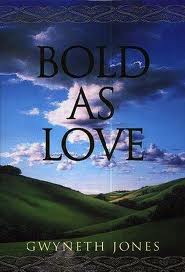
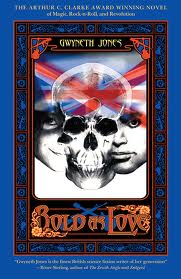
This is the book that, infamously, Tansy threw across the room when she got to the end and discovered it wasn’t a standalone novel. And I can understand that; I was halfway through it before she told me it was this one, and I too had just assumed it would stand alone. Truthfully, I think it could: there’s a huge messy pile of unresolved issues by the end of the book, but it’s done in such a way that actually I don’t feel a burning need to go find the next FOUR BOOKS. Well… that’s kind of a lie. I really really want to know what happens to my guys, but it’s a delicious sense of anticipation, not a burning MUST HAVE RESOLUTION NOW GETOUTOFMYWAY feeling.
Anyway. I was amazed to discover the book was only written in 2001; I thought it would prove to be much older. As Torque Control point out, it feels like it’s rooted in 1971 – the music, the festivals, etc. At the same time there are definite aspects that make it very modern – and those are mostly the same aspects which, when I thought about them carefully, contribute to the science fictional feel. (More on that later.) So it’s set at some time in the near future when the United Kingdom is splintering into separate countries, and a music festival has been organised to mark Dissolution. From this, essentially, come the main players in the novel – all musicians of one stripe or another – who end up being involved in politics. This seemingly-natural transition was, for me, the one aspect that didn’t sit comfortably. Perhaps it’s because I’m not very aware of the counter-culture movement in the UK (or Australia for that matter), and maybe they have, or could be imagined in the near future to have, this sort of political clout. It’s a minor quibble, though; after all, it’s sf/fantasy, and sometimes they require a bit of a leap.
Sf/fantasy? Well. Yes. When Tansy mentioned that it’s part of a series, she also mentioned that the fantastic elements become more pronounced over the series, and I can already see areas in which that can happen. But it is also definitely science fictional: there’s advanced technology in some areas, for example, and anyway it’s set in the future. I know that’s not a hard&fast guarantee of sf – just look at Michael Chadbourn – but it’s still there. In fact I think it’s one of the most fascinating meta-aspects of the book: it’s so genre, but… why does it have that feel? I don’t know, and I’m slowly coming to the realisation that actually, I don’t care about classifications so much. It’s a GOOD BOOK.
The plot, then, revolves around what happens to England (mostly) after Dissolution. There are social issues – such as the impact of a large Muslim minority; environmental issues – mostly around sustainability – which also tie into technological ideas; political issues – exactly what would happen if you put a bunch of counter-cultural musicians in a position of power? – and lots&lots of personal issues. After all, even when society is collapsing around you, in reality the thing that’s most likely to concern individuals is Does s/he like me? Who are my friends? What’s going to happen to me?
This is actually the first Gwyneth Jones book I’ve managed to get through, of two attempted: I gave up on Escape Plans pretty early on. And she is nasty to her characters! I don’t think there’s a single undamaged person in the entire ensemble. Thing is, the damage doesn’t make you want to cry for them, usually; instead, it turns them into quite hard characters, who would be utterly contemptuous of anyone even thinking of being sympathetic. Fiorinda is the sort of woman (girl, really, she’s a teenager – at least in years) who would fascinate me in real life but probably repel at the same time: she’s cynical and hard, and I’d be way too soft for her. She makes for an intriguing, and contradictory, main character. The main two male characters essentially revolve around her. I love Sage: he’s totally anarchic and narcissistic, while also being tender and considerate and generally awesome – plus his stage shows sound like they’d blow your head off. And Ax… well. He’s Mick Jagger and Jim Morrisson and David Bowie. And Bono and Bob Geldof too. I really really liked him, but I think Sage is still my favourite because he’s a bit more… human. And he’d hate me for saying it.
It’s a marvellous book. It deals with gender issues, social issues, and political issues. It wraps all of those things into the equivalent of the most awesome three-day music festival in the mud; you can’t let go, you can’t go home, you have to see it through. I have two copies (by accident) and I’m seriously thinking about keeping both of them.
Brightness Falls from the Air
One of the most interesting things about this book as an object is that nowhere (that I could find) does it mention that James Tiptree Jr is actually Alice Sheldon. Neither, though, is there any personal pronoun used for the author. This is really only interesting when you know something about the history of Tiptree, I guess, but it is revealing. It came out in 1985, which puts it only a couple of years before Tiptree’s death and several after s/he had been ‘outed’ as Alice Sheldon. So was the publisher trying to cash in on the Tiptree name and people now knowing the ‘truth’? Was it Sheldon/Tiptree’s decision? I’d be fascinated to know.
Going in, I thought this would have some of the terribly interesting gender discussions that many of Tiptree’s short stories have, and that – combined of course with the reality of Tiptree’s life – led to the Wiscon award for gender-bending in SF/fantasy being named after her. However, it’s not there. This isn’t to say anything against the story itself, which I’ll get to, but it was something of a surprise for me. There are awesome female characters; a female in command of a base, who is never questioned by the males under her, and a bunch of other women playing vastly different roles from one another – very few of the female characters or their dialogue had me cringing, which is laudable. There’s a homosexual relationship that’s neither more nor less obvious than the hetero ones… and everyone is referred to by the same honorific…. hmm. Ok. Maybe it actually is quite gender-subversive, or at least was for 1985.
Mild spoilers
There is a certain attitude in books and films that I – no doubt derivatively – refer to as the Agatha Christie Vibe. A group of people get together somewhere nice, mostly unknown to each other, and you just know that something very bad is going to happen. Brightness Falls from the Air, by James Tiptree Jr, is strong in that vibe. A planet where few humans live in order to monitor (in a good way) the indigenous sentients is about to experience a phenomenal cosmic event, and a select few tourists get to land for the show. Hello, sinister vibe.
I’ll admit, somewhat guiltily now, that I went into this book not entirely sure that I was going to enjoy it, but figuring it would be worthwhile because yo, it’s Tiptree, right? Yes, well. This is one of the best action-SF books I’ve read in a long, long time. The characters are awesome, the plot is skilfully drawn and brilliantly brought together, the worldbuilding is exquisite, and the issues it addresses – because there are some – are relevant and not overdone. Also, the writing: I could Not. Put. It. Down.
Whoever would have thought that a book which includes kiddie p0rn could have me waxing so lyrical?
Yeh. Kiddie p0rn. When I realised what was going on I was initially horrified – and, honestly, still am. It’s not a major focus of the book, but I have to put it out there, as I imagine it was picked up by contemporary reviewers. So: there’s a group of four teenagers who, with their manager, are among the tourists who arrive on the planet. It’s clear from the outset that they are TV-equivalent stars. But it’s only maybe a third of the way through that you discover there’s a sexual element to their stardom, and that there has been for a number of years. There are a number of fascinating things about this element, which account for why it didn’t immediately make me want to throw the book across the room. For a start, the manager is not the one exploiting them – he’s sympathetic, and looks after them as well as he can. For another, they’re mostly doing p0rn with each other; there’s a vague suggestion that they have been in such situations with adults, but it’s unclear. The main thing that makes this… not acceptable, because it is still horrendous, and Tiptree never suggests that it’s a good thing, but… easier to read about, is the adolescents themselves. They don’t suggest it’s a wonderful life; they’re pragmatic about their careers; and it’s never actually a central element of the story. I don’t think I’ve explained this at all well, to be honest, but all I can say is: despite its presence, I am not hesitating to recommend the book.
So, the characters. They’re marvellously entertaining. There’s an aloof one, a slightly crazy one, the teens, an on-the-surface pleasant one, sensible and earnest ones – and all of them, basically, are given interesting backgrounds, sound motives for all of their actions, complex and intriguing interactions with everyone else, and individuality. Seriously, Tiptree was a master at characterisation. There’s maybe one character who doesn’t get much explanation overall, but that’s not bad in such a large ensemble.
The plot? As I said, there’s an Agatha Christie vibe: something is clearly going to go disastrously wrong. And it does… in fact, several things do. I anticipated one of them, but the other major plot point was totally unexpected – in a good way: it made perfect sense, and upon revelation I could see where Tiptree had been leading up to it by stealth. And the two disasters weave around one another, without tripping the other up. One is an intensely personal disaster, while the other is on a more mercenary level, which is really nice; they deal with different issues and allow Tiptree to explore different reactions, emotions, and all that stuff.
Finally, there’s a really interesting element of, essentially, post-colonial critique, particularly at the very end. I have no idea whether Tiptree was into literary theory – I should hurry up and read that bio I guess – but I know post-colonialism was starting to be discussed at around the time the book was published. There are aliens on this planet, and they were terribly abused by humans in the past. Now, humans have taken it on themselves to try and rectify that… but of course, that’s still a colonial, paternalistic attitude, assuming the aliens are completely incapable of looking after themselves. Towards the end, then, there’s a suggestion of how this could change. It’s neat.
It should be clear that I adored this book, of course. It’s brilliantly paced, full of awesome characters, deals with meaty issues without getting moralistic, ponderous, or annoying, and the plot is just wonderful.
Writing masculinity
What better anthology to read at a largely testosterone-fuelled event like a 24 hour bike race than one intending to discuss masculinity? And so it was that I read c0ck, edited by Keith Stevenson and Andrew Macrae.
ETA: I have been reminded that the best way to pronounce the title is with a Scottish accent – “cawwwk” – and then it doesn’t sound nearly so rude.
I got into the Australian sf scene just after this anthology came out in 2006, and despite hearing good things about it and seeing it for sale at numerous cos, I only got around to buying it at WorldCon this year. I feel that I am now a bona fide member of the scene. I read it in a day – it’s only 130-odd pages long, and I’d already read the longest piece in it earlier in the week. Lying in my sleeping bag, my brain started analysing my reactions, and I couldn’t go to sleep until I wrote this:
Taken individually, many of these stories are just sf/f/horrow; quite good, mostly, but not necessarily exceptional in the issues of ideologies they present. However, being collected in this anthology – with such a provocative title – means they create something of a gestalt: they become a sum greater than their parts, forcing the reader to acknowledge and consider the particular modes and methods of characterisation utilised (if, that is, you follow the type of reading suggested by the editors). As a collection, these stories interrogate ways of being male (and, conversely, female) that are possible, acceptable, or viable. The very idea of what it means to be a man is questioned and investigated. In 137 pages, these authors use sf in particular in ways that to me are exactly what the genre should be about: they tell engaging, sometimes creepy, stories, all with quite different characters, and they suggest ways of thinking about ourselves and society that might, hopefully, lead to change in those ways of thinking.
Yes, I get a bit pompous late at night. Anyway, I primarily bought the anthology because of Paul Haines’ Ditmar-winning “The Devil in Mr Pussy (or How I Found God inside my Wife),” which was exactly as creepy and shudder-inducing and brilliantly written as I have come to expect from the man. One of the things I really like about Haines is he in some ways so domestic a writer – most of the stuff I’ve read is set in suburbia, with normal people as the characters – that it is intensely believable and, therefore, intensely horrific. In this case, a couple move into a new house and are trying to have a baby. He’s also trying to write, and ends up taking the cat’s antidepressants. Weird, weird things happen. This was a well-deserved Ditmar win.
I liked most of the other stories in the anthology. Cat Sparks’ “The Jarrah Run” was another favourite, set on an alien world, and kinda interrogating the idea of the knight errant, and “Honeymoon” by Adam Browne and John Dixon was also excellent, with a clever take on suitors fighting for the hand of the maiden. All up, I think the collection basically succeeds in its aims. If nothing else, I was forced to ask of each story what it was saying about masculinity, whether that was realistic or stereotypical, whether I subscribed to that idea or not, and the implications of all of those. There’s violence, and control issues, and sex (lots of sex), helplessness, frustration, and a variety of relationships with women and other men. I’m pleased to have finally read it; I think it’s a really interesting part of the Aussie spec fic scene of the last few years.
Episode 21 of Galactic Suburbia
You can get us from iTunes, or download from Galactic Suburbia.
In which we work, play, shake up our format a little (gasp!) and cover the life & death of magazines, the changing face of the industry, respect for non fiction, sexual harassment, rants, reboots and as usual, books, books and more books. Also a few sneaky clues about what Twelfth Planet Press is publishing next year!
News
Realms of Fantasy is back, again…
Escape Pod expands: “We have been pushing to expand what Escape Pod does, adding an SF blog and distributing our stories via magazine format. We’re also becoming a pro market, and hope to keep paying our authors pro rates well into 2011 if the donations make it possible.”
Cheryl Morgan talks about paying for reviews as semipro.
On the Cooks Source scandal and seeing stuff on the internet as ‘public domain’.
Jim C Hines on reporting sexual harassment in SF/F.
Old men complaining? When you get old, do you by consequence lose your sense of wonder? Just simply because you’ve read everything? And is/should all SF be aimed/written for the 60 year old man? And Jason Sanford responds
New Buffy Reboot
New Friend of the Podcast: The Writer & the Critic (Mondy & Kirstyn).
Chat, rants and backpedalling…
What Culture have we Consumed?
Alex: Blameless, Gail Carriger; “The Devil in Mr Pussy,” Paul Haines; Women of Other Worlds, ed. Helen Merrick and Tess Williams; Bold as Love, Gwyneth Jones; Day of the Triffids (2009 BBC production)
Alisa: works too hard, and also Fringe.
Tansy: To Write Like a Woman, Joanna Russ; Marianne, the Magus & the Manticore by Sheri S Tepper; Sourdough & Other Stories, Angela Slatter; China Mountain Zhang, Maureen McHugh, Mists of Avalon movie
Please send feedback to us at galacticsuburbia@gmail.com, follow us on Twitter at @galacticsuburbs, check out Galactic Suburbia on Facebook and don’t forget to leave a review on iTunes if you love us!
A revolutionary feminist
The idea of being a revolutionary feminist isn’t exactly a ground-breaking one. However, in this context, it is, because the woman I’m referring to is Inessa Armand.
Never heard of her? What a surprise.
Have you heard the one about how V.I. Lenin, married but childless, had a lover who was kinda involved in the Bolshevik party?
That would be Inessa. Except that she almost certainly wasn’t his lover, but she was deeply, thoughtfully, and passionately committed to the Bolshevik party.
There are very few books, it seems, that look at the role of women in the Russian Revolution. There have been a few books written about Aleksandra Kollontai, which I’m keen to get my hands on – but for Westerners especially, she’s a ‘fun’ topic because she spouted all sorts of daring philosophies like ‘free love’ and that abortions ought to be legal. I also have a book on my pile to read that collates the reminiscences of women from the early Soviet era. But, really, compared to the number of books on Lenin and Stalin and Tolstoy, let alone the minutiae of aspects of the Revolution, women get short shrift.
R.C Elwood confronted this in 1996 when he wrote about Armand. He is very open about how he came to write the book, which I like: he’d been struck by some seeming inconsistencies around what little was written about her, he suggested one of his students write a thesis on her, and then… essentially his imagination was captured. One of the problems that he faced is that almost none of her writing has been published. While you can go read almost every little note or letter that Mighty Lenin ever committed to paper, not so for Armand. While it appears that she started several articles, most never got published – and the fault for that appears to lie with Lenin, who was dismissive of her work. And while she probably wrote many letters to Lenin, given the 130+ that he is known to have written to her, they have neither been collected nor published (or hadn’t to 1996; I haven’t seen any evidence of them, anyway).
Elwood’s is a well written, and well structured, biography. (It might seem obvious how to structure a biography, but within standard chronology I have read some truly confusing stuff.) He tells Armand’s story in a straightforward manner, and didn’t seem to me to be making too many leaps of intuition. He also incorporates a fair amount of history about the situation in pre-revolutionary Russia, and the immediate after-effects of the October Revolution; as with Lenin, Armand wasn’t actually in the country for the February one. Sadly, for Armand herself and in thinking about how she might have continued to influence affairs, she died in 1920 – while the Civil War was still going, before War Communism was repealed and the NEP introduced. Thinking about it though, this might almost have been a good thing, since she didn’t have to face Stalin’s rise to power.
My one quibble is Elwood’s use of the term ‘feminist’. He never theorises what he actually means by that, and whether he is using the term in a modern or a contemporary way. He doesn’t spend much time – and none early on – discussing what was obviously a problem for the Bolsheviks: that most women who identified as feminist at this time were doing so from a bourgeois perspective. Consequently, there were real problems for women who identified both as Marxist and feminist, since Marxists said women’s issues were a class problem, not a gender one. Anyway, this leads to some sections where it sounds like Armand evolved from feminism to Marxism, which I would take issue with and I’m not sure was Elwood’s intention.
There are lots of things to like about this book, but perhaps my favourite is the chapter focussing on the historiography of the notion that Armand was Lenin’s lover. Elwood details what he reconstruct of the earliest suggestions of such a relationship, then looks at the actual evidence, and points out all the flaws and inconsistencies. Of course, as he acknowledges, it is a possibility he was wrong; they (with Lenin’s wife Krupskaia) did spend a lot of time in the same places, and they did write to each other a lot. But the weight of the evidence at the moment says they were not involved like that. Apparently you actually could be female and have an impact on politics other than through your sex life. Who knew?
Women of Other Worlds
Helen Merrick and Tess Williams had the chance to attend WisCon 20 in 1996. This book, which they co-edited, sprang directly from that experience. It’s a thick book – well over 400 pages – filled with fiction, poetry, and a variety of non-fiction pieces: some critical essays on authors or particular works, some collected correspondence, a few along the lines of memoirs. I haven’t read the whole lot yet, but the pieces I haven’t read are those that relate to work I’m unfamiliar with. So there are a couple relating to Lois McMaster Bujold, for example, which I’ll read when I’ve finally caught up with the world and read her stuff.
A complete review of the book would be… extensive, to say the least. But there are a few pieces that especially made me think. For a start, there were a few pieces of fiction that I didn’t really like. That’s an odd place to start a discussion of the collection, perhaps, but it was an important thing for me to realise and come to grips with. Part of me expects to always like everything in a particular set: all feminist SF, for example, or everything by Ursula le Guin… even everything SF, period. (This account for my dismay at not enjoying Terminal World by Alastair Reynolds as much as I had hoped, given my love of everything else he’s written.) So to discover that I didn’t like everything chosen by Merrick and Williams for inclusion was interesting, and gave me pause, and was ultimately quite useful in helping me think through my attitudes. There was much fiction I did like, of course, and one of those in particular was “Home by the Sea,” by Elisabeth Vonarburg. It’s a marvellous tale about struggling with identity, and family, and personal history, in the context of a vague environmental disaster. Kelley Eskridge’s “And Salome Danced” is also a brilliant piece, creepy and lush and subtle. Showing just how useful the internet has become in facilitating criticism, it’s followed by a essay comprising email correspondence from the Fem-SF list about that story, allowing for all sorts of interesting comparison and discussion.
As an anthology relating to WisCon, there are of course a couple of pieces relating to James Tiptree Jr, although – not unexpectedly – they’re neither straight biography nor criticism. There’s an excerpt from one of the cookbooks put out to raise money for the eponymous award, which is hilarious and sounds delicious and makes me want to buy the book, and Pat Murphy’s reminiscences about how the award got started. And Justine Larbalestier contributes an essay on “Alice James Raccoona Tiptree Davey Hastings Bradley Sheldon Jr”, and the stories told about that collection of identities, that makes me itch to go read the bio sitting on my shelf.
Judith Merrill, to whom the anthology is dedicated, finishes the anthology, with an excerpt from her memoirs, and a reflection on the compiling of the same. She had been a Guest of Honour at the con, and died before the anthology was completed. It’s another bio that I really must get my hands on, because she sounds like a most amazing woman, especially in the context of her time but really for all time. I’ve read hardly any of her work, and I’ve tried looking for one of her novels (Shadow on the Hearth), but she seems to be totally out print, which is tragic.
What Merrick and Williams show in this book is how different sorts of writing can work together to give an impression of a community, all its different aspects and ways of relating and divergences. It’s my sort of book; good fiction, good criticism, humour and an attempt to understand the world, or bits of it anyway.
An open letter
Dear Joanna
– do you mind if you call you Joanna? I’m not going to pretend like I know you from your writing, but Ms Russ feels rather distant and Professor Russ is rather intimidating. I do kinda get the feeling, from your work, that should I meet you in a social setting, after I recovered from my awkward fangirl-induced silence and/or hysteria, you would be Joanna. Thus –
Dear Joanna
I’m 31. That means all of your novels were written before I was born. Much of your short fiction was, too, and almost all of your reviews. (Happily you’ve kept writing essays and the like, so I’ve got heaps still to read – not that I’m even through your fiction yet.) Despite being an historian myself, and one obsessed by the ancient and medieval worlds at that, there is a small part of me that is still somewhat amazed that work from before my birth can have an impact on me. Although I quite like Ancient Greek tragedy, for example, medieval literature rarely affects me on a visceral level; it’s too foreign; I mostly like the ancient tragedies because they’ve become so wrapped up in Western European culture.
The point is, your fiction does affect me. I’m only a child of the ’70s by the grace of three months, and I grew up in Australia, so I don’t really understand the anti-feminist rhetoric that so clearly affected The Female Man, for example. I sometimes get made fun of for identifying as a feminist, which is insulting and horrible and all those sorts of things, but it’s never turned actively nasty, actively hostile – which I know is a blessing. Reading The Female Man, especially the section where you anticipate reviewers’ reactions? Well. It was like a punch to the guts to realise that you expected that sort of reaction. And it makes me admire you fiercely for being willing to put your work out there and endure that sort of reaction because you believed in your work, and in what you were saying.
(All of this may make me sound naive and innocent. I’m not, really. It’s just that my understanding of second-wave feminists’ experiences has often been a bit academic, I guess. Hostile critical reviews, especially when they’ve already been actively anticipated and lampooned, are not academic.)
The first of your work that I read was “When it Changed,” and I had the advantage of reading it without already knowing the reality of life on Whileaway. When I gave a copy of that story and The Female Man to a friend of mine entering law school (she has a Masters in Philosophy as well, don’t worry), I had to scribble out the intro to “When it Changed” because it revealed who the narrator was, which is of course most of the fun. Since then, I’ve read one of your Alyx stories, The Two of Them, “Souls” (which I was overwhelmingly excited to see as a double with a Tiptree story!), and To Write like a Woman. I really enjoyed that collection of your non-fiction, by the way, and I’m dead keen to get the others. You have such an incisive mind, and such a delightful turn of phrase. I especially enjoyed your essays on “What can a Heroine do? or why Women can’t Write,” and “Somebody’s Trying to Kill me and I think it’s My Husband: the Modern Gothic.” You maintain an inspiring balance between humour, and compassion, and cutting criticism that makes your work wonderful to read. So, thank you for that. You have indeed inspired me.
My one issue I wanted to mention is your early dismissal of stories you said you were set in “galactic suburbia.” Admittedly I only know about this from Lisa Yaszek’s book of that same name. I quite enjoy the (well-written) stories set there, and I’m wondering whether you have changed your mind since your discussion of them. If you haven’t, that’s fine… I guess I wonder if, with distance between then and now, things have changed. And at the heart of that wonder is the question of whether you think things actually have changed enough for it to be worth changing your mind. This is getting convoluted; let me explain my (now admittedly naive) thought process. I am presuming that part of your dismissal stemmed from the idea that those stories weren’t feminist enough, and that female authors ought to be writing more challenging, more overtly feminist, work. Maybe I’m wrong; maybe you just didn’t like them. Fair enough. But if my assumption has any truth, do you now think that there can be a place for more domestically-oriented texts? Hmm… it may well be that I am just digging myself in deeper now, and this is making me sound totally unreconstructed.
The reality is, this is fanmail. I love your work. I love that you write/wrote fiction and non-fiction, that you are an academic who is passionate about science fiction, that you are a passionate feminist, and – what spins me out – that you have been those things for so long (sorry, I don’t mean to imply that I think you are old…). You are an inspiration to me.
With deep regards and immense gratitude
Alex
2011 Book Club
Thanks to a tip from Tansy, I have just signed myself up for an online book club for 2011: women in science fiction. I’ve read two – The Handmaid’s Tale and Lilith’s Brood (although I read that as three separate books) – and already own another – Mappa Mundi, which I will read before the designated month because Robson is one of the GoH at Swancon36/Natcon50. Of the others, I’ve been hanging out to read more than half of them, and know the names of most of the others, so this will be a great opportunity to get stuck into them and also discuss them to bits! I’m looking forward to it a lot.
Galactic Suburbia 20!!
You can download us from iTunes or from our website!
In which we talk World Fantasy, female editors, Joanna Russ, James Tiptree Jr, Connie Willis, Pat Murphy, and more World Fantasy – plus Alisa tells us off for not mentioning how awesome certain books actually are (we totally did).
News
World Fantasy Award winners!
Peter Tennant at Black Static looks at the stats for women being published in recent horror & dark fantasy anthologies; the Hathor Legacy compares representation of female authors in two recent horror anthols.
Cat Sparks is the new fiction editor of Cosmos, taking over from Damien Broderick.
Discussion on the lack of female editors in pro fantasy publications (read through the comments which raise many important points about the post).
Steampunkgate (yes, really):
Charles Stross criticises the “glut” of steampunk and calls it out at a subgenre;
Nisi Shawl talks about the literary side of steampunk just isn’t as diverse and interesting as the other aspects of steampunk… yet;
Catherynne Valente rants and then raves about steampunk;
Scott Westerfeld gets cranky about the steampunk haterz.
Small press turned imprint to publish line of multicultural SF/Fantasy for children.
Jeff VanderMeer reports on Amazon Best of SF/F lists for 2010.
What have we been reading/listening to?
Alex: Changeless, Gail Carriger; The Two of Them, Joanna Russ; Brightness Falls from the Air, James Tiptree Jr; Full Moon City, ed Darrell Schweitzer and Martin Greenberg; backlog of Tor.com (esp. AM Dellamonica’s “The Cage” and Robert Reed’s “The Next Invasion“) and Strange Horizons (esp. Sandra McDonald’s “Seven Sexy Cowboy Robots“).
Alisa: Fire Watch, Remake (both Connie Willis); White Cat by Holly Black; Ethan of Athos by Lois McMaster Bujold.
Tansy: The Hundred Thousand Kingdoms, NK Jemisin, Adventures in Time and Space with Max Merriwell, by Pat Murphy.
Pet Subject
Capclave and World Fantasy Convention! Alex and Tansy interrogate Alisa about her trip away, her loot, her adventures and all the gossip.
Please send feedback to us at galacticsuburbia@gmail.com, follow us on Twitter at @galacticsuburbs, check out Galactic Suburbia on Facebook and don’t forget to leave a review on iTunes if you love us!
The Two of Them
I could say that I read this book, by Joanna Russ, to continue my education into feminist sf. That would partly be true. It does, however, make it sound like my reading of it was like adding bran to my muesli; something I felt I ought to do. And initially, there might have been a smidgeon of this in my thinking: I’d heard about The Female Man, for example, but hadn’t read it until last year. And it was so… amazing, and confronting, and challenging, that I realised I had to read more Russ to keep experiencing that. While also getting the chance to educate myself. It’s the same thing I get with reading history: I love the knowledge, and I love knowing it too.
The Two of Them is quite different from The Female Man. It’s a much more conventional narrative, in that it generally keeps to the same point of view throughout and has a generally straightforward timeline. There is some leaping between past and future, but that’s not exactly radical.
That said, there are some glimpses of the Russ I was expecting from The Female Man. There are instances of the author speaking to the audience, questioning her own narrative – not just her techniques, but the structure of the narrative itself. And this only happens towards the end of the story, so all of a sudden the reader is struck both with the fact of the story being a construction, and that the narrator may not be entirely trustworthy. That’s quite disconcerting.
The story revolves around a woman who was a teen in the US in the 1950s. She ends up working for a shadowy organisation that is never fully explained (which reminded me of the company in Iain Banks’ Transition, to the extent that I wonder whether he was influenced by it), and finds herself on a planet that is clearly based on the idea of a Muslim world. There, she meets a young girl who wants to be a poet, but only men are allowed to be. (Incidentally, it was at that point I got a weird feeling of deja vous. Flicking to the front of the books, I discovered a note thanking Suzette Haden Elgin for allowing Russ to use the characters from her short story “For the Sake of Grace” – I know I’ve read, sometime, in an anthology I can’t remember the name of. This is a fascinating example of intertextuality.)
The story moves into an exploration of issues concerning colonisation – does she have a right to interfere with how this planet’s society works? – and, of course, patriarchy and paternalism and coming face to face with the unconscious sexism that she’s been living with for years. Russ develops this particularly well, because the reader too is largely unaware of the sexism: it’s not like those stories where the characters are oblivious but the reader is shouting in rage. The discovery, the revelation, of how her personal relationships have been functioning is as surprising, and horrifying, and I guess depressing to the reader (well, this reader anyway) as for her.
Tied in with this meaty, crunchy (hi Tansy) exploration of issues, there’s also a scifi/adventure story. The SF element isn’t especially overt: there are space ships, and maybe time travel, but they’re just a part of the book’s reality – they don’t rate a great detailed explanation, because they don’t matter, in the same way that a toaster or a radio don’t rate explanation in a mainstream novel. It’s also short, at around 180 pages.
I can’t wait to read the essays on this novel in on Joanna Russ, which I’ve had sitting on my shelf for ages. I’m sure there are all sorts of issues and hints and allusions that I’ve missed, because they were specific to Russ’ context. This is the other thing I love about Russ’ writing: it allows for multiple re-readings, because it’s so complex – as well as being a great read.


